Maximum Shelf: The Room by Jonas Karlsson, trans. by Neil Smith

Maximum Shelf is the weekly Shelf Awareness feature focusing on an upcoming title we love and believe will be a great handselling opportunity for booksellers everywhere. The features are written by our editors and reviewers and the publisher has helped support the issue.

This review was published by Shelf Awareness on November 10, 2014.


room
“The first time I walked into the room I turned back almost at once.”

From this skillfully subtle opening line, the titular room is spotlighted as the crux of a strange and surreal tale. The first-person narrator of Jonas Karlsson’s The Room remains nameless for much of his story. He assures the reader that he has been given his new position working for the Authority because of the outstanding work done at his last post–as implied by his boss, “gesturing upwards with his hand to indicate my career trajectory.” This narrator, eventually identified as Björn, is a consummate bureaucrat and couldn’t be prouder of his efficiency. He sets himself a strict schedule: 55 minutes of work followed by five minutes of break time for coffee, toilet and sundry; if he needs the toilet sooner, he practices restraint.

Björn is odd from the first, but we take him at his word: he is good at his job, perhaps not well-liked by his fellows, but effective and ambitious. In this new post, he is determined to work his way to the top, and secretly exults in a future in which his boss Karl will acknowledge Björn’s prowess and grovel for his approval. Social awkwardness is his greatest challenge. His attempts to infiltrate the politics and society of his new office environment are clumsy; nonetheless, he endures the Christmas party. He’s unhappily positioned at the very center of the open-plan office space, with a boorish deskmate whose piles of paper threaten to encroach upon Björn’s territory.

On the other hand, there is the room. Björn discovers it by accident while looking for the toilet. It is a lovely space, a perfectly appointed, perfectly proportioned, old-fashioned, classy office. In his eyes, “The whole room breathed tradition…. Is this what monks feel like as they walk the corridors of their monasteries?” He catches sight of himself in the mirror, and is struck by how good he looks, despite not usually feeling that he is attractive, or even worrying about such things. His suit even fits better when he is in the room.

Björn begins visiting the room regularly, and a problem arises. His coworkers see him standing in a particular spot, along the hallway on the way to the toilets. He just stands there, entirely still and dead to the world, looking contented. This is unnerving. They don’t see the room; the room doesn’t exist on architectural plans or for anyone else; Björn concedes that, when he paces it off, no room should fit in that precise space. The other fourth-floor employees of the Authority gang up on him, enlisting the boss’s power against him, and he is instructed to never enter “the room” again, under any circumstances. But Björn knows that he is a worthy opponent for these small-brained incompetents. He takes on a protracted confrontation in which these conflicts only deepen.

Björn is an exemplary unreliable narrator. As in the best instances, the reader is left to put together fractured pieces of information shared along the way, and struggle to devise the truth of the room and Björn’s sanity. It’s tempting to flip back to earlier scenes and reconsider. Who is crazy here, Björn or his colleagues? Is he the last breath of reason in an insane world, or vice versa? Are we observing the workings of magic, fantasy, conspiracy or madness? Is this really modern Stockholm, or an Orwellian nightmare? The parallel realities experienced by Björn and his colleagues, and the high-strung nature of his interior drama, are sketched with exquisite subtlety in deceptively simple language, and Neil Smith’s translation from the Swedish is pitch perfect. The Room simultaneously approaches claustrophobia in its physical scope and achieves boundless significance.

There are several levels to the uncomfortable probing Karlsson undertakes throughout Björn’s odd tale. Clearly this is in part a critique of bureaucracy and office politics (is it really ideal to dispose of your problem employee by putting him to work restocking printer paper?), but Karlsson also sketches larger doubts about the subjectivity of reality, social graces and the importance of control over the different aspects of our lives.

Karlsson’s prose and the inventiveness of Björn’s surreal mental workings are often funny; indeed, the humor comes in moments of breathless surprise that amplify its effect. This story will, of course, strike comic chords with the cube-dwelling set. But the overall impact is also deeply thought-provoking and profoundly disquieting, and the combination of the banal and the absurd results in a striking and singular read.

The Room is a very slim book with a very large footprint, recalling Kafka and Beckett, and posing questions about the nature of truth as well as the value of defining one’s own work and life. As the reader interprets Björn’s world and social cues, doubts are cast on his belief in his own superiority. But the drama persists until the final, bizarre conclusion.


Rating: 8 fairy-lights.

Come back tomorrow for my interview with Karlsson.

Maximum Shelf: The Goddess of Small Victories by Yannick Grannec, trans. by Willard Wood

Maximum Shelf is the weekly Shelf Awareness feature focusing on an upcoming title we love and believe will be a great handselling opportunity for booksellers everywhere. The features are written by our editors and reviewers and the publisher has helped support the issue.

This review was published by Shelf Awareness on August 6, 2014.


small

Kurt Gödel was a mathematician, logician and philosopher, best known for his incompleteness theorem, and often referred to as one of the greatest logicians since Aristotle. Born in Austria in 1906, he immigrated to the United States in 1940 to escape Hitler’s growing power and to pursue his scholarly work. Plagued by mental illness but also highly accomplished in his field, he would easily make an interesting subject to pursue. But Yannick Grannec’s first novel, The Goddess of Small Victories, is not about Kurt Gödel; it is about his wife, Adele.

Adele was six years older than Kurt, and was employed as a dancer at a cabaret when they met in 1927. They were a couple for more than a decade (during which time she nursed him through several rounds of institutionalization) before they married, with the continuing disapproval of his family. Adele would face rejection and isolation in the academic community as well, particularly when the couple finally settled at Princeton, where he worked at the Princeton Institute for Advanced Study (IAS).

These details are a matter of historical record. Grannec’s foray into fiction begins with her other protagonist: it is 1980, Gödel has recently died of anorexia, and Anna Roth, an employee at the IAS, has been tasked with recovering Gödel’s archives from his widow. Adele lives in a nursing home, and continues to hold a grudge against the academic establishment that shunned her; she is known to be a prickly old woman, and at first lives up to her reputation. But she sees something she recognizes in Anna, the daughter of two egomaniacal Princeton professors, who never felt that she fit into that society, being a more timid sort. Gradually, as Anna makes regular visits to the nursing home, the two women begin to open up to one another. Adele calls it a trade: she’ll tell her story if Anna tells hers. Chapters of The Goddess of Small Victories alternate between a third-person view of Anna’s visits to Adele in 1980, and a first-person telling of Adele’s story as it happened chronologically, beginning in 1928.

In this way, “the younger woman” (as Anna is often labeled) gets to visit Adele’s past worlds: Vienna in the 1930’s, postwar Princeton, McCarthyism, the Cold War; the difficulties of being an immigrant with poor English, the thrill of close friendship with Einstein and other luminaries and, centrally, the challenge of marriage to a tortured genius. Gödel is concerned with the infinite, but unable to handle the minutiae of his life: he is a consistently and increasingly troubled man–gifted, but also cold and demanding. He suffers from depression and paranoia, starves himself, meticulously tracks his body temperature and bowel activity, and refuses to see anyone outside a small circle that includes Einstein, Oskar Morgenstern, Robert Oppenheimer and their wives. He harangues his friends with conspiracy theories and an insistent rehashing of his unpopular notions. These few individuals naturally compose Adele’s entire social world, as well. Gödel tests Adele mightily, but in the end her love persists, as does her belief in infinity (a popular topic in the Gödel marriage and within their intellectual circle).

In exchange, Adele enjoys hearing about Anna’s life, though it has been marked by broken relationships and fear. The elder woman is outspoken, where the younger is reticent; Adele is enlivened by the challenge of spicing up Anna’s professional and love lives. Anna, as it turns out, has had a gifted-but-troubled mathematician in her own life as well. As the book and the women’s relationship unfold, the reader’s perspective moves more deeply inside Adele’s head, hearing her more intimate thoughts and becoming privy to her fears and insecurities, which increase as she ages and her marriage disappoints her. Anna and Adele make a journey together, and soon Gödel’s archives are no longer the point (except for Anna’s employer).

In an author’s note at the end, Grannec succinctly outlines which parts of the story are historically confirmed, which are relatively safe conjectures, and which she has created. Sticklers for historical accuracy should be satisfied. The translation from French to English by Willard Wood is smooth, establishing appropriate voices for the two different protagonists, and creating the evolving atmospheres of nervousness, fear and, eventually, desperation that characterize the Gödel household.

In the end, The Goddess of Small Victories delicately evokes both Adele’s varied experiences, in historical context, and also Anna’s more circumscribed life, which leaves room for future decision-making. While light is shed on the life and work of Kurt Gödel, he takes a backseat to his dynamic wife in Grannec’s compassionate telling. The finer technical details of Gödel’s work are outlined in narrative form, as Gödel reluctantly tries to tutor Adele, or discusses theories of philosophy with Einstein and the others. (Grannec also inserts footnotes regularly to offer further explanation, or to attribute quotations.) These mathematical and philosophical dialogues, the reader is reminded, are oversimplified; but they are enough to either whet the appetite, or impress upon one the magnitude of Gödel’s genius. The stars of this story, however, are two strong and intriguing women, who are stronger together.


Rating: 8 chocolates.

Come back tomorrow for my interview with Grannec!

The Mad and the Bad by Jean-Patrick Manchette, trans. by Donald Nicholson-Smith

Fans of classic noir will be entranced by this spare, hard-boiled novel of suspense translated from the French.

mad and bad

Jean-Patrick Manchette’s The Mad and the Bad was originally published in French (Ô Dingos, Ô Châteaux!) in 1972. Donald Nicholson-Smith’s 2013 translation is the first into English, and is introduced here by American crime writer James Sallis.

Michel Hartog is an architect, made fabulously wealthy by the sudden death of his brother and sister-in-law. Along with their riches, he has inherited the responsibility of caring for their spoiled and difficult son, Peter, age “six or seven.” Michel has a reputation for employing the damaged, crippled and ill, so it is in character that he would use his wealth to have a shockingly beautiful young woman released from an insane asylum to look after his nephew. Julie Ballanger is rightfully suspicious of her new patron; the eccentric Michel immediately supplies her with alcohol, which she had learned to avoid in her former home, and it mixes poorly with her tranquilizers and antidepressants.

A killer named Thompson and three semi-competent thugs have been hired to execute Julie and Peter, but an ulcer is eating Thompson from the inside out, and his is a race against time. After Julie and Peter are kidnapped from a public park by Thompson’s men, the madwoman and her young charge manage to escape and race for a labyrinthine estate in the mountains that Julie saw in a picture Michel carries. She hopes to find her employer and safety there, but in fact finds neither. The reader wonders if Thompson will get to Julie and Peter before his stomach gets to him; meanwhile, the remote mountain fortress holds an unexpected surprise.

Manchette’s plot is straightforward, and his characters’ motives are fairly simple, if profoundly disquieting: to kill, to survive, to inflict pain or to avoid it. The bulk of the story is devoted to character sketches and explorations of those simple, disturbing motivations. The dialogue is spare, almost dreamlike, and Manchette’s settings tend toward the cinematic. Special attention is paid to architectural features; bare white walls, opulent yet sterile, are the perfect backdrop for blood splatters. Shots are fired, large tables are turned, fires are set and cars are driven into crowds. The Mad and the Bad is odd and gruesome, but maintains a twisted sense of humor throughout.

Nicholson-Smith’s translation is unadorned, a perfect match for Manchette’s style, which is sparse and tersely written but with an artistic eye for detail. Julie and Peter flee, Thompson pursues them doubled over in agony, and the reader is well satisfied by the end of the suspense.


This review originally ran as a *starred review* in the June 24, 2014 issue of Shelf Awareness for the Book Trade. To subscribe, click here.


Rating: 6 croissants.

Out Stealing Horses by Per Petterson (audio), trans. by Anne Born

out stealing horsesYou may recall that Pops read and reviewed this book some time ago, and recommended it. I’m glad I finally got around to it.

Out Stealing Horses is just a short book, but in the end, it is bigger than it looks. I would like to commend my Pops for his spare review, leaving the plot mostly untouched and teasing us with rather coy praise; he convinced me to read this book (although it took me a while), and now that I have, I can see where his leaving the plot alone was the right move. I absolutely agree that

a summary may in itself sound spare and unremarkable – and spoil the real value here. What’s special is the way the story is told and how it is revealed, the author’s voice and the narrative structure he uses.

So, no summary for you, only setting: our elderly protagonist lives alone and isolated in a remote patch of Norwegian forest, as the twentieth century comes to a close. We alternate between his quiet dog walks and simple meals, and his memories of a brief time when he was a young boy-becoming-man. There are perhaps more questions raised than answers supplied; but we don’t mind, because of the lovely evocative moody writing and what we know of our protagonist by the end – which is far from everything.

Again, echoing my father, I was impressed by the translation; enough linguistic oddities remain to indicate translation, only slightly and very pleasantly, as with “very many thanks” (a sweet phrase but not one you hear often in English). I also appreciate Pops’s note about pacing, that it varies, ratcheting up and then calming back down. For all its thought-provoking and occasionally stressful subject matter, Out Stealing Horses is ultimately a rather soothing book. It should go without saying, then, that Richard Poe’s narration is also excellent, matching the tone, mood, atmosphere, pacing, and lyricism that I understand is present in print.

Quiet, contemplative, and understated, I think this is a fine work of art. I get the feeling that this is a book with many layers, and that multiple readings would yield returns, and to the extent that it is about aging, I confess I wonder if I got it all. This is also true of the war bits – I have questions – but I suspect we’re supposed to have questions.

I don’t think my review has done this book justice, but I do think my father’s did beautifully, so let me refer you back to it (again, here), and simply add my additional praise. Good book. Check it out.


Rating: 8 stolen horses.

Antigone by Sophocles, trans. by Dudley Fitts and Robert Fitzgerald

oedipusThis is the third play in a trilogy. Please see my write-ups of the first two: Oedipus Rex and Oedipus at Colonus.

I have studied Antigone in some depth before, also in Fitzgerald’s translation, and I enjoyed it immensely again. The action is this: brothers Eteocles and Polyneices have done battle for the kingship of Thebes, and both have been killed, Eteocles within the city walls and Polyneices, attacking from without. Now king again, Creon – uncle to Antigone, Ismene, Eteocles, and Polyneices – decrees that Eteocles will be buried with full honors but Polyneices will not, because he was a traitor who attacked his own city. You have no doubt noticed the great significance of the oracles I’ve named so far in these plays: the gods were a very real, very important part of life in the ancient Greece represented in these works. One of the deeply serious principles at play in their culture would have been honoring one’s family, and respectfully burying one’s dead. Therefore, Antigone doesn’t hesitate to defy Creon’s royal decree – on pain of death – and bury her brother. She is caught, captured, makes no denial, and is sentenced. Creon is too cowardly to order her death, so he orders her locked in an underground cell and fed; whether she lives or dies, he says, is no fault of his.

The real conflict here is between god’s man and man’s law. Antigone asked Ismene to assist her in burying their brother but Ismene refused, citing man’s law as dominant; Antigone takes it as a given that god’s law, regarding the burial of one’s dead relatives, is superior. When Antigone is caught, Ismene changes her opinion, begging to be put to death with her sister, but Antigone refuses her this honor: she didn’t earn it. Creon, for his own reasons, refuses to punish her: he has begun to dread the consequences of his stiff policy, in light of public sentiment sympathizing with Antigone’s cause. From being steadfast and confident in his decree in the beginning, Creon is increasingly worried that he may be wrong; but – in another theme of the play – he is too proud (or has too much hubris) to back down. His son Haimon is engaged to marry Antigone, and comes to Creon to ask for her pardon – not because he is “girlstruck,” but because he cares for his father’s fate. This is the first of several warnings that Creon should heed; the next comes in the form of the respected seer Teiresias. Ironically, Oedipus had failed to listen to Teiresias in Oedipus Rex, and Creon will make the same mistake here. The Chorus eventually convinces Creon to pardon Antigone and bury Polyneices, but this decision comes too late. When the party arrives at Antigone’s cell, she has killed herself; Creon is there just in time to see his son Haimon do the same. This is a classic tragedy, in terms of its fatal flaw – Creon’s hubris in thinking to rule against god’s law, and then in his reluctance to admit he was wrong and change his policy – resulting in the death of his family. Because, oh yes, his queen wife (Haimon’s mother) also kills herself when she hears the news. Whew.

To me this is by far the strongest of the three plays. I noted a number of iconic lines that I felt the need to share with you. In fact, these lines taken together serve somewhat to give a feel for the action of this play, which is most importantly internal action: Creon is stiff and unbending; Creon doubts himself; Creon reverses. It is a conflict between moral stances. Also, as you can see, there is a feminist undertone here as well – represented not least by Creon’s idiocy.

Ismene to Antigone when Antigone asks her to disobey Creon’s rule:

We are only women,
We cannot fight with men, Antigone!

Same scene, Ismene to Antigone again:

Impossible things should not be tried at all.

Creon, arrogantly scolding Antigone for what he ironically sees as her pride in disobeying him:

She has much to learn.
The inflexible heart breaks first, the toughest iron
Cracks first, and the wildest horses bend their necks
At the pull of the smallest curb.

Creon again, betraying the real reasons for his reluctance to reconsider his stance:

Who is the man here,
She or I, if this crime goes unpunished?

And even worse – still Creon:

Whoever is chosen to govern should be obeyed –
Must be obeyed, in all thing, great and small,
Just and unjust!

(Just and unjust? Did you really mean to say that, Creon?)

If we must lose,
Let’s lose to a man, at least! Is a woman stronger than we?

Haimon, giving his father good advice:

It is not reason never to yield to reason!

Just a few of my favorite lines. I hope they communicate the power and drama in this short but very moving play.


Rating: 8 birds of augury.

Oedipus at Colonus by Sophocles, trans. by Dudley Fitts and Robert Fitzgerald

oedipusThis is the second play in a trilogy; see the first, Oedipus Rex, here.

At the opening of Oedipus at Colonus, 20 years have passed, during which Oedipus has wandered in exile with his daughter Antigone as faithful companion and caregiver. He initially hoped for a sentence of death from Creon, but was given banishment instead. He arrives near Athens hoping for asylum, as his second daughter Ismene appears with news. Thebes is experiencing conflict: the two sons of Oedipus, Eteocles and Polyneices, are fighting for the kingship. An oracle has instructed that Oedipus can help; but he refuses, even when Polyneices shows up to ask for his father’s blessing. Oedipus resents that his sons heartlessly allowed him to be turned out of the city. Although he wanted death in the beginning, he has since decided that his crimes were unknowing – he killed his father in a fair fight, not knowing who the man was, and defending his life; and he married his mother not knowing his relationship to her, only knowing that she was a queen whose favor he had won. And he resents the life he’s earned by his innocent crimes. At Colonus, he meets Theseus, king of Athens, who defends Oedipus and his daughters against the treachery of Creon. Following another oracle that says Oedipus will bring peace and glory to the city that offers him refuge, Theseus welcomes Oedipus to die there at Colonus.

This middle play (the only one that I had not read before) was in some ways the quietest of the three, and apparently the least known. It was followed, in my edition, by a commentary that Oedipus Rex lacked. This commentary described the principles of translation ascribed to by Fitzgerald, and gave some background information on Greek theatre and tips for presenting this in the modern era. I found it useful. I was probably least moved by Oedipus Colonus; but it did portray the loving relationship between Antigone and her father (brother) that helps establish her love of family, which we will see so strongly in Antigone. She is growing as a character; she did not speak in Oedipus Rex, and in this play she is a speaking character but still subordinate to her father’s needs. She is kidnapped, apparently helpless to defend herself, but her strength is increasing as her father’s life ends.


Rating: 5 holy places.

Oedipus Rex by Sophocles, trans. by Dudley Fitts and Robert Fitzgerald

oedipus“The Oedipus Cycle” is made up of three plays by Sophocles: Oedipus Rex, Oedipus at Colonus, and Antigone. I cannot remember at this moment what motivated me to read or reread these plays; something else I read, no doubt. I remember Greek tragic drama very fondly from high school, where Mrs. Smith inspired me in many of my present-day literary loves (hello, Hemingway and Homer).

This triptych concerns the mythic curse on the House of Thebes, which I will retell quickly in my own words. Ahead: spoilers. Oedipus was both to the Theban King Laius and Queen Jocasta, but upon his birth, an oracle prophesied that this baby boy would grow up to murder his father and marry his mother. Wishing to avoid this fate, Laius took the boy out in the woods, pierced his heels and pinned them together, and left him to die. Now, this is no way to avoid the fates. Oedipus was raised by a foster father and mother who claimed him as their own, until as a young man he heard this prophecy given, and not wishing to fulfill it against the parents he knew and claimed, he fled them. Along the road on his travels, he came across an older man who wouldn’t yield the road as Oedipus thought proper. They quarreled, and fought, and Oedipus killed the older man (guess who this will turn out to be). He continues on the road to Thebes, a city-state that has just lost its king to a mysterious murder; he solves the riddle of the Sphinx, marries their queen, and happily begets four children.

When Oedipus Rex (or “Oedipus the King”) opens, King Oedipus is struggling to relieve his city of a plague. He must appease the gods, and the oracle tells him the way to do this is to finally avenge the former king’s murder. He agrees that Laius deserves justice – ironically volunteering to serve as his child should: “I say I take the son’s part, just as though / I were his son…” (as translated in my edition by Dudley Fitts and Robert Fitzgerald). And Oedipus curses the murderer, or anyone who would hide his identity, with death or banishment. This will have consequences. The action of the play, the tension and emotion, resides in Oedipus’s earnest cursing of the murderer who turns out to be himself; adding incest to his unknown crimes is too much for him, as his queen (wife, mother) kills herself and Oedipus gouges out his own eyes and puts himself at the mercy of his brother-in-law, Creon. Here the play ends.

There is some ambivalence, at least for me, in identifying the fatal flaw or crime of the tragic hero in this play. (It will be much clearer in Antigone.) Oedipus is indeed guilty of murdering his father and marrying his mother – terrible crimes, to be sure – but he did both unknowingly, and to his knowledge had every right to kill (in self defense) and marry. I think his fatal flaw is at least shared by his parents: the crime was in trying to avoid the predestined fate assigned them all by the gods. This you can’t do! One wonders, if Oedipus had been raised at home, how these things would have come to pass; clearly differently, as he would have known his parents. Presumably he would have been more at fault. But at any rate, the point is made that it is futile to avoid the fate assigned you by the gods. Perhaps his limited responsibility here is what earns Oedipus a somewhat reduced sentence – of which, more in the next installment.

I enjoyed this play for its feeling. The characters are passionate, emotional, and all of this is well evoked by the somewhat dramatic (but this is drama, after all!) but very understandable language. I think Fitzgerald’s translation is excellent; I find it moving, and the atmosphere of building doom and foreboding is exquisite.

Coming up: the next two plays.


Rating: 7 places where 3 roads meet.

The Prisoners by Guy de Maupassant

demaupassantPerhaps the best and the worst of The Prisoners is that it is like the other de Maupassant short stories I have read. This is to say that it is finely crafted with great attention to detail and wonderful expressiveness in very few words; it is also to say that it covers more of the same ground as I have seen in other of his work. That is, it is about the Prussian invasion and occupation of France in the Franco-Prussian War, and it highlights the honor and resourcefulness – and occasional corruptness and idiocy – of the French.

In this story, a young woman who is “daughter and wife of a forester” is home alone with her mother. The daughter’s wife is serving in the French army; the father is in town drilling with the local militia. This young woman is strong and unafraid. When half a dozen Germans show up demanding to be fed dinner, she tricks them into her cellar – once, apparently, an underground prison cell – until the local militia can come to take them into custody. The young woman is represented as a fine example of patriotism, courage, and quick wits; the French should be proud of her (and her father certainly is, although it is implied that the leader of the militia is happy to take credit for the capture). The militiamen, however, don’t get an uncritical treatment. I will leave this part spoiler-free, but an unfortunate and avoidable incident highlights that they are less competent than our daughter-and-wife.

This is yet another brief, effective short story from de Maupassant, who likes to both praise and expose his countrymen and -women for their behaviors during the Franco-Prussian War. He’s one of the very finest short story writers I’ve read, for his incisive use of language and imagery. Another winner.


Rating: 7 pumps.

Vera Gran: The Accused by Agata Tuszyńska, trans. by Charles Ruas

The unanswered questions surrounding the life of a lounge singer in the ghettos of Warsaw, as seen through the gauze of memory.

veragran

Vera Gran was a wildly popular Jewish lounge singer in the Warsaw Ghetto during World War II. In 2007, she died in an apartment in Paris–filthy, claustrophobic, paranoid and hateful. For decades, despite being found innocent by several tribunals, she had faced accusations of collaboration with the Gestapo.

Agata Tuszyńska was 19 when her mother, also a survivor of the Warsaw Ghetto, first told her she was Jewish. In her approach to a profoundly sad and traumatized old woman, Tuszyńska seeks the truth but realizes it cannot be pinned down. Vera Gran: The Accused is not a biography, but a shifting portrait of Gran, the Ghetto and survivors’ guilt; it is a contemplation of what we will do (and should do) to survive. Readers unfamiliar with Vera Gran may be more familiar with Wladyslaw Szpilman, the subject of Roman Polanski’s award-winning film The Pianist: Szpilman was Gran’s piano accompanist, but he cut her out of his memoir–later becoming one of her most vocal accusers. The nature of memory and memoir, the power of the stories we tell when those stories outlast memory of the events themselves, becomes a central theme in Tuszyńska’s book.

Charles Ruas’s translation from the French is subtly poetic and adds to the quiet tones of Tuszyńska’s musing as well as Gran’s anger. It is this atmosphere, along with the unknowable questions surrounding Gran, that makes Vera Gran: The Accused a remarkable and memorable contemplation.


This review originally ran in the March 1, 2013 issue of Shelf Awareness for Readers. To subscribe, click here, and you’ll receive two issues per week of book reviews and other bookish fun!


Rating: 6 changed stories.

Two Friends and The Lancer’s Wife, by Guy de Maupassant

photo credit

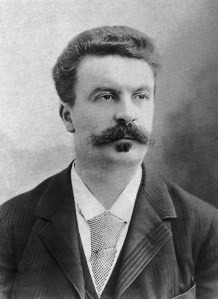
Guy de Maupassant (photo credit)

I recently read my very first Maupassant, Boule de Suif, and found it stellarly crafted. Recently I had a few more loose reading moments – the perfect chance to dip back into his short story collection briefly. The next two stories of his that I’ve encountered continue very much in the same subject area. The French are being occupied by the hated Prussians, and the French citizens are more or less commonly outraged, but they all react differently. As in Boule de Suif, the incisive portrayals of human character are the strength of these stories, along with character sketches and images of occupied wartime.

The Lancer’s Wife sees a small band of French soldiers, after a French defeat, living under Swiss protection. Their captain is furious at being removed from the action, and takes a handful of his men, including our narrator, secretly back into France to fight guerrilla-style. This tiny group, joined by the captain’s loyal and martial wife, encounters a tiny Prussian group of fighters, which includes the Prussian lancer’s wife as well. Without spoilers, I shall say that the two wives come face to face, and the issue is one of honor. If the qualities and moral of this story are a little idealistic, I am happy to be forgiving, because it’s well done and a joy to read.

In Two Friends, two Frenchmen who have enjoyed fishing together in the past, but who are now living under Prussian occupation, endeavor to go fishing once again, and are captured by the enemy. Again there is a question of honor. Again high standards are met, and I am left, after these two stories, with a feeling of nostalgia for the fine men and women of a time gone by. These are lofty emotions to be evoked by stories about war; but Maupassant renders the setting so beautifully that, again, I can only marvel at the craft.

I believe Boule de Suif is more or less accepted as his finest story, and it’s true that these, while impressive, were shorter and less impactful. However, they were easy to lose myself in. This man is a master of the short story.


Rating: 7 chins held high.