War and Turpentine by Stefan Hertmans, trans. by David Mckay

This historical novel told in two voices explores war and family with sensitivity and grace.

war and turpentine

Stefan Hertmans’s War & Turpentine is a superlative novel of war, love, family and discovery.

Urbain Martien was a painter and a soldier, devout and devoted to his family. Late in life, he painstakingly handwrote two volumes of memoir: one of a “practically medieval” childhood in the 19th century, and one of serving in World War I. His unnamed grandson waited more than 30 years to open these notebooks. Parts of War & Turpentine are narrated by that grandson, a writer now in midlife, in which he recounts his own memories of Urbain and his war stories, integrating what he learns from the journals. The novel then shifts to the battlefields and to the voice of Urbain himself.

This Flemish family story explores the difficulties of class and culture in early-20th-century Europe. Urbain portrays his father, who labored in poverty as an undersung restorer of church paintings and frescoes, and the mother he adored. His grandson discovers in the memoirs a love found and lost during the war. Urbain’s battle-ravaged world is populated by family, romance and a passion for art–and as the title suggests, by the tension between two halves of a life. This is a story of seeking the truth of one’s ancestors, a past that can never be fully known. “Maybe his silence says more than enough about his life as it was then.”

Hertmans’s writing, and David McKay’s translation from Dutch, is elegant and unadorned, intense and restrained. War & Turpentine is a world to get lost in, referencing a history both broad and personal.


This review originally ran in the August 12, 2016 issue of Shelf Awareness for the Book Trade. To subscribe, click here.


Rating: 7 scars.

Women Lovers, or The Third Woman by Natalie Clifford Barney, ed. and trans. by Chelsea Ray

A sprightly, autobiographical 1926 novel of a Belle Époque lesbian love triangle, written in French by an American and appearing in English for the first time.

woman lovers

The works of Natalie Clifford Barney, an American who lived in Paris and wrote in French, are little known, and her 1926 autobiographical novel Amants féminins was published for the first time only in 2013. Woman Lovers, or The Third Woman is the first English translation.

A scholarly introduction by Melanie C. Hawthorne and a translator’s essay by Chelsea Ray place this work in the context of modernism and evolving gender definitions while detailing Barney’s biography. These introductory materials are revealing and absorbing in their own right, if a little dry in their academic tone. The novel, however, leaps energetically to life.

Barney’s protagonist N., who stands in for the author, believes in love among women as an ideal of pleasure and friendship. “Friendship is simply love without pleasure!” she declares. “Love is heavy for two to carry, and happiness is monotonous.” With a new lover, M., she establishes an “association” by which the two women will comfort those in romantic distress by sharing their affections. When she brings such a woman into her relationship with M., however, N. is unexpectedly left out, jealous and hurt.

Barney is perhaps best known for her aphorisms, and she uses such pithy fragments as well as screenplay-style dialogue, mock journal entries, a combination of first- and third-person perspectives and even drawings to tell her story. Woman Lovers, while brief, is thus a noteworthy and historically significant piece of experimental literature, queer theory and a captivating roman à clef all at once.


This review originally ran in the July 29, 2016 issue of Shelf Awareness for Readers. To subscribe, click here, and you’ll receive two issues per week of book reviews and other bookish news.


Rating: 7 chestnuts.

Teaser Tuesdays: Women Lovers, or The Third Woman by Natalie Clifford Barney, ed. and trans. by Chelsea Ray

Teaser Tuesdays is a weekly bookish meme, hosted by MizB of Books and a Beat.

Teaser

woman lovers
This was a fun, thought-provoking one: short, and simultaneously animated (if one were to read the novel alone, for enjoyment) and dense (if one were to read all the introductory materials and take an academic stance).

I couldn’t choose, so here are two teasers.

First, to outline pithily the opinion of our protagonist (a thin veil for the author herself):

(Couples) were the first bourgeois!

So boring!

Or more dramatically:

Chopped into bits, our feelings were still twitching, even though they were deprived of the very thing that gave them life.

I love the imagery: feelings not only made physical, but made to physically suffer.

Keep your eyes open for Women Lovers.


This quotation comes from an uncorrected advance proof and is subject to change.

So Much for That Winter by Dorthe Nors, trans. by Misha Hoekstra

Experimental in form, these two novellas explore everyday frustrations in love and art.

so much for that winter

Two novellas by Dorthe Nors (Karate Chop) compose So Much for That Winter, translated by Misha Hoekstra from the Danish. They are as stark and unusual in form as they are bleak in mood. The first is “Minna Needs Rehearsal Space,” which is told entirely in declarative sentences, each on its own line. They range from the mundane to the philosophical: “People love wistful pop”; “Hope is a roe deer on a bluff.” This austere narrative style reveals a more complex story, about a woman who has suffered a breakup and seeks space–literal and figurative–for her work as an avant-garde composer. She hides away in her apartment, daydreams a relationship with Ingmar Bergman, and flees to an island she hopes will mend her.

“Days” follows, formed of numbered lists that make up the days of a woman’s life: a diary of sorts. The unnamed character is a frustrated writer, also with a relationship recently ended. Her days are inordinately filled with walks in cemeteries and lots of ice cream. Again the prosaic details blend with moments of poetry: “2. Sorted laundry, two piles, Tuesday”; “But the one who writes must dare to stand with her fledglings stuck to her fingers and surrender them in showers of spittle and roses.”

The result of these startling, experimental novellas is both somber and playful, the themes of romantic disappointment and creative blocks heightened by the minimalist style. So Much for That Winter is a compelling investigation of form and emotion.


This review originally ran in the June 21, 2016 issue of Shelf Awareness for Readers. To subscribe, click here, and you’ll receive two issues per week of book reviews and other bookish news.


Rating: 7 bike rides.

Journey to Texas, 1833 by Detlef Dunt, trans. by Anders Saustrup, ed. by James C. Kearney & Geir Bentzen

Detlef Thomas Friedrich Jordt was born in the Holstein region of Germany in 1793, and in 1833 immigrated to Texas. He was motivated by a letter from an earlier immigrant, Friedrich Ernst. Although the two were not acquainted, the letter had circulated widely in the region, with an explicit message: that others should join Ernst in a land of promise and opportunity. Jordt’s own experience led him to publish in 1834 a book titled Reise nach Texas, under the pseudonym Detlef Dunt. The first English translation of this travelogue/travel guide was published in 2015 as Journey to Texas, 1833.

This is a varied and informative compilation, including not only Jordt’s original text but significant supplementary material. A translation of Reise nach Texas was found among the papers of the late Anders Saustrup, a recognized scholar of German immigration to Texas. James C. Kearney and Geir Bentzen then took on the project. Their introduction covers Jordt’s family history; the social, political and economic circumstances in Germany that pushed so many to emigrate; the significance of the Ernst letter; and commentary on Jordt’s writing. The translation of Reise nach Texas makes up a little more than half of the volume…

This is just a stub: my full review of Journey to Texas was published in the Spring 2016 issue of Concho River Review. You can subscribe or purchase a single issue by clicking that link.

I’d just like to add that this was an extra fun read for me personally, because I know quite well the area that’s covered in these pages. For many years my parents owned a ranch just a few miles from where Dunt/Jordt is believed to be buried. It felt a little like coming home.


Rating: 6 small towns I used to ride my bike through.

Mon amie américaine by Michèle Halberstadt, trans. by Bruce Benderson

In a long letter to a friend in a coma, a Parisian woman meditates on friendship.

mon amie

Parisian Michèle and New Yorker Molly have been friends for many years. As colleagues in the film industry, they travel together, and talk on the phone nearly daily–until, at 40, Molly collapses in her office and becomes comatose. Michèle Halberstadt’s (The Pianist in the Dark) novel Mon Amie Américaine takes the form of a long letter Michèle writes to Molly, in lieu of speaking, because “The words I can’t share with you are choking me.” As Molly remains unresponsive, uncomfortable truths are revealed behind a presumably lifelong friendship.

Michèle’s letter acts as a diary, an account of her experience of Molly’s near death: getting the news; tracking her friend’s progress (or lack thereof); being forbidden to visit; and finally, after Molly awakens several months later, discovering a different person from the one she’s missed. The new Molly is hesitant, frightened and languid where the old one was a high-powered businesswoman, vibrant and fun. Meanwhile, Michèle suffers injuries in her own life, with no Molly to turn to.

Bruce Benderson’s translation from the French is melodic and evokes fluent but accented English, exactly as the reader expects Michèle to sound. Her tone ranges from elegiac to loving to frustrated (“How many times in the last ten years have I repeated you ought to see a specialist”) to self-pitying and to resigned. This love letter to friendship ends by considering what we are willing to do for those we love, and what obstacles even friendship may be unable to overcome.


This review originally ran in the April 22, 2016 issue of Shelf Awareness for Readers. To subscribe, click here, and you’ll receive two issues per week of book reviews and other bookish news.


Rating: 7 phone messages.

Hill by Jean Giono, trans. by Paul Eprile

This slim French novel in a new translation pits humankind against the natural world in moody, lyrical prose.

hill

Hill, Jean Giono’s first novel, won the Prix Brentano in 1929 and has been newly translated into English by Paul Eprile. Focused on the conflict between humans and nature in a tiny French village, the story’s imagery and atmosphere offer a thrilling, disturbing, visceral experience in an unassuming package.

A small Provençal hamlet known as the Bastides Blanches (the White Houses), or simply the Bastides, has been for some time slouching back toward a state of nature. In these crumbling houses now live four families comprising a dozen residents–plus one, a mute vagabond they call Gagou, “who throws off the reckoning.” The eldest resident, an old man named Janet, falls ill, takes to his bed, and here the troubles begin: an ill omen is noted, the town’s water supply runs dry, and the surrounding landscape takes on a sinister cast. Janet begins to speak in tongues, and “in the old man’s talk there are chasms where untold powers rumble.” The men of the village meet to strategize as the natural world encircling the Bastides advances.

Hill runs just over 100 pages, but its impact is powerful. Giono sketches his characters sparingly. The character of Gagou presents ominous questions that are left unanswered: Are his differences malevolent, or merely another force of nature? The individualities of human characters are not the point; instead, this story is about the shape of the world, the breadth and agency of nature independent of humankind. Eprile’s translation emphasizes language and a brooding tone. The result is a curious, intriguing novel of wind, earth, water and fire, both threatening and luminous.


This review originally ran in the April 12, 2016 issue of Shelf Awareness for Readers. To subscribe, click here, and you’ll receive two issues per week of book reviews and other bookish news.


Rating: 6 purple foams.

Distant Light by Antonio Moresco, trans. by Richard Dixon

A man on a remote mountain puzzles over a mysterious distant light in this gently disquieting novel.

distant light

Antonio Moresco offers an otherworldly story of isolation with Distant Light, translated from the Italian by Richard Dixon. The unnamed narrator opens with the statement that “I have come here to disappear.” He is the sole resident of an abandoned village in the mountains, and spends his day wandering the ruins of houses, sheds and a cemetery that are fast returning to nature. He contemplates the forces around him, described in sinister terms: evil, savage plants strangling and fighting one another in “this slaughter, this blind and relentless torsion they call life.” While bothered by these thoughts, and the noises of the wild animals, he is most tormented by the mystery of the light across the gorge. Deep in a thick forest, the light comes on each evening at the same time. What could it be–human, bioluminescence, alien?

Distant Light combines poetry and philosophy, and employs a setting both threatening and teeming with life. In a plot where not much happens, with few characters and no names, Moresco nevertheless evokes profound concepts and deep emotions. His quietly anguished protagonist claims to seek seclusion but cannot put down the question of the “maelstrom of little lights.” When the man finally crosses the gorge and meets the small boy living alone in an ancient house, he finds only another puzzle. Lonesome, dreamy, desolate, this is a novel of reflection on humanity’s place in the universe and the fluid relationship between life and death. Patient readers of philosophy will appreciate this brief but deliberately paced meditation.


This review originally ran in the March 29, 2016 issue of Shelf Awareness for Readers. To subscribe, click here, and you’ll receive two issues per week of book reviews and other bookish news.


Rating: 7 potholes.

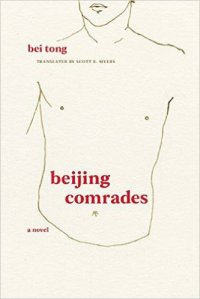
Beijing Comrades by Bei Tong, trans. by Scott E. Myers

A passionate, troubled love affair between two men is set in a time of cultural upheaval, in late 20th-century China.

beijing comrades

Translator Scott E. Myers’s introduction to Beijing Comrades is itself an engrossing story: the tale was originally serialized online, and the author–listed here as Bei Tong, elsewhere as Beijing Comrade, Miss Wang and other names–remains anonymous; Myers does not know Bei’s gender. This is the first English translation and the third version of the novel to be published, combining two previous publications and a new manuscript by Bei with an expanded story and explicit sexual detail.

Beijing Comrades is about Handong, a privileged, successful, egotistical businessman, and Lan Yu, a younger man of modest circumstances. When Lan Yu arrives in Beijing as a student, Handong immediately takes him as a lover. The older man had been accustomed to myriad sexual conquests of both men and women, defined by psychological domination and materialism, but this liaison is different, eventually coming to dominate both men’s lives. Over the years, Handong and Lan Yu strain to reconcile their relationship with a culture in upheaval: late 1980s China, experimenting with capitalism, approaching the Tian’anmen Square protests, increasingly materialistic and anti-gay.

While the dialogue is stylistically inconsistent, reminding readers of the fact of translation, the emotions of the story reinforce its realism. First-person narrator Handong is not always a likable character: he is cynical, profit-driven, fickle in love and often cruel. But these flaws make him credible, and even increase the impact of both men’s anguish.

Beijing Comrades is an important entry in the Chinese historical record as well as a moving, erotic and emotional novel.


This review originally ran in the March 25, 2016 issue of Shelf Awareness for Readers. To subscribe, click here, and you’ll receive two issues per week of book reviews and other bookish news.


Rating: 7 dinners out.

Fever at Dawn by Péter Gárdos, trans. by Elizabeth Szász

This historical novel of the hard-won love of two Holocaust survivors is based on the experience of the author’s parents.

fever at dawn

Péter Gárdos’s Fever at Dawn is a novel based on the lives and love of his parents. It spans less than a year, beginning in July of 1945. In that brief time, Gárdos evokes worlds of love and pain.

Miklós is a 25-year-old Hungarian Jew, an idealistic journalist and dreamy poet, just released from Bergen-Belsen concentration camp at the end of World War II. In the opening pages, he’s aboard a ship that will take him and 223 other survivors to Stockholm, to convalesce in Swedish hospitals under the administration of the Red Cross. In that first scene, Miklós collapses on deck. He is very ill with tuberculosis and is told he has six months to live. Undeterred, he requests from the Swedish Office of Refugees a list of women survivors who, like him, are being nursed in Sweden. He asks that they be from his region of Hungary and under 30. From his hospital bed in a “barracks-like wooden hut,” he writes 117 identical letters to these women. He gets 18 replies, and gains several pen pals, but only Lili captures his heart.

Over the next several months, Miklós and Lili correspond, exchanging stories from their past lives and their respective hospital settings hundreds of kilometers apart. Miklós asks for a picture of Lili, but is careful not to mention that he has virtually no teeth. Both make new friends: Miklós has Harry, the resident Don Juan, and a larger group of loyal comrades, while Lili has two confidantes. These secondary characters contribute to the budding romance in various ways. Fragments from the lovers’ letters supplement a narrative lively with humor and antics–at the men’s dorm in particular–as well as the continuing calamity of the war. In December, they manage to meet: Miklós travels all day for a brief visit, hoping to declare his love and be answered.

Gárdos draws this story in part from his parents’ letters, which his mother presented to him after Miklós’s death. Fever at Dawn, told in Gárdos’s first-person voice, is a sweet love story framed by horror. The war is over, but the bad news continues to trickle in. The Hungarians living in Sweden are displaced in every sense, seeking loved ones, scraping joy out of a bleak day-to-day existence. Miklós is repeatedly reminded of his six-month sentence, his time dwindling; but he is determined, after all he’s survived, to marry.

At once heartrending and lighthearted, this romance covers enormous ground in love and war, joy and tragedy, humor and pathos. Fever at Dawn, with its historical backdrop, will win over many readers.


This review originally ran in the March 24, 2016 issue of Shelf Awareness for the Book Trade. To subscribe, click here.


Rating: 7 scraps of cloth.