

The Bishop’s Villa by Sacha Naspini, transl. by Clarissa Botsford

In this transporting novel based on real events, a shy cobbler in an Italian village during World War II is gradually drawn into quiet acts in the Resistance.

Sacha Naspini (Nives) brings close and poignant attention to true events with his historical novel The Bishop’s Villa, translated from the Italian by Clarissa Botsford.

In the fall of 1943, in the sleepy village of Le Case in Tuscany’s Maremma region, a cobbler goes about his daily business. Solitary and quiet by nature, René makes do with just two fingers on his right hand following a childhood accident with a lathe; his nickname in town is Settebello, after the “lucky seven” card in scopa. When the local bishop rents out the seminary and surrounding villa to be used as a prison camp for the region’s Jewish population, Le Case mostly plods on as before. Some local residents speak cruelly of the prisoners; many simply ignore their presence. René mends the shoes brought to him for repair by prison guards. For most townspeople, the war is poverty, deprivation, and the passage of time.

But René’s neighbor Anna, a lifelong friend, has just lost her son, who fought for the Resistance until he was captured and executed by the Wehrmacht. Anna is galvanized; René wants her to stand down. And then Anna vanishes, leaving behind a note for René. She has gone to join the partisans, to “fight for Edoardo and for Italy.” When René learns that Anna might have become imprisoned in the bishop’s villa, he finds that he can no longer fail to act. His subtle sabotage begins with boots. “He chose rusty nails, some so brittle that they crumbled at the first blow. He hammered them in a little crooked, curved inwards as if he were aiming for the heel… the hole in the sole would get wider, like a small surface wound.”

In short chapters, Naspini draws readers into René’s world: first the tightly confined life of the village cobbler, traveling back and forth between home, workshop, and Anna’s apartment, and then to the tighter confines of a cell in the bishop’s villa. Botsford’s translation is terse and atmospheric, punctuated by lyrical or romantic phrasings: wonder is “like a child unable to describe a treasure they’d chanced upon under a stone.” With torture, “you can chew [a man’s] bones clean, but you can’t touch his soul, which means you will never win.”

The Bishop’s Villa is absorbing, transporting, beautiful, and grim. Naspini’s Author’s Note makes clear his drive to lay bare a shameful chapter of history; but with this novel he has also written a love story, for without Anna, “René would never have used the tools of his trade to fight his war.” The result is moving and layered.


This review originally ran in the September 12, 2024 issue of Shelf Awareness for the Book Trade. To subscribe, click here.


Rating: 7 soles.

Jellyfish Have No Ears by Adèle Rosenfeld, transl. by Jeffrey Zuckerman

This engrossing first novel illuminates an experience of hearing loss that is both frightening and beautiful, filled with surprising imagery.

Adèle Rosenfeld’s Jellyfish Have No Ears is a strange, haunting story of sensory presence and absence, language and loss, relationships and choices. Translated from the French by Jeffrey Zuckerman, this first novel follows a young woman whose limited hearing has left her always straddling the experiences of the hearing and the deaf. Her progressive hearing loss eventually poses a choice between a cochlear implant and profound deafness. In a world she finds increasingly incomprehensible, Louise navigates work (in the French governmental bureaucracy, processing first birth and then death certificates), friendship (with the eccentric Anna, who views Louise’s deafness as poetic), and a romantic relationship with a hearing man. She is accompanied as well by a dog, a soldier, and a botanist who deals in “miraginary” plants; these three characters are hallucinations or creations of Louise’s imagination who offer valuable advice.

“When someone can’t make use of a particular sense anymore, the cortex reorganizes so that area of the brain is repurposed by the senses that person still has.” Because her world contains less and less sound, Louise’s vision is vibrant. Jellyfish is bursting with sensory descriptions, including sounds heard and missed, “the warmth of timbres, this soft sheen of wind, of color, of all sound’s snags and snarls.” Visual details are evocative and often surprising: “eyes as blank as an ice floe after an orca had gone by with a penguin in its mouth.” The effect of this unusual perspective is riveting.

Louise ponders large, philosophical questions of whether she will still be herself if she agrees to an implant. With an implant, she’s told, she won’t hear like she did before, but a psychologist also asserts, “Your brain will have forgotten what ‘before’ means.” She wonders if she needs sound to activate memory and whether “[s]ilence set free words and images held captive by language.” She investigates the experiences of those “uprooted from their language” and creates for herself a “sound herbarium.” In Zuckerman’s translation, Louise’s voice on the page is by turns stark, stoic, and dramatic. As those around her pressure her to take the implant or to embrace deafness, Louise reveals a strong personality: fiercely obstinate and attached to her vivid interior world.

A curious, thought-provoking, intensely mind-bending exploration of the loss of a sense and the potential richness as well as struggle of life with an invisible disability. Imaginative and spellbinding, Jellyfish Have No Ears is unforgettable.


This review originally ran in the May 24, 2024 issue of Shelf Awareness for the Book Trade. To subscribe, click here.


Rating: 7 poppies.

The Dallergut Dream Department Store by Miye Lee, transl. by Sandy Joosun Lee

Sleepers shop for dreams at a very special department store, where dreams may come true not only for customers but for employees as well.

With The Dallergut Dream Department Store, Miye Lee explores the nature and power of dreams, the possibilities created by choosing them, and human nature itself. Whimsical and sweet, this debut novel translated from Korean by Sandy Joosun Lee will leave any reader musing and looking forward to a good night’s rest.

“For centuries, Penny’s hometown has been famous for its sleep products. Now it has evolved into a metropolis…. The locals, including Penny, who grew up here, are used to seeing outsiders roaming around in sleepwear.” Penny is terribly excited to interview at the Dallergut Dream Department Store, the crown jewel in a town devoted to sleepers’ needs. She has studied the mythology and history, but meeting Dallergut himself is intimidating. However, he turns out to be nothing but nice, forgiving her learner’s errors and prioritizing the sale of the right dream to the right customer, even over profits. Penny fangirls over the greatest dreammakers, whom she gets to meet in her new job: Nicholas, who specializes in seasonal dreams; Babynap Rockabye, who creates conception dreams; Maxim, who does surprising work in a dark back-alley studio; and Bancho, who cares for animals.

Penny has so much to learn, from bank deposits to the Eyelid Scale, not to mention the power of precognitive dreams. Purchased dreams are paid for only after they have had an effect on the sleeper, and payments come in the form of emotions experienced, so no one pays in advance or for a dud. Dreammakers can get fabulously rich and famous, but their best reward is helping people (or animals). Nap dreams differ importantly from longer ones. “Bad” dreams may serve a purpose, too. And there is, perhaps unsurprisingly, an important link between dreams, in the sense of aspirations and ambitions, and dreams as in the images and sensations that visit sleepers.

Penny is an innocent, wide-eyed disciple of Dallergut and his good works, as well as the celebrity dreammakers. Through her perspective and her refreshing tone, readers encounter an appealing, absorbing, imaginative world with rules for who designs experiences for whom. In her translator’s note, Sandy Joosun Lee calls The Dallergut Dream Department Store “a story that is both fun and deep… unpretentious yet full of life,” and keeps Penny’s observations disarmingly enthusiastic and earnest. The pleasing tale, while simple on its surface, asks questions about self-determination and the mysterious power of nighttime imaginings to impact one’s daily, “real” life. With a Calm Cookie or a Deep Sleep Candy, or just the right dream, all things are possible in Lee’s captivating world.


This review originally ran in the April 19, 2024 issue of Shelf Awareness for the Book Trade. To subscribe, click here.


Rating: 7 cups of forest-scented tea.

Strega by Johanne Lykke Holm, transl. by Saskia Vogel

In mesmerizing, allegorical storytelling, nine maids at a mountain hotel consider the violence the world offers them when one suddenly disappears.

Johanne Lykke Holm’s first novel in English, Strega, is a fever dream meditation on girlhood, female friendships and unnamed dangers.

Rafaela is 19 years old when she leaves her parents’ home and travels into the mountains to work as a maid at an old hotel, with eight other girls her age. They clean and polish and set tables for every meal; they wash sheets and dress in clean uniforms, but no guests arrive. Lounging together, sharing cigarettes and liqueurs and candies, they are immediately close. Their matronly bosses are strict, even punitive, but their days still feel relaxed and without energy, emphasizing the pointlessness of their work. The hotel was once a shocking red, fading to pink against the forests; the strangely sinister neighboring nuns call it Il Rosso. Rafa calls it “a morgue beneath the trees.” When listless summer turns to fall, the hotel throws a party, and one of the nine girls disappears.

The remaining eight girls search for her; her parents appear to claim her possessions; the barren season at the hotel stretches on. In one of Strega‘s figurative turns, the missing girl–presumed murdered–comes to stand in for female victims of unspecified violence. At the beginning, Rafa confides, “I knew a woman’s life could at any point be turned into a crime scene. I had yet to understand that I was already living inside the crime scene, that the crime scene was not the bed but the body, that the crime had already taken place.” Near its end, “We can only find a way out of this crime scene by constructing one of our own.”

Holm’s prose, translated from the Swedish by Saskia Vogel, is hypnotic, dreamlike and favors repetition in phrasing and images: “Our hands would repeat the same movements… our hands always repeated the same movements.” Strega is saturated with red: “We watched a red light rise from the grass and take the form of a hand. I knew it was the blame and the distribution of blame”; “Women are drawn to all things earthly. Bitter soda and red herbs, a lipstick in a bitter red shade. And death, of course.” These short, declarative sentences offer surprising lyricism, so that each line demands the reader’s attention.

The novel is short and spare, but unwavering in its intensity. Strega is riveting: surreal, ominous, somehow both vague and sharp in its observations about the harms that girls submit to when they become women.


This review originally ran in the September 27, 2022 issue of Shelf Awareness for the Book Trade. To subscribe, click here.


Rating: 7 aspergilla.

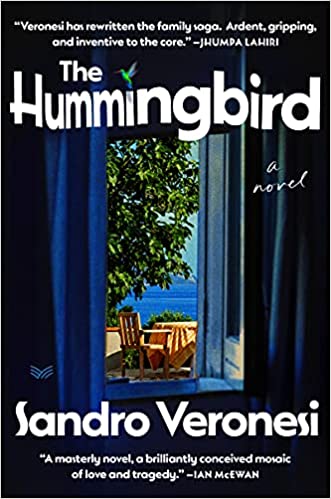
The Hummingbird by Sandro Veronesi, transl. by Elena Pala

This family saga set in Italy, with one life at its center, is moving, literary, philosophical and multi-layered.

The Hummingbird by Sandro Veronesi (Quiet Chaos; The Force of the Past), translated from the Italian by Elena Pala, is a shape-shifting, multigenerational novel of family, love, loss, joy, change and pain.

When readers meet Marco Carrera, the year is 1999 and he is a 40-year-old ophthalmologist in Rome, about to meet destiny in the form of a psychoanalyst breaking his confidentiality oath. From here, chapters jump back and forth in time from 1960 to 2030. Readers meet the great love of Marco’s life, visit his childhood, witness his marriage and divorce. When he is just a boy, Marco stops growing, remaining small and childlike well into his teenage years: his mother nicknames him “the hummingbird” for his stature, a moniker that will echo into his adulthood. He becomes a father and eventually a grandfather, so that four generations of his family flash kaleidoscopically across these pages; Marco is ever at the novel’s center, however, even as he is accused of holding still through life’s storms. “You can keep still as time flows around you, you can stop it flowing, sometimes you can turn back time, even–just like a hummingbird, you can fly backwards and retrieve lost time.” The novel mimics this movement with its nearly stop-action chronology.

Some chapters take a straight narrative form, others are transcribed conversations, letters, postcards or e-mails. Elena Pala’s translation from the Italian feels perfectly suited to this twisting, many-faceted form, as different voices take the lead. The pieced-together story moves between Rome and a Tuscan coastal town where the Carreras have a vacation home; its characters travel much farther (Spain, Germany, the United States), but Marco’s orbit is limited. Rather, as he keeps still, his family and friends revolve around him.

In these various forms, across time and space, Veronesi refers to numerous other literary voices (a Samuel Beckett epigraph sets the tone) and concepts from ophthalmology, psychotherapy, architecture and design, among other disparate fields. The Hummingbird is clearly an intellectual exercise, but can also be read more simply as a story about a single, deceptively ordinary life: Marco might appear unremarkable at first glance, but he has lived remarkable tragedies and triumphs, which will define him. He is affected by his experiences as if by ocean waves, his life a series of natural forces, or natural disaster. Packed with pathos, humor and tragedy, the novel’s finish is both a quiet goodbye and a crescendo, the only fitting end to such an unobtrusive but resounding life.


This review originally ran in the December 2, 2021 issue of Shelf Awareness for the Book Trade. To subscribe, click here.


Rating: 7 appointments.

When Me and God Were Little by Mads Nygaard, transl. by Steve Schein

A rocky childhood on the Danish North Sea is rendered in weird but apt terms by an extraordinary young narrator.

Mads Nygaard’s When Me and God Were Little, translated by Steve Schein, is a stark portrayal of a hardscrabble childhood in a blue-collar, small town in Denmark, on the coast of the North Sea. Its narrator is seven-year-old Karl Gustav (who would rather be called Big Ox), and his distinctive point of view is filled with preposterous details that make perfect sense to him. “In our town you couldn’t drown barefoot,” he begins, and yet his big brother, Alexander, has managed to do just that, permanently upsetting Karl Gustav’s worldview.

His father is a drunk, but owns his own business building houses, and “Our house was so big that Mom still hadn’t gotten around to vacuuming all the rooms.” “Dad weighed 250 pounds and it was all muscle, except for the hair,” but then Dad goes to jail (something about the papers in his file drawers; the young narrator isn’t concerned with the details), so Karl Gustav and his mother move into a county-owned house in a new town. Unperturbed, the child carries on obsessing over soccer (he plays alone over four fields through the winter) and terrorizing his teachers. Years pass, very few friends come and go, and readers follow Karl Gustav’s experiments with porn, disastrous employment, grifting, a doomed love affair with another damaged young person and a developing relationship with his father. The loss of his brother will always loom large, for Alexander was a hero: “He just smiled, knowing everything.” But other losses accrue, as Karl Gustav learns more about the wide, perplexing world. By the book’s end, the narrator is a teenager, perhaps still ungainly, but wiser for the trials he’s seen.

This is an unusual novel, its narrator’s voice colorful, unpolished and unforgettable in Schein’s gruff translation. It is Karl Gustav’s singular perspective that makes When Me and God Were Little the memorable, bizarre, poignant adventure that it is. It’s absurd and often fantastic, as this narrator delivers an earnestly nonsensical account of events that readers know to be impossible. And yet it rings true, because what is childhood if not nonsensical? Karl Gustav is all bluster and pain, bluffing in the face of forces bigger than he is. His story is gritty, messy but real, and there are no happy endings on this harsh coastline. The novel is filled with cigarettes and swagger and masturbation literal and figurative, often unbeautiful but somehow still lovely in its authentic, unvarnished view of a difficult coming-of-age.


This review originally ran in the October 29, 2021 issue of Shelf Awareness for the Book Trade. To subscribe, click here.


Rating: 6 hedgehogs.

When We Cease to Understand the World by Benjamin Labatut, transl. by Adrian Nathan West

Wide-ranging, mystical, crazed and inspired, this singular novel explores theoretical physics through a series of weird, engrossing human stories.

Benjamin Labatut’s When We Cease to Understand the World is an astonishing historical novel of physics, war, human weakness and quantum physics. In a lovely translation from the Spanish by Adrian Nathan West, the fictionalized histories of Albert Einstein, Werner Heisenberg, Erwin Schrödinger and more come alive to disquiet and intrigue readers.

The book opens with Hermann Göring’s addiction to dihydrocodeine and the suicides of many Nazi leaders by cyanide in the final months of World War II. It gets only a little less grim from there. But even with such bleak subject matter, Labatut’s imaginative evocations of disturbed minds from the rarified ranks of mathematics and physics are thoroughly captivating and strangely lovely, joining science with mysticism in surprising ways. “In the deepest substrate of all things, physics had not found the solid, unassailable reality Schrödinger and Einstein had dreamt of, ruled over by a rational God pulling the threads of the world, but a domain of wonders and rarities, borne of the whims of a many-armed goddess toying with chance.”

Labatut’s narrative travels in time and space, covering the development of pesticides, chemical weapons and Prussian blue pigment; painting, literature and opera; the existential angst of particle and quantum physics; eroticism and fever dreams. A young Heisenberg interrupts Schrödinger’s lecture to argue about the nature of subatomic particles. Later the reader sees Heisenberg feverish, ill, madly dreaming of spectral lines and harmonically bound electrons while reading Goethe’s poems inspired by the Persian mystic Hafez. Schrödinger also raves, theorizing and obsessing over the adolescent daughter of his physician. Lesser-known scientific figures include Karl Schwarzschild, the soldier who first exactly solved Einstein’s equation of general relativity and died shortly after; Shinichi Mochizuki, who revolutionized mathematics and then withdrew from the field; Alexander Grothendieck, who fled society to live as a hermit and also gave up mathematics entirely; and the seventh duc de Broglie, a “timid prince” whose Nobel Prize did not help him stomach the infighting among scholars of theoretical physics. These are the figures and the stories that have shaped major advances in science in the modern era; they also verge on insanity.

This astonishing novel blends forms: lyrical, inventive and also rooted in history, concerned with the overlaps of genius and madness, innovation and destruction. “The physicist–like the poet–should not describe the facts of the world, but rather generate metaphors and mental connections…. That aspect of nature required a completely new language,” writes Labatut, and likewise he offers a new way of writing about science and history. The vision of reality painted by When We Cease to Understand the World is terrifying but finely wrought, and will live long in readers’ minds.


This review originally ran in the August 30, 2021 issue of Shelf Awareness for the Book Trade. To subscribe, click here.


Rating: 7 cats.

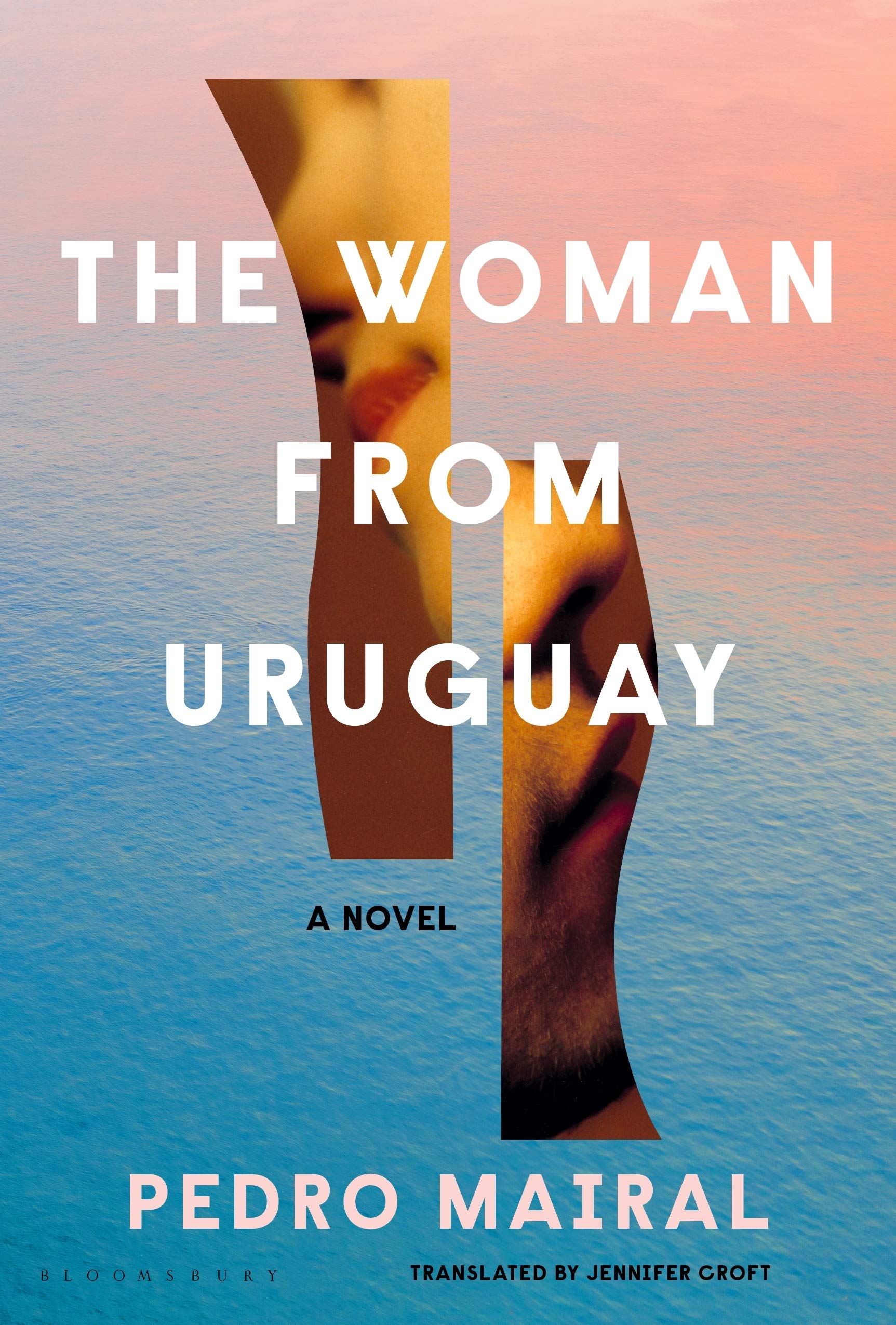
The Woman from Uruguay by Pedro Mairal, transl. by Jennifer Croft

Part picaresque, part tragedy, this critical day in the life of a hapless Argentine writer and would-be lover is both entertaining and thought-provoking.

Pedro Mairal’s The Woman from Uruguay follows a contemporary Argentine writer named Lucas for a single fateful Tuesday, as he travels from Buenos Aires to Montevideo and back again. Lucas narrates these events, with flashes forward and back in time, in a lengthy direct address to his wife, Catalina. “You told me I talked in my sleep. That’s the first thing I remember.” He is stumbling, if not entirely failing, as a writer, in debt to nearly everyone he knows, and fairly sure that Catalina is cheating on him. The purpose of the day trip to Uruguay is ostensibly to collect a significant sum of money in cash (advances on two books), which Lucas expects will change his fortunes. His hidden, secondary purpose is to visit the titular woman with whom Lucas has been captivated since they met at a writers’ festival months earlier. He calls her Guerra–war–and is obsessed by their so-far-unconsummated affair.

Lucas is not an entirely likable narrator. He is self-pitying, a bit sleazy in his adulterous aspirations and at best a mediocre husband and father. He resents his wife for her ability to support him financially, and his young son for disrupting his work (“How am I supposed to write with my kid dangling from my balls?”). But readers will be drawn in by the mysterious Guerra and the pathetic and darkly comic narrative of Lucas’s unlucky day. He can be woefully misguided by desire (for Guerra, for escape from responsibility), artful in his telling (Lucas is a writer, after all), wry, clever and even wise. In buying a ukulele for his son: “I realized I’d rather play the ukulele well than keep playing the guitar poorly, and that was like a new personal philosophy. If you can’t handle life, try a lifelet.” The translation from Spanish to English by Jennifer Croft (Homesick) handles such moods and idiosyncrasies perfectly. Lucas’s child is a “tiny little elderly man, that haiku of a person,” “a drunken dwarf.” Readers may not be precisely rooting for Lucas to get what he wants (which is a bit unclear even to Lucas), but they will certainly be eager to find out what happens next.

In just 17 hours, this luckless protagonist experiences great hopes and severe losses, navigating both a marital crisis and an existential one with limited grace but great ardor and intensity. Challenged in love, marriage, parenthood, finances and fantasy, he makes a mess but comes away with a story to tell and, for a writer, there are worse endings. “May death be to know all,” he muses in hindsight. “For now, I can only imagine.”


This review originally ran in the June 4, 2021 issue of Shelf Awareness for the Book Trade. To subscribe, click here.


Rating: 6 hopes.

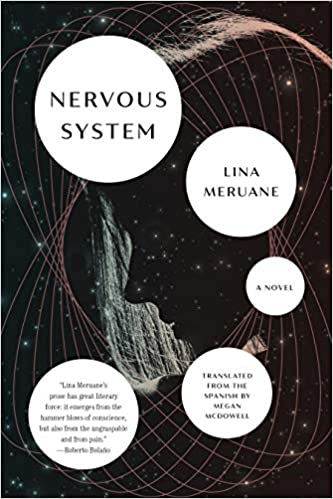
Nervous System by Lina Meruane, transl. by Megan McDowell

This complex novel moves between outer space and private torments to embrace bonds forged in pain.

Lina Meruane’s Nervous System is a novel both fanciful and visceral, pairing the study of the cosmos with medical mysteries and wounds on earth. It is set dually in “the country of the present” and “the country of the past,” the latter swimming with political violence and trauma, and bearing a resemblance to Meruane’s native Chile. Megan McDowell’s translation from the Spanish establishes an eerie tone, both emotional and detached.

The protagonist is Ella. Her partner is El: Are these names, or the Spanish pronouns She and He? El is also known as “the bone guy,” a forensic scientist combing through mass graves, “more migrant bodies made to disappear piece by piece,” to determine cause of death. Ella’s father is simply the Father, her stepmother the Mother; only gradually the reader becomes aware of the Firstborn and the Twins (Boy Twin and Girl Twin), completing a family filled with holes and secrets. Ella is supposed to be writing her doctoral dissertation in astrophysics, but she has stalled. “This final attempt would be spent on stars that had already lost their light and collapsed in on themselves, forming dense black holes.” Instead, she winds up tracking not solar systems but the systems of her own body, as an undiagnosed condition contributes to her long, slow downfall.

The narrative unfolds in a bit of a fever dream, as Ella’s thought process combines words in lyric but not-quite-literal forms, and chronology moves backward and forward. Chapters are set in “future time,” “restless present,” “between times” and “past imperfect.” “The universe has never known harmony, has never been a perfect mechanism, it’s no good for measuring time precisely.” Ella’s “voice is many voices, her question is nervous nebulous shooting short circuit of stars.”

The novel is narrated in a third-person perspective close to Ella’s own consciousness, and characterized by a dreamy, distant way of describing even horrendous events, “women hacked to pieces and children lost in arid lands.” Eventually readers understand that illness, injury and all sorts of damage manifest in the body and in the memory, and great love and animosity can and frequently do exist side by side. Amid these personal and political traumas, family and history, lies commentary on the modern world, relationships, grief and connection. “Maybe with time everything would be restored, but maybe not, because there in the night the stupid stars still hung and sprinkled calcium over the universe.” Nervous System is filled with anguish and unease, but also starlight, which touches Ella at its close.


This review originally ran in the April 27, 2021 issue of Shelf Awareness for the Book Trade. To subscribe, click here.


Rating: 6 treacherous rats.

White Shadow by Roy Jacobsen, transl. by Don Bartlett and Don Shaw

This second in a gripping trilogy of home, place and relationships sees a woman struggle alone, and then less alone, in World War II Norway.

Roy Jacobsen’s White Shadow is the second in his Barrøy trilogy, following The Unseen, which introduced readers to the Barrøy family and the small Norwegian island that shares their name. White Shadow opens: “The fish came first. Man is merely a persistent guest.” It is not a man but a woman, however, who occupies the center of the novel. Now in her mid-30s, Ingrid Barrøy works on the mainland, splitting and salting cod and herring. She “longed to be gone, to be back on Barrøy, but no one can be alone on an island and this autumn neither man nor beast was there, Barrøy lay deserted and abandoned, it hadn’t even been visible since the end of October, but she couldn’t be here on the main island either.”

After paddling back to Barrøy, Ingrid is indeed alone amid the ruins of her family home, until the British bomb a German steamer carrying troops and prisoners of war in nearby waters. In her family’s hayloft she finds a man alive. They do not share a language, but they share much. Hiding her guest from the Nazis and their Norwegian collaborators will send Ingrid away from home again, and it will be another arduous feat to return, but it is always Barrøy for this stalwart protagonist. She stands “suddenly wonderstruck at all the things that had kept her on the island, which in truth were nothing at all.”

Translated from the Norwegian by Don Bartlett and Don Shaw, Jacobsen’s prose is as stark and unadorned as the landscape he portrays. His characters are hardworking, worn and stoic against a ruthless natural world, but there is beauty in their strength, and in the harsh simplicity of island life. “It is as it has always been, Barrøy has everything yet lacks something of real importance.” The central setting is limited in its scope, but in Ingrid’s travels she meets a variety of characters, including profiteers and refugees, eventually repopulating her home and tentatively, perhaps, building something new.

While there is a thread of romance here, White Shadow is more a profile of an individual and a culture (“people who never sat down”). It is also a sensory experience of rough conditions and cold, work ethic and strong ties. Ingrid’s community is hard-won and all the sweeter for it. No familiarity with The Unseen is necessary for this second installment, which stands alone comfortably, although the final lines do gesture at questions about the future of Barrøy.


This review originally ran in the March 18, 2021 issue of Shelf Awareness for the Book Trade. To subscribe, click here.


Rating: 7 herring.