We Were Brothers by Barry Moser

This reflective memoir of brotherhood, the evils of racism and sibling spats is as finely illustrated as it is well told, and will please diverse readers.

we were brothers

Book designer and illustrator Barry Moser and his brother, Tommy, grew up in the Tennessee country surrounding Chattanooga in the Jim Crow era. As boys, they were never close, and shared more physical conflict than anything else. As men, they grew further apart, disagreeing about everything from food to politics, as Barry renounced the racism they were raised with and Tommy did not. Only near the very end of Tommy’s life did they begin to communicate meaningfully and build the beginning of a relationship that would be cut short. We Were Brothers is Barry’s memoir of regret and remembrance.

The story of these two young men, and the times in which they lived, is plainly depicted. Moser’s narrative tone is straightforward in its observations from the perspective of small children, but the wisdom of the older man shines quietly through. For example, he wonders at his mother’s friendship with a black neighbor, who was accepted in many ways almost as family, but still expected to act differently in front of certain company; the family’s ingrained racism is inexplicable in this context, but never questioned. The young boys have a playmate who is black: he is mistreated in ways that do not resonate with the childhood Barry, but in adulthood he cannot remember that boy without tears.

After many disagreements and fistfights, the brothers go their separate ways, with Tommy joining the military while Barry went to college. Barry came to view the anti-Vietnam War movement with sympathy, reassessed his family’s racist views and left the South, while Tommy stayed. In his late 50s, Barry takes a phone call from his estranged brother that ends in racial epithets. Barry hangs up on Tommy, and their discord appears permanent. But then they begin writing letters, in which each man shares his hurts and disappointments. The first few letters, reproduced in the book, seem promising of a new era of openness, understanding and allowance for past mistakes. And then Tommy dies.

Moser’s deceptively simple story is accompanied by his own extraordinarily lovely drawings of the characters and places in question, so that the reader gains a visual glimpse into the people he evokes. We Were Brothers skillfully displays an introspective quality as the older man looks back with regret over a relationship he never had, and with appreciation for one briefly shared. Moser’s understated style only reinforces that musing tone. In the end, even as the painful brotherhood he recalls echoes the evils of a racist time and place, Moser’s calmly gentle, elegiac storytelling voice paints a picture that is loving as well as remorseful.


This review originally ran in the October 6, 2015 issue of Shelf Awareness for the Book Trade. To subscribe, click here.


Rating: 7 wished-for letters.

Teaser Tuesdays: Thunder & Lightning by Lauren Redniss

Teaser Tuesdays is a weekly bookish meme, hosted by MizB of Should Be Reading.

thunder lightning

This is a lovely, gorgeous art book, you guys, and isn’t weather fascinating? Clear win all around, and I can’t wait to share my review with you. For now, I couldn’t help but indulge in these lines, which cracked me up, in a men-Mars-women-Venus sort of way.

Look at men’s and women’s boots. The first chill in the air in September or October, women’s boot sales go right through the roof. Now, the weather’s still nice at that time of year in a lot of the U.S. Men’s boot sales don’t budge. Men’s boot sales move much later in the season, in late October or November when it’s really cold and really wet and men’s socks are getting wet.

(From a lengthy quotation by Frederick Fox, CEO of Planalytics.)

Even with intriguing and whimsical text, the visual art is the best part. Sign up for your copy now.

This quotation comes from an uncorrected advance proof and is subject to change.

The Wild Party by Joseph Moncure March, illustrated by Art Spiegelman

What?! I found time to read a book just ’cause I wanted to? I know! It was amazing. I’ve read a lot of truly astonishing good books this year that I got assigned to read; but there’s nothing like choosing one myself.

wild partyIt was from MetaMaus that I first learned about this slim book, and it is worth tracking down, friends. The Wild Party is a book-length story-poem originally published in 1928 but banned far and wide for its explicit content. (Tame by our standards today: there are references to sex and a fistfight or two. And lots of booze.) It is the narrative of a party, in the jazzy, profligate 1920’s. Queenie and Burrs live together, but their relationship does not run smoothly; in the opening stanzas they threaten each other’s lives, and then make a very tentative peace by deciding to throw a party that night. Everybody comes: and the descriptions of their guests are lovely, vivid, ghoulish and grand. The party itself does not run smoothly, either. It is a great orgy of drink, music, betrayals and sex. It’s awesome.

I loved Art Spiegelman’s introduction, in which he points out that he doesn’t normally do poetry (thus reassuring the rest of us, likewise). William S. Burroughs gave confirmatory acclaim to March’s work by reciting a good portion to Spiegelman at their first meeting. And of course I loved Spiegelman’s illustrations of the poem, which conform perfectly to March’s words. There’s nothing like a literary work that is evocative of pictures… unless it is those pictures also perfectly composed.

A quick read of, I don’t know, under two hours, this narrative poem takes the reader on a wild ride, and Spiegelman paints it beautifully. Do check it out.


Rating: 8 unnamed drinks.

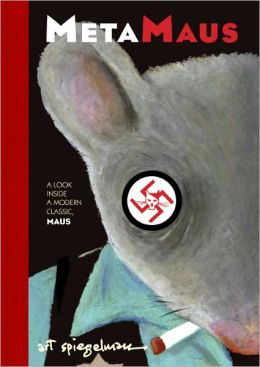
MetaMaus: A Look Inside a Modern Classic, Maus by Art Spiegelman

Begin with Maus I and Maus II. And then move on to MetaMaus, filled with images from the book and discussions with Art, and his wife and two children, about what it all means, his process, his motivations, and the impact these powerful little books have had on all of them.
metamaus
At the outset, let me say, holy magnificent book. MetaMaus asks the questions (according to its back cover), why the Holocaust? why mice? why comics? And of course, the Holocaust is the easiest to answer, to me: the Holocaust because it was what he knew (“write what you know”), except that he didn’t know the Holocaust. He emphasizes that. (And I confess it surprised me, that a survivors’ son could have grown up with such a limited knowledge of what happened so recently, and so centrally to his own personal and family history. I had a fairly decent, basic grasp of the Holocaust in grade school. But then, I grew up a full generation after the author did. Clearly a lot had changed.) Still, it was what arced over him, what oppressed him or at least leaned against him; what else was there? In fact, my surprise was that it wasn’t that obvious – that he wasn’t driven to write (draw) about the Holocaust, at least not that he knew: “What consciously motivated me was the impulse of wanting to do a long comic that needed a bookmark.” He needed to make a full-length comic, as it turned out. Who knew. I am baffled by the visual arts, at least as much as I am stimulated and inspired by the written/verbal ones; most of the visual artistry of Maus escaped me before reading this book, which is part of why I found it so wonderful. Unlike many monographs meant to elucidate the visual arts for us plebeians, this really brought it home to me, exposed so much more, increased my understanding & appreciation.

But the real question I was here for: why mice? Honestly, this was my chief concern (followed by: why cats, why pigs, why dogs…) and all those questions are answered, happily. And of course there are only more questions behind them, much discussion of the imagery and symbolism that belongs to animals in different cultures, for example, and some of that taking-back of the derogatory where Jews were called rats by the Nazis, for example. MetaMaus follows these paths, and lets us get to know the author. I found it very satisfying, after getting to know a version of him and feel him so strongly. We should always be so lucky.

And then the CD! This book is accompanied by a CD with complete images of both of the books; over 7,000 early sketches & studies & the like; video and audio files including recordings of interviews with Vladek; and some of the pamphlets off his mother’s bookshelf that Art used in his research. I think there were about 4 hours of Vladek interviews – the man’s actual voice! – and an hour-long home movie made by Art and Francoise on a visit to Auschwitz. Holy smokes, the CD is chock-full of goodies. I did not exhaustively study it, I confess. There was just so much; and I felt so well-served by the reading of the book itself. I did enjoy listening to Vladek’s voice, though: it brought everything to life, and was an interesting counterpoint to the relative unreality of comics.

Of course another theme of the book is the power and faultiness of memory. I love memoir, and I love that memoir almost inevitably has to confront this obstacle: the ‘mem’ in memoir is unavoidably problematic, at least enough to raise questions. In Maus‘s case, the clearest example comes when Vladek describes leaving Auschwitz and denies that there was an orchestra playing at the gates. As Art has documented, there is substantial support for the existence of this orchestra: there are photographs, and there are eyewitnesses among the Nazis, the Jews, and the musicians. But Vladek is sure there was no orchestra. What to do? I love Art’s discussion of the problem: how he could have represented Vladek’s version, or the official one, or left the whole question out of his story; but he instead elected to show the actual question. There is a panel in which there is an orchestra – followed by Vladek’s denial of the orchestra – followed by a panel in which the orchestra is no longer present, except that if you look closely, you can see the tips and shadows of their presence behind the marching prisoners. This is really something. Of course, when I read the comic, I didn’t catch that visual shadow, just the discussion of the question.

I learned a lot of intriguing details. Who knew the size of these (quite small) comics was so important to Spiegelman? Or more surprising, that he drew the originals in that same small size? And the details about the different reactions to the books in different countries (it’s been translated into some thirty languages) were fascinating to me. I had innumerable little details of the comics pointed out to me and elucidated – things I would never, in 100 readings, have figured out for myself, but value greatly once they were explained to me. But I most enjoyed the feeling of greater intimacy with a very talented, and unique artist. And I remain boggled by the dual artistry of the composition of this book as narrative, next to the visual artistry of the comic aspect. Art Spiegelman is a special man. The two Maus books were special, and should be required reading (for, I don’t know, everyone). And then if you like those – do yourself a favor and immerse yourself in this behind-the-scenes look. If you appreciate art (in any format) and are interested in process, also check this one out. And for those of you who prefer other formats than plain old reading, the CD has a great deal to offer in formats all over the map. Major win!

Additionally, I had to mark many passages for further consideration, so many philosophies I found valuable…

On communication vs. High Arts:

I do like to communicate clearly. It’s a pleasure. And as soon as one is involved with communication, one’s already suspect in the High Arts. A lot of what happens in the more rarefied precincts of art is that the word “communication” gets replaced by “communion,” and one is involved in a kind of religious experience with the artist as shaman. And that’s really different than, “Hey, I’ll tell you a yarn.” Or even “I’ll tell you a parable,” if you want to be didactic. And it’s always been either a skill or a deficiency that I try to make contact with with people.

I appreciate this, because I think High Arts (his phrase, but I like it) can sometimes let us down a great deal when it gets religious, or mysterious, or snooty. I’m not saying everything has to be forever perfectly literal and transparent, and I do enjoy moments of inexplicable beauty. But I think it’s exclusive and elitist to shun honest communication.

On the authenticity of his way of story-telling:

Everything drawn in the so-called past in the story that Vladek is telling is very clearly an attempt by the son to show what the father is telling. And that offered a margin within which to operate authentically. The fact that you’re told that I’m trying to show you what I understand of what Vladek is telling me is built into the fabric of the narrative itself, and allows that narrative to get told.

This reminds me of one of my favorite movies, 2 Seconds. There is an extended sequence where Lorenzo is telling Laurie the story of his professional bike racing career and how it ended. He speaks, and we see the action he is describing – but we see it as imagined by Laurie as she listens – but apparently Lorenzo can see it too, because he corrects it here and there. For example, he’s describing walking down a country road, and we see a young man doing just that, and kind of waddling on his clipless cycling shoes, with the cleats on them. And then we skip back to Lorenzo and Laurie sitting and talking, and he corrects her: “no no, we didn’t waddle, our shoes were soft leather” (I paraphrase). Skip back to the young man walking down the country road, smoothly on his smooth soles. I love love love this effect. In the same way, for example, in the question of the orchestra at Auschwitz, Spiegelman makes it clear that his father is correctly his visualization as they go. And this makes it honest and clear that he is only telling a story as told to him and as he understands it, which I appreciate deeply for its honesty.

On nihilism and ethics:

One night, we’re going down to feed the cats after one of our snooze-and-probe sessions, and he’s carrying those scraps downstairs and he says, apropos of I don’t remember what, that basically he’s a nihilist. And I ask him how this involves getting up in the middle of the night to talk to dying AIDS patients, and being so available to patients way past the point of it being good for his health, and he says something that one might take as just an off-the-cuff remark, but I found profound: “Well, I decided that behaving ethically was the most nihilistic thing I could do.” It delighted me as an idea, as a way of living one’s life.

This quotation launched a lengthy discussion for my father and I of the different meanings of ‘values,’ ‘morals’ and ‘ethics.’

On stories:

[The word ‘story’] comes from medieval Latin historia. It refers to those very early comic strips made before the invention of newsprint: the stained-glass windows that told a superhero story about that guy who could walk on water and turn it into wine. This is how in English, the word ‘story’ has come to mean both story as in stories of a building and story as a narrative. And at that point one is steered toward an architectural model for what a comic is, something very basic about comics narrative. Comics pages are structures made up of panels, sort of the way the windows in a church articulate a story. Thinking of these pages as units that have to be joined together, as if each page was some kind of building with windows init, was something that often happens overtly in Maus, and sometimes is just implicit in the DNA of the medium.

Story as architecture was a little mind-blowing to me, too. Allow these few examples to show how deeply thought-provoking I found this book. It’s a really dense, exciting experience.

So, to sum up: I found each Maus book thrilling and touching it itself. MetaMaus was equally thrilling and touching, increased the experience of both Mauses, and additionally set loose all kind of thought threads for me, that I have listed here as briefly as I could stand so as to not ramble on all day. Clearly I’m a fan. Pick up this book, and keep your notebook handy as you go.


Rating: what the hell, 10 sketches.

Maus II, A Survivor’s Tale: And Here My Troubles Began by Art Spiegelman

Following Maus I, in a word: every bit as good.

maus iiMaus II picks up Art Spiegelman’s, and his father’s, stories more or less where they left us last. Art continues to have difficulty relating to his dad, but still needs to hear the story, and his father just wants him around at whatever cost. We get the full details of father Vladek’s stay at Auschwitz and Dachau (it is of the latter camp that Vladek gives the line that becomes a subtitle, “and here my troubles began”), and a vague sketching of mother Anja’s time at Auschwitz: she is no longer around to tell her side, and Vladek is a little blurry on that account. Art continues to mourn the loss of her notes on her own wartime experience – destroyed by Vladek in a quest for forgetfulness.

In this book we also get to know Art a little better, as well as his wife Francoise. We meet his therapist, another Holocaust survivor. We see some of the fame earned by Maus I, which was not a force for good in Art’s life.

The art is still amazing. Detailed, and so representative of so much, despite the characters being portrayed not as people but as animals. To review: Jews are mice, Poles are pigs, Germans are cats, and as we see here, Americans are dogs. Maus II opens with an exchange I found charming, where Art worries about how to draw his wife, Francoise: originally a frog, he suggests, since she is French, but she insists she is a mouse, having converted to Judaism to satisfy Vladek’s need for appearances in the marriage. The use of animals for people, and their categorization in this way, is one of the most striking, interesting choices of this book – after, I guess, the choice to make it a comic at all. More on that when I get to MetaMaus.

I digress. The art is still beautiful, impactful, and communicative. The storyline is evocative and strangely universal, even while it is the unique story of a Holocaust survivor and his family; most people have experienced these difficulties relating to their parents, who are loved but hard to understand. The dialog between Art and Vladek is funny, and heartrending, familiar and true, even while it is also disturbingly stereotypical of Jews – a tension that Art and Francoise discuss. They acknowledge that this is how Vladek really is, so this is how he must be portrayed. Okay. I’m good with that, especially after it’s been acknowledged, owned in this way.

This is an astounding book. I am a total amateur at appreciating the visual arts, so I can barely claim to understand that aspect of it, but I like it. And as a work of memoir, love, portrayal, language, and history, I am deeply impressed. Read these books.


Rating: 9 cigarettes.

The Little Prince by Antoine de Saint-Exupéry, trans. by Richard Howard

little princeThe Little Prince is a classic children’s book that has been on my list for some time, so imagine my surprise when it appeared as well in a book I recently enjoyed, Hell and Good Company: The Spanish Civil War and the World it Made by Richard Rhodes. I had no idea that Saint-Exupéry played a role in the Spanish Civil War – apparently he volunteered there as a pilot. This helped The Little Prince jump to the top of my list, and here we are.

As it is a children’s book, it was an easy, quick read, just under 90 pages and full of delightful illustrations by Saint-Exupéry himself. These illustrations are an important part of the story: the power of art, and its greater or lesser power to realistically capture appearances. Apparently my edition is a new translation, by Richard Howard, and comes with newly restored illustrations as well. Howard opens with a brief meditation on the important work of translation that I found thought-provoking.

And then the story itself, which concerns our narrator, a pilot crashed and stranded in the African desert, and the little prince he is surprised to meet there. The prince tells us he has come from his own tiny little planet, far away. He is worried about a very special flower he left there. Thus proceeds the story of the little prince, and our pilot’s somewhat clumsy attempt to help; the prince’s departure, and the pilot’s dealing with it.

The morals here are sweet, as one might expect, and as I hadn’t expected, also offer some words about handling grief and loss. The image of one’s departed friend living in the stars and comforting us from afar is familiar and cozy. The Little Prince also comments on the strangeness of the adult world:

If you tell grown-ups, “I saw a beautiful red brick house, with geraniums at the windows and doves on the roof…,” they won’t be able to imagine such a house. You have to tell them, “I saw a house worth a hundred thousand francs.” Then they exclaim, “What a pretty house!”

…That’s the way they are. You must not hold it against them. Children should be very understanding of grown-ups.

Further allegory and comment are provided by the little prince’s bemusement at the confused values of those he meets on his interplanetary travels, before reaching Earth: the king, the vain man, the drunkard, the businessman, the lamplighter, the geographer; and those (considerably wiser) he meets on Earth before the pilot: snake, flowers, and others; and the wisest of all, a fox. It is the fox that teaches him that “anything essential is invisible to the eyes” and that “you become responsible forever for what you’ve tamed.”

A beautiful story, sweetly told and charmingly illustrated, with layers to appreciate on different readings and at different ages: everything a kid’s book should be.


Rating: 7 boas with elephants inside them.

Maus I, A Survivor’s Tale: My Father Bleeds History by Art Spiegelman

mausI have heard about this book for years, and am glad I finally picked it up.

Art Spiegelman’s father was a survivor of Auschwitz. Subtitled (excellently) “My Father Bleeds History,” this book tells the elder Spiegelman’s story, as told to Art, complete with the dialog between father and son that constitutes Art’s research. The action therefore switches back and forth between late-twentieth-century New York City and 1930’s Poland. The father-and-son interview portions are humorous, although with a sad note: Vladek Spiegelman is unhappily married following the suicide of his first wife (Art’s mother), Anja. The flashback parts are, naturally, disturbing, as they tell the story of Polish Jews as Nazi Germany pushed into Poland.

There is also a love story, that of Anja and Vladek, and the family story of Art and Vladek, father and son, getting to know one another and setting boundaries (as in the question of calling in the middle of the night about fixing downspouts). As Art himself laments, Vladek makes for quite a stereotypical – or racist – image of an older Jewish man: he is stingy with his money, manipulates his son using guilt, and speaks in a broken English dialect that I found quite charming, actually. But the story itself is killer, of course. There is a part II, and why do I not already have it here in my hands?

I am no connoisseur of comic (or cartoon?) art (I don’t even know what to call it). I will say that the art is fine, good: lots of black, easy to read (remarkably easy to read – I don’t do many graphic novels, and this one flew by). Spiegelman plays with symbols by making Jews mice, the Nazis cats, and non-Jewish Poles pigs. When the Jews try to blend in with Polish society after they have been removed, they wear pig masks over their mouse faces.

I was reminded of Alison Bechdel, most obviously because of the graphic format, yes, but it doesn’t stop there: Are You My Mother? also dealt with a parent, and framed the parent’s story with the interview process (and the familial tensions that came with it). That framing, that in-and-out of the story by way of the interviews, was familiar, and it’s a technique I like.

I have a feeling that there is quite a bit here to be studied from a more academic angle. I raced through this read in a quick evening, and it probably deserves more time & attention, but I need guidance. Happily, I have not only Maus II to look forward to, but MetaMaus (if I can find it?) with background material. Stay tuned.

Any graphic format fans out there? What have you enjoyed?


Rating: 9 chandeliers.

Are You My Mother? by Alison Bechdel

motherI am deeply impressed by Alison Bechdel: her self-awareness, her fraught journey through her life and her relationship with her mother, her psychoanalysis and her work in this book (and, I’ll wager, her earlier Fun Home, which I haven’t read but have heard lots of good things about. I’ve put it on the list). This is a memoir of her mother, at first glance; but it’s more self-involved than that, although I don’t mean that in a bad way. That’s just what this book is. It’s the story of her writing a book about her mother, and it’s that book; it’s really a book about herself, then.

It is also a graphic memoir, which is not a format I’ve spent much time on, as I find it a little exhausting to follow; I guess I’m a traditionalist when it comes to my reading matter! I prefer traditional fonts, and certainly hard-copy rather than electronic (well, there are the audiobooks…). I’ve read very few graphic works, and although I’ve enjoyed them all, I tend to find them a little more effortful. On the other hand, though, I sped through these 289 pages easily in an afternoon. Seeing Bechdel’s visual version of herself, her mother, and her other characters (a father, two brothers, two psychoanalysts, a few girlfriends) added to the experience; so, props on the format as well, as it turns out. (This is where I’ll note that Alison Bechdel is also the author of the esteemed comic strip, Dykes to Watch Out For, and a whole pile of books of said comic.)

I feel the need to address a personal element of my reading this book. I have aspired for a handful of years now to write a book about my own mother. And it was my mother who gave me this book – I believe after she went to an author reading at a bookstore? – with a nudge toward writing my own version. This is funny to me now that I’ve read Are You My Mother?, because for one thing, Bechdel’s mom was less than pleased with her efforts (is there a joke in there, Mom?); also, the book I envision, hope, one day to write is not very much like this one. No criticism there, of course. I dream of something a little more like Haven Kimmel’s mother-book, She Got Up Off the Couch. That is, I want to tell my mother’s story (unavoidably mediated through the lens of being her daughter), because I think her life story needs telling. Bechdel’s need was admittedly a little more self-focused. She quotes Virginia Woolf more than once: about To the Lighthouse, “I suppose that I did for myself who psycho-analysts do for their patients. I expressed some very long felt and deeply felt emotion. And in expressing it I explained it and then laid it to rest.” And that is what Bechdel is working on doing through this memoir: psychoanalyze herself, and put her emotions to rest. At the end, it feels like she does, at least a little.

She is quite involved in the idea of psychoanalysis, and does quite a bit of her own research; in addition to relationships with two different analysts, she reads Freud and some lesser-knowns; her personal favorite is one Winnicott. She opens each chapter with a dream, then sets it in the timeline of her life and discusses what it might mean. It’s an interesting lens, and not one I’m familiar with. I’m not ready to go get analyzed, myself, but I came away respecting Bechdel’s process. Some of the papers she studies and quotes from are overly academic for what I was looking to get out of this book, but that’s okay; I let them flow over me and stayed on track with what Bechdel was up to, which was what I was looking for.

I found Bechdel funny, personable, sympathetic, and authentic. I’m glad for her in what she gained through this process. I expect to come back to this book for some thoughts on my own work, if/when I ever get that far; for now, it was a rewarding read. And I’ll be looking for Fun Home. For feminists, lesbians, mothers, daughters, or people with relationships to solve – I recommend this deftly drawn work of emotion and searching. Thank you, Alison.


Rating: 7 sessions.

The Book of Jezebel: An Illustrated Encyclopedia of Lady Things by Anna Holmes

A colorful and clever reference guide to life as a woman that readers can enjoy straight through, cover to cover.

jezebel

The Book of Jezebel, edited by the creator of the popular feminist website with contributions from many of its writers, is an illustrated encyclopedia of “lady things.” The Jezebel definition of lady things includes body parts, clothing, historical and contemporary women in pop culture, literature and politics–and women’s issues related to feminism, reproductive rights and relationships. It also contains an “ode to female friendship,” (mostly) humorous attacks on certain public figures and plenty of photographs and illustrations that add to the book’s informational value and its hilarity.

Although often funny, The Book of Jezebel is serious in its underlying intent, aspiring to balance empowerment with femininity. It’s not just for women, but for men who love them as well.


This review originally ran in the November 29, 2013 issue of Shelf Awareness for Readers. To subscribe, click here, and you’ll receive two issues per week of book reviews and other bookish fun!


Rating: 8 steps.

Stretching by Bob Anderson, illustrated by Jean Anderson

I received my copy of Bob Anderson’s iconic Stretching on my 16th birthday, as you can see here:

stretch

That inscription reads, “Happy 16th Julie. May you always keep on stretching mind, body & soul – 7 years & beyond! Love, Dad.” You see I was Julie rather than Julia and he was Dad rather than Pops – it’s been a little while! (The 7-year part is a reference to my aunt (my father’s sister) Laura Kastner’s book, The Seven Year Stretch.) I was a young athlete and my father was a slightly older one, and he wanted to pass on the important lessons communicated here.

stretchingStretching was originally published in 1980, before I was born; my copy was printed in 1997, but this book has been through multiple editions since. I still see posters on the walls at gyms and the like with Jean Anderson’s recognizable illustrations, teaching Bob Anderson’s stretches. Paging through this book now, I am impressed at how well it stands up. We mostly still use the concepts outlined here. I showed it to my physical therapist’s intern (hi, Percy!) and he thought it still looked pretty solid.

The book opens with chapters on who should stretch (hint: he’s pretty inclusive), when to stretch, why to stretch, etc., and then begins on the stretches themselves, which are heavily illustrated. The illustrations, by the author’s wife, are perfect: simple line drawings that show the positions used, with cross-hatching to indicate where I should feel the stretch.

I hope the Anderson's won't mind my sharing of this one page (click to enlarge)

I hope the Anderson’s won’t mind my sharing of this one page

A good portion of the book is dedicated to these text-and-illustration teachings; and then come combinations of stretches, like stretching routines for times of day and while watching television, and for various sports. As a soccer player I wore out that two-page spread; as a cyclist I keep a photocopy of the corresponding two pages handy. Then there are exercises for developing strength; a note to teachers and coaches; and advice on nutrition, back care, and running and cycling techniques. The nutrition part is a little more apt to be dated – possibly outdated, depending on what you believe, but mostly dated in the sense that today a person could read copious volumes on any one of several dozen faddish, extreme dietary programs (yes, I’m looking at you, Paleo), and Anderson’s advice is old-fashionedly simple. Also charmingly dated is the bit on cycling technique; nothing I found in a quick skim is wrong, but as with nutrition, it’s a far cry from the laser-heavy methods of precision bike fitting we use today. Frankly, I miss Anderson’s matter-of-factness and simplicity, but there you are.

In a word, this is a great reference manual for anybody – literally – but possibly of special interest to athletes, because of the sport-specific advice offered. Although old, it’s still gold. Thanks, Pops! Still stretching!


Rating: 9 deep breaths.