Jeeves in the Morning by P.G. Wodehouse

More Jeeves! (See my past readings here, here, here, and here.) At this point I’m recognizing all the Bertie-and-Jeeves patterns. There will be daunting aunts; there will be engagements, future, past and present, and conflicts between them; there will be secrets and hiding places and nighttime sneakings around; there will be old school friends and grouchy nobility who Bertie offended when he was young. Perhaps most importantly (to Husband, especially), there are very funny names. Jeeves will, of course, come to the rescue.

In this installment, Jeeves desires to go fishing in a river in the countryside, but Bertie resists visiting the idyllic town of Steeple Bumpleigh (funny name number one) because of the family residing there (daunting aunt) and the resident nobility (grouchy). Also, he dreads contact with Florence Craye, to whom he was formerly betrothed (check), although he has a few old school chums (check) out there as well. Jeeves joins forces with said grouchy nobility and manages to install Bertie in Steeple Bumpleigh, where he ends up bumblingly trying to help said old school chums pull off a desired engagement. Old acquaintances include Nobby Hopwood, Boko Fittleworth, and by far my personal favorite, Stilton Cheesewright. Stilton recalls another occasional Wodehouse pattern: the bicycling policeman.

It’s a funny one, and as a bonus, there is a “fancy dress” (costume) ball. Bertie humbles the nobility some, but it takes Jeeves to finish the job. I continue to be a fan of Wodehouse; he makes me giggle. Bertie does indulge in some misogyny here and there but it did not bother me as much as it did that one time. These books are admittedly more silly than anything else, but that doesn’t make them any less valuable; I think Wodehouse is a genius of comedy, both in phrasing (and names!) and in situations. These are classic comedies-of-error. Recommended.


Rating: 6 giggles.

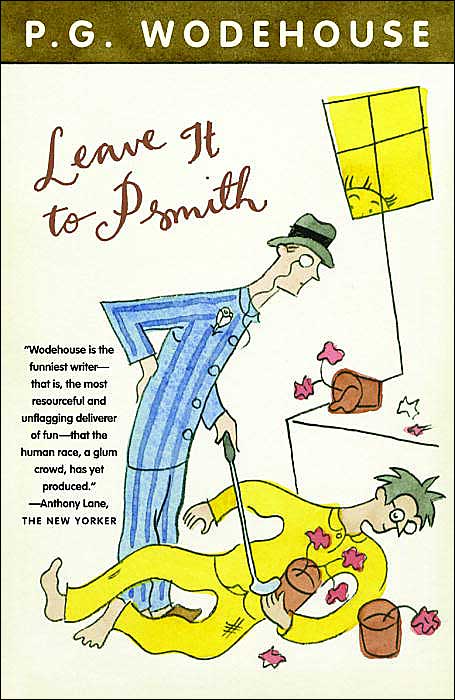
Leave It to Psmith by P.G. Wodehouse

Let’s hear it for Psmith! Wodehouse wins again! I love this guy. He makes me laugh. His stories are lighthearted and feel-good and things always come out right in the end. This is my first non-Jeeves Wodehouse, and I loved it.

I don’t think I’m able to sum this plot up briefly, but I will say: there is a spacey Earl (whom we met the other day) with a thick-headed and scheming son, a tyrannical (but efficient!) secretary, a decidedly difficult sister, and a hard-beset brother-in-law. There is a small crowd of people trying to steal a diamond necklace, mostly independent and unaware of one another. And Psmith (the ‘p’ is silent) comes on the scene to solve the world’s problems and woo the girl – under a false name, naturally. He is a perfect Wodehouse creation: a little bit bumbling but oh so charming and well-dressed. There are several strong female characters (some portrayed more flatteringly than others) and the requisite daunting aunt. There is a troubled but eventually happy love affair. And oh, the laughs.

I was relieved to detect none of the misogyny in Leave It to Psmith that I found in my last Wodehouse read. This was as delightful as it gets. While there is hilarity and even some light slapstick, Psmith is less ridiculous than Bertie Wooster, and a little more capable. I still like the Jeeves and Wooster pairing, mind you, but Psmith is a new love. Beyond that, I should direct you to Simon’s recent discussion of the wonders of Wodehouse as he said it so well. More ice cream, please!


Rating: 6 giggles.

book beginnings on Friday: Leave It to Psmith by P.G. Wodehouse

Thanks to Katy at A Few More Pages for hosting this meme. To participate, share the first line or two of the book you are currently reading and, if you feel so moved, let us know what your first impressions were based on that first line.

Today we’re back with Wodehouse, in my first departure from his Jeeves novels. I was feeling in need of some comfort food, and as Simon recently said, Wodehouse is like ice cream: perhaps not commendable for daily fare but oh so good when a person needs something sweet and rich.

My expectations are being met so far: the first several pages had me in stitches, unable to choose my favorite lines to quote. Of course, today’s exercise mandates the first lines, thereby relieving me of that decision. I have taken the liberty of quoting a longer passage than is customary because these were too good to miss:

At the open window of the great library of Blandings Castle, drooping like a wet sock, as was his habit when he had nothing to prop his spine against, the Earl of Emsworth, that amiable and boneheaded peer, stood gazing out over his domain.

It was a lovely morning and the air was fragrant with gentle summer scents. Yet in his lordship’s pale blue eyes there was a look of melancholy. His brown was furrowed, his mouth peevish. And this was all the more strange in that he was normally as happy as only a fluffy-minded man with excellent health and a large income can be.

You see what I mean? “Amiable and boneheaded” and still more, “fluffy-minded.” Not to be missed! I love the characterization in these opening lines of the Earl of Emsworth: likeable, but (at best) spacey. Wodehouse continues his streak, as far as I’m concerned.

What are you reading this weekend?

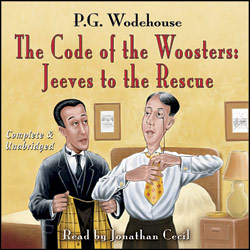
The Code of the Woosters: Jeeves to the Rescue by P.G. Wodehouse

Here we are again with Bertram Wooster and his unrivaled valet, Jeeves. This is the third full-length novel in the series (see my reviews of the first two, Thank You, Jeeves and Right Ho, Jeeves). In this installment, Bertie is recovering from a hangover following his old pal Augustus “Gussie” Fink-Nottle’s bachelor party, when his Aunt Dahlia sends him off on an errand to sniff derisively at a silver cow creamer (it only gets weirder from here, stay with me) and thereby hopefully lower the price for his Uncle Tom who desires it. But a rival collector buys it out from under Uncle Tom, and Aunt Dahlia sends him off a step further: to the country home of the cow creamer’s new owner, Sir Watkyn Bassett, to steal it from him. Bertie was already on his way there, at Gussie’s request, to help patch the rift in Gussie’s engagement to the Bassett daughter, Madeline. Upon arrival, he finds the cow creamer extremely well-guarded, suspicious and threatening parties all around, and a second couple on the rocks: the Bassett niece, Stephanie “Stiffy” Byng, and the local curate Harold “Stinker” Pinker, another old school chum of Bertie’s. Before he knows it, he’s engaged to steal cow creamers on the behalves of several rival parties, and that’s just the beginning of the mix-ups to come. Bertie (and Gussie, and Stinker) are threatened with incarceration and bodily harm as well as called-off weddings, or Bertie’s enforced marriage to one or the other of the girls, among other frightening fates.

If you haven’t figured it out, funny names are among Wodehouse’s several areas of genius. Husband is still laughing at What-Whatley from Thank You, Jeeves.

This was decidedly another delightfully laugh-out-loud funny and silly Jeeves book. I had a grand time. The antics of Bertie Wooster, his many incompetencies, and the completely deadpan assistance provided by his “man” are incomparable. This series is also incomparably silly, so if you struggle with silliness, beware. If, however, you appreciate silliness, also beware: other drivers think I’m crazy as I laugh out loud while driving around with these audiobooks in my car. I highly recommend Jonathon Cecil’s narration and hope I can listen to him narrate the entire series.

On the other hand, I struggled with something in Code of the Woosters that I don’t remember encountering in the first two books: misogyny. This is Bertie’s misogyny as opposed to Wodehouse’s – although of course there is not necessarily or even very often a difference, is there? (This book appears to have been published originally in 1938, partially explaining the issue.) Bertie is afflicted by the women in his life. These are generally his female peers in their relationships with his old school friends, and his aunts (“the aged ancestor” etc.). The first person voice of Bertie, then, laments the difficulty of the female sex. What the reader finds easy to observe, of course, is that it is not just the perversities of the females that accosts him – it is also his own ineptitude, and that of his male friends. (Gussie Fink-Nottle is a hopeless wreck in ways that can be blamed on no female, unless of course one blames his mother.) If this element was present in the first two books I loved, I missed it. Here, it came up repeatedly, until I got a little exasperated with hearing about how obnoxious, trying, immoral, and difficult Bertie finds women. I wonder if he ever becomes attached to one throughout the series? I’m not put off enough to give up, so I’ll let you know in our next installment of the comic Bertie & Jeeves duo.

My final (and minor) quibble with The Code of the Woosters is in the final fate of Constable Oates. I won’t give the finish away, but suffice it to say: when we first meet Oates he is assaulted by a vicious Aberdeen terrier while riding his bicycle, resulting in a crash, and he earned my sympathy (obviously) immediately. He does nothing more offensive in the rest of the story than want his personal property returned to him; he doesn’t even appear to share in Sir Watkyn Bassett’s ambition to throw the thief in the “chokey.” For him to come up for Bertie’s hostility seems unfair to me; I felt for Oates, myself. But that’s the final quibble.

I enjoyed this hilarious book far more than I was bothered by it, and highly recommend Wodehouse for giggles aloud. Audiobook lovers, please look out for Jonathon Cecil; he has come to embody Bertie, Jeeves, and the rest to me. Laugh on.

book beginnings on Friday: The Code of the Woosters by P.G. Wodehouse

Thanks to Katy at A Few More Pages for hosting this meme. To participate, share the first line or two of the book you are currently reading and, if you feel so moved, let us know what your first impressions were based on that first line.


I am always delighted to jump into another Jeeves episode by Wodehouse; they are just too darned funny! And I’ve been hooked on Jonathon Cecil’s narration of them from the start. I definitely recommend his versions on audio. Here’s our beginning of The Code of the Woosters:

I reached a hand from under the blankets, and rang the bell for Jeeves.
‘Good evening, Jeeves.’
‘Good morning, sir.’
This surprised me.

Review to come soon. Please keep your eyes open for Wodehouse; I don’t think you’ll regret it!

Houston Shakespeare Festival presents The Taming of the Shrew

Petruchio and Kate

I saw this production on 8/7 with Husband and another couple. (And I reviewed the written play recently, here.) It was a good time! For one thing, I remembered my spectacles this time, so I could see the stage. Also, we all stayed awake through the whole thing. As I said about Othello, the pacing might have been a bit slow, especially for a performance that was past my bedtime… in the dark… viewed from a blanket on a hill with a glass (or two) of wine (or beer).

I thought this performance was outstanding. The bawdy humor came through loud and clear; even Husband followed the whole thing (with some quick briefing beforehand). Some of the modern costume choices were cute and clever, too, and Husband got a kick out of the scene in which Hortensio, in disguise as an appropriate music instructor, tutors Bianca. He’s sort of wild metal guy, and that was fun.

So we had a lovely evening outside, even in Houston – the key being to wait until after dark to be out there. The Houston Shakespeare Festival, in its 37th year, has done it again. This performance was professional, clearly presented, understandable to regular folk, and funny! The humor of The Taming of the Shrew came through. I really think that, when performing Shakespeare, your job is to just let the bard speak, and they did.

As to the misogyny question, I don’t think they took a stance, but just presented the text, with its underlying bawdiness, and let us draw our own conclusions. I will continue to optimistically believe that Shakespeare didn’t mean for us to take him too literally. Really, Kate’s submission at the end is too ludicrous to be intended seriously – right? What do you think?

Right Ho, Jeeves by P.G. Wodehouse

Oh, Bertie Wooster. You are so silly and so deadpan. The dialogue is killer. The abbreviations are droll. The voice of Bertie is priceless. (I did get a voice – literally – for Bertie in my head in my first Wodehouse encounter via audio, which if anything has increased my enjoyment. Luckily the narrator was great and I now hear him in my head as I read this.) Wodehouse is a comic genius. These Jeeves-and-Wooster books are light, easy, even fluffy, but also pure gold: so easy to consume and so very pleasurable.

The story is this. Our narrator, Bertie Wooster, is a man of leisure in the London scene, light on the brains, perhaps, but blissfully unaware of it. He doesn’t have real problems, but rather those of a Shakespearean comedy plot. In my limited (two book) experience, they are the problems of confused lovers. Think A Midsummer Night’s Dream. Luckily, Bertie, and his surrounding community, are served by the genius valet Jeeves – so quintessentially useful, wise, clever, and discreet that his name has become an eponym. Jeeves solves all the problems, in the end, with aplomb, good taste, and tact. He even lets Bertie think he’s clever too – sometimes. I should also point out that Wodehouse has a genius for names. Bertie Wooster, Reginald Jeeves, and “the Bassett” are tamely named in comparison to Gussie Fink-Nottle, Tuppy Glossop, and the Market Snodsbury School. (Husband’s favorite is still Whatwhatley, or however you might spell it, from Thank You, Jeeves.)

In this book, Bertie is called to Aunt Dahlia’s country home to help out a pair of troubled lovers: cousin Angela and her fiance Tuppy. They are quickly joined by Madeline Bassett and her admirer, Bertie’s old friend Gussie, who has a debilitating fascination with newts, to the exclusion of everything else until Madeline came along. Gussy is having trouble wooing Madeline; Angela has throw Tuppy over. Bertie finagles Gussy into speaking at the Market Snodsbury grammar school in his stead. Bertie decides the answer to teetotaler Gussy’s problems is to get him drunk just before his speech. This results in a switcheroo (as my mother would say), and Angela ends up engaged to Gussy. Bertie’s machinations not seeming to do the trick, as usual, Jeeves steps in and saves the day. Right ho, Jeeves.

I love these little books and think I need to keep one on the nightstand always. They are laugh-out-loud silly job. If you can find audiobooks read by Jonathon Cecil, I recommend them as well.

The Taming of the Shrew by William Shakespeare

I am sure I have read this play before, because I have some vague memory of it; but I don’t know when. My reread is inspired by the Houston Shakespeare Festival: I’m going to go see both this, and Othello, in the next week. Fellow Houstonians, don’t miss this event! These two plays are both showing 4-5 times, in the next 8 days or so, at Miller Outdoor Theatre. For FREE. It’s an awesome summer tradition; I’ve been attending the Shakespeare Fest every summer since I was small. Don’t think I’m going to find time to reread Othello, sadly.

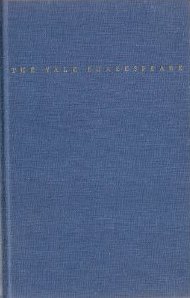
So. The Taming of the Shrew is not one of Shakespeare’s most famous plays (and was rather hard to find at Half Price Books. Lots of Macbeth, Romeo and Juliet, Midsummer Night’s Dream. Thus my very sweet, but visually unstimulating, little Yale Shakespeare blue cloth-bound hardback, pictured), but I think it’s a nice little romp. It’s a comedy involving two sisters: Bianca, the younger, has several suitors; she is attractive and admired. Her older sister Katherina, however, is very difficult, sharp-tongued, scolding, and generally unattractive to prospective suitors. Their father Baptista forbids any suitors to Bianca until such time as Katherina is married. I’m not entirely clear on whether it was his express intention or not, but the result of this is that Bianca’s suitors set out looking for a husband for Katherina, aka the shrew. They find a willing suitor, Petruchio, who feels that Kate’s wealth is worth the fight, and he has a plan. Thus the title: Petruchio sets out to tame the shrew, using such ugly, abusive, domineering, insane behavior that she gives up being “shrewish” and submits to his every desire, agreeing with any crazy thing he says. (The sun is the moon. An old man is a beautiful young maiden. Yes, husband, anything you say.) Petruchio weds, and tames, Kate; sundry other characters wed too. Lucentio marries Bianca, and Hortensio marries a widow (also for her money). The three new husbands make a bet on their wives, as to who can be shown to be most obedient. Petruchio’s reformed shrew wins him the bet, and she ends the play with a speech arguing that a woman should serve and obey her “lord” (husband).

There has been much controversy over this play, pretty much since it was born, regarding gender/marital roles, misogyny, feminism. I’m a bit inclined to agree with the camp that says Shakespeare was actually on the women’s side and was being instructively tongue-in-cheek, but mostly I’m willing to sit back and hear what you think; I don’t find it entirely clear what Shakespeare had in mind, from this distance. (I never did finish Fraser’s Young Shakespeare and thus have not started his Shakespeare: The Later Years. I found the writing awfully dry. If I ever finish these, or find a more palatable biography, perhaps I’ll take a stab at pretending I know what he had in mind. Until then, I am agnostic on this point.) At any rate, it’s an interesting study. Yes, Petruchio’s treatment of Kate is offensive; yes, her final speech makes me shiver. But she wasn’t a respectably independent woman early on; she was just kind of bitchy. Neither of them is sympathetic. So, it’s not as clear-cut as, Petruchio destroys Kate’s fine and virtous strong-woman spirit, or anything.

At any rate, I’m almost certain the upcoming performance will be the first time I’ve seen this play onstage, and I look forward to seeing how the Festival handles the political problems of The Taming of the Shrew. You can expect to see my write-up of the show soon.

Anybody read this play? How do you react to the chauvinism?

book beginnings on Friday: Right Ho, Jeeves by P.G. Wodehouse

Thanks to Katy at A Few More Pages for hosting this meme. To participate, share the first line or two of the book you are currently reading and, if you feel so moved, let us know what your first impressions were based on that first line.

Back to Jeeves, we are! I so enjoyed Thank You, Jeeves that I picked this up on an evening when I was feeling a little down and not quite ready for bed. Thankfully, Wodehouse will cheer a girl up. Since I listened to the first on audio (and LOVED the narrator), I had that voice (and accent) to read this one in, inside my head. I’m loving it. We begin:

“Jeeves,” I said, “may I speak frankly?”
“Certainly, sir.”
“What I have to say may wound you.”
“Not at all, sir.”
“Well, then –”
No — wait. Hold the line a minute. I’ve gone off the rails.

I like it. 🙂 If you haven’t checked Wodehouse out yet, I recommend him for purely silly, clever British humor.

Thank You, Jeeves by P.G. Wodehouse (audio)

What a charming little venture into the British peerage. This may be a first for me, but I think the audio format actually improved this experience! (I actually have Right Ho, Jeeves at home in paperback, so I can compare then. Although the voice may already be established in my head… we may never know.)

Sir Pelham Grenville Wodehouse was an extremely prolific British humorist; he wrote plays, poems, short stories, novels, and more (I’m getting this mostly from Wikipedia, FYI, along with a general sense I’ve had of him). The stories in his Jeeves series are among his best-known, and I, not knowing much about him, decided to start there.

Thank You, Jeeves is just silliness, but of the most enjoyable sort.

Bertram Wooster (Bertie), our narrator, retires to the country when London society ostracizes his playing of the banjolele, and for the same reason he loses his valet, Jeeves, who can’t stand the playing of the banjolele any more than London can. Jeeves enters the employment of Bertie’s old friend Chuffy, who also houses Bertie in a cottage on his country estate. American millionaire Stoker shows up to discuss business dealings, along with his daughter Pauline, formerly engaged to Bertie, soon engaged to Chuffy. A rather Shakespearean case of mistaken identities, love triangles, and well-meaning bumblings ensues. (Like so often in Shakespeare, a good dose of Telling Everyone The Truth In A Forthright Manner would have solved everything early on, but then there wouldn’t have been a funny book.) Also in Shakespearean fashion, the servant Jeeves is a sharper tack than his employers. Eventually the talented, intelligent, well-read, scheming, and discreet Jeeves solves everyone’s problems up neatly, reuniting several estranged couples, keeping everyone out of jail, and even returning Bertie to London where he belongs, and himself to Bertie’s employ. But not before I get to enjoy all sorts of hilarity and irony, in the events of the book but most especially in the dialog. I think this Wodehouse is a master of goofy dialog, and this narrator Jonathan Cecil performed it admirably. Husband did not follow the action at all but greatly enjoyed hearing the characters exclaim over Lord Whatwhatly (I don’t know how this is spelled as I was listening, not reading, but it is funny-sounding).

I will definitely search out more Wodehouse; he is deserving of his fine reputation as a humorist. This was funny and lighthearted and easy to “read.” I recommend.