movie: The Shining (1980)

The 1977 novel by Stephen King which I just reviewed was made into a movie by Stanley Kubrick in 1980. Husband and I planned to watch it on Halloween (as I’d just finished the book) but we couldn’t even wait that long.

I struggle to retain a little perspective as I write this review. I loved the book very much. Movies made from books are often disappointing, and I keep reminding myself, this is not because they are less good, only different. The format requires that they compress the action, often curtailing development of characters and plot, to fit into two hours or so. Interior thoughts and motivations are often lost (see recent discussion). None of which means that movies can’t be good; they just can’t be books.

As you’re already gathering, this movie disappointed me in that it wasn’t just like the book. In fact, they have relatively little in common. Both are about the Torrance family: Jack, Wendy, and Danny. Jack is still a recovering alcoholic, still takes the caretaker job at the Overlook Hotel. Dick Hallorann still befriends Danny, although their friendship is much less profound. My first great let-down was in Hallorann: I found him sort of bumbling in the movie, less developed, certainly less capable and fun, less someone I want to hang out with. For that matter, my earliest warning was in the character of Ullman, the hotel manager: a real creep in the book, he was an oily but not exceptionally unpleasant nonentity in the movie… I guess these are the sacrifices we make to time restraints. And of course, the monsters are reduced in number and in detail, again presumably because of the time limitations. Most damningly, a certain key character meets an entirely different ending in the movie, which I have a hard time forgiving. I have to keep reminding myself, these are different stories.

But the real departure from book to movie, it seems to me, is in the source of the evil. As I noted, in the book, Jack is an essentially good – flawed, but human – man, husband, and father. The Overlook Hotel is an evil entity that preys upon his weaknesses and takes him over. Jack as man is redeemed somewhat. In the movie, though, Jack goes insane and tries to kill his wife and child. No redemption there.

But how was the movie as just a movie, without these unrealistic comparisons to the book? Okay, I’m trying. As a movie it was indeed spooky. It created atmosphere. The scenes with Danny riding his Big Wheel through the halls alone were powerful. For that matter, the images were all powerful – and absolutely iconic today. (I could have identified all of the images in this post for you before I saw the movie. And I am a pop culture dunce.) Stanley Kubrick did his Stanley Kubrick thing. I think it would have been an enjoyable and impactful movie experience, had I seen it first. Clearly, however, the book ruined me for it. Which is so often the case. However, I also think that the movie would have ruined me for the book. Scatman Crothers’ portrayal of Hallorann was not at all what I’d pictured, and I like my conception of him better. So there’s a conundrum. If you have to pick one format, kids, I recommend the book.


Rating: 5 advantages taken.

The Shining by Stephen King (audio)

Another masterpiece by Stephen King! Probably my favorite yet. Spellbinding.

I suspect the storyline of The Shining is familiar to us all, so I will sketch it very briefly. Jack Torrance is a recovering alcoholic; his family has been made unstable, financially and otherwise, by his drinking. He takes a job at the Overlook Hotel in the Colorado mountains as winter caretaker, which involves moving his wife Wendy and son Danny in for some 6 months, for most of which they will be snowbound and cut off from the world. Danny has a unique gift for seeing things: the past, the future, dead people. The Overlook has a uniquely grotesque history.

The Shining is a masterful book in several ways. Perhaps the most obvious is the atmosphere: King’s pacing, building of tension as the story unfolds, and foreshadowing, are precisely designed to spook his reader. Danny’s gift – his “shine” – provides the perfect vehicle for this foreshadowing. The character development is finely done as well. Jack is a conflicted character; he loves his wife and son and wants to do well by them, but he battles inner demons, particularly alcoholism, and this internal conflict is well done. He feels like a real person. Wendy, too, struggles with what’s right for her family; she has considered leaving Jack before and continues to deliberate. And Danny is a sweet child, not inappropriately aged (the way gifted children sometimes are in fiction) – at least not to my limited childless knowledge. He can see more than he can understand.

The hotel has a will of its own and is a character unto itself. Place, or building, as willful force of evil is a device we’ve encountered before, Rebecca being one of the best examples. The Overlook is another. I love how Jack’s research into the hotel’s history seems to feed its power to harass him. I love that the Overlook preys on Jack’s weaknesses. It is truly, deeply creepy in the most delicious way.

And while we’re discussing characters – how about my very favorite, the hotel’s summertime cook, Dick Hallorann? Hallorann befriends Danny, shares his strange gift (although it shines more strongly in Danny), puts the name “the shining” to it for him, and comes to the family’s aid late in the book. Dick is a lovely, colorful character, full of personality and, again, very human conflicts. I like him very much.

The Overlook Hotel’s evil finds an outlet through Jack Torrance. His struggle with alcoholism and growing cabin fever make him a good target; but it remains clear that Jack is an essentially good man. Even in the worst of times, he experiences some personal growth. Wendy, too, learns about her son and their relationship is left looking stronger than ever as the story comes to a close.

I found this book exciting; suspenseful; rich; engaging; filled with people I cared about. Oh, and the audio! Campbell Scott’s narration is divine. I loved his voices for all the characters, and he contributed significantly to the atmosphere which is probably The Shining‘s finest quality. If you haven’t enjoyed this book yet, I strongly recommend that you get the audio book read by Campbell Scott if at all possible! This has been one of my most enjoyable audio reads this year to date.


Rating: 8 roque mallets.

Movie review to come. Briefly: not as good as the book (who’s surprised?), and really only vaguely related to it. EDIT: movie review here.

movie: Night of the Living Dead (1968)

In case you haven’t been around here much, I’m not a big movie watcher. I didn’t watch a lot of tv as a kid; am not real strong on pop culture; and horror movies were never my top choice. Also, my parents hadn’t yet met in 1968. So this movie was altogether new to me when Husband and I sat down on Halloween and watched Night of the Living Dead, the original 1968 black and white movie in which a group of strangers gathers in a farmhouse to defend themselves against …we would now call them zombies, although that term isn’t used in the film. In the film, they’re called ‘ghouls.’

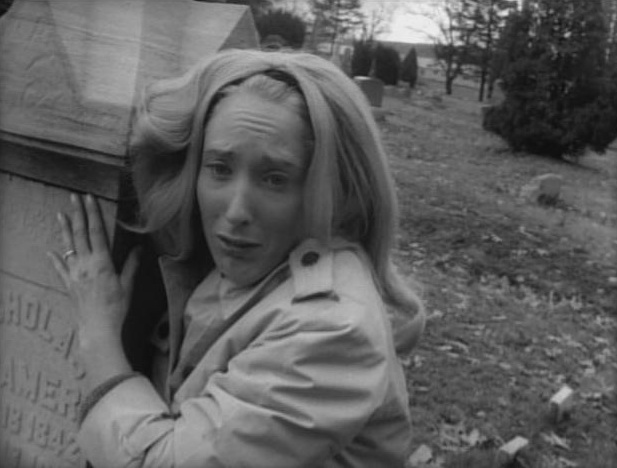
Barbra


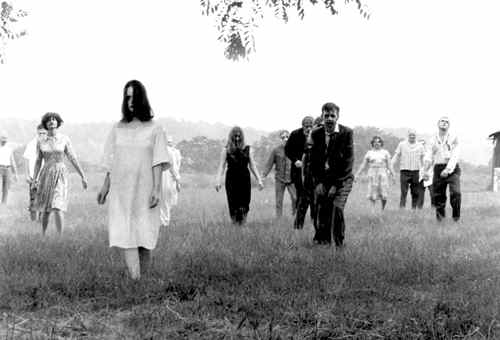
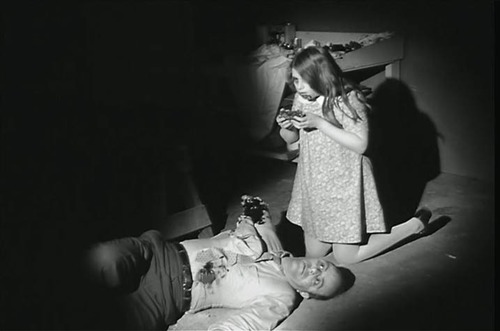
In the opening scene, Barbra and her brother Johnny are visiting their father’s grave (and Johnny’s being a real pill about it, by the way) when a ghoul approaches and… goodbye Johnny. Barbra runs to a farmhouse, chased by the undead, and holes up, soon to be joined by a stranger named Ben. Ben keeps his calm and has a plan to board up and defend the farmhouse, while Barbra becomes hysterical and then catatonic. It turns out that they have company: another group of frightened (living) people were already hiding in the basement. There’s a young couple, and an older married couple with an injured daughter. The movie covers just the one night, in which the zombies, I mean ghouls, mill about outside and the people inside make plans to escape. The radio and television inform them that there is an epidemic of ghouls ravaging the country, killing people and eating them.

‘ghouls’


Cinematographically, this film struck me favorably. I am no student of this art form, especially in black and white, but the few black and white films I’ve seen have impressed me with their use of light and shadow – necessarily, since that’s the big visual contrast they have to work with. Certain aspects of the movie were woefully dated: pacing is always the first I notice with older movies, since we have such short attention spans these days; the dialog felt stilted and abrupt; the acting was overly dramatic; and can I just gripe about Barbra for a moment? What a worthless weak female figure, and how disgusting is that? I imagine her portrayal took some heat in 1968, too! But just as I started to scoff at these faults, I’d jump in my seat. Despite the dated aspects, that fine use of light & dark and the suspense, the surprises, and let me say, the terror of the undead eating people is still scary. I can see why this movie was a hit and why it still draws a following. I can see why some consider it a classic.

yep. still scary


I do have one final complaint, relating to how the movie ends. I won’t articulate it here, in case you want to go discover it yourself. I will only say, I have a certain James Dean movie in mind, which did it better.

I enjoyed this movie far more than I expected to at about 20 minutes in. Touché, old movies. Happy Halloween.


Rating: 6 groans ‘n’ moans.

book beginnings on Friday: The Shining by Stephen King

Thanks to Rose City Reader for hosting this meme. To participate, share the first line or two of the book you are currently reading and, if you feel so moved, let us know what your first impressions were based on that first line.

Ooh, I’m excited about this one! Remember when I listened to that first chapter of his future release, Doctor Sleep? That’s the sequel to The Shining, due in 2013, and I loved it. So now I’m back to reading the first one. I’ve never seen the movie, either, although I’ve seen some images from it (Jack Nicholson’s face through that busted-up door is rather iconic) and have a vague impression. This audio version, read by Campbell Scott, came recommended (by Natalie), so here we go. It begins:

Jack Torrance thought: Officious little prick.

Ullman stood five-five, and when he moved, it was with the prissy speed that seems to be the exclusive domain of all small plump men.

I think that is fine imagery. I’m loving this book so far, and yes, Scott’s reading does seem to be letting me inside the head of the disturbing (disturbed?) Jack Torrance. Husband is pleased that I’m reading this book, too, although he was disappointed to hear that I will probably not be done with it by Halloween – he wants to watch the movie then, but I think November will have to do just as well.

movie: We Need to Talk About Kevin (2011)

I just happened across this movie the other day. I really enjoyed the book by Lionel Shriver – pre-blog, sorry, but I’ll recap here very briefly. The book is an epistolary novel, meaning it comes to us in the form of a series of letters from Eva to her husband Franklin. Their family has clearly suffered a tragedy of sorts, which goes unnamed until the very end, and the source of that tragedy, equally clearly, is their son Kevin. Eva is trying to process her difficulty with Kevin, and to figure out where the blame for what’s wrong with him lies. Was it in him from the start? Or was she a bad mother, and turned him bad? She felt the evil in him while he was still in the womb – or maybe she was just a non-nurturing mother. To me, that was the overarching question of the book: where did the badness come from? And it’s an interesting question. At the risk of sounding creepy, I guess I also found it kind of refreshing to see a presentation of motherhood that wasn’t all roses, sunshine, and easy bonding. Not all readers, or bloggers, enjoyed the book (by a long shot!), but I did. And I found its big reveal surprising. Important tip: if you want to enjoy the book, don’t let anybody spoil it for you! (No spoilers here.)

So, the movie. I was interested in two things: how well would the movie communicate the profound creepiness of Kevin the little boy? And how would the epistolary format difficulty be overcome? As in the case of book-to-movie The Lovely Bones, which in book form is narrated from heaven, the voice of Eva in her letters is difficult to translate into movie form unless you’re going to have Eva’s character voiceover the whole thing, which doesn’t sound appealing. (Qualifier: I only read and never watched The Lovely Bones. Apparently the film met with mixed reviews.)

As to the first question, they made Kevin creepy as hell, which was perfect. His manipulation of one parent while showing his dark side to the other reminded me of that terrifying woman-child in Orphan (shudder). I thought the toddler Kevin was great; before he started speaking, he would glower at his mother until I thought surely he was going to blurt obscenities. But this is just a little boy!

Eva with little Kevin


And as to the second question, how to translate the epistolary format, the film took an arty, quiet, disjointed approach. There may be a technical term for this style – I am so very far from being a film buff. It reminded me of Punch Drunk Love, that outlier of Adam Sandler’s ouvre, which is far less tragic than this one, but what can I say, I don’t see a lot of movies. The chronology jumped around. And this raised a whole new question for me, one I can’t answer. Is the final big reveal as surprising in the movie as it is in the book? Since I knew it going in, I can’t say.

Throughout, the movie relies heavily on the repetition of one highly (screamingly) symbolic color, red, and is extremely quiet. Dialogue is very sparse. It drags along a little, but that might be part of the arty nature of it. (Short attention spans, beware.) It expresses terror in a whisper – an awfully effective technique. It communicated the same discomfort, questions, and alarm that the book did, and like the book, it’s not for everyone. But I think this film does what it set out to do.

preview chapter: Doctor Sleep by Stephen King (audio)

As noted yesterday, there is a teaser chapter at the end of Stephen King’s The Wind Through the Keyhole for his upcoming book, Doctor Sleep. I am giving this one chapter its own post here because it grabbed me hard. Good job, Mr. King, you have me salivating for a book that’s not out til 2013. Thanks.

Doctor Sleep will be a sequel to King’s huge 1977 hit, The Shining, upon which was based the 1980 Stanley Kubrick / Jack Nicholson movie by the same name. I have neither read nor watched The Shining, but after listening to King’s reading of the first chapter of Doctor Sleep, I will. I have a copy of the audiobook (sadly, not read by King) on its way to me now. I got the storyline of both the book and the movie, and the differences between the two, off Wikipedia. I won’t regurgitate what I read; if you too need the background, go read up (bookmovie).

Doctor Sleep opens with Danny Torrance seeing dead people again, a few years after the death of his father and other frightening events at the Overlook Hotel. Dick Hallorann comes to town to help him deal with the trauma and the apparently very real risk of the ghosts (are they ghosts? these decaying corpses?) doing him bodily harm. Dick arms young Danny with a tool to protect himself, but the chapter ends with a sort of “and then they were safe… or were they?” moment. Oh the suspense!

Here I am pimping Stephen King, I suppose, and I don’t think he needs my help. But just the one chapter held my interest so thoroughly that it began to eclipse the wonderful Wind Through the Keyhole that I had just finished. I am impressed, am I intrigued, I am seeking out more Stephen King. Check him out.

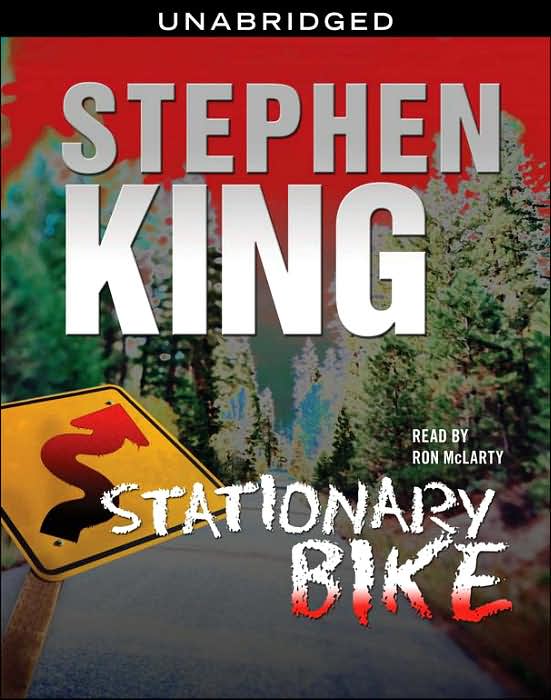
Stationary Bike by Stephen King (audio)

I’m going to call this one a short story, at only an hour and a half, unabridged. It made for a nice short entertaining story during our drive up for a bike race a few weeks ago.

Richard Siftkitz is a freelance commercial artist, making his living by drawing and painting commissioned works for advertisements, pamphlets, movies posters, record covers, and the like. He’s 38 years old when the story opens, and his doctor is concerned about his cholesterol level (Richard likes to eat a lot of fast food). The doctor explains the issue with a metaphor: he tells Richard that there is a little team of workmen, of the hardhat-and-work-boots variety, living inside his body, working hard to keep his arteries clear of the junk Richard is putting into them. If they are made to work too hard for too many years, they’ll get tired, start doing sloppy work, and eventually quit or be overcome.

Richard takes this concern to heart, and goes out and buys… that’s right, a stationary bike. He sets it up in the basement of his apartment building and paints a mural on the wall, of a road through a forest. This road represents both the road he pretends he’s riding down, and one of the roads that his little tiny interior metaphorical workmen are keeping cleared for him. He pins up maps on the wall and considers himself to be riding down real roads in upstate New York, eventually achieving the Canadian border and riding onward deep into the Canadian forests. Richard’s very active imagination simultaneously creates full lives for the team of four men he envisions working inside his body. He gives them names and backgrounds and families.

Without ruining too much for you, I will say that Richard’s imagined workmen take on lives of their own, and his imaginary ride through the Canadian woods takes on proportions larger than he meant for it to have. He finds himself in danger.

I found this short audiobook entertaining and spooky. The tension built nicely. There were little clips of music that played in between chapters; it started off sort of Musak-ish, but as the story got creepier, the music got creepier, growing with the mood. It was well done. Luckily (since I’m not real good with horror!) it wasn’t unbearably scary but it did give us some creeps. I liked it.