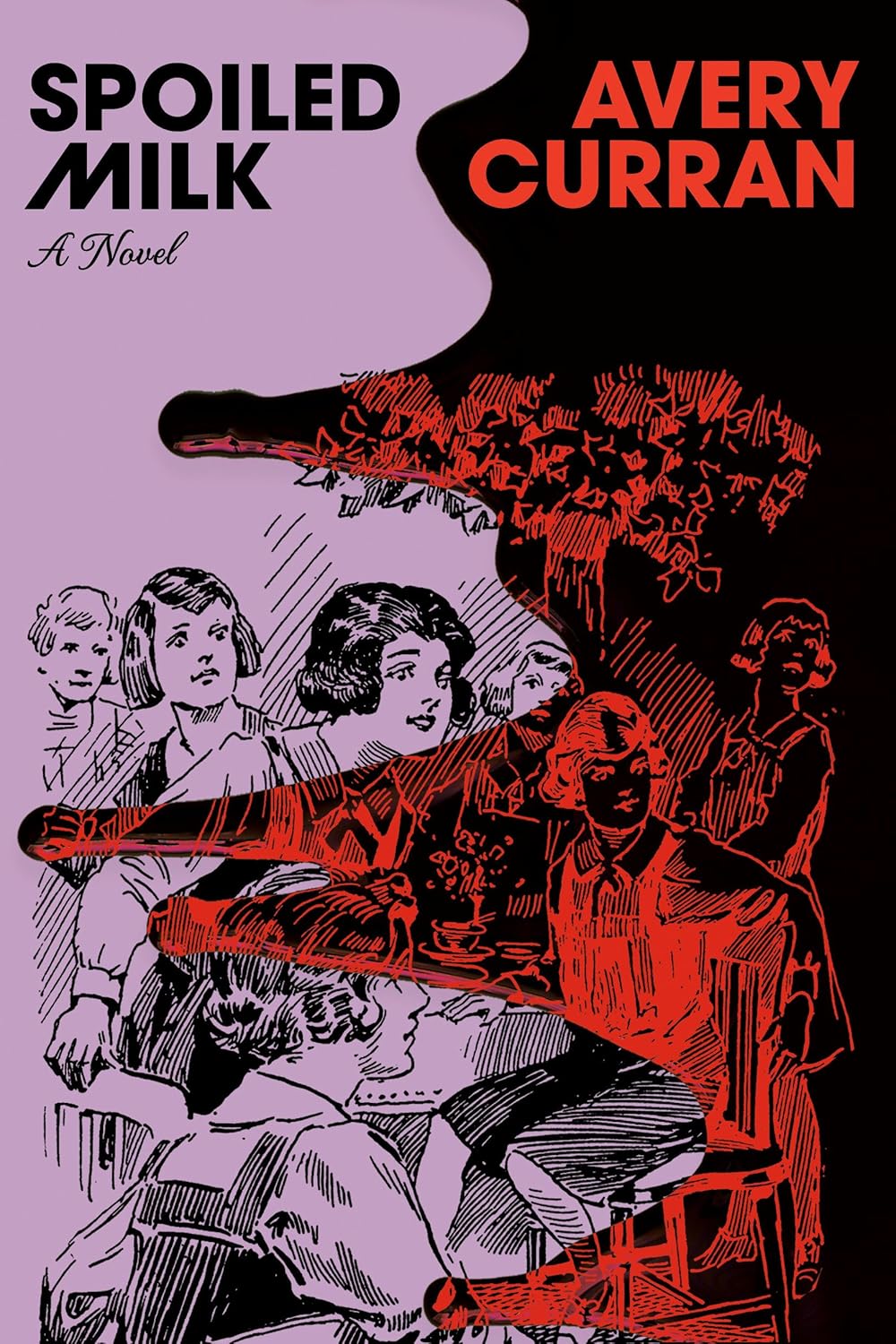
Witchcraft by Sole Otero, trans. by Andrea Rosenberg

This graphic novel follows an unusual household over several centuries in Buenos Aires, Argentina, through various characters whose lives are impacted, if not ruined, by three enigmatic sisters.

Argentinean comics artist Sole Otero (Mothballs) offers a tale that meanders through historical and speculative fiction with Witchcraft, a graphic novel that spans centuries in Buenos Aires. In Otero’s evolving but recognizable visual style, the opening scene emerges spookily from the fog, as a ship arrives in Nuestra Señora del Buen Ayre in 1768. (One of a series of footnotes explains that this was the original name of Buenos Aires, given by the conqueror Pedro de Mendoza.) Readers see three women disembark with their goat, taking with them the three-year-old son of another passenger, to the latter’s wails of despair. From these early, atmospheric pages, a sense of unease is established and maintained.

The following sections of the narrative undertake large jumps in time. In more or less present-day Buenos Aires, a man tells his friend a scarcely credible story of nude women dancing around entranced nude men, with a goat and a chalk circle and “this super creepy music.” In an earlier, historical setting, a Mapuche woman goes to work at a grand estate for three sisters who are both feared and respected in their local village, to a horrifying end. In modern times, a reclusive woman exchanges e-mails with a similarly lonely man, the veterinarian who came on a house call to look at her sick cat; he tells strange, disturbing tales about his family and the elderly goat they want him to save. A nunnery sends an allegedly evil orphan girl to live with three sisters who normally adopt only boys. From these and other narrative threads, populated by spirits, witch hunts, pleas and losses, readers begin to piece together the fractured story of the María sisters and their unusual, perhaps supernatural, habits.

Otero’s style of illustration varies somewhat between sections, but is often distorted or off-kilter, and highly detailed; in full color, her characters’ facial expressions and contortions advance the unnerving atmosphere of the larger story. Page spreads may include carefully spaced panels or no panels at all; text style likewise shifts, with infrequent footnotes to help readers along. This results in a sinister, mysterious, and deeply compelling reading experience. Translated by Andrea Rosenberg (who also translated Otero’s Mothballs), Witchcraft blends horror, dark magic and dark humor, rage and righteousness. This disjointed, sometimes discomfiting, entertaining story addresses colonial power and indigenous resistance alongside ritual, sex, and sacrifice in an eerie, phantasmagoric package not soon forgotten.


This review originally ran in the August 18, 2025 issue of Shelf Awareness for the Book Trade. To subscribe, click here.


Rating: 6 trees climbed.

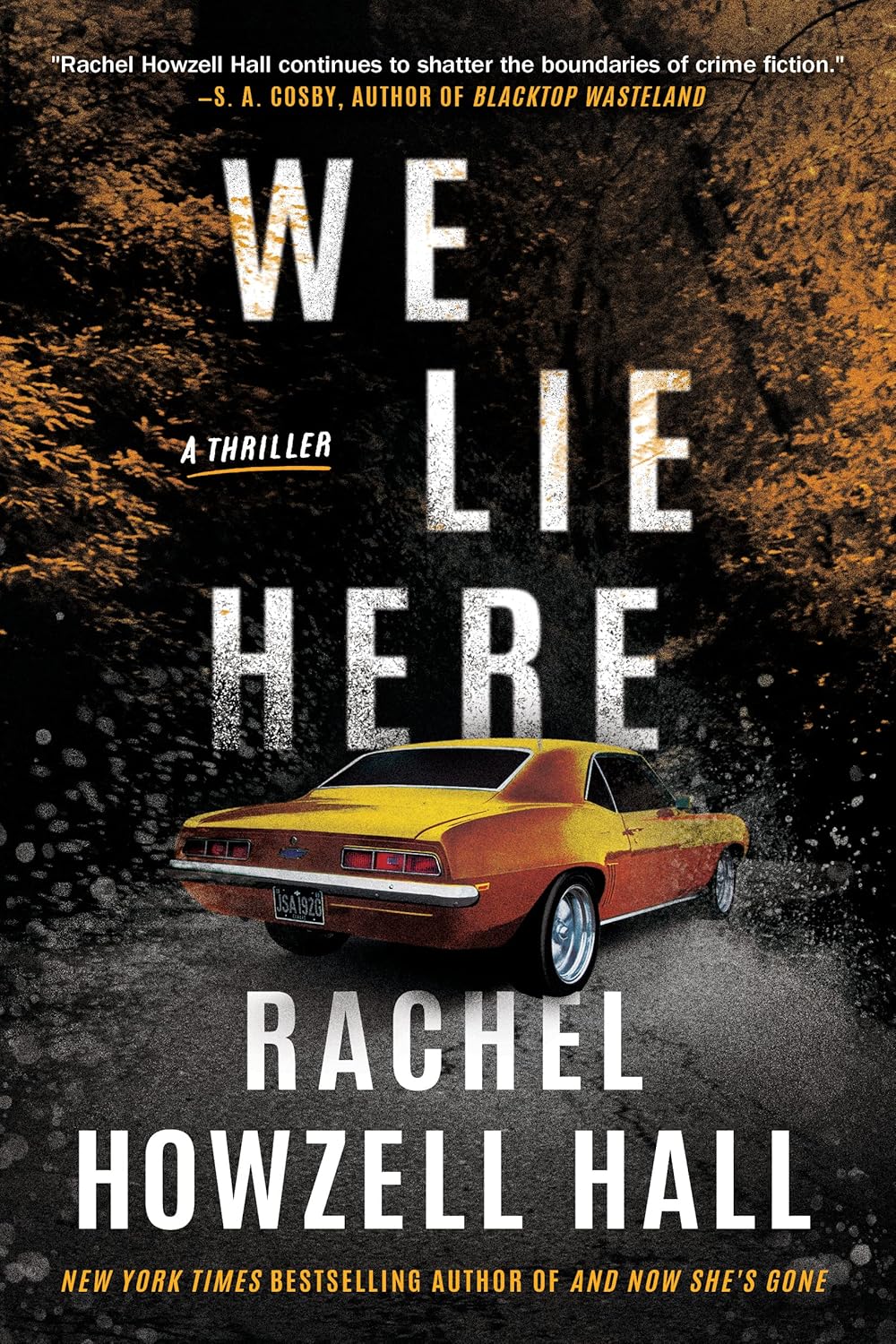
We Lie Here by Rachel Howzell Hall

This tense, suspenseful thriller slipped easily along with the momentum of a well-designed plot, for the most part. There were a few hiccups in the late-middle for this reader, but the finish got me, and this author deserves a hat tip for the big reveal which in hindsight feels almost obvious, but I never did see it coming.

We meet Yara Marie Gibson when she’s on her way back to Palmdale from Los Angeles. L.A. holds her moderately successful (it’s still early) career as a writer for television, her awesome boyfriend Shane, and her young-adult life; Palmdale, in the Antelope Valley in northern Los Angeles County, is home, and it’s trying to kill her. The novel’s first line is “The city of Palmdale takes my breath away,” and she means it literally. Yara suffers from severe asthma and allergies, worsened by anxiety, which is in turn worsened by her family in general and her mother in particular, plus the fact that her mother and sister smoke cigarettes every waking moment, and indoors. Yara is highly motivated by the party she’s throwing for her parents’ twentieth wedding anniversary, a very elaborate affair for which she’s footing the bill; nobody even pretends that her younger sister Dominique is not her mother’s favorite, but Yara is driven to give her parents this gift. Her father seems loving, but Barbara Gibson (who goes by a multitude of nicknames in Yara’s first-person narrative) is the sort of figure who sucks all the oxygen out of a room – this works metaphorically as well as in the sense that Yara, again, cannot breathe here…

These 400 pages take place over just a week or so, as Yara prepares for the party while choking to death in her childhood bedroom, and a series of strange events and characters arise: mysterious long-lost family members show up and disappear, threatening messages new and old come to light, bodies are found. There are numerous fights and shouty phone calls, and old secrets from before her parents’ marriage come to light. The Gibsons are a family with some messes and dysfunction–in other words, perfectly normal, if not perfectly healthy. They are also “the only Black family on the block,” and Yara is always aware of the impact of race on her life and safety. There are links to old Black Hollywood royalty, and racism both then and now.

A plot element that threw me for much of the book was Yara’s amateur sleuthing, which is accepted as natural by so many characters, including an old friend of hers who is a sheriff’s deputy. It didn’t quite follow for me that Yara’s job as a writer for a fictional TV crime show, and her blood relationship to a recently deceased woman (potentially a murder in which Yara would be a suspect), would qualify her to get the inside information she receives from such an official source; I expected a little more leave-it-to-the-professionals. This was a minor sticking point, but it lasted long enough for me (a hundred pages or more?) to impact my experience of the book. A lot of Yara’s personality, bless her heart, is her anxiety, forgetfulness, and breathing difficulties. And (highlight white text to reveal spoilers): at the discovery that her father was married before he married her mother, Yara’s reaction is more violent than I found likely. I mean, I guess she might have heard of this before, but the way she flips out felt outsized to me. I did pause and remind myself that we don’t all react to anything in the same way; and it’s clear that Yara’s parents’ marriage carries a lot of weight for her, thus this big party. Ah well. I coached myself through it.

As I said, in the middle portion of the book, there were some draggy bits – especially as I dealt with these small but persistent questions. But it does pick back up again! My experience of the novel’s opening pages was electric: Hall grabbed me with scene, dialog, sensory detail, and a strong sense of place, and anxiety about family is pretty universally relatable; it was a great start. And by the big crescendo and denouement (including a compelling epilogue), we were right back on track and on pace. It was an enjoyable fictional world to sink into, overall: escapism, suspense, momentum. Not perfect, but well worth the price of admission.


Rating: 6-and-a-half puffs on the inhaler.

The Staircase in the Woods by Chuck Wendig

Former best friends reenter a scene of horror in this clever, terrifying novel about the dangers that lurk in friendships, home, and the self.

The singular Chuck Wendig (Blackbirds and more) brings his trademark blend of humor, profanity, and shrewd observation to the weirdly charismatic The Staircase in the Woods. Chilling, disturbing, and deliciously entertaining, this horror novel stars a group of one-time best friends who reunite as adults across a chasm of time and trauma. Nick is as abrasive as ever, but at least he gets them all back together again. Hamish has traded in his Birkenstocks, jam bands, and extra weight for fitness, church, and family. Lore (formerly Lauren) has achieved professional success, but only through an increasingly belligerent go-it-alone approach. Owen (aka Nailbiter) is barely surviving his mental health woes. And Matty, once their golden boy, hasn’t been seen since that day in the woods in 1998. Five teens went camping, four came back out again. Now, more than 20 years later, they have a chance to try to find out what went wrong–or lose themselves like Matty did.

Four dysfunctional adults walk into a different set of woods, fighting among themselves and against their own demons, and enter a sinister otherworld that may have consumed their friend. Wendig’s narrative emphasizes the strengths and failures of friendship, and the difficulties of both childhood and adulthood. His snark is obscenity laden but also earnest in its compassion. The Staircase in the Woods deals in torture, violence, and abuse, especially within families, portraying how connection to place and the importance of home can cause at least as much pain as comfort. The result is haunting and unforgettable.


This review originally ran in the May 2, 2025 issue of Shelf Awareness for Readers. To subscribe, click here, and you’ll receive two issues per week of book reviews and other bookish news.


Rating: 7 cuts.

Mexican Gothic by Silvia Moreno-Garcia

I really enjoyed Gods of Jade and Shadow, with the caveat for sensitive readers to beware a certain amount of gore and darkness. This one is imaginative, compelling, and surely fulfills its claims to the horror genre; but some of those more horrifying elements started to push my tolerances, which are famously high (though not limitless). I’d thought about putting this in white text, like I do spoilers, but I think it deserves a proper trigger warning: this novel not only deals in sexual contact without consent, but those scenes were heightened – at least in my feelings – by a mind-control element that caused the nonconsenting party to enjoy what was happening, as it was happening (although not before or after). This gave me a unique ‘ick’ I’d perhaps not encountered before. And in considering the book now, I find that part of the experience is overshadowing the rest for me.

It’s a good story, and well executed. I like the setting – beginning in 1950s Mexico City and then moving to a classically disturbing, possibly haunted, gothic mansion in disrepair, high in the misty rural Mexican hills. I like the details, including society’s dos and don’ts and the dresses and accessories of a popular, pretty, privileged young woman, our protagonist, Noémi Taboada. She’s plucky, thinks for herself, is unwilling to settle for a young woman’s few destined roles. These days, she’s thinking she’d like to study anthropology in graduate school. She’s well read, and also loves a party, a nice dress, and a fawning young man (and preferably a new one on a regular schedule). I like her.

Her cousin Catalina is a bit different, more demure, a few years older, enchanted by fairy tales and romance, which is how she ends up married to the enigmatic Virgil Doyle. Married, and spirited away to the yet more enigmatic estate known as High Place, on an abandoned silver mine. Where Noémi is to visit, and perhaps to rescue her.

High Place is bad news, its residents sinister (and dedicated to eugenics, ick again), its history very mysterious. Noémi is up for a lot, but this place may get the best of her. There’s always Francis, a Doyle cousin who might – on and off – be an ally. There’s a creepy old cemetery (of course), and something strange going on with the mushrooms. There are actually some really interesting ideas at play. But, like I said, the special ick I found here challenged me quite a bit.

I’ve left the rating at a 7. It’s a well-done story. But it’s left me feeling not so great. I’m intrigued enough to keep on checking out Moreno-Garcia’s backlist.


Rating: 7 cards.

The Devil in Silver by Victor LaValle

Victor LaValle: I loved The Changeling, couldn’t make it very far into The Ecstatic, did okay with The Ballad of Black Tom. I have found The Devil in Silver quite intriguing and absorbing; I don’t guess I loved it as much as The Changeling, but it sure did take me on a trip, and I’ll be thinking about it for some time.

We begin:

They brought the big man in on a winter night when the moon looked as hazy as the heart of an ice cube.

The big man will turn out to be Pepper, and he’s being brought into the New Hyde mental hospital in Queens by a trio of detectives who couldn’t be bothered to process him into the actual jail, and instead have defaulted to a simpler drop-off scenario. This will have long-lasting consequences for Pepper, however. One of the quickest questions to arise in the reader’s mind: who among us would countenance this involuntary commitment process without coming across a little unhinged? If I am perhaps a little drunk, indignant, and arguing my absolute sanity, will I read as sane, or…? Tiniest spoiler alert ever: Pepper is not immediately released from New Hyde. However reluctantly, he makes friends (of a sort), although his assumption that they don’t need psych meds any more than he does will be tested.

Pepper is no hero, no wronged but upstanding citizen. He’s rather average, maybe a little of an underachiever or a slob, deeply unremarkable, but that’s the point – none of these qualities should have him locked up, drugged against his will, restrained to a bed for inhumane days at a time. The methods of the doctors and nurses on staff (no heroes among them, but like Pepper, regular human beings capable of small graces and big messes) aren’t the worst of what New Hyde has to offer, though. There appears to be a veritable devil housed in a secure room just down the hall. But is this antagonist truly what it appears? Just how sane is anybody? (Questions of the un/reliable narrator may arise.)

There are deeply compelling characters here, and profound pathos, crimes and forgiveness and oh so many questions. The story is fairly explicit about questioning systems: the hospital has purchased a software program for its ancient computer that is supposed to allow staff to digitize patient charts. But it bought the wrong program, instead winding up with one that is supposed to help homeowners trying to avoid foreclosure. Except that program isn’t really supposed to help homeowners, but just get them lost in a maze of paperwork until, oops, the foreclosure has gone through. “Most systems barely work, but those same systems cover their asses much more successfully.”

Pepper is our protagonist, and most chapters feature his close-third-person perspective, but select few center other characters – his friends among the patients, or the staff – and even beyond that (one memorably checks in with an enormous lone rat, and the philosophies of rats). Stories apparently pulled from the news blur the line between Pepper’s fictional world and our real one (see also LaValle’s author’s note, which I loved). Vincent Van Gogh plays an important role. This is a novel about mental illness, societal ills and broken/working systems, with horror and realism tangled up together. It’s hard to look away from, even in its most disturbing moments. LaValle is strong.


Rating: 8 butts.

The Axeman’s Carnival by Catherine Chidgey

Told in the voice of a magpie, with humor and wisdom, this unflinching portrait of nature picks at the thin veil between the elemental violence and drama of both human and animal worlds.

Catherine Chidgey (Pet; Remote Sympathy) offers a singular combination of compassion, desperation, dark humor, and slow-building terror with The Axeman’s Carnival, set in rural high-country New Zealand. The story is told through the unusual perspective of a magpie fallen from the nest and rescued by a woman named Marnie, who lives on Wilderness Road with her husband, Rob, a sheep farmer and competitive axeman. They’re “under a lot of pressure,” a refrain that contributes to a general sense of foreboding: a drought threatens their livelihood; Marnie mourns a lost pregnancy; she is isolated from the world beyond their farm. An ominous thread runs through their lives in ways that readers gradually become aware of.

The narrator shares memories of being in the eggshell, occupying the nest with his sister and brothers. “She lifted me into her pillowed palm” and a relationship begins. Marnie releases the magpie to his flock, but he chooses to return to the woman he adores; she names him Tama, and posts his pictures to the Internet, which gains Tama a following. The sheep station suffers setbacks, and Rob’s temper and drinking become increasingly menacing, even as he trains for the annual competition where he hopes to win his 10th golden axe, which will offer both the affirmation he craves and a badly needed monetary prize. Tama’s Internet fame presents a financial opportunity for the family, but also puts them in the public eye, with new risks. Tama’s view of events is curious, in both senses of the word; “that was how houses worked,” he repeatedly notes, with each strange or sinister observation.

Magpies are very smart birds. Tama relates the story with humor and wisdom. He mimics human speech and understands it well enough to communicate, and the reader benefits from his viewpoint as he describes events, with grim foreshadowing. “When I think about what happened later, I remember that day,” he says, of various small violences. “Rob honed an axe with his honing stone…. He ran the blade through the hair on his forearm to test the sharpness, and we watched his crime show about shapely murdered women with torn-off clothes who’d let their attackers in their front doors.” Rob’s temper, his taste for crime shows and murdered women, his axes and admirable strength, his jealousy and Marnie’s fear, all contribute to the reader’s trepidation of what is to come. But The Axeman’s Carnival has tricks up its sleeve, and Tama himself should not be underestimated.


This review originally ran in the June 18, 2024 issue of Shelf Awareness for the Book Trade. To subscribe, click here.


Rating: 8 cashews.

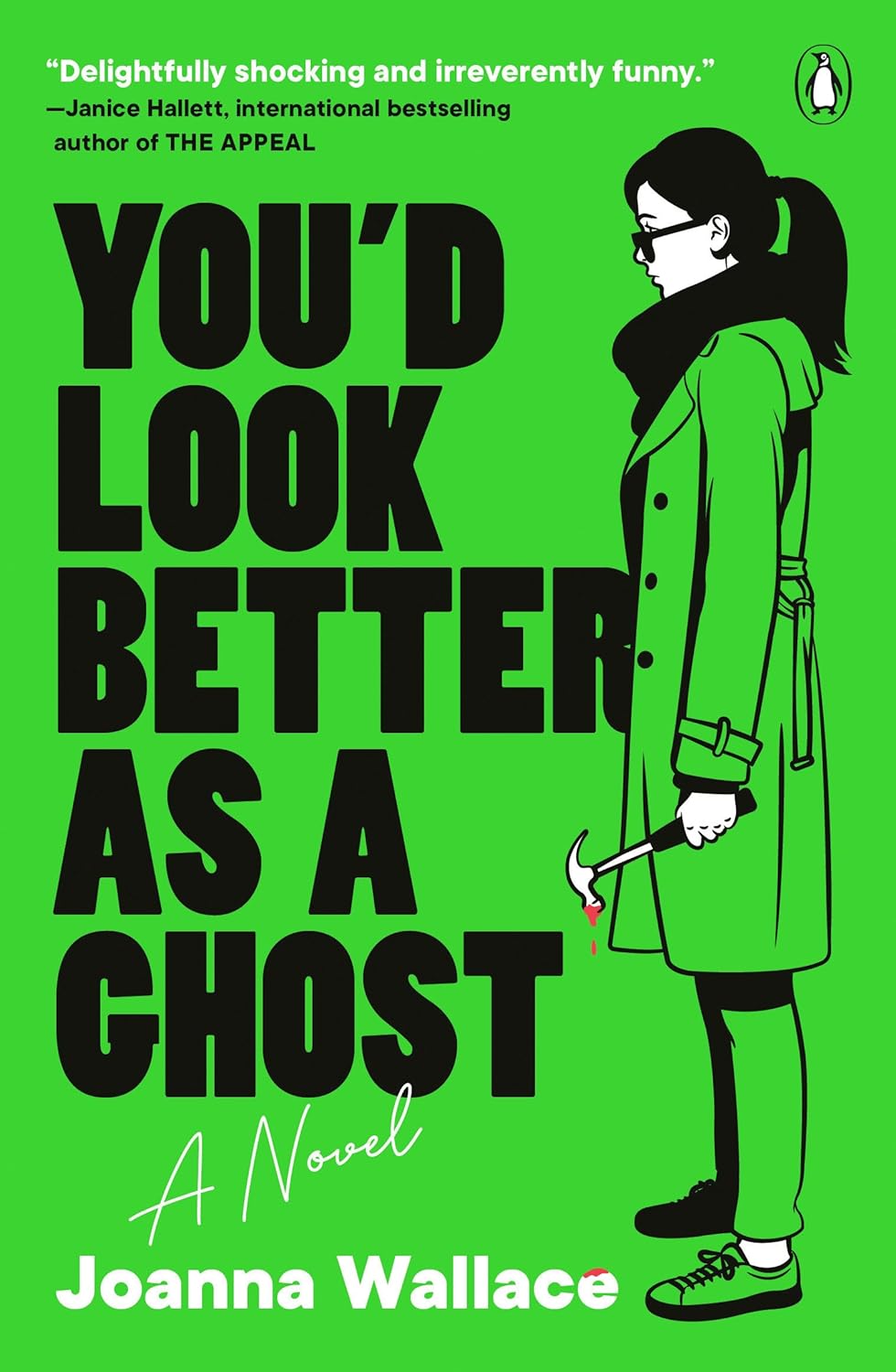
You’d Look Better as a Ghost by Joanna Wallace

Plot twists and a weirdly relatable serial killer offer readers a wild ride in this darkly comic thriller of grief and murder.

Joanna Wallace’s first novel, You’d Look Better as a Ghost, combines black humor and a realistic portrayal of grief with a serial killer, with whom readers are surprisingly inclined to empathize. This oddball story is both grim and unexpectedly entertaining.

When readers first meet narrator Claire, she is standing awkwardly at her father’s funeral, wondering at the strange behavior of the “serious-looking men in serious black suits… standing seriously too close and staring at me. Are they waiting for me to talk?” She assesses their comments, taking everything literally, contemplating human idiosyncrasies. She’s not all that good with people, and she’s also deeply grieving.

It’s not just grief. Claire has always struggled with the habits of those she calls “ordinary people,” a group she does not identify with. “Whenever I’m unsure of how I’m expected to respond, I use a cliché. Even if I’m not sure what it means, even if I use it incorrectly, no one ever seems to mind.” She lives alone outside of London, painting, running on her treadmill, and now wrestling with the loss of her father following a painful battle with early-onset dementia, psych wards, and abusive care homes. Her late father seems to be the one person she’s ever felt close to; flashbacks to childhood sketch a chilly if not disturbing portrait of her mother. Plagued by migraines, Claire gets a doctor’s referral to a bereavement counseling group. “I may not have cried, drunk to excess or wrung my hands in disbelief since Dad died but I’ve definitely become more reckless with my kills.”

Oh, yes: Claire is also a serial killer. She struggles with “ordinary people” to the extent that she often feels the need to end their lives, a process for which she enjoys taking her time. Her new bereavement group offers her potential outlets for her creativity, as well as new challenges.

In Claire’s witty, deadpan voice, You’d Look Better as a Ghost revels in dark humor. A new acquaintance “asks whether I want anything to eat. A slice of chocolate cake. That’s what I really want. But I’m mindful of the fact that I killed this woman’s sister fairly recently and the cake is ridiculously overpriced. So, I order a shortbread biscuit instead. Feels like the decent thing to do.” Claire has some very firm ideas of propriety; for example, pairing wellies with a kilt bothers her considerably more than dismemberment does. But the novel also deals seriously with the protracted grief of losing a loved one to dementia, and the potentially redemptive power of true friendship. Amid much irreverence, its themes are genuinely heartfelt and even sweet. This debut is fresh and unforgettable.


This review originally ran in the January 29, 2024 issue of Shelf Awareness for the Book Trade. To subscribe, click here.


Rating: 7 mugs of soup.

Salem’s Lot by Stephen King (audio)

It took me a while to get to this one, but I am very pleased to be back in the Stephen King universe. Salem’s Lot is classic horror. King doesn’t get everything right (and this was published in 1975), but there’s not much question that he’s a supremely great writer. His stories are very easy to take in and get lost in. I enjoyed this very much, and I’ll keep working my way through his extensive catalog.

I won’t spend too much time on plot; you can find that elsewhere. My audio version opens with a short foreword or introduction which King reads himself, and it made me feel so good about what I was headed into. In his own voice, I heard the style and easy sentences of a master, and heard him discussing reading and writing as lifetime loves. He describes reading Dracula as a young boy, and then a bunch of secondhand E.C. Comics, and reimagining the vampire story for a contemporary U.S. of A. He confesses that Salem’s Lot, only his second novel, is dated, but he still counts it among his favorites. “Carrie, the book which came before it, seems almost fey by comparison. There is more confidence here, more willingness to be funny.” It only made me more excited about the story to come. Ron McLarty reads the novel itself, and very well I think: I have no comment on his reading either way, which is a good sign.

In Salem’s Lot, the moderately successful novelist Ben Mears returns to the Maine town where he spent just a few years as a boy, but where he had an indelibly frightening experience in a moody old mansion where a famous recluse had hung himself. He meets a nice girl, and settles in to a room in a boarding house to work on a spooky fourth novel. To a mild, idyllic backdrop, Ben courts the girl, Susan Norton, and makes new friends. But the town of Jerusalem’s Lot (or Salem’s Lot, or simply The Lot) isn’t done with mysterious, creepy figures. Ben’s not the only newcomer in town. A beloved dog is found impaled on a cemetery fence. Two young brothers disappear in the night, and one death follows another. A small but tough motley crew forms up: Ben, the writer; Susan, the young woman; Matt, an aging high school English teacher; Mark, a middle-school boy new to town; Father Callahan, the town’s Catholic priest, who will figure in the Dark Tower series; and Dr. Jimmy Cody. Together they will fight an ancient evil. The novel’s prologue serves as a teaser, with an unnamed man and boy on a cross-country trip. This action actually falls chronologically at the end of the book, just before its epilogue–sending me immediately back to the beginning when I finished listening to it.

King absolutely excels at realism, exquisite detail, and a combination of quaint small-town living (as sordid as sweet, but very true to life) with horror. He’s got a social conscience perhaps ahead of his time. His characters feel accurate, and everything flows very naturally; his sentences are that very special kind of smooth and easy that appears effortless but is actually extremely rare and difficult to achieve. It’s masterful and I’m a little bit in awe. On the other hand, there was one element that got under my skin. To protect plot spoilers, I’ll discuss it here briefly in white text (highlight to read): I really liked Susan Norton’s character, and was invested in her development not only as character but as strong young woman coming into control of her own destiny. She was the first of our powerful little team to fall to the big bad vampire, and I quite resented how that worked; after I’d come to see her as a proper strong woman and major player, it felt like she got thrown away like the cheap girl character in a pulpy horror story. Jimmy Cody later falls, too, but I was left with the sense that Susan didn’t get the treatment she deserved. I was left with the taste of misogyny in my mouth and felt sad about it. I respect Stephen King’s efforts, and find him better (in the lyrics of the Drive-By Truckers, who were talking about somebody entirely different) “at worst, no worse than most white men of his generation, north or south”… but it still made me sad. I’ll also recall again that in his introduction he acknowledged that this novel is dated. I hope this is part of what he meant, and that we’re still getting better now.

This issue, for me, was worth noting but did not fatally poison the experience. It’s an outstanding horror novel, and it’s sticking with me, and King is a marvel. I sort of want to go back and read the entire Dark Tower series over again (ha), but there’s so much more King out there, too. I do recommend. There’s not much perfect in this world.


Rating: 8 ice cream sodas.

Black Sheep by Rachel Harrison

In this darkly comedic yet philosophical horror novel, an unhappy 20-something returns home to the insular community and church she’d left behind only to find frights worse than she’d remembered.

Black Sheep by Rachel Harrison (Such Sharp Teeth; Cackle; The Return) moves inexorably from the darkly absurd into terrifying horror. Readers follow apathetic, antisocial Vesper Wright as she returns home to her estranged family and learns that what she knew of her unorthodox upbringing was just the beginning.

Vesper is 23 years old, working as a server at a chain restaurant “in an unglamorous part of Westchester County, sporting a polo and serving plates of baby back ribs I was fairly certain were generated in a lab.” She’s unhappy but relieved to be free from the family, community, and church in which she was raised–until she receives an invitation to attend the wedding of her former best friend and her first boyfriend. Magnetically drawn to the place she misses, dreads, and still thinks of as home, Vesper reencounters not only the unusual church but her powerful mother, a horror movie megastar who never proved very maternal: “I’d only ever seen her emote on screen, her vulnerability behind glass. She was more human to me when she was pretending to be someone other than herself.” What she finds at home will blow Vesper’s world, and perhaps literally the entire world, wide open. She reconsiders her memories and “that our past is not the truth. It’s warped by time and emotion, inevitably muddied by love and resentment, joy and shame, hope and regret.” Eventually Vesper will have to rethink everything she thought she understood about her family, her church, and her past–and reexamine her loss of faith.

Early on, Black Sheep exhibits black humor and an accessible 20-something nihilistic angst. Details of Vesper’s former church are darkly comic. As the stakes rise, however, Harrison’s imaginative plot turns gruesomely to true horror. Fans of the genre will find pleasure in both the playful and the ghastly aspects. Aside from the terror, Vesper’s story ruminates on themes that include nature vs. nurture, the legacy of family trauma, and the repercussions of organized religion in its various forms. “Nothing terrified me more than this. The notion that without a choice we inherit parts of us that we cannot change. Cannot cut out.” This subject matter elevates a horror novel to a study in philosophy, even as the bloodletting ramps up.

Black Sheep is can’t-look-away riveting in its best and most disturbing moments, gripping readers on both conceptual and visceral levels. Vesper’s discontent and wrestling with her own worst self, her former family’s creepy cultlike demeanor, and the final crescendo of action add up to an unforgettable adventure.


This review originally ran in the July 14, 2023 issue of Shelf Awareness for the Book Trade. To subscribe, click here.


Rating: 6 glasses of wine.

The Writing Retreat by Julia Bartz

In this shape-shifting tale, aspiring novelists come together at a possibly haunted estate with a famously reclusive writer–for what turns out to be as much horror as inspiration.

Alex, the glum protagonist of Julia Bartz’s The Writing Retreat, has recently crossed into her 30s. Stuck in long-term writer’s block, her dreams of making it as a novelist are just about dead; she holds a thankless and “bleakly underpaid” position in publishing; her sex life is equally bleak; and she still mourns her traumatic friend-breakup with the more successful Wren a year ago. So it feels like a shocking and undeserved honor to be accepted to a fantastically exclusive writing retreat hosted by Roza Vallo, the wildly successful novelist Alex has idolized since she was 12 years old. The catch is that Wren has been accepted, too.

Roza’s Blackbriar Estate in the Adirondacks in New York is grand, dramatic and supposedly haunted. Roza herself is famous, rather controversial and private: the five young women attending the retreat must sign NDAs. Alex’s adoration of her enigmatic hero is enormous, and she senses this is her big shot at turning her life around: “If I lived in a pocket of Roza Vallo’s brain, however small, I sensed it would bolster my own existence.” She is also nearly crippled by anxiety about being near Wren–but that concern is quickly overshadowed by the terms of Roza’s intensely competitive program for the retreat. The five writers in attendance must each complete a whole novel in just 28 days, and the best of their works will win a million-dollar advance on a publishing deal. Even as the high-speed writing race ramps up and the drama with Wren continues to smolder, it emerges that something still more sinister is going on behind the scenes at Blackbriar Estate. Inexorably, The Writing Retreat evolves into a locked-room mystery, as eight women–five young writers, two staff and Roza–find themselves snowed in at Blackbriar and beset by potentially fatal threats that may be supernatural or simply human evil.

Bartz imbues her writing with a shape-shifting momentum: the plot’s focus moves from the small, painful dramas of competition and jealousies in friendship into horror and psychological suspense. Blackbriar Estate is both magnetic, in its haunting history and narrative possibilities, and stifling. The world of writing and publishing can be, at turns, solitary, socially supportive, triumphant and backbiting, and The Writing Retreat encompasses all these possibilities and more, as it explores friendship and family traumas, artistic crises and human nature. Bartz’s debut subverts genre in the interest of entertainment, satire and chilling thrills.


This review originally ran in the January 19, 2023 issue of Shelf Awareness for the Book Trade. To subscribe, click here.


Rating: 7 words.