A Distant Heartbeat: A War, a Disappearance, and a Family’s Secrets by Eunice Lipton

An inquisitive memoir investigates the author’s uncle, who was killed in the Abraham Lincoln Brigade in the Spanish Civil War.

distant heartbeat

Eunice Lipton grew up with an awareness of her uncle Dave that was specific and conflicted in emotional tone, and vague in points of fact. She knew he’d been in the Abraham Lincoln Brigade in the Spanish Civil War, and killed in action when he was 22. His brother Phil says, “Dave died for something. He was somebody.” His brother Louis, the author’s father, says he died for nothing. The author’s mother says he was the nicest man she ever knew. A Distant Heartbeat asks: Who was Dave Lipton? Why did this respectful son lie, tell his parents he would be working at a hotel in the Catskills, and then go to Spain? What does his story have to offer history?

Dave Lipton (formerly Lifshitz) was a Latvian Jewish immigrant, immersed in leftist youth politics in 1930s New York City. Surrounded by peers whose convictions mirrored his, Dave was one of very few to join that foreign war. His niece, born after his death, grew up with only scraps of his life and death: the repeated refrains of family members–died for nothing, died for something–and a few photos discovered in her childhood. She speaks to surviving veterans and friends of Dave, travels to an International Brigades reunion in Spain, studies letters and archival photographs. She finds more questions: What is the nature and cause of familial betrayal? Who was Dave’s mystery companion? In the end, Lipton’s research and musings offer only fleeting conclusions about family and principles, in a precise, elegiac journey through history, family tensions and human drama.


This review originally ran in the April 8, 2016 issue of Shelf Awareness for Readers. To subscribe, click here, and you’ll receive two issues per week of book reviews and other bookish news.


Rating: 7 photographs.

Teaser Tuesdays: Joe Gould’s Teeth by Jill Lepore

Teaser Tuesdays is a weekly bookish meme, hosted by MizB of Books and a Beat.

Teaser

This is one of the best books I’ve read this year. Please pardon the double-teaser. I couldn’t choose.

First and more complicatedly, Lepore quotes her subject, Joe Gould, in a letter to Ezra Pound in 1930. Gould is known (among other things) for being supposedly at work on a massive “Oral History of Our Time.” The parenthetical is hers.

joe gould's teeth

“Of course, I am a book-reviewer not a critic. That, I fear, is a distinction. It seems marvelous how many critics there are. And the blathering pother they make… Here is something cheerful to think about. To some extent the radio will supersede printing. That is good. There will be fewer books.” (The Oral History, he once explained, would include a discussion of this transformation: “I intend to write a series of chapters on the various means of communication, from oxcarts to airplanes.”)

I really wanted to share the oxcarts-to-airplanes concept because I thought it was delightful. But of course I couldn’t help going up a bit to see the book-reviewer-vs.-critic question, too! And as a bonus: people have been predicting the death of the printed book since way before e-readers. (Spoiler: Joe Gould died in an insane asylum.)

I was also struck by Lepore’s observation, below.

It has taken me a very long time, my whole life, to learn that the asymmetry of the historical record isn’t always a consequence of people being silenced against their will. Some people don’t want to be remembered, or heard, or saved. They want to be left alone.

Compared to the tone of the first teaser I chose, this second is more sober, and sobering. It’s an interesting concept for a historian to keep in mind – for the purposes of research strategies, but possibly ethics as well.

Check out Joe Gould’s Teeth. It’s outstanding.

This quotation comes from an uncorrected advance proof and is subject to change.

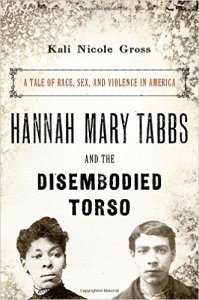
Hannah Mary Tabbs and the Disembodied Torso: A Tale of Race, Sex, and Violence in America by Kali Nicole Gross

In this shrewd historical study, a salacious murder trial in 1887 Philadelphia offers insights on criminal justice, violence, race and gender.

hannah mary tabbs

When Kali Nicole Gross (Colored Amazons) came across the case of an unusual 1887 Philadelphia murder, she found a story with many layers. In Hannah Mary Tabbs and the Disembodied Torso: A Tale of Race, Sex, and Violence in America, she explores the intricacies of that case and its implications on criminal justice, a culture of violence and conceptions of race and gender.

Hannah Mary Tabbs was an unusual post-Reconstruction black woman–she unabashedly pursued sex outside of marriage and used violence and physical threats to make a reputation for herself in her black community in Philadelphia’s Seventh Ward. In the white community, meanwhile, she upheld the idea of womanly virtue and subservience to her white employers. Gross argues that this manipulative, variable representation of herself allowed Tabbs to almost get away with a serious crime. Tabbs had a lover whose headless, limbless torso turned up on the edge of a pond outside of town. The man convicted for that murder was, Gross contends, a patsy. The skin tones of the various players in this love triangle appear to have played as large a role as their guilt or innocence.

In prose that demonstrates careful research and offers a realistic reconstruction of the crime, Gross comments on social standards for morality and relationships between races and genders. The case of the disembodied torso is not only a sensational piece of true crime, but an opportunity to reflect on these continuing complexities.


This review originally ran in the February 9, 2016 issue of Shelf Awareness for Readers. To subscribe, click here, and you’ll receive two issues per week of book reviews and other bookish news.


Rating: 6 assumptions.

Ostend: Stefan Zweig, Joseph Roth, and the Summer Before the Dark by Volker Weidermann, trans. by Carol Brown Janeway

This poetic contemplation in translation illuminates an uneasy creative community of artists and writers gathered one summer as fascism and Nazism are growing in Europe.

ostend

Volker Weidermann’s Ostend: Stefan Zweig, Joseph Roth, and the Summer Before the Dark is a glimmering work of language and an insightful tribute to literary friendship in a singular historical moment.

Stefan Zweig was a successful and popular Austrian writer; Joseph Roth was less successful but also gifted, a tortured, heavy-drinking writer whom Zweig called his “literary conscience.” When war loomed in the summer of 1936, Zweig returned to the Belgian seaside town of Ostend, where he had spent the summer of 1914. His work no longer welcome in Germany, his home in Salzburg defiled by police and his marriage collapsed, he nonetheless joyfully embarked on new work and new love with his secretary, Lotte Altmann. And he brought along Roth, supporting him financially and in his work (support that would strain their complex, fraternal relationship throughout). The troubled Roth, too, found new and rejuvenating love with a German writer, Irmgard Keun, one of the few non-Jews in their small émigré community.

Aside from brief background and epilogue, Weidermann stays within the boundaries of the summer of 1936–the summer before the dark, in which Zweig, Roth and an assortment of “detractors… fighters… cynics… drinkers… blowhards… silent onlookers” manage for a single season to love, laugh and exercise creative genius in a world rapidly falling into war and fascism. Translated from the German into lyrical, meditative prose by Carol Brown Janeway, Ostend is a brief but scintillating portrayal of this season, its spirit and a set of remarkable characters.


This review originally ran in the February 5, 2016 issue of Shelf Awareness for Readers. To subscribe, click here, and you’ll receive two issues per week of book reviews and other bookish news.


Rating: 8 little schnapps glasses.

The Cowshed: Memories of the Chinese Cultural Revolution by Ji Xianlin, trans. by Chenxing Jiang

This memoir by a survivor of the Chinese Cultural Revolution poignantly sheds light on an under-examined period in history.

cowshed

Ji Xianlin was one of many Chinese intellectuals held in makeshift prisons, called cowsheds, on university campuses during China’s Cultural Revolution, which began in 1966 and lasted for 10 years. He was mocked, humiliated, beaten and starved. He wrote about these experiences only reluctantly, observing late in life that none of his fellows had done so and that younger Chinese need to know their history in order to learn from it. In 1998, he released his memoir, now translated into English for the first time as The Cowshed: Memories of the Chinese Cultural Revolution.

Ji narrates his years of torment compellingly, in remarkably fair-minded fashion. He claims that his work is not literary, but it is adorned with lovely metaphors: he compares his torture to Indian and Chinese concepts of hell, “a veritable pagoda of horrors,” and makes reference to the steep path to Mount Tai, one of five Taoist sacred mountains.

Ji’s story is painfully moving and beautifully related, elevated by his preface and journalist Zha Jianying’s introduction, and his appendix, an abbreviated memoir of Ji’s whole life that puts the bulk of The Cowshed into perspective. He ponders the question of human nature as basically good or bad, and illuminates Chinese culture with sensitivity and humor; for example, “We Chinese intellectuals are descended from a tradition of scholars who would rather be killed than humiliated.” Until his death in Beijing in 2009, the wise older man who wrote this book remained a patriot who wanted the best for China and who appreciated that he saw the Cultural Revolution so intimately, if only so that he could bear witness.


This review originally ran in the February 5, 2016 issue of Shelf Awareness for Readers. To subscribe, click here, and you’ll receive two issues per week of book reviews and other bookish news.


Rating: 7 cornmeal cakes.

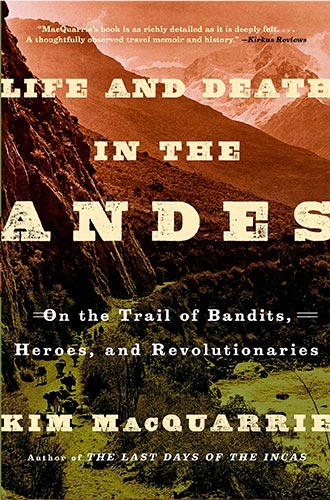
Life and Death in the Andes: On the Trail of Bandits, Heroes, and Revolutionaries by Kim MacQuarrie

This mesmerizing history of the Andes Mountains smoothly brings colorful characters and outrageous stories to general readers.

andes

Kim MacQuarrie (Last Days of the Incas) has long been fascinated by the vast region defined by the Andes Mountains. Having traveled and studied the length of these mountains, 4,500 miles of South America, he shares their stories in Life and Death in the Andes: On the Trail of Bandits, Heroes, and Revolutionaries.

Protagonists range over centuries and national borders, and include Pablo Escobar, the modern Colombian drug lord; Charles Darwin as an amateur naturalist in Ecuador’s Galápagos Islands; the 1980s Shining Path guerrilla movement in Peru; a teenaged girl sacrificed by the Incas in the 1400s; Che Guevara, making his final stand in Bolivia; and Butch Cassidy and the Sundance Kid, whose lives likewise end in Bolivia. MacQuarrie explores cultural conflicts with sensitivity, as in examining Hiram Bingham, the “discoverer” of the Machu Picchu ruins in Peru, who conveniently ignored earlier local knowledge of the site. Finally, MacQuarrie introduces the Yámana people of the southernmost points of Chile and Argentina, and meets with the last speaker of the Yámana language.

Life and Death in the Andes is captivating, its fascinating tales told with enthusiasm as well as careful research when dealing with relatively straightforward facts or with the story of “Juanita”–a young woman who lived in the 15th century–told as “an imaginative reconstruction based upon historical, ethnographic, forensic, and archaeological evidence.” This engaging history of dramatic stories and arresting characters is entertaining as well as informative, and its readability serves to recommend it widely.


This review originally ran in the December 22, 2015 issue of Shelf Awareness for Readers. To subscribe, click here, and you’ll receive two issues per week of book reviews and other bookish fun!


Rating: 8 coca leaves.

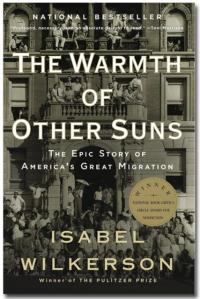
guest review: The Warmth of Other Suns by Isabel Wilkerson, from Pops

More than three years ago, I listened to the audio version of this book, and reviewed it here. At that time, Pops commented:

You make a most important point – that this is essential American history, of which most white Americans are sadly unaware. Jim Crow discouraged personal initiative and disrupted families & communities – a loss for the South. The challenge for black Americans to recreate their lives in “foreign” parts of the country, and the consequences for those regions, is an important part of our collective & continuing history.

He has now gotten around to reading The Warmth of Other Suns himself, and posted a longer comment to that original review. I thought it deserved its own post here so that more readers would have a chance at his thoughts.

warmth

I finally picked this one up, overcame the weighty intimidation of 600 pages and fully appreciated what Wilkerson created. I will simply add to your good observations.

Like you, I enjoyed her written voice and how she allows herself to be part of the story. Her own family story, and its part in her motivation for writing, is important and contributes to the warmth of her people stories. She writes with open sympathy, if not empathy, for the migrants, and full appreciation for the courage & fortitude revealed in their experiences; and I found that appropriate. Just one example, from her earliest pages describing the magnitude of the migrants’ decisions: “it was the first big step the nation’s servant class ever took without asking.”

I am struck by the breadth of her story, much attributable to how she weaves in anecdote & nuance in the course of her narrative. Whole books can be written of the wide ranging cultural contributions in literature, music, sports (maybe even “root doctors” in medicine?) – from the early stages of slavery forward, but released in a torrent once the migration began escaping Jim Crow. She mentions this in passing, but we learn more as she accumulates anecdotes & chapter heading quotes.

The racism implicit in mainstream history & sociology accounts is due full treatment elsewhere, but she obliquely makes the point well with examples of contemporary “professional” accounts, including some that are uncomfortably recent.

And I’m glad she also observes the way the migrants changed the cities, not just the reverse; this is not a Black History Month episode – it’s an essential part of American history that has been ignored and misunderstood at our loss. Her treatment of the Jim Crow regime is a good example, as she describes the deliberate way it was constructed, one little ordinance or ambiguous social convention at a time, enforced by law but often also arbitrarily, in the shadows, hidden under literal cloaks as well as cloaks of darkness. The not-knowing was part of the terror; her analogy to the spread of Nazism is worthy. She describes the terrible impact on individuals, both physical & mental; but also the deep & insidious cultural impacts, including the scars on a white culture so pitifully dependent on the master/slave mentality.

Hers is a wonderful contribution to our history, and will no doubt guide my further reading as it has yours.

Thoughtful as ever. Thanks, Pops. For those that missed it, this is an exhortation to go get Wilkerson’s excellent book today! (My final editorial addition: I really do recommend the audio version.)

Merry Christmas, y’all.

Memento Mori: The Dead Among Us by Paul Koudounaris

Photographs of memento mori from around the world illustrate rich relationships with death.

memento mori

Paul Koudounaris (The Empire of Death) presents phenomenal photographs and a fascinating survey of death across cultures and history with Memento Mori: The Dead Among Us. His text is concise but effective, allowing his photography to take the lead. Images are gorgeously rendered in large format and across full spreads. They feature ossuaries, charnel houses and intricate, artistic arrangements of bones, mummies and decorated skeletons from various cultures.

Koudounaris portrays the Torajans of Indonesia, who place their dead in caves, and after the coffins disintegrate, arrange the bones decoratively; the Aymara Indians of Bolivia, who keep treasured skulls in their homes and ask them for advice; and the elaborate, even decadent, Catholic ossuaries created in response to Protestant reforms. Buddhists gilded certain mummies; Rwandans set up memorial vaults. Wrapped in a blue satin cover, with more than 500 illustrations, Memento Mori offers a striking tribute to many ways of remembering and honoring death and the dead.


This review originally ran in the November 27, 2015 issue of Shelf Awareness for Readers. To subscribe, click here, and you’ll receive two issues per week of book reviews and other bookish fun!


Rating: 7 perspectives.

Teaser Tuesdays: Memento Mori: The Dead Among Us by Paul Koudounaris

Teaser Tuesdays is a weekly bookish meme, hosted by MizB of Should Be Reading.

This year I am writing a gift review of Memento Mori, a big, beautiful coffee-table-style art book about reminders of death, or the dead, across cultures and years.

memento moriToday’s teaser sets up the concept that “our” (modern, Western) cultural approach to death is not the only one.

Leaving the village, I asked the guide if it was considered unusual to keep mummies in the home. His response was unforgettable. No, he did not find it unusual, because when he was a boy, he and his brothers slept in the same bed as the mummy of their grandfather.

The author is visiting Tana Toraja, a region in Sulawesi, Indonesia. As he’ll show, their practice of embracing the dead, preserving them and keeping them around as respected or beloved family members, is actually common in world history. Koudounaris’s informative writing is fascinating, but I admit the real feature here is his breathtaking photographs of memento mori. Stick around for my review to come around the holidays.

This quotation comes from an uncorrected advance proof and is subject to change.

Teaser Tuesdays: Life and Death in the Andes by Kim MacQuarrie

Teaser Tuesdays is a weekly bookish meme, hosted by MizB of Should Be Reading.

I am loving Life and Death in the Andes. It’s a moderately fat book at nearly 400 pages, but never less than captivating in all its various stories. Stay tuned for my review to come in December.

andes

Today’s teaser is, of course, related to a sense of place.

“It is the fate of every voyager,” Darwin wrote later in his autobiography, “[that] when he has just discovered what object in any place is more particularly worthy of his attention, to be hurried from it.” Right now, however, Darwin was so upset he could hardly eat.

Why was Darwin so upset? It wasn’t seasickness, although his early days on the Beagle were beset by that complaint. No, he was dismayed to discover after the fact that he wasn’t such a professional naturalist, after all. Do pick up this engaging history to learn more!

This quotation comes from an uncorrected advance proof and is subject to change.