guest review: The Fire Next Time by James Baldwin, from Pops

Pops sent me this guest review – unexpected, unsolicited, but very welcome – with the note, “you will likely find it easy to tie this into your own readings.” Certainly; but he had no idea how timely, as I’ve just recently reviewed Jesmyn Ward’s forthcoming The Fire This Time, a collected of essays and poems Ward solicited from today’s minds, to answer Baldwin’s 1963 book. I read Baldwin’s Notes of a Native Son and Go Tell It On the Mountain, and so have some idea of his voice & power, but I hadn’t read this title, so it’s excellent to have Pops’s perfectly-timed review. Synchronicity, we’ll call it.
the fire next time

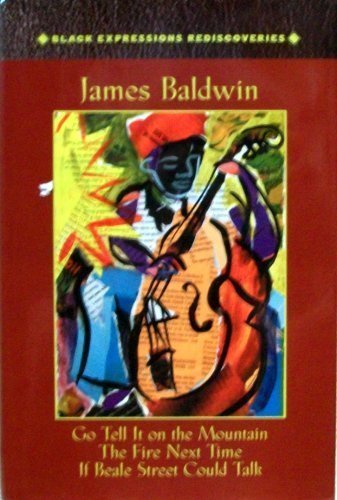
I recently finished James Baldwin’s The Fire Next Time, which is a strange bird in form as it consists of two essays that are pretty different: a short personal letter to his 14 yr-old namesake nephew, and a much longer autobiographical, contemplative ramble, a sort of musing, largely about religion. My book’s dust cover says it “caused a great stir upon publication in 1963 and landed its author on the cover of Time [magazine]” – while he was on a Civil Rights speaking tour of the US south. (He lived mostly in France beginning in 1948 at age 24.) In 1963 Baldwin was an established author, an “accepted” spokesman for the Black experience. His call in these two essays for integration & reconciliation during the outbreak of angry & nationalist activism is the likely source of that “great stir.” Indeed, the great value in reading these today is in appreciating the issues of that pivotal time in our history.

The short piece has a long title: “My Dungeon Shook: Letter to My Nephew on the 100th Anniversary of Emancipation.” This is the one recently associated with the book title, compared to numerous other public letters by Black authors to the next generation. (This is a comparison where context is again important, as we are challenged to appreciate the Black Lives Matter movement as it matures.)

Baldwin describes his great-grandfather’s “terrible life; he was defeated long before he died because, at the bottom of his heart, he really believed what white people said about him.” This begins a two track theme: an unbridled (almost bitter?) depiction of the oppression & tragedy of racism, with also a sober appreciation of the need for reconciliation & even love. On the former: “You were born into a society which spelled out with brutal clarity, and in as many ways as possible, that you were a worthless human being.” Yet, after more of such clarity, he says, “The really terrible thing, old buddy, is that you must accept them… and accept them with love.” In spite of all, he advocates for integration, “this is what it means: that we, with love, shall force our brothers to see themselves as they are, to cease fleeing from reality and begin to change it.”

With this in mind, he closes by reminding young James that he is prepared for the future: “you come from sturdy, peasant stock… [who] in the teeth of the most terrifying odds, achieved an unassailable & monumental dignity. You come from a long line of great poets, some of the greatest poets since Homer. One of them said, The very time I thought I was lost, My dungeon shook and my chains fell off.” This of course ties us back to the essay title; but oh, there is much more.

The words Baldwin quotes in italics are from a traditional spiritual. In fact, in his “I Have a Dream” speech, when MLK Jr. says “in the words of the old Negro spiritual…” he is referencing the same source, a spiritual now generally known under the title “Free at Last!” but also appearing under different titles and with varying lyrics. Here is the pertinent section of an “accepted” version that agrees with Baldwin’s quotation:

Free at last, free at last,
Thank God Almighty, I’m free at last.
The very time I thought I was lost,
Thank God Almighty, I’m free at last;
My dungeon shook and my chains fell off,
Thank God Almighty, I’m free at last,
This is religion, I do know,
Thank God Almighty, I’m free at last;
For I never felt such a love before,
Thank God Almighty, I’m free at last.

Further, MLK delivered his speech on Aug 28, 1963; Baldwin’s essays were published in book form in 1963 but had earlier been published in The New Yorker in 1962. Did MLK have occasion to read Baldwin during those turbulent months? Though I find no record in a quick search, it is quite likely; they ended close friends and Baldwin was widely read in the movement. In any event, I am quite satisfied & comforted just thinking in terms of “like minds.” And this is not the last time Baldwin invokes religious and musical references, both an essential part of the Civil Rights movement.

The second & longer (~90 page) essay is the autobiographical “Down at the Cross: Letter from a Region in My Mind,” the main title taken from a hymn quoted after the title page. It begins with the author at age 14 (same as nephew James, above) and describes how his abusive stepfather drives him to join a Pentecostal church, where he is successful as a preacher. In long and rambling paragraphs, suitable for exploring those “regions in his mind,” he relates his mixed experience with religion – and racism – up through adulthood, concluding, “the Christian world has revealed itself as morally bankrupt and politically unstable.”

His narrative path arrives at his moment of writing as he tells of his recent audience with Elijah Muhammad, which opens a lengthy account of his perspective on the Nation of Islam and racism as seeks a path to reconciliation, consistent with the first essay. As he does for young James, here again he closes with a measure of hope and a call for action, as he considers the prospect for continued racial strife: “at the center of this dreadful storm, this vast confusion, stand the black people of this nation, who must now share the fate of a nation that has never accepted them, to which they were brought in chains. Well if this is so, then one has no choice but to do all in one’s power to change that fate… I know that what I am asking is impossible. But in our time, as in every time, the impossible is the least that one can demand.”

His final line provides a caution for those who hesitate at key moments in history, and the title for the book, as he quotes a spiritual, a “slave song” called “O Mary Don’t You Weep”: “If we do not now dare everything, the fulfillment of that prophecy, re-created from the Bible in the song by a slave, is upon us: God gave Noah the rainbow sign, No more water, the fire next time!

movie: Walking Tall (1973)

walking tallIn this movie, Buford Pusser returns home, after a stint in the Marines and a career as a wrestler, to McNairy County, Tennessee with his wife and two children. The town has changed since he’s been away. Almost immediately, he gets beaten nearly to death at a bar where he busted the house cheating at craps. The sheriff wants nothing to do with the case, and tells him to drop it. Buford returns to the juke joint to beat the crap out of his attackers in turn; represents himself at trial for assault charges, and wins; and then goes on to run for sheriff, and win.

As the spunky new sheriff, Buford is determined to run the gambling, prostitution and illegal stills out of his home county. Corruption runs so high, however, that he is nearly a one-man crusade. He has a staff of deputies, a few of whom are loyal. But it’s uphill work.

This plot is based on a true story, and here I’ll confess that my interest is not in this movie in its own right. Instead, I am fascinated by the larger debate this movie is a part of: the legend and history of Sheriff Buford Pusser, in its various representations. I first heard of Pusser and Walking Tall in a couple of Drive-by Truckers songs. (Regular readers may recall this is my favorite band.) In “The Buford Stick,” I heard the perspective that Buford Pusser was a crooked sheriff and a bully, messing around with a system that had worked just fine before he came along, thank you. Or, from the lead-in to “The Boys From Alabama”:

We’re gonna take you up to McNairy County, Tennessee
Back in the days when Sheriff Buford Pusser ran things around there
Sheriff Buford Pusser was tryin’ to clean up McNairy County, Tennessee
From all them boot leggers that was bringin’ crime and corruption
And illegal liquor into his little dry county
And for his troubles he got ambushed, and his wife was murdered, and his house got blown up
And they made a movie about it called “Walkin’ Tall”
This is the other side of that story

And that’s what I knew about the movie.

One of the many things I love about the Truckers is that they are unafraid to look at the complexity of the real world, its ugliness, and they don’t turn to the easy out of choosing sides: they are neither consistently pro-establishment nor anti-authority, because it’s not that clear-cut, is it. In the case of Sheriff Buford Pusser, with these two songs, they experiment with the perspective of McNairy County’s criminal element – or, to put it another way, “a hardworking man with a family to feed.” In other songs and other cases drawn from real life, the Truckers continue to question corruption in positions of authority.

The movie shows Pusser in an on-balance-positive light; among other things, he pushes (not always gracefully) for civil rights for the black residents of McNairy County. But even in this portrayal, there are disturbing glimpses: he is not a fan of rights for the (alleged!) criminals he pursues, and I didn’t enjoy the scene when he is arresting a prostitute and slaps her ass. This history, like so many in life, was probably pretty complicated, with good guys and bad guys on both side of the law – or, good and bad within each guy.

I love this stuff: layers, ambiguity, and especially the intersection of art (movies, songs) and deeply serious real life. This is probably a great example of the interdisciplinary nature of life. (Even a teaching opportunity!) Literature and other creative, fictional forms comment on life, which responds to literature.

So I found the viewing experience engrossing, for reasons outside the movie itself. The movie itself is fine, and interesting; it certainly paints a picture of a time and place. And I think even without a backstory that it should provoke some consideration: like, just how “good” are the good guys? A social study, to be sure. I’d recommend this for any number of audiences.


Rating: 8 routine matters.

The Art of History: Unlocking the Past in Fiction & Nonfiction by Christopher Bram

A succinct survey of history in both fiction and nonfiction offers advice for writers and readers.

the art of history

Christopher Bram takes on the broad subject of what history has to offer literature–and vice versa–with The Art of History: Unlocking the Past in Fiction & Nonfiction.

Beginning with memories of a high school English teacher, Bram celebrates the interest and value of reading and writing history. His thesis is that history need not be written in dry, textbook form: in both fiction and nonfiction, a talent for storytelling and a keen eye for just the right details, in the right quantity, can render the near and distant past in enthralling fashion. “Details,” he says, “are the raisins in the raisin bread.” He examines works including Gabriel García Márquez’s Love in the Time of Cholera, David McCullough’s The Path Between the Seas and Leo Tolstoy’s War and Peace, and topics ranging through war, slavery in the United States, comedic perspectives and the blending of lines between fiction and nonfiction. An author in both disciplines, Bram does not claim objectivity: he is clear about his love for Toni Morrison’s Beloved and his disregard for Hilary Mantel’s Wolf Hall, among others.

Books in “The Art of” series inspect craft from a perspective seemingly for writers and critics, and Bram offers good advice: “In both fiction and nonfiction, writing well means knowing what to leave out.” But The Art of History works for readers as well, as in an appendix of Bram’s recommended reading. Exploration, appreciation and instruction combine in this slim, accessible study of literary history and historical literature.


This review originally ran in the July 5, 2016 issue of Shelf Awareness for Readers. To subscribe, click here, and you’ll receive two issues per week of book reviews and other bookish news.


Rating: 6 details.

Everybody Behaves Badly: The True Story Behind Hemingway’s Masterpiece The Sun Also Rises by Lesley M. M. Blume

This study of the creation of The Sun Also Rises illuminates both the compelling story and Hemingway’s complex and not entirely likable personality and behavior.

everybody behaves badly

Many books have been written about Hemingway, but it seems there is still more to be learned. Lesley M.M. Blume’s Everybody Behaves Badly zooms in on the creation of The Sun Also Rises, Hemingway’s first novel and the one that firmly established his reputations, literary and otherwise. As her subtitle promises, Blume seeks the true story: in this case, the real men and women whose lives inspired Hemingway’s fiction, which some claimed was not really fiction at all.

Everybody Behaves Badly is not a biography of Hemingway; it skips his childhood to open with his marriage to Hadley Richardson, and the couple’s move to Paris in pursuit of cheap living and a storied expat community. Blume portrays a devilishly charismatic young writer, ambitious and confident, who easily collected mentors and admirers. She follows that young writer to Pamplona with a group of friends in 1925, and through the weeks after in which he wrote feverishly. Unflatteringly immortalized, one of the people Hemingway transformed into a character spoke of lives divided into B.S. and A.S.: before Sun, and after. Blume’s study concludes as Hemingway’s career expands, his first marriage ends and his second begins.

A biography of a novel, then, Everybody Behaves Badly is itself an engrossing and varied tale: raucous and dissipated, pitiable and serious. Blume’s research offers new detail to a well-studied story, and her narrative style is as entertaining as the original. Obviously required for Hemingway fans, this engaging work of nonfiction will also please a broad audience.


This review originally ran in the June 7, 2016 issue of Shelf Awareness for Readers. To subscribe, click here, and you’ll receive two issues per week of book reviews and other bookish news.


Rating: 8 slight changes.

Coyote America: A Natural and Supernatural History by Dan Flores

This biography of the coyote in biological, political and historical terms illuminates a much-maligned North American original.

coyote america

Dan Flores (The Natural West) examines an iconic North American original in Coyote America: A Natural and Supernatural History. This small, clever, charismatic predator originally roamed the interior West, enjoying a mutual tolerance with the people who lived there. Some Native American tribes built creation myths around the coyote, “America’s universal deity.” After European colonization, coyotes became the enemy of ranchers and herders–undeservedly, as scientists would eventually show, as their prey is more bite-sized. Decades of extermination efforts only encouraged the diminutive canine, however, whose range now extends from Alaska and Canada into Central America, from coast to coast. Coyotes now live in every major city in the United States, which surprises many but, Flores argues, shouldn’t: they were there first.

Styled as a biography, Coyote America follows its protagonist through history, geography, human perceptions and millions of years of American canid evolution, with detailed accounts of governmental policies regarding predators. Flores sees the coyote as an avatar for humankind. Like us, the coyote is highly flexible, can be social or solitary, and adapts well to changing environments. Coyote mythology, well documented in other books, plays a minor role here, although Wile E. makes an appearance.

Flores has a tendency to use nine words where two would do, but his slight long-windedness is well offset by the endless fascinations of his subject. Nature lovers, students of U.S. natural resource policy and those charmed by the native American “song-dog” will be engrossed.


This review originally ran in the June 7, 2016 issue of Shelf Awareness for Readers. To subscribe, click here, and you’ll receive two issues per week of book reviews and other bookish news.


Rating: 7 words.

Joe Gould’s Teeth by Jill Lepore

This story of a missing manuscript and its darkly unhinged author has momentum and beauty.

joe gould's teeth

Joe Gould is best known through two profile pieces Joseph Mitchell wrote for the New Yorker. In 1942, Mitchell introduced a harmless eccentric engrossed in writing “The Oral History of Our Time”–at some nine million words, supposedly the longest unpublished work in history. In the second piece, in 1964, Gould (then deceased) is a dirty, sinister man, and Mitchell asserts that there had never been any such manuscript. Jill Lepore (a staff writer at the New Yorker and author of numerous works of nonfiction), like so many before her, was intrigued. Was there an oral history, or wasn’t there? Who was Gould, really?

Joe Gould’s Teeth is a biography of Gould, a study of the record he left behind and the story of Lepore’s search. Gould was a graphomaniac; his written legacy includes letters, diaries, essays, ramblings but rather little oral history. Lepore seeks the mythical manuscript, but finds the mystery of a man. She describes herself as stumbling, falling into the “chasm” of Gould, who claimed to be “left-handed in both hands” and whose thinking was “sticky” with details. She follows him through archives and memories, and into his obsession with African-American sculptor Augusta Savage. Savage, as a secondary character, is more sympathetic (and sane), and possibly more enigmatic than Gould.

Lepore’s contribution to this undeniably riveting story lies in her research, but even more in her wise, nuanced telling. Joe Gould was a genius, a madman, destitute, beloved of e.e. cummings and Ezra Pound, by turns likable and malicious. Joe Gould’s Teeth is an astonishing, wide-ranging and thoroughly enthralling work of history.


This review originally ran in the May 31, 2016 issue of Shelf Awareness for Readers. To subscribe, click here, and you’ll receive two issues per week of book reviews and other bookish news.


Rating: 9 notebooks.

Who Shot Sports: A Photographic History, 1843 to the Present by Gail Buckland

Disclosure: I read an uncorrected advance proof sent to me as a review copy.

who shot sportsI’m sorry not to love this book. I love the concept: a coffee-table style art book of sports photography, beginning with the first known “sports photograph” in 1843 (a portrait of an unknown tennis player), and including nearly 300 images. In the final publication, 120 of these photographs will be printed in color. My galley copy has just a few pages of full color, but I can tell the end result will be visually impressive.
The pictures are great. And the history is fairly well done: there is some discussion of technological advances (geared toward the layperson, not the professional photographer), and trends and values. The text itself, however, is very uneven. It started to bother me at about halfway through, as it began to repeat itself: in particular, Dr. Harold Edgerton’s feat in pioneering stroboscopic photography is noted over and over again, at different points in the book but also repeatedly on the same page. Who Shot Sports is organized thematically, with chapters like “Fans and Followers” and “Vantage Point”; within these chapters are photos that fit into that theme, from different eras. The surrounding text profiles the photographers rather than the athletes, and one of the express goals of the book is to highlight those often still unknown men and women (but mostly they are men, even now). These bios vary widely in length and quality, and often feel more like lists of facts than composed or relevant narratives.

But the line that stopped me and wouldn’t let me go was, “Banning African Americans, who were such talented athletes, was especially cruel and malicious.”

This is a racial stereotype that has not served African Americans well historically, and anytime we assume something to be true of an entire population, we look silly and find ourselves in some cases wrong. I read another 20-30 pages past this point, but couldn’t move on in my mind.

I will point out again that I read an uncorrected proof, meaning that this book is likely to see another round of editing before publication. They may catch this line in time. But they also sent this copy out for review, and should expect to be held accountable for its contents. Typos and formatting problems are common issues with galleys; images may be missing or shown in poor resolution, with the understanding that the finished copy will include the real thing. But tone-deaf racial profiling I can’t help but note.

This will clearly be a beautiful volume of photography. I think the text might be worth, at best, skimming. Unless of course you are as bothered by that one line as I was.


Rating: 9 light sources for photos, 3 for text. Draw your own conclusions (always).

Journey to Texas, 1833 by Detlef Dunt, trans. by Anders Saustrup, ed. by James C. Kearney & Geir Bentzen

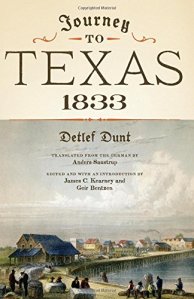
Detlef Thomas Friedrich Jordt was born in the Holstein region of Germany in 1793, and in 1833 immigrated to Texas. He was motivated by a letter from an earlier immigrant, Friedrich Ernst. Although the two were not acquainted, the letter had circulated widely in the region, with an explicit message: that others should join Ernst in a land of promise and opportunity. Jordt’s own experience led him to publish in 1834 a book titled Reise nach Texas, under the pseudonym Detlef Dunt. The first English translation of this travelogue/travel guide was published in 2015 as Journey to Texas, 1833.

This is a varied and informative compilation, including not only Jordt’s original text but significant supplementary material. A translation of Reise nach Texas was found among the papers of the late Anders Saustrup, a recognized scholar of German immigration to Texas. James C. Kearney and Geir Bentzen then took on the project. Their introduction covers Jordt’s family history; the social, political and economic circumstances in Germany that pushed so many to emigrate; the significance of the Ernst letter; and commentary on Jordt’s writing. The translation of Reise nach Texas makes up a little more than half of the volume…

This is just a stub: my full review of Journey to Texas was published in the Spring 2016 issue of Concho River Review. You can subscribe or purchase a single issue by clicking that link.

I’d just like to add that this was an extra fun read for me personally, because I know quite well the area that’s covered in these pages. For many years my parents owned a ranch just a few miles from where Dunt/Jordt is believed to be buried. It felt a little like coming home.


Rating: 6 small towns I used to ride my bike through.

book beginnings on Friday: Everybody Behaves Badly: The True Story Behind Hemingway’s Masterpiece The Sun Also Rises by Lesley M. M. Blume

book beginnings

Thanks to Rose City Reader for hosting this meme. To participate, share the first line or two of the book you are currently reading and, if you feel so moved, let us know what your first impressions were based on that first line.

Guess what brought me to this one. It’s been a while since I read The Sun Also Rises (first discovered in Mrs. Smith’s English class in high school, which began my Hemingway admiration). I wonder if I’ll find time for a reread…

everybody behaves badly

I think these opening lines set the scene nicely – or the atmosphere of Hemingway’s life and fame, if you will.

In March 1934, Vanity Fair ran a mischievous editorial: a page of Ernest Hemingway paper dolls, featuring cutouts of various famous Hemingway personas. On display: Hemingway as a toreador, clinging to a severed bull’s head; Hemingway as a brooding, café-dwelling writer (four wine bottles adorn his table, and a waiter is seen toting three more in his direction); Hemingway as a bloodied war veteran.

I wonder how much that page of paper dolls would be worth now!

This quotation comes from an uncorrected advance proof and is subject to change.

Teaser Tuesdays: Coyote America: A Natural & Supernatural History by Dan Flores

Teaser Tuesdays is a weekly bookish meme, hosted by MizB of Books and a Beat.

Teaser

Coyotes seem to make consistently interesting reading – for me at least – whether Native American mythology or the natural history that is handled here.

coyote america

I thought I’d share one of the fascinating tidbits I learned. Coyotes interbreed quite avidly with red wolves in the southern U.S.; not so the gray wolves of the West.

Mech also points out that killing coyotes, not mating with them, is intrinsic to gray wolf behavior. Julie Young of the Predator Research Facility even told me that in experiments there, coyotes inseminated with gray wolf sperm actually killed the puppies they bore.

They are quite clear on their preferences, it seems. That makes sense to me, considering the Trickster Coyote I knew as a child from books like Coyote &. Stay tuned…

This quotation comes from an uncorrected advance proof and is subject to change.