Medal of Honor: Portraits of Valor Beyond the Call of Duty

A respectful and compelling salute to Medal of Honor winners through brief profiles and striking portraits.

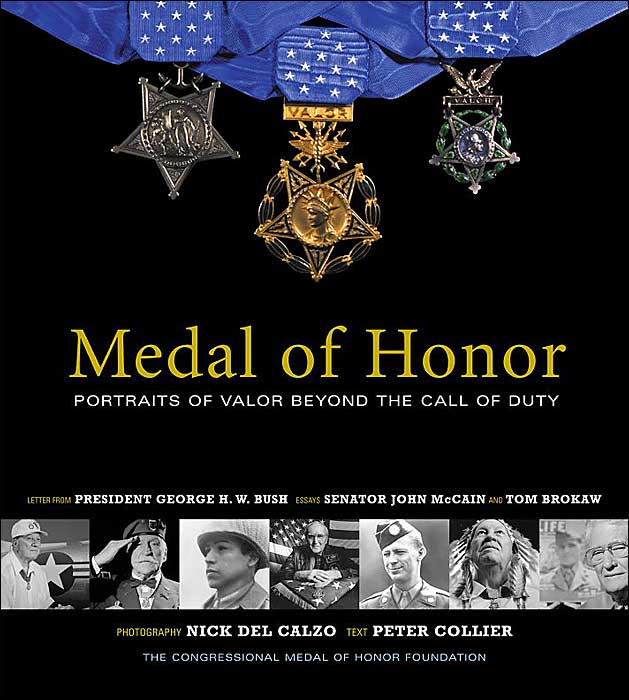
Medal of Honor begins with a thoughtful, detailed yet succinct history of the Congressional Medal of Honor, providing an excellent introduction to the subject; later chapters include letters from every living U.S. president and short essays on wars from World War II through Afghanistan. But Peter Collier’s real achievement lies in the 144 profiles of Medal of Honor recipients, representing every branch of the military, accompanied by Nick Del Calzo’s stunningly beautiful photographic portraits. Collier’s profiles tell of the circumstances leading to each citation, along with details of the recipients’ lives that illuminate themes of humility, friendship and service. With one page devoted to each, Medal of Honor makes for easy coffee-table reading, and it’s tempting to read them all in one sitting. This incredibly touching commemoration transcends politics to celebrate the contributions of brave, and selfless individuals in simple, glowing stories.


This review originally ran in the December 6, 2011 issue of Shelf Awareness for Readers. To subscribe, click here, and you’ll receive two issues per week of book reviews and other bookish fun!

The Autobiography of Benjamin Franklin

I have heard that this was an important, well-written and interesting autobiography. I don’t recall where I heard it, but I made a note and it stuck in my head. So I found the audiobook and gave it a try.

What I learned was a more detailed version of what I knew: Benjamin Franklin was an interesting, hard-working, thoughtful man who helped shape our nation’s history. He was an indentured servant, a runaway, a businessman, an entrepreneur, a diplomat, a politician, an inventor, an author, a militiaman, a scholar and a philosopher, and a father. He invented many items, large and small, that improved the everyday life of people in his time, showing an intelligence and curiosity about how things work that I admire. He was also instrumental in beginning both a school (which became both the University of Pennsylvania, and a free school for poor kids) and a public hospital in his adopted hometown of Philadelphia. He did a lot of good things and had some interesting ideas. He was a moralist, and wrote tracts in which he espoused a “right way” of living.

The style of his autobiography is unfortunately stiff and pompous, though. I think that perhaps the narration of my Mission Audio edition didn’t help. The language in which this book was written is necessarily dated and sounds odd to the modern ear; but if today’s actors can make Shakespeare palatable, for gosh sake, you’d think they could have found a narrator who would bring Franklin to life, too. Instead they went with a sort of whuffling, sedate, staid voice that emphasized not this senior statesman’s timeless wisdom and accessibility – which I think might be there, hidden in the text – but the distance from which he speaks. The long pauses and bombastic tone went a long way towards ruining this experience for me.

I didn’t enjoy this autobiography at all, which was a disappointment. Actually I’m not quite sure why I finished it (Husband asked, and I couldn’t answer); maybe I had that much faith in the long-lost recommendation, or maybe I was just mesmerized by the monotonous narration… I didn’t even get the consolation of learning new bits about Franklin. I came away with the same vague notion of who he was and what his legacy was that I’d started with. For educational purposes, I actually got more out of the “timeline of his life” appended at the end than I did out of the bulk of the book. I feel that the autobiography itself was probably flawed, in that it leans towards anecdotes of little consequence, moralizing, and self-congratulations. But the narration was the final straw. Unfortunately I cannot recommend this book; and if you do decide to seek it out (in which case, let me know if it goes any better for you!), for the love of Dog, avoid the Mission Audio version.

Teaser Tuesdays: The Autobiography of Benjamin Franklin

Teaser Tuesdays is a weekly bookish meme, hosted by MizB of Should Be Reading. Anyone can play along! Just open your current read to a random page and share a few sentences. Be careful not to include spoilers!


I’ve chosen you a teaser today from Benjamin Franklin’s Autobiography, which I’ve heard repeatedly is worth reading.

I disliked the trade [his father’s, of being a tallow-chandler or candle-maker], and had a strong inclination for the sea, but my father declared against it; however, living near the water, I was much in and about it, learnt early to swim well, and to manage boats; and when in a boat or canoe with other boys, I was commonly allowed to govern, especially in any case of difficulty; and upon other occasions I was generally a leader among the boys, and sometimes led them into scrapes, of which I will mention one instance, as it shows an early projecting public spirit, tho’ not then justly conducted.

He then goes on to explain that, needing a wharf to fish off of to keep their feet out of the mud, he and the other local boys – at his urging – purloined some building supplies from a nearby construction site and built themselves a stone wharf. They do get caught.

Into the Silence by Wade Davis

An epic history of adventure and adversity, of one man and a nation’s quest for redemption.

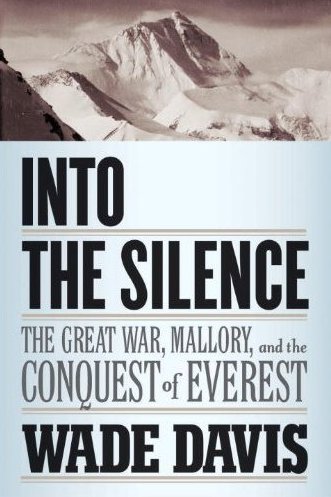
In Into the Silence, Wade Davis (The Wayfinders, The Serpent and the Rainbow) portrays several attempts to climb Mount Everest during the 1920s within the context of the state of the British Empire after the First World War. With the benefit of new access to primary sources, he begins with visceral descriptions of the Great War in all its horrifying violence, as seen through the eyes of several players in the later Everest drama, and then follows these men through the postwar numbness of a Britain that had lost the bulk of a generation. Davis makes a convincing argument that the assault on Everest was “the ultimate gesture of imperial redemption.”

George Mallory was the star of three successive attempts to summit a mountain that was at the time a complete mystery–its weather patterns and geography entirely unknown, the cultures that surrounded it viewed by the British with a misguided paternalism. Along with a host of fellow climbers, adventurers and scientists, Mallory was driven toward an accomplishment that the nation came to grasp as an outlet for its frustrations and a hopeful liberating triumph. While he was the principal character in the eyes of his contemporaries and in history, the other explorers also receive well-deserved and detailed attention in Davis’s account.

Into the Silence is a book about mountaineering and a respectable adventure epic with all the alpinist details, but it’s also so much more: a heartbreaking portrayal of war; the story of more than a dozen individuals whose lives were rocked by a war and a mountain; and finally, a history of a nation watching its own imperial era come to an end.


This review originally ran in the November 4, 2011 issue of Shelf Awareness for Readers. To subscribe, click here, and you’ll receive two issues per week of book reviews and other bookish fun!

Teaser Tuesdays: Inferno: The World at War, 1939-1945 by Max Hastings

Teaser Tuesdays is a weekly bookish meme, hosted by MizB of Should Be Reading. Anyone can play along! Just open your current read to a random page and share a few sentences. Be careful not to include spoilers!

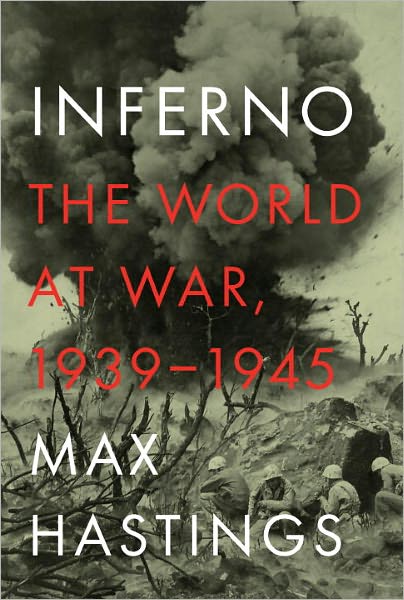
For our teaser today, from this chunky nonfiction volume of WWII, I give you the beginning of chapter 8, from page 178:

The people of the United States observed the first twenty-seven months of the struggle in Europe with mingled fascination, horror and disdain. The chief character in J.P. Marquand’s contemporary novel So Little Time says: “You could get away from the war for a little while, but not for long, because it was everywhere, even in the sunlight. It lay behind everything you said or did. You could taste it in your food, you could hear it in music.”

Perhaps not a cheerful book. But rich with history! Do you like to read books about war?

This quotation comes from an uncorrected advance proof and is subject to change.

Newspaper Titan: The Infamous Life and Monumental Times of Cissy Patterson by Amanda Smith

The exhaustive–but not exhausting–biography of a complicated and difficult woman, heiress to a newspaper dynasty and a fascinating and controversial figure.

Amanda Smith’s (Hostage to Fortune: The Letters of Joseph P. Kennedy) exhaustively researched biography of Cissy Patterson begins several decades before her birth, with her grandfather Joseph Medill and his creation of the Chicago Tribune. The extended family of Medills, Pattersons and McCormicks would be newspaper royalty for several generations; but perhaps none cut a stranger figure than Cissy.

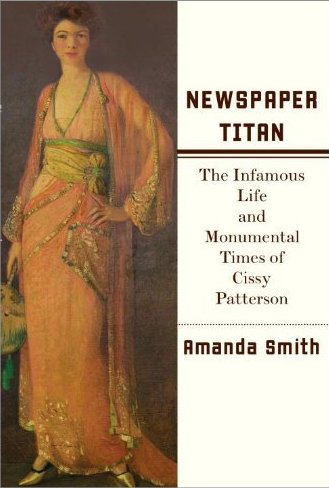
Eleanor Medill Patterson, known as Cissy, led was born in 1881 into a fractious, influential newspaper family and married a dissolute Polish count who turned out to be broke and who kidnapped their daughter, Felicia. With great effort and the interventions of powerful political figures from around the world, she regained her daughter and divorced. The countess then had a series of unsatisfying relationships and grew estranged from Felicia; published two acclaimed novels; and married a Jewish man despite her apparent anti-Semitism and eventual sympathy with the Nazi cause in World War II. Late in life, she began a newspaper career as journalist, editor and, finally, publisher and owner of the enormously successful Washington (D.C.) Times-Herald, which she created out of two failing papers. When she died in 1948, alcoholic, vindictive and erratic Cissy left a fortune, including ownership of the Times-Herald, whose disposition was held up by court battles sparked by conflicting wills and accusations of her insanity.

Called “perhaps the most powerful” and the “most hated” woman in America in the 1940s, Cissy’s fascinating and curious life is examined here in detail. But this lengthy book is never boring, because its subject is such an outrageously flamboyant and historically significant figure.


This review originally ran in the September 20, 2011 issue of Shelf Awareness for Readers. To subscribe, click here, and you’ll receive two issues per week of book reviews and other bookish fun!

book beginnings on Friday: Into the Silence by Wade Davis


Thanks to Katy at A Few More Pages for hosting this meme. To participate, share the first line or two of the book you are currently reading and, if you feel so moved, let us know what your first impressions were based on that first line.

Into the Silence: The Great War, Mallory, and the Conquest of Everest appears to be a largeish, well-researched, exhaustive coverage of its three overlapping subjects. I’m just a bit into it but am finding it to be gripping, and painful in its discussions of the tragedy that was WWI. You know, I feel like we say this about just about all the wars (and rightfully), but what an awful thing it was…

I am going to give you a double beginning today. The prologue:

On the morning of June 6, 1924, at a camp perched at 23,000 feet on an ice ledge high above the East Rongbuk Glacier and just below the lip of Everest’s North Col, expedition leader Lieutenant Colonel Edward Norton said farewell to two men about the make a final desperate attempt for the summit. At thirty-seven, George Leigh Mallory was Britain’s most illustrious climber.

And chapter one:

On the very day that George Mallory and Sandy Irvine disappeared on Everest, another party of British climbers slowly made their way to the summit of a quite different mountain and in very different circumstances. At 2,949 feet, Great Gable was not a serious or difficult climb, but it was said to be “the most completely beautiful of English mountains.”

So you can see the juxtaposition set up. I find this to be an effective way of linking his topics (see the subtitle) right from the start.

A word on nonfiction book beginnings: Unlike in fiction, where I feel the first lines should always grab or surprise the reader and interest her, I think nonfiction can take one of two routes. I do like to be grabbed in the first lines, of course, and extra points are given for this. But it’s extra credit, not required work. Sometimes nonfiction begins quietly, stating a date, a place, arranging a background, and this I find effective, too. Somehow, with nonfiction, I’m comfortable settling into things with this understated approach, which I think the above falls into.

What are your thoughts? And what are you reading this weekend?

These quotations come from an uncorrected advance proof and are subject to change.

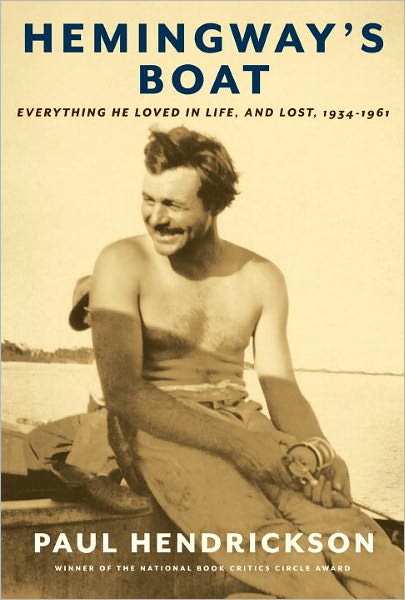
Teaser Tuesdays: Hemingway’s Boat: Everything He Loved in Life, and Lost, 1934-1961 by Paul Hendrickson

Teaser Tuesdays is a weekly bookish meme, hosted by MizB of Should Be Reading. Anyone can play along! Just open your current read to a random page and share a few sentences. Be careful not to include spoilers!

Ohhh you guys, I almost tear up just thinking about this guy. I’m a big fan of Hemingway’s work, and an amateur scholar of his life; he was such a fascinating, complex, difficult, sad man. I adore him and I love to read what he wrote, and what others have written about him. And Hendrickson is doing it for me! This is a great book, aside from my personal obsession with the subject. More to come (I’ve gushed too much already). Now for your teaser, from page 287 of my galley copy.

To me, the mentions suggest that even or especially up in Michigan, even for an exuberant boy who’s not yet seventeen, getting your sleep is crucial, and not only for physical reasons. Without it, darkness is already visible, if just barely.

I like how he evokes the darkness here. As Hendrickson notes (and every Hem scholar knows!), not only Ernest himself would die by suicide, but also his father, two (or maybe three) of his siblings, and his granddaughter.

This quotation comes from an uncorrected advance proof and is subject to change.

Teaser Tuesdays: Newspaper Titan by Amanda Smith


Teaser Tuesdays is a weekly bookish meme, hosted by MizB of Should Be Reading. Anyone can play along! Just open your current read to a random page and share a few sentences. Be careful not to include spoilers!


Newpaper Titan: The Infamous Life and Monumental Times of Cissy Patterson is a hefty biography of the heiress to the Chicago Tribune dynasty, and formidable newspaperwoman in her own right. Smith covers the family history beginning well before Cissy’s birth in 1881, through her death in 1948. I’m just beginning the book, and actually had never heard of Cissy before, but so far she is proving to be a most interesting subject – meaning, as is usually the case with the most interesting subjects, that she is a controversial and difficult-to-like figure. My teaser comes from page 347:

Although Cissy was the first and only woman editor of any newspaper in the Hearst chain, she was by no means the Chief’s sole female employee. The son of a formidable mother, William Randolph Hearst himself did not share the low estimate of feminine competence that his Washington Herald staff had betrayed when Cissy invaded their city room.

This quotation comes from an uncorrected advance proof and is subject to change.

The Devil in the White City by Erik Larson

THIS is how I like my nonfiction! See, Castaneda? Like this! I can’t exactly explain the difference. There’s just something very narrative, conversational, interesting about this. Similarly, Dethroning the King, Janet Malcolm, Annie Londonderry, etc. It’s not sensationalist; it’s just exciting. Written like a thriller or like a work of fiction, but no less serious a work of nonfiction for it. How to explain? Let me quote a very average paragraph for you, from page 27:

Each man recognized and respected the other’s skills. The resultant harmony was reflected in the operation of their office, which, according to one historian, functioned with the mechanical precision of a “slaughterhouse,” an apt allusion, given Burnham’s close professional and personal association with the stockyards. But Burham also created an office culture that anticipated that of businesses that would not appear for another century. He installed a gym. During lunch hour employees played handball. Burnham gave fencing lessons. Root played impromptu recitals on a rented piano. “The office was full of a rush of work,” Starrett said, “but the spirit of the place was delightfully free and easy and human in comparison with other offices I had worked in.”

See, that second sentence is long and convoluted and uses biggish words, but it flows and communicates; it doesn’t impede communication, and what it certainly doesn’t do is brag.

All right, rant aside, this is an excellent book! I started it Friday night and finished it Sunday afternoon. Not to repeat the back-of-the-book blurbs, but this work of nonfiction absolutely reads like a thriller; it’s difficult to put down. Very enjoyable. After years (literally) on my TBR shelves, I picked it up because I had such a groove going, after Annie Londonderry and Clara and Mr. Tiffany, two books set in the same era with overlapping locations – Annie in New York, Boston, and Chicago as well as all around the world, and Clara in New York, with the Chicago World Fair playing a role as well. I enjoyed both of these books so much, and especially the extra immersion in time-and-place I got by reading them back-to-back, that I wanted to go straight into The Devil and the White City next. And I’m so glad I did.

The story is this: Daniel H. Burnham, along with a huge cast of other talents and characters and against all odds, pulled together the World’s Columbian Exposition of 1893, better known to us as the Chicago World Fair. Concurrently, a man named Herman Webster Mudgett but known by his most-used alias, Dr. H.H. Holmes, murdered an unknown number of people, at least 27 but estimated as high as 200, in Chicago on the very edge of the fair grounds. Larson tells the story of the fair, of the serial murders, and of a larger time-and-place from the points of view of these two men, mostly, with side journeys into several other lives.

The World’s Fair is a character unto itself, as is the city of Chicago. Larson gives us the styles and morals of the time, and helps us to understand how it was that dozens of people, mostly young women experiencing a freedom unknown to their parents’ generation, could disappear into Holmes’ grasp. We see the wonder and beauty and ambition and angst of those who worked to produce the landmark event that was the White City, as the fair was known. We see the everyday struggles that allowed Holmes to methodically go about his evil pleasures.

Larson walks a fine line in trying to enter the heads of historical figures, especially the elusive Holmes, and still call his book nonfiction; but he’s got me convinced. He points out that everything in quotation marks is attributable, and defends the two murder scenes he chooses to portray with the evidence available to him in his research. In fact, as an aside, I enjoyed his “Notes and Sources,” and the brief story of his research there. He even mentions, in some cases, in which library or rare book room he found a particular elusive source. Further, also from Notes and Sources, page 395-6:

I do not employ researchers, nor did I conduct any primary research using the Internet. I need physical contact with my sources, and there’s only one way to get it. To me every trip to a library or archive is like a small detective story.

I know all of us booklovers (and librarians) enjoy that.

This is an engaging, riveting read. The historical value is vast. I’m always amazed by how the pieces of our history fit together. Am I the only one? I feel like there are so many names, personalities, and events in our history, but we learn them as individual bits; it’s always a little thrill when they come together in ways I don’t expect. For example, reading that Elias Disney worked as a carpenter and furniture-maker in the building of the fair, and went home to tell his sons, including little Walt, stories of the “magical realm beside the lake.” Isn’t that a charming little anecdote? Several of these connections are left in suspense, too; if your history is a bit weak in the right places, as mine was, you get these happy little surprises. I like that.

I found this book captivating, and I recommend it as a pleasurable read that may sneak some learning in on you. I invite readers of thrillers and evocative nonfiction to enter this fantastic, glittering, magical, and deadly – and true – world.