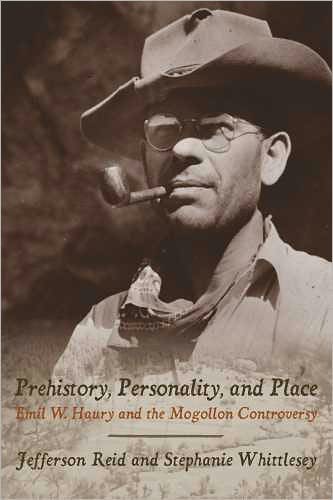
Prehistory, Personality, and Place by Jefferson Reid and Stephanie Whittlesey

I picked this book up on a recent trip to the Gila National Forest in New Mexico. We stopped by the visitor’s center for the Gila Cliff Dwellings, and it just caught my eye; what can I say? I think it was the subtitle, Emil W. Haury and the Mogollon Controversy. I casually find archaeology as intriguing as the next person does, although it’s never been a serious interest; but the idea (as expressed on the back cover) of a controversy over whether a people deserve to be recognized as unto themselves, with their own accomplishments and culture, definitely appealed to me.

First of all, I appreciated the Preface, wherein the authors explain their personal connection to Haury (a teacher and mentor), their interest in the Mongollon question, and what they intend with this book. This is not to be a biography of Haury, but his story coincides heavily with the one they will be telling. I like to hear from authors (of nonfiction, anyway) what they’re up to like this.

Reid & Whittlesey do a fine job of completing their stated task. After reading this short (~150 pages) but dense book, I feel fairly well-versed (you know, for an amateur) in the Mogollon controversy and the players involved. In a nutshell, Emil Haury was a young and gifted archeologist who, in the 1930’s, discovered artifacts in the southwest United States (Arizona and New Mexico) that did not fit into the contemporary understanding of the two cultures then known to have inhabited those parts: Anasazi and Hohokam. He postulated that he had discovered evidence of a distinct culture which he named after the mountains where he was working: Mogollon. The archeological community was immediately up in arms over a few key issues, namely, whether the Mogollon were indeed a distinct and different group, and whether they were as ancient as Haury believed. There was also some question of their eventual fate: were they assimilated into the Anasazi culture, or did they continue to exist as a morphed but still individual culture, past 1000 AD?

Haury would spend the rest of his life and career working to validate the existence, antiquity, and distinctiveness of the Mogollon, while also investigating other cultures (there is tangential reference to the apparently significant-in-its-own-right Hohokam controversy), establishing field schools, and teaching. He seems to have been a remarkable man. By the mid-1960’s, the controversy was all but entirely resolved, more or less in favor of Haury’s initial theories. There were other important players as well, of course, and we meet many of them on both sides of the controversy; but Reid & Whittlesey make an excellent argument for the strength of Haury’s personality and his academic authority playing a key role in the decades-long discussion. Which brings me back to the title of the book. This book is about the Mogollon controversy, yes, but it is also about the relationship between personality, place, and the study of archeology (or prehistory, or anthropology, or – I venture to extend the concept – the study of most social disciplines). Reid & Whittlesey demonstrate how Haury’s personality was a key player, and also how the places that formed and influenced him – his birthplace in the wide-open Kansas plains to the striking vistas of the southwest – played their own roles in the drama.

I found their arguments about personality and place convincing and appealing. The archeology, and the questions (and relatively few answers) about prehistoric peoples, were mildly interesting to me; but I was definitely more engrossed by the drama of academic minds in debate. That was the more accessible human-interest story, if you follow. I continue to have questions about that debate, in particular its partisan nature. it seemed to me that there were really two “schools” of thought, and they follow the lines of literal schools of study so remarkably that I felt sure this was not a coincidence. In other words, it struck me not as a difference of intellectual interpretations of data, but of two groups of people pitted against each other. The archeologists who had helped establish our understanding of the Anasazi were invested in keeping that culture supreme in prehistory; they resisted the idea that there may have been other players in the same (or earlier) time, like they were rooting for their own dog in the fight. It’s a shame to think that these men (they were mostly men) were inserting personal feelings and alliances into the study of science. But that’s humanity for you, I suppose. For the record, this understanding, of the personal rather than scientific nature of the controversy, is mine, and not the authors’.

I thought this was a well-executed and informative book, and I recommend it, but be aware: it’s a little dense and academic for the general audience. I understand that it was intended for the general public, and I do think it works (I had no prior expertise, certainly) but it took a little extra effort, so bear that in mind.

I’m glad I picked up a total unknown, and I enjoyed it.


For another general-audience book on antiquity & archeology, you might be interested in my review of Tutankhamen: The Search for an Egyptian King by Joyce Tyldesley.


Rating: 5 academic papers.

Teaser Tuesdays: Prehistory, Personality and Place: Emil W. Haury and the Mogollon Controversy by Jefferson Reid and Stephanie Whittlesey

Teaser Tuesdays is a weekly bookish meme, hosted by MizB of Should Be Reading. Anyone can play along! Just open your current read to a random page and share a few sentences. Be careful not to include spoilers!

I picked up this slim book on a whim, blind to its contents, but it seems to be going well! Here’s a quick what’s-it-about teaser for you:

The discoverer was Haury, surely the preeminent archaeologist of his day. The controversy was whether the Mogollon culture was a valid, distinctive cultural entity or simply a backwoods variant of the better-known Ancestral Pueblo, or Anasazi, culture.

So far, I like that the authors seem to be telling the story of the controversy (and Haury), without taking part in the debate themselves. This may change, of course.

What are you enjoying on this balmy Tuesday?

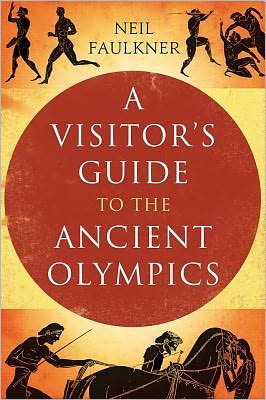
A Visitor’s Guide to the Ancient Olympics by Neil Faulkner

What an odd mix of genres this book is. It sets itself up as a travel guide: eat here, sleep here, don’t forget to pack this – but to a destination that would require time travel. As Faulkner says in his introduction, this is necessarily (by its fantastical nature!) not an entirely academic book; but he does have an academic background, and rather than wildly making things up, he does follow history & research. He just uses his imagination where it makes sense to do so, and in a way that makes sense: he makes educated guesses. (As he points out in the intro, again, he has to pick a day for each event; it is unrealistic that a guide to an Olympic festival would be unable to say when the footraces would be held.) So, note my tags for this post: travel guide; sports; historical fiction; nonfiction. It is a puzzle. A uniquely styled book.

And an enjoyable one, too. At just under 250 pages, it’s an easy read. The sections are short. There is an emphasis for most of the book on ancient Greek culture in general, and on what the Olympic Games represent in that culture (in a nutshell: this is a religious festival; sport is merely a form of religious ritual). The sport itself comes in only late in the book, and I confess that this was a slight disappointment to me: that section of the book that describes the athletic contests was very interesting to me and I wanted more of the same. But the detail on ancient Greece was intriguing, too; I have an interest in ancient Greek mythology & literature, and there were plenty of references that I was pleased to connect.

This book is probably most successful as a travel guide, which is a little awkward since as much as one might wish to, it is in fact impossible to attend the Olympic Games of 388 BC. Faulkner does a good job of elucidating the issues a person would face in attending these Games if she could. Again in a nutshell: there is no lodging, transport is difficult to arrange and expensive, food is odd and limited, and the Olympic Village would be teeming with refuse, stink, and insect activity. It would be hard to see the events on display as there are no stands; spectators 100,000 strong merely shove each other around for a view. In other words, he might have talked me out of the trip if I were planning on it. As a view into the life of ancient Greeks and especially the role of professional athletes in their society, this book was informative and fascinating. Its unique format, too, added special interest. I am bemused and intrigued. Recommended, but probably for a fairly distinct audience. I was well entertained, with my intersecting interests in sport and ancient Greece, and my tolerance for an odd format.


I read an uncorrected advance proof.

Rating: 6 events.

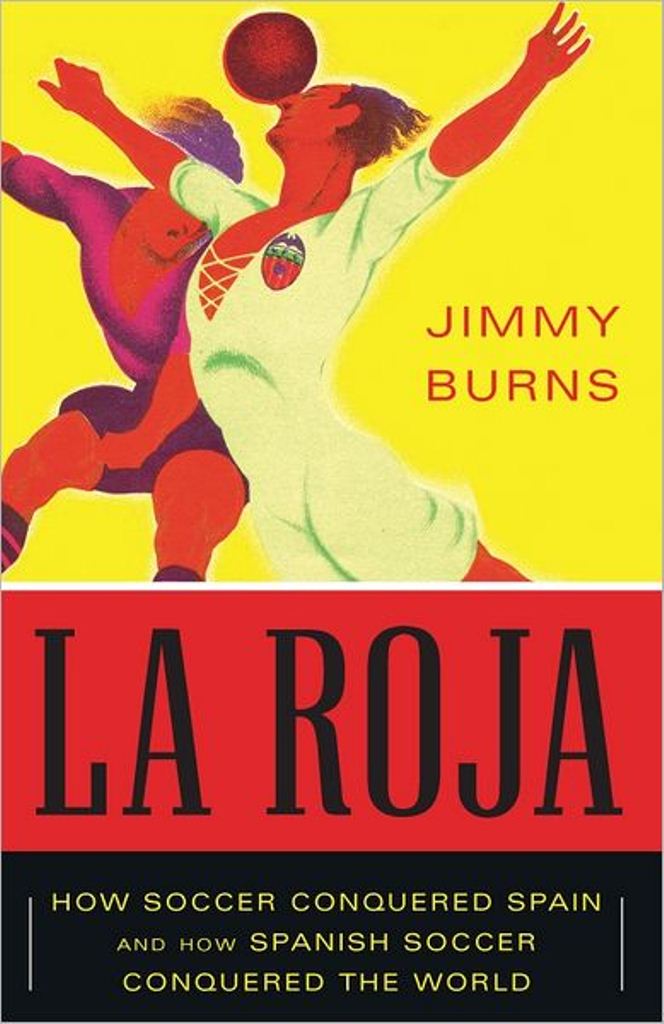
La Roja: How Soccer Conquered Spain and How Spanish Soccer Conquered the World by Jimmy Burns

An examination of Spanish history through the filter of a beautiful game.

Jimmy Burns has an emotional relationship to the soccer teams and the legacy of his native Spain. He’s written several books on the sport, culminating in La Roja, which sets out to tell the story of Spanish soccer, from the moment when the British introduced the nation to the sport in the 1880s to the present day, when the sport has become ubiquitous. Soccer acted as a major propaganda tool in the Spanish Civil War; Franco used it to maintain control of local populations, installing loyal political figures as club presidents and managers. During his rule, Spanish club teams fought fiercely amongst themselves, with regional politics playing a heavy role; in international play, Franco’s politics were at the forefront of every interaction. These were underachieving, frustrating years for Spanish soccer. Only in the late 20th century did Spain begin to come into its own, winning Olympic gold in 1992 and, finally, the pinnacle of a World Cup championship in 2010.

Burns relates nearly 150 years of Spanish soccer history, capturing its roots, the regionalism, the racism, the politics, the bullfighting connections and even a cultural reminiscence of Don Quixote. He portrays personalities, rivalries, strong emotions–including his own–and moments of shining success for a much-beset nation. Often heavier on history than on sport, La Roja is a window into Spain and its component cultures, regions and histories as well as a celebration of soccer and its most recent champions.


This review originally ran in the June 1, 2012 issue of Shelf Awareness for Readers. To subscribe, click here, and you’ll receive two issues per week of book reviews and other bookish fun!


Rating: 5 soccer balls.

A Difficult Woman: The Challenging Life and Times of Lillian Hellman by Alice Kessler-Harris

Lillian Hellman’s paradoxical, powerful personality set against the backdrop of a turbulent century.

Lillian Hellman (1905-1984) was many things: a successful playwright, screenwriter and memoirist; a suspected Communist (maligned as an unrepentant Stalinist) who stood up against political intimidation in the 1950s; a labor organizer and civil rights activist; partner to Dashiell Hammett for more than 30 years; a woman criticized for being manlike and grasping, but simultaneously overly feminine and stylish; a New Orleans-born resident of New York, Hollywood and Martha’s Vineyard who persisted in calling herself a Southerner. She was respected for her literary contributions, hailed as a hero by a feminist movement that she largely rejected, praised and excoriated for her politics and, ultimately, vilified for what came to be seen as the outrageous mendacity of her memoirs. It would be difficult to locate a biographical subject more contradictory or complex. In A Difficult Woman, Alice Kessler-Harris makes an excellent case that Hellman represents the complexities and changing mores of the 20th century.

The contradictions in her personality and politics are brought into relief by her written work–including plays still popular in repertory theater today–which always included strong moral statements. The concepts of truth and deception, or betrayal and loyalty, play large roles in her work and this insightful biography, rich with context, shows how they were also themes that defined her life. Not an apologia, but an exploration of nuances, A Difficult Woman gives us an infinitely more complex Hellman than the popular image that has survived her.


This review originally ran in the May 1, 2012 issue of Shelf Awareness for Readers. To subscribe, click here, and you’ll receive two issues per week of book reviews and other bookish fun!


Rating: 9 ambiguities.

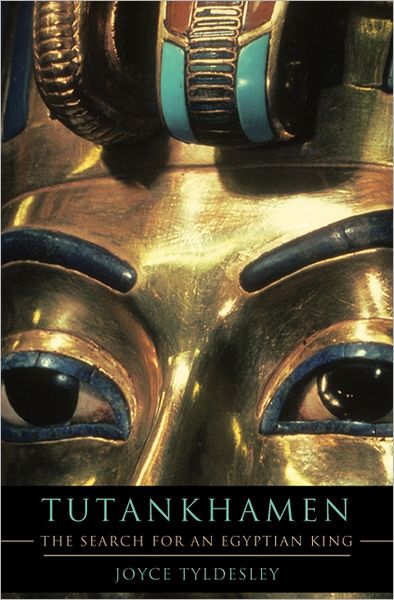
Tutankhamen: The Search for an Egyptian King by Joyce Tyldesley

A new biography of a very old figure still shrouded in mystery.


Joyce Tyldesley (Cleopatra: Last Queen of Egypt) takes on the life of King Tutankhamen, examining the many questions still surrounding his life and the archeology of his tomb, whose discovery in 1922 caused a wave of what Tyldesley calls “Tut-mania” across the Western world. As a king, Tutankhamen came to rule very young, yet managed to effect great change during his short reign–but was then removed from written records by his successors, an act with great consequence in ancient Egyptian theology. His tomb is unusual: relatively undisturbed, and as Tyldesley retraces, surrounded by mystery and myth.

The first, larger part of Tutankhamen is devoted to the archeological record and what it tells us about Tutankhamen and some of his relatives. Tyldesley discusses and critiques various theories (for example, regarding his biological parents) and acknowledges that little is known for certain. Next, she examines Tutankhamen’s legacy in our world–most notably, the rampant myths and legends about the curse on his tomb, which spread as quickly as the news of its discovery. Finally, for those interested in a clear storyline, she outlines her best approximation of Tutankhamen’s life story (while noting that it is only a well-educated theory).

Tutankhamen succeeds in making this ancient monarch accessible to the average reader. Beware of developing an appetite for Egyptology upon reading!


This review originally ran in the March 13, 2012 issue of Shelf Awareness for Readers. To subscribe, click here, and you’ll receive two issues per week of book reviews and other bookish fun!


Rating: 5 mummies.

First Lady of Fleet Street by Eilat Negev and Yehuda Koren

The biography of a pioneering female newspaper editor in early 20th-century London.


Rachel Sassoon was the heiress daughter of a wealthy Jewish businessman who was rooted in Baghdad but proud of the family’s new status after he moved them to London in 1860, while Rachel was still a baby. Only nine years old when her father died, Rachel’s options were increased by his fortune and broadened by his absence until, long past the standard marriageable age, and with considerable life experience behind her, she made what her family viewed as an unforgivable decision: she married Frederick Beer, who was also of Jewish ancestry but had converted to Christianity. (For this, Rachel was ostracized from the family until Frederick’s death, when a brother had her certified as “of unsound mind.”)

She found love with Frederick, but more importantly for posterity, she found a newspaper: Beer’s Observer drew her interest, but it took her own newspaper, the Sunday Times, to unleash Rachel’s creative and industrial spirit. She took on issues of women’s rights and suffrage, workers’ rights, the arts, criminal justice, and international political and social issues; the Sunday Times was for a decade Rachel Beer’s personal soapbox.

Eilat Negev and Yehuda Koren’s matter-of-fact portrayal of Rachel’s life sheds light on the experiences of women and people with Jewish backgrounds in her time, while the stories of the Beer and Sassoon families depict larger issues regarding the era’s immigration and business patterns. The First Lady of Fleet Street is an engaging snapshot of several aspects of early 20th-century life as seen through the lens of one remarkable woman.


This review originally ran in the March 2, 2012 issue of Shelf Awareness for Readers. To subscribe, click here, and you’ll receive two issues per week of book reviews and other bookish fun!


Rating: 5 understudied women.

Inferno: The World at War, 1939-1945 by Max Hastings


Max Hastings is a highly regarded war historian (primarily WWII) and author of a great many books examining his subject from various angles (most recently Winston’s War). His latest, Inferno, covers WWII through the lens of “regular people” as primary sources. In his introduction, he explains that his book does not seek to be a comprehensive study of WWII in all its events, bringing a reader from zero knowledge up to expert level; rather, it assumes some familiarity with the war and concentrates on people: “This is a book chiefly about human experience.”

Hastings did what he set out to do: he exposed the human experience of WWII, in all its horror and almost incomprehensible suffering and death, in its follies and incompetencies and cruelties and in its rare moments of black humor. The brief quotations from regular folks from dozens of countries are moving, illustrative, and diverse, both in viewpoint and in origin. They offer a valuable telling of the war, and serve as a great history lesson/review too.

This is a high-quality book; it has a lot to offer. At almost 700 pages, the reader’s motivation will have to be fairly high to invest the time and effort required to reap the full benefits. But for the interested reader, a treasure trove of honest contemporary accounts of this remarkable tragedy of history awaits.


This review was written for Shelf Awareness for Readers. To subscribe, click here, and you’ll receive two issues per week of book reviews and other bookish fun!

The Castrato and His Wife by Helen Berry

An intriguing story of a castrato’s unprecedented marriage and its implications for society at large.


Giusto Ferdinando Tenducci was an 18th-century Italian opera singer and a celebrity in England. Part of his mystique and mystery, and the reason both for his reportedly divine voice and his unusual social standing, was his status as a castrato. Tenducci had been castrated as a young boy in the hopes that he would make his fortune out of his singing. As historian Helen Berry explains, a surprising number of Italian youths underwent this dangerous operation in Tenducci’s day, although (like today’s hopeful rock stars) few actually succeeded. Tenducci not only beat the odds by making a (sometimes tenuous) fortune in opera, but also accomplished a surprising feat: he married a young English girl of good family.

The Castrato and His Wife is the story of that brief marriage and its annulment in an extremely curious extended legal case. It is also the story of Italian opera in the 1700s, both as an institution and as a business; of castration and its relationship with the Catholic Church; and of the institution of marriage and society’s changing concepts thereof. Berry’s prose can be a touch long-winded and academic at times, but Tenducci’s heart-wrenching story is unusual and evocative. Berry addresses a topic we still find mysterious, and Tenducci’s distinctive situation is surprisingly relevant to the ongoing question of what constitutes legal marriage.


This review originally ran in the January 6, 2012 issue of Shelf Awareness for Readers. To subscribe, click here, and you’ll receive two issues per week of book reviews and other bookish fun!

book beginnings on Friday: The First Lady of Fleet Street by Eilat Negev and Yehuda Koren

Thanks to Katy at A Few More Pages for hosting this meme. To participate, share the first line or two of the book you are currently reading and, if you feel so moved, let us know what your first impressions were based on that first line.

Today I’m reading The First Lady of Fleet Street: The Life of Rachel Beer: Crusading Heiress and Newspaper Pioneer. I’m intrigued for several reasons: I tend to appreciate biographies of semi-obscure figures (if they’re well done, which I can’t yet judge of this one); this will be my second newspaperwoman biography of the year (here‘s the first); and I like Rachel’s last name. 🙂 The book begins with a prologue:

Late May 1903. Earl’s Court, a two-storey stone mansion in Tunbridge Wells.

A slight woman sits erect in her chair, nearly swallowed by her weighty crepe mourning dress. Heavily framed mirrors, priceless paintings, dim-gilt Chinese cabinets, and fresh lilies and orchids adorn every inch of the spacious drawing room.

Well done, I say, and I am optimistic.

What are you reading this weekend?

This quotation comes from an uncorrected advance proof and is subject to change.