Team of Rivals by Doris Kearns Goodwin (audio)

teamofrivalsMostly I read books first and then (maybe) watch the movie, later. This time I did it backwards: I recently saw the new movie Lincoln (with Daniel Day Lewis), and then began listening to this book on audio, on which the movie was based. Not that there’s any shortage of Lincoln histories out there; but this is the one Spielberg turned into film. So please forgive me if this review is a little heavy on comparisons to the movie…

Beginning with which, the movie begins on the eve of the battle to ratify the 13th amendment, but the book starts much earlier, with Lincoln struggling to get the Republican Party’s nomination for presidential candidate. We follow Lincoln through his nomination, his campaign, and the setting up of his cabinet. The title of the book, appropriately, describes its subject: not Lincoln himself so much (as in the movie), but his skillful political alignment of his rivals for the Republican nomination in his cabinet. We get to know these other characters much better in the book than we did in the movie (which was also appropriately titled. Its focus was different). As this book effectively communicates, one of Lincoln’s political strengths was in placing his rivals where their strong points could best play to his administration’s advantage, and where their animosity toward him could best be neutralized.

Just as with the movie, I worried a little about an overly patriotic, positive portrayal of Lincoln. As in the movie, he is depicted as being strongly concerned about the black man or woman’s natural right to liberty; and while this is a sentiment we applaud today, I am afraid it was not at the center of the Civil War or Lincoln’s personal priorities. In other words, it’s something we love to think about our lauded 16th president today, but it’s not entirely historically accurate. Along these lines, I noted repeatedly that Goodwin uses rather many superlatives, which decreased my confidence in her neutrality slightly.

These concerns aside, I enjoyed the story. Not only Lincoln and his wife and children, but the characters (along with their families) of Bates, Chase, and Seward are evoked, and it made this critical moment in my nation’s history come alive. It was an absolutely entertaining story to listen to; and Goodwin’s great reputation (she has a Pulitzer to her name) and the reasoned pace & structure give me confidence that this is a responsible piece of historical writing… but I still felt that there was some positive slant, as above.

The audio narration by Richard Thomas was everything it should have been. This is a fine book, very readable, which makes Lincoln’s White House history accessible and makes the story come alive. But it might not be hard-edged journalism, for what that’s worth.


Rating: 6 machinations.

The Greater Journey: Americans in Paris by David McCullough (audio)

greaterjourneyThis is my first experience with the very well-respected David McCullough. “Americans in Paris” is a huge topic; but if anyone can do it justice, we’re told, McCullough might be that one. This feels like a quite comprehensive study of Americans in Paris in the 1800’s, complete with name-dropping and historical context. (I say “feels like” because I don’t have the historical knowledge myself to confirm or question McCullough’s comprehensiveness!)

McCullough follows Americans in Paris more or less chronologically, starting with the 1830’s and following through the end of the century. His subjects range over various disciplines and the story he tells seems to ramble, from art & literature, to medicine, to culture, war, and back to art. In the 1830’s we meet those who were among the first to make the journey, including Ralph Waldo Emerson, James Fenimore Cooper, Samuel Morse, and Oliver Wendell Holmes. A number of chapters are devoted to visual artists and writers, and the artistic superiority of France and the Continent which was only beginning to be challenged by Americans. Samuel Morse not only painted his masterpiece in Paris, but began work on what would become the telegraph; Harriet Beecher Stowe sought escape from the publicity following Uncle Tom’s Cabin; the first American female medical students studied there; and Charles Sumner’s observation of black students in Paris would lead him to a new understanding of black Americans’ abilities, and help him become one of our first abolitionist Congressmen. Rather fewer chapters* are devoted to the medicals, but I enjoyed very much McCullough’s descriptions of the École de Médecine and the American students who studied there. At the time, France was the place to study medicine, and the personalities who taught it loomed large; their role in this section of the book was very entertaining to me. (Also, I thought of The Lady and Her Monsters as McCullough discussed the dissection of cadavers, and their sources.)

Moving forward a few decades, later waves of American visitors to Paris would more commonly bring their families with them to live a fuller life than that of the student or artist; and there would be many more of them. One of the strongest sections of The Greater Journey describes the Franco-Prussian War (1870-71), and the role of American ambassador Elihu Washburne. He was the only ambassador who stayed, and he saved innumerable Americans as well as Germans, helping them evacuate and generally organizing and supporting – literally, in many cases, as he fed & boarded a number of the displaced. He was well regarded for this work, above and beyond the call of duty. The Franco-Prussian War (which felt vaguely familiar to me from my recent readings of de Maupassant), is well told; and McCullough’s description the Paris Commune is evocative and powerful.

Another figure that receives personal attention is sculptor Augustus Saint-Gaudens, an Irish-American kid from a family of decidedly modest means who travels to Paris and becomes a world-renowned artist. You may know him for his bronze Robert Gould Shaw Memorial on Boston Common and his statue of William Tecumseh Sherman at a corner in New York’s Central Park. Saint-Gaudens’ life is examined from his youth through his old age and death; I found this study of an artist to be a very interesting sub-story within The Greater Journey. Likewise the life of Mary Cassatt, an American painter famous for Impressionism who was significantly shaped by Paris.

In other words, while McCullough seems almost to ramble amongst various people, disciplines, and issues, each of his individual subjects is well-treated and fascinating; and any seeming lack of structure is happily tolerated because all the stories are so enjoyable. It’s not really that the book lacks structure, only that following Parisian Americans chronologically takes us through all these twists and turns. The whole is highly readable and a good primer in French/American history in the 1800’s. For example, one consistent thread throughout is the close relationship shared by our two countries during this century, beginning with General Lafayette’s support of the American Revolution in 1776.

The Greater Journey is an interesting and enjoyable read, a good central place to learn a number of individual facts and anecdotes about Americans traveling and living in Paris in 1830-1900. I have the impression that McCullough’s research is good; I am charmed.

*I am not entirely clear on the proportions of the book devoted to each subject, because I listened to the audio and thus could not grab chunks of pages for visual comparison. It is a shortcoming of the audio format. You get only my impressions.


Rating: 7 croissants.

book beginnings on Friday: Team of Rivals by Doris Kearns Goodwin

Thanks to Rose City Reader for hosting this meme. To participate, share the first line or two of the book you are currently reading and, if you feel so moved, let us know what your first impressions were based on that first line.

teamofrivals

After recently seeing the movie Lincoln, I have been ready to finally listen to this book, upon which the movie was based. It begins:

On May 18, 1860, the day when the Republican Party would nominate its candidate for president, Abraham Lincoln was up early. As he climbed the stairs to his plainly furnished law office on the west side of the public square in Springfield, Illinois, breakfast was being served at the 130-room Chenery House on Fourth Street.

Simple enough, yes, but I think this is an example of slipping details and impressions upon the reader in what reads like a straightforward few sentences. Picture a man who’s up early on this day: is he nervous? That would be understandable. His office is plainly furnished, and they’re serving breakfast elsewhere. He’s a man of the people rather than an aristocrat, perhaps.

I’m excited about this read. I will say that Goodwin uses rather many superlatives, so far, and there’s a danger, when someone is portrayed as being masterful, expert, the most and the best, of wearing me out a little. But I’ll wait and see. It’s easy to get excited about Abraham Lincoln, of course.

That’s my new read – and what are you reading this weekend?

Teaser Tuesdays: Vera Gran: The Accused by Agata Tuszyńska

Teaser Tuesdays is a weekly bookish meme, hosted by MizB of Should Be Reading. The idea is to open your current read to a random page and share a few sentences. And try not to include spoilers!

veragran

What an interesting study of a woman I’d never heard of – which has turned out to be a genre I really enjoy, in fact. (Biographies of women I’ve never heard of, that is.) And one of the central themes is the nature, and limitations, of memory:

Perhaps memory is only an element of the process, and memory modifies itself when being evoked. Perhaps memory does not weave a tapestry but runs along a particular strand, uniquely under the influence of the moment.

I am sure we can all sympathize with the shortcomings of our memories; but perhaps few have paid a price like the one Vera Gran paid. Stay tuned for my review.

This quotation comes from an uncorrected advance proof and is subject to change.

Life Below Stairs: True Lives of Edwardian Servants by Alison Maloney

A simple but thorough glimpse into the lives of British house servants in the early 1900s.

In the wake of Downton Abbey‘s wild success, Alison Maloney’s Life Below Stairs offers an in-depth look at the lives of the serving class in the era of King Edward VII (1901-1910) and the Great War. She examines all aspects of servants’ place in society and relationships to their masters and one another, including social backgrounds, the responsibilities of each servant in households large and small–from the lowly house or hall boy and the maid-of-all-work to the butler and housekeeper–and their working conditions. She also provides details on fine dining, complete with table service instructions and menus that boggle the mind. Finally, she describes servants’ opportunities for retirement or marriage out of service, giving the modern reader an idea of exactly how limited their lives could be. Many poor children and teens would feel lucky to get a position in a “good house,” and not feel dishonored by such a post–in contrast, a contemporary source relates, “service [was] considered rather degrading in America.”

Although comprehensive in its survey of staff’s lives, options, and conditions, Life Below Stairs is a surprisingly easy read. Short chapters and accompanying tables, contemporary newspaper clippings and illustrations make this an accessible and charming way to study the lives of Edwardian servants. As a companion to Downton Abbey or simply a dip into another time, Maloney’s study satisfies.


This review originally ran in the January 4, 2013 issue of Shelf Awareness for Readers. To subscribe, click here, and you’ll receive two issues per week of book reviews and other bookish fun!


Rating: 6 eyes lowered.

movie: Lincoln (2012)

In honor of my mother’s birthday recently, Husband and I accompanied my parents to see Steven Spielberg’s Lincoln, starring Daniel Day Lewis, Sally Field, and Tommy Lee Jones, backed up by a further star-studded cast. It was truly impressive, as expected.

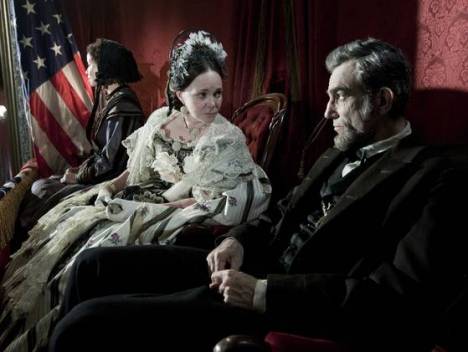
Daniel Day Lewis as Lincoln and Sally Field as Mary Todd Lincoln (Photo: David James, DreamWorks II/Twentieth Century Fox)

Daniel Day Lewis as Lincoln and Sally Field as Mary Todd Lincoln (photo credit)

There is no shortage out there of positive reviews of this movie, many of which say it better than I can and know the historical details better than I do, so I shall try to keep this brief. As promised, Daniel Day Lewis IS Lincoln. The visual impact of Lewis’s Lincoln, and of the period costume and cinematic effect (use of light and shadow, especially) is very good – but again, this is Spielberg, so no great surprises. The emotional impact is great, too. The scene where the 13th amendment is voted in, and the reactions to that vote, I found very powerful. It was an enjoyable experience.

I felt somewhat, and Pops expressed a similar feeling, that this movie’s view of history was a little “feel-good.” My vague recollection of American history yields a more cynical view, in which the Civil War was not so much about the human rights of black people as it was about states’ rights vs. federalism, economics, and yes, slavery, but more as an issue of the above (economy, industry) than as a civil rights issue. Specifically, I believe I recall reading the Lincoln-Douglas debates for a freshman political science course and noting that Lincoln was not quite the egalitarian the movie represents – although, to be fair, the movie does have him balk at black suffrage. At any rate, it felt like this Lincoln encourages us, as Americans, to be proud of our very principled, virtuous past, to a degree perhaps a tad simplified and glorified. That said, it DID feel good. So your feelings about this question depend on what you want from the film – historical accuracy, or fuzzy feelings.

This cast was outstanding. Aside from the big names D.D. Lewis, Sally Field, and Tommy Lee Jones (and Spielberg), you will recognize a great many faces further, and everyone did an outstanding job. (Between us, my group of 4 recognized actors from Breaking Away, Bad News Bears, ER, and Mr. Deeds, and that was fun.) I think I enjoyed Tommy Lee Jones’s Thaddeus Stevens the best. Now, the acting and the screenwriting tended towards the theatrical or dramatic rather than the realistic; many, perhaps the majority of the scenes involve grand, sweeping, profound statements, delivered with lifted chin. But this, too, is not necessarily a criticism. It’s not realism, but theatre – finely produced theatre.

As you know, I am always curious about historical accuracy in works of historical fiction or dramatizations. In this case, we all wondered about Stevens’s relationship with his housekeeper: in the movie, they are lovers. I poked around the internet enough to see that historians have speculated but cannot confirm such a theory; and it was Pops that sent along this excellent link, in which Slate discusses historical accuracy throughout the film. Don’t hesitate to click on some of the links within it, too: I did and found it all fascinating.

I will leave you here with the idea that this is a magnificent, entertaining, thought-provoking, if slightly rosy portrayal of our 16th president, presented by an outstanding cast.


Rating: 7 flashing eyes.

Teaser Tuesdays: The Honored Society by Petra Reski

Teaser Tuesdays is a weekly bookish meme, hosted by MizB of Should Be Reading. Anyone can play along! Just open your current read to a random page and share a few sentences. Be careful not to include spoilers!

honoredsociety

This is an interesting book. Its subject is the Italian Mafia and its global role; and most of the prose is straightforward. But it occasionally meanders into fancy, even poetry, as here:

In the middle of Piazza Marina there’s a huge magnolia fig tree that has grown into a vast and magical forest. The trunk is reddish brown, like the Sicilian soil, and has transformed itself into some fabulous creature that consists of knotted, frozen snakes, dragons half hidden in the ground, and elongated elephants. Every time I turn my back on this tree I half expect it to stretch out its arms and grab me.

I am charmed. And the Mafia bits are fine, too. 🙂

This quotation comes from an uncorrected advance proof and is subject to change.

book beginnings on Friday: The Lady and Her Monsters by Roseanne Montillo

Thanks to Rose City Reader for hosting this meme. To participate, share the first line or two of the book you are currently reading and, if you feel so moved, let us know what your first impressions were based on that first line.

monsters

The Lady and Her Monsters: A Tale of Dissections, Real-Life Dr. Frankensteins, and the Creation of Mary Shelley’s Masterpiece is a fascinating title, isn’t it? I was attracted immediately. It begins:

Camillo’s footsteps echoed loudly as he crossed the empty cobblestone streets of Bologna toward his uncle’s house. The afternoon was hot, and the scorching heat, coupled with that lazy midafternoon spell between noon and evening, allowed him to go by virtually unnoticed.

Although this is a work of nonfiction, I think these atmospheric opening lines are appropriate, since its subject is something of a gothic ghost story.

Happy reading to you this weekend!

This quotation comes from an uncorrected advance proof and is subject to change.

Master of the Mountain by Henry Wiencek

The sad but enlightening story of Thomas Jefferson, a dedicated slaveowner masquerading as an emancipationist. Henry Wiencek studied George Washington’s convoluted relationship to slavery in An Imperfect God; with Master of the Mountain, he turns his attention to Thomas Jefferson. As one would expect, Sally Hemings is a crucial part of the story, but Wiencek also meticulously records the experiences of many others among the more than 600 slaves Jefferson owned in his life, offering a detailed portrait of daily life at Monticello.

After speaking out eloquently about the need for emancipation early in his life, Jefferson not only let pass several opportunities to push for abolition but worked to maintain the existence of slavery, noting the profits to be had–even though in public writings and correspondence with anti-slavery activists, Jefferson continued to claim a devotion to human rights and disgust with the “peculiar institution.” Wiencek appears briefly to consider the forgiving popular characterization of Jefferson’s relationship with slavery as “compartmentalized” or “complex.” But as Jefferson devolves from a youthful, idealistic opponent to a staunch defender of slavery, Wiencek firmly condemns Jefferson’s pretense of virtue, put to the lie by the abuses at Monticello. Master of the Mountain is well-documented and detailed without being tedious. The stories of real people come alive, making Jefferson’s wrongs all the more painful and his hypocrisy the more outrageous. The final chapter calls this founding father to account in no uncertain terms.


This review originally ran in the October 26, 2012 issue of Shelf Awareness for Readers. To subscribe, click here, and you’ll receive two issues per week of book reviews and other bookish fun!


Rating: 6 advantages taken.

On a Farther Shore: The Life and Legacy of Rachel Carson by William Souder

Rachel Carson was born in 1927 and by the 1950’s was the author of several bestsellers, a national hero for her lyrical, literary, scientifically accurate books about the ocean. She also published myriad magazine and newspaper articles, both as a government employee and as a freelance writer. In 1962 she published a somewhat different kind of book. Silent Spring retained the literary style for which she was well loved, but its subject – while still the natural world – took a different tone. Carson wrote about the then-widely-used pesticide DDT and its sinister effects, not just on the insects it claimed to target, but on wildlife generally including many fish and birds (hence the title) and even human life.

The immediate reaction to her book was mixed. Critical reviews were more positive than negative, but the government (to varying degrees) and the pesticide industry (predictably and totally) offered less praise. Carson came under attack as a hysterical nature faddist and Communist sympathizer, even as Silent Spring topped bestseller lists and initiated federal investigations. Today, the ecology and environmental movements credit Rachel Carson and Silent Spring with helping to establish what is now a central issue of our times.

William Souder’s new biography of Carson, published on Silent Spring‘s 50th anniversary, begins with the conjecture that Carson’s name is now “unknown to almost anyone under the age of fifty.” There are a few of us, of course (although I confess my personal poll may not constitute a random sampling), but his point is well taken: in 2012, Carson is less on our minds. But even if DDT is no longer sprayed on kids playing at the beach and the rivers we catch our fish out of, environmental issues are among the most pressing of our day. (I am thinking of climate change, overpopulation, water tables, land use, urban sprawl, species extinction…)

That’s the argument for Carson as a biographer’s subject. Now, how did Souder do? As observed yesterday, his style is rather a traditional one. Souder himself does not enter into the story as a character; he doesn’t give us his own impressions (unless you delve into the Notes at the back of the book, on which more is coming in a later post). I am a fan of the newer style of “creative nonfiction” exemplified most recently at pagesofjulia by Soundings, but that doesn’t mean the straightforward sort of biography is necessarily dry, either.

Souder brings his subject to life. His plentiful research (again see those Notes) clearly and exhaustively outlines Carson’s background and personality, and enigmas. For instance, he notes the weekend in college when she went one two dates with a boy from another school, and then as far as we can tell, never dated again. He writes eloquently of her strange single-mindedness, for example in reading Henry Williamson for his nature writing (which she loved) while totally ignoring his frank Nazi sympathies.

I will mention one angle that I noted as absent: there is nothing in Souder’s book about Carson suffering for her sex in the field of science. This seemed like a natural obstacle for her to have faced as a science writer in the 1950’s and 1960’s, and I wonder at its absence, particularly in comparison to Soundings, where Tharp’s professional limitations as a woman are one of the central issues. Did Carson not feel that she was held back? Did Souder miss something? His work feels thorough. I am hesitant to think he missed such an important angle, but it makes me wonder. There are a few references by her contemporaries to her status as a “spinster,” but even these don’t feel particularly biting. And apparently her critics entirely missed the lesbian question. Carson had a very close female friend for the final 10-12 years of her life with whom she exchanged ardent letters. Whether they had a sexual relationship is not known, although Souder makes the case that it’s unlikely; but that’s irrelevant in looking for contemporary criticism of her for it. It seems like such an obvious way for her detractors to attack her. I just wonder.

Despite my questions about the role sexism might have played in Carson’s career, this biography feels well-researched, thoughtful, and finely wrought. It can also serve as a fairly good quick introduction to the history of ecology, environmentalism, and nature writing: Aldo Leopold, John Muir, and Teddy Roosevelt all get put into context. In fact, context is one of its strengths (again, see yesterday’s post). I feel like I know Carson much better now, which is of course what I was looking for, but it was also an enjoyable read. I recommend On a Farther Shore, because Rachel Carson is every bit as relevant today as ever.


Rating: 7 birds’ eggs.