book beginnings on Friday: Young Men and Fire by Norman Maclean

Thanks to Rose City Reader for hosting this meme. To participate, share the first line or two of the book you are currently reading and, if you feel so moved, let us know what your first impressions were based on that first line.

young men and fire

Following an informative and lovely Publisher’s Note, which tells us that this is a posthumous publication of an unfinished (but largely formed) work, Norman Maclean begins his book Young Men and Fire with a story about the beginning of his involvement with the Mann Gulch Fire.

It was a few days after the tenth of August, 1949, when I first saw the Mann Gulch fire and started to become, even then in part consciously, a small part of its story.

To think that while the fire was still burning, in 1949, Maclean knew he’d be tied to it forever – though he didn’t begin this book til 1976, and it was unfinished at his death in 1990 – is profound in itself.

I think I am a serious Maclean fan. Stay tuned.

Junius and Albert’s Adventures in the Confederacy by Peter Carlson

Adventure, suspense, and a dash of romance make for a highly readable–and absolutely true–Civil War story.

junius
Peter Carlson’s Junius and Albert’s Adventures in the Confederacy opens with the capture of its titular subjects near Vicksburg in 1863, then rewinds to show how they landed in such a predicament. Albert Richardson, an enterprising journalist for the New York Tribune, had decided to travel south as an undercover correspondent, and naturally chose his best friend and fellow newspaperman Junius Browne to accompany him. The stakes were high if they were discovered–the Tribune was reviled as a liberal abolitionist paper–but the two young men were game for adventure. After their capture, they spent nearly two years in a series of Confederate prisons before escaping, half-starved and freezing, to trek overland toward Union lines in December 1864.

Despite the serious and frequently tragic nature of Albert and Junius’s story, the book’s title signals the often playful tone that Carlson (K Blows Top) employs. The descriptions of Confederate prisons like Libby, Castle Thunder and Salisbury are horrific, but there is also the occasional scene of mirth–as when prisoners put on a variety show to celebrate the 4th of July. Besides Junius and Albert, the other colorful personalities in Carlson’s history include a larger-than-life “Union pilot” skilled at guiding refugees over the mountains to freedom, and a beautiful young Southern horsewoman who rescues them during a perilous moment. With eccentric and likeable characters like these, Carlson’s history successfully masquerades as an entertaining adventure story.


This review originally ran as a *starred review* in the June 4, 2013 issue of Shelf Awareness for Readers. To subscribe, click here, and you’ll receive two issues per week of book reviews and other bookish fun!


Rating: 7 weary months.

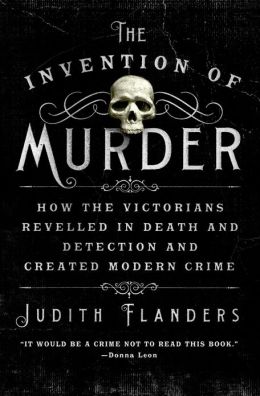
book beginnings on Friday: The Invention of Murder by Judith Flanders

Thanks to Rose City Reader for hosting this meme. To participate, share the first line or two of the book you are currently reading and, if you feel so moved, let us know what your first impressions were based on that first line.

murder

I am pleased to be reading this hefty work of history regarding the Victorians’ fascination with murder – a relative rarity in that era – and the birth of the murder mystery genre in literature (as you know, that’s my favorite genre in fiction). And I’m pleased to share with you a great, and representative, book beginning:

“Pleasant it is, no doubt, to drink tea with your sweetheart, but most disagreeable to find her bubbling in the tea-urn.” So wrote Thomas de Quincey in 1826, and indeed, it is hard to argue with him. But even more pleasant, he thought, was to read about someone else’s sweetheart bubbling in the tea urn, and that, too, is hard to argue with, for crime, especially murder, is very pleasant to think about in the abstract: it is like hearing blustery rain on the windowpane when sitting indoors.

This statement is a little disturbing, but I think inarguable, and maps out where the book is heading.

This quotation comes from an uncorrected advance proof and is subject to change.

Yellowstone, Land of Wonders: Promenade in North America’s National Park by Jules Leclercq

An unprecedented English translation of a travel narrative from the early years of Yellowstone National Park.

yellowstone
In 1883, a well-traveled French lawyer, writer and judge named Jules Leclercq explored the newly designated Yellowstone National Park on horseback. Three years later, he published a book praising the area’s strange and wondrous marvels–but the book is not simply a lovely appreciation of natural scenery. Leclercq also researched the history of the region and its people in order to write a scholarly study, a snapshot of a place in time. And yet there has never been a complete English-language translation of his original text until Janet Chapple and Suzanne Cane’s Yellowstone, Land of Wonders.

Leclercq is most fascinated by Yellowstone’s geysers: “The mind is so occupied with the extraordinary geological phenomena bursting upon one at every step,” he writes, “that one views the scenery only abstractedly.” He does, however, turn his pen to Yellowstone Lake and Falls; he considers the latter far superior to Niagara. He also includes a chapter on the park’s wildlife, and warns that whole species will be exterminated if hunting continues unchecked.

Leclercq’s narrative is imperfect. He sometimes quotes without attribution from contemporary sources and gets geological details wrong. But Chapple and Cane meticulously keep readers informed on such points. Their translation and editing–with copious notes–is thorough in confirming and expanding Leclercq’s points, offering commentary not just on Yellowstone but on the author and his era. The result has more than just historical value; as Leclercq concludes (and as is still true today), “All this grandeur inspires grave and religious thoughts.”


This review originally ran in the May 10, 2013 issue of Shelf Awareness for Readers. To subscribe, click here, and you’ll receive two issues per week of book reviews and other bookish fun!


Rating: 6 geysers.

In the City of Bikes by Pete Jordan

A history of Amsterdam’s love affair with the bicycle contained within an American cyclist’s memoir.

cityofbikes
After the close of his first memoir, Dishwasher, Pete Jordan moved to Amsterdam for a semester to study urban planning, with a focus on his passion: bicycles. He never left.

Jordan’s decision to move was rather capricious–he knew almost nothing about Amsterdam–but he found a city packed with bicycles and rich with cycling history. In the City of Bikes is the story of his journey from itinerant dishwasher to settled family man, as well as a thoroughly researched history of the bicycle in Amsterdam. Beginning with the early bikes of the 1800s and cycling’s golden age in the 1890s, when the safety bicycle hit the streets, Jordan moves on to the tire shortages and (in this case, bicycle-related) atrocities of the city’s Nazi occupation before concluding with his own place in modern cycle-crazy Amsterdam.

Joining Jordan are his new wife, Amy Joy, and their son, Ferris, a passenger and later pilot of Amsterdam bicycles since his conception. When Amy Joy becomes proprietor of a local bike shop, the Jordans have truly found their home in the Dutch capital. Considering his reason for going in the first place, Jordan is especially well suited and qualified to tell this story, and he lives up to expectations with a meticulous detailing of Amsterdam’s bikes. Full of personal anecdote, self-deprecating humor, local lore and a history of cycling that positively bursts with enthusiasm, In the City of Bikes is both a memoir and an ode to bicycles.


This review originally ran in the May 3, 2013 issue of Shelf Awareness for Readers. To subscribe, click here, and you’ll receive two issues per week of book reviews and other bookish fun!


Rating: 7 tire-powered light generators.

526395_4403542975615_1825014471_n

Bonus photo I couldn’t resist, of me in the early 2000’s, cycling in Bruges – but it may as well be Amsterdam, and I did ride there too – on a Dutch-style bike. (Hoping this gives me extra reviewer-cred!)

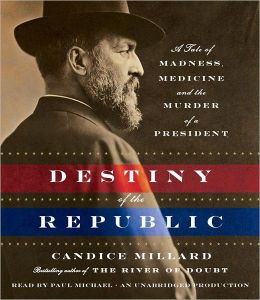
Destiny of the Republic: A Tale of Madness, Medicine and the Murder of a President by Candice Millard (audio)

destinyJames A. Garfield was the 20th president of the United States, and served one of our shortest terms: after being shot by assassin Charles J. Guiteau, he lived over two months before dying in September of 1881. Destiny of the Republic is the story of Garfield’s short presidency. As expressed in the subtitle, it is also the story of Guiteau’s madness and the medical era in which Garfield was unsuccessfully treated. What is left out of the title is the story of Alexander Graham Bell, who worked on a metal detector that was related to his recent invention, the telephone, with the intention of locating the bullet lodged in Garfield’s torso. So, to recap: this is the story of Garfield the President, Giteau the assassin, Bell the inventor, and a Dr. Bliss, who headed up the President’s medical team.

I knew next to nothing about Garfield, although I had a vague sense of his dying journey to the sea, passing by train through crowds of Americans gathered to honor him. I assume I’m not alone in my ignorance; he’s a long-dead president who (necessarily, by virtue of his short service) made no historical contributions sufficient to bring him to a modern layperson’s consciousness. So, I’ll fill in a little more. Garfield is painted in the opening chapters as a very sympathetic man: he did not aspire to the White House, but rather was nominated against his will by a post-Civil-War Republic Party that could not agree on any of the more favored candidates for nomination (Ulysses S. Grant, James G. Blaine and John Sherman). He was humble. In this book, he is a likeable character (more on that to follow).

Interspersed with descriptions of Garfield, his very humble past as a poverty-stricken and fatherless child, and his marriage to Lucretia (“Crete” ), are descriptions of Guiteau. Guiteau is, briefly, delusional. I don’t know what his diagnosis would be in today’s mental health establishment, but he would be diagnosed. He believes he deserves great things and the world owes him; he is a chronic petty criminal, and because he once wrote a speech (never delivered) stumping for Garfield, he believes upon Garfield’s election that he deserves a lucrative posting, preferably to Paris. (One of the hot political issues of this age was the spoils system.) In his diseased mind, Garfield’s failure to honor him becomes a crime punishable by death; and/or it’s God’s will that Garfield be killed; and/or Vice President Chester Arthur needs to be President for the sake of the country, etc. Thus the assassination.

Also interspersed are some of the thinkers of the era. Alexander Graham Bell has just invented the telephone, which although not ubiquitous, is beginning to change communications for some of the population, and will have great future impact; in the meantime Bell works feverishly on that and other inventions. Also contemporary is the British Joseph Lister, pioneer of the concept of antisepsis, or sterilization of medical (especially surgical) equipment. Medical minds of the day did not generally believe in germs, because they could not see them, and practiced surgery on the second patient with the blood of the first still wet on their hands (not to mention pus and general dirt). Lister tried to convince American doctors of the lifesaving power of sterilization, but in the case of Garfield’s Dr. Bliss, failed.

So the action of the story follows Garfield’s nomination, election, and early days in office; Guiteau’s descent into madness, and his shooting of the President; Bell’s laboratory work, including work on a machine to locate the bullet lost inside the President; and the medical community’s thoughts on antisepsis. Dr. Bliss is an unsympathetic character. He successfully bluffs a small crowd of other doctors, several better qualified, and at least one more open to the idea of sterile surgery, out of the White House, taking over Garfield’s care himself. He is imperious, intolerant, and unpleasant; it also turns out that he had the wrong medical ideas, with the knowledge we have now. Garfield suffers in the White House for some two months after being shot, with a bullet lodged near his liver. During this time he is endlessly poked and prodded with filthy fingers and probing implements, deep into his wound. We know now – indeed, they mostly understood upon his autopsy – that it was not the gunshot that killed him, but the massive infection caused by unsterilized instruments. And then, we hear of the First Lady’s mourning, and the trial and hanging of Guiteau. In the epilogue, we also follow Bell, Bliss and Lister through to their eventual ends.

I found this story fascinating, as perhaps is clear from my lengthy synopsis. I liked that Millard sketched the political background of the United States in the decades after the Civil War, the lingering divisiveness of North vs. South, the corruption of the spoils system and the conflict between VP Arthur and Garfield’s presidency. I found the characters interesting, compelling, and real. This history is told relatively briefly and at a quick pace: I think reluctant readers of nonfiction will be pleased, and yet I don’t have reason to think it was dumbed down or oversimplified. Destiny of the Republic is good, readable history for the mainstream reader, and I recommend it.

I do have one concern. Garfield is portrayed in a wholly sympathetic light. I don’t know enough to criticize him; but I’m always suspicious of such a glowing picture of a historical figure. Surely he wasn’t all good? I worry about so much praise, as I said in my review of Team of Rivals.

I really enjoyed getting a glimpse of the medical thinking of this era, which I thought was well handled, although in brief. The conceptual leap to believing in invisible germs and the risk of infection has to be one of the more important in the history of medicine, and I can understand how people like Bliss who thought they knew what they were doing would be skeptical, although it’s hard to sympathize with him in this story of the huge consequences of his skepticism (coupled with his egotism and nasty personality, of course). There was another angle I wish had been explored as well, regarding Bliss’s very imposing nature, the bossiness with which he took over Garfield’s care, and his unwillingness to let either the President or the First Lady choose a doctor or make medical decisions. This is another area of medical practice in which change has occurred much more recently: the authority of doctor versus patient. We’re still working this one out, but today, no doctor would be so likely to barge in and tell the wife of an unconscious man which doctor would be treating him; and if she called in the doctors of her choosing and fired the first, her decision would stand. Now, Mrs. Garfield never tried to “fire” Bliss – it wasn’t done. But that’s my point: the concept of who holds the power in that relationship, doctor vs. patient (& family/caregiver) has changed drastically. As someone who works in a hospital setting with patients and family members, not to mention some of the decisions I’ve seen made in my own family, my mind jumped at this part of Garfield’s story. He had no advocate to protect him against the failures of the medical establishment; no second opinions were allowed; the patient and his family were allowed no part in the decision-making process. Not only would antisepsis have made the difference to Garfield, but, I submit, patient advocacy and empowerment would likely have made a major change as well: if he had still died, at least he might have been much more comfortable, and I think quality of life even at the end of life should not be discounted. If I had written this story (with my perspective as a medical librarian), I would have added this facet to Garfield’s story as well.

Minor quibbles aside, I really enjoyed Destiny of the Republic and found it an easy, engaging, quick read that I would recommend to anyone. The audio production, read by Paul Micheal, was entertaining and gave the varying voices to the story that I think it needed. Well done.


Rating: 8 propaganda-ridden medical bulletins.

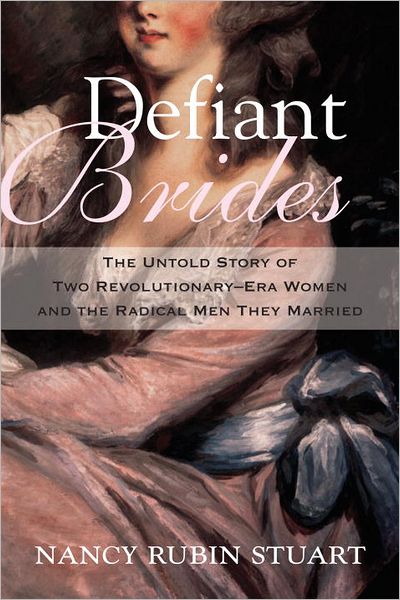
Defiant Brides: The Untold Story of Two Revolutionary-Era Women and the Radical Men They Married by Nancy Rubin Stuart

Parallel profiles of two wives on opposite sides of the American Revolution.

defiant

Margaret “Peggy” Shippen Arnold and Lucy Flucker Knox have traditionally been treated as historical footnotes in relation to their more famous husbands, Benedict Arnold and Henry Knox. Nancy Rubin Stuart (The Muse of the Revolution) remedies this neglect in Defiant Brides, a double biography that examines these two women as individuals as well as influential players in the American Revolution.

Peggy was a beautiful blonde belle of Philadelphia society, from a family that favored the British. Lucy was from a well-to-do, firmly Loyalist Boston family. The Shippens reluctantly admitted the political expediency of Peggy’s marriage to military hero Benedict Arnold; the Fluckers disowned Lucy for the sin of matrimony with patriot Henry Knox. Lucy supported her husband’s military and political careers in relative poverty and socialized with George and Martha Washington, even as she fretted over Knox’s long absences and missed the opulence of her youth. Peggy staunchly championed her husband through his treason and banishment and their subsequent financial difficulties in England and Canada; her part in Arnold’s betrayal at West Point, and her own possible role as a spy, remain controversial.

Stuart’s thoughtful research and consideration brings each woman forward into her own spotlight, reflecting on the flaws and strengths that Peggy and Lucy brought to their marriages and to the events of their time. Defiant Brides is an effortless read and a fresh perspective on the American Revolution, featuring two women who defied their parents to marry into a conflict that shaped a nation.


This review originally ran as a *starred review* in the April 23, 2013 issue of Shelf Awareness for Readers. To subscribe, click here, and you’ll receive two issues per week of book reviews and other bookish fun!


Rating: 7 degrees of loyalty.

Crossing the Borders of Time by Leslie Maitland (audio)

crossingCrossing the Borders of Time is a grand, sweeping story, combining history and tragedy with romance, and to top it off it’s nonfiction. Leslie Maitland grew up with the legend of her mother Janine’s great love, a man named Roland that she had to leave as a teen during World War II, when as a Jew she fled Europe with her family for the United States by way of Cuba. Roland was a French Catholic and had to stay behind, but the young couple pledged to marry as soon as they could. Janine’s family cooperated with the war to keep the two apart until Janine married an American man and had two children; her troubled marriage weathered several storms, but she always remembered Roland wistfully. As the book opens, Leslie’s father Len is dying, as Leslie heads off with trepidation on a journey to find the lost Roland and give her mother another chance at love. The author reads this audio version herself – a phenomenon with which I have had 100% success, continued here with Leslie’s own heartfelt recollections, and her relation of Janine and Roland’s stories complete with the French and German (and Spanish) accents that season their lives.

The iPod can be misleading when it comes to audiobooks. I don’t even remember loading this one into my gadget, and I certainly hadn’t remembered its length, so I was surprised as it unfolded into no fewer than 15 discs’ worth, about 19 hours. However, it was well worth the time spent. Maitland makes no pretense about the romance of this story – that is, that it is a love story, but also that she approached with a sense of romance, despite her training as a journalist. She occasionally has to stop herself and try to pull back, and question whether she’s behaving rationally, as she searches for the mythologized Roland. But this is a personal matter rather than a professional one, and it’s no surprise that she feels strongly, having grown up hearing about her mother’s first love.

Nevertheless, much of the tale is told in flashback, and in journalistic style, as Maitland reports the lives of her forbears: her great-grandparents Simon and Jeanette; her grandparents, Sigmar and Alice; and Janine, born Johanna (Hanna or Hannele) in German-held Alsace. As Alsace exchanged hands between France and Germany over the years, so Janine/Hanna struggled to define herself, as her parents’ first escape from Nazi Germany takes them just over the border from Freiburg into the French town of Mulhouse where she first met Roland. She would call herself French rather than German from that point forward. As Maitland’s story reaches her own era, her first-person voice reappears: she tells us her own perspective on her parents’ marriage, how distant her father, how conflicted her feelings about that beloved parent when he leaves for another woman and then comes back home again.

When the narrative fully inhabits the modern day and Maitland’s own perceptions, the pace picks up; what has been a history becomes a race against time as Janine ages and Roland remains elusive. Perhaps it is not too much of a spoiler to say that he is finally located; as a coworker of mine pointed out, there likely would not have been a book if Maitland had been unable to find him. But the final fates of our romantic hero and heroine are not straightforward, so you’ll still have to read the book to find out how it all concludes!

One of the greatest strengths of Crossing the Borders of Time has to be Maitland’s tone. I appreciated the air of nostalgia that permeates her telling of Janine’s history before and during the war; she combines journalistic style (citing sources, noting the odd inconsistency, describing an interviewee) with the emotional daughter searching for her mother’s legend. And if she lapses into the sentimental and romantic as things draw to a close, I don’t think she owes us an apology; I found this voice compelling and convincing, and entertaining.

Narrative nonfiction with emotion, but also a commitment to truth, always makes for a fine way to learn history. I found this an enjoyable, evocative, feeling story.


Rating: 7 hidden telegrams.

Teaser Tuesdays: Junius and Albert’s Adventures in the Confederacy by Peter Carlson

Teaser Tuesdays is a weekly bookish meme, hosted by MizB of Should Be Reading. The idea is to open your current read to a random page and share a few sentences. And try not to include spoilers!

junius

The title of this book is both playfully appealing and a little confusing, as some folks I’ve mentioned it to think it might be a children’s book. It is not. It is a history of two young Northern journalists who travel south during the American Civil War to act as war correspondents, are captured and imprisoned for many months, and eventually escape to trek north again. However, the playfulness remains: in the title, in the writing, and yes, in the story itself. Our two heroes share a certain cynical wit that occasionally lightens what is a quite sad story. As in…

Browne might be the only war correspondent in history to describe his near-death experience by quoting Goethe’s grandmother.

I liked this one line for what it says about the book as a whole – both its subject, and its presentation. Don’t you think?

This quotation comes from an uncorrected advance proof and is subject to change.

Teaser Tuesdays: Crossing the Borders of Time by Leslie Maitland, again

Teaser Tuesdays is a weekly bookish meme, hosted by MizB of Should Be Reading. The idea is to open your current read to a random page and share a few sentences. And try not to include spoilers!

crossing

I continue to enjoy this memoir by the daughter of a French-German Jew who fled the Nazis as a teen and thereby lost her love. I did tease you from it last week, but I thought these lines were too evocative, thoughtful and real not to share.

His impromptu recital was a peaceful close to a day that had wakened to the tumult of athletes speeding through narrow Renaissance streets, crowds cheering at corners and loudspeakers blaring. That evening I would leave feeling grateful for the quiet bravery of all the Ficks and the Fimbels, people who risked their lives to wrestle with power in places whose names are not even footnotes in history’s pages.

The setting for this scene is a French town the author is visiting, one of the several towns along her family’s route from Freiburg eventually to the United States. Fick and Fimbel are two men who helped them escape occupied France. The athletes are triathletes in competition, and the impromptu recital is given especially for the visiting Maitland by Fick, now a very old man, on the organ in his church; and I think all together they make a fine sweeping view of this place in time. For one thing (referencing Maitland’s title), the Renaissance streets that now see triathletes whizzing by on what I’m sure are very fancy bikes surely never expected such a thing. And then add the organ music played by a quietly heroic man for the daughter of a woman he hasn’t seen in many decades… there is something profound in this vignette, isn’t there?