My Life on the Road by Gloria Steinem

Gloria Steinem’s straight-talking memoir is rich with personal anecdote, political history and a fervent love for living on the go.

steinem

Gloria Steinem, founder of New York and Ms. magazines and many women’s organizations and a noted leader of the women’s movement, shares her stories from along the way in My Life on the Road. This simply stated memoir recounts Steinem’s childhood, her organizing and activism from her youth into the present, with commentary on the social and political events of those decades. But it is also explicitly a story of life lived on the move. As she sees it in hindsight, Steinem inherited a love for constant motion from her father, who lived for most of her life out of his car, with little Gloria keeping him company for her first 10 years. As a young woman not ready to settle down to marriage and motherhood, and then as an organizer, she kept moving. One chapter is dedicated to her choice to travel communally rather than use an automobile of her own, because it offers increased opportunities for contact.

In stating her goals for this book, Steinem cites storytelling as a central drive. Much is told in short vignettes, stories from those she’s met in her travels or lessons learned on her way. There are more than a few instances of Steinem making assumptions about people (Harley riders, cab drivers), only to have them proven wrong–emphasizing the idea that every person is more than he or she appears.

Steinem hopes to encourage her readers to hit the road, too. She is clearly deeply passionate about the advantages of travel: for perspective, for personal development and for plain enjoyment. She recommends that politicians travel the country and the world: “I called big-city contributors from on-the-road places, so I could say, ‘You don’t know what it’s like out here.'”

My Life on the Road is not a history of the women’s movement, although of course it contains many references to that history, as well as to the U.S. political climate and events of the second half of the 20th century. Instead, Steinem’s memoir is a glimpse into one remarkable woman’s life and philosophies of the road. It includes profiles of Steinem’s immediate family and friends like Bella Abzug, Wilma Mankiller and Florynce Kennedy, and briefly addresses the conflict between Steinem and Betty Friedan. Steinem’s writing style is personal, warm, approachable and straightforward. Her fans will be satisfied by this personal view, one that combines a love for people and places and stories and change with a love for movements–in both senses.


This review originally ran in the October 15, 2015 issue of Shelf Awareness for the Book Trade. To subscribe, click here.


Rating: 7 stories.

Mary McGrory: The First Queen of Journalism by John Norris

A pioneering journalist’s compelling life story, evocatively told.

mary mcgrory

John Norris’s Mary McGrory: The First Queen of Journalism is a well-researched and engaging biography of a fascinating figure, as well as an accessible view of some five decades of U.S. political history.

Mary McGrory had been a book reviewer for the Washington Evening Star for more than a decade when her editor offered her the chance to cover the Army-McCarthy hearings of 1954. Her first political assignment became the beginning of an influential career: she would go on to cover 12 presidential elections, and everything between. Boston Irish Catholic, with a strong impulse to volunteerism and charity, very proper and private in her personal life, Mary happily smoked and drank with the heartiest of her male colleagues. She flirted and made the men carry her bags, but “perhaps more than any other journalist in American history, she pushed her editors (and they were invariably men) to come to terms with the fact that women had something worthwhile to say.” Not an impartial journalist, even as she worked to push Bobby Kennedy into the 1968 presidential race, she practically hired Eugene McCarthy’s campaign manager herself. She never liked Nixon; dated Jack Kennedy before he was married (or president); was propositioned by Lyndon Johnson. Despite such drama, however, her greatest accomplishments were journalistic, as her exhaustive list of awards indicates.

Even with such absorbing material, Norris (The Disaster Gypsies) earns his reader’s respect with careful attention to detail and a precarious but precise balance between his primary, individual subject and the context of U.S. and world history. Mary McGrory is a striking story, meticulously and entertainingly portrayed.


Come back on Wednesday for my interview with John Norris.

This review originally ran in the September 22, 2015 issue of Shelf Awareness for Readers. To subscribe, click here, and you’ll receive two issues per week of book reviews and other bookish fun!


Rating: 7 Christmas parties.

Teaser Tuesdays: My Life on the Road by Gloria Steinem

Teaser Tuesdays is a weekly bookish meme, hosted by MizB of Should Be Reading.

my life on the road

I was intimidated to read this book by Steinem – my first of hers – because she is such an accomplished, impressive woman. But I shouldn’t have been. She is warm and approachable on the page. Her story is not only of interest and worth reading (which of course I knew going in), but also well and simply told.

The book is a series of stories, and for today’s teaser, I’ve chosen one very short one for you.

On another campus, some women tell me about men who leave their own underwear on the floor and don’t feel compelled to pick it up – or even notice what they’ve done. By now, the shouts and laughter have become quite rowdy, and I’ve begun to worry about a silent young Japanese woman in the front row. Perhaps we are offending her.

As if summoned by my thought, she stands and turns to face all five hundred or so women. “When my husband leaves his underwear on the floor,” she says quietly, “I find it useful to nail it to the floor.”

Amid laughter and cheers, this shy young woman seems surprised to find herself laughing, too. She tells the group this is the first time she has ever said anything in public.

This quotation comes from an uncorrected advance proof and is subject to change.

Teaser Tuesdays: Mary McGrory: The First Queen of Journalism by John Norris

Teaser Tuesdays is a weekly bookish meme, hosted by MizB of Should Be Reading.

mary mcgrory

I am reading a delightful biography of a groundbreaking newspaperwoman, who wrote book reviews (ahem!) before her political coverage began; she would cover 12 political campaigns (and everything in between) in her lengthy and influential career. I am reminded somewhat of Newspaper Titan. But John Norris can tell it better than I can, of course.

In many ways, Mary was as much an anolmaly at the end of her career as she was at its beginning. When she broke through, during the Army-McCarthy hearings, she was the lone female reporter in the room. On the campaign trail, she was one woman surrounded by a hundred men. By the end of her career, she was working in an environment where there were more and more women, most female reporters were married, and employers like the Post provided maternity leave and benefits. To this new generation of women, Mary was a throwback: the woman who took on McCarthy and Nixon; the pioneer who was forced to decide between career and love; a beloved relic from an earlier era who drank with the Kennedys and crafted handwritten thank-you notes. Mary had gone an entire career without ever being the norm.

Stay tuned for my review of the book, followed by my interview with the author.

This quotation comes from an uncorrected advance proof and is subject to change.

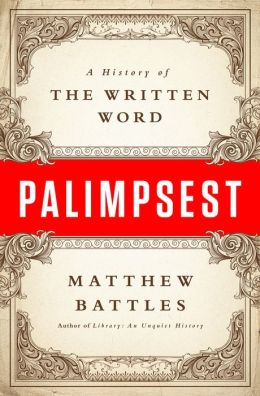
Palimpsest: A History of the Written Word by Matthew Battles

Bibliophiles and historians will be thrilled by this enthusiastic, detailed account of writing throughout history.

palimpsest

Matthew Battles (Library: An Unquiet History) undertakes a mammoth topic with Palimpsest: A History of the Written Word. Rather than an exhaustive chronicle, however, he has composed an extended meditation, a roaming through the centuries. The result is a collection of narrative examinations of writing as a technology, as a means of wielding power, as artistry and as communication. As Battles quotes it, the Oxford English Dictionary defines a palimpsest as a “writing surface on which the original text has been effaced or partially erased, and then overwritten by another.” His imagination is captured by this concept in fact and as metaphor, and Palimpsest is in part a drawn-out consideration of “mind as page” and “page as mind” (the titles of its opening and closing chapters).

Battles’s survey ranges from Mesopotamian cuneiform in the fourth century BCE to early printing, word processing and social media. He explores Thoreau’s views on Confucianism, the clay tablets of The Epic of Gilgamesh, the topology of Chinese hanzi and the fascination with writing in Great Expectations. He is intrigued by the politics of the printing press and various typefaces. Historians, writers, philosophers and anthropologists including Socrates, Claude Lévi-Strauss, Jean-Jacques Rousseau, Emily Dickinson, Ezra Pound and Ralph Waldo Emerson provide context for the philosophical significance of writing. Battles points out that modern computer code is a type of writing as well, “a kind of text that can’t exist on its own. But what other kind of text has ever existed?”

Among other revelations, Palimpsest elucidates the original meaning of “pirated” literature: “not… the unauthorized reproduction of someone else’s work but the use of a printing press without proper license,” and Allen Ginsberg’s modern redefinition of “graffiti,” which originally referred in the Italian to words or ornaments carved in clay forms. How we learn to write changes as our cultural expectations of writing change; thus what Battles calls a “feedback loop” of change in writing technologies perpetuates. In other words, in an increasingly digital age, Battles argues that writing is in flux–as it has been since its beginnings.

Palimpsest returns more than once to an emphasis on writing as art, and Battles’s own writing style is often decorative. The meandering structure of this expansive essay on writing in history, as well as its formal and academic tone, may pose challenges for some readers. However, the reader and writing fan absorbed by writing’s miscellany will find much to love and sink into in Palimpsest.


This review originally ran as a *starred review* in the July 10, 2015 issue of Shelf Awareness for the Book Trade. To subscribe, click here.


Rating: 4 radicals.*

*For my personal reaction to his style, although the quality of writing and research are sure to please other readers.

The Wilderness of Ruin: A Tale of Madness, Fire, and the Hunt for America’s Youngest Serial Killer by Roseanne Montillo

A dramatically told history of murder, madness and urban growing pains.

ruin

In The Wilderness of Ruin: A Tale of Madness, Fire and the Hunt for America’s Youngest Serial Killer, Roseanne Montillo (The Lady and Her Monsters) concentrates on a gripping era of Boston’s history. In the late 1800s, a series of seemingly unrelated events are her focus: the Great Fire of 1872, which broke out despite the efforts of a fire chief who saw dangers parallel to Chicago’s Great Fire the previous year; the literary work of Herman Melville, who was increasingly fascinated by the concept of insanity; and, at the heart of this book, the crimes and incarceration of a boy named Jesse Harding Pomeroy.

Montillo follows Pomeroy’s childhood, his early crimes of torture against younger boys and the murders of two small children for which he would be convicted, in a burned-out city struggling with modernization and increasing class divisions. Throughout the investigation and trial, Pomeroy exhibits characteristics that would later have termed him a psychopath, and his lawyers’ attempt to plead insanity is part of the early establishment of precedent in such cases. Meanwhile, Melville experiments in his literature with the labels of monomania and moral insanity, and Dr. Oliver Wendell Holmes applies his medical expertise to the possible role of sensational dime novels in Pomeroy’s crimes, and weighs in on the question of executing the boy, who was 14 years old at the time of his conviction. Using detailed research, Montillo braids together these cross-disciplinary subjects–urban development and class, fire and murder, the definition of insanity and the standards of judicial punishment–into a story that has the momentum of a thriller.


This review originally ran in the March 31, 2015 issue of Shelf Awareness for Readers. To subscribe, click here, and you’ll receive two issues per week of book reviews and other bookish fun!


Rating: 6 piles of ashes.

my anniversary in history

This post is somewhat related to a an ongoing series.


Today is the 7th anniversary of my marriage to this handsome, supportive, bike-riding, brewing Husband.

wed

On a far more sober note, some reading I did several months ago yielded these surprising coincidences. Also on April 19, in 1937:

  • Picasso began to conceive & sketch his theme for a commissioned mural that would become Guernica;
  • Canadian Norman Bethune resigned from the revolutionary blood transfusion organization he had founded & shaped in republican Spain; and
  • sent by the Nazis, twelve newly designed Messerschmitt Bf 109s arrived in northern Spain to support Franco’s forces.

These are momentous events that shaped the Spanish Civil War and its place in history, and I was struck that a day so meaningful in my life would have such larger implications. I just wanted to share.

…Thanks to Hell and Good Company, a fine book by Richard Rhodes, for these timely details.

Strong Inside: Perry Wallace and the Collision of Race and Sports in the South by Andrew Maraniss

A perceptive, sensitive history of both basketball and desegregation in the late 1960s.

strong inside

Perry Wallace, Jr., was a quiet, respectful student from Nashville, Tenn., who excelled at school (especially in math and science), at playing the trumpet and on the basketball court. Though not a natural leader or revolutionary, when recruited by schools across the nation, he reluctantly “made the decision to attend Vanderbilt University not because of the fact that he would be a trailblazer, but in spite of it.” When he enrolled in 1966, Wallace became the first African American to play in the Southeastern Conference, thus desegregating Deep South athletics. At Vanderbilt, he played in the same gym where Stokely Carmichael and Martin Luther King, Jr., participated in a speakers’ symposium during Wallace’s freshman year.

In his four years at “the Harvard of the South,” Wallace was harassed, spat upon, called names and assaulted on the court in a series of “fouls” that went uncalled. (His coach told him to “learn to duck.”) The away games in Mississippi were the worst, but even at Vanderbilt his classmates publicly ignored him, yet still cheered him on the court and furtively asked for his help with their homework.

Andrew Maraniss’s Strong Inside: Perry Wallace and the Collision of Race and Sports in the South deftly reveals the nuances of Wallace’s childhood, early education, groundbreaking career of torments and triumphs at Vanderbilt and the exceptional, well-rounded life that followed. A Vanderbilt alumnus, Maraniss shows great compassion and insight with a detailed narrative that is both broad and deep, covering the civil rights movement and college basketball with equal authority. Wallace’s story is powerfully moving and deservedly, beautifully told.


This review originally ran in the March 17, 2015 issue of Shelf Awareness for Readers. To subscribe, click here, and you’ll receive two issues per week of book reviews and other bookish fun!


Rating: 8 fouls not called.

A Greater Ireland: The Land League and Transatlantic Nationalism in Gilded Age America by Ely M. Janis

Scholarly examinations of a political movement delve into the nature of the Irish American identity.

greater ireland

A Greater Ireland: The Land League and Transatlantic Nationalism in Gilded Age America, by Ely M. Janis, is a concise, meticulously researched examination of one specific thread in a shared Irish and Irish American history: the Irish National Land League of the 1880s. This organization spanned the globe, uniting citizens of both Ireland and the United States in pursuing Irish land reform and self-rule, and had lasting repercussions for Irish American identity and political involvement.

…Click here to read the full review.


This review was published on February 27, 2015 by ForeWord Reviews.

IMG_4538


My rating: 3 speaking appearances, for tedious readability.

Maximum Shelf: Dead Wake: The Last Crossing of the Lusitania by Erik Larson

Maximum Shelf is the weekly Shelf Awareness feature focusing on an upcoming title we love and believe will be a great handselling opportunity for booksellers everywhere. The features are written by our editors and reviewers and the publisher has helped support the issue.

This review was published by Shelf Awareness on February 9, 2015.


dead wakeIn May of 1915, a torpedo fired from a German submarine struck the RMS Lusitania, a British passenger ship with nearly 200 Americans aboard. She sunk off the coast of Ireland in less than 20 minutes (due to a sequence of events unforeseen even by its attacker), killing 1,200 passengers and crew, fully half of whose remains were never recovered. Common knowledge has it that this event drove the United States to enter a European war that would become World War I, but, in fact, while the Lusitania‘s fate played some role in that decision, it took two full years and the secret German Zimmerman telegram for the U.S. to enter the war in 1917.

Erik Larson examines this extended U.S. isolationism, the final days aboard the Lusitania, and related events and characters in Dead Wake: The Last Crossing of the Lusitania. As in his earlier books (Isaac’s Storm; In the Garden of Beasts), Larson presents exhaustive research with precision and accuracy, in extraordinarily compelling prose. Dead Wake is a masterpiece of gripping narrative nonfiction, arguably the most riveting of Larson’s works.

Nearly 2,000 people boarded the Lusitania in New York City, bound for Liverpool, including 1,300 passengers, of whom 189 were Americans. An unusually large proportion were children and babies. The Lusitania was the biggest and fastest civilian ship on the seas in that 10th month of European war. These superlatives–plus the reassurances of the captain, William Thomas Turner, and the Liverpool-based Cunard Line–allowed the ship to confidently set sail despite a German warning published in all the New York papers on the morning of the Lusitania‘s departure, that “vessels flying the flag of Great Britain, or of any of her allies, are liable to destruction.” Larson provides detail and humanity by profiling several passengers and crew members, including a Vanderbilt heir; a psychic; and a Boston bookseller who boarded with a small but invaluable collection of William Makepeace Thackeray’s original illustrations and Charles Dickens’s own copy of A Christmas Carol, complete with the author’s marginalia.

Just weeks earlier, another vessel had departed from the other side of the Atlantic Ocean. German Unterseeboot-20 was captained by Walther Schwieger, a well-regarded young Kapitänleutnant known for his aggressive and innovative tactics. Because submarines lost radio contact with their bases almost immediately upon departure and remained out of contact for much of their cruise, Schwieger was in full charge of his boat, empowered to cruise, dive and attack on his own, with the full support of his government. In following Schwieger’s submarine in the weeks leading up to the climax, Larson gives the story dimension; far from presenting the German captain as a monster, he is humanized, for example, by the devotion of the men who worked under him, and the presence on board of a litter of puppies rescued, interestingly, from another ship sunk by torpedo.

As he builds toward the inevitable intersection of U-20 with the Lusitania, Larson introduces more characters. Captain Turner of the Cunard Line had decades of experience at sea, and had just testified in a civil case against the owners of the Titanic on behalf of the families of deceased passengers. He was known to his men as a brave and capable but old-fashioned captain, with “one foot on the deck of a sailing ship.” U.S. President Woodrow Wilson had had a rough year, even without the European conflict: having lost his wife Ellen in late 1914, his mourning left him unmoored and struggling to concentrate, until he met widow Edith Bolling Galt. His love for her would prove overwhelming, and their courtship strained–she rejected his first marriage proposal. This love story is affecting, and if it serves as a distraction from the sinking ship at the center of this book, that is a fine style choice by Larson: it was a distraction for Wilson, too.

Meanwhile, a secret section of the British Admiralty was tasked with intercepting and decoding German wireless messages, a purpose known to only nine senior officials, who were hampered in using any information gained for fear of having its cryptanalysis ability revealed. They would therefore fail to warn Turner of U-20’s preying presence in the waters he sailed. Such parallel plots and individual profiles add color and depth to Larson’s account, as when the chief of British naval intelligence is described as “part Machiavelli, part schoolboy.”

The Lusitania‘s story is in itself moving, and carries great historical significance, but these events positively glitter with life in Larson’s engaging, quick-paced and captivating prose. Though it incorporates well-documented history, Dead Wake still contains elements of suspense for all but the most expert readers; as Larson acknowledges, he had his own misconceptions coming into this project, and learned surprising facts in his research, as readers surely will. The pages fly by as such details are revealed and the action ratchets up toward a climactic event that we all see coming, but that still makes us catch our breath. In spellbinding, immediate language, Larson contrasts the “books, and cigars, and fine foods, afternoon tea, and the easy cadence of shipboard life” on the Lusitania with the “U-boat sweat,” foul odors and close air aboard U-20. His enthralling description of passengers joking about submarines and torpedoes, in the very moments before the torpedo strike, and “making polite apologies” just after, in the scramble for life jackets, keep the reader fully engaged. Appealingly, in his “Note to Readers” and “Sources and Acknowledgments,” Larson writes in a more personal voice about the joy of the research process, and about his frank difficulty in understanding the passengers who boarded the Lusitania in the face of warnings from Germany about travel in a war zone.

Dead Wake is both a thoroughly satisfying read, and an unparalleled adventure into world history. Larson’s fans will rejoice, and grow in number.


Rating: 8 life jackets.

How lucky am I to get to interview Erik Larson?? Come back tomorrow to read the result.