Maximum Shelf: Let Us Descend by Jesmyn Ward

Maximum Shelf is the weekly Shelf Awareness feature focusing on an upcoming title we love and believe will be a great handselling opportunity for booksellers everywhere. The features are written by our editors and reviewers and the publisher has helped support the issue.

This review was published by Shelf Awareness on May 17, 2023.


Two-time National Book Award-winner for Fiction Jesmyn Ward (Men We Reaped; Navigate Your Stars; The Fire This Time; Sing, Unburied, Sing; Salvage the Bones) takes a different direction with her fourth novel, Let Us Descend: it’s her first historical narrative. Beautifully written and heartrending, Ward’s story sensitively handles grief, love, and recovery. On a rice plantation in the Carolinas, an enslaved teenager named Annis narrates as she works alongside her beloved mother. Mama is a source of comfort and strength even as her finger bones are “blades in sheaths.” Annis says, “The first weapon I ever held was my mother’s hand.” This steely woman teaches Annis lessons of combat learned from her own mother, one of thousands of warrior wives to an African king, tasked with both protection and elephant hunting. “In this world, you your own weapon,” she tells her daughter, and Annis will need to be.

Annis’s father is the plantation owner who owns her and her mother. Annis has half-sisters in the big house. “My sire’s house hulks; its insides pinned by creaks,” and her “sallow sisters” have a tutor to read to them, to teach them the texts of ancient Greece, about bees and wasps and Dante’s Inferno: “The tutor is telling a story of a man, an ancient Italian, who is walking down into hell. The hell he travels has levels like my father’s house.” Let Us Descend‘s title is a nod to Dante, and a cue to the reader to notice hells, descents, and journeys south. Annis listens and learns. Through her natural gifts, her own interest, and with her mother’s help, she becomes skilled in foraging: herbs, mushrooms, medicinal plants, and simple foods. She learns to befriend the bees she hears her sisters’ tutor speak of.

Then Annis’s father chooses to sell her mother south. The “Georgia Man” takes her away in a line of stolen people for the long walk to market. Annis falls into a near-fatal grief at being left without the most important person in her life, until a kind friend pulls her back to the surface. But soon, Annis and Safi, her friend-turned-lover, are sent on the same walk with the Georgia Man. From the plantation where she was born, Annis makes a death march to a New Orleans slave market and is sold to a cruel lady whose Louisiana sugar plantation marks a further descent, into a new level of hell. Others will uplift her along the way, but she never shakes the excruciating grief for her mother.

Along the way she gains and loses friends, and meets a spirit: Aza controls the storms and winds, and has stolen the name of Annis’s maternal grandmother, the warrior Mama Aza. “Aza’s hair a living thing: scudded clouds, the setting sun lighting them on fire. She leans forward and a breeze blows from her. Feels like the slap of a freshly washed linen on my face, snapping in a cool wind.” The spirit seeks her own identity and self-importance in relation to others, and has locked onto Annis’s maternal line as a way to achieve this: she models herself after the grandmother Annis never knew, and her use of the name Aza represents both connection and theft. That Annis refers to enslaved people like herself as “stolen” adds a layer to Aza’s use of the name.

Less centered around plot and character than Ward’s previous novels, Annis’s story is more elemental and thematic, dealing primarily with grief, forces of nature and human evil, villains and allies. The spirits she meets–chiefly Aza, but others as well–are closely associated with natural forces. “Another spirit, white and cold as snow, walks the edge of the river; it hungers for warmth, for breath, for blood, for fear, and it, too, glances against the enslaved stolen and feeds. Another spirit slithers from rooftop to rooftop before twining about wrought iron balconies outside plaçage women’s bedrooms, where it hums, telling the bound women to portion out poison in pinches over the years, to revolt, revolt, revolt.” These spirits can help but also harm, offer but also take away; they may represent another form of attempted ownership, as Aza has taken Mama Aza’s name. In a magical-realism twist, Annis finds these spirits widen her world beyond her immediate suffering to other timelines and possibilities.

Just as Ward’s title refers to Dante’s story of a descent into ever-deeper levels of hell, her hero makes a parallel, nonconsensual descent into the deeper South, into pain and suffering and sorrow, and into the worsening and worst of humanity. The novel moves with Annis from the Carolinas to Louisiana, and in story, back to Africa, where Mama Aza established the fighting spirit she would pass on.

Ward gives Annis’s voice a raw strength and musicality. After she is imprisoned in an underground cell by a particularly sadistic plantation owner, Aza tells her, “When you were up north, your sorrow choked your song. Swallowed it down. Even so, it hummed. But the walk changed it. The further you went, the more it rose until the woman put you down in the earth. Then it shrieked.” Attention to descriptive detail emphasizes Annis’s close relationship to place, and the importance of the land itself (not least in supplementing the enslaved people’s painfully meager allotted diet). “The water reaches in every direction, duckweed bright and green, floating on the murky wet. Cypress, fresh with rain, shimmers.”

As much pain, struggle, torture as there is in these pages, there are also various forms of love, and great strength, power, and personal reclamation. Let Us Descend ends with surprising hope. “How the whitewash of starlight would buoy them along. How they dance with the rocking deck. How them sing.” With this novel, Ward’s talent continues to deepen and glow.


Rating: 6 broad, glossy leaves.

Come back Friday for my interview with Ward.

A History of Burning by Janika Oza

Janika Oza’s A History of Burning is a stunning multigenerational saga that follows a family and a community who move during the years 1898 to 1992 from India to Kenya to Uganda, to Canada and the U.K., and beyond. In nearly a dozen voices, Oza’s debut novel illuminates immigration patterns and pain alongside familial joys and sorrows.

Readers first meet 13-year-old Pirbhai in Gujarat, India; he is, as the oldest son, fierce with the need to provide for his family. In exchange for a coin and the promise of opportunity, he unwittingly sells himself into labor on the railroad the British are building in East Africa. Pirbhai builds a family and a community with other Indian Africans; his children and grandchildren feel buoyed by the strong ties but sometimes limited by the strictures of tradition and duty. After Ugandan independence, anti-Asian sentiment drives them out of the only country they have known. Pirbhai’s son, Vinod, thinks there must be a “third possibility–not African, not Indian, but something beyond borders, an identity forged over decades of scattering apart and, miraculously, finding repair.” Each generation struggles in a new place, the tight-knit family always navigating change and searching for a place to call their own. Oza’s gorgeous prose is lush with detail–colors, flavors, emotions–and saturated with loveliness and pain, “the messy, the beautiful, the wild improbable light.” A History of Burning admirably charts how–by the time Pirbhai’s descendants plant seeds in Canadian soil–history, both personal and collective, is formed from the stories we tell and the silences we allow to remain.


This review originally ran in the May 5, 2023 issue of Shelf Awareness for Readers. To subscribe, click here, and you’ll receive two issues per week of book reviews and other bookish news.


Rating: 8 matunda.

Murder Your Employer: The McMasters Guide to Homicide by Rupert Holmes

So you’ve decided to commit a murder.

Congratulations.

Murder Your Employer is a genre mash-up, and great fun. It purports to be a how-to manual on how to commit a murder (the Conservatory prefers “deletion”) without getting caught – in this case, specifically the deletion of one’s employer, with future volumes promised. (Other popular deletions include work rivals, financial advisors and spouses.) The book’s narrator is Dean Harbinger Harrow – Dean being not a first name but a title, as he serves as Dean of the McMasters Conservatory for the Applied Arts, a top-secret institution that trains would-be deletists to remain successful and forever unknown. It contains narratives within, however: short on actual training-manual-style directives, instead the bulk is made up of examples in the form of the stories of three McMasters students, all majoring in employer deletions.

The central protagonist is Cliff Iverson, who botched his first attempt to murder the toxic, womanizing, belligerent boss at his aircraft manufacturing job. Instead of criminal charges, he faces involuntary admission to McMasters (for very mysterious reasons). We are treated to his journal throughout, as well as the Dean’s notes on the progress of Cliff and two fellow students: Gemma Lindley, who needs to get rid of her blackmailing boss, and a woman known at the school as Dulcie Mown, although everyone finds her dimly familiar (the reader knows why).

So we have a how-to-manual, framing an epistolary novel (journal entries and other documents), in an idyllic boarding school milieu, on the absurdist subject of ‘an education in murder,’ filled with wordplay, puns and humor, with a certain amount of suspense as our three students aim to successfully complete their theses (intended deletions), wrapped up in a mystery (who is responsible for Cliff’s enrollment at McMasters in the first place?). Oh and the setting is historical, in the 1950s, so bookies and bad guys have a certain style and type. It is a mad, beautiful mess of genres, and I found it enormous fun (despite a rather crabby review from Kirkus, who does not think it cute). Yes: it does require a fair amount of suspension of disbelief; I would think that would be obvious, since it’s a slightly unhinged promotion of the murderous arts. (Somewhat in their defense, McMasters does have some moral standards. Make sure your target is deserving and all other options have been exhausted; no innocent bystanders; certainly no serial killings or mass murders; etc.) It’s ridiculous and it knows it (think The Princess Bride).

The pacing is not snappy, but I thought it was nice to linger with each of our characters – Harrow rather silly, Cliff earnest and serious, Gemma haunted, Dulcie driven – and in the slightly cartoonish historical setting. The McMasters world itself is a sort of madcap Opposite Day, and the ‘real’ world features caricatures. Dean Harrow is a bit of a buffoon (and yes, pun-obsessed). It was fun and, I admit, relaxing. The whole conceit is ludicrous enough that it let me let go. I don’t think real life murders are cute, but this book surely is.


Rating: 7 MacArthur-style sunglasses.

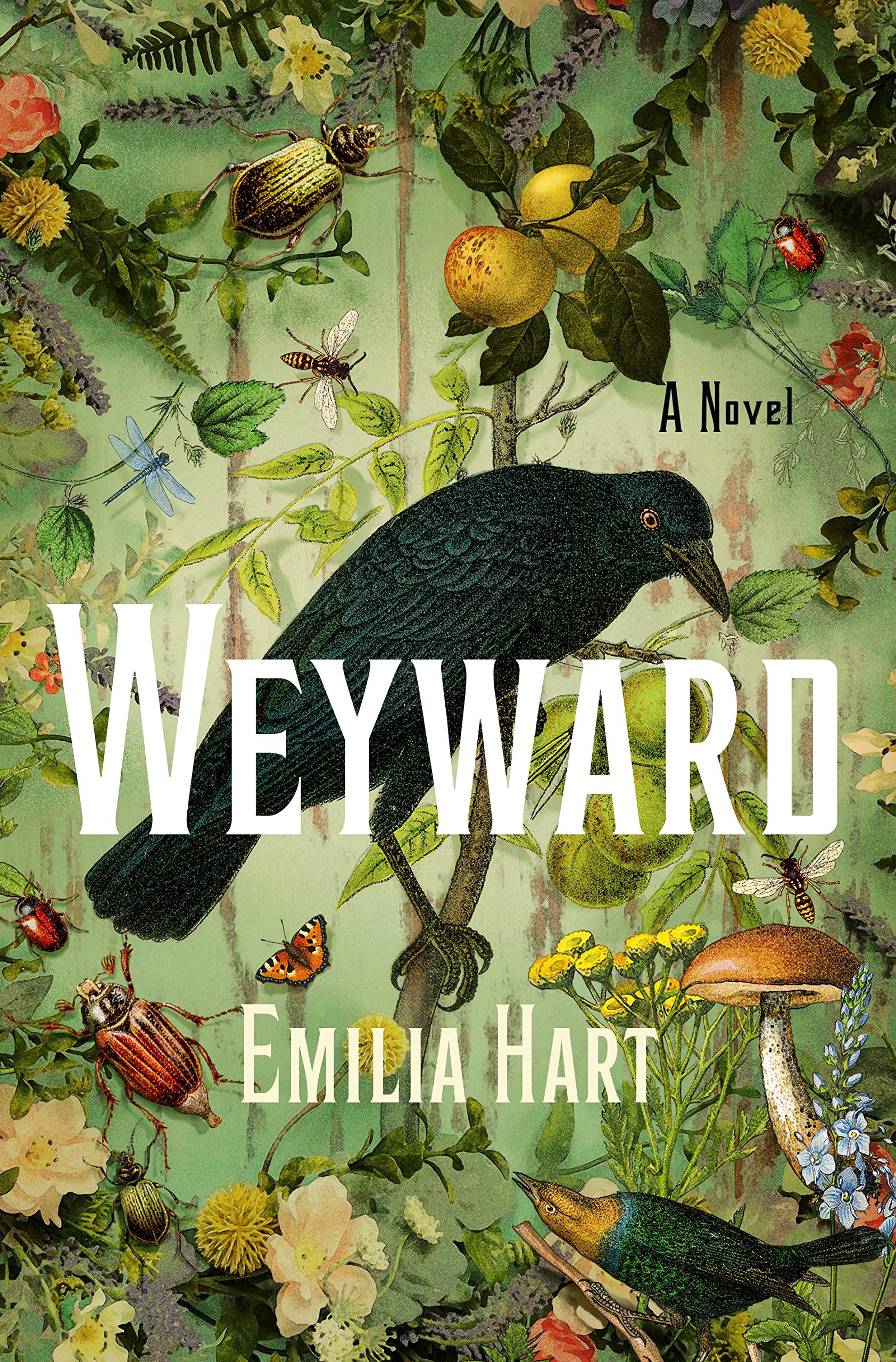
Weyward by Emilia Hart

The stories of three imperiled protagonists across centuries connect in this suspenseful, magical debut about the power of women and the natural world.

Emilia Hart’s first novel, Weyward, glows and glimmers with hidden powers, thrills and danger, a close connection with nature and between women across time. Three distinct stories eventually link to form a larger tale about strength, resilience and love.

Altha goes on trial for witchcraft in the English countryside in 1619. In 2019 London, Kate attempts to escape an abusive partner while harboring a significant secret. And at a grand estate in 1942, teenaged Violet struggles against the limitations of her father’s strict household rules, consumed by an unladylike love for trees, insects and other natural wonders. In alternating chapters, each of these stories deepens. Altha, the daughter of a healer, tries her best to follow in her beloved late mother’s footsteps, helping her neighbors and causing no harm, while dodging the increasingly avid witch-hunters of her time. Locked in a Lancaster dungeon, Altha does what she can to protect herself. Kate flees the city undetected, holing up in a cottage inherited from a great-aunt she hardly knew, but her safety there is tenuous as she plans for an uncertain future. Violet is a tenacious and spirited 16-year-old, but powerless as she is imprisoned in her father’s world; she dreams of becoming a biologist or an entomologist, but cannot even visit the local village. Men in the Weyward world, in all three timelines, are sources of power and abuse, not kindness, but Violet’s loyal brother forms a notable exception.

Each woman must learn about and come to terms with her powers and her connections to the natural world. Violet is passionately entwined with a particular beech tree, with damselflies and weasels, but no one will even tell her her mother’s name, let alone the family history that she senses casts a shadow on her life. Having lost her father at a young age in a curious accident, Kate lives in fear of the birds and insects that most call to her. Altha is reluctant to exercise her full powers, having promised her mother she would be careful. But, she says, “I had begun to suspect that nature, to us, was as much a life force as the very air we breathed.”

Hart expertly weaves together disparate but connected storylines, with leaves and butterfly cocoons and a mountain stream. Her protagonists are strong, but hard beset by the forces around them, even across centuries. Her prose sparkles with wonder and simmers with danger. Weyward‘s atmosphere is compelling, as each plot thread offers suspense. With a momentum of its own, this debut draws readers inexorably to a glorious conclusion that celebrates connectedness and the power of women and nature.


This review originally ran in the February 2, 2023 issue of Shelf Awareness for the Book Trade. To subscribe, click here.


Rating: 7 feathers.

Stone Blind by Natalie Haynes

Natalie Haynes splendidly showcases classical scholarship, witty humor and an appreciation for nuance in this reframing of the story of Medusa.

With Stone Blind, Natalie Haynes (A Thousand Ships; Pandora’s Jar) brings her authoritative expertise in Greek myths to bear on Medusa, whose story is fresh and surprising in this telling. Haynes is both a scholar of the classics and a stand-up comic, and that combination is brilliantly evident in this sardonic, darkly funny adaptation.

Stone Blind combines several threads familiar to fans of Greek mythology, although readers need no previous knowledge to follow along. Zeus, king of the gods on Olympus, philanders and bickers with his wife, Hera; this narrative will witness Athene’s birth and a battle between gods and giants, among other Olympian events. Medusa is delivered as an infant mortal to the two elder Gorgons who will be her sisters–in this version, they are monsters only in their unusual appearance, and they care for their fragile mortal sister with great tenderness. As a young woman, Medusa is raped by Poseidon in Athene’s temple. The goddess is so offended by this sacrilege that she punishes the victim, replacing Medusa’s hair with snakes and bestowing her most famous attribute: the ability to turn any living creature to stone by eye contact. In a third thread, the demigod Perseus comes of age as a bumbling incompetent: self-serving, lazy, whining, unnecessarily violent. And Andromeda, legendary beauty and princess of Ethiopia, is cursed to death by her mother Cassiope’s hubris.

These threads come together in complex ways when gods are offended and angered and play out their dramas with mortal pawns. Traditional storytelling has cast Perseus as a hero and Medusa as a monster, but Haynes does not concur: “The hero isn’t the one who’s kind or brave or loyal. Sometimes–not always, but sometimes–he is monstrous. And the monster? Who is she?”

“Who decides what is a monster?” Medusa’s sister asks. To which Medusa responds: “I don’t know…. Men, I suppose.”

Haynes’s genius lies not only in her subtle recasting of this story–with an emphasis on who assigns roles and draws conclusions–but in her dryly scathing humor. Her gods are (even more than usual) immature, selfish and often silly. Athene is “delighted with herself” for the simplest of observations about humanity; she burst forth from Zeus’s head fully formed, but not necessarily with the emotional maturity or world knowledge her physical perfection would imply. Poseidon’s bluster and Zeus’s carelessness of his children are exaggerated. Perseus is a dolt, impervious to learning the lessons of his (mis)adventures. Haynes writes in many voices: those of olive trees, Medusa’s snakes-for-hair, a crow, the gods and mortals that make up this twisting tale. A surprising ending caps off her truly delightful and novel version of a very old story.


This review originally ran in the January 6, 2023 issue of Shelf Awareness for the Book Trade. To subscribe, click here.


Rating: 8 birds.

Homegoing by Yaa Gyasi

I’ve had this one on my list(s) for a while now, but as it increasingly appeared in credits from books I enjoyed – as inspiration, as research, as most admired – I knew I needed to get to it sooner. Homegoing deserves the accolades. It’s both expansive and easy to read, in how beautifully it flows – although the subject matter is not generally easy.

There’s a helpful family tree in the front matter, as in These Ghosts are Family (which is one that refers to this book in an interview with the author at the end). This lets readers track the connections as we move through generations. Each chapter is titled for the character it focuses on, and each character appears in the family tree; they are featured chronologically across centuries. At the head of this tree is a woman called Maame who lived in what is now Ghana in the mid-1700s. We slowly learn that she had two husbands and two daughters at two different points in her life in Fante and Asante territories respectively. The daughters, Esi and Effia, did not know about each other, and their lives led in different directions. Near the novel’s beginning they are found under the same roof but in very different circumstances: one as the wife of a white British slaver, the other imprisoned in the dungeon underground. One is able to stay in her home region (Gold Coast as a British colony), while the other is kidnapped and carried across an ocean to become a slave in America. Later chapters follow their descendants until more or less contemporary times – everyone on the family tree gets a focus chapter except for Maame herself, whose story we learn only in pieces. These lives are filled with color and detail and struggle and pain, and love and music and beauty; in every iteration they continue to witness racism, colorism and the enduring legacies of slavery and colonialism, in different ways. I of course failed to mark the quotation that said so eloquently how the same prejudices were ongoing but in subtler and more insidious ways in later times than they had been in slavery’s heyday.

Homegoing is a beautiful, absorbing novel. Every one of the featured lives is so finely wrought, I spent at least half the book lost in each of them individually; it took me most of the book to begin anticipating their connections, although I was aware of those connections all along. They are all filled with such detail and richness, but it is possible that earlier chapters stand alone more securely than later ones. Some readers call this a novel in connected stories, and I do feel that each character’s story is a whole work in itself. But there’s no question in my mind that it is more novel than collection.

Aside from realistic portrayals of lives across a remarkable span of years and locations, Gyasi also offers threads of something mythic or otherworldly: there are persistent suggestions that this family may be cursed by ill luck and fire, and its members may have a special gift of foresight. Indeed, some coincidences are difficult to explain. On the more real-world side, Homegoing is very much about the legacy of slavery from African roots to American “improvement” of the system. It has big thoughts and observations to make while still being first a story about individual people.

The New Yorker is rather harder on this book in Laura Miller’s review, and I confess that she has some points, particularly about typing in the American characters versus the African ones. The larger impression I walk away with is much more positive than Miller’s seems to have been. But I am entirely on board with her optimism about Gyasi’s future work.


Rating: 9 cocoa nuts.

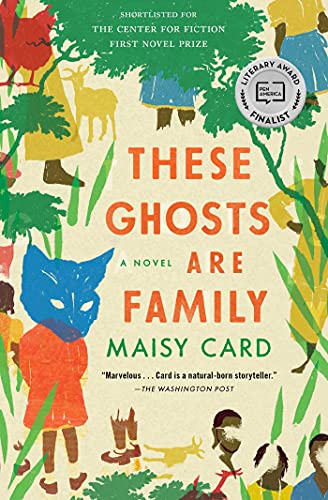
These Ghosts Are Family by Maisie Card

This was a fascinating journey. These Ghosts Are Family follows a family for generations, from slavery in Jamaica, through emancipation and decades of struggle with old class systems, immigration to London and New York, through permutations of relations, including a fresh start with a new identity (or, if you like, identity theft). The timeline jumps around and the focus and point of view shift, so that readers see this extended family at different times and from different perspectives. Issues of class, race and colorism and the relationships between privileged and less privileged classes, including but not limited to enslavement, will be obvious themes; we know that rape and issues of gender arise under these conditions too. The characters are infinitely fascinating. I was not so much expecting the question of supernatural elements: duppies or ghosts and Ol’ Hige, “a Caribbean version of a vampire story.” By the book’s end, I was left reeling with all the possibilities. There is plenty of heaviness: children abused, spouses failing to see eye to eye, parents and children letting each other down. But there are some quietly loving relationships scattered throughout. As I close the final pages, I’m a bit at a loss because there’s so much to consider. (And because we ended with a decidedly weird trio of spooky vampire children living in the woods.)

The book begins with a family tree, which I did refer to throughout. It presented me with a confusion that was answered on the first page. I’m going to spoil that one here because, again, first page of the novel (and it’s also given away on the back of the book and in most blurbs): the aged Stanford Solomon reveals, on his deathbed, that in fact he is (or was) also Abel Paisley, presumed dead some thirty-five years ago, at which point he took the identity of his friend Stanford. “Stanford” has both a wife and daughter and another daughter out of wedlock, all in New York; Abel left behind a wife and two children in Jamaica when he supposedly died. Stanford/Abel’s revelation obviously affects those around him. But I’m going to diverge from the blurbs here, and say that this is not the event around which the book revolves, and by its end, Stanford is by no means the central character. Rather, he is one branch on the family tree that is the book’s center. He’s just one link, and I don’t think he earns the role the blurb says he plays. Rather, I find the book more about larger patterns – slavery, class and race and colorism following slavery, migration and immigration, gender roles, the persistent damages of all these institutions and systems, trauma, and family dynamics. It’s about the multiple generations of this single family, for sure, but their combined story is very much about those larger patterns and systems. There’s nothing preachy or intentional-feeling about this, but the Paisley/Stanford family is inextricable from larger issues. I put Stanford/Abel at its center only in that he opens the book and occurs at the more-or-less center of the family tree as we find it here. The book ends somewhere very different, and that feels right.

In between, the story is told by numerous voices spanning some 200 years. That multiplicity of voices was a great choice for this story. (I have just said the same about a brilliant novel whose review is still forthcoming: Lookout by Christine Byl.) I love the kaleidoscopic or triangulated perspective on events offered by the different views. And for a novel whose focus is so broad – generations of a family across continents, countries, and centuries – it makes sense to move around like this. I guess such a big story told by one voice (with some kind of time-traveling power, I suppose) would be a different kind of accomplishment, and I can imagine it done beautifully, but Card’s choice feels just perfect here. The multiple voices also allow her to give us different dialects, which add to the texture and richness of the whole.

This adventure into these varied lives is expertly done, not always comfortable because of the subject matter, but engrossing and well worth the immersive experience. Card is a talent.


Rating: 7 names.

The Ballad of Black Tom by Victor LaValle

People who move to New York always make the same mistake… They come looking for magic, whether evil or good, and nothing will convince them it isn’t here.

The year is 1924, and Charles Thomas Tester wouldn’t call himself a con man; he thinks of himself as an entertainer. He’s not much of a musician, unlike his beloved father, but he knows how to put on the right look and scrape a living where he can. It helps to leave Harlem, where he supports his father and himself in a tenement apartment, and travel to the likes of Red Hook and Flushing. There’s risk there for a Black man, but more to be gained, too. Charles plays off wealthier New Yorkers’ search for magic–until he gets into more than he’d bargained for. In Flatbush he meets a wealthy eccentric named Robert Suydam with ideas about how to change the world. An anxious, sensitive police detective and a burly bully of a private investigator are on the tail of the unlikely allies, Charles and Suydam; between them they will certainly change the shape of the world, in unexpected ways.

The Ballad of Black Tom has magic and race and racism and wishes and love and violence and simple street entertainers’ illusions. There are characters from different walks of life – I love the varieties of ethnic foods available in the Victoria Society. Charles Thomas Tester is both a straightforwardly relatable character – loves his father, just wants a little financial wiggle room – and a dangerous enigma. This book is short, but it casts a spell. Victor LaValle continues to intrigue me. Recall that I loved one book of his and couldn’t finish the next. This one is compelling. I have The Devil in Silver waiting on my shelf. We shall see.

Meanwhile, Black Tom will keep me thinking for a while – not least with its final prophecy.


Rating: 7 pages.

Galatea by Madeline Miller

Although I found Circe less mind-blowing than I did The Song of Achilles, I will still follow Madeline Miller anywhere. I was very excited about this new book, which is labeled as a short story, but packaged as a freestanding little hardback. The story is very short – just 50 pages plus an afterword.

50 little tiny pages

According to Wikipedia, “Galatea is a name popularly applied to the statue carved of ivory by Pygmalion of Cyprus, which then came to life in Greek mythology.” In Ovid’s version of the myth, in Metamorphoses (which Miller indicates is “almost solely” her source for this work), she does not have a name. Pygmalion is a sculptor so horrified by real, live women that he can only be happy with the ivory statue of one he creates for himself, in perfection and perfect, chaste silence; he prays to Venus for her to come alive, and she does, to bear him a child but (in Ovid’s telling) to remain silent and modest. (Delightfully, and disturbingly, in the poem “Pygmalion’s Bride” by Carol Ann Duffy in The World’s Wife, she defeats his sexual advances by pretending to reciprocate them.)

Here, Miller gives us Galatea’s first-person voice from the hospital room where she is institutionalized, imprisoned, on Pygmalion’s orders. He visits in order to fetishize and rape her. Having born him a daughter and seen how limited their child’s life will be with such a domineering, misogynistic father, Galatea has tried to escape him and save her daughter, but so far failed. When he tells her what his latest project is, however, she tries again.

In Miller’s writing, Galatea’s voice is lyrical and grim. “The door closed, and the room swelled around me like a bruise.” She handles her husband’s abuses with an impassive stoicism that reads as strength rather than stoniness, because she feels strongly toward her daughter (and hides well her disgust with Pygmalion). She is brave, clever, and grandly terrible, worth of Greek myth and the empowerment we want for her. This is a brief but powerful triumphant retelling of an upsetting myth. Miller is awesome and I will preorder anything she writes. Go read it now.


Rating: 8 cups of tea.

Gone Missing in Harlem by Karla FC Holloway

This one’s a bit genre-defying. I really enjoyed it. Gone Missing in Harlem looked like a mystery at its outset, but it turned out to be broader than that. Historical fiction, clearly: it’s set in Harlem during the Great Depression, with flashbacks to Carolina (North or South, I’m not sure we ever know), highlighting the Great Migration of Black Americans from the rural South to northern cities. It handles mental health issues in several threads, and the challenges of parenting through traumas and breaking cycles. It ranges widely.

We see the title event in the very first chapter. A young mother, Selma, parks her pram just outside a grocery for a very short time while she pays for some apples; when she comes out, it is discovered that her baby is gone. An uproar immediately ensues. Harlem’s residents are horrified, excited, titillated, and incensed at the lackluster response from the police department: the city is still reeling from the disappearance and death of the Lindbergh baby, and Harlem can easily see the difference in how a poor baby from their community is treated. We do have the city’s first Black policeman on the job (and with a fresh Black cadet in tow), and he is both clever and committed. But weeks and months pass, and Selma’s baby Chloe is not recovered.

One of the things I loved best about this book was the constant shifting of perspective. While I’m fairly certain we never get a first-person point of view, chapters switch focuses in close third person perspectives between a large number of characters: Selma; the police officer; Selma’s brother Percy (aka June Bug); their mother (a central figure), DeLilah, aka Lilah, Mama Lil, or Mrs. Mosby; several members of the wealthy white family Lilah works for; the social-climbing Black woman she works for later; a neighbor down the hall; and others. (The policeman and his apprentice form a delightful Holmes-and-Watson pair – indeed with reference to their famous counterparts – and appreciate libraries, librarians and book research most pleasingly.) This multiplicity of perspectives enriches the narrative like nothing else might have, and help take this story from the (deceptively simple) mystery it might have been to a whole complex tapestry of questions, in the best way. Class is arguably as important as race, and race is complicated by colorism. Several generations address the difficulties of parenting; the complexities of love, fear, and aspiration; and the importance of making a plan. As for that deceptively simple mystery, there is a big surprise near the novel’s end that had me entirely, literally slack-jawed. I did stumble upon a handful of grammatical errors that I wish had been caught in editing, but that’s a small issue (and likely only for a few readers). I’m very impressed at the absorbing story, the wealth of those multiple POVs, and the tender handling of a broad range of issues.


Rating: 7 needles.