The First Fifteen Lives of Harry August by Claire North (audio)

I am doing the unfortunate thing where I’ve waited too long since I listened to this one. In my defense, it was a whirlwind two-week road trip that allowed me to listen to several (!) audiobooks.

Another recommendation by Liz, this one’s pretty mind-bending. Harry August narrates the story of his lives himself, beginning with the first time, when he lived unremarkably. He was born in a train station washroom in 1919, and was then adopted but didn’t know it; his adoptive mother died when he was young, and his adoptive father remained distant; he served in World War II and then returned to the estate where his father had served as a sort of maintenance man, which role Harry takes over until his own death in old age. Ho hum. Then… it all starts over again. In his second life, he does not handle well the knowledge that this has all happened once before. In his third life, he uses what he knows of the war (for example) to his advantage, staying away from high-casualty battles and the like. With each life, he gains a little better understanding of what he’s experiencing. But he struggles to make meaning of it all, even as he meets others like himself: ouroborans, they call themselves, or kalachakras. Until, that is, he meets one man in particular, a fellow ouroboran who will become perhaps his greatest friend and nemesis.

I’ve already said too much, and will let you discover Harry’s many lives and acquaintances for yourself from here.

It’s quite a thought-provoking concept, and a new twist on time travel and the tricky question of the butterfly effect. (Would you kill Hitler? What if he’s only replaced by something worse?) The novel is not plot-driven, precisely, and it’s not character-driven at all. Harry has remarkable drive to learn, understand, and explain; this intrigues me about him, but he’s a bit short on actual personality (and has more of it than anyone else in the book). So, a concept-driven novel, which is a change. I found it perfectly absorbing, one to get lost in, and to occasionally pause and ponder. I will say, there weren’t characters I liked, and that can make it a little tough to hook in. I was very intrigued, but often bemused too.

The audiobook was a strong production on the whole. Peter Kenny does a wide range of voices, which are often pleasing, but I must say his American accents are not convincing.

It will be interested to see how this one sticks with me.


Rating: 7 beakers.

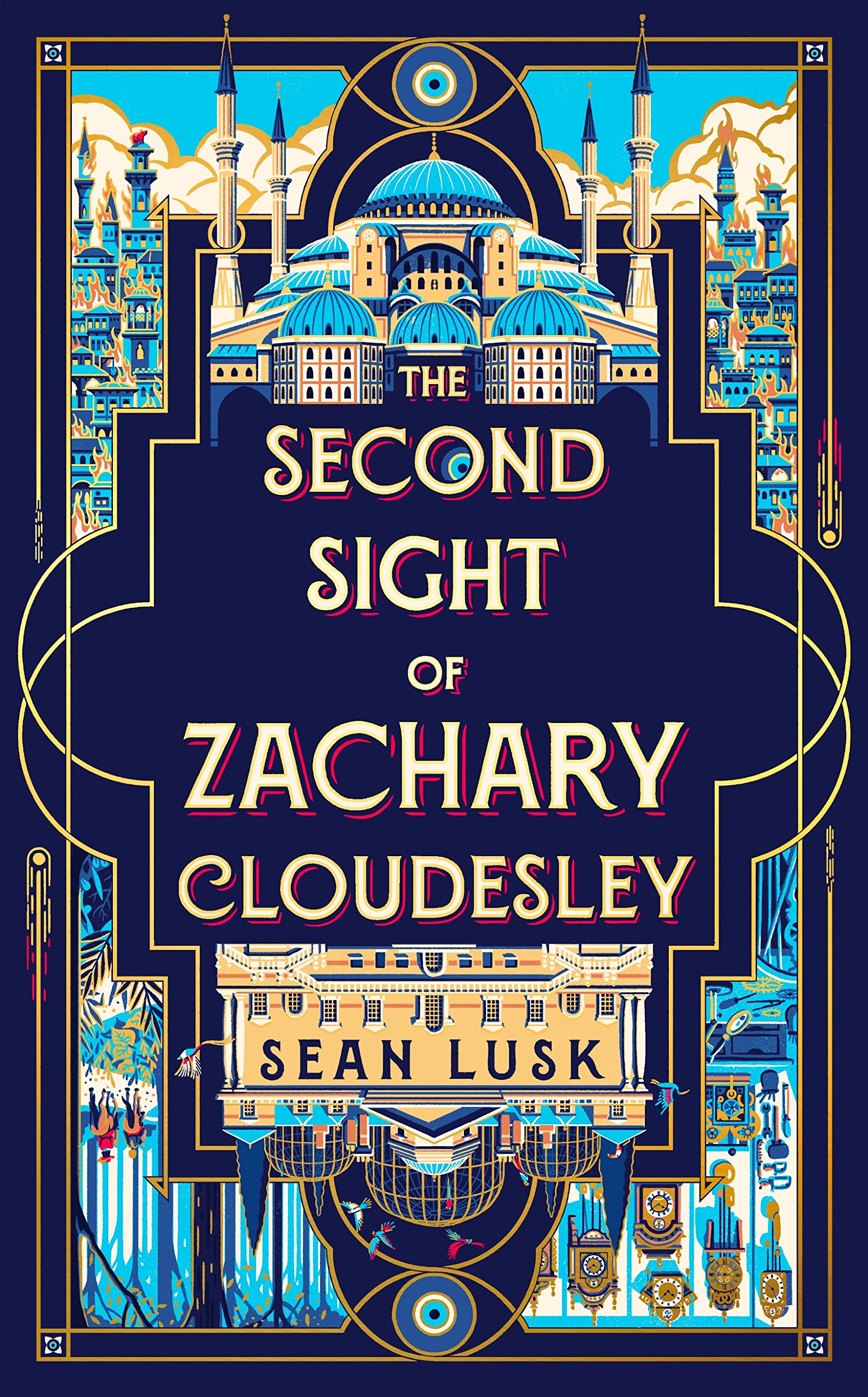
The Second Sight of Zachary Cloudesley by Sean Lusk

An exceptional boy in a loving, if odd, family, surrounded by automatons, must adventure into historical Constantinople to save his father in this debut novel of love and whimsy.

Sean Lusk’s debut novel, The Second Sight of Zachary Cloudesley, is a strange, spellbinding, imaginative work of magical realism set in 1700s London and Constantinople, exploring Pinocchio-esque questions about what is real, and the many forms of love. It contains no shortage of tragedy, but always retains a charming sense of wonder.

In London in 1754, Abel Cloudesley anxiously paces outside the birthing chamber where his beloved wife, Alice, labors. Zachary Cloudesley’s life begins with his mother’s death; Abel will be a loving father, but at first the experience is clouded by grief.

Abel is a clockmaker, but clocks are only the beginning of his artistry: he creates clockwork creatures, automatons that move and communicate like the real-life animals and humans they mimic. In Abel’s workshop, Zachary suffers a life-changing injury, resulting in the treasured son being sent away to be raised in the safety of his eccentric great-aunt Frances’s home in the country. Zachary’s no-nonsense nurse, Mrs. Morley, and the staunchly feminist Frances round out an unusual family for a very unusual boy. Zachary is a genius, precocious in everything, a great reader and nature lover. He also knows things–the past, the future–that he should not be able to know. When Abel is sent away to distant Constantinople on an odd and dangerous mission, seven-year-old Zachary says, “You should not go, Papa. You know that, don’t you?” Abel knows, but sail he does.

Years later, a teenaged Zachary will set out to rescue his father–believed to be long dead–from imprisonment in the Ottoman court. Zachary is still a deeply intelligent young man, but his studies have been conducted from the English countryside, and these travels will be eye-opening. Readers will delight in following the devoted son as he learns about a broader world, encounters romance, and seeks family. Through these pages are woven the clockwork wonders that have gotten Abel into this mess, and may yet get him out.

The Second Sight of Zachary Cloudesley is enchanting. Abel and Zachary are sensitive, compelling characters; Mrs. Morley and Aunt Franny are stalwart and impressive female heroes in two very different styles; Mrs. Morley’s daughter (raised alongside Zachary nearly as a sister) offers her own development and young romance; and Abel’s gifted employee Tom, an indispensable friend to the family, is not quite what he appears.

Lusk’s engrossing novel wraps a coming-of-age narrative in a historical setting, with lovable characters and dreamlike twists. Don’t miss Lusk’s memorable, sweet, original debut.


This review originally ran in the October 12, 2023 issue of Shelf Awareness for the Book Trade. To subscribe, click here.


Rating: 8 peacock feathers.

Maximum Shelf: A Short Walk Through a Wide World by Douglas Westerbeke

Maximum Shelf is the weekly Shelf Awareness feature focusing on an upcoming title we love and believe will be a great handselling opportunity for booksellers everywhere. The features are written by our editors and reviewers and the publisher has helped support the issue.

This review was published by Shelf Awareness on October 12, 2023.


Douglas Westerbeke’s debut novel, A Short Walk Through a Wide World, is a wild romping adventure, a poignant tale of relationships and interconnectedness, and a compelling journey of self-discovery. The worldwide (and possibly beyond) travels of Aubry Tourvel have something for every reader, with a momentum that’s impossible to turn away from.

“The paper is clean and white–she hasn’t drawn her first line–so when the drop of blood falls and makes its little red mark on the page, she freezes. Her pencil hovers in her hand. Her heart, like it always does, gives her chest an extra kick.” With these opening lines, readers meet Aubry mid-scene, in a marketplace in Siam. Her illness has returned. First the blood, “And then the pain strikes–a terrible, venomous pain–a weeping pain, like a nail through a rotten tooth.” The first pages are adrenaline-fueled, as Aubry runs for her life.

Aubry recounts her past in fragments to people she meets along the way. In early chapters, she narrates the beginning of this singular illness, this mysterious curse that appeared when she was nine years old in 1885, where her family lived in Belle Époque Paris. She ran, and “Every step made her breath flow easier, made the pain slip a little farther away. She knew this would be her strategy from now on. She would outrun it.” Precocious Aubry quickly intuits the inexplicable rules of her condition: she can never revisit the same place twice, can never retrace her steps, can stay in one place only two to three days, four at the most, before she must move on. And so begins a life of constant travel. From a privileged, spoiled childhood, Aubry becomes resourceful, wary, self-sufficient, standoffish, and eventually a kind–but always watchful–wanderer.

Aubry fashions a spear and becomes adept with it. She travels mainly on foot and by boat, doing odd jobs, fishing and hunting. Her relationships, while often meaningful, last only days. One of her most significant love affairs lasts a whole week, aboard a moving train, until the train breaks down and she must leave her lover behind. A few acquaintances try to travel with Aubry, but it becomes increasingly clear that she is special, able to withstand more than the average human. On foot, she crosses the Himalayas, and the Calanshio Sand Sea in the Libyan desert. She finds libraries filled with wordless books containing only pictorial storytelling–to overcome language barriers–and discovers that these libraries, perhaps a little magic, are for her alone.

The workings of Aubry’s unique, global-scale library are never clear, even to her. There, she finds everything she needs: sustenance, warmth, information. “It comforts her that for every path she’s taken during her many revolutions around the world–for every individual footstep, it seems–there’s a story. Something once happened, a past that is not hers.” This is what library-lovers everywhere have long known, but it is also a device that allows for one of the more magical elements of Aubry’s strange travels. “‘It seems,’ said [one brief acquaintance], ‘that the world you travel through is not the same world we travel through.’ My God, thinks Aubry. My God.”

It is a lonely life. People she meets tend to “romanticize her illness. They imagine an eternal holiday, which is ludicrous, of course. Does anyone really want an eternal holiday? A holiday is a temporary break from the routine, a chance to shake off the dust of habit, to experiment with new foods and customs, but then to return, perhaps borrowing from the outside, perhaps rejecting it–but either way, a return.”

Westerbeke’s imagination is prodigious, and the details with which he fleshes out this absorbing tale are equally abundant. A Short Walk Through a Wide World abounds in the tastes, smells, textures, and sensations of a woman who lives almost from moment to moment. Her haphazard travels, rarely planned, are always in response to a sharp pain or a nosebleed, or worse. She stays just a half-step ahead of the illness which she’s come to personify. “It clung to her back, fingers and toes screwed into her bones, gasping and grinning at all the places she went, a happy demon mounted forever on her shoulders.” She speaks to it, and it responds.

Aubry’s travels arrange themselves into a moving story, often sad, but also filled with joy and fun. Aubry has a special weakness for children, and delights in engaging with them wherever she goes, from a ferry in Siam to a tribe in the Congo. This expansive tale offers new ways of looking at the world–wise, questioning, as rich in emotional depth as it is in detail. The characters she meets are numerous and diverse: New Zealanders rescue her in Siam; an Ottoman fisherman encourages her to gain a meaningful skill; an Indian prince befriends her; a Tibetan nomad invites her to hunt a mysterious beast; a Mexican journalist tracks her down in Alaska. A Short Walk Through a Wide World is utterly engrossing, a world–worlds–to get lost in. In these riveting, swashbuckling adventures, tender meditations on relationships, and philosophical musings about travel and home, every reader will find something to love.


Rating: 9 horned cucumbers.

Come back Monday for my interview with Westerbeke.

We Must Not Think of Ourselves by Lauren Grodstein

Thought-provoking, tender, and horrifying, this memorable novel of Jewish lives in the Warsaw Ghetto offers timeless lessons.

Lauren Grodstein’s novel We Must Not Think of Ourselves is a quietly terrifying immersion in the experience of Jewish occupants of Poland’s Warsaw Ghetto during 1940-42. An English teacher before internment, widower Adam Paskow continues his calling behind the heavily guarded walls. Late one afternoon a man named Ringelblum, who wants Adam to join an archival project, approaches him in his classroom: “It is up to us to write our own history,” he tells Adam. “Deny the Germans the last word.” Adam, Grodstein’s narrator, also writes journal entries for Ringelblum’s project, because “there was no reason not to comply.” Having lost his beloved wife four years earlier and now his livelihood, home, and freedom, Adam stumbles through a new life, sharing an apartment with 10 occupants in two families–all previously strangers to each other. He helps dispense sparse servings of soup at the Aid Society and, via conversation and poetry, teaches English. He slowly sells off his wife’s fine linen sheets, silk pillowcases, and shoes. He transcribes interviews with his students, and the men, women, and children he lives with. New relationships form. He remembers his wife, waits for liberation, and then begins to understand that it may not come.

Prior to the Nazis’ invasion of Poland, Adam was non-practicing (“I had barely remembered I was a Jew”) and married to a wealthy non-Jewish woman; her mother’s rejection of him and her father’s demonstrative tolerance and proclaimed support highlight differences that the younger couple find insignificant. Adam calls himself a coward, but the honesty with which he bears witness is striking. His journal entries vary from the chapters that come between them; the direct first-person narration of the latter takes a more personal tone, but in both cases, Adam shares an unvarnished view of individual characters in all their complexities, never relying on easy labels. Adam, who teaches multiple languages, loves language in general, and Grodstein gives him a beautiful writing voice.

Grodstein (The Explanation for Everything; Our Short History) bases her historical novel upon a few real characters and events. Emanuel Ringelblum did oversee an archival project, which provides the background for this realistic, heartrending glimpse into the lives of Jewish occupants of the Warsaw Ghetto. We Must Not Think of Ourselves brings a horrifying chapter of history to readers with intimate, detailed portraits. In his detailed recording of other lives and of his own, Adam reveals that love may be found even in the starkest of situations, and he faces the hardest of choices about sacrifice: Who will you save if you can’t save them all?


This review originally ran in the October 5, 2023 issue of Shelf Awareness for the Book Trade. To subscribe, click here.


Rating: 7 chicken feet.

Julia by Sandra Newman

This feminist retelling of Orwell’s 1984 brings the original’s philosophies, wit, and horror to modern readers with a strikingly reinvented protagonist.

Julia returns the timelessly relevant world of 1984 to readers’ attentions with a female protagonist more clever and feeling, and perhaps more cynical, than George Orwell’s Winston Smith ever was.

Sandra Newman’s retelling matches closely Orwell’s familiar and disquieting original. Big Brother is the leader of the nation of Oceania, at war with Eastasia (or was it Eurasia?). Telescreens squawking nonstop propaganda constantly observe every move of the Citizens of Airstrip One, formerly London. Where Orwell offered Julia as colleague, lover, and co-conspirator to his antihero, Winston Smith, here Julia Worthing gets a backstory.

She grew up in Semi-Autonomous Zone 5, previously Kent; had her first affair with a Party member at the age of 14; and won a Hero of the Socialist Family badge for denouncing her mother (a more complex story than it immediately sounds). As an adult, Julia works in the Ministry of Truth’s Fiction Department as a mechanic, repairing and maintaining the machines that design plots for the mind-controlling entertainment of the masses. “She was perpetually fascinated by the plot machinery,” Newman writes, but “about the books that were the end result, she knew little and cared less.”

Julia lives a straightforward, self-serving life, outwardly obedient to Party regulations and a member of the Junior Anti-Sex League, but is secretly involved in a number of minor sexual affairs, trading in black-market goods for the simple pleasures of real chocolate. Though fond of Winston in some ways, she has no illusions about the possibilities their narrow world allows them and lives mostly at peace within her limits. Newman’s version does not differ from Orwell’s in these particulars, but it does expand Julia considerably, and appealingly, as a character increasingly wrestling with not only the contradictions between lived experience and the Party’s narrative but also questions of right and wrong. “Anything was possible when one was never told the truth.”

Newman (The Country of Ice Cream Star) offers a tragic and harrowing story in lovely, evocative prose, revealing all the ugliness and beautiful possibility of a world hopelessly scarred by hate and manipulation and yet, somehow, still capable of hope. Julia is double-, triple-, and quadruple-crossed: “All was false. It was known to be false, but everyone lied about the lies, until no one knew where the lies began and ended.” Electrically memorable, Julia is as startling and incendiary as 1984 ever was, with dark humor and pathos commenting on perennially timely questions.


This review originally ran in the August 31, 2023 issue of Shelf Awareness for the Book Trade. To subscribe, click here.


Rating: 7 questions.

Girls with a Voice and Girls with Courage by Ann Turnbull and Adèle Geras

Another loan from my favorite 11-year-old, this is a pair of historical novels linked by location. Girls with a Voice, by Ann Turnbull, is about a 12-year-old girl named Mary Ann who travels from London to a boarding school in the nearby village of Chelsea in 1764. She is excited to study singing and the harpsichord there, because she wants to perform as an opera singer onstage (an ambition her family is not especially supportive of). She makes good friends, not only with her fellow pupils, but with a maid in the large house where the school is located. The maid, Jenny, also has a fine singing voice, but because of her class, cannot have the same training as Mary Ann. Jenny sings ballads in the streets for money, however, which Mary Ann finds extraordinary. When circumstances change for Mary Ann’s family, she has to get creative in problem-solving to continue following her dream.

In Girls with Courage, set in 1857, Adèle Geras tells us about Lizzie, also 12, who is on a journey from her home in the country into London, to stay with family in their large, impressive home on Chelsea Walk. This is the same home that housed Mary Ann’s boarding school nearly 100 years earlier; what was then an outlying village is now part of the city, and Lizzie, a country mouse, is awed by the bustle. Lizzie’s father died when she was young, and her beloved mother Cecily is now remarried to a dour man who has suggested Lizzie go away for a spell, as Cecily is pregnant. Lizzie will stay with her father’s brother’s family: uncle, aunt, three cousins including a boy her own age, another uncle who has been injured in the Crimean War, and a grandmother, as well as several servants. Compared to her spare country upbringing, this life strikes Lizzie as grand and luxurious, although also limiting: she enjoyed learning about plants and trees from a local orchardist, and now is forced to do needlework that she finds very tedious. Cut off from her late father’s books by the mean stepfather, she now yearns to learn the math and science that her cousin Hugh gets to study. She misses her mother terribly–and when something seems to have gone amiss back home, Lizzie will have to be brave to help.

As you can tell from these summaries, both stories are a bit sweet and instructive. While I like these protagonists, they are earnest and simple and good-hearted in a way that leaves off the grit and snark and fun I like in all my reading, children’s and young adult of course included. Compared to the Dragon Slippers trilogy this same young friend introduced me to, Girls is less delightful. That said, I passed a pleasant enough day-and-a-half here, and have no argument with the messaging about girls following their passions – whether in music or botany – and standing up for themselves (and their mothers). This messaging is not exactly radical, but still solid. And I’m glad my young friend is interested in history. I look forward to hearing what she loved about the book, and will continue reading anything she brings me.


Rating: 6 walnuts.

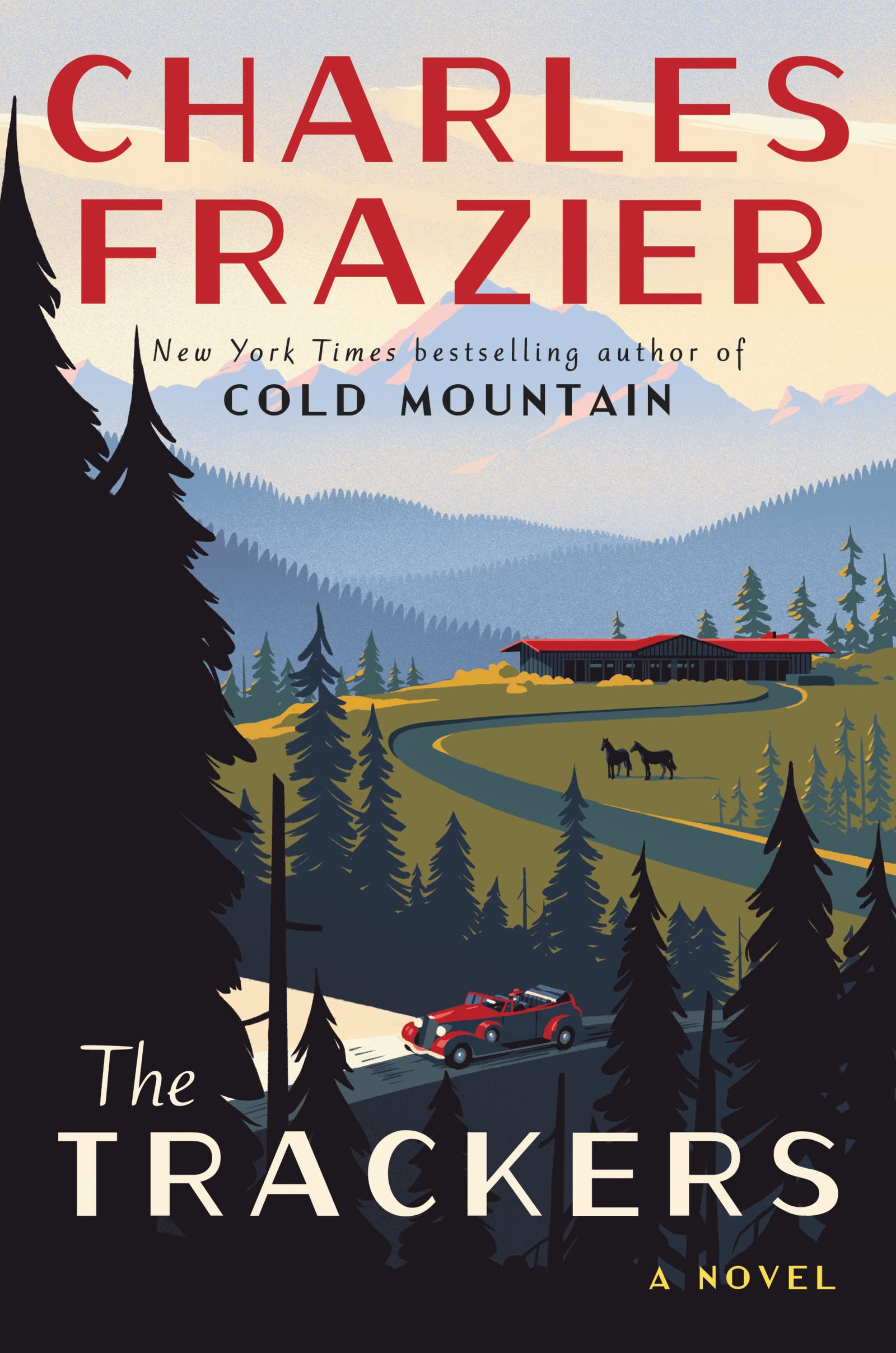
The Trackers by Charles Frazier

I never read any Frazier before, although I’ve been aware of his well-received Cold Mountain. I liked what I saw in teasers about this recently-published historical novel: set in the Depression and centered around an artist named Val Welch who’s been hired to paint a mural in the post office of small-town Dawes, Wyoming. An old art school mentor helped him get this New Deal commission: “Hutch was the right kind of idealist for the times. He believed public art could be like a pebble thrown into a still pond, a small influence but spreading in all directions.” Val is back-and-forth between idealism and cynicism, but he does take art seriously, and earnestly wants to do a proper job of this mural. There is a public education aspect to the job, as locals wander in while he paints. He tells them,

The mural is going to express waves of history always swelling and cresting and breaking and rising again, and all the images will be slightly tilted forward, leaning into the future.

I was twenty-seven, so take that into consideration.

The locals are not always charmed. They keep telling him the joke that WPA really stands for We Piddle About (and he doesn’t even work for the WPA). But he still feels it’s important work.

In a nutshell, this is the book I was hoping to read: art, community, historical time and place. But the book Frazier wrote is a little different from that. We first meet Val Welch as he’s traveling west, from home in Virginia to Dawes; we see some of the country through his eyes, and we arrive with him at Long Shot, the ranch owned by the extremely wealthy John Long (old friend to Val’s mentor Hutch) and Long’s wife, Eve. Long Shot is opulent, and Long very pleased with himself. He’s hoping to go into politics. His right-hand man Faro is a hard-handed old cowboy, around whom rumors congregate. Eve is a beauty, much younger than her blowhard husband, with stories to tell about being a childhood tramp following the harvest cycle around the country and leading a successful cowboy band. She can offer hard edges, a movie star’s glamour, and whatever story her current audience is apt to find most engaging. It’s implied that her personal history is changeable at the least. Val is easily drawn into the odd family of Long, Eve and Faro. When Eve runs away, Long hires him (at an extraordinary wage) to track her. Val steps away from his mural with an alacrity that surprised me.

The rest of the novel is not about art, but about the intrigue and spiderwebs of Long and Eve’s marriage, Eve’s alleged first husband Jake, and the characters Val meets in Seattle, San Francisco, and a Florida backwater while trying to track down a woman no one understands. The Trackers refers in its title to Val’s efforts, obviously (and a few others who jump in on the game in the book’s present), but also to a couple of figures in Val’s mural. The mural trackers fall off the page pretty quickly, though, which is a metaphor for the mural and the public art thread in general. The tracking-of-Eve storyline is well executed, technically and in its craft elements, and Frazier writes beautifully and compellingly in descriptive details, characterization, and dialog; it’s not at all surprising that his books have won awards. The mystery of Eve is suspenseful and well paced. But as a thread, the beautiful, deceptive woman and her various bumble-headed male admirers didn’t do a lot for me. I was much more interested in the public art / historical angle. That’s not a great criticism of Frazier: he wrote a different book than the one I’d hoped to read, and it’s not his fault that I got a different impression from wherever I read about this book. I will make a slight criticism in that his female lead feels like a Hemingway woman to me. She doesn’t pass the Bechdel test but seems a male fantasy; does she have an interior life that’s not in relationship to the men around her and how they react to her? Her clothing, her literal onstage performances, the way she smokes a cigarette, are all about the male gaze. I find this disappointing.

It kept me reading, but I missed the book I wished I were reading. And I thought Eve was a missed opportunity. Passes technical muster, but not impressive to this reader.


Rating: 6 glasses of champagne.

Maximum Shelf: Let Us Descend by Jesmyn Ward

Maximum Shelf is the weekly Shelf Awareness feature focusing on an upcoming title we love and believe will be a great handselling opportunity for booksellers everywhere. The features are written by our editors and reviewers and the publisher has helped support the issue.

This review was published by Shelf Awareness on May 17, 2023.


Two-time National Book Award-winner for Fiction Jesmyn Ward (Men We Reaped; Navigate Your Stars; The Fire This Time; Sing, Unburied, Sing; Salvage the Bones) takes a different direction with her fourth novel, Let Us Descend: it’s her first historical narrative. Beautifully written and heartrending, Ward’s story sensitively handles grief, love, and recovery. On a rice plantation in the Carolinas, an enslaved teenager named Annis narrates as she works alongside her beloved mother. Mama is a source of comfort and strength even as her finger bones are “blades in sheaths.” Annis says, “The first weapon I ever held was my mother’s hand.” This steely woman teaches Annis lessons of combat learned from her own mother, one of thousands of warrior wives to an African king, tasked with both protection and elephant hunting. “In this world, you your own weapon,” she tells her daughter, and Annis will need to be.

Annis’s father is the plantation owner who owns her and her mother. Annis has half-sisters in the big house. “My sire’s house hulks; its insides pinned by creaks,” and her “sallow sisters” have a tutor to read to them, to teach them the texts of ancient Greece, about bees and wasps and Dante’s Inferno: “The tutor is telling a story of a man, an ancient Italian, who is walking down into hell. The hell he travels has levels like my father’s house.” Let Us Descend‘s title is a nod to Dante, and a cue to the reader to notice hells, descents, and journeys south. Annis listens and learns. Through her natural gifts, her own interest, and with her mother’s help, she becomes skilled in foraging: herbs, mushrooms, medicinal plants, and simple foods. She learns to befriend the bees she hears her sisters’ tutor speak of.

Then Annis’s father chooses to sell her mother south. The “Georgia Man” takes her away in a line of stolen people for the long walk to market. Annis falls into a near-fatal grief at being left without the most important person in her life, until a kind friend pulls her back to the surface. But soon, Annis and Safi, her friend-turned-lover, are sent on the same walk with the Georgia Man. From the plantation where she was born, Annis makes a death march to a New Orleans slave market and is sold to a cruel lady whose Louisiana sugar plantation marks a further descent, into a new level of hell. Others will uplift her along the way, but she never shakes the excruciating grief for her mother.

Along the way she gains and loses friends, and meets a spirit: Aza controls the storms and winds, and has stolen the name of Annis’s maternal grandmother, the warrior Mama Aza. “Aza’s hair a living thing: scudded clouds, the setting sun lighting them on fire. She leans forward and a breeze blows from her. Feels like the slap of a freshly washed linen on my face, snapping in a cool wind.” The spirit seeks her own identity and self-importance in relation to others, and has locked onto Annis’s maternal line as a way to achieve this: she models herself after the grandmother Annis never knew, and her use of the name Aza represents both connection and theft. That Annis refers to enslaved people like herself as “stolen” adds a layer to Aza’s use of the name.

Less centered around plot and character than Ward’s previous novels, Annis’s story is more elemental and thematic, dealing primarily with grief, forces of nature and human evil, villains and allies. The spirits she meets–chiefly Aza, but others as well–are closely associated with natural forces. “Another spirit, white and cold as snow, walks the edge of the river; it hungers for warmth, for breath, for blood, for fear, and it, too, glances against the enslaved stolen and feeds. Another spirit slithers from rooftop to rooftop before twining about wrought iron balconies outside plaçage women’s bedrooms, where it hums, telling the bound women to portion out poison in pinches over the years, to revolt, revolt, revolt.” These spirits can help but also harm, offer but also take away; they may represent another form of attempted ownership, as Aza has taken Mama Aza’s name. In a magical-realism twist, Annis finds these spirits widen her world beyond her immediate suffering to other timelines and possibilities.

Just as Ward’s title refers to Dante’s story of a descent into ever-deeper levels of hell, her hero makes a parallel, nonconsensual descent into the deeper South, into pain and suffering and sorrow, and into the worsening and worst of humanity. The novel moves with Annis from the Carolinas to Louisiana, and in story, back to Africa, where Mama Aza established the fighting spirit she would pass on.

Ward gives Annis’s voice a raw strength and musicality. After she is imprisoned in an underground cell by a particularly sadistic plantation owner, Aza tells her, “When you were up north, your sorrow choked your song. Swallowed it down. Even so, it hummed. But the walk changed it. The further you went, the more it rose until the woman put you down in the earth. Then it shrieked.” Attention to descriptive detail emphasizes Annis’s close relationship to place, and the importance of the land itself (not least in supplementing the enslaved people’s painfully meager allotted diet). “The water reaches in every direction, duckweed bright and green, floating on the murky wet. Cypress, fresh with rain, shimmers.”

As much pain, struggle, torture as there is in these pages, there are also various forms of love, and great strength, power, and personal reclamation. Let Us Descend ends with surprising hope. “How the whitewash of starlight would buoy them along. How they dance with the rocking deck. How them sing.” With this novel, Ward’s talent continues to deepen and glow.


Rating: 6 broad, glossy leaves.

Come back Friday for my interview with Ward.

A History of Burning by Janika Oza

Janika Oza’s A History of Burning is a stunning multigenerational saga that follows a family and a community who move during the years 1898 to 1992 from India to Kenya to Uganda, to Canada and the U.K., and beyond. In nearly a dozen voices, Oza’s debut novel illuminates immigration patterns and pain alongside familial joys and sorrows.

Readers first meet 13-year-old Pirbhai in Gujarat, India; he is, as the oldest son, fierce with the need to provide for his family. In exchange for a coin and the promise of opportunity, he unwittingly sells himself into labor on the railroad the British are building in East Africa. Pirbhai builds a family and a community with other Indian Africans; his children and grandchildren feel buoyed by the strong ties but sometimes limited by the strictures of tradition and duty. After Ugandan independence, anti-Asian sentiment drives them out of the only country they have known. Pirbhai’s son, Vinod, thinks there must be a “third possibility–not African, not Indian, but something beyond borders, an identity forged over decades of scattering apart and, miraculously, finding repair.” Each generation struggles in a new place, the tight-knit family always navigating change and searching for a place to call their own. Oza’s gorgeous prose is lush with detail–colors, flavors, emotions–and saturated with loveliness and pain, “the messy, the beautiful, the wild improbable light.” A History of Burning admirably charts how–by the time Pirbhai’s descendants plant seeds in Canadian soil–history, both personal and collective, is formed from the stories we tell and the silences we allow to remain.


This review originally ran in the May 5, 2023 issue of Shelf Awareness for Readers. To subscribe, click here, and you’ll receive two issues per week of book reviews and other bookish news.


Rating: 8 matunda.

Murder Your Employer: The McMasters Guide to Homicide by Rupert Holmes

So you’ve decided to commit a murder.

Congratulations.

Murder Your Employer is a genre mash-up, and great fun. It purports to be a how-to manual on how to commit a murder (the Conservatory prefers “deletion”) without getting caught – in this case, specifically the deletion of one’s employer, with future volumes promised. (Other popular deletions include work rivals, financial advisors and spouses.) The book’s narrator is Dean Harbinger Harrow – Dean being not a first name but a title, as he serves as Dean of the McMasters Conservatory for the Applied Arts, a top-secret institution that trains would-be deletists to remain successful and forever unknown. It contains narratives within, however: short on actual training-manual-style directives, instead the bulk is made up of examples in the form of the stories of three McMasters students, all majoring in employer deletions.

The central protagonist is Cliff Iverson, who botched his first attempt to murder the toxic, womanizing, belligerent boss at his aircraft manufacturing job. Instead of criminal charges, he faces involuntary admission to McMasters (for very mysterious reasons). We are treated to his journal throughout, as well as the Dean’s notes on the progress of Cliff and two fellow students: Gemma Lindley, who needs to get rid of her blackmailing boss, and a woman known at the school as Dulcie Mown, although everyone finds her dimly familiar (the reader knows why).

So we have a how-to-manual, framing an epistolary novel (journal entries and other documents), in an idyllic boarding school milieu, on the absurdist subject of ‘an education in murder,’ filled with wordplay, puns and humor, with a certain amount of suspense as our three students aim to successfully complete their theses (intended deletions), wrapped up in a mystery (who is responsible for Cliff’s enrollment at McMasters in the first place?). Oh and the setting is historical, in the 1950s, so bookies and bad guys have a certain style and type. It is a mad, beautiful mess of genres, and I found it enormous fun (despite a rather crabby review from Kirkus, who does not think it cute). Yes: it does require a fair amount of suspension of disbelief; I would think that would be obvious, since it’s a slightly unhinged promotion of the murderous arts. (Somewhat in their defense, McMasters does have some moral standards. Make sure your target is deserving and all other options have been exhausted; no innocent bystanders; certainly no serial killings or mass murders; etc.) It’s ridiculous and it knows it (think The Princess Bride).

The pacing is not snappy, but I thought it was nice to linger with each of our characters – Harrow rather silly, Cliff earnest and serious, Gemma haunted, Dulcie driven – and in the slightly cartoonish historical setting. The McMasters world itself is a sort of madcap Opposite Day, and the ‘real’ world features caricatures. Dean Harrow is a bit of a buffoon (and yes, pun-obsessed). It was fun and, I admit, relaxing. The whole conceit is ludicrous enough that it let me let go. I don’t think real life murders are cute, but this book surely is.


Rating: 7 MacArthur-style sunglasses.