The Bishop’s Villa by Sacha Naspini, trans. by Clarissa Botsford

In this transporting novel based on real events, a shy cobbler in an Italian village during World War II is gradually drawn into quiet acts in the Resistance.

Sacha Naspini (Nives) brings close and poignant attention to true events with his historical novel The Bishop’s Villa, translated from the Italian by Clarissa Botsford.

In the fall of 1943, in the sleepy village of Le Case in Tuscany’s Maremma region, a cobbler goes about his daily business. Solitary and quiet by nature, René makes do with just two fingers on his right hand following a childhood accident with a lathe; his nickname in town is Settebello, after the “lucky seven” card in scopa. When the local bishop rents out the seminary and surrounding villa to be used as a prison camp for the region’s Jewish population, Le Case mostly plods on as before. Some local residents speak cruelly of the prisoners; many simply ignore their presence. René mends the shoes brought to him for repair by prison guards. For most townspeople, the war is poverty, deprivation, and the passage of time.

But René’s neighbor Anna, a lifelong friend, has just lost her son, who fought for the Resistance until he was captured and executed by the Wehrmacht. Anna is galvanized; René wants her to stand down. And then Anna vanishes, leaving behind a note for René. She has gone to join the partisans, to “fight for Edoardo and for Italy.” When René learns that Anna might have become imprisoned in the bishop’s villa, he finds that he can no longer fail to act. His subtle sabotage begins with boots. “He chose rusty nails, some so brittle that they crumbled at the first blow. He hammered them in a little crooked, curved inwards as if he were aiming for the heel… the hole in the sole would get wider, like a small surface wound.”

In short chapters, Naspini draws readers into René’s world: first the tightly confined life of the village cobbler, traveling back and forth between home, workshop, and Anna’s apartment, and then to the tighter confines of a cell in the bishop’s villa. Botsford’s translation is terse and atmospheric, punctuated by lyrical or romantic phrasings: wonder is “like a child unable to describe a treasure they’d chanced upon under a stone.” With torture, “you can chew [a man’s] bones clean, but you can’t touch his soul, which means you will never win.”

The Bishop’s Villa is absorbing, transporting, beautiful, and grim. Naspini’s Author’s Note makes clear his drive to lay bare a shameful chapter of history; but with this novel he has also written a love story, for without Anna, “René would never have used the tools of his trade to fight his war.” The result is moving and layered.


This review originally ran in the September 12, 2024 issue of Shelf Awareness for the Book Trade. To subscribe, click here.


Rating: 7 soles.

Mexican Gothic by Silvia Moreno-Garcia

I really enjoyed Gods of Jade and Shadow, with the caveat for sensitive readers to beware a certain amount of gore and darkness. This one is imaginative, compelling, and surely fulfills its claims to the horror genre; but some of those more horrifying elements started to push my tolerances, which are famously high (though not limitless). I’d thought about putting this in white text, like I do spoilers, but I think it deserves a proper trigger warning: this novel not only deals in sexual contact without consent, but those scenes were heightened – at least in my feelings – by a mind-control element that caused the nonconsenting party to enjoy what was happening, as it was happening (although not before or after). This gave me a unique ‘ick’ I’d perhaps not encountered before. And in considering the book now, I find that part of the experience is overshadowing the rest for me.

It’s a good story, and well executed. I like the setting – beginning in 1950s Mexico City and then moving to a classically disturbing, possibly haunted, gothic mansion in disrepair, high in the misty rural Mexican hills. I like the details, including society’s dos and don’ts and the dresses and accessories of a popular, pretty, privileged young woman, our protagonist, Noémi Taboada. She’s plucky, thinks for herself, is unwilling to settle for a young woman’s few destined roles. These days, she’s thinking she’d like to study anthropology in graduate school. She’s well read, and also loves a party, a nice dress, and a fawning young man (and preferably a new one on a regular schedule). I like her.

Her cousin Catalina is a bit different, more demure, a few years older, enchanted by fairy tales and romance, which is how she ends up married to the enigmatic Virgil Doyle. Married, and spirited away to the yet more enigmatic estate known as High Place, on an abandoned silver mine. Where Noémi is to visit, and perhaps to rescue her.

High Place is bad news, its residents sinister (and dedicated to eugenics, ick again), its history very mysterious. Noémi is up for a lot, but this place may get the best of her. There’s always Francis, a Doyle cousin who might – on and off – be an ally. There’s a creepy old cemetery (of course), and something strange going on with the mushrooms. There are actually some really interesting ideas at play. But, like I said, the special ick I found here challenged me quite a bit.

I’ve left the rating at a 7. It’s a well-done story. But it’s left me feeling not so great. I’m intrigued enough to keep on checking out Moreno-Garcia’s backlist.


Rating: 7 cards.

Season of the Swamp by Yuri Herrera, trans. by Lisa Dillman

Yuri Herrera applies his exceptional gift for succinct, imaginative storytelling to a fictionalized history of Benito Juárez in exile in New Orleans.

By 1853, Benito Juárez had served as judge, deputy, and governor of the state of Oaxaca, but he would not become Mexico’s first indigenous president until after a period of exile. Among other locations, he spent 18 months in exile in New Orleans, a time about which relatively little is known. With Season of the Swamp, Yuri Herrera (Signs Preceding the End of the World; Kingdom Cons; A Silent Fury; Ten Planets) sheds speculative light on this brief chapter in Juárez’s life. Herrera’s regular English translator, Lisa Dillman, again brings a precise ear for Herrera’s linguistic play to this spellbinding fictionalized history.

Besides Herrera’s contextualizing prologue, the name Benito Juárez almost never appears. Instead, readers accompany an unnamed protagonist, in close third-person perspective, from his arrival in this remarkable “city that served up accidents on a platter” through his departure, by which time “if one day he was dropped there without anyone telling him where he was, he’d know it was New Orleans even with his eyes closed.” Juárez marvels at the heat, the Yellow Jack epidemic, the local culture soaked in music and dance, and the stray dogs. He has seen other cities–“Seville, Gibraltar, New York–all of them rich, but none like this, where you could so clearly see the blood on the gold.” He is dismayed at the enslaved people, referred to as “the captured,” sold in open markets and subjugated, as in the novella’s memorable opening scene. He meets with fellow exiles and political minds, makes new friends, settles in. New Orleans is beautiful and horrifying, and Herrera portrays both aspects simultaneously, with humor and lyricism: “A moment later, the austere innkeeper began mopping up the sanguineous intimacies smeared all over the floor.”

Wordplay and a special attention to language form a persistent feature in Herrera’s work. A fellow expat claims Méjico, but Juárez recognizes it’s been pronounced “not with a Mexican ex but a Spaniard’s jay…. ‘This is the vegetable market,’ Cabañas veed iberically.” Juárez is attuned to new languages, including music and body language, and thinks of language learning as related to his time spent teaching high school physics: “his students began to glimpse a new world in those equations, the same way you see animals in the clouds, except these animals actually existed.” A sense of wonder and play, linguistic curiosity, and a knack for being both morbid and funny, contribute to an absorbingly pleasurable read, even amid the death and tragedy. Herrera offers another brilliant novella steeped in political and historical time and place.


This review originally ran in the August 1, 2024 issue of Shelf Awareness for the Book Trade. To subscribe, click here.


Rating: 8 high-flown zees.

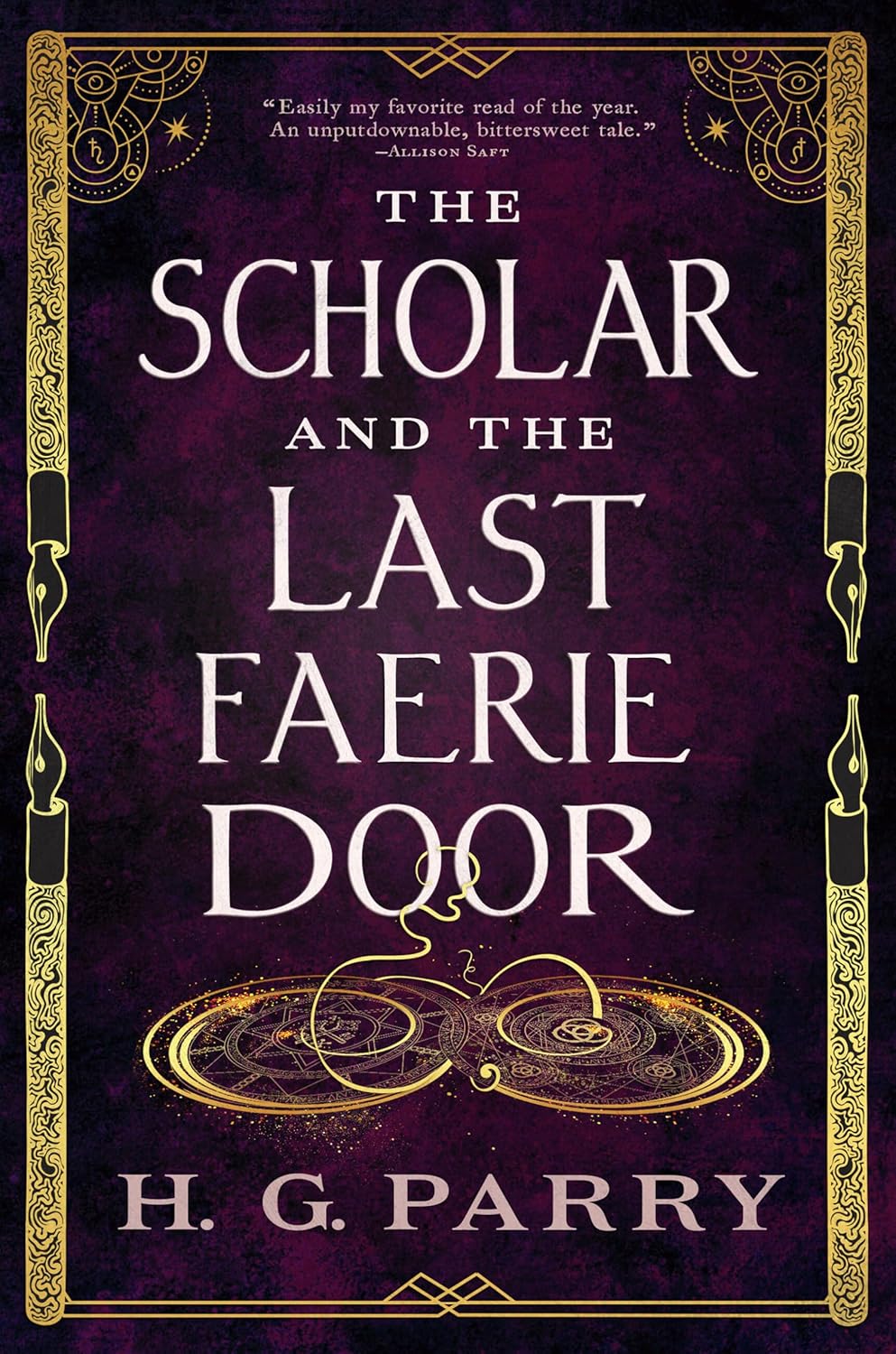
The Magician’s Daughter by H. G. Parry

Liz always recommends winners, but this one is the best of the year so far.

The Magician’s Daughter is a dream of a novel about magic, family, trust, coming of age, a changing world, and figuring out what’s right (or the closest we can come) and what’s wrong. I confess I am in danger of being suggestible by the Alix E. Harrow blurb on the cover of my edition, which reads in part: “a brand-new classic, both wholly original and wonderfully nostalgic.” I read that before I read the book, so there’s a danger there. But I think she got it right: there is both the tried and true and familiar here, and something fresh and new. I loved it so much. And this may be in part the right book at the right time, but I fell into it in ways I needed to.

Biddy has only ever known life on the island of Hy-Brasil, where she lives with her surrogate father figure, a mage named Rowen, and his familiar Hutchincroft, who sometimes takes human form but mostly lives as a golden-colored rabbit. She is now about sixteen, or seventeen: they can’t be sure, of course. She’s always known the story, that she was found shipwrecked alone in a small boat, which had been very unusually allowed to drift near Hy-Brasil. Off the coast of Ireland, beyond the Aran Islands, the magical island is only detectible every seven years; to accept the small craft that bought her there as an infant has always meant to Biddy (in her secret thoughts) that there must be something special about her. She might not have magic as Rowan does, but she hoped she was meant for big things.

And so in her teenaged years, it has begun to chafe that Rowan won’t let her leave the island. And he’s been leaving himself, more and more, in his form as a raven, out all night and sometimes even returning hurt. The outside world seems to be unraveling in some way, and Biddy is ill equipped to understand or help, being without magic and forbidden and unable to travel, but change is afoot…

Eventually Biddy and the reader learn that magic has been slowly leaving the world. The British Council of mages has seen upheavals in the last seventy years (mages live a long time, and this is all easily within Rowan’s experience), and those in power just now are not necessarily doing the kind of good work Rowan (and Biddy) believe in. It is now the year 1912, and Biddy is ready to step off her island for the first time in her memory, to take some serious risks. On the streets of London, she sees poverty and exploitation as well as overwhelming numbers of people (and intriguing fashion, which she’s always been curious about). She meets some looming figures from Rowan’s past, and the character of her beloved guardian gets somewhat complicated by these new perspectives. Especially in the Rookwood Asylum for Destitute Girls, she sees suffering and injustice like she’d never comprehended. There is much wrong in this larger world, and even all the magic one could dream of couldn’t fix it all, but with magic leaving the world things are worse than they should be. What can an orphan girl with no magic of her own possibly do? But with Rowan in profound danger, Biddy will have to try.

There is a touch of the fairy tale here, a dose of historical fiction, and lots of magical fantasy elements. Parry excels at world-building and realism. I love the sense that this could all be real, that there could be little hints and strains of magic in this real world that we regular folk are just not accustomed to noticing. Mages, like the rest of us, are susceptible to jealousies and the corruptions of power. There is a strong hint at the end that the world is about to see some larger problems – and again, this is 1912, so that is very believable foreshadowing. I desperately want the sequel to this lovely, absorbing novel! And will be investigating Parry’s backlist.

I needed the escape offered by this novel at this precise time that I picked it up, and am calling it the best book I’ve read this year. Thank you again and always, Liz. (I’m typing this review on your birthday although it won’t publish for some weeks.) Hugs and magic.


Rating: 10 hairstyles.

Junia, The Book Mule of Troublesome Creek by Kim Michele Richardson, illus. by David C. Gardner

Well, I was sure I’d been sold on this book by one of my talented colleagues at Shelf Awareness, but I cannot find that review. Somebody sold me on it, and I’d credit them if I could, because it was a solid recommendation.

Junia is an absolute delight. Aimed at readers aged 4-8, it’s a sweet picture book in simple but fun prose, starring the mule Junia that some readers will know from 2019’s successful novel The Book Woman of Troublesome Creek. Junia and her Book Woman travel the hills and hollers of eastern Kentucky during the Great Depression as part of that state’s Pack Horse Librarian project, under the WPA. (The books are fiction but strongly rooted in fact; Richardson is a recognized researcher of this unusual bit of history.) The book follows them for a single day of environmental and climactic hardships, including encounters with wildlife and a narrow miss when a bridge washes away. They visit diverse households and communities, delivering reading material and having amiable interactions with readers. The relationship between Junia and her Book Woman is loving; it’s an all-around wholesome story.

There is alliteration, fun onomatopoeia, and perfectly wonderful illustrations that reward a close look: note the identifiable rhododendron, the child with the paper airplane and a book called Flight, and a faraway fire tower that we’ll approach on later pages. The visual style is sort of soft-edged but quite detailed, with a bit of whimsy, and lots of personality for the starring mule. I love the regional, historical focus, and I feel it strikes a lovely balance between entertaining and readable, and educational. The book’s text is followed by an Author’s Note with “real” facts and historical photographs, so the young reader (perhaps with extra help in this section) can get a bit more enrichment out of it, and quite painlessly, I think.

I did buy this book with a particular reader in mind, who is eight years old, and I thought of her several times as I read: I know her dad will tickle her with his own “soft whiskered muzzle” as Junia does to her favorite little readers, and I know they’ll enjoy the farts. This quick read was really fun for me – I’m glad I stepped out of my usual zone to check it out. I guess I’ll try the Book Woman novel next!


Rating: 8 shiny red apples.

A Revolver to Carry at Night by Monika Zgustova, trans. by Julie Jones

This slim, immersive novel cleverly examines the interior experiences of Véra Nabokov as she supports her famous husband’s literary career.

With A Revolver to Carry at Night, Monika Zgustova (Dressed for a Dance in the Snow) examines the life of a fictionalized Véra Nabokov, necessarily in relation to the famous husband whose career she helped shape. Zgustova offers snippets of the lives of Véra and Vladimir, including both mundane and life-changing moments, alongside their son, Dmitri; Vladimir’s one-time lover Irina Guadanini; and the Nabokovs’ friend Filippa Rolf. Translated from the Spanish by Julie Jones, this brief but absorbing novel is both terse and expressive.

The novel contains four parts, set in 1977 Montreux; 1937 Cannes; 1964 Boston and New York; and finally Montreux in 1990, following Vladimir Nabokov’s death. These nonchronological sections allow for various perspectives on the same events, like the couple’s first meeting. In Zgustova’s telling, Véra orchestrated the relationship and the marriage from the start. Planning to meet the author at a dance, “[s]he thought that she could only attract a special man like him by doing something original. That’s why she had chosen to wear not a delicate, feminine mask but the head of a wolf.” The image of the wolf that would indeed intrigue him that night will be evoked again later to describe Véra. A Revolver to Carry at Night is told in a close third-person narrative, shifting perspective among Véra, Vladimir, and others, allowing readers to become engrossed in the various characters’ thoughts and feelings.

“She knew that in Russian circles, people said that Véra had coerced Vladimir into marrying her. They may have been right, but… so what? We all create our own lives. If she hadn’t organized it, he wouldn’t have married her, and with a different wife, he would never have become a famous writer.” Véra is “that crazy, marvelous sleepwalker,” “a fragile and vulnerable woman,” ambitious, complex, controlling, and not necessarily likable. “She knew she didn’t have any artistic talent and lacked creative genius… so she decided to realize the work of her life by creating someone whom she could help by fusing with him and becoming part of his creation….” In the absence of her own creative career, she privately takes credit for her contributions to Vladimir’s. “She was proud to leave her own mark, although it was small and anonymous, on world literature.” The titular revolver is a literal object Véra carries as well as a symbol of her insecurity and tough exterior; it is observed that “Véra would always make sure it was loaded.”

Based on events from the Nabokovs’ real lives, A Revolver to Carry at Night offers insight as well as imagination into the life of a strong woman who fought for what she wanted. It is not always flattering, but its subject would appreciate the hard-nosed lack of sentimentality.


This review originally ran in the February 12, 2024 issue of Shelf Awareness for the Book Trade. To subscribe, click here.


Rating: 6 black cats.

Upright Women Wanted by Sarah Gailey

My biggest question about this book is, is this the beginning of a series? Because it was so short and maybe a little bit rushed but also left us absolutely on the edge of a sequel, and I’m interested in finding out more.

Upright Women Wanted is under 200 pages, set in an alternative American Southwest under a totalitarian regime with strict control of information and vigilante troops of bandit-sheriffs running small towns. Esther has just run away from home to escape a forced marriage to the former fiancé of her best friend, following that best friend’s execution (by Esther’s father) for possession of resistance literature. The dead best friend was also her secret partner. Esther stows away in a Librarian’s book wagon, hoping the Librarians can straighten her out, in more ways than one, but they will instead open a wider and far more dangerous world than she’d previously imagined. And it might just be a good thing.

Some of the character development and romance goes by a bit more quickly than might have been most satisfying. If queer librarian resisters, spies, and assassins on horseback sound exciting, you should check this one out. That said, there might not be much more than you just saw in the preview. But again, it’s a short little novel, and pretty action packed, and I’m prepared to be excited about book two. Is there a book two??


Rating: 7 synth-pouches of wine.

The Divorcées by Rowan Beaird

In this sparkling, lushly imagined first novel set on a “divorce ranch” outside 1950s Reno, Nev., women yearning for simple freedoms forge bonds that offer new hope and new dangers.

Rowan Beaird’s first novel, The Divorcées, draws readers into a singular historical time and place: the so-called “divorce ranches” surrounding Reno, Nev., in the 1950s. State laws allowed for quick and painless divorce–an exception at the time–for Nevada residents of just six weeks. In Beaird’s lushly imagined, compassionate novel, Lois has chosen to leave a loveless marriage. She travels, funded grudgingly by her unloving father, from Chicago to Reno, where she is installed at the Golden Yarrow with a handful of women like her, putting in their six weeks before being able to divorce: young to middle-aged, with some financial security but limited options, choosing to leave husbands who have been unfaithful, abusive, or simply disappointing. Among these women, Lois has the unprecedented experience of making friends.

Pressed into the back seat of a ranch vehicle traveling to a local bar or casino, swimming laps in the ranch pool, and over cocktails, she begins to form bonds, eventually with one woman in particular. Greer Lang is beautiful, forceful, magnetic, and she seems to think Lois is special, too. Under the spell of this connection, Lois blossoms into a new version of herself, empowered and titillated. But what will happen when her six weeks are up? Will she retain her new self and her new friend? At what cost?

Lois is more comfortable with life in the films she loves, having excelled at “[s]tories as currency” since she was a child. She lies to make her way through a world that does not value an independent, solitary woman, especially one not drawn to marriage or motherhood. Nights out at cowboy bars and casinos offer a thrilling, glittery freedom she’s never had before. At the Golden Yarrow, though this is not the ranch’s purpose, Lois sees that there just might be another way. “She feels like a tree unknotting itself in the soil and also someone tending to it, trying to buckle its roots and train its branches to grow upward in clean, graceful lines.”

Beaird’s writing is lovely, noting “the unwashed windows and marigolds, this tender detritus of curling magazines and loose powder” in the women’s rooms, the casinos “coated with cigarette ash and slivers of orange peel, stained with spit and spilled gin.” Her protagonist is perceptive: “Perhaps [young girls will] learn something none of the ranch’s guests had until after they were wed, and be better for it.” She sees “the marks of men” on abused women and imagines other possibilities, paths at the ranch “cracking open to her like different branches of a tree.” The Divorcées is tender and compassionate, wise and incisive, and gorgeously rendered, even in heart-rending moments. Lois’s journey of growth and exploration forms a masterful and unforgettable debut.


This review originally ran in the January 16, 2024 issue of Shelf Awareness for the Book Trade. To subscribe, click here.


Rating: 8 common desert flowers.

Maximum Shelf: Swift River by Essie Chambers

Maximum Shelf is the weekly Shelf Awareness feature focusing on an upcoming title we love and believe will be a great handselling opportunity for booksellers everywhere. The features are written by our editors and reviewers and the publisher has helped support the issue.

This review was published by Shelf Awareness on January 24, 2024.


Swift River tackles an impressively broad range of issues, including race, class, and body image, within the coming-of-age of Diamond Newberry. Essie Chambers’s first novel, building upon her work in film and television (Descendant, 2022), is set in the decaying New England mill town of Swift River, with meditations on place and the effect of a hometown upon generations of lives. Sixteen-year-old Diamond narrates: “This isn’t a mystery or a legend. It’s a story about leaving. It starts with my body. My body is a map of the world.” Her voice is strong, clear, and confident, interspersed with flashbacks to Diamond’s life at age nine, when her father disappeared. These two timelines are eventually joined by letters from a previously unknown aunt and great-aunt, so that the voices of three women over decades triangulate a story of longing, family connections, and growing into oneself.

“Picture my Pop’s sneakers: worn out and mud-caked from gardening, neatly positioned on the riverbank where the grass meets the sand.” This indelible image, published in the newspaper, haunts Diamond as she mourns her lost father. He was the lone man of color in Swift River. “Pop is the only other brown I know. No one else in town has dark skin like ours, not even Ma, which is what makes our family different.”

Years after the sneakers on the riverbank, in the summer of 1987, Diamond’s Ma, of “pure Irish stock,” is unemployed and dependent on pain pills after a traumatic car accident. Mother and daughter live in extreme poverty, and Diamond has dealt with her grief by eating. Diamond and Ma, like many mothers and daughters, have a complex, push-and-pull relationship, mutually dependent and melding love and disdain. By class, by race, by Diamond’s weight–their household is defined by difference. Ma has a plan to finally get a death certificate for the missing Pop (now that the requisite seven years have passed) and collect his insurance. Diamond, at 16, has forged Ma’s signature and signed herself up for driver’s education classes. She seeks escape. Out of the blue, a letter from an Aunt Lena in Woodville, Georgia, disrupts Diamond’s sense of herself and her heritage, and establishes her first link to any family since her beloved Pop disappeared.

As Diamond and Lena exchange letters, a new version of Swift River unfolds. Diamond learns about the past: “Time is folded in half. Black people live here, they call this town home. They are millworkers and cobblers, carpenters and servants. A ‘Negro’ church sits next to a ‘Negro’ schoolhouse; the mill bell carves up their days… clotheslines stretch across yards like flags marking a Black land… In one night, they’re gone. Those were my people.” Aunt Lena also sends Diamond older, preserved letters from Lena’s Aunt Clara, so that three versions of Swift River emerge through the years. Race is at the heart of their stories, an issue Diamond has had little context for until now. As she grows into herself, and rebels against Ma–including learning to drive, a literalization of her need for movement and self-determination–she finds new family and a new version of the world she thought she knew.

Swift River is an ambitious novel. Diamond and Ma struggle with small-town ostracization and class. The history of Swift River, with its firm racial lines and exodus on the night the Black former residents called “The Leaving,” as well as Pop and Diamond’s personal experiences, offers access to a larger history of race in America. Diamond’s choices about her own body, including food, track her sense of agency and self. The gravity of the novel’s themes is leavened by Diamond’s strengths: she is smart, sings beautifully, and takes initiative in her own life against all odds. At driver’s ed, she makes a new friend, Shelly, a hard-edged girl with problems and hopes of her own. Between the many hardships, Chambers imbues the story with warm compassion, gentle humor, and a care and respect for relationships between women: Diamond and Ma, Diamond and Aunt Lena, Clara and her sister Sweetie. “Who is a person without their people?” Other than the significant absence of one man, this is a story about women.

Chambers’s choice of the epistolary format is inspired, as Lena’s and Clara’s voices emphasize the importance of relationships and connection. Their perspectives on Swift River strengthen the significance of place and displacement. Lena writes to Diamond, “Your hometown makes you and breaks you and makes you again. Daddy said that to me. I wonder if that’s how you’ll feel about Swift River if you ever leave it?” The question of whether to stay or to go is at Swift River‘s heart, as Diamond told readers early on: “It’s a story about leaving.”

Featuring strong characters and a strong sense of place, amid numerous social issues and personal challenges, Chambers’s first novel will appeal to a wide audience and stick with its readers long past its stirring final pages.


Rating: 7 newspapers.

Come back Friday for my interview with Chambers.

Maximum Shelf: The Safekeep by Yael van der Wouden

Maximum Shelf is the weekly Shelf Awareness feature focusing on an upcoming title we love and believe will be a great handselling opportunity for booksellers everywhere. The features are written by our editors and reviewers and the publisher has helped support the issue.

This review was published by Shelf Awareness on January 17, 2024.


Yael van der Wouden’s first novel, The Safekeep, explores the rural Dutch landscape in the years following World War II through the life of a lonely, sheltered woman reluctantly forging new bonds. In what is largely a closed-in, personal story with a solitary protagonist, van der Wouden also examines larger issues in the social context of Dutch postwar society.

The story is set in 1961, in a rural Dutch province that has largely recovered from war, on its surface. Isabel has spent her life tucked away in the house where her family relocated from Amsterdam during the war. An uncle found the place for them, and 11-year-old Isabel took up residence with her mother, younger brother Hendrik and elder brother Louis. Eventually, their mother died and the brothers moved away, but Isabel stayed, believing there was nowhere else for her. She keeps the house meticulously, polishing dishes and micromanaging a series of beleaguered maids. “She belonged to the house in the sense that she had nothing else, no other life than the house, but the house, by itself, did not belong to her.” She lunches occasionally with Hendrik, less often with Louis. In her lonely, strictly regimented life, the house is Isabel’s constant, the thing she can control, her greatest comfort.

The Safekeep opens in her garden. While digging out late-season vegetables, Isabel finds a shard of broken ceramic, “Blue flowers along the inch of a rim, the suggestion of a hare’s leg where the crockery had broken. It had once been a plate, which was part of a set–her mother’s favourite…. There was no explanation for the broken piece, for where it had come from and why it had been buried. None of Mother’s plates had ever gone missing.” This beginning offers an early clue that Isabel’s understanding of the house and its contents, of her own personal history, may be flawed.

Further disruptions follow. Hendrik, a steadfast supporter of his solitary sister, nevertheless lives a life she hasn’t come to terms with. He lives with a man; this makes Isabel uncomfortable. Worse, Louis brings yet another young woman, Eva, to a dinner with his siblings. Eva sets Isabel on edge for reasons Isabel does not understand. Additionally, any serious liaison for Louis implies a threat to Isabel, who is permitted to stay in the house only until Louis (its intended inheritor) settles down to start a family. Worse yet, at Louis’s insistence, Eva comes to stay at the house with Isabel while he is on a trip: Isabel is horrified to be made to share her space with a woman she despises.

The tension in the house rises to a nearly unbearable pitch. Isabel habitually suspects her maids of stealing, and now suspects Eva, whose own history is murky, as well. Isabel obsessively inventories china dishes, silverware, and items of décor, counting spoons and watching Eva’s every move. She cleans and displays and relocates the mysterious shard of plate from the garden, imbuing this small object with outsized power. Eva’s presence continues to feel inexplicable. Louis’s return from abroad, to collect Isabel’s unwanted houseguest, is delayed. Tensions continue to build.

Van der Wouden excels in surprises, including changes in tone. The Safekeep remains, almost in its entirety, nearly claustrophobic in its focus on Isabel’s commitment to her family home. “Bound to the house, [Hendrik] said. As if it was a tether and not a shelter. And not her own love, too.” But this tightly bound, insular story of one woman’s struggle finally zooms out, with near dizzying quickness, to engage with larger questions. An old friend of Isabel’s mother is preoccupied with a dish that was given to her “to keep” before the war, by a neighbor who now wants it back. This friend believes it is hers now; the neighbor disagrees. “What does it matter, gifting, keeping? She gave it to me. It was a terrible time. She was gone for years.” As its title hints, van der Wouden’s novel will puzzle over various meanings of safekeeping. Likewise, the sparsely populated story is punctuated by passages of erotic writing that surprise as much by their loveliness as by their departure from the book’s otherwise lonely atmosphere. Not only the story of one family’s struggle or Isabel’s quiet pain, The Safekeep addresses themes of yearning, possession, the difficulties of Dutch recovery from World War II and of same-sex couples’ experiences in a society still regaining its feet.

In the end, like a country recovering from a trauma, Isabel must step outside her space of comfort and familiarity in order to learn and grow. “Isabel tested one [of the frozen canals] with her foot, and found it solid, and then stood on it in wonder: a miracle, she thought, to stand so solidly on what could also engulf you.” Van der Wouden communicates and implies much with a minimalist style that is often quietly, shockingly, beautiful. “The shadows lifted as though they’d only been glimpsed under the hem of a skirt–the lift on an arm, secrets of the body that only unfolded for the night.” The Safekeep is a slow-burning, deceptively austere novel, whose subtle, crafty questions and lovely, lyric style will follow the reader long after its conclusion.


Rating: 8 pears.

Come back Friday for my interview with van der Wouden.