guest review: Suite Française by Irène Némirovsky (audio), trans. by Sandra Smith – from Pops

I have an exciting guest reviewer today: my father. He’s off for the season now – he leaves Houston for the hot months (must be nice to be retired!) and does all his favorite things: running, riding his bike, camping and hiking and visiting beautiful outdoor settings all over. Not to mention, visiting all the great craft beer and brewpubs he can find. He’ll settle for a few months at a time in some hip small town with the right combination of culture, outdoors, and beer; and he’ll move on for the next attraction. This summer I sent him off with a small collection of audiobooks for all that driving, and he has hesitatingly agreed to see about writing up his reactions to them for me to post here. Today he’s sharing with us his thoughts on Suite Française by Irène Némirovsky. Pops, you’re on.
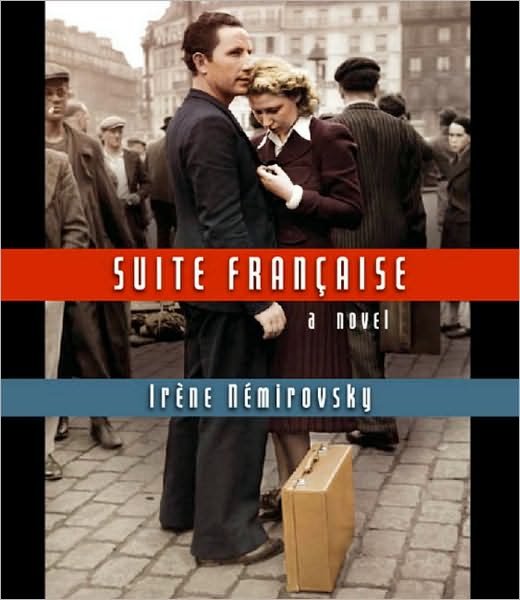
This is not a major work, but is indeed unique, intriguing and noteworthy in a number of respects.

Synopsis: this is a work of fiction written contemporaneously with the author’s own experience during the 1940 German onslaught in France and the subsequent occupation and collaboration. Unlike many journal-type works from the period, this is stylishly written with a now-familiar formula using a cast of fictional, intertwining characters to personalize incidents and experiences amidst real-life events. (Among a number of intriguing questions raised by this work – was this formula at all established at the time?)

For me, this reading was reminiscent of Winds of War (Herman Wouk, 1971); while not nearly as ambitious in scope (actually, a strength), Suite Francaise was as engaging both for the characters as well as for revealing historical nuance. I thoroughly enjoyed it, spent time reflecting over it, and was left wishing for the narrative to continue.

So – what’s exceptional about it?

First, much of the impact derives from knowing the author’s own story and how the book came to life. Born 1903, she was a Russian Jewish immigrant to France (1918), converted to the Catholic Church (1939), published numerous works of renown before the war (including one brought to film), was denied French citizenship in 1938 due to Jewish heritage, and has since been criticized for being a self-hating Jew. She was in the course of writing this work as events unfolded, expecting to create a novel in 5 parts. She finished two parts, was denounced by French collaborators and deported to Auschwitz where she died within a month. Many more of her writings were published since the war. But her daughters retained this notebook manuscript, keeping it unread until 1990 due to anxiety over the expected pain of reading her wartime “journal” – only then, before donating the pages to an archive, did they realize what powerful words those pages held. Written 1940-42, it was published in 2004, acclaimed, translated and read internationally.

Reading with this background, there are numerous elements that may gain impact or raise questions either in the context of her own experience or a clear sightline to contemporary thinking of the time.

  • There are a number of musings by characters and narrator about the future during and after the war that raised chills for me knowing they were written so early in the war.
  • The story contrasts individuals’ different experiences of war, from common civilians feeling powerless and distant from the passions of aggression versus the anonymous, indistinct elites and politicians driving the conflict.
  • She sharply depicts still-thriving class contradictions that threaten to surmount the national conflict: aristocrats of mixed national heritage, communists, resistance fighters, the Church, city vs provinces, villagers vs farmers.
  • There is one passage that strongly evokes scenes from Lord of the Flies. This includes one of several “arbitrary” non war-related deaths in the story. I was left wondering about the origin and meaning of these.
  • Aristocrats and other characters tending to be collaborators make reference to their sympathies opposing the advance of Jews, communists and Freemasons (a triad central to Nazi propaganda). Freemasons?
  • How the French characters respond to the war depends greatly on whether they experienced the “first war” only 25 years (and one young generation) earlier, or the 1870 war (with Prussia, resulting in a victorious German Empire); for the entire society the immediacy of both was stunning.
  • As often occurs with translated works (and in this case the separation of 60+ years), numerous passages had me wondering about the author’s full meaning.

Well you’ve sold me on needing to read this book; and I certainly didn’t know any of that backstory, which does indeed enrich the experience. Thanks for the guest post! Please do give us more as you keep listening!

The Paris Wife by Paula McLain

Ahhh. This was really a joy and a pleasure to consume. I’m just sorry it’s over.

(Let me apologize in advance for a lengthy post today, but I have a lot to say about this book.)

Ernest Hemingway is my greatest literary obsession; I’ve certainly loved, and returned to, and reread, and studied other authors, but Hemingway has been the love of my reading life. Certainly, that was a large part of the appeal of this book: to come home to familiar and much-loved territory. We all know that feeling, I think: visiting an old neighborhood, hearing a song from one’s happy youth, telling old friends the same old stories of shared memories.

So, as I’ve said, part of the luxuriant pleasure of this book was all the intertwining threads of familiarity. I have recently been reading By-Line: Ernest Hemingway, a collection of his newspaper and magazines stories and dispatches, many from the Hadley era of his life. I’ve read 3 or 4 biographies, and piles of his novels and short stories, and nonfiction/memoirs like Death in the Afternoon (about the bullfights he saw) and A Moveable Feast (about his life in Paris with Hadley). And I just yesterday purchased The Garden of Eden, a novel published posthumously (and controversially edited by his surviving family), about a couple who becomes a triangle on the beaches of France and in Spain. I read it years ago but wanted to own my own copy. I remember really loving this book, although it’s surrounded by critical ambivalence and debate; this is where Hemingway most directly ventures into gender-changing, gender ambiguity, cross-dressing, bisexuality, threesomes… and all sorts of interesting and disturbing subjects linked by some biographers to Hemingway’s mother’s tendency to dress him up as a little girl when he was young. I find it all fascinating.

my Hemingway library at present


Hadley Richardson was Hemingway’s first wife; they married when he was just 22, and she was 29, and surprised at herself for landing such a vibrant, popular, ambitious young man. They took off for Paris quickly, and shared the early years of Hemingway’s career, including the publication of Three Stories and Ten Poems, In Our Time, and The Sun Also Rises, his first novel and the one that really launched his career. They also shared poverty and insecurity, a number of hardships, an unstable but scintillating circle of famous friends, and an unplanned pregnancy. Their story ends (I’m not giving anything away here, it’s history) when Hemingway begins an affair with Pauline Pfeiffer, who will be his second wife (who will be thrown over for the third, who will be thrown over for the fourth, who will hear the gunshot when he commits suicide just before his 62nd birthday).

So, as I’ve said, a large part of the joy of this book for me was sharing so intimately in the life of someone I feel I know well, and whose work I love. But there was a real danger there; for if it had been done badly or in poor taste (overly sentimental or maudlin, or vindictive towards Hem the womanizer) or inaccurately, imagine my upset! With this subject being so near to my heart, the standards were very high.

Paula McLain has my gratitude and admiration, because she’s done beautifully! This is a gorgeous novel. Her writing style (in Hadley’s voice, in first person) is a bit like Hemingway’s, although not quite so sparse. She paints pictures with short brush strokes. Hadley’s character is an interesting blend of strength and weakness (which is an observation she makes about Hem, too); she repeatedly bemoans her un-modern tendency to obey and bow to her difficult husband, compared with the women around her and their new-age relationship rules. She “lets him go” to Pauline without a fight, from the perspective of several mutual friends. But I think she maintains a certain dignity, and not just in her defeat at the deceitful Pauline’s hands. And at any rate, her voice is clear and authentic and emotionally revealing without being sappy. She seems to be honest with herself, and with the reader. In many ways this is a novel about a woman struggling to find and maintain her own identity in the unique setting of 1920’s expatriate Paris, and while being a loving wife and mother. In this sense it wouldn’t need to be about Hemingway; it’s a woman’s story, and it’s important without the celebrity. It reminded me a little of Kate Chopin’s The Awakening, or The Painted Veil by W. Somerset Maugham.

I loved how McLain (or Hadley) used some of Hemingway’s own rhetoric about truth and turned it back around on him. For example, on page 230, Hadley is dealing with her feelings about being completely left out of the book, The Sun Also Rises, when all the others present made it in as characters (none flattering):

I was incredibly proud of him and also felt hurt and shut out by the book. These feelings existed in a difficult tangle, but neither was truer than the other.

Hadley was a complex and mostly sympathetic character; I got frustrated with her here and there for not standing up for herself a bit more, but she was so authentic and real and human, I mostly was able to take her as she was. Hemingway was not so sympathetic, which is also very authentic and real. He was a cad towards the men and women in his life, pretty consistently. He was also very lovable, which is why so many men and women came back to him over and over for more fun and abuse. He was, as Hadley says on page 311,

such an enigma, really – fine and strong and weak and cruel. An incomparable friend and a son of a bitch. In the end, there wasn’t one thing about him that was truer than the rest. It was all true.

Again with the truth of the thing, which Hem himself loved to cite.

What a work of art this book was, and how evocative of emotions. It was exhausting and cathartic. Is my reaction colored by my love of all things Hemingway? Yes. But my standards were also raised almost impossibly high, so please take me seriously when I give McLain an A+, and thank you, ma’am.

a collection of destinations for you

Today I wanted to share with you how I start my day, and where it takes me. Maybe you’ll come along.

When I get to the library in the morning, one of the things I try to do as it fits into other necessary morning tasks, is read my Shelf Awareness email. This is a daily digest for booksellers (or, in my case, librarians) with bookish news. A lot of the news regards the bookselling industry specifically – how Barnes and Noble and Borders are doing, profiles of small or family-owned book stores, market trends, and whatnot. These items are not terribly interesting to me, usually, but I skim them and am sometimes interested. I read it, more, for the book reviews and interesting links. Generally, bookish trends are of interest to me and help me do my job. It does pay for me to know what people want to buy because I buy the books for my library and obviously I try to provide what people are wanting these days. If you’re interested in the emails, you can sign up here.

Today, for example, I learned from Shelf Awareness of the renaming of the Boscobel Aerodrome in Orcabessa, Jamaica as the Ian Fleming International Airport. Ian Fleming wrote the James Bond books, reportedly at a “scenic retreat” nearby. That’s a fun fact.

I also found this teaser: “the Guardian asked readers to check their literary balances with a ‘banking in literature’ quiz”, and I thought, oh boy a literary quiz! but it turned out to be quite specifically a quiz about banking in literature, which turns out to be something in which I am not an expert, so that was kind of a flop, for me personally. Maybe you’ll do better.

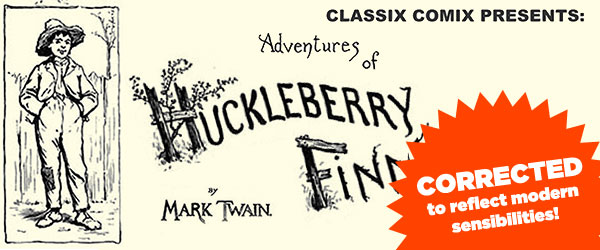
But then I found Tom the Dancing Bug’s classix comix version of the Adventures of Huckleberry Finn (Corrected to reflect modern sensibilities). If you’re reading my reading blog you’re probably the sort of person who is also aware of the general furor regarding NewSouth‘s republication of Mark Twain’s The Adventures of Tom Sawyer and The Adventures of Huckleberry Finn without use of the n-word or “injun”. I will say very briefly that I am scandalized and strongly against this move, for the oft-cited reasons that a) we respect Mark Twain for his original genius and no one should be re-writing him, b) he put those words in on PURPOSE for goodness sake and with a purpose, which included satire and the bringing to our attention that these words are and were overused and wrong, and c) that the use of these very words always incites discussion (as evidenced by this recent furor), which is a good thing. YES these words are offensive, and this offense is still relevent; that’s why we still need Mark Twain’s work as he originally, thoughtfully created it. So. See the above cartoon for what I think is a very clever satire of the republication.

Next, Shelf Awareness tells me that David Nicholls’ book One Day is moving forward and being made into a movie, which was predicted from the very start. I read this book when a patron loaned it to me, and I enjoyed it fine, although I definitely agreed with Publishers Weekly’s view that it was made for the screen. I don’t watch a lot of movies (largely because the Husband doesn’t like to) but I do like Anne Hathaway, who’s in this one, so I may find a way to see it (without the Husband).

Something else I got out of today’s Shelf Awareness email – and this is a little embarrassing – but when I followed the above link to that ‘banking in literature’ quiz, I found mention of Watership Down as “bucolic children’s fiction”, which didn’t sound familiar to me. I mean, I know the name Watership Down (by Richard Adams), but didn’t think it was a children’s book; I think I had it crossed up in my head with Fahrenheit 451 or Slaughterhouse 5 or something. So I had to go look up Watership Down, and it sounds lovely (and also it turns out that at least somebody on wikipedia agrees with my vague impression that it’s highly allegorical), and now I am determined to read this book because it sounds great. So there you go, after clicking several links and looking things up, I have a new book TBR, and I guess that’s part of what Shelf Awareness is all about.

Finally, in my blog explorations, I came across a really, really delightful post today from author Sharon Kay Penman, in which she discusses historical accuracy, her dedication to it (hear hear! something I blogged about earlier), her responsibility to us readers, and some specific challenges. For example, the personalities she writes about, from the Middle Ages, have significantly different values from ours, regarding women’s rights, animal cruelty, conduct in warfare, etc. I highly recommend taking a few minutes to read this post from an author I deeply respect. (Sharon Kay Penman–>)

You’ve just taken a tour through my morning ramblings on the interwebs; hope you’ve found something interesting. 🙂 What do you play with on the internet to find bookish news or tidbits?

Midweek bookish transitions.

Well folks, today is the sad day that saw the end of When Christ and His Saints Slept. It’s always a good book that leaves me mourning its close. I can still remember finishing Wuthering Heights in high school and moping on the couch for days, just so sad that there was no more.

Moment of silence.

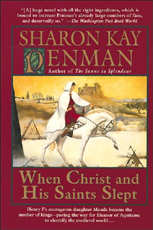
The story of Maude/Henry and Stephen/Eustace’s 19-year battle for the English crown ended a little bit anticlimactically, which is no judgment on Penman’s part since she stuck to history! But wasn’t a let-down, or anything. She finished on a hopeful note, with Ranulf and Rhiannon heading happily home to Wales with baby Gilbert; and I came away with the feeling that justice was more or less served all around, which is a strange coincidence when dealing with historical fact. Her afterword and author’s note were gold to me, by the way; definitely worth the 5 minutes or so it takes to read these few pages. She ties up the historical endings for myriad characters, and then discusses historical accuracy (thank you!!) and where she chose to take liberties, and where she chose between different accounts. This is where I learned that Ranulf was an invention; I really appreciated what Penman wrote about enjoying playing god with this one character, which is an unusual experience for her. What fun! I guess that’s how she was able to give us such a happy, hopeful ending, that we get to finish for ourselves. Ahhhh.

So unlike in the case of Wuthering Heights, there are sequels; this book is the first in a trilogy, and there are still a number of Penman novels that await me. That earns another Ahhhh.

Next up: I’m watching the poll below for a tiebreaker betwixt Room and Still Missing. Help a girl out; at this time tomorrow I will have started one or the other! Thanks for your time.

admiring Sharon Kay Penman; and, a discussion of historical accuracy

As I near the end of this masterpiece, I’m marveling at author Penman’s ability to keep everything straight. The number of people, castles, battles, the family relationships, the sequence of events, the shifting loyalties – I’m doing okay as the reader at staying clear, but only because I allow myself to drift and be re-seated by my gracious guide every so often; and of course because she’s created strong enough characters that it’s easy to follow each personality. (No one would ever get Henry and Eustace confused.) I wonder just how close to true history she stays? Clearly there’s an unbelievable amount of research involved; but I wonder how truly accurate this novel is. Of course, the devil’s advocate might wonder how truly accurate our “history” books are on this time, too, considering how long ago (the 1100’s) and that history is written by the victor, and all. At any rate, this book has encouraged me to do some research of my own: into Penman herself.

First I went looking for the author’s website; these are often my favorite resources in answering questions about a series, like series order and years of publication, as well as what’s coming out. (I figure generally an author has an interest in promoting upcoming work and in keeping them straight.) Penman lists her books both alphabetically and chronologically, isn’t that helpful of her. And wouldn’t you know, she has a blog! What fun.

The first thing I learned on her website is that I lied when I said I’d only read one book of hers before this one. I read The Queen’s Man several years ago and forgot who the author was. Now that it’s been pointed out to me I do recall that book as being in her style, but call me suggestible. I’m such a haphazard reader: I read the third in one Penman trilogy and am now reading the first in another… no respect for series order. You know, I kind of think it’s the mark of a good book that it stands alone even if it is part of a series. I’m generally not bothered by spoilers or out-of-order reading. Maybe I’m just fortunate to have a short memory; I have certainly reread books (like mysteries) that benefit from surprise plot twists, and been surprised all over again! (I consider this a gift, allowing for repeated enjoyment of the same revelation.) I love Penman and would love to read more; but I’ll most likely just fall upon whatever crosses my path next, without regard for order. With so many wonderful books in the world, I rarely find myself seeking out particular ones; it’s so easy to just read the wonderful book that lands on my desk next.

But my purpose in seeking Penman out was to look into her research methods. The first thing I came upon was her research recommendations, sort of an annotated list with discussion of resources. But I had a lot more fun reading her medieval mishaps, where she confesses to mistakes in historical accuracy, including a number of anachronisms that I, for one, would never in a million years have spotted. Remember, I read historical fiction in part because it teaches me history! …which I love, but I also want to remain aware of the inherent risk of learning something incorrectly as fact. So again, how closely researched? If Penman is concerned about whether or not Stephen’s hunting hawks wore hoods, or the expected life span of an Irish wolfhound in the 1400’s, I can’t believe she’d get the sequence (or victors!) of major battles wrong. But let’s not make assumptions.

According to her blog, Penman’s normal contract for a novel is three years, during which she does research that she repeatedly calls obsessive-compulsive. This is promising. But I’m not sure that reading her own characterization of her research is a fair way to judge; surely any author of historical fiction would claim exhaustiveness? This leads me to look for similar information about Philippa Gregory, another author of historical fiction I’ve enjoyed. A few minutes of internet research makes it easy to see that the internet, at least, gives Penman much more credit for accuracy than Gregory. This doesn’t surprise me too much, as Penman’s books read a bit more “seriously” than Gregory: P spends more time on historical details while G is a bit fluffier, a bit more romance-novel.

I fear that the final conclusion I’m coming to, is that one would have to do considerable research, nearly become an expert oneself, to best judge how accurate Penman’s (or Gregory’s) fiction really is. I’m not interested in that much research just now! Short of such an investment myself, I can only look at the statements made my other readers, who are themselves experts to greater or lesser extents, unknown to me. I found an interesting discussion here from librarything that sort of illustrates my point: it’s open to interpretation, depending on your level of expertise. I guess what I’d most like to read is an article of literary criticism written by an academic scholar of the era of history under discussion; but I don’t think those sorts of scholars tend to spend their time critiquing Sharon Kay Penman.* sigh.

Does it matter how historically accurate a work of fiction is? Yes and no. Historical accuracy does not effect my enjoyment of this book, because I don’t know any better. (If I know better, we’re in a whole new topic; see below.) As a work of fiction, it can be very very strong, both as literary achievement and as entertainment, without being very accurate at all. At some point, of course, it might be best to let it stand as “fiction” rather than claiming to be “historical”; but you get my point. However, there is a real danger in educating ourselves through fiction. Using fiction to learn history requires vigilant attention be paid to historical accuracy. So, it depends on what your purpose is in reading. But awareness is always important in life and in reading: awareness of our purposes in reading; awareness of historical accuracy; awareness of what our reading is convincing us of, regardless of our original purpose.

I especially appreciated a comment on that same librarything discussion, made by margad in message 28: “sometimes small inaccuracies can completely spoil one’s trust in an author.” This is a real concern. I deeply disliked a book called Sophie’s World, by Jostein Gaarder, for a number of reasons, but immediately off the bat I disliked it for a reference to what Homer “wrote.” Homer was prehistory; there was no writing; this is incredibly important in appreciating what he achieved, grumble grumble. Get a fact that I know wrong in the early pages, and you will lose me, immediately and probably irreconcilably.

Have I gotten far enough off topic? My original purpose in writing today was to say wow, Ms. Penman, hats off to you for writing such a lengthy and detailed novel that keeps everything so straight – whether it’s perfectly accurate or not, that’s an achievement, and I’ve enjoyed it mightily, and have no idea how true to fact it is. 🙂


*I did find a little smidge of such criticism, of all things, about Gregory here:

Internationally renowned novel critic Dr. James Higgins (who has a PhD in Historic Literature from the University of Australia) said of Gregory when he reviewed The Other Boleyn Girl: “Philippa Gregory has created a mesmerising work of fiction, seamlessly intertwined with historical fact. While her list of sources may give some reason to believe her novel contains more fact than fiction, it is quite clear to me that Gregory has gained a knowledge of the basic storyline, as well the culture and customs of the Tudor Court, and embellished and dramatised it even more (if that is possible).”

Conclusion? She writes historical fiction. Thank you Mr. Higgins. At least I know such a scholar exists!

mostly through When Christ and His Saints Slept

I’m continuing to enjoy Penman; what a luxury this weekend of laziness is.

What a feat: to tell the story of several decades of civil war in such agonizing detail, complete with all the characters and personalities and constantly shifting loyalties and betrayals. The sheer number of battles and quantity of blood is shocking and sobering (thus the title), but after hundreds of pages of it, I’m still engaged. I guess I do become a little bit numb but we still care about the people and we still want to see what happens to them. Maude and Stephen grow from youth into age, and their children take up the fight, still chasing the crown. The war is shocking. We know war is bad, yes, but the civilian massacres just go on… it makes me consider political issues that are far from settled today. It’s sad (but very human) how both sides bemoan the civilian suffering but continue to fight; each says golly I wish all this suffering could end, but I still need my crown (for my son) and it’s really the other side’s fault it’s still going on, if only *they* would give up… Epic is absolutely the word for this novel. But I’m still deeply engaged and invested in these people. I’m not very strong on English monarchic history, but reading fiction is helping me! (I know, it’s fiction, don’t worry, I’m not taking it as gospel. But at least I’m getting some of the major characters set in time, even if they never delivered these lines.)

As I wrote in an earlier post, I do appreciate how Penman visits with characters from various strata of society. I miss that we haven’t revisited Berold or Barbe and Marthe since the first 30 pages of the book; I thought for sure we’d see them again (and maybe we still will, I’m only on page 575, lol). But perhaps we met them only so they could introduce other people and scenes. I like the colorful, three-dimensional feel these characters add to the story.

Penman takes me into another world, and keeps me there for 750 pages. I’m swept into another dimension, with conflicting loyalties and no easy answers, and human characters, and love and romance and tragedy and death. It’s an amazing tale. And I do think historical fiction can be educational. Still recommending.

several pots on the fire

So last night I found myself with some unexpected free time at home, and because it was *unexpected*, I had unfortunately left my current book, When Christ and His Saints Slept, at the library at work. Bummer. I’m already going to have several going at once when I start Faithful Place as planned tomorrow. So I picked up one of the many (many, many) lying around TBR, and started…

The Things They Carried, by Tim O’Brien. This is not a new book; it was originally published in 1990, and I became aware of it this year with the 20th anniversary republication and various discussions. It’s a collection of related short stories (or a novel, depending on who you ask) set in the Vietnam War, and based on O’Brien’s experiences there. I read only one story/chapter last night before bed; but I can see why this book has been so talked about. This story/chapter that I read is “The Things They Carried,” and I love how he uses those things to tell so much of a story. It’s sort of sparsely written, and using “things” rather than emotions, which to me makes for less telling and more showing. It’s beautiful and sad and evocative. I look forward to more.

I was a little sorry to start another book while reading one and ready to start another tomorrow. But then I realized that I have several going at any one time, as it is… there’s Dust by Martha Grimes on the bedside table, and Frederica by Georgette Heyer in the bathroom, and This Book is Overdue! by Marilyn Johnson on the coffee table. What fun, when a person gets to live like this. Do you read several books at a time?

When Christ and His Saints Slept

What an enjoyable book. This is only my second Sharon Kay Penman experience, which I need to work on; I got stuck on The Reckoning and read it over and over when I should be reading more of her work! I got through the first 100 pages of this 750-page book this weekend, and I’m engrossed. It is an awfully long book at 750, but I’m not intimidated; she’s so easy to read. It’s a real saga of historical fiction, dealing with the fight for the English crown after the death of King Henry I in 1135, between his daughter Maude and nephew Stephen.

I think a large part of what makes Penman’s work special is the characters. She writes a multitude of more (or less) sympathetic characters; we grow to like them (or not), and we get to know them fairly quickly. While there are many characters, I for one don’t have trouble keeping track of them because they emerge quickly as having recognizable personalities. (I’m always glad when they have different names, too; too often in historical fiction about English royalty we’re bombarded with Elizabeths, Marys, Georges, Henrys and Richards until it’s all a blur, but so far in this story everyone holds distinct names, thank goodness.) The characters provide multiple perspectives on a complex story, which helps illustrate the ambiguities – is Stephen right in seizing the crown? etc. It also calls into question the reliability of these perspectives; think of reliable or unreliable narrators. The third person perspective stays constant, but seems to interpret through different characters, so we get different perspectives. When we’re with Stephen, we see him as being sympathetic to Maude; when we visit Maude, we see Stephen as being more grasping and ruthless, so the perspectives change. Through Geoffrey’s eyes, Maude is an evil ice queen; through Maude’s, Geoffrey is violent and disrespectful.

The other thing I notice about Penman’s characters (in contrast, for example, to what I recall of Phillippa Gregory’s dealing with similar stories) is that we visit with decidedly lower-class, minor historical figures. To me, this makes the world much more real. The characters tend to have some nuance and complexity, making them more human, too. Varied perspective and multiple complex characters from diverse walks of life make for a fascinating story. Expect me to take a little while to finish this lengthy novel. But unlike some books of this size, I expect to enjoy every minute of it.


readalong: FYI, with a little lead time: My buddy Karma and I are going to be reading this book together, starting this Friday the 17th. Please join us for discussions here!

book beginnings on Friday

This meme is hosted by Katy at A Few More Pages.

From When Christ and His Saints Slept, by Sharon Kay Penman:

“Stephen was never to forget his fifth birthday, for that was the day he lost his father. In actual fact, that wasn’t precisely so.”

Hm. I call this a good, grabby opener: “this is so. actually it isn’t.” That makes me say, what? Tell me more. Plus, I recall Penman’s The Reckoning (the only other of hers I’ve read) as one of those books I can enjoy over and over again, and every time be sad when it ends. I’ll let you know how it goes.

Phillippa Gregory

Just wanted to mention that I’ve recently discovered this author… and I’ve really enjoyed everything I’ve found so far (three titles: The Other Boleyn Girl, The Boleyn Inheritance, and The Other Queen). They’re historical fiction, and she’s got them set in the 15th-20th centuries, but all 3 that I’ve read come from the 15th; I enjoyed The Other Boleyn Girl the most, if you’re looking for a place to start. I’ll be finishing her 15th century series before branching out. As you might guess from the titles, these books deal with the Tudor monarchy, and they have everything: intrigue, suspense, drama, romance (of a fairly cynical sort, what do you expect at the royal court?) and some medium-steamy sex, too. They’re fairly long and engrossing; great to keep me for a whole weekend (not too many books can do that). I recommend.