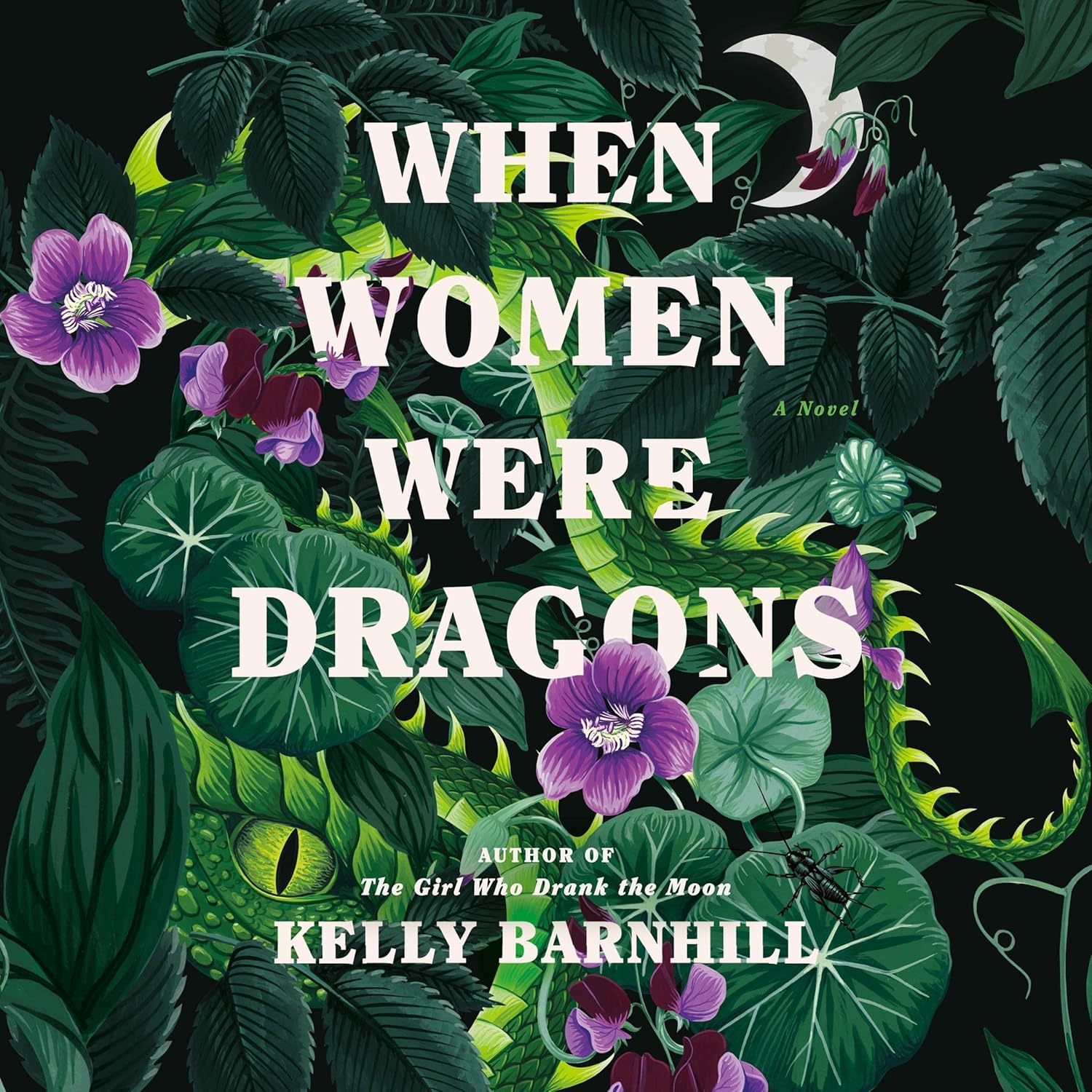
When Women Were Dragons by Kelly Barnhill (audio)

I don’t recall where I got this title from, but I loved this book, and am grateful to whatever review or list sent it my way. Also to my lovely partner who gifted it to me for the long drive from Texas to West Virginia.

When Women Were Dragons: Being the Truthful Accounting of the Life of Alex Green–Physicist, Professor, Activist. Still Human. A memoir, of sorts is a living, breathing tale, ever expanding, filled with metaphor that reshapes itself with the reader’s interpretation. It opens with a strange letter from a Nebraska housewife in 1898 to her mother, shortly before the woman spontaneously dragoned. Next we have an excerpt from the opening statement given by Dr. Henry Gantz to the House Committee on Un-American Activities in 1957. Then we get into the first-person narration of Alex Green, who will tell most of this story, with brief insertions mostly from Dr. Gantz’s work – bit of an epistolary format. (The audiobook is narrated by Kimberly Farr, as Alex Green, and Mark Bramhall, as Dr. Gantz, which I thought was a great choice.) “I was four years old when I first met a dragon. I didn’t tell my mother. I didn’t think she’d understand.”

I think this must be right around 1950. Alex grows up in small-town Wisconsin, in a pretty 1950s world: there are many things we just don’t talk about, including cancer, menstruation and most aspects of girlhood and womanhood, what to expect on one’s wedding night, diversity in sexual orientation and gender expression, our feelings, and dragons. When Alex is a little girl, her mother goes away for some time – months – and no one explains or even acknowledges the change; likewise when her mother returns, gaunt, weak, different (she doesn’t even smell right). The reader understands better than little-girl Alex when her mother’s chest is glimpsed, missing breasts, two scars like smiles. This world is recognizably our own except for the dragons. Women in this world can dragon (that’s a verb), or become dragons, at which point they sometimes eat their husbands (this seems to happen frequently with very unlikeable, not to say abusive, husbands) before flying away. Dragoning is a poorly understood phenomenon because, as with much that is female or feminine, society judges it too shameful to examine, and science mostly averts its gaze. Dr. Gantz is a rare exception: he believes in the scientific mandate to learn, whatever truths are revealed. Biology should never be shameful. His research articles and responses to an oppressive world are useful seasonings to this story, and he is himself a delightful character, alongside the heroic librarian Mrs. Gyzinska.

And oh, Alex’s auntie Marla, a wonderful woman who comes and cares for her while her mother is away in cancer treatment, a big powerful woman who flies airplanes during the war and works as a car mechanic and wears men’s clothes and takes very little shit, and who we lose to the Mass Dragoning of 1955. When Marla dragons, she leaves behind an infant daughter, Alex’s cousin Beatrice, who from here on is raised as Alex’s sister. Such is the gaslighting of Alex’s family and world that she learns to really believe – almost – that she has no aunt, that Beatrice has always been her sister. (Echoes of 1984. We have always been at war with Eastasia.) And boy, the time Alex has raising her younger sister, Beatrice, a delightful dragon of a child if there ever was one.

Despite all I’ve just thrown at you, I’ve barely scraped the surface of this remarkable novel. It contains many stories and many layers, much that is very recognizable from our ‘real’ world, and lots of potential metaphors to ponder. I wondered at different times if dragoning were a metaphor for menstruation; for puberty; for “un-american activities” (certainly, HUAC seems to conflate them); for simply being independent, self-determining, and female (except that those who dragon are overwhelmingly but not universally girls and women). This story tackles the way we handle difference, and especially gender, sexuality, and gender expression. It contains such maddening (if entirely realistic) renderings of sexism that it was sometimes hard to listen to. It contains transcendent moments of personal discovery, joyful academic inquiry, love and coming-of-age, and some lovely iterations of family and built family, which I always appreciate. “Sometimes,” confides Alex at an advanced age, “the expansive nature of family takes my breath away.” There is such good fun; I especially liked the line “If that dragon was hoping for sympathy, she was crying in front of the wrong teenager,” which I got to share with my favorite dragon-loving teenager. It considers the looping of time and relationships. It’s got science and wonder, a bit like A Tale for the Time Being, but I liked this better. I’m a bit over the moon about it, and am giving it a perfect score. Also, I loved the audio format, with the one caveat that I wish I could pull more quotations that I loved.

Do give it a go, and let me know what you think.


Rating: 10 military-issued boots.

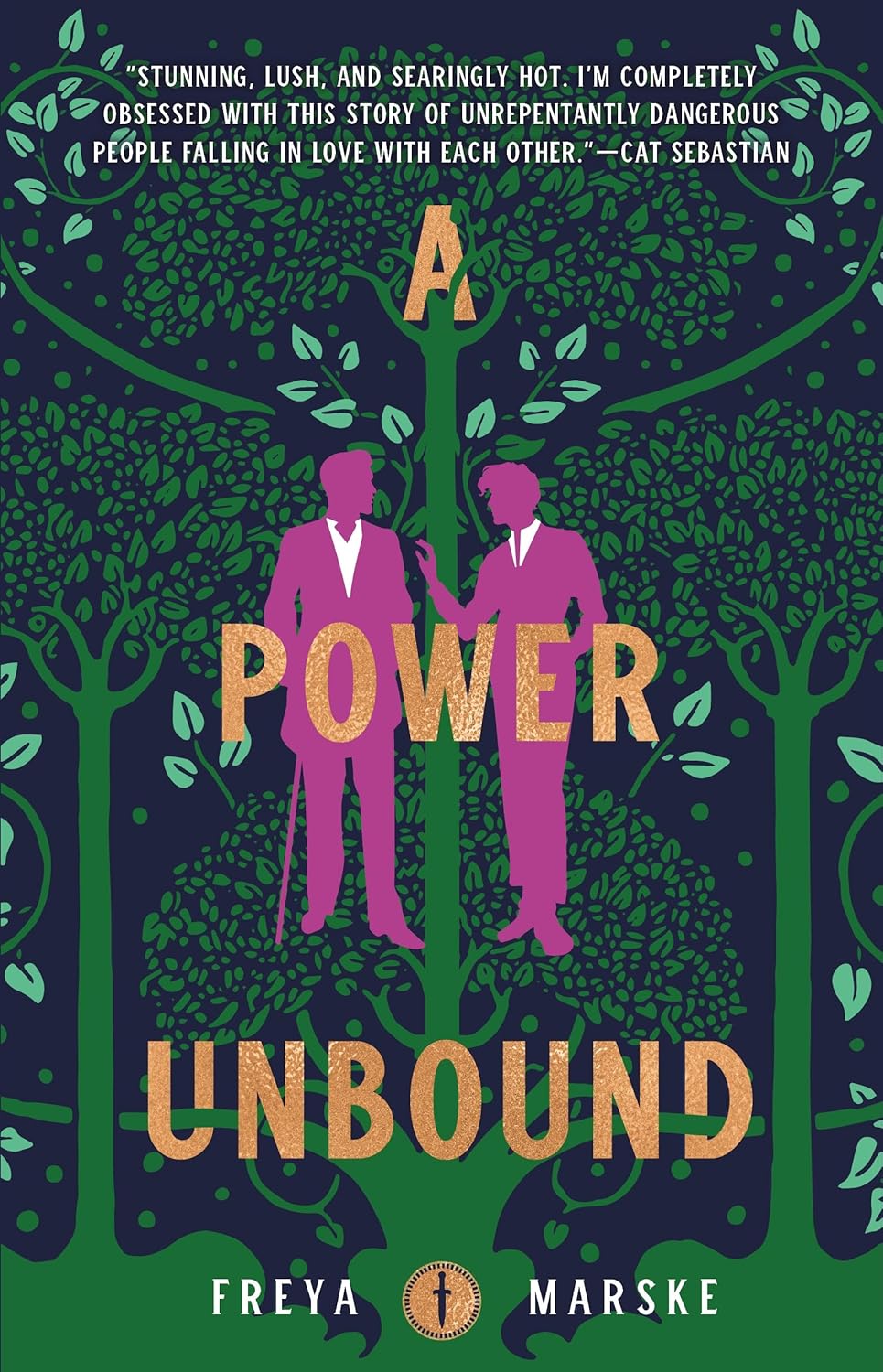
A Marvellous Light by Freya Marske

Billed as historical fantasy, with a strong thread of queer romance, this was an absolutely delightful and fun read – not always joyful in the moment-to-moment struggles of its protagonists (whom I loved), but ultimately deeply satisfying. There was romance (and sex), intrigue and angst, wonderful humor, and a complex magical world. I’m excited for book two, and beyond.

We first meet Reginald Gatling in his final moments, and witness his torture and death by magical means at the hands of assailants unknown. They want to know where something is, and all they get from him, past a secret-binding spell, is the location: his office. In the next chapter, we meet Sir Robert (Robin) Blyth, who is irritated and mystified by his new job replacing the missing Reggie – in Reggie’s office. (Here we also meet the indomitable Miss Morrissey, assistant to Reggie and now Robin. As both a woman and a person of Indian descent, she is exceedingly rare in British civil service, and will prove to be one of the most capable, awesome, and entertaining characters in this story, although a relatively minor one.) And in bursts Edwin Courcey, who had been Reggie’s special liaison and is now to be Robin’s, although they do not get off to a good start. For one thing, Robin has no idea what his job is supposed to be.

What quickly follows is Robin’s “unbusheling,” which is what the magical world calls it when a nonmagical person is let in on the big secret that magic does in fact exist. Turns out that in Britain’s already heavily stratified society, there is a yet another distinction between magical and nonmagical families, and even the former can have the odd, unfortunate nonmagical individual – like Miss Morrissey, whose sister is a very capable magician. And then there is Edwin, who comes from a powerful, wealthy, magical family, but is the bullied younger son, and though an enormously accomplished academic student of magic, has vanishingly little power of his own. Robin is an athlete, a jock, not a scholar, and though he has a title, his estate is nearly bankrupt, and he has a much-beloved younger sister to care for on his civil servant’s salary. Add to all of this the mystery of the missing Reggie, a curse soon (and violently) set upon the freshly unbusheled Robin, Edwin’s own family traumas, and an enigmatic threat to the magical world as we know it – indeed, maybe the world overall – and Edwin and Robin may need to figure out how to get along with each other even if it does not come naturally.

Phew. I’ll stop here, with much left unsaid. This was a completely absorbing, page-turning adventure, and when we finally got to the sex-and-romance (after a long slow burn) it was a great relief. (Fully realized sexual content, if that’s a concern.) This magical world and its rules are complex, even sometimes a bit overwhelming – but that’s Robin’s experience too, so we’re just wrestling with it all by his side, and will probably survive as he does.

This book is pretty heavily male, but I cannot understate the value of Miss Morrissey, who may not have magic but outdoes all the powerful men who surround her in cleverness and the ability to get things done, including some scathing (and hilarious) observations about gender in society. I would follow Miss Morrissey anywhere. Book two does promise to be centered on women, although (from a glance) unfortunately not Miss Morrissey. I’m still 100% in.


Rating: 9 swans.

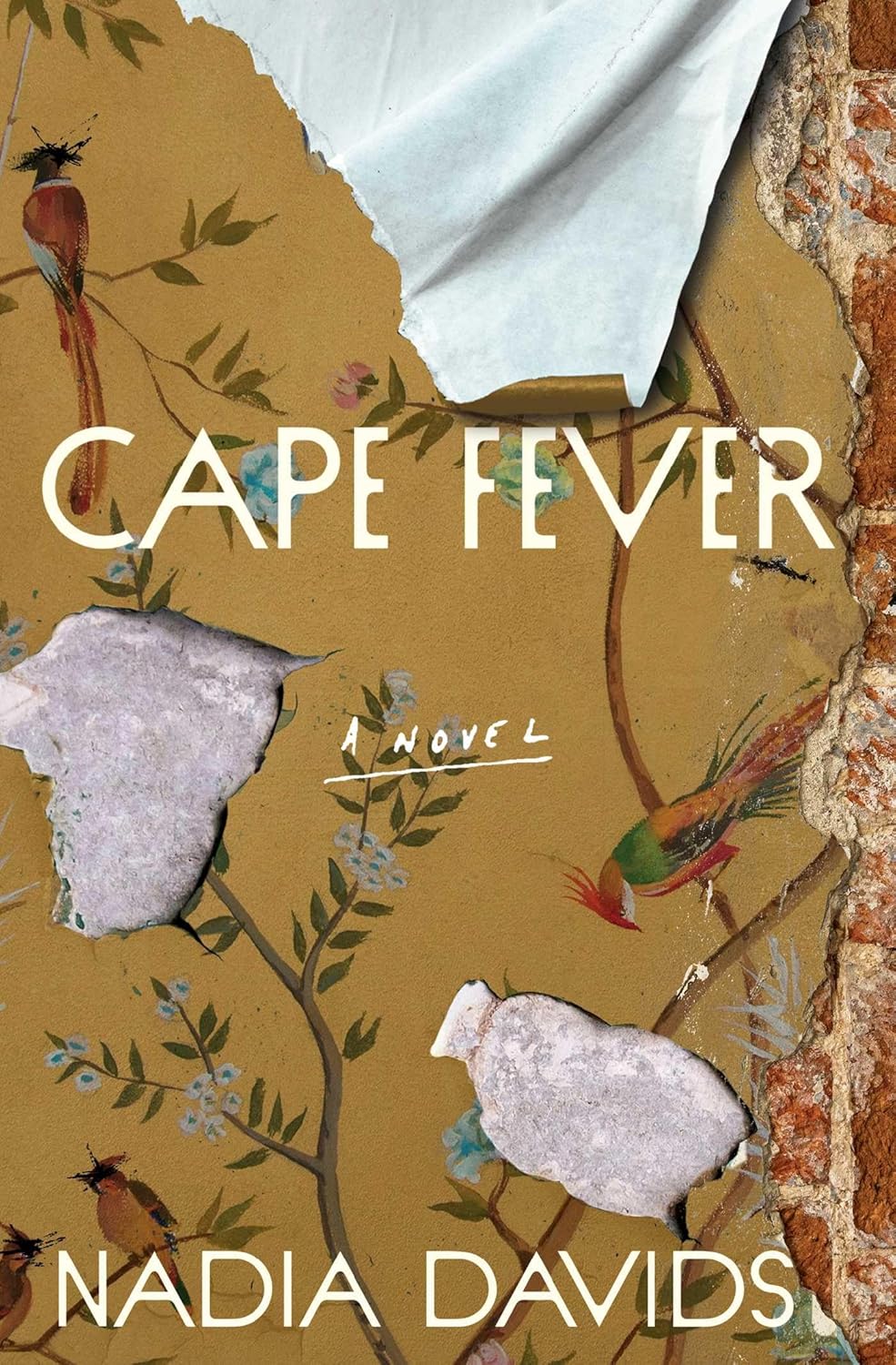
Cape Fever by Nadia Davids

A lonely colonial woman offers to write letters to the fiancé of her maid and the two become disturbingly intertwined in this evocative gothic tale of race, class, and spirits.

“I come highly recommended to Mrs. Hattingh through sentences I tell her I cannot read.” South African novelist Nadia Davids’s twisting gothic drama Cape Fever, her U.S. debut, opens by highlighting narrator Soraya’s ability to read, which she keeps from her employer. Soraya goes to work for the settler Mrs. Hattingh in 1920: hired as a combined cleaner and cook, the younger woman understands that the elder is not as wealthy as she wishes to appear. In the colonial city in which Mrs. Hattingh reigns over a large, lonely home, Soraya’s close-knit, loving family lives in the nearby Muslim quarter; Soraya is permitted by her employer to visit only rarely. Her father is an artist in religious calligraphy, creating beautiful works of prayer and devotion. The word “proclaim,” he instructs her, is “also read, recite. You see? For us, to read, to recite, is one,” and “The person is a pen. The person is paper.” Soraya’s fiancé, Nour, is an accomplished scholar who works on a farm while saving for teachers’ college.

There are moments in which Soraya feels something like fellowship with her employer, when she intuits that “every woman, rich or poor, madam or maid, dreams of escape.” But working for and living with Mrs. Hattingh, under power structures bigger than the individual, is deeply unpleasant. “She’s never understood the scale of what she wants and asks for.” Soraya retreats, in her small room, into the stories and characters that have come to her all her life: the Gray Women, as she terms the spirits that she alone can see; a seawoman with ink for blood; a woman who makes a baby out of soap. She finds Mrs. Hattingh’s house is teeming with spirits.

Mrs. Hattingh introduces a new comfort and stressor when she offers to write to Nour on Soraya’s behalf. As one woman takes the voice of the other–and intercepts the correspondence that arrives in return–their identities blur in disturbing ways. Soraya holds what she can of her own life in private and cherishes her visits to her family’s home, until even these are forbidden. In the increasingly claustrophobic manor, the tension between the two women builds, resulting in complex layers of psychological intrigue amid themes of class, race, love, grief, and haunting. In Soraya’s compelling voice, Davids blends mysticism, quiet power and resistance, and pain born of a long stretch of history in this unsettling tale of suspense. Cape Fever is beautiful, discomfiting, and moving.


This review originally ran as a *starred review* in the October 28, 2025 issue of Shelf Awareness for the Book Trade. To subscribe, click here.


Rating: 7 pickled lemons.

The Midnight Bargain by C. L. Polk

As much as I loved the Kingston Cycle, it’s tempting to say this is my favorite Polk yet. I am really digging the combination of historical setting (including lots of lush clothing detail – not really my area but it’s surprising, richly enjoyable in Polk’s capable writing hands), romance and strong feeling, with a fantasy / speculative framing but around very approachable values. This author has mastered that combination, and it is extremely satisfying to this reader.

In this case, please meet Beatrice Clayborn, the elder daughter of a banker father who has squandered the family’s wealth, and a magician mother who has been collared, literally, so that she cannot practice magic. This is the cost of marriage for female practitioners in the culture Beatrice has been born into. Men have the opportunity to study and improve their practice; women are bound. Beatrice chafes at this rule; she has been practicing her magic in secret, searching for the coded grimoire that will allow her to become a mage. If she succeeds, she will make herself unmarriageable, thereby disappointing her father, but she will also be able to help him improve the family’s financial situation. If she fails, she will be married off to a man of her father’s choosing, collared, denied her true self. We are introduced to Beatrice on the cusp of the bargaining season: she is being presented to high society as an ingenue (read debutante), for the purpose of attracting a suitor (preferably several) and eventually an advantageous marital match.

Bargaining season involves all the primping (clothes! and maquillage), dancing, preening, and social chess you can possibly imagine. It is profoundly not Beatrice’s scene; but it is very much Harriet’s. Harriet is Beatrice’s younger sister, and although she can be a little hard on Beatrice’s nerves, she is also one of the elder sister’s greatest concerns. Beatrice knows that if she fails at bargaining season – if she reveals herself as a “difficult woman,” undesirable, fails to make a match – she will cost Harriet her own chance at the same. Harriet is actually good at these games, and likes them, and deserves her own shot. Beatrice needs to become a mage and prevent her own marriage – but not appear to fail at the social game. It’s complicated.

So she’s struggling to be attractive but not too attractive, and never objectionable (even when the most objectionable men are thrown at her, and even when they are unspeakably rude), and meanwhile she’s struggling to train herself to a very high level of magical performance – and she’s made a new enemy, who might be becoming a friend, and whose brother is interesting. Powerful, wealthy, gorgeous, a capable magician – and he shows a surprising capacity to listen to Beatrice’s opinions on women’s rights. But if Beatrice marries, even for love, even to a man of her own choosing, she will lose her magic forever. She might just wind up facing a lose/lose set of options. But what if there were another way?

I appreciate that Polk’s alt-historical setting feels accurate and real, and the issues at stake – women’s rights, mostly – are both modern and at home in her setting. (Feminism is not new, is it, nor the need.) And I guess part of the reason I find all those period-clothing details so interesting is that they are, in fact, about class and gender and those bargaining season politics. And maybe it’s just a little bit fun to read about the frills and lace and stomachers and fichus and other things I had to look up – I have no time for it in my real life, but part of the fun of reading is to experience other lives, isn’t it? At any rate. This novel was fun and wrenching and powerful and just absorbing, and I would read another twenty-five of them by this author; I hope they are writing furiously and keep doing it for a long time. What’s next??


Rating: 9 picnic baskets.

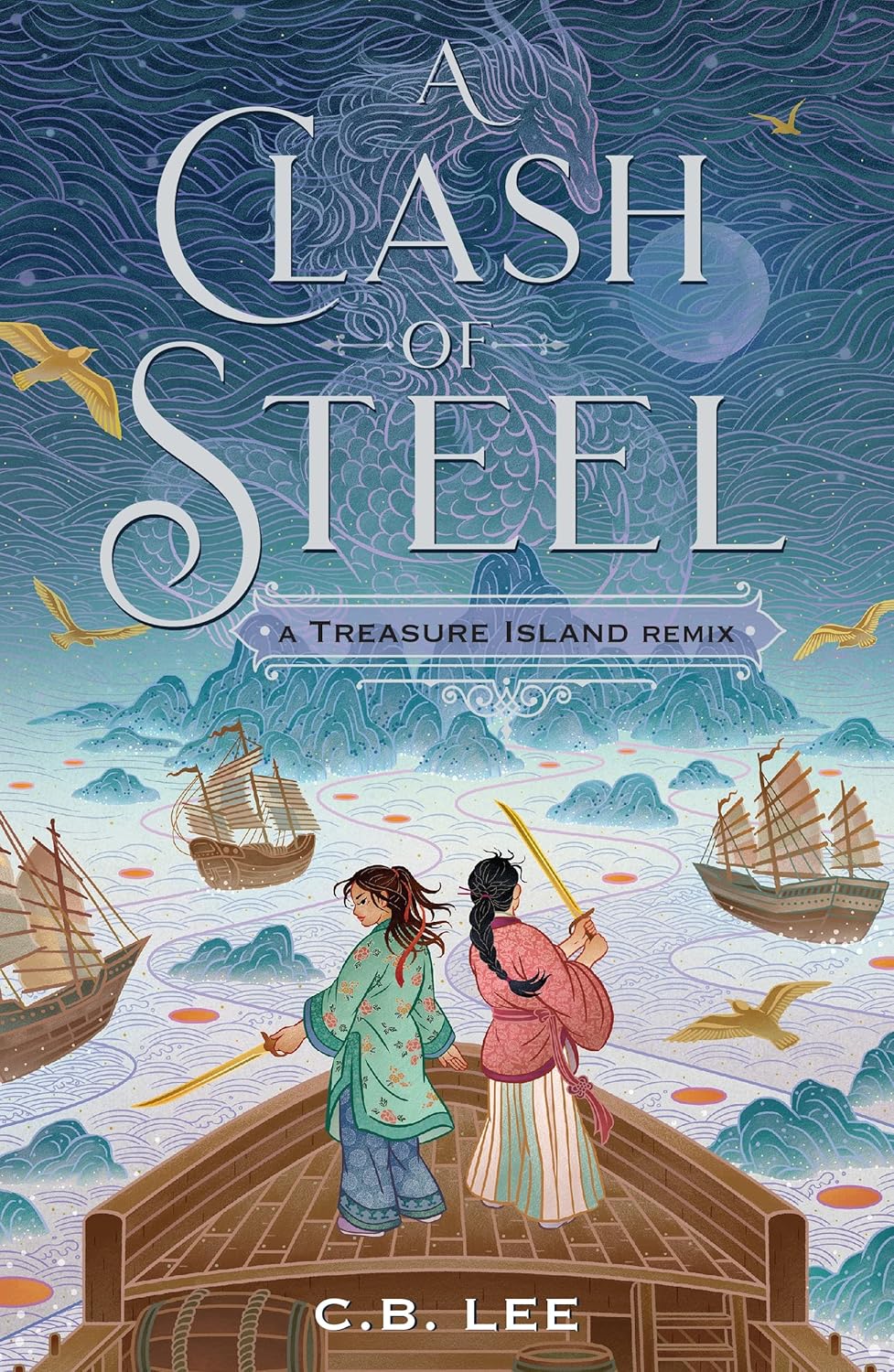
Clash of Steel: A Treasure Island Remix by C. B. Lee

I think this is my favorite of the remix series. Clash of Steel follows Treasure Island perhaps a bit less closely than some, but the broad strokes are there. I love the way that C. B. Lee has adopted their own personal history, and really substantive research into world history, to reset Stevenson’s classic tale of adventure, pirates, hidden treasure, family, loyalty and betrayal (etc.) in the South China Sea in piracy’s golden age. In this process, they offer protagonists who are girls and women, queer, and Chinese and Vietnamese. None of this is cut to fit Stevenson’s story; it’s a riff, set to history, in a time and place where it fits naturally. I loved the whole story. I also loved the supplemental materials at the back of the book, but let’s go in order.

We begin with a prologue set in 1818 South China Sea in which we meet an eight-year-old girl named Anh, aboard a small fishing vessel with her mother (the captain), her little brother, and a small crew. We get a glimpse of dangers at sea, a tight-knit family group, a daring young girl, and an interest in tales of hidden pirates’ treasures. Then we fast-forward to 1826, a small village in China’s Guangdong province. Sixteen-year-old Xiang has never left her village, not for lack of desire. Her father is long dead at sea; her mother is a successful salt merchant and proprietor of several teahouses, including the one where Xiang lives in this backwater, locked away, kept ‘safe’ but unhappy. She dwells in the stories she reads of travel and adventure, and on the high point from where she can view the city of Canton, and dream.

An opportunity comes when she convinces her mother to take her to the city, to visit the larger teahouse there, to see the commercial center–Mother wishes to marry her off to a young man from an appropriate family, but Xiang intends to show enough prowess that she might be permitted to run the teahouse someday. She has always yearned for her mother’s approval, which has never come. If only she could prove herself worthy, she might win that approbation as well as a chance to have a wider life than the village can ever afford. In her brief hours in the city, she meets a magnetic girl her own age–Anh–and gets a snatch of an idea of the kind of life that might be possible: adventure, gumption, authenticity, more. Then a series of events forces her hand. Faced with being shipped peremptorily back to the village forevermore, Xiang takes a chance and runs away. See Xiang on a fishing ship that is also a trade vessel that is also a smuggling ship; see her learn to sail and fend for herself; see her forming closer relationships than she’s ever had before. For a time, it seems all sorts of things might be within reach: family, love, riches, independence. Or violent death and the end of everything she thought she knew about her own background.

Xiang’s story calls on Lee’s own history (descended from Vietnamese refugees of the fall of Saigon, with Chinese roots “tangled together in past generations in conflict and trauma,” and yes, with pirates appearing in that story as well) and the documented history of Zheng Yi Sao, a “pirate queen” who commanded over 70,000 pirates and over 1,200 vessels. I was so pleased by not only the author’s note and acknowledgments, but also language notes, pronunciation guide, and extended historical notes. Finally, we were gifted with an alternate prologue, which (I agree with Lee’s editor) would have revealed too much of the plot if it had appeared at the beginning of the book; but coming where it did, offers intriguing character insight. I wonder if it might have made sense as a sort of flashback late in the story. At any rate, all this extra material enriched my experience of this story, and I loved having the extended historical notes in particular, because I knew nothing of this era of world history in which a Chinese and Vietnamese empire of pirates controlled the South China Sea and subdued all Chinese, British, and Portuguese naval efforts. Thrilling! Oh, and the normalcy of same-sex relationships in this time and place setting, which was apparently disrupted only by Western influence during the Qing dynasty. These references to history make the imaginative adventure tale all the more engaging, at least for this reader.

This story was captivating, and I loved having enough background to appreciate it on several levels. I’ll be looking out for C. B. Lee and am definitely in for more remixed classics.


Rating: 8 baos.

Even Though I Knew the End by C. L. Polk

I’m a big fan of C. L. Polk.

Even Though I Knew the End is romance amid magic and determinism wrapped in a PI novella. (It’s actually a bit of a much-less-dark cousin to last week’s Harmattan Season.) When we meet Helen Brandt, she’s in a Chicago alley attempting an augury, for which she’ll be paid a whopping $50, which she can add to the nest egg she’ll leave her beloved, Edith, on this their last weekend together. The murder she’s meant to investigate turns out much uglier than originally understood, and besides, her augury is interrupted by two members of the Brotherhood of the Compass, a sort of magical professional society from which she’s been barred. Oh and one of them is her long-lost brother (literal). Same-sex love in 1941 Chicago is a challenge unto itself (Helen has friends who have disappeared into insane asylums, for example), as is being a woman in that same setting. Add to that mix angels, demons, souls sold and stolen and earned back.

I loved the historical setting (but plus magic), and the queer speakeasy and community; I loved the femme fatale / gorgeous-but-dangerous-dame sort of character, and found Edith’s religious devotion an unexpected twist. Again (and in such a short time span for this reader) I met some classic or traditional elements of a noir tale, mixed up with new ones. I heard echoes of Chuck Wendig’s Miriam Black. But where Harmattan Season was grim, Polk offers hope – however bittersweet and limited – for a happier ending. As smoke-shadowed as this world is, Even Though I Knew the End is also deeply sweet in its romantic element.

I felt that those Polk shorts I read recently offered varied degrees of success with the shorter format – meaning, some felt a bit more complete or fully realized than others. Many writers, I’d venture, get trained in the novel-length form, and/or have the most reading experience in that length; masters of the short story seem fewer than masters at the novel. (Am I reaching? Do you agree?) I don’t know if that shorter form is harder, or just a place where we tend to get less experience. At any rate. If Polk was experimenting with highly enjoyable but imperfect success in those shorts, here I feel they have achieved something pretty perfect, fully realized, in these 133 pages. Which is not to say I don’t want more of Helen (and Edith) – I very much do. But Helen’s days were always numbered; maybe this is all we get.

Plenty gritty but still sweet, masterfully complete in a small package, with period detail and imaginative flair–I love this story and will follow Polk wherever they may lead next.


Rating: 9 perfect cups of coffee.

Harmattan Season by Tochi Onyebuchi

My first Onyebuchi is an interesting one to characterize as to genre. Harmattan Season is a PI story with some classic noir elements: protagonist Boubacar is down on his luck, a little self-sabotaging, unsure of what he’s working toward, fighting some old demons and secrets. It’s historical fiction, set in a West African nation under French colonial rule in a not-quite-modern timeline. It’s fantasy, or speculative fiction: there is magic afoot. One could argue it’s dystopian, but the colonial rule bit kind of covers that already.

Onyebuchi has a firm grasp of pacing and suspense, and Bouba is a compelling central character. He’s mixed race, or deux fois (“two times”), half French and half indigenous, and struggles with that identity: does it mean he gets part of each of two worlds? Or none of either? Does he fit in a little bit everywhere, or nowhere at all? The reader will learn slowly that his in-between status is further indicated morally by some of his past actions.

“Fortune always left whatever room I walked into, which is why I don’t leave my place much these days.” In the opening scene, Bouba is awakened in the middle of the night by banging on his front door. A woman stumbles in, holding a bleeding abdominal wound. She asks him to hide her; he does, as the police arrive next. One of them, it turns out, is an old associate of Bouba’s – you might even say a friend, or the closest thing he has. They leave. The woman has vanished. Unpaid, Bouba spend most of the rest of the novel trying to solve the mystery of the bleeding woman: who she was, what happened to her. He will uncover many layers of intrigue, wrongdoing, and attempted corrections, in spheres both political and personal.

I think a better grasp of West African history and politics would have given me a deeper understanding of some plot elements – and some linguistic background might have helped as well. There were a few unfamiliar words, some of which I got from French (like deux fois), some of which seem to belong to Onyebuchi’s fictional world (dugulenw), but some of which are not his invention (like the title’s harmattan, a dry seasonal West African wind). How many of the latter, or how many slight variations or references, did I miss? This is a good example of how reading ‘the other’ can be a bit more challenging but also why it’s important to do it. I’m just noting where I might have missed some nuance. Partly, I think, for this reason, I had a slow time getting engaged with the momentum of the plot, but we got there, and I wound up feeling involved with Bouba’s wellbeing and that of the community he gradually decided he belonged to.

I think Onyebuchi is a skilled writer with a fascinating and fresh take on genre intersections, and I’m curious about what else he’s done.


Rating: 7 apples.

Mutual Interest by Olivia Wolfgang-Smith

Mutual Interest is my favorite book I’ve read this year. I loved it. It’s wry, witty, heartrending, extremely cleverly written, and takes a massively wide-angle lens that charmed me enormously. I’m going to keep this review brief and vague, because (even more than usual) I want to recommend that you head into this book knowing as little as possible about plot specifics. If that doesn’t suit you, I can offer you my colleague’s very fine review at Shelf Awareness, which sold me on the book in the first place: longer version here, shorter here.

Here is what I do want you to know:

This brilliant second novel (following Glassworks, which I have not read) is set mostly in Manhattan at the turn of the century from 1800s to 1900s. Our chief protagonist is from Utica, NY, where an unsatisfactory childhood sends her out into a wider world, wringing a life out of her charm, machinations, expert read of other humans, and desperation. Vivian is, arguably, a bit of a con artist, and certainly a master manipulator, but in her own mind, she improves the lot of those she works upon even as she improves her own; she would like us to believe that her exploits are benign, and she is so skilled that we mostly believe her. Eventually, her life will intertwine (she will quite purposefully intertwine it) with two others, in both public and private spheres. I think I’m going to stop there.

Between the ups and downs, loves and heartaches, foibles and hilarities, mad successes and stomach-dropping setbacks of Vivian and her two friends, Wolfgang-Smith employs an immensely omniscient narrator to make observations about the shape of a wide, wide world. “Time and cause unravel in all directions,” this voice tells us, and it all starts with a volcanic eruption, and a bicycle. This astonishing, entertaining, wrenching novel left me reeling; I hope you love it, too.


Rating: 10 manhole covers.

Witchcraft by Sole Otero, trans. by Andrea Rosenberg

This graphic novel follows an unusual household over several centuries in Buenos Aires, Argentina, through various characters whose lives are impacted, if not ruined, by three enigmatic sisters.

Argentinean comics artist Sole Otero (Mothballs) offers a tale that meanders through historical and speculative fiction with Witchcraft, a graphic novel that spans centuries in Buenos Aires. In Otero’s evolving but recognizable visual style, the opening scene emerges spookily from the fog, as a ship arrives in Nuestra Señora del Buen Ayre in 1768. (One of a series of footnotes explains that this was the original name of Buenos Aires, given by the conqueror Pedro de Mendoza.) Readers see three women disembark with their goat, taking with them the three-year-old son of another passenger, to the latter’s wails of despair. From these early, atmospheric pages, a sense of unease is established and maintained.

The following sections of the narrative undertake large jumps in time. In more or less present-day Buenos Aires, a man tells his friend a scarcely credible story of nude women dancing around entranced nude men, with a goat and a chalk circle and “this super creepy music.” In an earlier, historical setting, a Mapuche woman goes to work at a grand estate for three sisters who are both feared and respected in their local village, to a horrifying end. In modern times, a reclusive woman exchanges e-mails with a similarly lonely man, the veterinarian who came on a house call to look at her sick cat; he tells strange, disturbing tales about his family and the elderly goat they want him to save. A nunnery sends an allegedly evil orphan girl to live with three sisters who normally adopt only boys. From these and other narrative threads, populated by spirits, witch hunts, pleas and losses, readers begin to piece together the fractured story of the María sisters and their unusual, perhaps supernatural, habits.

Otero’s style of illustration varies somewhat between sections, but is often distorted or off-kilter, and highly detailed; in full color, her characters’ facial expressions and contortions advance the unnerving atmosphere of the larger story. Page spreads may include carefully spaced panels or no panels at all; text style likewise shifts, with infrequent footnotes to help readers along. This results in a sinister, mysterious, and deeply compelling reading experience. Translated by Andrea Rosenberg (who also translated Otero’s Mothballs), Witchcraft blends horror, dark magic and dark humor, rage and righteousness. This disjointed, sometimes discomfiting, entertaining story addresses colonial power and indigenous resistance alongside ritual, sex, and sacrifice in an eerie, phantasmagoric package not soon forgotten.


This review originally ran in the August 18, 2025 issue of Shelf Awareness for the Book Trade. To subscribe, click here.


Rating: 6 trees climbed.

Trouble the Saints by Alaya Dawn Johnson

Trouble the Saints is bewitching, mesmerizing. It begins mid-scene, a move that is always risky but can have big rewards: the writer asks the reader to wade through a little confusion in favor of action and immediacy, trusting her to wrangle the context clues and have patience with the pace at which details and secrets unfold. It’s well done here. There are cards, and dreams, and magic hands – saints’ hands – and a violent backstory for a protagonist who is however strongly committed to her own concept of justice. The reader finds out as she does how she’s been betrayed – and by the one she loves the most.

Phyllis, or Pea or Sweet Pea to those she is close to, is a paid assassin for a Russian mobster in early 1940s New York City. She is known as Victor’s knife, or Victor’s angel – because she only agrees to kill when the victim deserves to die. She is also a ‘high yellow’ woman of color passing for white in a pretty high-stakes setting. Her years-ago lover, Dev, is a Hindu man guided by karma and reincarnation; he could not abide Pea’s work. His current partner is also one of Pea’s dearest friends, the singer/dancer/entertainment manager Tamara, who is Black enough to suffer the full weight of prejudice and discrimination when Pea can sometimes skirt it. So: violence, organized crime, race and racism and colorism, oh and Hitler’s on the rise, and also Pea’s immaculate skill with her knives is owing to her saints’ hands, which manifest in different ways for different individuals. Dev can sense threats with his. Tamara doesn’t have the hands, but she is an oracle: with her great-aunt’s cards she can read fortunes, or the future, or both – the rules are revealed slowly, to us as well as to these characters. There are others, with different backgrounds, skin tones, and degrees of magic or understanding. Danger and hauntings are everywhere, but there is also romance and the kind of connection that transcends that label.

Trouble the Saints is an astonishing book that keeps surprising, not least with its changes in perspective. These subjects range widely and never feel overambitious for the remarkable Alaya Dawn Johnson, who imbues even the gruesome with poetry. She’s a new name to me but one I’ll be looking for. It took me a day or two to recover, and I’m still thinking about love, friendship, and what we carry on with us. Whew.


Rating: 8 letters.