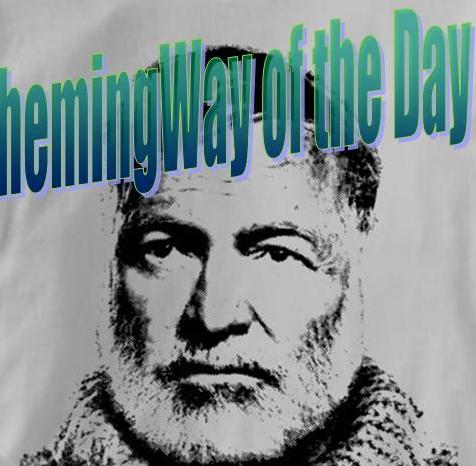
hemingWay of the Day: on uniforms

The first time we [Hem with French guerrillas] had entered the town all but two were naked from the waist up, and the populace did not greet us with any degree of fervor. The second time I went in with them, everyone was uniformed and we were cheered considerably. The third time we went through the town the men were all helmeted and we were cheered wildly, kissed extensively and heavily champagned, and we made our headquarters in the Hotel du Grand Veneur, which had an excellent wine cellar.

from Battle for Paris, printed in Collier’s on September 30, 1944

I like this not only because of the evident power of uniform, but also because of that final aside that the Hotel had an excellent wine cellar. So much is implied by this brief phrase.

hemingWay of the Day: on robots

Lots of people call this weapon the doodlebug, the robot bomb, the buzz bomb and other names hatched in the brains of the keener Fleet Street types, but so far nobody I have ever known who has fought him has referred to Joe Louis as Toots. So we will continue to refer to this weapon as the pilotless aircraft in this release from your pilotless-aircraft editor, and you can call it any of those quaint or coy names you wish, but only when you are alone.

from London Fights the Robots, printed in Collier’s on August 19, 1944

(please catch the irony in the title of his article! did he get to name it himself?)

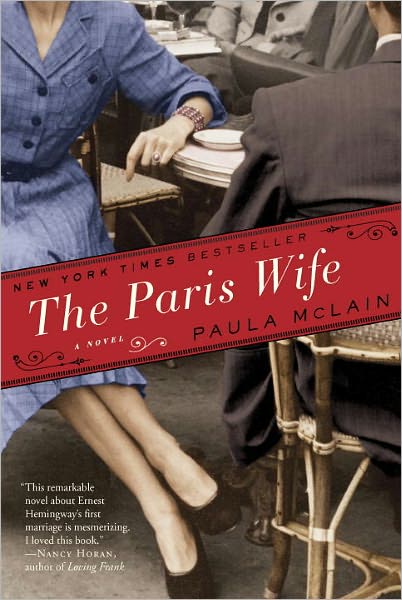
The Paris Wife by Paula McLain

Ahhh. This was really a joy and a pleasure to consume. I’m just sorry it’s over.

(Let me apologize in advance for a lengthy post today, but I have a lot to say about this book.)

Ernest Hemingway is my greatest literary obsession; I’ve certainly loved, and returned to, and reread, and studied other authors, but Hemingway has been the love of my reading life. Certainly, that was a large part of the appeal of this book: to come home to familiar and much-loved territory. We all know that feeling, I think: visiting an old neighborhood, hearing a song from one’s happy youth, telling old friends the same old stories of shared memories.

So, as I’ve said, part of the luxuriant pleasure of this book was all the intertwining threads of familiarity. I have recently been reading By-Line: Ernest Hemingway, a collection of his newspaper and magazines stories and dispatches, many from the Hadley era of his life. I’ve read 3 or 4 biographies, and piles of his novels and short stories, and nonfiction/memoirs like Death in the Afternoon (about the bullfights he saw) and A Moveable Feast (about his life in Paris with Hadley). And I just yesterday purchased The Garden of Eden, a novel published posthumously (and controversially edited by his surviving family), about a couple who becomes a triangle on the beaches of France and in Spain. I read it years ago but wanted to own my own copy. I remember really loving this book, although it’s surrounded by critical ambivalence and debate; this is where Hemingway most directly ventures into gender-changing, gender ambiguity, cross-dressing, bisexuality, threesomes… and all sorts of interesting and disturbing subjects linked by some biographers to Hemingway’s mother’s tendency to dress him up as a little girl when he was young. I find it all fascinating.

my Hemingway library at present


Hadley Richardson was Hemingway’s first wife; they married when he was just 22, and she was 29, and surprised at herself for landing such a vibrant, popular, ambitious young man. They took off for Paris quickly, and shared the early years of Hemingway’s career, including the publication of Three Stories and Ten Poems, In Our Time, and The Sun Also Rises, his first novel and the one that really launched his career. They also shared poverty and insecurity, a number of hardships, an unstable but scintillating circle of famous friends, and an unplanned pregnancy. Their story ends (I’m not giving anything away here, it’s history) when Hemingway begins an affair with Pauline Pfeiffer, who will be his second wife (who will be thrown over for the third, who will be thrown over for the fourth, who will hear the gunshot when he commits suicide just before his 62nd birthday).

So, as I’ve said, a large part of the joy of this book for me was sharing so intimately in the life of someone I feel I know well, and whose work I love. But there was a real danger there; for if it had been done badly or in poor taste (overly sentimental or maudlin, or vindictive towards Hem the womanizer) or inaccurately, imagine my upset! With this subject being so near to my heart, the standards were very high.

Paula McLain has my gratitude and admiration, because she’s done beautifully! This is a gorgeous novel. Her writing style (in Hadley’s voice, in first person) is a bit like Hemingway’s, although not quite so sparse. She paints pictures with short brush strokes. Hadley’s character is an interesting blend of strength and weakness (which is an observation she makes about Hem, too); she repeatedly bemoans her un-modern tendency to obey and bow to her difficult husband, compared with the women around her and their new-age relationship rules. She “lets him go” to Pauline without a fight, from the perspective of several mutual friends. But I think she maintains a certain dignity, and not just in her defeat at the deceitful Pauline’s hands. And at any rate, her voice is clear and authentic and emotionally revealing without being sappy. She seems to be honest with herself, and with the reader. In many ways this is a novel about a woman struggling to find and maintain her own identity in the unique setting of 1920’s expatriate Paris, and while being a loving wife and mother. In this sense it wouldn’t need to be about Hemingway; it’s a woman’s story, and it’s important without the celebrity. It reminded me a little of Kate Chopin’s The Awakening, or The Painted Veil by W. Somerset Maugham.

I loved how McLain (or Hadley) used some of Hemingway’s own rhetoric about truth and turned it back around on him. For example, on page 230, Hadley is dealing with her feelings about being completely left out of the book, The Sun Also Rises, when all the others present made it in as characters (none flattering):

I was incredibly proud of him and also felt hurt and shut out by the book. These feelings existed in a difficult tangle, but neither was truer than the other.

Hadley was a complex and mostly sympathetic character; I got frustrated with her here and there for not standing up for herself a bit more, but she was so authentic and real and human, I mostly was able to take her as she was. Hemingway was not so sympathetic, which is also very authentic and real. He was a cad towards the men and women in his life, pretty consistently. He was also very lovable, which is why so many men and women came back to him over and over for more fun and abuse. He was, as Hadley says on page 311,

such an enigma, really – fine and strong and weak and cruel. An incomparable friend and a son of a bitch. In the end, there wasn’t one thing about him that was truer than the rest. It was all true.

Again with the truth of the thing, which Hem himself loved to cite.

What a work of art this book was, and how evocative of emotions. It was exhausting and cathartic. Is my reaction colored by my love of all things Hemingway? Yes. But my standards were also raised almost impossibly high, so please take me seriously when I give McLain an A+, and thank you, ma’am.

Midweek Miscellany & hemingWay of the Day: on Spanish whisky

I have a sprinkling of things to share with you today.

One. I have updated my blogroll (look right–> and down some) to include all the blogs that I (try to) visit every day. And you will see ABOVE the blogroll, a short list of My Very Favorites. Check ’em out.

Two. I have a very favorite blog post of the day to share with you, too: it’s a review of a book called To Bed With Grand Music by Marghanita Laski and you can find this delightful post here. I am super intrigued by the idea of this book, and it’s completely due to the discussion of it by the Book Snob, so thank you Book Snob! This one goes on the list. Check that out, too.

Three. I am still reading By-Line: Ernest Hemingway, and still loving every minute of it. I may have to put it down at some point to pick up An Incomplete Revenge, the next Maisie book. But fortunately, as a collection of short pieces, By-Line is a pretty good book to put down and pick back up. I should also confess to now being in the middle of no fewer than five books. Hm. (The others are Whatever You Say I Am by Anthony Bozza; The Things They Carried by Tim O’Brien; Dust by Martha Grimes; and The Club Dumas by Arturo Perez-Reverte. Eclectic, a bit.)

Four. Now for my daily quotation out of By-Line.

Beer is scarce and whisky is almost unobtainable. Store windows are full of Spanish imitations of all cordials, whiskies and vermouths. These are not recommended for internal use, although I am employing something called Milords Ecosses Whisky on my face after shaving. It smarts a little, but I feel very hygenic. I believe it would be possible to cure athlete’s foot with it, but one must by very careful not to spill it on one’s clothes because it eats wool.

(from Hemingway’s dispatch on Sept. 30, 1937 from Madrid, in covering the Spanish Civil War. incidentally the subject of perhaps my most favorite novel ever, For Whom the Bell Tolls, for which Hem pretty obviously collected his material during the very time when this dispatch was written.)

Does this make you laugh? It does me. I’m having a good day of laughing while I read; I usually laugh at the posts of Useless Beauty, books i done read, TERRIBLEMINDS, and Hyperbole and a Half, too. It’s a good day when you laugh out loud while reading.

Hemingway’s recommended reading

In reading By-Line: Ernest Hemingway, I have been struck several times over, now, by his graciously recommending books that I should be reading. I have compiled them here for you in case you are as interested as I am:

Anna Karenina, Tolstoy
Far Away and Long Ago, W.H. Hudson
Buddenbrooks, Thomas Mann
Wuthering Heights, Bronte
Madame Bovary, Flaubert
War and Peace, Tolstoy
A Sportsman’s Sketches, Turgenev
The Brothers Karamazov, Dostoevsky
Hail and Farewell, George Moore
Huckleberry Finn, Mark Twain
Winesburg, Ohio, Sherwood Anderson
La Reine Margot, Dumas
La Maison Tellier, De Maupassant
Le Rouge et le Noir, Stendhal
La Chartreuse de Parme, Stendhal
Dubliners, James Joyce
Yeats’s Autobiographies
Midshipman Easy, Marryat
Frank Mildmay, Marryat
Peter Simple, Marryat
L’Education Sentimentale, Flaubert
Portrait of the Artist, James Joyce
Ulysses, James Joyce
Tom Jones, Henry Fielding
Joseph Andrews, Henry Fielding
The Open Boat, Stephen Crane
The Blue Hotel, Stephen Crane

…as well as “all the good De Maupassant, all the good Kipling, all of Turgenev… Henry James’s short stories, especially Madame de Mauves, and The Turn of the Screw, The Portrait of a Lady, The American -” here he is interrupted by the young writer to whom he has been dictating. (The young man says he can’t possibly write all these down, and Hemingway promises to give him more the next day; “there are about three times that many.”)

The list I’ve compiled here for you comes from two different articles. In the first, he’s basically discussing boredom, not having the opportunity to hunt or fish, and having already read for the first time all “the best of the books”; he says he “would rather read again for the first time [these books] and a few others than have an assured income of a million dollars a year.” In the second story, Hemingway portrays himself as pestered by a young struggling writer who has traveled to Key West to beg for his advice and help. Hemingway employs the young man and is tortured (it would seem) by having these advice-giving sessions, in one of which he gives a slightly different list of books that it is “necessary” a writer have read. I have bolded for you the ones that appear in both of his lists.

So how do we feel about this? Well, first of all I feel shamed, because I have read exactly THREE of these books. Dear, dear! I’m not exquisitely well-read but I generally feel I’m above-average. (Don’t ask me what the average is, that’s a whole new subject. I am especially above it if the “average” is those kids on Jersey Shore. They write books too, you know.) I have read Wuthering Heights, Madame Bovary, and of course The Adventures of Huckleberry Finn, all three of which I absolutely agree are outstanding and timeless books. So do I need to follow Hemingway’s advice? Well, as I’ve said before, I consider myself awfully a fan of his. I am inclined to want to read the books he considered “best” and “necessary.” These generally sound like solid pillars of a person’s education who wants to call herself well-read. I shall put them on The List but you know how that goes. The List is pages and pages long.

What about you? What do you think? Are you inclined to take advice from Papa? (Perhaps you despise Papa. Some people do. It’s allowed.) Or what about your favorite author – would you feel strongly about reading the books he or she described as “best” and “necessary”? How about the fact that there is only one book on his list by a woman? How bothered are you by this? I’d love to hear your feelings! Thanks and have a happy Tuesday!

back from the weekend, with very little reading, just a touch of Hemingway.

Hello friends. Thanks for bearing with me. Life is busy. I have this job, see. And I’m taking this class in Database Searching which is fab but takes up time. And I’m trying to be back on this bike and train for the Ouachita Challenge, and we took that vacation, and, and. Thanks for bearing with me.

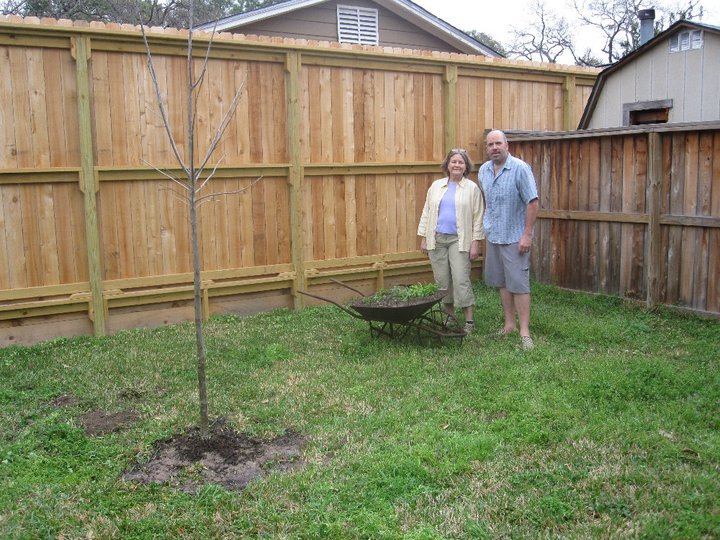
I had a great weekend, very productive. On Saturday I got to ride bikes with the Husband who made it home from Newark earlier than expected; we planted a tree and did some yard stuff; my mother brought us a beautiful quilt she made for us; and I finally photographed for you of a beautiful set of bookshelves the Husband made (several weeks ago now). Pictures:

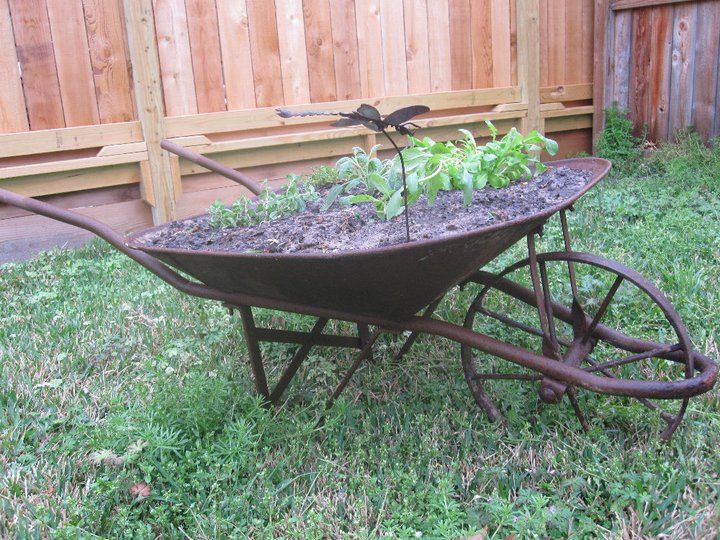
Mother and Husband with swamp cypress oak and whimsical wheelbarrow herb garden


whimsical wheelbarrow herb garden with dragonfly


Encyclopaedia Britannica bookshelves, courtesy of Husband (please ignore electronic mess)


close-up Encyclopaedia Britannica shelves


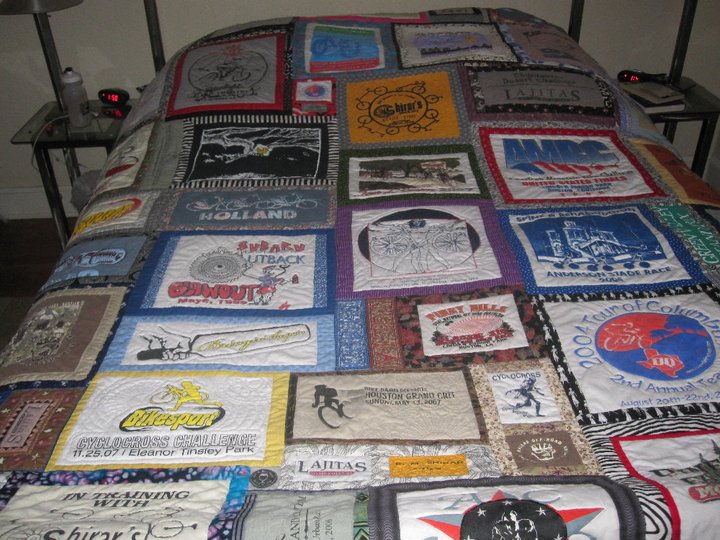
beautiful "union" t-shirt quilt courtesy of Mother


This is an elaborate, beautifully crafted quilt made up of (cycling) event t-shirts belonging to the Husband and myself. It is our wedding gift (we will soon be married 3 years, this is not a fast process) from my Mother and it’s a “union” quilt because it symbolizes our union, combining our two histories of bicycle racing as it does. It’s so lovely, we don’t know what to do with the little dogs who like to muss up bedcoverings.

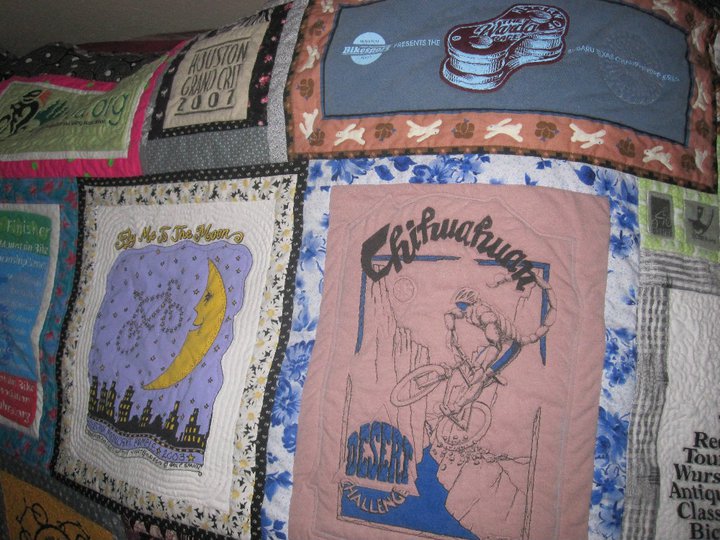
close-up of quilt: notice Chihuahuan Desert Challenge (earlier incarnation of the trip we just took to Big Bend) and above, the Warda Race (earlier incarnation of the race I did yesterday)

Aren’t I a lucky girl? And that was Saturday.

Yesterday – Sunday – I headed out to race Bikesport Presents the Warda Race. Without boring you too much (hopefully), I will say that I have gotten fat & out of shape while being off the bike for an unexpectedly long time this past fall & winter, and I knew this race would be a rude awakening. So, I did the reasonable thing and signed up for not the Category 2 Men, not the Category 1 Women, but the Pro Women’s race. This got me an extra lap of pain and suffering and embarrassment in my currently-undersized spandex. It went as expected. But, this kind of pain and suffering is going to get me back on track. I’m now less than 5 weeks away from the Ouachita Challenge, so it’s time to get to work.

This busy, productive, and happy weekend did not leave time for much reading. I don’t think I did any reading, in fact. So today I’m back on By-Line: Ernest Hemingway, and very happy to be. I shall make a few bookish remarks so this blog doesn’t seem too much a sham, ok?

I really enjoy reading Hemingway’s short articles and dispatches. I can’t believe it took me this long to pick up on this little pleasure. I have always loved him and have devoured all his novels, several of his nonfiction works (and I think you really have to love Hemingway to get through Death in the Afternoon – or bull-fighting, perhaps – but I actually did enjoy it), and I THINK I’ve read all his short stories – I’ve got a collection of collections. But somehow this collection of his journalism has eluded me til now.

These are short pieces of writing, covering his international travels, war and international politics, fishing, hunting, and general lifestyle. It seems that then, as now, this man’s life was of some interest; he had outrageous adventures (how much he’s elaborated or exaggerated them, would be a subject for another post) and saw outrageous sights. Hemingway’s fiction was heavily based on fact, and I fear his journalism might be tinged with fiction, especially where the Exploits of Papa are concerned. This is one of the mysteries and controversies of Hemingway. It may not be a popular feminist position to take, but I adore Hemingway for his work, even if he wasn’t a savory character – let alone a good husband. To any of his wives.

I was contemplating today, as I read some hunting-and-fishing stories he wrote for Esquire, that one of the Hemingway’s most beautiful and rare talents, is that he makes me care about things I don’t care about. I don’t care for hunting or fishing. These activities are not interesting to me; and in some cases I find hunting downright distasteful. But when Hemingway describes the way a fish, or a bird, moves, or the battle between the fisherman and his prey a la The Old Man and the Sea, or when he describes the experience of the bottle of icy cold white wine he’s had stuck down in the cold trout stream all day – I can taste the wine, and I care about the fish. He makes me taste and feel things very vibrantly, even things I’ve never experienced. He’s a very visceral writer.

In the same way, I’ve always said one of my favorite things about the Drive-by Truckers is their ability to make me care about things I don’t care about. For example, car racing is not interesting to me. But just about every time I hear a recording of them playing Daddy’s Cup (and I’ve heard it a lot), I cry. Take a moment and listen, yourself. (The video portion of this video is just filler. You’re there for the audio. Close your eyes.)

I’ve even sent the Husband (who does care about fishing) a short article by Hemingway to read, and the Husband, who doesn’t read, did enjoy it. The Husband prefers to DO things rather than sit around and read about them (we don’t watch movies, because two hours is too long to sit down – I love that he’s a do-er), but perhaps he can appreciate that Hemingway makes his reader feel the action, the doing of it.

I may be moving slowly these days, but a nice compilation like this, of short stories, or newspaper articles, or what have you, is just the thing for a part-time reader. Thanks for bearing with me and my busy life, and have a happy Monday!

Teaser Tuesdays: By-line: Ernest Hemingway. and, hemingWay of the Day: on tucking in shirts


Teaser Tuesdays is a weekly bookish meme, hosted by MizB of Should Be Reading. Anyone can play along! Just do the following:

* Grab your current read
* Open to a random page
* Share two (2) “teaser” sentences from somewhere on that page
* BE CAREFUL NOT TO INCLUDE SPOILERS! (make sure that what you share doesn’t give too much away! You don’t want to ruin the book for others!)
* Share the title & author, too, so that other TT participants can add the book to their TBR Lists if they like your teasers!


I am so very much enjoying this different selection of Hemingway’s writing. He’s one of my very very all-time favorites, and I’ve read all his fiction, and while I love to reread it, it’s always nice to find something new in his familiar style. Here’s a tidbit for you from page 44:

Bismarck said all men in the Balkans who tuck their shirts into their trousers are crooks. The shirts of the peasants, of course, hang outside. At any rate, when I found Hamid Bey – next to Kemal, perhaps the most powerful man in the Angora government – in his Stamboul office where he directs the Kemalist government in Europe, while drawing a large salary as administrator of the Imperial Ottoman Bank, a French capitalized concern – his shirt was tucked in, for he was dressed in a grey business suit.

I liked Hem’s method here of implying his feelings about Bey using the words of a third party.

I was also pleasantly surprised just this morning to read in my daily Shelf Awareness email about a new book, released TODAY, by Paula McLain. It’s called The Paris Wife, and it is a historical novel about Hadley, Hemingway’s first wife, and the Mrs. Hemingway of his dispatches at least early in By-Line: Ernest Hemingway where I am reading now. I have ordered this for my library and am in danger of being the very first to check it out. I love anything Hemingway and share McLain’s concern that Hadley is not exhaustively covered in studies of Hemingway’s life. I look forward to reading about her even if it’s fiction. Thanks you Ms. McLain.