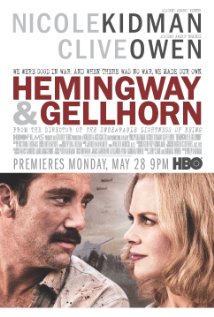
 Many thanks to my gracious in-laws for DVR-ing this HBO special so that I could watch it later on. You know this was a high priority for me! We had a lovely evening, the four of us, enjoying this newly released film about Hemingway’s time with his third wife (the shortest of his marriages), Martha Gellhorn. Gellhorn met Papa in Key West while he was married to Pauline; their romance developed as they shared a common career as war correspondents. His marriage to Pauline ended just a few weeks before he married Gellhorn. While married to Martha, Hemingway wrote For Whom the Bell Tolls. During their barely four years of marriage, professional rivalry posed one of the couple’s greatest difficulties. Hem was not accustomed to having a woman challenge him in his area of expertise, and he handled it badly. They parted less than amicably, with Gellhorn doing the leaving (an unusual experience for the famous writer).
This film did an admirable job of covering this relationship. With just a few qualifying remarks, I can say I really enjoyed it.
The movie opens with Hem & Martha’s meeting in the famous Key West bar, Sloppy Joe’s. I was concerned, early on, because of the overly dramatic dialogue; Hemingway, I kept thinking, would never write dialogue like this. It was theatrical; every line could have ended a chapter (or served for a movie trailer clip). It was overwrought. But as soon as we met Pauline, I started to feel more at home. Pauline was exactly as I picture her. She played the hypocritical righteousness of the spurned wife perfectly. (Keep in mind, as Pauline demands that Hem be a faithful husband, that she stole him from his first wife, arguably in an even more shameful manner than Martha’s, since Pauline befriended Hadley en route to the husband-thievery.)
And it got better from there. I have to give Nicole Kidman credit: I wasn’t sure I could stomach her, not being a big fan; but she was great. Her acting was good and she communicated the Martha Gellhorn I know from the history books: spunky, competitive, impatient with Papa’s neediness and intolerant of his philandering (yes, there’s some hypocrisy again), an inexperienced journalist early in their relationship but later a real professional, and later still, dismissive of history’s desire to relegate her to (a famous quotation, used in the movie) “a footnote to someone else’s life.” (Hint: Hemingway is “someone else.”)
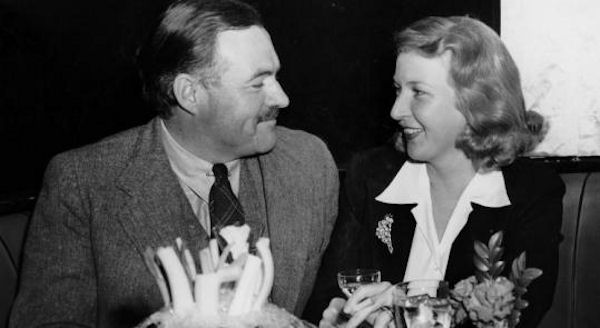
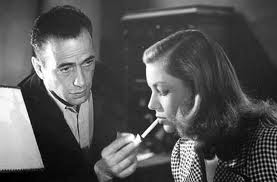
Clive Owen was acceptable as Hemingway, but I couldn’t feel him as Papa. Hey, I’m willing to allow that perhaps my own attachment to the character is strong enough to have created impossibly high standards. (Owens’s acting was perfectly fine, though. My father-in-law commented that Hemingway was a real drunken braggart asshole! To which I say, yes! He was authentically portrayed, as well!) I will say that I think Hemingway himself was handsomer than Owens, where Kidman has the opposite problem: she was, if anything, too beautiful, too glamorous, to be Gellhorn. Gellhorn was a lovely lady, don’t get me wrong, but Kidman is a knockout. See for yourself:
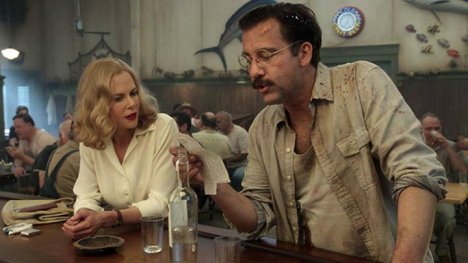
Clive Owen as Ernest Hemingway & Nicole Kidman as Martha Gellhorn
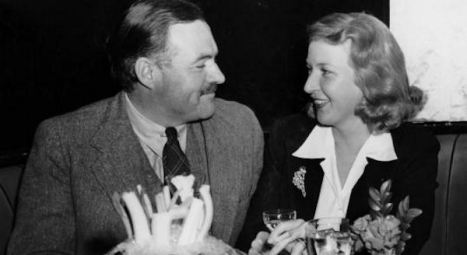
the real Hemingway & Gellhorn
While we’re discussing actors, I thought Parker Posey made a surprisingly perfect Mary Welsh. Who’d have thought? If you had told me who would play her role, I would never have believe she could pull it off – for one thing, look old enough! – but she was actually exactly the right person for that role. Casting director, I apologize for my skepticism.
I think the film’s strongest moments were definitely in Spain. The chronology goes: couple meets in Key West (overwrought dialogue abounds); they travel to Spain (lovely cinematography as well as great acting, great images, and – take note – fairly graphic sex); couple moves to Cuba and purchases the Finca Vigia, relationship starts falling apart; Gellhorn continues to pursue wars around the world, and the film loses just a little bit of its magic. Particularly when she visits Dachau and then Auschwitz and comments on the effect of those horrors on her psyche, I felt that it was handled too cursorily. Perhaps a film should not enter Dachau without investing the time, energy, and emotion that it deserves? That was a strange 30-second sideplot; it felt a little disjointed to me. By all means tell us about Dachau if it belongs in your story; but in that case take a minute to do it right. …This is really just a quibble, though.
Final scenes included Hemingway’s great descent into depression and craziness, and finally, his suicide. I had mixed feelings. If this is the story of Hemingway and Gellhorn, I’m not sure his demise really plays into it. But it was necessary, I suppose, to make sense of Gellhorn’s final remarks about his death 30 years past. Hemingway and Gellhorn’s deteriorating relationship felt accurately portrayed, and I liked the frame of an elder Gellhorn reminiscing the rest of the story for us, then going off back into battle. That part was accurate, too.
I wondered many times whether I was seeing real, authentic, historic footage of various scenes from the various wars depicted. I feel confident that at least *some* were authentic; but I doubt my own ability to draw the line. This is high praise.
I think one of the things it is easy to misunderstand, when watching a movie about Hemingway (this is true of Gellhorn, too), is that his life really was that wild, adventurous, exciting, dangerous, and filled with big names. He really did bully John Dos Passos that unrelentingly, and they really were friends (sort of, in the way men could be friends with Hemingway) through it all. The most outrageous parts of this film were perhaps the truest parts.
Recommended!
Filed under: musings | Tagged: Hemingway, movies | 11 Comments »











 pagesofjulia