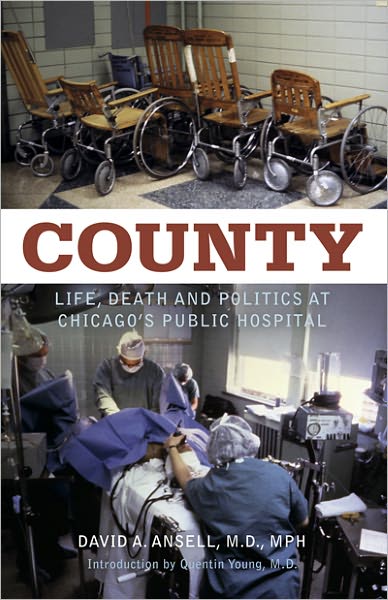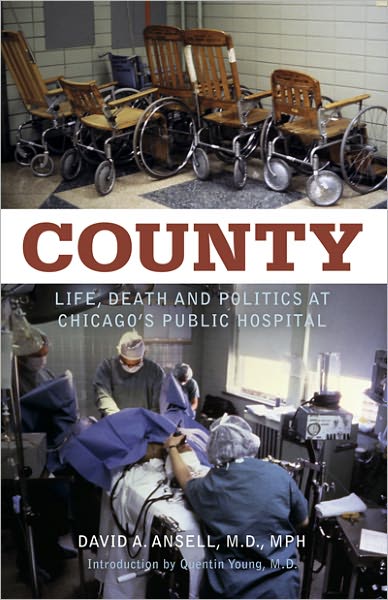
County: Life, Death and Politics at Chicago’s Public Hospital by David A. Ansell

I read ~150 of County‘s ~200 pages in one night, and forced myself off to bed. Finished the next day. Ansell is no professional writer; I itched to get out my red pen here and there. But his story is powerful and evocative, and his passion for the injustices he describes absolutely screams off the page.

I found myself swept away in the story of “County,” as Ansell refers to the Cook County Hospital in Chicago where he spent the bulk of his career. As a med student, he and his friends suspected they wanted to go to County, famous for its overcrowding, underfunding, racial disparity, and incredible challenge. His group was concerned about social injustice. Fresh off antiwar protests and sensitive to racism, these idealistic young med students drove down from New York to Chicago to visit the hospital and interview with Quentin Young, then Chairman of the Department of Internal Medicine, famous pioneer of desegregation and human rights in health care. They were shocked at the squalor and disorganization, even having come in with some impressions. Ansell & friends, eventually known as the “Syracuse Group,” conspired to become residents at County, precisely because of the challenges it presented.

Ansell is strongest when telling his personal story. Residents at County in his day (he started in 1978) had little to no supervision or assistance from their attending physicians; he describes an environment in which the residents all muddle through together, cooperatively, learning as they went. This was a great education but often resulted in less-than-optimal care for the poverty-stricken patients. From resident, he goes on to a position as an attending physician at County, although his original plan had been to head back east after completing his residency. He was immediately hooked, though, by the neediness of County, the organization, and his patients. He was also involved in politics and activism from his first moment on campus – literally. He attended a meeting on the day of his scheduled interview for residency.

Over the years, Dr. Ansell would serve in various positions in the ER and in the outpatient clinic, and be part of the birth of the Breast Cancer Screening Program and County’s AIDS Clinic. His patients, and their problems, made deep impressions on him. He was active in trying to right the wrongs of the health care system and of County’s management and underfunding in particular. When the politics really get going, Ansell can get a little bit soap-boxy. I have mixed feelings about this aspect of the book. While unquestionably passionate, righteous, and well-informed, he can tend to come on a little strong. Preachy, even. My concern here is the one my old buddy Gerber expressed about Barbara Ehrenreich’s Nickled and Dimed: On Not Getting By in America, years ago: the author’s personal political starting point is so overtly obvious that the (actually very strong) point of the book may be dismissed because of the author’s prejudice. Speaking as someone who DOES share Ansell’s politics, and who still feels that he can get a little preachy, I have concerns about the book achieving its goal of education and perhaps even changing minds.

But the stories about Ansell’s experience learning and working as a professional doctor, the stories about his patients and their troubles, and the stories about the challenges of County… its politics, the underfunding, the horrific and inhumane conditions… these are where Ansell shines. It’s a powerful, emotional, evocative book. It makes good points: it argues that access to health care is a human right, and should not be dependent upon health insurance or employment status. It is definitely a political book. I recommend it, just with a few reservations. Because it is short and engrossing, you can almost read this book in one sitting or two. And I think it is absolutely worth your time.

Teaser Tuesdays: County: Life, Death and Politics at Chicago’s Public Hospital by David A. Ansell

Teaser Tuesdays is a weekly bookish meme, hosted by MizB of Should Be Reading. Anyone can play along! Just open your current read to a random page and share a few sentences. Be careful not to include spoilers!

From page 127,

The high-pitched beeping of my pager pierced the still of the early morning air. My heart-rate increased in a Pavlovian response that harkened back to my days as a resident when the beeping often presaged a patient in trouble.

I am not quite through and thus not writing my review yet, but I can say for now: OMG. This book is powerful and outstanding, and rivaling Fire Season for my Best of 2011 honors. This is not just the story of our nation’s health care system and all its woes, nor a story of racism, poverty, politics and injustice – although it is these things, it is first Dr. Ansell’s personal story, and I find it powerful. Stay tuned.

Crossings.

I have a few things to share with you today. They aren’t books, but you might be interested anyway.

First, last week I discovered a new-to-me concept called postcrossing. (I was alerted to this concept by write meg!. Thank you Meg.) The idea is an international exchange of postcards – yes the really actually hardcopy kind. It’s not pen-pals; you don’t get from the person you give to. But you send postcards to people around the world (and you get a short bio from them so you have something to write about, if you’re having trouble with that part), and then you get them, too! I really like the idea. It means you get snail mail that is pretty, personal, and not bills or catalogs. So, I signed up immediately upon reading Meg’s post and clicking the link; I’m in! And then I sent my first 5 postcards, to Germany, Austria, Ukraine, Taiwan, and Russia. BUT. I didn’t use enough postage, and I didn’t put my return address, either. So guess what? At lunchtime today I’m going to go buy some international postcard stamps and start again :-/ Ah well. I’m still in! And I’m going to get postcards!

So how funny and coincidental that right after discovering postcrossings, I came across a similar project. (Now that I am trying to retrace my steps, I have NO IDEA how I got there. Sorry.) BookCrossing works a lot like postcrossing does: you register and get a unique identifier code for your postcard or book. This allows the postcard or book to be tracked – so if it’s a postcard, you get credit for having sent it, and you get more postcards coming to you. If it’s a book, you can see where its travels take it – if its recipients are logging it on the website, that is. This is much less likely with BookCrossing, it seems to me, because you can just leave books around, wherever, or hand them to random people, who may or may not care to get online and log their receipt of them. I would guess they wouldn’t, very often. Whereas, in postcrossing, the recipient of your card actively requested it, and is actively participating in the same system, whereby one only receives a card if one gets credit for sending cards; therefore I would guess everyone is fairly interested in logging them into the system. (Also, postcrossing recipients, by definition, have internet access and are comfortable with the system. This is not something we can assume when handing out books or leaving them on park benches.)

I think BookCrossing sounds like great fun, but I won’t be joining that one. Why? Several reasons. I think there are a number of similar programs online (PaperBack Swap, for instance), where people can trade and send books around. Another reason that comes to mind was discussed today over at Tales From the Reading Room: people who are not actively seeking out free things (as the postcrossing participants are) don’t necessarily place a high value on them. I think litlove (the above blogger) is right on target when she points out that “free often means without value,” or at least is perceived that way.

But mostly, I guess, I won’t be BookCrossing because it’s sort of what I do for a living, which is a beautiful reason not to play, really. In the hospital where I work, I run a small library that distributes reading materials. We have a nice collection of hardback books that we purchase new, catalog, and circulate just like your local public library; and just like a PL, we want them back and will ask you to pay for them if lost. But we also have a large collection of paperback books, donated by the boxful every day, that freely roam the hospital and beyond. These books are very much playing the BookCrossing game (minus the tracking), and they make a huge difference to our patients, caregivers, visitors, and staff and faculty. It means that there’s always an abundance of free and various reading materials randomly distributed in our little world, and that’s a beautiful thing.

identifying with the prison librarian

Well, you tell me, does this make me a little nuts, or just mean that Steinberg is a skilled author? It’s occurring to me that our situations are parallel: we both work in “special libraries” (that’s a real term), meaning we’re not in schools, universities, or public libraries. Prisons and hospitals are fairly unique environments. I’m not sure my employer would appreciate the comparison, but both are large institutions, and I have heard my patrons say they feel a little bit like they’re being processed in a machine. I’ve been thanked for using their names instead of 8-digit numerical identifiers. That’s kind of sad. I just had this strange feeling as I walked back from lunch, having reluctantly closed Running the Books, that perhaps it’s weird that I’ve become accustomed to seeing signs on escalators that say “If You Are Feeling Dizzy or Unstable, Please Use the Elevator” and in bathroom stalls that say “If you have had an accident or soiled your clothing and need help, please call XXX.XXX.XXXX.” People here are not necessarily happy to be here. Also, I share with Avi the prison librarian the embargo against connecting with our patrons. There are different reasons – his are a serious security risk, are considered to have lost the privilege of making friends, threaten his job. Mine have a federally protected right to privacy and are going through utterly life-changing events. But they’re all people and we all too easily see ourselves and our loved ones in these strangers. Of course, Avi sees the same people for long periods of time (very much the norm in prison I think) and my people come and go unpredictably (and when they go, I never know why). But I’m getting into this book and identifying with Avi’s workplace conundrums.