Fulton Theatre presents Next to Normal (2019)

I feel so glad and so lucky that I found a charming little theatre in Lancaster, Pennsylvania, and this play to attend. It was a phenomenal performance and experience all around. This is the best part of traveling: finding gems like this.

First of all, the space and background: let me set the stage, if you will. The Fulton Theatre is a grand, historic old opera house, of a certain type. The main theatre space is opulent, extravagant: ornate carvings, gilt, red velvet. My date and I snuck in to see this space after our play was over; but Next to Normal was performed upstairs, in the “studio.” It reminded me very much of the iDiOm/Sylvia, with spare furnishings and rows of chairs set up on the floor for the audience. I was a little disappointed not to see the big grand theatre in action, of course, but I admit seeing this smaller, simpler space was a comfort, because it reminded me of another theatre I’ve really appreciated (I’m still remembering Clown Bar fondly).

the lovely Fulton Opera House (photo credit)

So, a small space, unassuming, and with moderately minimal props and backdrop, and a small cast of just six. I have seen a larger cast play in small space – Clown Bar was one of those exceptions – but generally a smaller space does mean fewer players. They did indulge in costume changes, though.

Now on to the play, itself.

Next to Normal was written by Brian Yorkey (book and lyrics) and Tom Kitt (music), and I appreciate it very much as a play, to begin with. The topics it deals with are not small undertakings. Family dysfunction and severe mental illness are difficult to approach in any art form, I think. Here we have a mother, Diane, who is ill – how ill becomes gradually clear, but she clearly struggles to get out of bed and deal with her daily life within the home, let alone outside it. Her husband, Dan, means well, but he’s ill-equipped to help his wife with her outsized problems. There are two children who are affected in different ways. And there’s a big reveal part-way through, which I won’t spoil for you here, but it’s important.

Did I mention yet that this play was a musical? A rock musical, that is. It sounded weird coming in (doesn’t it sound weird?) – a rock musical about mental illness and family dysfunction.

The high-school-aged daughter gets her first boyfriend, and Diane has a psychiatrist, and then another (both played by the same actor); and that’s the whole cast: mom, dad, two kids, boyfriend, psych. In two acts, Diane gets sicker. She is prescribed lots of drugs; she experiences hallucinations; she attempts to kill herself; she is hospitalized, and undergoes electroconvulsive therapy (ECT). The nuclear family learns some things about themselves individually, about each other, and about how they work together. The ending is surprisingly hopeful, but feels earned.

My one real concern that I want to voice is something that often concerns me in conversations about mental illness. There seem to be two well-intentioned stories we tell ourselves/each other: that it’s okay to take drugs, to get the help one needs; and that one is stronger if one can be okay without drugs. I think it’s tricky to navigate these two messages, either one of which can be potentially damaging. On the one hand, there’s an argument that we’re too pill-happy in this culture, and that we start our kids on drugs too young. On the other hand, the feeling that you’re stronger if you can “do it” without drugs is really problematic for those people who suffer from conditions that require medication, as some do. The narrative of this play came down a little bit on the side of praising and admiring the drug-free path. And if that works for the fictional Diane, of course I am so happy for her. But that kind of praise can be discouraging, even damaging, for patients who need drugs to be okay. I just wanted to voice that because it occurred to me as I watched the play unfold. And as I’m writing this, I guess I need to observe how personal this material felt. Without violating anyone’s privacy, I thought of some loved ones who have struggled or are currently struggling in ways I recognized here. It was sobering and hard to watch, of course, but it also felt good to have certain people seen. Art is powerful. I’m glad that art addresses such topics as these – even the really hard ones – because the hardest parts of life deserve to have this light shined upon them.

Also, can we talk about the extraordinary image, above? Click through to the larger version. That woman with her blurred-out face, the suburban ideal in her torso, and the pills spilling out from her lower extremities. The sense of time passing all around her. That’s an ideal of accompanying art.

Even with this serious and disturbing material, Next to Normal is remarkably also very funny, and so heartwarming, even through the challenges. And played by such gifted actors – I could feel their passion and power. I paused to admire, at intermission, how odd it is that I can be simultaneously aware that this is “just” a play, and also so invested in these characters who are fiction, and I know that, and yet they make me laugh and cry, and I just want for Diane to be okay and for her daughter Natalie to feel loved and to know it’s okay, she doesn’t have to be perfect to make up for everything… I want Dan to know it’s not his job to fix his wife. Gosh, but I love the theatre.

The thing that was most surprising and impressive about this play I’ve saved for last. Listen to this: the actor who played Dan was unavailable at the last minute, and so they called upon an actor with twenty-four hours’ notice to step in. Jeffrey Coon did not have time to learn his lines; he played the role with a bound script in one hand, flipping through its pages as he went. But he knew the scenes! And he knew the music! He played the physical role perfectly, including interactions with other actors; he knew his blocking. And recall this is a musical: when he glanced down at that playbook for his lines, he was often not speaking but singing them. He knew the songs, musically, just needed the words as he went. Because Dan is some kind of businessman, often carrying a briefcase, he was able to make that bound script often serve as a prop, so that it sometimes disappeared and we could forget about it altogether. I have NEVER seen this before. And I cannot imagine it’s ever done this well: Coon’s acting as Dan was superb, spot-on emotionally and in key with his fellow players. His singing was impressive – great voice, but also timing and feeling. I cannot communicate here how impressed I was with this performance. I didn’t know it could work this well. I can only assume this guy (who works for the Fulton as his day job as well) is a professional ideal. My admiration for this art form has just been raised another ten notches, watching this man slide into this slot so smoothly. During final curtain calls, the other actors made a point to celebrate him, too, so that I could see they shared my feelings about his incredible performance.

I feel again like the luckiest woman alive, when I get to travel through a small city and find a shining experience like this one. I’m going to treasure Next to Normal, the Fulton Theatre, and Jeffrey Coon’s performance for some time.


Rating: 9 pills.

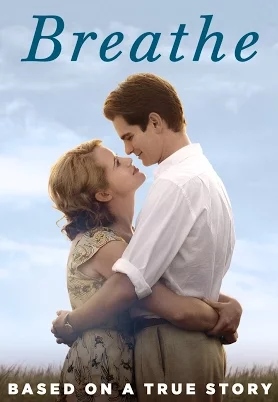
Breathe (2017)

Breathe is a lovely movie. If not the finest accomplishment of the art form, it was a very enjoyable, positive, uplifting story; and if that sounds sentimental, then guilty as charged, what do you want from me, I’m human. I appreciated knowing that it was a true story because I loved the background (nodding to the necessity for ADA legislation, for instance) of looking for hints of today in this version of yesterday. Disability rights matter to me. In the selfish way that our own experiences shape our concerns in the world, I have a bad knee; I had knee surgery some years ago and needed special accommodations a time or two, and my frustrations in meeting even my simple, and temporary, needs gave me a greater appreciation for the much bigger concerns of more profoundly and permanently challenged people.

This is a rather sentimental story, with a love story forming at least part of its heart. Robin and Diana meet and fall in love, and they marry around the time that he falls ill with a fever that ends in his total paralysis by polio: “you can’t even breathe for yourself.” He becomes depressed in the hospital (and who can blame him?!) but she won’t “let” him die, insists that he pursue his life anyway, and they have to break him out of the hospital against the wishes of its administration, in an era when polio patients were apparently, according to this film, basically imprisoned. What follows is a family of friends making their own way: building him a wheelchair that incorporates his breathing apparatus, dealing with the obvious calamity of the breathing apparatus failing, and gradually freeing him to travel the world. They attend a disability conference in Germany where they have to literally break the doorway out of a hotel room to fit his chair in (this is where I see promises of ADA). He lives a longer and fuller life than anyone thought possible, frees some of his co-polio-sufferers from the hospital/prison system, and dies at home with his family with him–in an assisted suicide, by the way, thereby touching on another medical-ethics hot button.

This film absolutely deals in emotions, and gets a wee bit saccharine; but it felt really good, I learned some things, and it was, well, sweet. I had a perfectly nice time watching this movie and I cried at the end and then felt better again. There are worse ways to spend an evening.


Rating: objectively, 7, but I give 8 dusty Spanish roads for emotional impact.

Modern Death: How Medicine Changed the End of Life by Haider Warraich

This interdisciplinary study of death and how we can improve–not avoid–it is highly readable and timely.

modern-death

In Modern Death: How Medicine Changed the End of Life, Haider Warraich explores how human death has evolved over the course of history and offers recommendations for its future. A medical doctor, Warraich supplements his research with anecdotes from his personal experience, and draws on literature, theology, statistics and legal theory as well as the hard sciences. The resulting expert opinion is heartfelt, convincing and well informed.

Warraich begins with the mechanics of how cells die and the opportunities for analogy they offer: cells choose to die to promote the good of the organism; not dying on time is as bad as dying too soon. He recounts the medical advances that have increased human life spans astronomically in the last two centuries. Chiefly, people now die far less frequently from infection and simple injuries, instead living long enough to die of cancer and heart disease. Because of both medical and cultural shifts, more people die in hospitals or nursing homes than at home.

This is the story of how medicine learned to save and expand lives–especially through procedures like cardiopulmonary resuscitation–and then how medicine learned not to resuscitate. Warraich shows what modern death looks like, how it works, its achievements and shortcomings–and then investigates what a good death could look like, and how we can do better. Science has lengthened lives so successfully, delayed death so thoroughly, that our new problem often is not staying alive, but letting go.

In what comes to feel like the real heart of Modern Death, Warraich then studies the nuances of euthanasia, assisted suicides and the withdrawal of life support systems, and their legal histories in the United States and worldwide. He finds that these three categories of death are far less distinct than generally believed. Finally, he advocates strongly for patients’ control over their own ends of life and exhorts his readers–patients and physicians alike–to discuss death openly.

These conclusions form the book’s central purpose. Along the way, Warraich explores different cultures’ and religions’ approaches to death. He also discusses the philosophical and legal difficulties in defining death and life. Warraich’s chief goal is a better end-of-life experience for everyone.

If Modern Death occasionally uses a few more words than necessary, the inclusion of Warraich’s anecdotal experiences enliven what could have been a dry academic text. For readers interested in its thesis–that death is an important part of life, and medicine and society could do a better job of delivering this experience–it is a sincere and thorough examination of an often overlooked subject. Well served by Warraich’s professional expertise and earnest emphasis, this is an indispensable entry into the conversation about death.


This review originally ran in the January 6, 2017 issue of Shelf Awareness for the Book Trade. To subscribe, click here.


Rating: 7 cells.

book beginnings on Friday: Modern Death: How Medicine Changed the End of Life by Haider Warraich

Thanks to Rose City Reader for hosting this meme. To participate, share the first line or two of the book you are currently reading and, if you feel so moved, let us know what your first impressions were based on that first line.

I do enjoy learning more about end-of-life issues, medical and legal and ethical. This one seems to be for me.

modern-death

The opening chapter, “How Cells Die,” begins:

It had been the longest of months–in both the best and the worst possible ways. Brockton is a small town about a half-hour drive south of Boston, but in many ways it seems a world apart.

A little out of context, it seems, but we are just beginning. I like that it’s not a dry, thesis-sentence sort of beginning. Reading on, Haider Warraich does seem to grasp the idea of narrative writing, making his storytelling immediate and personal; and he does have a personal story to tell, being an MD. I am optimistic.

Modern Death is forthcoming in February. Stick around!


This quotation comes from an uncorrected advance proof and is subject to change.

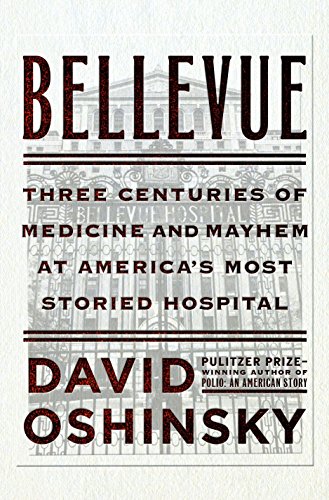
Bellevue: Three Centuries of Medicine and Mayhem at America’s Most Storied Hospital by David Oshinsky

This fascinating history of New York’s famous public hospital provides a microcosm of national and worldwide medical history.

bellevue

Bellevue is one of the oldest and most famous names in United States hospitals, known for housing violent criminals and mental health patients, the homeless and sufferers of rare and exotic diseases. The incredible, multi-layered history told by David Oshinsky in Bellevue: Three Centuries of Medicine and Mayhem at America’s Most Storied Hospital covers medical and general history both national and global. This thorough narrative is wide-ranging and endlessly gripping.

The institution began in 1736 as an almshouse, where the indigent were housed and given rudimentary medical care. From these earliest days, “Bel-Vue” had a reputation for dealing with society’s unwanted. And as Oshinsky shows, in its many incarnations, this reputation is intact. The flipside is that this public hospital has always attracted service-minded professionals pursuing innovation. Before modern considerations of medical ethics, this often meant experimenting on Bellevue’s impoverished patients and their diverse range of ailments: in exchange for charity medical aid, the thinking went, they offered themselves for clinical trials–as painful and medieval as they could be at times. Nevertheless, the hospital became central over the years in battling the yellow fever epidemic of the 1790s, the “Great Influenza” of the 1910s, the AIDS crisis of the 1980s, the September 11 attacks and Superstorm Sandy. Bellevue would see hospitals shift from being considered a last resort, only for those too poor to afford a private doctor’s home visits, to becoming the best medical care available (the development of anesthesia, germ theory and infection control being crucial).

The hospital has enjoyed affiliations with several medical schools, among the U.S.’s earliest and best, including its continuing relationship with New York University. NYU students get training in a premier teaching hospital that still treats an enormous and diverse patient population, while Bellevue gets talented, passionate residents and interns, many of whom remain and make their careers there. The history of Bellevue reflects social struggles, as women, Jews and African Americans gradually gained access to the medical profession, and anti-immigrant vitriol was aimed in turn at Irish, Italian and Jewish populations, among others, as waves of struggling immigrants contributed to Bellevue’s patient population. Bellevue successfully treated New York’s sole Ebola patient in 2014. Its tenuous funding situation (mostly public, and always under attack), high standards of care and public service mission continue.

Bellevue’s beauty and staggering scope lies in these historic, social and interdisciplinary connections. William Burroughs, Sylvia Plath, Charlie Mingus and Lead Belly passed through Bellevue’s history; its physicians have traveled the world and played roles in the scientific advances that have shaped modern medicine. Bellevue hosted the invention of forensic medicine, and major developments in medical photography, child psychiatry and AIDS treatments. Oshinsky (Pulitzer Prize-winner for Polio: An American Story) generally adheres to an impersonal, journalistic style, but his moving portrayal can’t hide his admiration for this longstanding institution. Bellevue is that rare, page-turning history: engaging, smart, clearly written and of broad general interest.


This review originally ran in the October 14, 2016 issue of Shelf Awareness for the Book Trade. To subscribe, click here.


Rating: 9 five-gallon containers of fuel.

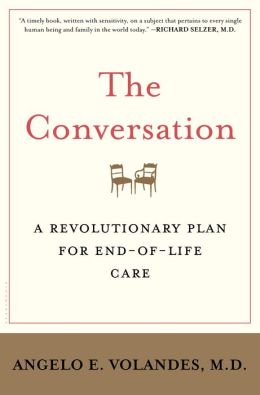
The Conversation: A Revolutionary Plan for End-of-Life Care by Angelo E. Volandes, M.D.

A physician’s fervent quest for better information about medical options for patients nearing their end, and the steps necessary to make those choices clear.

conversation
In The Conversation: A Revolutionary Plan for End-of-Life Care, Angelo Volandes, a medical doctor for decades, focuses on the extensive, intensive, intrusive medical interventions that patients routinely receive at the end of life, many of which extend life by a matter of hours or days or not at all, while decreasing its quality substantially. He earnestly argues that every patient should be offered the option to choose among three broad categories of care: life-prolonging, limited medical and comfort care–in other words, the choice between quantity and quality of life. The Conversation advocates for all patients and families to receive information about what end of life care looks like within these three categories, and firmly states the importance of patients, families and medical professionals having what he calls the Conversation about end-of-life wishes openly and often.

To make these points, Volandes describes his upbringing as the child of Greek immigrants and the impact it has had on his life: from his start as a student of Socrates and a Greek diner cook, his stint as a philosophy major and then his work as a medical practitioner, he has been interested in what good life (and good death) are. Appropriately, Volandes neither attempts nor claims to be impersonal or unemotional about this charged topic; rather, he brings his personal and professional experiences as well as research to his impassioned argument.

The majority of the book is devoted to stories of patients, families and circumstances–and Volandes’s own attempts, good and bad, at approaching the Conversation. With names changed, these are real-life anecdotes of choices made with more or less preparation and knowledge of what a decision will entail, or what an incapacitated patient would have wanted. The last quarter of the book is composed of several appendices and a lengthy, narrative notes section, all of which provides substantive hands-on advice aimed variously at the patient, or the patient’s spouse or children. The Conversation is a how-to manual, enlivened by engaging–if occasionally painful–true stories. Volandes makes his points succinctly and convincingly and offers readers the tools to make change within their own lives.


This review originally ran in the January 6, 2015 issue of Shelf Awareness for the Book Trade. To subscribe, click here, and you’ll receive two issues per week of book reviews and other bookish fun!


Rating: 7 people.

book beginnings on Friday: The Conversation: A Revolutionary Plan for End-of-Life Care by Angelo E. Volandes, M.D.

Thanks to Rose City Reader for hosting this meme. To participate, share the first line or two of the book you are currently reading and, if you feel so moved, let us know what your first impressions were based on that first line.

conversationThe Conversation focuses on a subject near and dear to me, after a little time spent in a hospital setting myself – although never in the position held by this author, a medical doctor.

It was a blustery March morning at the crack of dawn, and my medical team was refueling with ample cups of coffee in the hospital cafeteria before reviewing our list of patients. Just as I took a scalding sip, the overhead speaker blared.

“Cold Blue, Greenberg Five! Code Blue, Greenberg Five!”

I like that these opening lines really grab our attention. Shocking, perhaps? But also a realistic way to get into his head, I’d wager.

This quotation comes from an uncorrected advance proof and is subject to change.

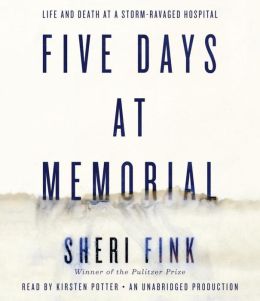
Five Days at Memorial: Life and Death in a Storm-Ravaged Hospital by Sheri Fink (audio)

five daysWell. This one is a lot to tell you about.

Sheri Fink is an award-winning journalist and holds both a PhD and an MD. In Five Days at Memorial, she examines fateful, famous and controversial events at Memorial Hospital in New Orleans in the five days following 2005’s Hurricane Katrina. Forty-five bodies were recovered from the hospital, with about 9 of them (depending on your source) suspected of having been euthanized by hospital staff during evacuations. I had been looking forward to reading this book but was leery going in, because this subject was clearly going to be emotionally fraught, depressing, poignant. I was quickly mesmerized, though: these events, while troubling and difficult to take in, fascinated me deeply. I have been increasingly interested (outside my reading of this book, for some time now) in the subjects of end-of-life, advanced directives, and our culture’s approach to death. And I am always intrigued by ambiguity, situations in which it is clear to see black-and-white or right-and-wrong. If ever there were such a situation, this is it.

Roughly the first half of the book is dedicated to relating the events of these five days, as revealed by Fink’s investigations. (Recall, as I mentioned in my book beginning, that she describes her copious research. I am fairly well convinced of its virtue.) We get to know a number of characters in the story: doctors, nurses, managers and administrators, patients and their family members. We know the ending, in a sense: the hurricane will be far worse than anyone imagined; the hospital will not be evacuated in one, two, three or four days; there will be crimes investigated. But the way the events unfold were unfamiliar to me in their details. Although this is a journalistic account, Fink also imbues it with suspense, which feels very natural: imagine the terror felt by those inside the hospital throughout. Not knowing the whereabouts or well-being of friends and family, isolated by rising floodwaters, without electricity, and plagued by rumor (on which more in a minute), a number of those inside Memorial feared for their lives. And some lost their lives.

The second half of the book describes the investigation of one doctor and (centrally) two nurses. Dr. Anna Pou was eventually called before a grand jury, which (some two years after Katrina) declined to indict her for multiple counts of second degree murder. In this section, we meet new characters, most notably two investigators who work as a comfortable team together. Fink also explores the history of euthanasia as a concept in different cultures and different legal understandings today, and the approach of bioethics, as well as post-Katrina attempts to establish emergency standards for triage, including the allocation of limited resources that will save some lives while ending others.

I was impressed by Fink’s style. I felt, in the end, that she let the facts (as she discovered them) stand alone. Many times throughout it felt like Fink’s voice spoke on one side of this painfully difficult controversy, but pages later she lent that voice to the other side, so that the effect was… shall I say, appropriately discomfiting. The fact is, I strongly feel, that none of us can perfectly know what happened in those five days, what anyone’s real motivation or intention was, and probably that none of us has the right entirely to judge actions taken in such profoundly weird circumstances.

Many questions remain, and I can easily understand and sympathize with divergent views: family members whose loved ones were (allegedly, possibly) euthanized are angry that they weren’t evacuated; hospital workers with no options left to them felt it was better to euthanize than to abandon patients to die slowly, painfully, and alone. I see it both ways. But the details, I think, are lost to me – someone who lived none of it, who’s just read the book. Dr. Pou, it appears, does not find this book’s treatment fair at all. While it’s true that Fink doesn’t exonerate her, I felt that she wasn’t condemned, either. It’s just… so complicated.

One of the more disturbing elements, to me, was the power of rumor and euphemism in the hospital and the accusations bandied about afterward. Doctors and nurses allegedly spoke of “making patients more comfortable,” or said “we won’t leave any living patients behind.” I don’t see how these vague phrases can be used to accuse someone of murder (or euthanasia, or what you like) – what if they literally just meant make someone comfortable? What if they meant that we will evacuate all living patients, thereby leaving none behind? I don’t think these statements necessarily point to killing people – certainly not beyond a reasonable doubt. And then the rumors: New Orleans after the storm saw violent crime and looting, but not (writes Fink) to the extent that it was rumored, within the hospital and more generally. Some of this fear and rumor was racially charged. Such a circumstance serves no one well.

In fact, the most damning evidence in Fink’s book for me was not the evidence that euthanasia had taken place – frankly, my value system allows for euthanasia as a fine option in certain circumstances – but the evidence that other hospitals faced similar challenges (loss of power, rising waters) and functioned better. I can’t recall the name at this moment (and the audiobook format is bad for looking up such things), but there was a hospital under analogous conditions that ran regular shifts – encouraging staff to sleep when not caring for patients – and sternly disallowed the spreading of rumors. (I think the phrase was something like “if you didn’t see it, don’t say it.”) Memorial saw a decidedly higher level of panic, and that was one of its critical failures. This can’t possibly be Dr. Pou’s fault: she’s just one person, incapable alone of preventing or inciting panic. In fact, as Fink presents it, if she did commit certain acts, she wasn’t alone; she was just singled out in investigations.

I can draw no conclusions after reading (listening to) this book, other than to say I think it was well told – visceral – and I am emphatic about the persistent ambiguity of this situation. In other words, I can’t judge, and I think it’s a little outrageous that anyone would try to. But I guess the justice system feels it has to try…

Narrator Kirsten Potter was well up to this task; full credit for the narration. I enjoyed this format for this book, but the major drawback for journalistic work is that I can’t flip back and check names, dates, etc.

Recommended, if you’re up for some tough topics and hearing about suffering.


Rating: 8 sleepless nights.

book beginnings on Friday: Five Days at Memorial: Life and Death in a Storm-Ravaged Hospital by Sheri Fink

Thanks to Rose City Reader for hosting this meme. To participate, share the first line or two of the book you are currently reading and, if you feel so moved, let us know what your first impressions were based on that first line.

five days

I have been intrigued by the idea of this book for some time now. I have some perspective on Katrina, to begin with. Not that my personal life was profoundly effected, but Houston residents saw the consequences come our way. For one thing, in the form of Katrina evacuees, and for another, because when Hurricane Rita was forecast for us just a few months later, the response was quite different than it might have been if our neighbors to the east had not just been so badly beaten. And then I suppose my interest is piqued as well because I work at a hospital now. Finally, I got to see Anna Deavere Smith perform last month (at the Medical Library Association Annual Conference in Chicago), and she did a short piece on the conditions at Charity Hospital in New Orleans that was – naturally – very moving. So here we are, finally.

Five Days at Memorial begins with an Author’s Note in which Fink describes her research methods (lots of interviews & other primary & secondary materials) and notes that she wasn’t at Memorial during the storm, although she visited later. She makes it clear that this is a journalistic work, and that she has been faithful to what she learned in her research – all dialog in quotations comes from interview, etc. – and that she has made an effort to keep her own reactions (“any book reflects the interwoven interpretations and insights of its author”) clearly delineated from the facts. I appreciate this.

I’d like to share two bits for your book beginning today. First of all, “Part I: Deadly Choices” begins with a quotation:

Blindness was spreading, not like a sudden tide flooding everything and carrying all before it, but like an insidious infiltration of a thousand and one turbulent rivulets which, having slowly drenched the earth, suddenly submerge it completely. – José Saramago, Blindness

And then the Prologue:

At last through the broken windows, the pulse of helicopter rotors and airboat propellers set the summer morning air throbbing with the promise of rescue. Floodwaters unleashed by Hurricane Katrina had marooned hundreds of people at the hospital, where they had now spent four days.

And that, I think, says enough for today.

The Empathy Exams by Leslie Jamison

An essay collection that earnestly examines feelings–the author’s and the world’s.

empathy

Leslie Jamison follows her debut novel, The Gin Closet, with an essay collection that has earned her the Graywolf Press Nonfiction Prize. The Empathy Exams opens with Jamison’s experience as a medical actor. In this role, she is given a character, complete with props and not only symptoms, but behaviors: body language, failure to make eye contact, dishonesty. In portraying deception, or a pretended lack of self-knowledge, Jamison contemplates what it is to feel, how we communicate what we feel and what we do with these communications.

While all her essays are linked by the topic of empathy, their subjects range widely. One essay about incarceration deals with a man serving time for mortgage fraud who continues to declare his innocence; another covers the case of the West Memphis Three and the documentaries about them that so moved Jamison as a young woman. “Morphology of the Hit” studies Vladimir Propp’s Morphology of the Folktale, which Jamison calls “a map for storytelling,” and she uses that map to construct a narrative of the random act of violence she experienced in Nicaragua.

Within the context of pain, both injury and chronic illness receive repeated treatment. The Barkley Marathon, a grueling, almost unfinishable race through Frozen Head State Park in Tennessee, is presented both as a subcultural phenomenon and a subtext for pain. Jamison attends a conference for Morgellons patients–who believe they are infested with fibers and foreign matter crawling out of their skin–and the few doctors who will take them seriously; she finds herself responding with such empathy that she is in danger of catching the disease herself. She also leads readers on two “Pain Tours,” closing with the specter of female pain, and female guilt over pain–making the studied choice to apologize for neither.

Throughout these varied topics, Jamison makes references to many thinkers and influences, from Lucy Grealy (Autobiography of a Face), Susan Sontag and Frida Kahlo to her own friends. Her essays often dwell in the theoretical and the academic; she is interested in philosophies, and admits to difficulty experiencing, recognizing and sharing her own emotions–a difficulty that occasionally manifests in pedagogy. However, readers will finish with no doubt she is sincere in her quest to own, identify and comprehend empathy.


This review originally ran in the April 3, 2014 issue of Shelf Awareness for the Book Trade. To subscribe, click here.


Rating: 4 itchy patches.

Not a great rating, right? Reminder: when I write reviews for the Shelf I work to (mostly objectively) state what is of high quality about a book, and who might like it and why; if applicable, I mention who might want to steer clear. When I rate the books here, I am stating my personal reaction. I think Jamison did good research & does some good writing; but the academic & theoretical nature of these essays didn’t appeal to me. I was hoping for a more emotional reaction to the world; and specifically I was interested in the medical acting concept, which received relatively little play time. I wonder if *I* have an essay to write about empathy, based on my experiences working in a cancer hospital. I don’t know that I’m ready to write it right now; but if/when I do, it will be more emotional and less cerebral than these essays here. Not better or worse; but this is how my personal reaction – the personal appeal this book had for me – rates The Empathy Exams.