The Company of Owls by Polly Atkin

A poet and nature writer shares the grace, beauty, and lessons in her quiet observations of “my neighbours, the owls” in this loving memoir.

Polly Atkin (Some of Us Just Fall) brings a poet’s sensibility to a contemplative study of nature and self with her memoir The Company of Owls. From her home in the village of Grasmere in England’s Lake District, Atkin can hear tawny owls calling to one another; on short walks, she feels privileged to watch them hunting, nesting, raising their young. During and after the Covid-19 lockdown, she marveled at their lives, so little known to us, and mused on isolation, companionship, humans’ relationship to the rest of the natural world, and more. Not an ornithologist by training, Atkin feels drawn to her poorly understood subject, associated with both wisdom and death, night-dwelling but sun-loving: “This book is about owls, but it is also about me.”

Atkin, who lives with several chronic illnesses that limit her mobility and ability to work in traditional ways, found herself under lockdown questioning the nature of solitude and our many reactions to it. She made art of Middle English words for aloneness: uplokkid, reclused, onlihede, and solnes, which become chapter titles. “But the more times I wrote the words out, the more shades of meaning leached from my brushstrokes. The more ambiguous I felt my state of seclusion to be, the more ambiguous I felt about isolation.” She related to what she perceives as the owls’ need for both separation and togetherness. In her own insomnia, she connected to their apparent affinity for both darkness and light. “Without other humans to see you and claim you as theirs, you feel less and less like one of them, more and more likely something else. Something nocturnal. Something unbound.” She watched a trio of owlets navigate siblinghood, and worked to resist what felt like anthropomorphism.

This is a classic memoir in its meditative pacing, thoughtfulness, and self-examination. And of course its author, with several volumes of poetry to her name, takes special care with both language and detail. The Company of Owls balances a careful focus on the hyperlocal owls immediately surrounding Atkin’s home, and a survey approach to the history of owls in the region, the humans who study them, and the owls Atkin encounters online via friends and algorithms. Despite the easy assumption (as she notes) that “technology disconnects us from the world around us,” Atkin benefits from a larger world of owls. That wider lens improves her view of what lies just beyond her own home: the Lake District’s tawny owls, in their small movements, births, and deaths. Atkin’s lovely, reflective memoir reminds all readers to slow down, listen, and find joy.


This review originally ran in the November 24, 2025 issue of Shelf Awareness for the Book Trade. To subscribe, click here.


Rating: 7 tourists.

rerun: The Wet Engine: Exploring the Mad Wild Miracle of the Heart by Brian Doyle

I was going to tell you that I’ve been thinking about Brian Doyle lately, but I think that’s always so.

I do think about this essay collection a lot.

Please enjoy this review originally from late 2020 (book published in 2005).

I am back again with another Doyle, different this time but totally recognizably him.

Here are the classic Doyle elements of celebration and beauty, but amid so much pain and loss… and I have to admit, the loss of Doyle himself felt very present for me here. I continue to feel it as a significant loss to this world, both because we will get no more of his transcendent writing, and because he just seems to be the most beautiful, loving, joyful, talented person, and we don’t have enough of those; it still hurts me that we’ve lost him. And that was right under the surface of all of these essays for me, in a way that was less true of Chicago, because that book was fiction rather than nonfiction, and also because it is not quite so explicitly about life and death in the way that The Wet Engine is, so the pain was closer to the surface for me, if that tracks.

The wet engine is the heart, often but not always the human heart, and the reason Doyle focuses here is that one heart that is important to him is in danger. His son Liam (age nine at the time of writing) was born with three chambers in his heart rather than four. He had to have several open-heart surgeries when he was an infant, and so his father learned about how hearts work and he got to know some cardiologists and surgeons. And because this father was Brian Doyle, he also did some meditating on the metaphoric meanings of heart, on all the language we use (heartbreak, heartsick, hearts swelling and leaping and failing, hearts held in hands and worn on sleeves), and on mysticism and miracle and mystery and magic. He also does research: Liam’s doctor, Dr. Dave, is profiled in considerable detail, as is Dr. Dave’s wife, Linda, and his mother, Hope. (It is through Hope that we find ourselves in an internment camp – really, a concentration camp – for Japanese Americans during World War II, in Topaz, Utah. Hope was interned there as a teenager with her family for nearly three years; she graduated from high school there. “No, I am not bitter, she says. No. Bitter is no place to be. But I do not forget.”) Shorter profiles explore other doctors and pioneers in medicine and cardiology from around the world, from the early days of the science through the present (like Dr. Dave’s colleague Hagop Hovaguimian, who can never stop working because too many people need his help). The people who people this book come not only from throughout history but from all over the world, which is frequently fun and which reinforces the feeling of enormous scope that Doyle achieves. “The doctor to my left is from Australia. He speaks Australian, a smiling sunny language which takes me a minute to get the pace and rhythm of, but then we get along swell…”

The Wet Engine is a collection of linked essays that explore these and other topics: the humans involved with hearts and their stories; the nature and power of stories; the language and metaphor and soul of the heart, and its place in our mythologies; the science of the hearts of humans and other species; Liam’s own life story, and Doyle’s navigation of it as Liam’s father. Everywhere of course is Doyle’s distinctive voice and style, made up of long lists and emotional appeals and exuberance and vulnerability. There is also God here, and my regular readers know I don’t spend a lot of time reading about God, but Doyle can get away with anything: the tone of reverence is entirely appropriate here, and his explorations (“God is not a person. God is not an idea. God is the engine. God is the beat. We are distracted by the word God…”) I can easily follow. (Also I am reminded of Amy Leach.) And I appreciate that Doyle doesn’t choose just one religious or spiritual angle of approach, but that he’s interested in holiness in a multitude of traditions.

I think what I love most about this book is that it feels like it includes all the disciplines of study. There is theology, and hard science – medicine, zoology, even botany – history, social justice, the arts – music, and his own literary genius, including some superlative descriptive work and expressions of gratitude and pain. I’m pretty interested in interdisciplinarity these days, and I’m assigning my students readings that do this work, including a short passage from The Wet Engine. (Synchronicity: I’d just given them a Joseph Mitchell essay called “Goodbye, Shirley Temple,” and then read that Hope was interned at that camp with Shirley Temple’s gardener. What?? The world is a mystery.) And all of this in Doyle’s own wild style.

I cried a lot, but it’s such a beautiful, instructive book. At scarcely over 100 pages, it is one that would bear lots of study. Again I rave.


Special recognition to Matt Ferrence for making me aware of this book a few years ago, when he assigned “Joyas Volardores,” the sixth essay, for an MFA residency. That one still stands out. Thanks, Matt.


Rating: 9 knobby knees.

Archival Quality by Ivy Noelle Weir and Steenz

This is a delightful graphic novel with a few threads that I enjoy: it takes place in a mysterious museum/library/archives setting; it’s a ghost story; it is concerned with mental illness and social justice; its cast departs from your run-of-the-mill beautiful straight white people; and it ends sweetly with an emphasis on friendship. I’m not sure where I got this recommendation, but it was a solid one.

Like most graphic novels, I found this one a quick read – I sped cover to cover in an evening. Celeste Walden has recently lost her library job after a depressive episode; she’s not doing so well, and her boyfriend Kyle is concerned, and she knows she has to get out of the house, but she really doesn’t want to work anywhere but a library again. That’s when she finds the Logan Museum, located in an old building that has also housed a hospital, an orphanage, and a sanitorium at different times. She’ll be an archivist, working nights, digitizing the museum’s images collection. And she is expected to live on premises, in a furnished apartment. Which of course involves things that go bump in the night. Kyle does not approve of this new job, but Cel is determined. Her new boss is disturbingly aloof, but the librarian who trains her is a lovely, supportive woman. And then the mysteries begin.

Cel’s mental illness is handled differently by different characters, including by herself, in ways that are true to life. The ghost story element is moving and involves some larger issues. Cel’s social circle – boyfriend, boss, librarian Holly, and Holly’s girlfriend – is small but impactful. I enjoyed the story, the characters, and the visual representations, which I felt communicated emotions and personalities nicely. I think this book would make a good choice for YA readers on up, and offers some excellent opportunities to discuss several topics that might appeal in middle school or high school classrooms or book clubs. I also enjoyed Weir’s afterword and Steenz’s “confidential files” at the end, which shed light on their friendship and process; the authors’ lives bear on the book, as is often the case. Definitely do recommend. Also, yay for libraries in literature.


Rating: 7 fruit baskets.

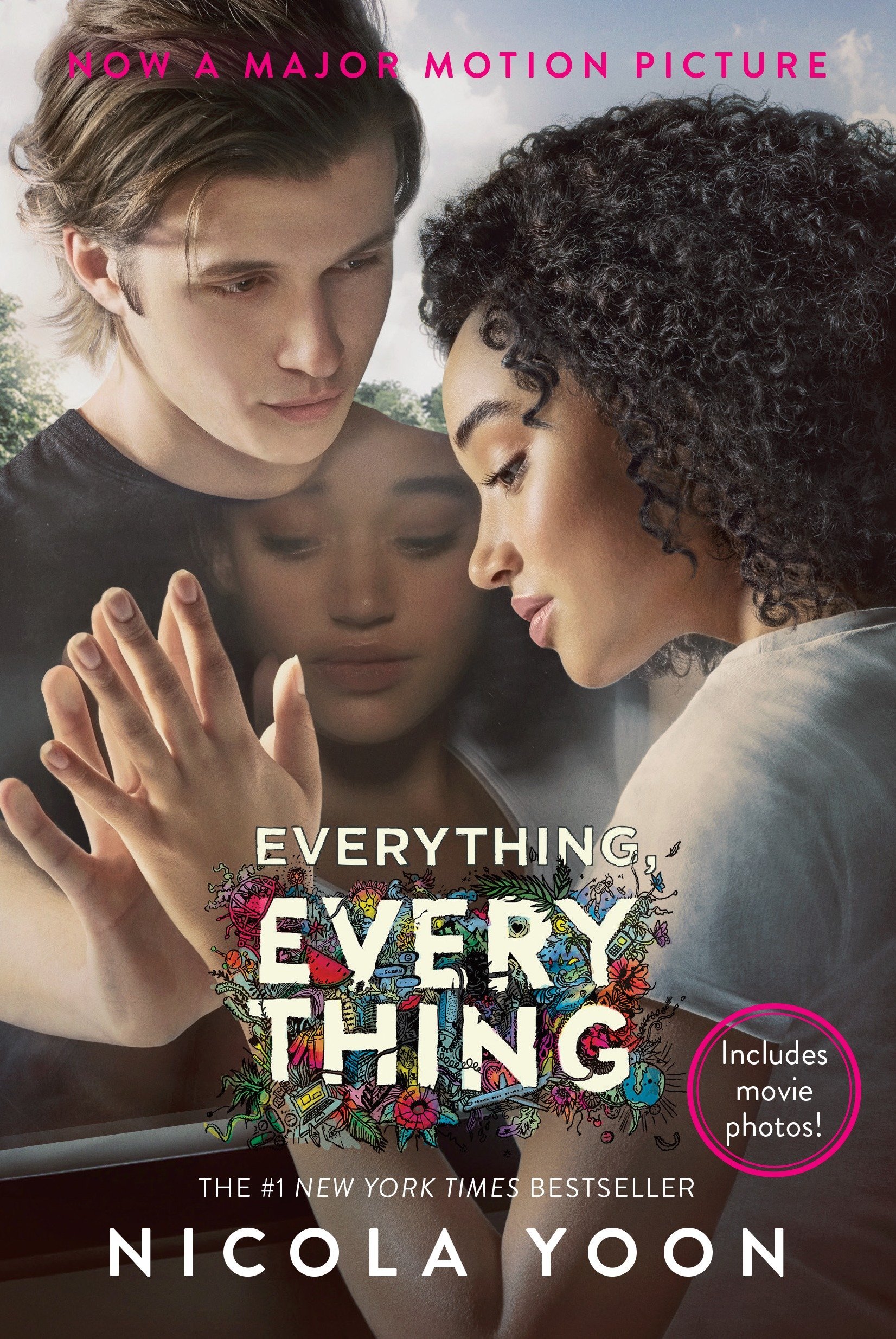
movie: Everything, Everything (2017)

I loved the book so much that I thought I’d love the movie, but I was wrong. I found it more gooey and less substantial, leaning too heavily on the staring into one another’s eyes and the admittedly compelling romantic trope of the view between two windows. (Also the beauty of both starring actors – and they are beautiful! but not what makes the story work.) The mother character is less warm here, and therefore less sympathetic; the mother-daughter relationship has none of the sweetness that makes it work in the book. It’s all less developed, as is always the case with book-to-movie adaptations. If the novel rose above the potentially juvenile nature of the “young adult” designation, the movie did not.

On the other hand, there was this bookstore shot with an out-of-focus copy of Paul Kingsnorth’s The Wake in the foreground as an Easter egg, so that’s worth some points.

I’m sure this movie is for somebody – perhaps it’s perfect for the young adult audience; it got good audience reviews. I found it too simple and saccharine. I watched the trailer for the movie version of The Sun Is Also a Star and decided to save my money. Oh well.


Rating: 4 books.

Everything, Everything by Nicola Yoon

After The Sun Is Also a Star I was sold on anything Nicola Yoon. Everything, Everything is her first novel, also a YA romance of star-crossed lovers, heavy on metaphor. I will buy whatever she writes next.

Madeline Whittier is just turning eighteen when we meet her. She lives in an immaculate home, in an entirely white room where “book spines provide the only color” and her best view of the outside world; she hasn’t left the house in seventeen years. She has SCID, or Severe Combined Immunodeficiency, or “bubble baby disease.” Luckily, her mother is a doctor, so she has the best care. She loves her books and goes to school via video calls and the occasional, exhaustively decontaminated visit from her architecture teacher. She has a great relationship with her nurse, Carla, and with her mom; she’s really not unhappy with this life, until a new family moves in next door. Through pantomimes from their windows, and emails, and IMs, Madeline and Olly fall in love.

SCID (a real disease) literalizes several truths about the more universal coming-of-age story. Madeline’s mother wants to protect her, while Madeline begins to chafe at the limitations of that protection. Falling in love involves risk, and necessitates keeping secrets. Throughout this book runs the question of whether love can really kill us or not; for Madeline, perhaps, it literally can. But for Madeline, as for all of us, it is also true that for her to grow into adulthood, she’s going to have to take some risks, and her mother will have to release her grasp a little bit.

The teenaged romance is as enchanted, magical, and absolute as these things really are. Olly is a delightful character, and like the male love interest in The Sun Is Also a Star, he has his own interests and personality to complement Madeline’s. Madeline lives through her books, especially The Little Prince, until her world suddenly grows exponentially larger. Olly is building a fanciful model of the universe on his roof, to escape the trauma of his own home life. They are very sweet with each other, and the whole story is best read in a breathless rush, the way young love happens. Yoon writes lovely, fresh, sparkling prose about universal experiences made specific, detailed, and gorgeous. Her characters are multifaceted and loveable. I feel like I get to disappear into these stories, and I can’t wait for her to write another one.


Rating: 8 rewards.

The Wet Engine: Exploring the Mad Wild Miracle of the Heart by Brian Doyle

I am back again with another Doyle, different this time but totally recognizably him.

Here are the classic Doyle elements of celebration and beauty, but amid so much pain and loss… and I have to admit, the loss of Doyle himself felt very present for me here. I continue to feel it as a significant loss to this world, both because we will get no more of his transcendent writing, and because he just seems to be the most beautiful, loving, joyful, talented person, and we don’t have enough of those; it still hurts me that we’ve lost him. And that was right under the surface of all of these essays for me, in a way that was less true of Chicago, because that book was fiction rather than nonfiction, and also because it is not quite so explicitly about life and death in the way that The Wet Engine is, so the pain was closer to the surface for me, if that tracks.

The wet engine is the heart, often but not always the human heart, and the reason Doyle focuses here is that one heart that is important to him is in danger. His son Liam (age nine at the time of writing) was born with three chambers in his heart rather than four. He had to have several open-heart surgeries when he was an infant, and so his father learned about how hearts work and he got to know some cardiologists and surgeons. And because this father was Brian Doyle, he also did some meditating on the metaphoric meanings of heart, on all the language we use (heartbreak, heartsick, hearts swelling and leaping and failing, hearts held in hands and worn on sleeves), and on mysticism and miracle and mystery and magic. He also does research: Liam’s doctor, Dr. Dave, is profiled in considerable detail, as is Dr. Dave’s wife, Linda, and his mother, Hope. (It is through Hope that we find ourselves in an internment camp – really, a concentration camp – for Japanese Americans during World War II, in Topaz, Utah. Hope was interned there as a teenager with her family for nearly three years; she graduated from high school there. “No, I am not bitter, she says. No. Bitter is no place to be. But I do not forget.”) Shorter profiles explore other doctors and pioneers in medicine and cardiology from around the world, from the early days of the science through the present (like Dr. Dave’s colleague Hagop Hovaguimian, who can never stop working because too many people need his help). The people who people this book come not only from throughout history but from all over the world, which is frequently fun and which reinforces the feeling of enormous scope that Doyle achieves. “The doctor to my left is from Australia. He speaks Australian, a smiling sunny language which takes me a minute to get the pace and rhythm of, but then we get along swell…”

The Wet Engine is a collection of linked essays that explore these and other topics: the humans involved with hearts and their stories; the nature and power of stories; the language and metaphor and soul of the heart, and its place in our mythologies; the science of the hearts of humans and other species; Liam’s own life story, and Doyle’s navigation of it as Liam’s father. Everywhere of course is Doyle’s distinctive voice and style, made up of long lists and emotional appeals and exuberance and vulnerability. There is also God here, and my regular readers know I don’t spend a lot of time reading about God, but Doyle can get away with anything: the tone of reverence is entirely appropriate here, and his explorations (“God is not a person. God is not an idea. God is the engine. God is the beat. We are distracted by the word God…”) I can easily follow. (Also I am reminded of Amy Leach.) And I appreciate that Doyle doesn’t choose just one religious or spiritual angle of approach, but that he’s interested in holiness in a multitude of traditions.

I think what I love most about this book is that it feels like it includes all the disciplines of study. There is theology, and hard science – medicine, zoology, even botany – history, social justice, the arts – music, and his own literary genius, including some superlative descriptive work and expressions of gratitude and pain. I’m pretty interested in interdisciplinarity these days, and I’m assigning my students readings that do this work, including a short passage from The Wet Engine. (Synchronicity: I’d just given them a Joseph Mitchell essay called “Goodbye, Shirley Temple,” and then read that Hope was interned at that camp with Shirley Temple’s gardener. What?? The world is a mystery.) And all of this in Doyle’s own wild style.

I cried a lot, but it’s such a beautiful, instructive book. At scarcely over 100 pages, it is one that would bear lots of study. Again I rave.


Special recognition to Matt Ferrence for making me aware of this book a few years ago, when he assigned “Joyas Volardores,” the sixth essay, for an MFA residency. That one still stands out. Thanks, Matt.


Rating: 9 knobby knees.

Appalachia North by Matthew Ferrence, in Still: The Journal

Following my earlier review, I am so deeply pleased to shared with you today this review in the Fall 2019 issue of Still: The Journal.

Matthew Ferrence’s Appalachia North is both memoir and outward-looking examination of place: what it means to be from somewhere, how our relationship to home can change, and the complicated and too-often negative role Appalachia plays in the national imagination, and in its own.

Ferrence was forty when he received a life-changing diagnosis…

Please click over to read the full review. Look for my interview with Matt on Friday. And many thanks again to the Editors at Still for considering and accepting my work.

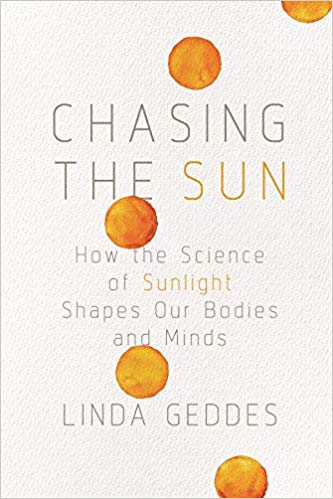
Chasing the Sun: How the Science of Sunlight Shapes Our Bodies and Minds by Linda Geddes

This broad study of the sun’s power over humankind, even in an age of electric lights and bright screens, is both absorbing and potentially life-changing.

Linda Geddes (Bumpology) illuminates the importance of one singular star in our human lives with Chasing the Sun: How the Science of Sunlight Shapes Our Bodies and Minds. The sun is life: allowing photosynthesis, warming the earth, providing solar power–it’s no wonder humans have long worshipped it. We have “assimilated starlight into the very fabric of our beings.”

People have resorted to the sun for medical purposes since early times, as well, and it is health and wellbeing that concerns Geddes in this lively, enlightening study. Circadian rhythms, her research reveals, are vital to many aspects of human life, governing blood pressure, body temperature, alertness, immune reactions, sleep cycles and quality and much more. “Almost half of our genes are under circadian control, including ones associated with every major illness investigated so far–including cancer, Alzheimer’s disease, type 2 diabetes, coronary artery disease, schizophrenia and obesity.” Shift work has recently been recognized as a probable carcinogen. In other words, the importance of sunlight to human existence can scarcely be overstated.

For this thoroughly researched investigation, Geddes consults history, international medicine, chronobiologists and NASA. She’s learned we get far too much artificial light and too brightly at night, while daytime interior lighting in most homes and offices is not nearly bright enough to simulate the sun’s power over our bodies. She also outlines light therapies for mental health issues, as well as for tuberculosis, and the special struggles and successes of populations at high latitudes, like Iceland. She speaks with fascinating people, like the man with non-24-hour sleep-wake disorder and the woman whose grandmother stuck to a strict meal schedule well into her 90s, and she visits the German “Chronocity” of Bad Kissingen, which advertises itself as “a place where internal time is as important as external time, and sleep is sacrosanct.”

While helpful to those interested in seasonal affective disorder or jet lag, this journey to the sun and back will certainly expose any reader to new concerns and marvels as well. Chasing the Sun offers many sobering lessons (sunlight and sleep cycles are life-and-death issues) and helpful tips (the utility of melatonin and vitamin D, and the importance of putting down that smartphone at least 30 minutes before bedtime). Geddes’s hopes for using what she’s learned, however, lean toward technological advances, not a return to older ways. This is also a riveting read, filled with characters, places, anecdotes and histories sure to fascinate. Geddes brings a sense of wonder to her work that is infectious, and makes scientific and medical concepts easy to understand through simple, serviceable prose. Caution: Chasing the Sun may inspire readers to try eating by candlelight and waking with the sun.


This review originally ran in the August 27, 2019 issue of Shelf Awareness for the Book Trade. To subscribe, click here.


Rating: 7 excited submariners.

The Diving Bell and the Butterfly by Jean-Dominique Bauby, trans. by Jeremy Leggatt

Jean-Dominique Bauby was in his early 40s and enjoying a career as editor in chief at French Elle magazine when he suffered a stroke and woke up, post-coma, with “locked-in syndrome”: he can only move one eye, and jiggle his head around a little. He writes this memoir – short at 132 pages, but still, extraordinary – by blinking his left eye at a friend who runs through the alphabet with him for every character in this book. That, alone, is astonishing.

But it’s also quite a good book. Chapters are short, episodic; language is often lovely, and not just descriptive. Where I expect someone in Bauby’s position to be bitter and melancholic, he is often nearly joyful, waxing about how he can go anywhere, taste anything in his mind.

My diving bell becomes less oppressive, and my mind takes flight like a butterfly. There is so much to do. You can wander off in space or in time, set out for Tierra del Fuego or for King Midas’s court.

In his imagination, he interacts playfully with the Empress Eugénie (his hospital’s patroness, who died in 1920); travels to New York, Hong Kong, Saint Petersburg; eats apricot pie, Alsatian sausage, or “a simple soft-boiled egg with fingers of toast and lightly salted butter.” (He is fed through a stomach tube.) He is also often very blue, as in the chapter ‘Sunday’ about how excruciating that day can be when he has no visitors and his hospital carers are indifferent to their job. But we don’t blame him, do we.

Bauby has both a sense of humor and a sense of the sublime. He tells us that in using the alphabet process wherein a guest runs through letters (not in ABC order, but in order of their frequency of use in French), some are inclined to wait for him to conclude each word himself: “unwilling to chance the smallest error, they will never take it upon themselves to provide the ‘room’ that follows ‘mush.'” Others jump to conclusions, in a hurry for the next word. “Yet I understood the poetry of such mind games one day when, attempting to ask for my glasses (lunettes), I was asked what I wanted to do with the moon (lune).” Lovely. Or: before the stroke, Bauby had been contemplating writing a modern retelling of The Count of Monte Cristo (fine book, that); now he finds it ironic that he is living the life of the character Grandpapa Noirtier, who also had locked-in syndrome. “As a punishment, I would have preferred to be transformed into M. Danglars, Franz d’Epinay, the Abbé Faria, or, at the very least, to copy out one thousand times: ‘I must not tamper with masterpieces.'” This is a narrator I like very much.

Lest that go too far, he’s not perfect, either. His relationship with his children and their mother, now that his world has so changed, is complicated by the fact that he had recently left them for another woman when he had his stroke.

This is a memoir with a heartbreaking human story at its core. Nothing much happens during the course of these pages – what has happened has already happened when it begins, although we do get a brief flashback version of the stroke itself, just at the end. (I suspect this question of sequence and not-happening will be Cynthia’s focus, in her upcoming seminar.) But the thoughts and feelings of this locked-in man are worthy of our attention, told as they are with careful focus, humor and humility, and a concern for language. Recommended.


Rating: 7 lucky days.

Appalachia North: A Memoir by Matthew Ferrence

Disclosure: Matt Ferrence was visiting faculty at this past winter’s residency at WVWC, and we really hit it off; I think he’s great, and he gifted me my copy of Blue Highways.


A shorter review now, with more to follow, because Still: the Journal has agreed to published my book review *and* an interview with Ferrence in their October issue. Hooray! For now, a teaser.

Building a literature based only on darkness is just another way to shackle ourselves to decline. Instead, we are who we are, and that’s the sound of red-winged blackbirds chirping in the blowing reeds alongside restoration wetlands, a dark plain bird with a hidden flash of brilliance, the real marker of hope.

You know I’m on an extended trip right now. I’ve been keeping track of birds, among other things. In the mid-east-coast area, I started to see red-winged blackbirds, which I don’t recall ever having seen before. They are a delight, that shock of bright red underlined by bright yellow on black-black background. I saw just a few, and then lots of them, diving and swooping and chattering at one another, plentiful as grackles. I looked them up, and see that they live where I’m from, too. How come I never saw a red-winged blackbird before?

This book is a little like that, for me. The recognition of something I didn’t know I needed, although it seems thoroughly obvious now I’ve seen it. And it’s from where I’m from, too. The synchronicities like this kept stacking up. Matt’s parents and my dad all love Wendell Berry, although his took it a step further and farmed on the farm they purchased when he was young, while we kept our city home even after purchasing a ranch when I was young. We’ve struggled with similar questions about where we’re from. My brain injury and his brain tumor are different, but also alike. Even the Facebook surveys we each put out about our home places, Pennsylvania or Northern Appalachia, and Texas. I can’t tell you how many times I scribbled “me too” in these margins. I don’t usually scribble anything in the margins at all, but when Matt sent me Blue Highways, I learned something.

Okay, then.

This book is that blend that I love best in nonfiction: both memoir and outward-looking examination of something larger than the self. Ferrence grew up on a farm in southwestern Pennsylvania. He didn’t know it yet, but he was born and raised in Northern Appalachia. At forty, he is diagnosed with a brain tumor. Appalachia is a much-maligned and little-understood region of this country, at least from the outside. Northern Appalachia is less understood, and (as Ferrence has it) exiled from both Appalachia and the U.S. He examines the geology and geography of sedimentary rock, mountains, and his own brain through many layers of metaphor. He pulls in plenty of outside voices: writers he admires (Abbey, Dillard, Sanders), and some he takes issue with. That’s another duality I deeply appreciate, that balance between one’s own voice and the voices that have informed it.

That’s all I want to say, in advance of Still‘s October issue – I will repost my longer review, and interview with Matt, when they’re available. For now, please know that this book caught me in that perfect place: both personally resonant in all the deepest ways, and an intellectual and artistic accomplishment I admire and would like to emulate. This is one of the most highly recommended books of 2019. And I don’t care who you are and where you’re from: you have something to learn from Appalachia North. Get out and get you a copy today. You’re welcome.


Rating: 9 collection points.