
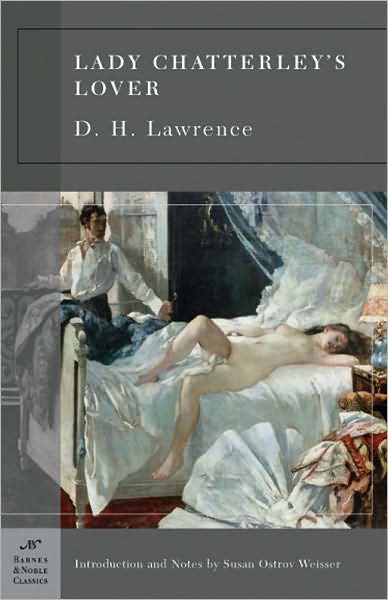
Lady Chatterley’s Lover by D. H. Lawrence
 I went into this one largely blind. I knew it was a classic, and I knew that its contemporary public found it obscene, even pornographic. But I didn’t know what to expect in the way of style or plot content.
So I’ll begin as if you’re in that same boat. Lady Chatterley’s Lover is set in England, in the years immediately following World War I. (I have found myself reading quite a few books, fiction and non, set in interwar Britain this year; I’m becoming pretty comfortable with this setting.) Our protagonist is a girl named Constance, who has a love affair as a teen while touring in France, but is called home when the war begins. She marries a young man named Clifford Chatterley while he’s on leave; the marriage does not appear to be particularly well thought through. Thus Connie becomes Lady Chatterley. When Clifford returns from the war, he first has to convalesce, and then they move together into his family seat, called Wragby – with Clifford paralyzed from the waist down, impotent, and wheelchair-bound.
To begin with, Connie had a larger, stronger personality than his. Now especially she is tied down, and in the dismal, closed-in environment that is Wragby, bordered by coal mines and their socially inferior, dirty, mean inhabitants. Clifford was arguably never fit to satisfy her, sexually, intellectually, or emotionally; his handicap now finishes that question.
In her malaise and misery, Connie takes a lover, briefly: Michaelis is a playwright, not really socially acceptable but moneyed, and therefore made semi-welcome at Wragby. This affair is not entirely satisfying, though, and following a particular sexual faux pas, Connie cuts him off.
For some time, then, she drags around Wragby, at first caring for Clifford dutifully, but eventually tiring and beginning to like him less. The main action of the book I shall try not to spoil for you, if you have managed to not know for this long. (I didn’t know, and had the pleasure of learning as I read.) But I will tell you that Clifford encourages Connie to get pregnant if she can, and assures her that he’ll acknowledge her child.
I found this book engrossing, after I got used to the style. Lawrence uses colons in odd ways, and with gusto, sprinkling them liberally. It took me a little while to get used to, and I continued to note his colons with amusement. More than punctuation, though, there is a sort of rolling rhythm to the narrative that I had to adjust to; it was lovely once I got going, but just different enough from what I’ve been reading lately to cause a change in pace. I wish I knew better how to Talk Lit and explain what I mean; I’m assuming there’s a term for the style; all I can say is, many classics or older novels have a style and a rhythm that I recognized here and that is different from modern releases.
The voice is third-person but shifts perspectives so that we see out from inside the heads of Connie and of her eponymous lover. There is dialect! I do like dialects, if I can understand them at all, and what they reflect; here, the dialects of various characters reflect social class, which is an important element of the book. One of the ongoing conflicts that Connie and Clifford experience is over social class; Clifford is accustomed to being one of the ruling class and assumes that that is as it should be, while Connie is a little more open-minded. There is discussion of socialism.
The larger theme, however, is a body-vs-mind question. In her youth, Connie and her sister Hilda were stimulated by the intellect of the young men they loved, and Connie continues to share activities of the mind with Clifford at least through the first half of the book. He becomes a fairly successful author, and she assists him in writing stories that make money but are not “important.” Clifford has several old friends – “the cronies” – who come by and have discussions, occasionally including Connie. As the story goes on, though, she finds that stimulating her mind is not enough; she needs to live a physical life, too, and Clifford could never offer her that.
Lady Chatterley’s Lover reminded me very much of Rebecca Harding Davis’s Life in the Iron Mills and Upton Sinclair’s The Jungle. All three describe industry and its workings as if they are characters, animate. In this case, the local coal mines, which Clifford owns and becomes increasingly interested and involved in managing, are a force almost of nature. Their dirt and noise dominate Wragby and depress Connie; work in the coal mines defines several generations of men, and the threat that the mines will close is part of the terror and change of the new post-war England.
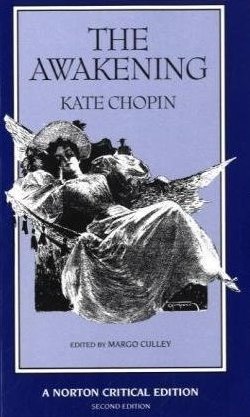
This was a beautiful book and I enjoyed it. Connie’s uncomfortable, unfulfilled position and struggle to find herself reminded me, in turn, of Katie Chopin’s The Awakening. It’s an important story to tell, and to read. It’s beautifully written.
But, you ask, what about the SEX?! Okay, I’ll tell you. First of all, the “obscene” and “pornographic” nature of this book is said to have diminished over time, but I still raised my eyebrows several times. There is very frank discussion of body parts, orgasms, and the various ways of achieving them; characters name their genitalia and call them by various terms not considered polite. Despite our new and jaded comfort with sex this is not a PG-rated book. But I thought it was well-done and fairly realistic, and I found several scenes of sexual frankness between lovers who really didn’t know each other very well, that suggest an openness we still haven’t entirely achieved.
Perhaps more shocking to me than the sex talk was the talk of affairs and illegitimate children. Not only Clifford, but Connie’s father, and various well-meaning bystanders comment on Connie not looking very healthy or happy, and recommend that she take a lover, even have a child by another man – they suggest this to her, even occasionally to him. It is taken fairly matter-of-factly. This, to me, was more outlandish than the sex. It’s not hard to see why the 1920’s world rejected this book as inappropriate; it’s still being challenged today all over the country. But as usual in dealing with banned books, I say let the individual decide. If you don’t like reading about body parts, steer clear. But this is a fine book, and you’d be missing something.
Filed under: book reviews | Tagged: Banned Books Week, classics, classics challenge, gender | 10 Comments »












 pagesofjulia