Speaking Truth to Power by Anita Hill, first half review

anitahillFor reasons I’ll discuss below, I have had to put this book down at about the halfway point, through no fault of Anita Hill’s absorbing story or lovely, clear, honest writing. This first review will be more about my emotional reactions and reason for pausing in my reading; soon I will publish my second-half-review which will be more about the book itself. Briefly, for the record, it’s a great book.

Anita Hill was a young black female lawyer from the south in the early 1980’s, when she found herself employed as an assistant to Clarence Thomas, then an aspiring government official looking for an appointment under President Bush (Senior). She was largely successful in leaving behind her unpleasant experiences in his employment as she moved onto other lines of work, teaching law back in her home state of Oklahoma, where she could be closer to her family and further from the nasty environment Thomas created for her in Washington, D.C. When Thomas was nominated to the Supreme Court in 1991, however, she reconsidered her silence on his sexual harassment, and ended up traveling to D.C. to testify at his confirmation hearing as to his behavior nearly 10 years earlier. She was excoriated for her decision and her actions; every piece of her life, her morals, her “virtue” were picked apart. This book is her attempt to set the record straight.

Most Americans know the name Anita Hill, in my (limited) survey. When I mentioned this book, a coworker spoke of having horrible, vivid dreams, set in the Senate, as the hearings went on; she sympathized with Hill’s unfortunate position. I am young enough that I don’t remember these events (I was 9 in 1991 and not paying much attention to sexual harassment and Supreme Court nominations, for which I suppose I’m glad); it’s history to me. However, the name Anita Hill did mean something to me, and it means much more now.

I am reading this book because my father raved about it and felt it was important reading for me, which I easily believed. And it’s a lovely book. But it so happens that I picked it up during a time when my personal life was in upheaval in a few ways. I don’t want to share too many personal details here (I’d rather get personal when the news is good!) but it involved my loved ones being spread around the globe dealing with various trauma, and I was distracted, worried, and depressed. And unfortunately, one of the central truths of Hill’s book, based on events in 1982 and 1991 and published in 1997, holds true today: that most women will be sexually harassed; that most will choose not to accuse their harassers; and that few harassers are sanctioned. Again, without revealing too much of my personal story, I know this firsthand. And reading about Hill’s experiences, both being harassed by Thomas, and then being harassed by her national media and political representatives, was entirely too painful to me. I felt physically sick to my stomach reading it, and I had to put it down.

I still agree with my father’s statements that this is a very good book, and that it’s an important book for me to read. I look forward to picking it back up – as I write this, personal-life issues are mostly resolved, and (thank goodness!) Husband is home here with me. Hill writes like a lawyer: she makes statements of what she knows to be true, and is careful to note where she speculates, while providing evidence to support her speculations. She speaks strongly where she is sure that she is right; and (as one would expect) she has a very sure and confident grasp of legal issues in their minutia, and is capable of making those legal details understandable to her reader. I also really enjoy her gentle, loving treatment of her family history; that background adds to her story immeasurably.

I wanted to give you this first-half-review of this book where I’ve paused in my reading of it, to note the painful emotional impact it’s had on me. Make no mistake, it’s a fine book and I will finish it and tell you more very soon. But for now, know that this story is rather excruciating.


Rating: 8 brave public statements.

Carrie by Stephen King

carrieHere’s a book-turned-movie we’ve probably all heard at least something about! And apparently it’s being made into a 2013 movie, although maybe for the film version I should start with the 1976 version with Sissy Spacek? I had the vaguest notion that I’d seen it already; but as I read the book I realized that this was definitely new material to me.

I am really glad that I picked up this collector’s edition at my local used bookstore. The introduction by Tabitha King, the author’s wife, was a great addition. She puts in perspective the creation and success of this, King’s first published novel, written while they were scraping out a living as parents of two small children, each working full-time on opposite schedules and hardly seeing each other. When this novel did well, then, it made the change of their lives, and started Stephen King on the path to become the huge name he is today. She also reveals that her own terrible PMS was (she is sure) the inspiration for Carrie’s menstrual difficulties, and muses on the strangeness of a novel centering around menstruation and the trauma of a girl’s first period, written by a man, in the 1970’s no less. I enjoyed this introduction.

And the book itself! Carrie is really something. I can appreciate (even with my very limited experience with Stephen King) how this book fits into his oeuvre: it’s a fine example of his ability to create atmosphere, and let us into the heads of his characters. Carrie herself is both tragic and terrifying. I can’t help but sympathize: she’s been abused by her mother from birth, and her completely bizarre upbringing has crippled any chance she might have had of fitting into her world. Now, as evidenced by Sue Snell’s inner conflict about her popularity, conformity is not necessarily a good thing; but Carrie is so far outside of her society that she’s handicapped by it. And to put it simply, kids can be so cruel, can’t they? But when Carrie begins to steer her own fate, I likewise can’t help but shiver.

Carrie comes into her telekinetic own after a trauma, when she gets her first period in very public fashion and is ridiculed (violently) for it; a double trauma, then, if you will (compounded by her total ignorance, at age sixteen, of menstruation). Whether her special powers are born of puberty or trauma is unclear; probably it’s both.

The novel is fairly short: at about 150 pages, it took me just two days to read (in the course of my normal, busy life). The structure is unique, partly epistolary, partly scrapbook-style: sometimes we look out from inside Carrie’s head, sometimes from the heads of other characters; interspersed are clippings from magazines, newspapers, news releases, and books. The effect is a little jarring and disjointed, in just the right way (and, you can bet, as King intended it). The final, climactic events are foreshadowed and referred to from the very beginning; this, and the building of the action, and the careful release of new pieces of information, combine to create the atmosphere and tension King is known for. And, as important as anything else about this book, he gets his adolescent female characters just right: they really are teenaged young women, and that’s no small accomplishment for any author, perhaps let alone a man.

I found Carrie terrific. There’s no question in my mind that this is a fine novel, quick to read but exquisitely crafted, definitely cinematic (want to see the movie now!) and classic. Perhaps it’s all hindsight, but I can see Stephen King’s rising star in this early work. And I want more than ever to read more of his!


Rating: 8 mind flexes.

On a Farther Shore: The Life and Legacy of Rachel Carson by William Souder

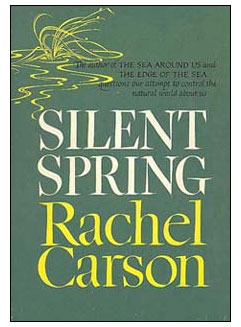
Rachel Carson was born in 1927 and by the 1950’s was the author of several bestsellers, a national hero for her lyrical, literary, scientifically accurate books about the ocean. She also published myriad magazine and newspaper articles, both as a government employee and as a freelance writer. In 1962 she published a somewhat different kind of book. Silent Spring retained the literary style for which she was well loved, but its subject – while still the natural world – took a different tone. Carson wrote about the then-widely-used pesticide DDT and its sinister effects, not just on the insects it claimed to target, but on wildlife generally including many fish and birds (hence the title) and even human life.

The immediate reaction to her book was mixed. Critical reviews were more positive than negative, but the government (to varying degrees) and the pesticide industry (predictably and totally) offered less praise. Carson came under attack as a hysterical nature faddist and Communist sympathizer, even as Silent Spring topped bestseller lists and initiated federal investigations. Today, the ecology and environmental movements credit Rachel Carson and Silent Spring with helping to establish what is now a central issue of our times.

William Souder’s new biography of Carson, published on Silent Spring‘s 50th anniversary, begins with the conjecture that Carson’s name is now “unknown to almost anyone under the age of fifty.” There are a few of us, of course (although I confess my personal poll may not constitute a random sampling), but his point is well taken: in 2012, Carson is less on our minds. But even if DDT is no longer sprayed on kids playing at the beach and the rivers we catch our fish out of, environmental issues are among the most pressing of our day. (I am thinking of climate change, overpopulation, water tables, land use, urban sprawl, species extinction…)

That’s the argument for Carson as a biographer’s subject. Now, how did Souder do? As observed yesterday, his style is rather a traditional one. Souder himself does not enter into the story as a character; he doesn’t give us his own impressions (unless you delve into the Notes at the back of the book, on which more is coming in a later post). I am a fan of the newer style of “creative nonfiction” exemplified most recently at pagesofjulia by Soundings, but that doesn’t mean the straightforward sort of biography is necessarily dry, either.

Souder brings his subject to life. His plentiful research (again see those Notes) clearly and exhaustively outlines Carson’s background and personality, and enigmas. For instance, he notes the weekend in college when she went one two dates with a boy from another school, and then as far as we can tell, never dated again. He writes eloquently of her strange single-mindedness, for example in reading Henry Williamson for his nature writing (which she loved) while totally ignoring his frank Nazi sympathies.

I will mention one angle that I noted as absent: there is nothing in Souder’s book about Carson suffering for her sex in the field of science. This seemed like a natural obstacle for her to have faced as a science writer in the 1950’s and 1960’s, and I wonder at its absence, particularly in comparison to Soundings, where Tharp’s professional limitations as a woman are one of the central issues. Did Carson not feel that she was held back? Did Souder miss something? His work feels thorough. I am hesitant to think he missed such an important angle, but it makes me wonder. There are a few references by her contemporaries to her status as a “spinster,” but even these don’t feel particularly biting. And apparently her critics entirely missed the lesbian question. Carson had a very close female friend for the final 10-12 years of her life with whom she exchanged ardent letters. Whether they had a sexual relationship is not known, although Souder makes the case that it’s unlikely; but that’s irrelevant in looking for contemporary criticism of her for it. It seems like such an obvious way for her detractors to attack her. I just wonder.

Despite my questions about the role sexism might have played in Carson’s career, this biography feels well-researched, thoughtful, and finely wrought. It can also serve as a fairly good quick introduction to the history of ecology, environmentalism, and nature writing: Aldo Leopold, John Muir, and Teddy Roosevelt all get put into context. In fact, context is one of its strengths (again, see yesterday’s post). I feel like I know Carson much better now, which is of course what I was looking for, but it was also an enjoyable read. I recommend On a Farther Shore, because Rachel Carson is every bit as relevant today as ever.


Rating: 7 birds’ eggs.

biographies of parallel lives: Rachel Carson and Marie Tharp; and beyond

Remember when I raved about Soundings, the biography of the woman who mapped the ocean floor? I was enchanted in part by the style in which author Hali Felt evoked her subject, Marie Tharp, as a personality as well as a historical figure. I was also fascinated by the unique persona of Tharp herself, and her role as a woman in science in the 1940’s, 50’s, and 60’s.

And now I’m very pleased to have picked up a new biography entitled On a Farther Shore, by William Souder, about Rachel Carson, for the 50th anniversary of the publication of her groundbreaking book. Silent Spring exposed the tragic truth, that the widely used pesticide DDT was killing not only bugs, but birds and myriad other wildlife, and even humans. Carson is credited with playing a major role in the birth of the environmentalist movement.

These two biographies employ very different styles. Felt is a visible character in the story she tells, of Tharp’s life through the lens of Felt’s research experience, while Souder’s work so far tracks like a traditional biography, with the author invisible. But their subjects share a few obvious similarities. Both were women on the margins of scientific communities that weren’t entirely prepared to let them in, and they were more or less contemporaries (Tharp was born 13 years later than Carson). Both challenged the gender barrier and accepted understandings of their fields. I recognized these parallels when I began reading On a Farther Shore.

But I wasn’t prepared for the confluences and coincidences that came fast and thick in the opening chapters. (I’m only about 50 pages in, so this is far from a final review of Souder’s work. Although I do like it so far!) For one thing, forgive my ignorance: I knew about Silent Spring (I read it when I was a kid), but had not known that prior to that most famous of her books, Carson had been a well-loved and bestselling author of literary writings about the ocean. So, number one: both women were fascinated with the sea. And then came a comparison of Silent Spring, with its unprecedented exposure of an industry that would later be legislated and regulated largely because of the book itself, to one of my all time favorites: Upton Sinclair’s The Jungle. Next I learned that Carson grew up scarcely an hour’s drive away from where Edward Abbey would grow up 20 years her junior. That is a hell of a coincidence.

As I joyfully made these connections (which I know will continue, because our world is all interconnected), I mused. I remember feeling, in middle school, even in high school, that certain subjects were “work,” were chores, weren’t fun, didn’t feel like they were teaching me things I’d need to know or care to know later in life. I liked English but had less use for history. And I also remember when this changed for me, and when learning for its own sake became something I felt passionately about. The light-bulb moment was related to the interconnectedness of all things. That history, biology, political science, and literature were all the same story; that nothing happens in a vacuum, just as Gertrude Stein, mentor and friend to my main man Ernest Hemingway, was a student at the Marine Biological Laboratory in Woods Hole, Massachusetts just a few decades ahead of Rachel Carson. I don’t know about the rest of you, but learning that the world is interdisciplinary and that contemporary figureheads from a variety of textbooks lived in the same world – that Einstein’s life work and philosophy was deeply influenced by his observation of German militarism culminating in Hitler’s rise to power, that the reclusive Harper Lee and the effervescent Truman Capote were buddies, that Mark Twain and the much-younger Helen Keller were close – has been the turning point for me in appreciating so much more reading and learning than I did even 10 years ago.

Recognizing these connections has led to myriad new directions in my own reading. Some of them have been in fiction (I’ve read Gertrude Stein because of her relationship with Hemingway), and many have been nonfiction. In general, I would definitely credit this larger observation with my ever-growing appreciation of nonfiction. I’m sometimes saddened to hear from people who don’t like nonfiction, because they’re missing so much. I suspect they just haven’t met the right style of nonfiction yet; but maybe, too, they haven’t had that light-bulb moment that did it for me.

Does anybody else share this feeling that everything being connected make the world a fascinating place? Has it influenced your reading habits?

Almost Somewhere by Suzanne Roberts

A contemplation of women relating to one another in nature, nestled within the tale of a backpacking trip.


In 1993, Suzanne Roberts was a college graduate lacking a firm plan for the future when she agreed to hike the John Muir Trail with two other women. Almost Somewhere is a travelogue of that month-long hike, but it’s also a woman’s foray into the male-dominated worlds of hiking and nature writing and a contemplation of the cattiness and competition that limits women’s attempts to connect with one another. Roberts is not gentle to herself or her companions as she describes their flaws and failures to support one another; she is frank about the bounds of their friendship. But she has a triumphant story to tell, because despite swollen joints, bugs, infighting and the doubts of fellow trail users, these three women hiked the John Muir Trail in its entirety and lived to tell about it.

Roberts writes plainly about gender issues, as the women (“we had gone through puberty a long time ago and, really, we were no longer girls”) consult a guidebook written by a man filled with language of “conquering” or “assaulting” mountains. She seeks not only meaningful relationships with other women, but also a feminine understanding of nature, having read nature writing only by men (Muir, Thoreau, Edward Abbey) up until this point. Her understanding of her experience is clear-headed and self-aware in retrospect, and she is considerate of her companions even in her criticism. Almost Somewhere is a contribution to the growing body of women’s nature writing, and a worthwhile, entertaining and occasionally funny story of the California wilderness.


This review originally ran as a *starred review* in the Sept. 4, 2012 issue of Shelf Awareness for Readers. To subscribe, click here, and you’ll receive two issues per week of book reviews and other bookish fun!


Rating: 6 small but important steps.

Soundings: The Story of the Remarkable Woman Who Mapped the Ocean Floor by Hali Felt

I’m so glad I picked this book up (and bought it for the library where I work). It sounded like just the sort of thing I appreciate: a biography of a little-known historical figure who made an important contribution to the world as we know it but was herself forgotten. In this case, the “remarkable woman” of the subtitle is Marie Tharp, whose meticulous study and cartography of the ocean floor established the concept of plate tectonics that science now recognizes as fact, but was at best a blasphemous and ridiculous notion before Tharp came along. Her achievements, however, were minimized by a scientific culture in which women did not belong. This biography is additionally appealing to me for its mood: author Hali Felt takes a whimsical, dreamy, almost fanciful tone at times. She describes her own attraction to Tharp’s story (born in part of Felt’s mother’s, and her own, fascination with maps) and the relationship she felt to her subject. She dreams of Tharp coming to her to explain the mysterious and unspoken parts of her life. This book is nonfiction, but it’s honest, personally related, and warm.

There is also an enigmatic love story of sorts hiding within Soundings: Tharp’s career and life were both tied to a man named Bruce Heezen. Heezen was her coworker, then her technical superior; but they shared a partnership in work, in science, in discovery, and apparently in all things. It is known that they were a couple, although they never married and the details of this side of their relationship are very few.

Felt follows Tharp from her childhood with a science-minded father she adored, through her education in English, music, geology, and mathematics, and to her first job in the oil & gas industry (oh, how familiar to this Texas girl). But she was held back: this was the 1940’s, and women in science were mostly expected to make copies, compute numbers, and brew coffee. Eventually Tharp found her way to New York, to Columbia University and the Lamont Geological Observatory. This is where she would meet and work with Heezen and quietly make history.

The science in this book is very friendly and accessible to a general reading public; the story that Felt set out to tell is more that of a woman’s life and accomplishments despite the limitations of her society, than that of tectonic plates per se. For that matter, Felt shows that it was Marie’s combined backgrounds in art as well as science that made her perfectly suited to play the role she did in history. Her meticulous re-checkings of data and attention to detail were indispensable – but so was her interest in visually representing the data available in a way that would show the general public (not just academics) what she’d discovered. So her achievement was artistic as well as scientific. Soundings does make the science side clear, but doesn’t dwell, and is never dry. Rather, Marie Tharp comes to life: she is a precocious child; an ambitious, able, frustrated student; a dedicated scientist; a life partner; an eccentric aging woman caught up in her own past, campaigning to honor and preserve the legacy of her other half.

Hali Felt was honest about the role she plays in the story she relates. She begins in her Introduction by briefly describing her own attraction to maps, and then follows a chronological format, beginning with Tharp’s childhood and following her life, and eventually her death. And then Felt returns to the story: her discovery of Marie Tharp’s existence, her interest, her decision to follow that interest, her research, her relationships with the living descendents of Tharp and Heezen’s world (the “Tharpophiles”), and in the Acknowledgements at the end, she even hints at the process by which she came to write and publish this book. I found all of these Felt-related details interesting too.

In a word, this is a lovely biography, and the style and tone of it may be my favorite part.


Rating: 9 double-checkings of data.

Bossypants by Tina Fey (audio)

This book has been out for a little over a year. What took me so long? Thank you, fellow bloggers who raved about this book, for finally getting it into my ears. As others have said before, get the audiobook! It does make it slightly cumbersome to go find your pdf file to see the pictures she refers to; but it’s so worth it to hear her make her jokes herself.

Tina Fey is a funny lady. This I knew, and I looked forward to the laughs, which are there in abundance. But what I hadn’t entirely expected was the more serious handling of issues like a woman’s place in male-dominated industries – which was silly of me, because Tina Fey does address issues. She tells stories about her own upbringing, her youth, her discovery of acting and comedy, her time spent at SNL, the creation of 30 Rock, her honeymoon, motherhood, and more. She is always classy in her discussion of other celebrities or folks from the industry: any criticisms are well packaged in understanding and explanation, while she mostly praises her colleagues in glowing and meaningful terms. She doesn’t just call everyone talented and charming – she gives thought-out, complex, positive evaluations. And any time she has dirt on someone, she leaves that someone entirely cloaked in anonymity (“the letters from their names are sprinkled randomly through this chapter”). I never got the impression she was being less than honest, because she still made her criticisms, but she was always respectful of the people she has worked with, and that impressed me.

Tina analyzes the challenges that face a woman in a position like hers, breaking into a field that (in her early days especially) was thought to be men’s work, and she does so fairly. For example, she writes (narrates) a funny and wise anecdote about the moment that she realized that she was experiencing, not institutional sexism, but a sheer male ignorance of menstruation and “feminine hygiene.” And she gives good advice.

She is also hilarious, and wise, about women’s fashion and body image, and the culture of Hollywood, modeling, and television. In the chapter entitled “Amazing, Gorgeous, Not Like That,” she describes a “typical” magazine photo shoot in great detail. I found the scenes regarding hair and makeup especially exotic, weird and different. I’m pretty far from a fashion photo shoot, myself.

This book was great fun and very funny, as you might expect; but as you might not have guessed right off (I didn’t), it also makes some good, serious points. There’s some well-stated feminism to be found here amid the good times. Highly recommended, and as many others have said before me, do get the audio version.


Rating: 7 pairs of Tina Fey glasses.

A Difficult Woman: The Challenging Life and Times of Lillian Hellman by Alice Kessler-Harris

Lillian Hellman’s paradoxical, powerful personality set against the backdrop of a turbulent century.

Lillian Hellman (1905-1984) was many things: a successful playwright, screenwriter and memoirist; a suspected Communist (maligned as an unrepentant Stalinist) who stood up against political intimidation in the 1950s; a labor organizer and civil rights activist; partner to Dashiell Hammett for more than 30 years; a woman criticized for being manlike and grasping, but simultaneously overly feminine and stylish; a New Orleans-born resident of New York, Hollywood and Martha’s Vineyard who persisted in calling herself a Southerner. She was respected for her literary contributions, hailed as a hero by a feminist movement that she largely rejected, praised and excoriated for her politics and, ultimately, vilified for what came to be seen as the outrageous mendacity of her memoirs. It would be difficult to locate a biographical subject more contradictory or complex. In A Difficult Woman, Alice Kessler-Harris makes an excellent case that Hellman represents the complexities and changing mores of the 20th century.

The contradictions in her personality and politics are brought into relief by her written work–including plays still popular in repertory theater today–which always included strong moral statements. The concepts of truth and deception, or betrayal and loyalty, play large roles in her work and this insightful biography, rich with context, shows how they were also themes that defined her life. Not an apologia, but an exploration of nuances, A Difficult Woman gives us an infinitely more complex Hellman than the popular image that has survived her.


This review originally ran in the May 1, 2012 issue of Shelf Awareness for Readers. To subscribe, click here, and you’ll receive two issues per week of book reviews and other bookish fun!


Rating: 9 ambiguities.

A Room of One’s Own by Virginia Woolf

A Room of One’s Own is a compilation and expansion of two papers Virginia Woolf presented in response to the prompt, “Women and Fiction.” It’s an essay of just over 100 pages, in my edition, in which she meditates on the subject, does a little research, and muses as to what we can expect from women in the world of fiction, what we’ve gotten from them in the past, and why. The final conclusion drawn, which forms the title, is that if a woman has five hundred a year and a room of her own she can be another Shakespeare. She points out that these requirements are symbolic: “five hundred a year stands for the power to contemplate… a lock on the door means the power to think for oneself.” She acknowledges that her demands are rather materialistic, and defends them by pointing out that resources are required for great art, that all our greatest artists and poets have been (almost entirely) men of means.

She makes some interesting arguments about the differences between men and women, and claims that women shouldn’t try to write like men; we are different, she says, and shouldn’t try to be the same. I guess this is a liberating argument in some ways, and I certainly agree that women shouldn’t try to be men; but in some ways this argument strikes me in a separate-but-equal fashion. I don’t necessarily appreciate having the “innate” differences harped upon, between sexes or ethnic groups or any of it. Part of celebrating diversity is about recognizing the diversity of the different groups, meaning their innate differences, yes, but part of tolerance and acceptance of diversity is about acknowledging our basic sameness too, right? It actually reminded me a little bit of VS Naipaul’s extraordinary and controversial remarks about female writers last year. Some of the response to his ignorant statement that women writers are always inferior to men came in the form of quizzes where, given a short excerpt of writing, the quiz-taker was to guess the writer’s sex. We all got a lot of them wrong, proving that a good writer is not necessarily a “woman writer” or a “man writer” but just a writer, which is a position I tend to agree with. (Same goes for poor writers, too, of course.) It’s odd to me that she also spends a certain amount of time exhorting women not to react to men’s exclusion or prejudice, but to write, as it were, in a vacuum, to not let the “opposition” color their work – either by apologizing or aggressing. Also a strong point, but seemingly a little at odds with her “women are different” point, perhaps. I got a little muddled here.

All in all I did not have the reaction to A Room of One’s Own that I expected to. I wholeheartedly applaud her basic sentiments, and I respect her for being the female writer in the face of male disapproval that she was. But some of her arguments got a little bit questionable to me; I suspect they may be a little dated. The course of the essay, too, was a touch rambling for my taste. As a persuasive essay it was a little more poetic and meandering than I was expecting. Is this slightly genre-bending? Maybe I came at it from a strange angle. At any rate, I respect it, I enjoyed it somewhat, and I congratulate Woolf; but I was not enraptured.

The Home-Maker by Dorothy Canfield

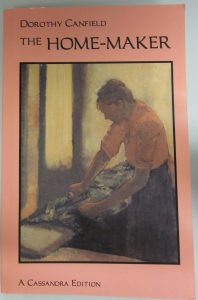
homemakerOh my. This has got to be one of my top *five* books of the year. What a delight! I’m reeling! First I would like to thank Thomas at My Porch, again, for sending me this book along with the also-lovely Some Tame Gazelle. (This was because I have cute dogs. Lucky me!) Thank you, Thomas! You did so splendidly selecting books for me.

I have a lot to say about this book and will try not to be too long-winded.

The Home-Maker is the story of the Knapp family. The mother, Evangeline, is the home-maker – of course, because how else could it possibly be done? (This book was published in the 1920’s and seems to be set about then, too.) She is efficient and hardworking, and miserable; and her three children are miserable as well, and two of them physically ill. Her husband, Lester, is a lackluster breadwinner, also miserable. In an accident (or was it? read the book), Lester is paralyzed, and their world turns on its ear. Eva ends up going to work, and Lester staying at home to play Mr. Mom. And presto change-o, everyone blossoms! It’s lovely. Eva is fulfilled, challenged, in her element; she earns raises and promotions and everyone’s respect and appreciation. Lester gets to know his children, marvels at their youthful struggles, their individuality, their talents. He learns to cook, bake, and darn socks. And the children become healthy, rosy-cheeked, encouraged – and the troublemaker amongst them gazes adoringly up at his father. It’s remarkable, and heartwarming, and, gosh.

As a story of a family, it is engaging, droll, actually laugh-out-loud funny at times. As an instructive tale – which it obviously is – it is straightforward and sensible. Who could not agree that we should all do what we’re best at and enjoy, if we’re so lucky as to have those two things coincide with one another, and to have a family comprised of all the roles necessary for universal happiness? It’s almost so obvious as to be dull; but the sad trick is that even in 2011, when we congratulate ourselves for being enlightened on such topics as gender roles, we still need this book. I can only imagine that this book’s contemporaries felt their feathers ruffled; but surprisingly, the introduction of my Cassandra Edition claims, “very little of the criticism was harsh or outraged.” This edition also includes an article Canfield wrote for the Los Angeles Examiner on marital relations; it’s well worth reading, too, and succinctly echoes the novel’s point: do what you do best, and be happy. That’s a big duh, right? But again, I’m afraid we still don’t have it right!

For example, one point that SCREAMED off the page at me was the same set of ideas applied to the currently uproarious debate about gay marriage. Canfield actually does refer to “a man and a woman” several times, but I’m going to give her credit and believe that if she were writing today, she’d apply the same logic she did to hetero-marriage. Two people who love each other and want to make a family should do it in the way that takes the best advantage of everyone’s skills and passions and makes everyone happiest! To me, this is abundantly easy to understand, but alas, still, we have debate. Sigh. I’m not trying to have that debate here (rather because I don’t think it merits much discussion) but it was an obvious corollary of Canfield’s position here so I wanted to mention it.

For those who fear a heavy-handed instructive tone weighing down a lovely story, don’t. I’m sensitive to that fault, myself (okay, it was nonfiction, but I loved County while lamenting its overly-obvious point). But it’s not an issue here. Canfield is matter-of-fact in her portrayals; I think the strength of the “issues” at play here are that they’re too clear-cut to BE issues. Does that make sense? And the story itself is delightful. “Cosmic Stephen in his pink gingham rompers!”

I really enjoyed this as much as just about anything else I read this whole year. It’s the first to compete with Fire Season by Philip Connors, which I’ve been calling my #1 best of 2011. (Rather different books they are, too.) Thomas, you’ve done me a great service, and here, I’ll try to pass it on: the rest of you, go find The Home-Maker today.


BUT.


Here’s my one caution for seekers of the book. I appreciated that my Cassandra Edition included the newspaper article that I mentioned above, and it’s a nice edition all-around, but for a single glaring flaw: page 134 is followed by page 119, which then runs back up to 134 and then skips to 151. So while reading this book and really enjoying it, I was suddenly thwarted! The publisher (after some discussion of what might be a reasonable way to deal with this issue) promised to put another copy in the mail to me. So it’s a nice edition, but find yourself a different one! Perhaps I’ll be able to make a recommendation when my new copy arrives.