Archival Quality by Ivy Noelle Weir and Steenz

This is a delightful graphic novel with a few threads that I enjoy: it takes place in a mysterious museum/library/archives setting; it’s a ghost story; it is concerned with mental illness and social justice; its cast departs from your run-of-the-mill beautiful straight white people; and it ends sweetly with an emphasis on friendship. I’m not sure where I got this recommendation, but it was a solid one.

Like most graphic novels, I found this one a quick read – I sped cover to cover in an evening. Celeste Walden has recently lost her library job after a depressive episode; she’s not doing so well, and her boyfriend Kyle is concerned, and she knows she has to get out of the house, but she really doesn’t want to work anywhere but a library again. That’s when she finds the Logan Museum, located in an old building that has also housed a hospital, an orphanage, and a sanitorium at different times. She’ll be an archivist, working nights, digitizing the museum’s images collection. And she is expected to live on premises, in a furnished apartment. Which of course involves things that go bump in the night. Kyle does not approve of this new job, but Cel is determined. Her new boss is disturbingly aloof, but the librarian who trains her is a lovely, supportive woman. And then the mysteries begin.

Cel’s mental illness is handled differently by different characters, including by herself, in ways that are true to life. The ghost story element is moving and involves some larger issues. Cel’s social circle – boyfriend, boss, librarian Holly, and Holly’s girlfriend – is small but impactful. I enjoyed the story, the characters, and the visual representations, which I felt communicated emotions and personalities nicely. I think this book would make a good choice for YA readers on up, and offers some excellent opportunities to discuss several topics that might appeal in middle school or high school classrooms or book clubs. I also enjoyed Weir’s afterword and Steenz’s “confidential files” at the end, which shed light on their friendship and process; the authors’ lives bear on the book, as is often the case. Definitely do recommend. Also, yay for libraries in literature.


Rating: 7 fruit baskets.

The Reading List by Sara Nisha Adams

A shared reading list improves the lives of two lonely individuals in this charming novel about the power of a good book.

In Sara Nisha Adams’s sweet, pleasing debut, The Reading List, two lonely characters in contemporary London–and a host of friends and family–learn just how much books, and other people, have to offer.

Mukesh is grieving after his wife’s death: “Now here he was, alone, still without any clue as to what he should do now she was gone, left in a lifeless, soulless, bookless house that had once been their home.” He wishes he were as close to his granddaughter, Priya, as she was to her grandmother, but he does not share their love of reading. Then he finds an unreturned library book his late wife loved and gives it a chance.

Aleisha, 17, works at the library, but begrudgingly. Her older brother is the reader in the family. Both are slowly being crushed by their mother’s oppressive depression; they’ve lost touch with their friends and even each other, leaving Aleisha alone in the world, traveling between work and home until even the boring local library begins to feel like a sanctuary. In a returned book, she finds a handwritten note that begins, “Just in case you need it,” with a list of book titles. Not knowing why, she tucks it away.

Following a prologue introducing the titular reading list, sections of the novel are named for books (The Time Traveler’s Wife, Rebecca and more); most chapters follow either Aleisha or Mukesh. In interstitial chapters labeled “The Reading List,” other characters interact with the same mysterious document in their own ways–a crime thriller fan grieving a break-up; a lonely divorcé; a young woman who collects lists.

Out of guilt and boredom, Aleisha begins reading the books on the found list and recommending them to the elderly Hindu man who has tentatively begun to visit her library. Together, Mukesh and his teenaged librarian share what they read. Both are unpracticed, but each has much to gain from the developing friendship and the fictional worlds that transport them away from their daily struggles. When tragedy strikes, the friendship and the reading list may help them get through: “‘Aleisha,’ Mukesh said softly. ‘Please try to remember that books aren’t always an escape; sometimes books teach us things. They show us the world; they don’t hide it.'”

The Reading List is a tender novel about human connection and community and the healing power of reading, about the support and compassion that all people need at one time or another. This book is a soothing salve.


This review originally ran in the July 8, 2021 issue of Shelf Awareness for the Book Trade. To subscribe, click here.


Rating: 8 cups of chai.

“These Precious Days” by Ann Patchett

From the January 2021 issue of Harper’s Magazine, sent to me by the infallible Liz, a transcendent essay by Ann Patchett. Now, I’m not sure if this is for real or how stable it is, but at least for now this link will let you read it for free, which you definitely should do. And it’s worth whatever they want you to pay for it, in any case.

“These Precious Days” is a lengthy essay, but it is riveting at every point. I had to put it down and walk away just to give my mind and my emotions a break, and to stretch it out – it is that strong and beautiful an experience. And it was hard to figure out where to take that break, because it wants to flow right through from start to finish.

There is a story running through this piece, and it is a story of a friendship, formed and forged during extraordinary times. As Patchett reminds us, she is a novelist, with a real interest in how stories are structured, where they begin and where they end. So it is with purpose that she gives us the story’s chosen beginning: it’s almost bedtime, Patchett has just finished a novel, and she needs something short to read before bed. From the umpteen books that naturally surround Ann Patchett, she chooses a collection of short stories by Tom Hanks. She is surprised to find it “a very good book,” and this sets her off on a journey where she gets to know Tom Hanks a little, interviews him for a television show, meets his assistant, sees him a few more times. This leads to Tom Hanks narrating the audiobook of The Dutch House, among other things. I’m not going to say any more about what happens. Trust me, you won’t be able to walk away from this one (unless you force yourself to do so with great effort, as I did, mostly for the pleasure of returning to it).

One thing I love about this essay is how it performs as a braided essay, barely. Patchett stays in a single narrative for the most part, telling the story of the developing friendship in the extraordinary times. After her introductory story about Tom Hanks (who is not the new friend, but reappears occasionally), she stays in this main thread so much of the time, and tells it so beautifully (and it is such an absorbing story) that I forget about the other thread – that there is a meta-thread in this essay about story, and about the shape and the shaping of this story. Those few and brief moments when she reminds us of the other topic are all the more effective for their scarcity. We are reminded that the narrator’s character is a novelist, and that the need she feels to shape narrative can’t be divorced from the life she’s living, where she has a dear new friend who is in danger. It’s extremely skillful writing, and I loved several facets of it: that weaving of threads (just barely, just a touch of one for seasoning in the main dish), the expertly paced storytelling, the appreciation for so-called coincidence, the delightful characters (of whom the author’s husband is a secondary example, but one I really liked), and the self-aware voice of Patchett herself. I’m left with the impression that Patchett is like Tom Hanks in a way (or my impression of Tom Hanks): despite being famous, they’re both also very decent and nice, more than one might expect. She’s allowed us intimately in here in a way that I think will appeal to many readers as it did to me.

Now’s a good time for me to confess that I’ve read none of Patchett’s fiction. (I think I’ve read a column or two, within the world of her bookstore advocacy.) I know her by reputation as a fine novelist and an important advocate of independent bookstores. I can now see that she is absolutely gifted and I need to read more of her work.

I can’t remember the last time an essay so bewitched and transported me. I insist you seek this one out. Thanks a million times as usual, Liz. (How’d I do?)

Saint Monkey by Jacinda Townsend

Disclosure: Jacinda is a friend and I love her.


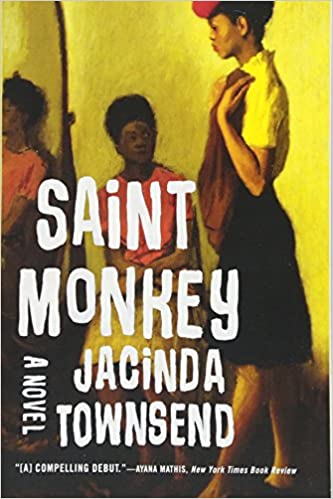
Saint Monkey is a rich novel full of detail, color, sound, and texture. In the 1950s, two girls, Audrey and Caroline, grow up as neighbors and (mostly) friends on the “colored” side of the small community of Mt. Sterling, Kentucky. For all that happens to both of them as they grow into womanhood, it is the rocky relationship between them that’s the heart of this book. Audrey is bookish and quiet (Caroline, in her head, calls her Poindexter), while Caroline is a bit more out in the world; the latter dreams of making it to Hollywood, but it is passive Audrey who gets out. Each girl loses a parent in childhood, and halfway loses the other as well: Audrey’s father is killed fighting in Korea, her mother then descending into the bottle; Caroline’s father brutally murders her mother and is then incarcerated (although not for long). These tragedies do not serve to bring them together. Often halfheartedly, but with enormous talent, Audrey plays the piano, and it is this that gets her spotted by a talent scout and packed onto a train for New York City. There she plays in the house band at the Apollo and gets romanced by a man the reader recognizes at once is not worth it. Meanwhile, back home, Caroline samples the young men in town and chooses not to respond to Audrey’s letters.

The novel alternates between the first-person perspectives of the two girls, so that we get Audrey’s close observations of her beloved friend, her earnest hopes and fears, her tentativeness, then Caroline’s brash, prickly, brave face and the vulnerability underneath. Their voices are distinct, and Caroline’s humor and vernacular is one of the highlights of the book, for me. From both angles, this is a world fine-grained and full of sensory details – rich, lush, dense with them – such that I had to slow down to take it all in. Saint Monkey‘s pace is unhurried; we’re here to look around and think and feel, not rush through lives that are hard enough in the first place. There is plenty of hardship: poverty, various forms of abuse, and the persistent low hum of abuse that is being both Black and female.

Audrey loves her grandfather. She loves living in Harlem and playing at the Apollo, loves the scene and even the music, for all that she approached it lackadaisically at first; she loves the man who becomes her husband, although I don’t. But she loves Caroline most of all. Caroline in turn relates to everything and everyone with a simmering rage, including her childhood friend, Poindexter; but the preoccupation is mutual. For all that this book is wide-ranging and handles well so many subjects – segregation, local culture, settings, music, families, frustration, and Caroline’s exquisite voice – I think it’s most about that intersection between two women who can neither come together nor separate. It’s fairly rare that a book insists that I slow down the way this one did. (I think the last was Giovanni’s Room, which is referenced in this one, of course.) I look forward to reading more like this: vibrant voices and the true emotions of human relationships. Look out for Townsend’s second novel to come from Graywolf in 2022.


Rating: 8 cases of cosmetics.

The Plover by Brian Doyle (audio)

And no thinking on this trip, either, he said to the gull floating over the stern. No recriminations and ruminations. No logs and journals and literary pretensions neither. Thinking can only, like the boat, proceed forward.

Thank goodness for Brian Doyle. I had been in a bit of a blue funk and looked for something cheerful to pick me up; a Brian Doyle novel was just the thing, I thought, and I was right.

Based on Martin Marten and Mink River, I foolishly thought the plover in this story would be an actual plover – a bird. Ha! No, the Plover is a boat. (And to be fair, the protagonist of Mink River turned out to be a crow.) Classically, for Doyle, we open with epigraphs: from Robert Louis Stevenson, George Harrison, and Annie Dillard. (Perfect.) Then we plunge right in and meet our protagonist, an eccentric fellow (aren’t they all) named Declan O’Donnell. An Irishman (read here with an accent) who hails from the Oregon coast and a fractured family, he’s invested himself totally in a small trawler he calls the Plover for perfect reasons. He’s “edited” her by, among other things, fitting a small mast and sails; and he heads off from Oregon, intending “west and then west.”

Declan is explicitly trying to escape humankind and all their “emotional complications… expectations and illusions… analysis and explications.” But of course, he is immediately joined (page 1) by a gull, to whom he holds forth at length: we already suspect he enjoys having the company. And the comedy of the book is in all the passengers he takes on: the narrative tells us that the census reaches over one thousand, if we count barnacles, but it also at one point reaches seven human beings. Declan is in fact a more social creature than he aspires to be, and that’s the central storyline here: Macmillan’s blurb calls it “the story of a cold man melting,” and I think that’s not too far off, although I might amend to call it the melting of a man who tried to be cold. Declan has had some trauma in his life, and his reaction is to try and shut himself off. He fails, and that’s one of the joys of this book.

There are so many joys, although also much trauma. Declan’s best friend, Piko, is one of Doyle’s exuberant characters – “he had legally changed his name for a while to an adjective, he played the flügelhorn in a jazz band that deliberately played only such events as weddings between Lutherans and Presbyterians and baptisms of babies named for animals, and he had once flensed a whale by himself, over the course of three weeks, on the beach, living in a tiny blue tent about the high tide line. He was one of those guys who seemed electrified by everyone and everything, the kind of guy who totally lit up when he saw a sparrow-hawk helicoptering over a corn shock, the kind of guy who liked every kid he ever met and every kid liked him… But he had been wounded by a storm, this guy, his little daughter hit by a bus driver when she was five years old waiting for the kindergarten bus, and his light was dimmed.” Pippa, the daughter, cannot move except for a possibly meaningless fluttering of her hands; she cannot speak except to make possibly meaningless squeaks and coos that sound like bird sounds. But she has a rich inner life. (Spoiler: Piko and Pippa will become passengers and crew on the Plover.) Both Piko and Pippa are very Doylesque characters: peculiar, delightful, brimming, wounded. There are more of these in the book – a Doyle novel is made of such characters. Again: just what I needed.

So Declan explores the world, becoming increasingly reluctant to set foot on land. He cares for his boat and weathers storms. He picks up passengers and rails against their very presence, but still they come on. He and his growing crew-family have a conflict with another ship and its ill-intending captain, but everything comes out well in the end. As the small, green, red-sailed Plover swells in population, tensions rise, but so does the incidence of miracles. Doyle is unafraid to take his whimsical characters to the brink of death and then snatch them, in unlikely fashion, back. Once you’ve made peace with this inclination (and I have), it’s great fun.

Declan is a devoted reader of the Irish author and orator Edmund Burke, who is much quoted here, along with a reference or two to Robert Louis Stevenson (upon whom Doyle would base a later book). Through these outside voices, through Declan’s own and the wise voices of his friends and comrades (including one very quirky minister for fisheries and marine resources and foreign affairs), The Plover is a novel of philosophy as well as the story of one plucky little boat and its captain.

David Drummond’s reading feels perfect to me. I love the many different voices, accents, rhythms he plays. Pippa’s exuberance, Declan’s grumpy Irish lilt, the minister’s volubility and interesting speech patterns, and so much more. (Somebody should write a paper on the minister’s word coinages.) A good narrator makes all the difference, and I’m so glad we got a good one here.

Doyle’s usual strengths are all present. Characters and story are brimming and bubbling with good cheer even in the face of significant and imaginative tragedy. Sentences are often long, convoluted, and performative of their content. Details are numerous and precise and bizarre. Nothing has changed; this man is a near-perfect novelist, for this reader. I’m still so sad he’s gone.


Rating: 8 crucial silences between notes.

movie: Rent: Filmed Live on Broadway (2008)

I first saw Rent when I was in high school. My dad and I traveled to New York City to investigate that city among a few others where we thought I might go to college. He got us tickets to see Rent at the Nederlander Theatre on Broadway. I already knew that I loved musical theatre at that time, but this production really changed something for me. It was the first time that I cried at a stage production or at any piece of art other than a book. The subject matter felt especially meaningful and timely for me, as I had friends still discovering their sexuality and coming out to their parents. It was an event that resonated. I immediately bought the soundtrack and it still makes me cry today, twenty years later.

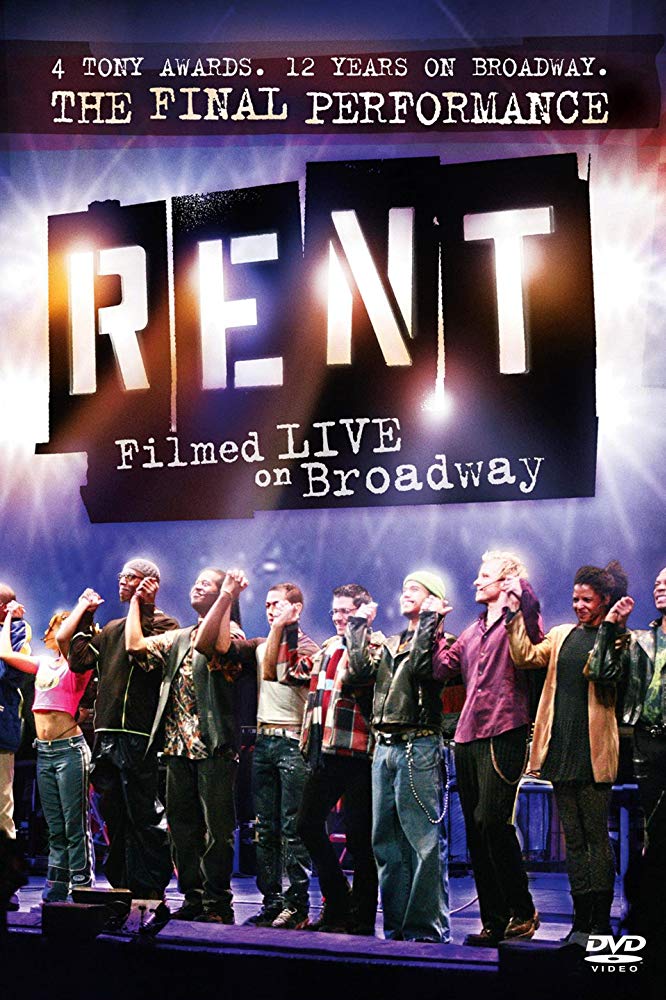
The friends I am visiting with now expressed an interest, and so we rented this version: a live taping of the final performance of the Broadway production, after a twelve-year run. The actors are almost entirely different (every major role was filled by a different actor in this version, from the one I saw). And I guess I had really invested in the first cast; but I have to say, this one was admirably close to the original, so even someone like me was able to be open to the new. Most cast members were very close in physical details as well as in talent; I was able to settle into this production and feel at home.

It’s still everything I remember, after all these years. Musical theatre does tend toward the theatrical (go figure) expression of emotions, but for the few moments of somewhat self-conscious hand-wringing that I might skip, there is such raw power… and the singing and dancing is amazing. I still find this play to be full of all the love, drama, angst, grief, rage, and passion I found there in the first place. It made me cry, again.

As a production, too, I think it works well – that is, both as a stage production (filmed live, with audience and applause) and as a cinecast. Unlike The Wiz and more like National Theatre Live, the camera angles varied and moved around, working for perspective and providing close-ups as appropriate. I don’t recall noticing that the cinematography in itself was extraordinary (as I often do with NT Live), but it was plenty serviceable. Since the chance to see Broadway’s version of Rent has passed, I’d strongly recommend this version.

It’s interesting to think about the extent to which an experience like this is about that original experience. I was probably 16 years old (maybe 17, but I think 16) sitting in the upper rows of the Nederlander Theatre, far from the stage. The words and lyrics and music and dramatic portrayals, the singing and dancing and kissing, took me so powerfully. I’ll never forget; I’ll also never have the same experience again, but every time I hear a song from Rent or see another production (even the 2005 movie, which I remember finding a disappointment), it refers to that original experience just enough to tap into some of those emotions. Still gets me.

In contrast, I have a friend and fellow writer who strongly dislikes Rent. He calls it a singing telegram to AIDS. Dave’s a few years younger than me, and I believe has never seen it live. I’d like to dismiss his opinion on these counts, but think I should give him a little more credit than that. Dave’s also a gay man, and some part of me feels I should defer to his opinion as being a part of a certain demographic – the play is about the AIDS crisis and has more queer characters than cis-het ones. (Another part of me knows that my own opinion & tastes remain worthwhile here.) At any rate I find it interesting, since I respect Dave’s approach to art and we often share interests and tastes. I wonder if he had gotten to see the play live at age 16 how it would have affected him… Then again, maybe the concern is that this is too serious an issue to get all song-and-dance about. That would be a position worth considering.

Local issues aside, Rent remains an important part of my personal understanding of art and value. I’m still hooked. Keep singing.


Rating: 8 samples that won’t delay, for its value in my personal mythology.

Stephen King’s The Body: Bookmarked by Aaron Burch

A writer’s examination of the writing that shaped him–even reluctantly–yields layers of self-awareness.

stephen kings the body

Ig Publishing’s Bookmarked series features writers contemplating the literature that has made deep impressions on their lives and work. Aaron Burch’s entry is Stephen King’s The Body, a brief but incisive consideration of King’s novella and Burch’s life in ways that surprise the author and intrigue the reader.

“The Body” is one of four novellas in King’s Different Seasons (which also includes “Rita Hayworth and the Shawshank Redemption”). It is perhaps better known for the film adaptation, 1986’s Stand by Me. Burch’s lifelong fascination began with the movie; he writes here about coming later to King’s written work as he becomes a reader, a writer and a teacher. King’s protagonist, Gordie Lachance, is also a writer and very much resembles King himself. The layers of meta-awareness continue in Stephen King’s The Body: Burch refers to his writing of the book and to its earlier drafts.

“The Body” is a Bildungsroman circling themes of friendship, nostalgia and loss as four childhood friends trek cross-country to view the dead body of a boy their age. Burch explores these themes with tenderness and sentiment, even as he resists the latter. Although “The Body” and Stand by Me provide the framework for Burch’s contemplation, his work is at least as much self-reflective memoir or personal essay as it is literary criticism. As he writes, his marriage looks to be breaking apart–a parallel Burch forces himself to confront. The two processes, writing and considering a marriage, prompt a direct gaze into difficult truths, but as King writes (as Gordie Lachance): “The most important things are the hardest to say.” This is a recurring sentiment in Burch’s slim book, where he earnestly attempts to address those hard things.

Burch exposes himself as a striking character who has a complicated relationship with art–the art he produces (up until now, only fiction) and the art he enjoys. He is an unlikely writer of literary criticism, with his resistance to considering authorial intent, and purposefully avoids behind-the-scenes perspectives on his favorite works. “It can be fun to take apart a magic trick and figure out how it actually works, but it also ruins the magic of the trick.” Having pushed himself, however, Burch is surprised to find his venture into literary criticism extraordinarily enlightening.

Burch elaborates on King’s themes of loss and friendship with those of transitions, of firsts: first date, first kiss, first job, first road trip. As Gordie (or King) writes, “There’s a high ritual to all fundamental events… the rites of passage, the magic corridor where the change happens.” The beauty of Stephen King’s The Body is in Burch entering that magic corridor, and splitting the experience wide open–uncomfortably, even–for the reader to study with him.


This review originally ran in the August 1, 2016 issue of Shelf Awareness for the Book Trade. To subscribe, click here.


Rating: 7 scenes.

movie: Stand by Me (1986)

Some months from now, you will see my review of Stephen King’s The Body, by Aaron Burch. One of the Bookmarked series, this slim book combines personal essay with literary appreciation – or in this case, film appreciation. Stand by Me is a movie based on Stephen King’s novella “The Body,” out of Different Seasons (a collection that also included “Rita Hayworth and the Shawshank Redemption”). For this reason, I put the book down halfway through to see this movie for the first time.

stand by meReleased in 1986, set in flashbacks to 1959, Stand by Me stars River Phoenix, Wil Wheaton, Corey Feldman and Jerry O’Connell as four childhood friends. Over a weekend, they hike through the woods to view the dead body of a boy their age, learning along the way about friendship and loss. It is a coming-of-age story.

I think I can see Burch’s attachment to this film, but it had a different effect on me, coming to it in adulthood. The emotional tones are there: sweet friendship, the pain of helpless childhood and loss at any time of life, nostalgia. I get them all, but I can see from here how they work; I didn’t get bowled over as Burch did. It is undeniably a sweet and sad story, though.

I marveled at how loving these boys are: lots of hugging, arms around one another, extended eye contact, explicit words of comfort. Have we gotten more homophobic as a culture since these days? I can’t see little boys loving each other this earnestly and physically today, which is sad. Maybe I’m wrong. I hope I am.

I enjoyed the humor, the pathos and the loving friendships. It was worth my time – especially in being able to appreciate Burch’s story. But I’m afraid it doesn’t have the same effect on an adult today that it did on a kid in the 1980’s, and I regret that. I’m also interested in “The Body” now (of course).

A worthwhile snapshot in time, but not one that reads the same now, unsurprisingly.


Rating: 7 cigarettes.

Maximum Shelf: Lily and the Octopus by Steven Rowley

Maximum Shelf is the weekly Shelf Awareness feature focusing on an upcoming title we love and believe will be a great handselling opportunity for booksellers everywhere. The features are written by our editors and reviewers and the publisher has helped support the issue.

This review was published by Shelf Awareness on May 9, 2016.


Steven Rowley’s first novel, Lily and the Octopus, is a startling, scintillating experience, both funny and emotionally wrenching: a story that shatters all expectations.

lily and the octopus

In the opening lines, narrator Ted Flask introduces his contented home life with his domestic partner, an aging dachshund named Lily. They live in Los Angeles, where Ted works from home, and they are comfortable in their routines: pizza on Sundays, Monopoly on Fridays, talking about cute boys on Thursdays. They have inside jokes, holiday traditions, and an idyllic story of love at first sight. Lily holds up her end of conversations, although as a dog she is of course distractible, and her memory can be short. Her voice is just as we expect a dog to sound. As a puppy (in flashbacks, as in the scene of their first meeting), her breathless enthusiasm comes out in all caps and exclamation points: “IT’S! A! GREAT! TIME! TO! BE! ALIVE!”

As the novel unfolds and Ted fills out as a character, though, it becomes clear that his life is not necessarily well-rounded. He has a therapist he dislikes; he finds her dim-witted, and in his head runs all her advice past his ideal, imaginary therapist. He has panic attacks. His career has stalled. A long-term relationship, ended 18 months ago, continues to haunt him; recent attempts at dating have gone poorly. Until Lily, he worried that he was unable to open up, unable to love. In Ted’s favor, he has a superlative human best friend named Trent, who always comes when called and brings Valium. And, crucially, Ted has Lily. She is the best thing in his disordered and inwardly-turned life.

Those first sentences introducing Lily also introduce the octopus. A new addition to their household, he has a death grip on Lily’s head, and he’s not going anywhere. Like Lily, the octopus talks. Ted wants him to leave, but the octopus will not let Lily go. She begins to have seizures. She weakens.

Ted dreams of an octopusectomy. The vet offers chemotherapy, radiation and surgery, but is not optimistic about Lily’s chances. Ted tries to involve her in the decision-making, but Lily is a dog: her attention span is limited (oh look, red ball!) and, anyway, at 12-and-a-half human years, she has been feeling a little run-down. She rarely speaks in caps anymore. Ted was warned by a vet that, as Lily aged, she would begin to exhibit what he called Enclosed World Syndrome; that is, her perceived world and realm of interest would shrink. It is true, her walks have gotten shorter. Of course, Ted himself has the same malady. As the octopus’s tentacles tighten around Lily’s precious small head, Ted realizes he has a battle on his hands.

It is easy to fear that the market for books about beloved dogs may be flooded, but this one does something new. Lily and the Octopus is its own beast, and the reader is not the same person at the end as at the beginning. In many ways this is the story of Steven Rowley’s life in all its emotional truth, if not in specific, literal details. Ted and Lily’s Los Angeles is a thoroughly realistic setting, but a few elements–most obviously the talking octopus–offer boggling departures. By relying on metaphor, Rowley creates a fantasy world with touches of magical realism, somehow both more affecting and more comforting than reality.

Lily and the Octopus comes with the trappings of humor, canine antics, strong characters and profound emotions. Rowley, who is also a screenwriter, peppers the story with Cate Blanchett, Ryans Gosling and Reynolds, Bradleys Cooper and Milton. Equally prominent are the literary references: Kipling’s jungle, Auden’s “Funeral Blues,” and a reading list to prepare for an octopus hunt: Hemingway, Melville, Patrick O’Brian. The book opens in the spirit of a fun read, but the tone quickly deepens to a sadder and a more intense experience. Ted and Lily’s story centers around relationships: love and life partnership, the nature of commitment and of loss, and what it looks like to fight for one’s friends. As Ted battles the octopus and tries to shore up his darling, he ends up examining every aspect of his own life, his own shortcomings and the strengths he discovers in himself, almost by surprise. His journey, then, is not only about a man and his dog but about breaking out of life’s stalemates. This introspection and interior aspect to the novel is only one of the depths that make it both more than another story about a beloved dog, and more than a whimsical work of fantasy–although it is a superb example of both.

Lily and the Octopus is literary and raw, and relentlessly heartfelt. Questions of who and how we love are at its center and, vitally, the question of how we part. Imaginative, ever-astonishing, suspenseful and wise, Rowley’s surprising novel is thoroughly gut-wrenching, but well worth the pain. With a winning dog at its robust heart, no reader could ask for more.


Rating: 9 moments with the red ball.

Come back tomorrow for my interview with Rowley.

The Throwback Special by Chris Bachelder

Set during a weekend of pro football reenactment, this sidesplitting novel displays all the baggage of male middle age.

throwback special

The Throwback Special stars a group of middle-aged men gathering for the 16th annual reenactment of a memorable moment in professional football: the 1985 sack, by Lawrence Taylor of the New York Giants, that resulted in a career-ending comminuted compound fracture of the leg for Washington Redskins quarterback Joe Theismann. In the hands of Chris Bachelder (Bear v. Shark), this is rich material, by turns poignant and droll.

The 22 men are expertly evoked as individuals, often pathetic but also sympathetic. “It could be said of each man, that he was the plant manager of a sophisticated psychological refinery, capable of converting vast quantities of crude ridicule into tiny, glittering nuggets of sentiment. And vice versa, as necessary.” This is Bachelder’s specialty: the intersection of the absurd with earnest emotion, neuroses lovingly portrayed. The Throwback Special is endlessly hilarious, ranging from the serious, even the existential–it is true of the play, like everything else, that “while it was happening it was ending”–to the shrewdly wise: a seven-page interior monologue about race relations by the group’s one person of color is surprisingly entertaining.

The book takes place over a single weekend, involving a certain amount of action but mostly focused on the men’s thoughts and reflections. In this brief window, Bachelder reveals the magic of professional sport spectating, the silliness and profundity of traditions, and the tender illogic of friendship. Obviously, this novel will attract football fans, but there is absolutely something for everyone (even the sports-averse) in this rollicking, irreverent but sweet human drama.


This review originally ran as a *starred review* in the March 22, 2016 issue of Shelf Awareness for Readers. To subscribe, click here, and you’ll receive two issues per week of book reviews and other bookish news.


Rating: 8 ping pong balls.