The Box in the Woods by Maureen Johnson

The Stevie Bell series continues, but we’ve left Ellingham behind, Stevie having solved the Truly Devious murders (although the world only knows a bit of that story). At this novel’s start, she’s puttering around at home with her parents, selling deli meats and cheeses at the grocery store and cleaning up the salad bar by night. Then she gets an invitation to really go to work: as far as her parents know, she’ll be a counselor at Camp Sunny Pines, but she’s really there to investigate the Box in the Woods murders of 1978, from back when this was Camp Wonder Falls. The tech-bro who’s hired her says he’ll employ her friends, too, which means Nate and Janelle, because David is enjoying his voter registration work in a different (and I’m pretty sure unnamed) part of the country. Stevie’s a bit disappointed, but she respects his mission.

Camp Sunny Pines is an amusing setting. Massachusetts is warm and muggy in the summertime, and Stevie is more cerebral than outdoorsy. She buys into the idea of rugged go-everywhere detectiveship in theory, but she quickly runs out of signature black t-shirts because she has to change them so often – these are sweaty environs, and she’s also doing far more running and biking than she’d like. It’s kind of fun to see her challenged in these ways. Her tech-bro boss does not have a good bedside manner for engaging with the community; Stevie is better at this, but less adept with her personal relationships, and one in particular: David (now her actual boyfriend) finds a reason to come out after all, but Stevie’s responsibilities and preoccupation with the case mean she doesn’t engage all that well with him. He does some driving her around, and tries to have an important conversation, but she’s too checked out. In contrast to what I said about the last few books, I felt sorry for David, who tries to be a good boyfriend and friend, while Stevie’s a bit awkward and inattentive.

I remain baffled by her friendships: Janelle, the purported best friend, is totally rad but much less a day-to-day ride-or-die joined-at-the-hip BFF than Nate, who I feel doesn’t get enough credit.

One of the things that made Nate and Stevie such good friends was their mutual hatred of sharing emotional things. Somehow, they managed to have a deeper bond by staying on the surface–as if they were snorkeling their feelings, floating along side by side, observing all of nature’s wonders without getting close enough to be stung by something under a rock.

That Janelle gets the best friend label is a feature of Johnson’s writing that just confuses me.

But I still love Stevie herself, even in her bumbling. There was, again, a passage that I hold onto as emblematic of her loveable personality. She’s preparing to meet David, and considers fixing herself up a bit, and then just kind of gives up – I love this facet of her, that she’s aware she’s not quite meeting an external social measure of so-called beauty but can’t bring herself to entirely care. (And David doesn’t. It’s fine.) I relate to this entirely.

The mystery is compelling, and I appreciate the final scene, even if the solution is a bit awkward too… I’m really here for Stevie’s clever mind, her interactions with other humans (for better and for worse), and her dear strangeness. I enjoy Johnson’s use of the classic feature wherein the detective just talks it out with her friends and acquaintances, and lets her mind drop things into place. I’m definitely excited about book five.


Rating: 7 crafts.

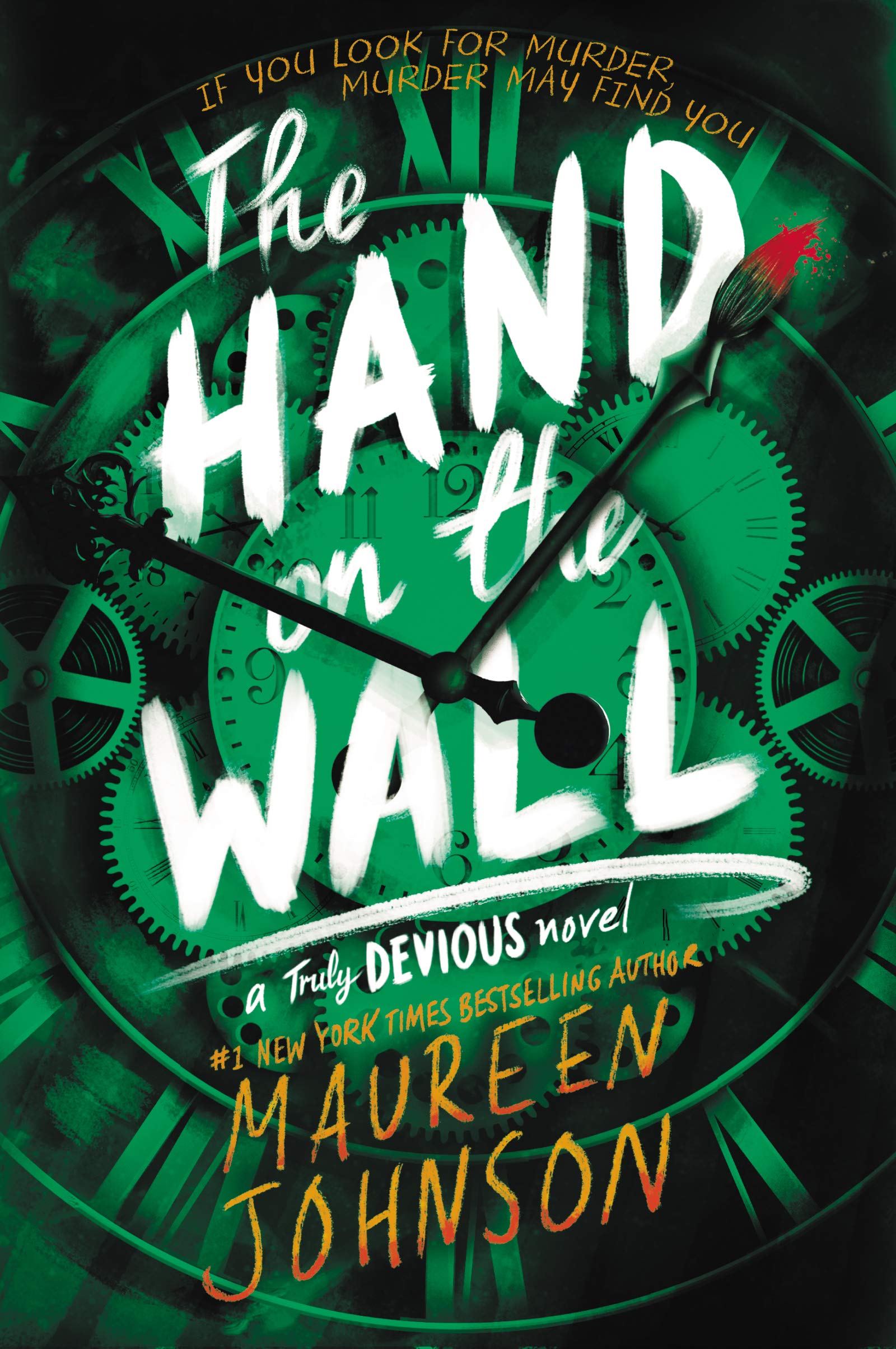
The Hand on the Wall by Maureen Johnson

On a day that I claimed to be overwhelmed with the student papers I had to grade, I also managed to wake up and immediately begin this book… and then stay up til midnight finishing its nearly 400 pages in the same day. I loved Truly Devious and was even more entranced by The Vanishing Stair, which annoyed me with a cliffhanger the night before and sent me directly into this one, book three. My main goal today is not to read a whole book by accident when I’m supposed to be working.

The Hand on the Wall is book three of three in the Truly Devious series – but the Stevie Bell series continues for two more books, a bit confusingly. The Truly Devious murders themselves (aka the crime of the century, the murder/kidnapping at Ellingham Academy in the 1930s) are wrapped up in this book, but newly minted detective hero Stevie apparently continues on. (I haven’t read book four yet! I’m staying strong.) This installment sees the advancing of Stevie’s investigations and her modest decline in terms of personal hygiene and nutrition; the beginning of real fears for her personal safety and/or that Ellingham may indeed be cursed; the continuing friendship and alliance with Security Larry (this is a relationship I have really enjoyed in two books now); and the bumpy evolution of Stevie’s match with the troubled David. I said in my last review that getting to know him a bit better would yield more sympathies, and we do get that here. I still find him a bit obnoxious and don’t appreciate his treatment of Stevie, but they’re making progress.

Stevie grows in her relationships with others. A bit weirdly, the amazing Janelle continues to be identified as Stevie’s best friend, but our hero actually spends more time talking with and confides more in Nate, a hilariously Eeyore-like blocked writer. Janelle is a great friend, but involved in her own love match (that’s going more smoothly than Stevie’s), and it’s actually Nate who ends up fulfilling a day-to-day best-friends role. We have a new friend as well, Mudge, who is loveable if a bit of a cariaciture: he’s here to exhibit exactly how drolly eccentric Ellingham students can be.

Mudge was Stevie Bell’s lab partner–a six-foot-something death-metalhead who wore purple-colored contacts with snake pupils and a black hoodie weighed down with fifty Disney pins, including some very rare ones that he would show off and explain to Stevie as they dissected cows’ eyes and other terrible things for the purposes of education. Mudge loved Disney more than anyone Stevie had ever met and had dreams of being an animatronic Imagineer. Ellingham Academy was the kind of place where Mudges were welcomed and understood.

Security Larry, mentioned above, is a former police detective and becomes a mentor to Stevie in her own work, both cautioning and trying to enforce the rules upon her and gradually, increasingly, viewing her as a peer. He’s great. Several other faculty members develop as well. I very much related to poor Dr. Quinn trying to convince her students to do the readings before class.

I love Stevie more and more. She “would rather eat bees than share her tender inner being with anyone else–she didn’t even want to share it with herself.” She undergoes an actual epiphany (pages 108-109) when she realizes that her weird, awkward self is just a perfectly fine version of a human, and that her own unique combination of qualities is precisely what’s gotten her where she is in life; this is a passage I would like to share with everyone I know, but especially young people and especially girls just making their way and finding themselves. I would follow this protagonist anywhere.

As befits the final book in a trilogy, this one ends on a note of triumph, closure, and hope – perhaps a bit neatly tied up, in fact, but I know there’s another Stevie Bell book to follow. Again, for the sake of my sleep I’m taking a day or two off, but expect more any time now. Maureen Johnson is my new favorite. Thanks again, Liz.


Rating: 9 moose.

The Vanishing Stair by Maureen Johnson

Book two of the Truly Devious series flew by. I stayed up late to finish this one and it ended on a serious cliffhanger, so look for my review of book three to follow this one immediately.

At the close of Truly Devious (for which there are mild-to-moderate spoilers here), The Vanishing Stair opens with Stevie glumly returned home to her parents’ house and her public high school. The gamechanger comes quickly in the form of the despicable Senator Edward King, her parents’ hero and employer and (surprise) the father of her love interest from Ellingham Academy. King has arranged everything for Stevie to return to Ellingham – funding the trip, heightening security following a student’s mysterious death, and convincing her parents of her safety. He wants Stevie, in return, to keep an eye on his wayward son David, with whom Stevie’s not on particularly good terms anyway. She’s thrilled to be back at the school where she feels stimulated: with her friends Nate and Janelle again, working on her life’s greatest passion, the solving of the 1930s Ellingham murders, and yea, David. Quickly a second body is added to the modern Ellingham count. Stevie gains a new advisor, an eccentric academic from the local (Burlington, Vermont) university with a drinking problem and a very nice nephew. David’s moods and attitude toward Stevie continue to swing wildly, hot to cold to nuclear.

The best thing about these books is Stevie herself. She’s socially awkward but mostly doesn’t care; she’s occasionally bothered by her inability to fit in back in the ‘normal’ world (of which Ellingham is not part), but only when she remembers. Despite sometimes showing signs of a standard teenager’s low self-esteem, she generally carries on as herself, unbothered. I like her. She’s an extremely focused detective – perhaps to the point of mild self-neglect, but that’s part of a long tradition of detective types in fiction (a fact she’s aware of). Johnson’s prose is downright funny: after camping out overnight in the school’s yoga studio, Stevie “felt a waffle pattern of yoga blanket on the right side of her face and the faint smell of lavender and patchouli permeating her being. It was like she had been run over by a boulder made of hippies.” Our young hero can be a little bumbling and dense – just like a teenager, no matter how smart. I have a little less patience for David’s antics, perhaps in part because he’s a rich boy? but mostly, I think, because we don’t have the close third person window into his interior self that we have into Stevie’s. He’s a suffering kid, too, and I think if we got inside his head it would be just as sympathetic as hers.

The mystery plot remains compelling: this book focuses in on the riddle that Albert Ellingham left behind on his final day, which the title of this book nods to. We’re learning things, about the historic murders as well as the modern suspicious deaths, but not the big final thing we want to know. Again: this one ends on a mad cliffhanger; I was actually a little peeved, and even more relieved that I already had book three ready and waiting. I recommend you do the same.

Liz was (as ever) 100% correct about this one. I’m pretty sure she said she ripped through the whole series, as I am clearly going to do as well.

These books are recognizably YA in a few ways: teenaged protagonists, a gentle handling of gore, violence, and sexual content, and humor. But the plotting is not too simplified for adult readers to enjoy, and a strong female lead who is still in her teens appeals to this reader at any age. I’m a fan.


Rating: 8 cats.

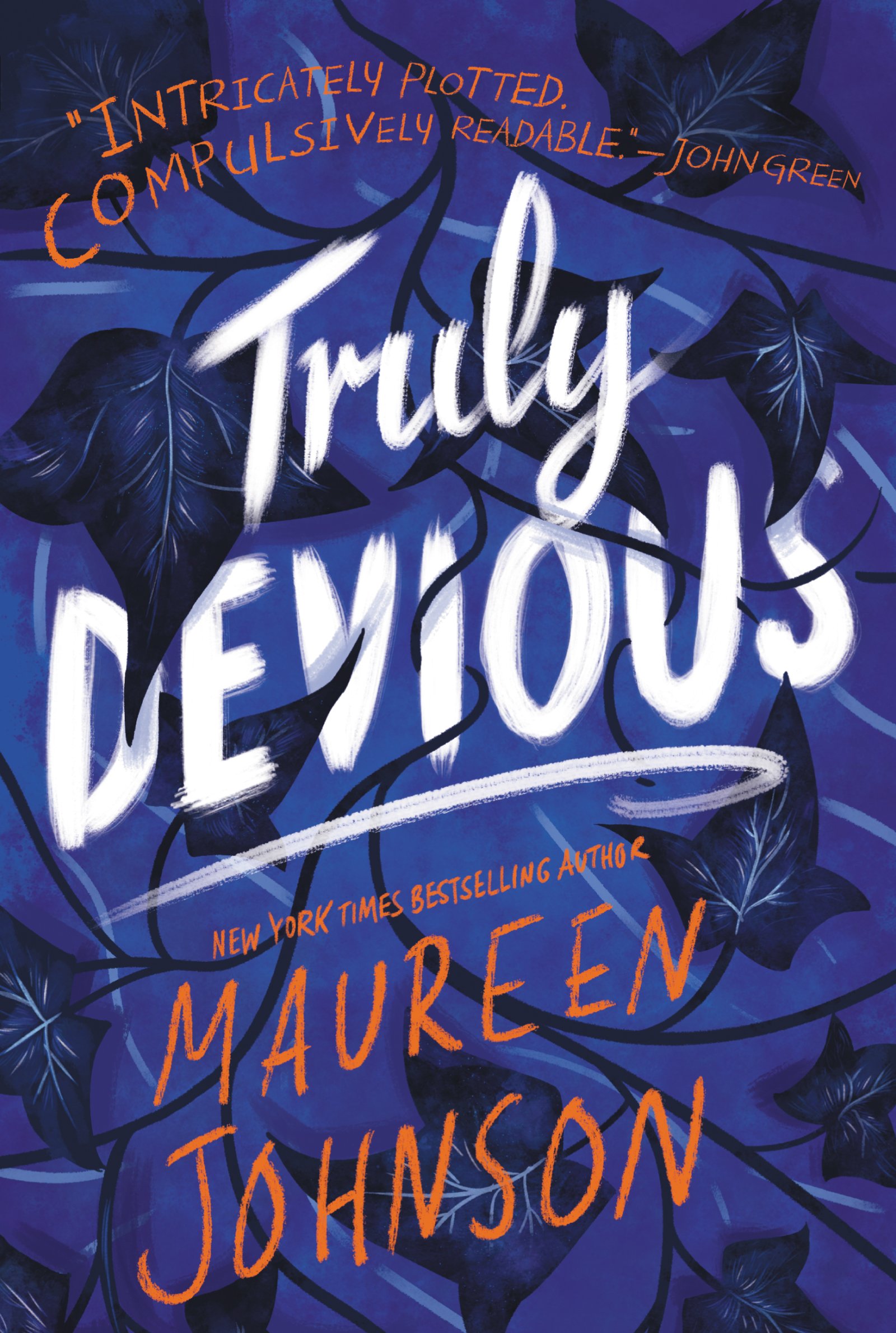
Truly Devious by Maureen Johnson

Yet another gem from Liz, Truly Devious is a positively delightful piece of fun (that also involves murder). It’s for young adults, but easily well-written enough, and sufficiently funny and clever on a few levels, to please adults (like Liz & me).

There are two timelines, although we spend the bulk of the book in one of them. First, in 1935, a teenaged genius is lucky enough to be plucked out of her New York City public school to attend a special new educational experiment in the mountains of Vermont: Albert Ellingham, major mogul, has established the Ellingham Academy to let kids like Dottie pursue the joys of learning in their own ways. Unluckily, a year later, Dottie is murdered at the idyllic Academy, apparently a bystander in a plot to kidnap for ransom Albert Ellingham’s wife and daughter. Readers get a glimpse of Dottie’s final moments, but her assailant is unnamed, undescribed, and genderless.

Much later, more or less in contemporary times (I didn’t notice a year for this timeline?), another teenaged girl is also delighted to be admitted to Ellingham, not despite but because of its murderous history. Stevie Bell, of Pittsburgh, is crime-obsessed: she hopes to become a detective, ideally for the FBI, and the Ellingham Academy murders are her dearest project. The remains of Iris Ellingham (Albert’s wife) were found as well as Dottie’s, but the body of young Alice Ellingham, aged four at the time of her disappearance, has never been found; technically Alice is Stevie’s host and educational benefactor in absentia. Socially awkward Stevie arrives at Ellingham determined to distance herself from her parents (who love her but do come off rather obnoxious, especially with their unfortunate political leanings), begin a new chapter in her life, maybe finally make some friends, and – most importantly – solve the biggest best crime she knows. Each of these goals will turn out to be ambitious, but Stevie is both smart and scrappy. She easily pairs up with Janelle (who hails from Chicago and excels at building machines and gadgets) and establishes a harder-won friendship with even more socially awkward Nate (a published and thoroughly writer’s-blocked novelist). Their dormmate Ellie is a free-wheeling artist who both impresses Stevie and makes her nervous; there is also a famous and spectacularly handsome filmmaker/actor (who however seems not very smart), and a mysterious boy named David who both attracts and repels Stevie.

While we check back in with 1936 (investigation, trial of an apparent straw man, Ellingham’s grief), the modern timeline dominates. Stevie is both a fine amateur detective (in a long literary tradition) and a teenaged girl, grappling with hormones, friendships, school, the sandpaper grip of her parents, and other challenges that will be familiar to all readers, not just those with true crime obsessions and unusual educational settings. By nature of having a female lead, Truly Devious involves some girl-empowerment messaging, but like its handling of nonbinary genders and queer characters, this messaging is simply built into the story, not A Point To Be Made.

Was this was pretty was?
Who knew. This was what a Stevie was, anyway.

Stevie and her friends are lovable above all; also smart, bumbling, funny, painfully awkward, and pleasingly eccentric. There is everything to enjoy.

I finished this book having just ordered book two but it wasn’t here yet and I felt a real sense of loss. I expect to burn right through books two through five, so look out for more Stevie Bell.


Rating: 8 poles.

Klara and the Sun by Kazuo Ishiguro

This is my first Ishiguro novel, and I found it magical. I usually avoid all writing about a book, even down to back-cover blurbs, once I’m committed to reading it, but in this case I’m glad I took a look at the back cover, where it refers to protagonist Klara as an Artificial Friend; in the book itself Klara and others like her are AFs, and I think it’s well into the book before that acronym gets clarified. (I was just telling a student that I need all acronyms spelled out in his paper!) So, armed with this knowledge…

We first meet Klara when she is living in a store, mostly in contact with her friend Rosa (another AF) and a woman known as Manager. Klara is deeply curious and observative, well above average in these ways, and Manager tries to help her and Rosa to be chosen (and promote the store) by placing them in the window, which is also an advantage because AFs are apparently solar powered. Klara refers to the Sun as if he is a higher power, sentient, a god of sorts; ‘he’ is not capitalized but it almost feels as if it should be. The reader doesn’t get any background information, but gradually understands that Klara is for sale, to serve as an Artificial Friend to a child who chooses her. There are a few hiccups in her path, but Klara does eventually go home with a girl named Josie, who is mysteriously and intermittently ill, and who treats Klara rather better – rather more as a real person – than most AFs can expect to be treated by the families that choose them. This is somewhat earned by Klara’s unique powers of observation and understanding. She follows not only human actions but also emotions closely, searching for the connections and causations in relationships. She doesn’t always read cues correctly, but her interest is genuine and… I’m going to say her empathy is genuine and innate.

For me, this is the crux of the story. It seems that this is not true of most AFs (although Klara’s is the only mind we get inside of, as she is the novel’s first-person narrator), but Klara definitely feels. She is puzzled by human feelings and relationships, which she must consciously learn and study, but she already – naturally – feels something for them. Josie matters to her from the beginning. Josie’s mother (“the Mother”) likewise draws her empathy, although she is slower to treat Klara like a real person. I’m reminded of The Robot in the Garden, a very different book but one that also addresses questions of humanity via nonhuman characters. It’s a neat trick. Additionally, the outsider’s perspective (here, a person who’s not quite human) allows for direct observation of the human experience that a human character couldn’t make in a work of fiction without it feeling weird and forced.

Other details of Klara and Josie’s world that we slowly puzzle together: Josie is “lifted,” or (in some unexplained way) genetically modified for higher academic/intellectual performance, which is an advantage that most children apparently receive – or most in her social milieu? This comes with some disadvantages, too, though, including social ones. Josie’s lifelong friendship with a neighbor – which they would like to develop into something more – is hindered by his not having been lifted. There’s plenty to explore here metaphorically, too, not only about what constitutes advantage (and at what cost), but also about relationships across societal boundaries. I find many parallels with the story I’ve just finished teaching this week: “Who Will Greet You At Home,” by Leslie Nneka Arimah, which also literalizes some metaphorical real-world truths to illustrate them more clearly. I am a fan of this technique.

It’s a beautiful, thoughtful book, clearly written by a master. Evocative, with lovely descriptions. Klara’s voice (again, in first person) has a formality to it that nods toward her extra-humanness, but also highlights the observations she can make that a human cannot. Her appreciation of simple vistas is sublime. I am charmed by her Sun-worship. There is something about her – vision? or her appreciation of sunlight? I’m still not sure what it is – that sometimes divides her view into grids, which I found fascinating; I wish I understood better what was going on there, and wonder what else I’m missing here.

I love it. I’m not sure I entirely understand it, but I love it: the magical wonder of Klara’s unique voice, the precocious sweetness of Josie’s relationship with her mother, the curious rules of this world. Definitely interested in more of Ishiguro’s work.


Rating: 8 alcoves.

Boys Come First by Aaron Foley

Three gay, Black, millennial men in Detroit face romantic, professional and existential challenges together in this deeply engaging novel about the importance of friendship.

With Boys Come First, Aaron Foley (How to Live in Detroit Without Being a Jackass) offers a delightful novel about romantic and career ambitions, friendship and the particular charms of and challenges faced by gay Black millennial men in Detroit. Chapters alternate perspectives among a lovable trio of friends.

Readers first meet Dominick as he departs New York City’s Hell’s Kitchen in a fluster: the start-up advertising firm he’d taken a chance on has just failed, immediately before he walked in on his boyfriend of eight years with another man. Dom flees home to Detroit to lick his wounds and reconnect with his old friend Troy. Troy teaches sixth grade at a charter school, eschewing his father’s considerable wealth in favor of giving back to the community, but he’s frustrated in his relationship with a domineering boyfriend, and the school’s charter is now under threat. Feeling a little stagnant, Troy has just picked up a mild-to-moderate cocaine habit. Meanwhile, Troy’s college friend Remy has styled himself as “Mr. Detroit,” a real estate prodigy and local celebrity: outwardly successful, but struggling to find meaningful connection with a partner who wants more than sex. (Remy oozes style, so it suits his character that his chapters are the only ones written in first person.) Remy likes sex, no mistake–each of the friends does, but each is also in search of something more meaningful.

Dom and Remy hit it off, and the boys’ club is complete. With group texts and happy hours around town, they support each other through messy hookups via dating app, professional disappointments and workplace microaggressions, heartbreaks and more. That is, until Remy’s latest development opportunity conflicts with Troy’s local advocacy. In Dom’s mind, “when you’re Black, gay, and thirtysomething, time always feels like it’s running out,” and these men feel both in-common and individual pressures to which any reader can relate.

Boys Come First is rich in flavor and detail, benefiting from Remy’s comprehensive knowledge of Motor City neighborhoods, Troy’s hyperlocal concerns for his school and Dom’s perspective as he returns from afar. The changing demographics of contemporary Detroit, by class but most pointedly by race, are front and center. Foley’s novel shows range, with its fun, silly and pathos-filled handling of the love-and-sex storylines, serious commentary on social issues and an endearing representation of sincere (if troubled) friendships. Unforgettable characters, madcap fun and mishaps converge in this sweet and, finally, aspirational story.


This review originally ran in the March 15, 2022 issue of Shelf Awareness for the Book Trade. To subscribe, click here.


Rating: 7 glasses of Lambrusco.

Aurora’s End by Amie Kaufman and Jay Kristoff

I am sad to see book 3 of this trilogy go by. Liz, what’s next?

With Aurora Rising, we met our cast of wacky characters, and saw them just begin to fit together. With Aurora Burning, we saw those bonds tighten even as the group began to be split apart by circumstance. Aurora’s End then brings all the dramas and plot conflicts, large and small, to their conclusions. This installment got still more convoluted in its science, and hit that note that sci-fi sometimes does for me, where it made me glaze over a bit: I just let the science go by and trust that it makes sense. It was definitely fun to mix up some timelines, I’ll say that. I am sorry to see it all come to an end, obviously, but I feel really good about where Kaufman and Kristoff left my new friends. There was some trickery right at the very end, but they brought it all around. And they are masterful worldbuilders; I’m going to look into their other work and see if there’s more there for me. This trilogy was such a treat as absorbing escapism, and I really needed that.


Rating: 8 gremps.

Shady Hollow by Juneau Black

This whimsical cozy mystery set in a town of animal characters will tickle and amuse alongside its whodunit plot.

Previously published in 2015 by Hammer & Birch, Shady Hollow is the first in a series of cozy mysteries starring sweet, lovable animal characters. Juneau Black (pen name of a two-author team) will please lovers of both woodland creatures and whodunits with this gentle, plot-twisting exploration of small-town life.

The community of Shady Hollow is home to a typical cast of amiable eccentrics, including a gossip-hungry hummingbird; a good-natured, coffee-slinging moose; a timid mouse accountant; and a family of upper-crusty beavers. When a cantankerous toad turns up dead in the mill pond, however, the town’s policebears turn out to be underprepared to investigate, and it falls to local reporter Vera Vixen to uncover the murderer. Vera the fox is “an old-school journalist, despite her youth,” and though new to town, her friendship with Lenore Lee (a wise raven well-read in murder and, naturally, owner of Nevermore Books) provides a solid base for her inquiries. The more she learns about the inhabitants of Shady Hollow, however, the more complicated the case becomes, and Vera herself may be in danger.

With its charming and affable characters, Shady Hollow nonetheless serves up plenty of intrigue and danger, ending with teasing hints of what’s to come in the next installment (Cold Clay is slated for March 2022). The nonhuman cast offers an extra note of humor: accused of cynicism, Lenore responds, “I’m a raven…. If you want sunshine and melodies, go find a swallow.” This captivating tale offers sunshine and murder in perfect proportion to keep readers entertained and engrossed in deceptively placid Shady Hollow.


This review originally ran in the January 28, 2022 issue of Shelf Awareness for Readers. To subscribe, click here, and you’ll receive five issues per week of book reviews and other bookish news.


Rating: 7 cups of coffee.

Come back Friday for my interview with Juneau Black!

A Spindle Splintered by Alix E. Harrow

This delightful little book brought to us once again by Liz. In this, the first in the Fractured Fables series, Alix E. Harrow retells the story of Sleeping Beauty in winning fashion, set in a recognizable modern Ohio but with a portal into magical realms, featuring various strong female and queer characters and general reclamation. It’s dedicated to “everyone who deserves a better story than the one they have,” and feels like a perfect response to the Toni Morrison quotation: “if there’s a book that you want to read, but it hasn’t been written yet, then you must write it.” A Spindle Splintered is just a novella at a hair over 100 pages, and I’m thoroughly entranced; I’ve already preordered book 2 in the series (A Mirror Mended), which should ship to me in June from Gaslight Books.

Sleeping Beauty is pretty much the worst fairy tale, any way you slice it.

It’s aimless and amoral and chauvinist as shit. It’s the fairy tale that feminist scholars cite when they want to talk about women’s passivity in historical narratives. (“She literally sleeps through her own climax,” as my favorite gender studies professor used to say. “Double entendre fully intended.”)…

Even among the other nerds who majored in folklore, Sleeping Beauty is nobody’s favorite. Romantic girls like Beauty and the Beast; vanilla girls like Cinderella; goth girls like Snow White.

Only dying girls like Sleeping Beauty.

In the first page, we learn these things about our narrator, Zinnia Gray: that she’s a nerd who majored in folklore. That she’s dying – has been dying all her life. That she loves Sleeping Beauty even though she knows it’s problematic as hell. In fact, Sleeping Beauty has been one of her life’s great obsessions. The action begins on Zinnia’s twenty-first birthday, when her best friend Charmaine Baldwin (Charm) throws her a Sleeping-Beauty-themed birthday party, in a tower and with an ancient spinning wheel, no less. Charm is a badass lesbian science major and Zinnia’s absolute champion. This twenty-first birthday is especially heavy, because no sufferer of Zinnia’s very rare disease (caused by environmental pollutants) has ever lived to twenty-two. Zin manages to prick her finger on the spindle of Charm’s birthday party prop – no small thing, as it’s quite dull, but she is a determined dying girl – “and then something happens, after all.”

Zin has an adventure in another world, side-by-side a plucky princess named Primrose. They aim to avoid not only the spindle of a spinning wheel but an unwanted marriage; they travel to take on a wicked fairy who is not who she seems; and they learn that they are but two in a whole galaxy of doomed or cursed or dying princesses or girls or women, who would all like the chance to rewrite their own stories. This is not “one of those soft, G-rated fairy tales, stripped of medieval horrors,” but rather “the kind of tale where prices are paid and blood is spilled.” Except it’s also a tale of empowerment and badass womanhood, of female friendships and love, and it ends in a joyful go-forth sort of moment. And it’s hilarious: Zinnia as narrator is wry, sarcastic, vulnerable, irreverent, just someone I’d love to know. (Dying girls sometimes use humor as a shield. “I personally feel that accepting my own imminent mortality is enough work without also having a healthy attitude about it.” And what of it?)

I am extremely excited about the next installment – I was afraid A Mirror Mended might take on another standalone fairy tale rewrite, but this is indeed the continued adventures of Zinna Gray, “professional fairy-tale fixer and lapsed Sleeping Beauty,” and I can’t wait.


Rating: 8 stones slick and dark with blood.

Monday’s Not Coming by Tiffany D. Jackson

This is the story of how my best friend disappeared. How nobody noticed she was gone except me. And how nobody cared until they found her… one year later.

Our narrator is Claudia, who returns home to Washington, D.C. from Georgia (where she spends summers with her grandmother) to enter eighth grade, and finds her best friend Monday has vanished. Monday hasn’t returned Claudia’s letters all summer, and now she can’t track her down by phone or at home. The timeline shifts between a few points before Monday’s disappearance – so that the readers gets to see their friendship – and the time after. Claudia’s first-person narration is heart-breaking: her angst, the drama and despair of teenagerhood, her isolation after losing her only friend (otherwise, social settings like school are not particularly kind to her, at least in her own view), and feels authentically like a fourteen-year-old’s voice. I found it a well-written book in general, with good pacing and tension and a sense of momentum; these 400+ pages flipped easily by.

The story of Monday’s disappearance is a mystery, even though the opening lines (quoted above) foreshadow at least one important element of the final solution. Monday’s Not Coming could fit into a few genres, including amateur detective story, as Claudia searches relentlessly for her friend even when everyone around her encourages her to give up. She begs her parents for help, tries a police detective – even Monday’s older sister tells her to just leave it. The reader slowly becomes aware of some issues Claudia herself faces, which bear on the unique relationship between the two girls – almost a codependence, in fact. Where we come to see that Monday was a strong student, Claudia struggles with her schoolwork, but has an intuitive feeling for color and design; she is a dancer, an artist and a creative thinker. “We lived in our own world,” she recalls, “with our own language and customs. We lived inside a thick, shiny bubble that no needle was sharp enough to pop.” A few reveals keep the plot moving neatly along. I have to say, though, that a final big reveal in the book’s last 50 pages felt like one step too many for this reader. I think it was gripping enough and this may have taken it a hair into the incredible. I don’t think the story needed that final complication.

Back-cover blurbs and promotional copy for this novel point out that its plot is “straight from the headlines,” in which girls of color do indeed disappear with scarcely a ripple in cities like D.C. In this regard, Monday’s Not Coming is firmly rooted in fact. How does a teenaged girl truly vanish without anybody noticing? Well, for one thing, it’s not quite that nobody notices as much as nobody seems to care, which is not less horrifying. It is to Jackson’s credit that the unbelievable is made believable in this narrative (even if I wasn’t a fan of the final wrinkle).

Claudia is a very real and painfully struggling young person, and a compelling narrator; it was an excellent choice to make hers the perspective for this story. Monday is a little bit of a shifting target. We mostly see her, obviously, through Claudia’s eyes, and Claudia comes to doubt her own truth; we are offered an idea that there was another version of Monday than the one Claudia knew (which I think is generally true of humans). Regardless of the ability of a teenaged girl – or any of us – to present multiple faces, Monday is a tragic figure and one we will mourn alongside her best friend. I was disappointed with some of the adults in this story (unavoidably), but they felt real, too. It certainly sheds a light on a very sad real-world issue, as intended. Alongside society’s failings of young women of color, Monday’s Not Coming touches on issues of class, gender representation, sexuality, and various cultural norms. I think it’s a strong choice for discussion groups (classrooms, book clubs) for these reasons.

I really enjoyed reading this one – well, ‘enjoy’ may be the wrong word for such a sad story, but I admired Jackson’s work.


Rating: 7 shades of red.