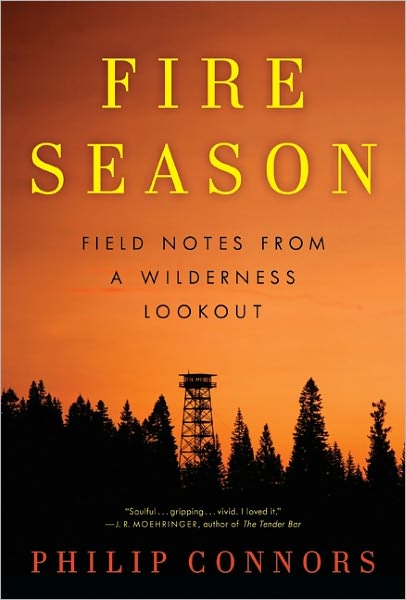
guest review: Fire Season by Philips Connors, from Tassava

reviewYou will recall from way back my original post about this very fine book, and my dad’s review of same. Now I have another to add to the accolades.


fireFrom his website, I’d like to share with you my buddy Christopher Tassava’s review (even with the undeserved praise in that opening line).

My ridiculously well-read friend Julia recommended that I read Fire Season, a book-length essay by Philip Connors on his work as a fire-tower lookout in the mountain forests of New Mexico. Connors’ writing is amazing, evoking both the wildness of his setting (which I now have a deep desire to see firsthand) and the civilized nature of his work, which aims, at its base, to preserve what man values in nature. I loved lines like

Time spent being a lookout isn’t spent at all. Every day in a lookout is a day not subtracted from the sum of one’s life.

which seems as true for my favorite outdoor activity (riding bikes!) as it does for being a lookout.

Connors’ skills at crafting prose are matched by his skills at explaining the American perspectives on fire and on wilderness. Much of the book concerns how the U.S. Forest Service – Connors’ employer – has understood the primordial force of wildfire, and how it has reacted to it. The historical material is fascinating on its own (someone seriously proposed clear cutting the Rockies to prevent fires!) and as context for Connors’ own stints in the watchtower. Not all of the fires he spots garner a response from the Forest Service: some are left to burn acres and miles of forest, contributing to the endless natural cycle of burning and growth.

But Connors also adds his voice to the conversation about what wilderness is, and what it’s for. He comes down in favor of preserving wilderness for its own sake: not as a place for humans to “recharge” but as a place apart from humans and, I thought by the end of the book, better than we are.

Glad you loved it, Tassava! Next up is Dirt Work, which I believe he is also loving. Stay tuned.

two striking paragraphs from Young Men and Fire

A cloudburst was already waiting to challenge us at the top of the ridge. From the bottom of Meriwether Canyon we could both see and hear it making preparations for a joust with us. As we tried not to fall backwards to where we started in the canyon, we could hear the storm rumble and paw the ground. When we neared the top, it tried to beat us back by splintering shafts of lightning on gigantic rocks. There was a lone tree near the top, only one, and in case we had any foolish ideas of taking refuge under it a bolt of lightning took aim and split it apart; it went down as if it had been hit by a battle-ax. Trying to reach the rocks, we were held motionless and vertical in our tracks by the wind. Only when the wind lessened for a moment could we move – then we fell forward. With the lessening of the wind the rain became cold and even heavier and forced us to retreat from the battlefield on top. The rain fell on us like a fortified wall falling. By the time we reached the bottom of Meriwether, we were shivering and demoralized and my brother-in-law probably already had pneumonia.

All this was like a demonstration arranged to let us know that Mann Gulch had power over earth, air, and water, as well as fire. As the wind continued to lessen, the rain increased and fell straight down. It was solid now everywhere. It knocked out the motor in our borrowed boat, and we couldn’t get it started again; after a while we didn’t try anymore, and it took several hours to pole and paddle our way back to Hilger Landing. My brother-in-law was seriously sick before we got there; he would never go back to Mann Gulch. So for some time Mann Gulch was mine alone, if I wanted it, and for some time I left it to the elements. I turned to the archives because I knew they would be dry and no wind would be there and the air would be the same air the stacks had been built around and nothing but a book or two had been moved since. The signs would demand “Silence” and even the silence would be musty, and for a time anything musty had an appeal.


I am seriously tempted to leave this passage to stand alone. Below I will make a few notes toward a closer reading of it; but feel free to skip my little words and reread Maclean and go on with your day.


Or, if you want my thoughts:

Here Maclean relates his first attempt to visit Mann Gulch, scene of the decades-old tragedy he wants to write a book about. It is a geographically remote and wild area, not easily reached. He refers several times in Young Men and Fire and in his related notes and letters (in The Norman Maclean Reader) to the “truculent universe,” reluctant to give up its secrets regarding these events. This first visit to the spot itself clearly informs his feeling of the universe’s truculence. Perhaps, he thinks, the archives will be more revealing. (As it turns out, they weren’t, especially.)

These paragraphs are both easy to read, and dense with description. You can feel the weather beating through your computer screen, can’t you? Look at the action verbs, the militarism, the agency attributed to the inanimate storm. It is waiting to challenge; preparing to joust; it rumbles and paws the ground. It tries to beat us back; it takes aim and disabuses us of foolish ideas. The top of the gulch is a battlefield; rain was like a fortified wall falling.

There is comedy: when the wind stopped we were able to move again – we fell forward. (Can you see the slapstick even in this dramatic moment? Does it make you smile?)

All of this was a demonstration – and note Maclean’s reference to the concept behind the title of this book, the elemental forces of earth, air, water, fire (and young men).

In this round of battle, Maclean concedes that the Gulch has won; he retreats to the archives, where the librarians among us are amused and charmed by the air the stacks had been built around, and the appeal of mustiness after such a run-in with the wild outdoors.


I again encourage you to read this amazing book.

notes on Young Men and Fire by Norman Maclean

young men and fireI decided to do a whole separate post (because my review was… long) sharing my notes as I read this book. As I’ve said before, I like to use a scrap of blank paper as a bookmark because I can takes notes on it. Often these are words I’m unfamiliar with, with page numbers, so I can look them up and reread them in their context; quotations with page numbers; or notes of concepts I want to include in a review. Some books fill a quarter-page piece of scrap paper with notes; some have 2-3 notes; a fair minority of the time, I can get all the way through a book with no notes at all and write a review from memory.

Young Men and Fire filled 3 quarter-page scraps of paper and part of a 4th, and I was writing very small. So I wanted to share these notes here. I’ve expanded them slightly to explain to you what I was noting; but still they are basically marginalia. [My page numbers refer to the 1992 hardback from the University of Chicago Press that I got from my local library.] I also left off a few that turned out to be less interesting avenues of pursuit, or that turned out to be personal.

  • author photo: this V.C. Wald 1981 portrait of Maclean in a boat, looking down, is evocative for me and I love it. (see bottom of post)
  • Ehrlich & Dillard blurbs: on the back of the book (among others). Gretel Ehrlich is one of those I had never heard of til I had, and now I see her everywhere. Dillard is one I’ve heard lots about, and it’s finally time for me to read her.
  • like The Perfect Storm: science, weather, geography – actually like it in subject too
  • takes his reader in hand to guide her on this together-journey
  • “left a world that is still burned out.” 86
  • “a mystery of the universe is how it has managed to survive with so much volunteer help.” 112 (having worked with volunteers, and been a volunteer myself, I found this quite apt and funny.)
  • great comments on human nature 114-15. “…most people think they can be of help, and some even seem born to rescue others, as poets think they are.”
  • stations of the cross (a concept that I had to look up: I am unapologetic about being an atheist, but regret a little how uneducated I am in the religions that I don’t believe in)
  • Custer: turns out to be a subject of sort of secondary obsession for Maclean. apparently The Norman Maclean Reader includes his unpublished notes on Custer that were headed for being their own book. I am looking into this.
  • poem 201: I had to look up a poem that was quoted without attribution; it turned out to be “In Flanders Fields” by Colonel John McCrae.
  • “I added a final truism for myself, ‘True poems are hard to find.'” 202
  • “Beer doesn’t seem to do much to remove dehydration, but it makes it easier to admit error.” … “We were too tired to sit down in the shade, if there was any, so we put the plastic bag with the rest of the beer between us on the hot hood of the engine. We figured, since beer couldn’t take away dehydration, we might as well drink it warm.” 209. What I can say, I guess I collect literary quotations about beer.
  • sewing machines 214. The scene described is one in which the smokejumpers play a game of volleyball, watched by visitors from The General Public, who are surprised the smokejumpers are “not as big as the Minnesota Vikings,” and after the game is over, “to the ever-increasing surprise of the visitors, would sit in front of sewing machines and peacefully mend their parachutes. They were very skillful with their sewing machines and damn well better have been, since their lives hung on their parachutes.” This one is for my mother, who not only collects sewing machines but also uses them. She also collects instances of the intersection of manliness and sewing machines – not as rare as you might think, it turns out. (She still has not gotten Husband onto one.)
  • this story in Fire Season? and Jumping Fire? note to self to go and check on the Mann Gulch’s appearance(s) in the two books; I’m sure it must be there…
  • story 214-15: a brief anecdote I appreciated, told by Hal Samsel
  • “…a storyteller should never look at a day as lost if he has learned something about how to tell stories, especially about how to make them shorter.” (which is a lesson Maclean learns from Hal, above.) 215
  • Ancient Age 216: a brand of bourbon that I confess I had to look up (I like Knob Creek myself, if you’re taking notes)
  • I begin to see clearly that I favor those authors who booze. Hemingway, Abbey, Burke, and Maclean, I’m looking at you.
  • math 229-30 and on… another note for my mother, who is a math person (geometry particularly) and might appreciate this discussion of math, its challenges, and its value, not to mention the math itself, complete with charts and graphs, that helps explain the Mann Gulch fire
  • Black Larry: the real-life character in Fire Season who recommended I read this book. make a note to send him a note.
  • silviculture 247: from the US Forest Service: “Silviculture is the art and science of controlling the establishment, growth, composition, health and quality of forests and woodlands to meet the diverse needs and values of landowners and society on a sustainable basis.” Maclean uses it in a way that suggests an earlier meaning (at least to him), of the science of controlling forests to meet the needs of loggers, which is not really the same thing as the above definition.
  • anemometer 248: An instrument for measuring the speed of the wind, or of any current of gas.
  • Phil Connors – management – Rothermel – 256: another note to check Fire Season for reference to a man named Rothermel who helped rework the Forest Service’s policies on managing fires rather than just always fighting them. again, I’m sure it’s in there.
  • (back to The Perfect Storm) as I remember it, Junger never addresses much his own strengths or weaknesses with the technical aspect of his research, that is, the science. Maclean does; he pokes fun at his limits with math. This brings in his own personality & amuses me. Also Junger never becomes a character until his final comments(?), whereas Maclean is a major character, necessarily, throughout.
  • “All of us have the privilege to choose what we wish to visualize as the edge of reality. Either tier of crosses allows us to picture the dead as dying with their boots on. On some of the bodies all but the boots were burned off. If you have lived a life that has thrown you in contact many times with nature, you have already discovered that sometimes you can deal with nature only by allowing it to push back what until now you and others thought were its edges.” 277
  • elements – title: I discussed this in my book review, how Maclean adds “young men” to our list of the elements, normally four: earth, air, fire, and water. thus the title of the book.

As you can see, this book inspired many ruminations in me, some still unfinished.

Many thanks to Veronica Wald for sharing this on her blog! It’s worth clicking the link above for the story of the iconic photo.

Young Men and Fire by Norman Maclean

EDIT: more of my notes on this book available here.

Black Larry told me I should read this book, and I’m so glad I did. Thank you, sir.


young men and fireI struggle to tell you how good this book is. You know I loved Maclean’s A River Runs Through It. This, though lesser known, is better.

Young Men and Fire is the true story of the Mann Gulch fire in Montana in 1949, in which 13 smokejumpers of a crew of 16 were killed. Maclean was in the area in the days after the deaths, and was moved – as any of us would have been moved, but more intimately, because he had worked with the Forest Service and fought fires himself, and had one particularly frightening close call. He hiked out to see the still-smoldering forest as the Mann Gulch fire died out, and he knew even in 1949 that he would tell the story of those 13 men and what happened there.

He started his research and writing in earnest in his late 70’s, years later, after the publication of A River Runs Through It that made him moderately famous, and which too he had written after retirement. But Mann Gulch had always been on his mind.

As I said in my book beginning post, I learned quickly that this was a posthumous publication, a cooperative effort by his publisher and his son to put together as faithfully as they could what he had been working on. He died in 1990 and the book was published in ’92. In my observation, it must have been very nearly finished, and/or their editing work is seamless, because it feels decidedly like a finished work to me, and it all feels like Maclean.

It begins with a story, Black Ghost, about Maclean’s visit to the scene of the tragedy while the fire still sputters, in which he compares it to his earlier experiences. This short story sets the background of Maclean’s continuing fascination with the Mann Gulch fire. Then the bulk of the book is divided into three parts. They are untitled, but I saw a clear method of division; I’ll share my impression here, and note that it’s my own and from memory. Part One is about the events of 1949, told narrative-style with what information Maclean has and relatively less commentary than we’ll find later on; it relates the events of the days on which a fire was spotted, men raced towards it, the fire blew up, men ran, and men died and their bodies were found. Part Two relates Maclean’s research: it’s the story of his life since 1949, in which he thinks and muses, travels, researches, draws diagrams, visits with the two survivors, and climbs the steep gulch repeatedly to examine minutely the remaining evidence. Part Three is a brief 9 pages in which he tries to say what the Mann Gulch fire really was, and what young men might have felt and thought in their final moments. Throughout, and concluding in Part Three, Maclean discusses the meaning and power and definition of tragedy in life and in art. There are also plentiful religious allusions. I’m not clear on Maclean’s own relationship to a church – he doesn’t make it abundantly clear – but he does make very clear that he was raised by a Presbyterian minister (which we know well from A River Runs Through It), and his religious training comes through, not least with many references to the stations of the cross.

Briefly, the Mann Gulch fire looked routine to a team of Smokejumpers from the air (and to the pilot and spotter who released them), although there were some especially challenging elements of wind that required men and equipment to be spread out over a larger area than usual, which cost them time in regrouping. Also, the team’s radio did not survive its “jump,” which would come to be significant. Once on the ground, their very experienced fire foreman went off to investigate and quickly concluded that they had better head the other way; while heading his team one way, they found fire suddenly in front of them as well as behind; and thus began what Maclean calls their race against fire. In minutes, a fire of such ferocity and speed that they could not understand it had overtaken the team and… the details are ugly. Five men survived the fire, two so badly burned that they died around noon the next day, which appears to have been a mercy. One of the remaining three survivors was the foreman, who would receive a lot of flak for the deaths of his mean; the other two were the youngest and most inexperienced of the crew, one of whom had lied about his age and was still not old enough to actually be jumping out of airplanes into forest fires.

To say that this is a powerful story is both understatement and unnecessary. Sixteen men, the majority of whom were just boys really, thought they were going to do a routine job; they were brave, but their bravery was born of confidence rather than a comprehension of what they were up against. The Smokejumpers were a brand new part of the Forest Service – established in 1940, and slowed during World War II by the bulk of them going overseas to jump out of planes for other purposes – and the boys themselves were young, too, “still so young they hadn’t learned to count the odds and to sense they might owe the universe a tragedy.” It doesn’t work to accuse them of hubris. Simply, a whole lot of just rotten luck, a failure to understand fire, a lack of experience (both personally and institutionally), and a confluence of events that created a perfect storm of fire, caused these young men horrible suffering and created an event that rocked the lives of many. Obviously, their families & loved ones were effected; also the Forest Service, which reacted very defensively and was sued by several families; and ramifications were felt in the burgeoning scientific understanding of forest fires and how they work, all of which Maclean explores.

This is a beautiful eulogy to 13 men, and an eloquent and compassionate chronicle of a significant event. It’s also a story personal to Maclean, about his fascination with this fire and the fate of those 13 men, and the telling of this story as his “homespun anti-shuffleboard philosophy of what to do when I was old enough to be scripturally dead” (meaning, he’d lived his three score and ten). I love that the process of researching the story and writing it is the story itself; they are inextricable in Maclean’s version, and that feels right. Of course, as a reader, writer, and lover of books and stories, that makes perfect sense to me.

Maclean’s version is beautifully written, complete and complex, with a respect for all the nuances, unknowns, and conflicting version and conflicting points of view. He examines the accusations made against the foreman who saved himself by setting an “escape fire” and was unsuccessful in convincing his men to join him – which might have saved them, too – and thereby invented a technique which is now a part of fire defense. He examines the different impressions of events by the two survivors and the ranger who was one of the first on the scene after the deaths (and who took copious notes and was a meticulous observer). In fact, he examines everything available to him in exhaustive detail, and justifies his conclusions and questions with a base in science: geography, weather, and what we know about fire (which is more than we knew in 1949, thanks in part to those 13 deaths).

The title derives from Maclean’s discussion of the four elements, earth, air, fire, and water, of which the Smokejumpers interact with three in their normal line of work: earth, air, and fire; by the end of the book he makes reference to the elemental nature of young men. Thus the title: the action of this book is at the intersection between the elemental forces of young men and fire.

Young Men and Fire is a work of art and of poetry, and so much more. It’s definitely one of the best books I have read or will read this year.


Rating: a rare 10 feet downgulch.

Further thoughts…

My personal tragedy now is that Maclean only wrote two books and I have now read them. I do see, though, that The Norman Maclean Reader includes “previously unpublished materials with incidental writings and selections from his two masterpieces” (says the University of Chicago Press), so I have that to look forward to. Also, I just learned that Maclean’s son has written a parallel work about a later fatal wildfire, Fire on the Mountain: The True Story of the South Canyon Fire, and my copy is on its way to me now.

book beginnings on Friday: Young Men and Fire by Norman Maclean

Thanks to Rose City Reader for hosting this meme. To participate, share the first line or two of the book you are currently reading and, if you feel so moved, let us know what your first impressions were based on that first line.

young men and fire

Following an informative and lovely Publisher’s Note, which tells us that this is a posthumous publication of an unfinished (but largely formed) work, Norman Maclean begins his book Young Men and Fire with a story about the beginning of his involvement with the Mann Gulch Fire.

It was a few days after the tenth of August, 1949, when I first saw the Mann Gulch fire and started to become, even then in part consciously, a small part of its story.

To think that while the fire was still burning, in 1949, Maclean knew he’d be tied to it forever – though he didn’t begin this book til 1976, and it was unfinished at his death in 1990 – is profound in itself.

I think I am a serious Maclean fan. Stay tuned.

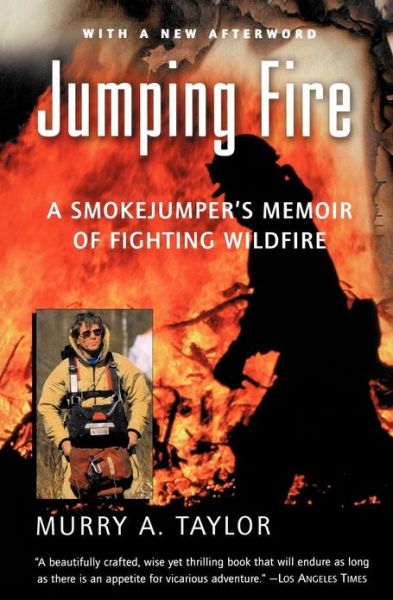
Jumping Fire: A Smokejumper’s Memoir of Fighting Wildfire by Murray A. Taylor

jumpingfire

I was not aware of smokejumping as a career until I read Phil Connors’s Fire Season a few years ago, but I was fascinated. Further, when I read Sebastian Junger’s The Perfect Storm in 2012, I learned (in the author’s interview at the end of my audio edition) that he had originally conceived a book that would contain chapters on each of a number of highly hazardous jobs. These were to include smokejumpers as well as the swordfishermen that ended up starring in his highly regarded book.

I believe it was my friend Don who recommended this book when I raved about Fire Season. [Thanks, Don!] Jumping Fire is a memoir by the oldest smokejumper ever to work the job (at least when this book is published – I cannot swear that his record still holds, but it seems to). As the name indicates, smokejumpers are wilderness firefighters who reach their dangerous destinations in dangerous fashion: parachuting out of aircraft adapted for the purpose. Taylor was 56 when he retired after an especially hot season in 2000.

I took one overwhelming early impression from this book: these smokejumpers are crazy! We’re talking about people jumping out of airplanes into forest fires! The ways in which they can die or be maimed are myriad on their way to the ground; and assuming they get there safely, they then have to fight a forest fire and, sometimes, hike back out again. Frequently they remain onsite for days, sometimes weeks, fighting fires around the clock on very little sleep and often with few rations (food & water have to be parachuted in, as well). They breathe smoke, suffer burns, dodge falling flaming trees, steer around rocks and trees and rivers upon their descents from the clouds. On the other hand, when not jumping or fighting fires, there’s a lot of waiting: “Bob Quillin [a fellow smokejumper] once described smokejumping as ‘prolonged periods of boredom punctuated by moments of stark terror.'” (I found that cute.) On top of which, the training is insane: “former marines who have become smokejumpers all agree that Alaska rookie training is tougher than anything they saw in boot camp.” So they have to really want to do this job. I am awed. I think they are nuts, without question. But it’s nice to know there are men (and women, too) out there willing to do such a crazy job. I can’t understand you, Taylor, but I take my hat off.

Taylor has rather many tales to relate of danger, injury, death and tragedy to relate; I had to close the book several times to stare into space and absorb the difficult moments. By all means, this lip-biting adrenaline rush is one of the admirable qualities of the book. But Taylor is also quite the romantic, and his love affair with a much younger woman occupies a number of pages, while his pining for her occupies still more. The firefighting/jumping remains at center stage, never fear; but there is a thread of wistful romance woven in. One is almost reminded of Abbey’s somewhat unfortunate Black Sun, although I hate to say such a thing. Taylor is rather more tasteful and less fantastic in his love affair, which is after all (if we believe him, and I have no reason not to) real. Page space is also devoted to a certain amount of (very natural) musing on human life and the wisdom of doing this hazardous work, when smokejumpers have wives and children at home who suffer when they are hurt or killed, and as Taylor ages and his knees complain about all those hard contacts with the ground. Or, on the challenges of the job:

Jumpers rarely speak openly about how they handle extreme fatigue, but when they do, they joke about it and claim to be the weakest in the bunch. At such times I just keep my mouth shut. For me, it’s always the same. Beyond the fatigue comes the sorrow and with the sorrow comes the loneliness. At the hour of my greatest exhaustion, I am lonely, emotionally frail, and at a loss to do much about it. No matter who claims to be the weakest, in the deep, dark pit of my soul, I know that it is me.

I found this a poignant consideration of his own weakness; but he also seems to acknowledge the universality of feeling inadequate, which is sort of a comment on humanity. And, of course, there’s no shortage of macho avoidance of such confessions.

Jumping Fire is the story of an absolutely fantastic, absolutely real occupation that very few of us will ever see face to face, and it is exhilarating and fascinating as such. But Taylor is also a fine writer, and contemplations of natural beauty and the tension between seeking comfort and seeking thrill and hardship are a great strength of this book, as well. I found it riveting, enjoyable, and thoughtful – recommended.


Rating: 8 racing hearts.

guest review: Fire Season by Philip Connors, from Pops

Today we’re visiting my father again, who’s traveling this summer. I put the screws on to compel him to buy a copy of Fire Season for himself to read on the road because I loved it so much (see here). I promised to buy it off him if he regretted the purchase; and I may, anyway, because I want to own a copy. Actually, though, I don’t know if it’s for sale. He did like it. I’m compiling some of his thoughts via email to share with you; they’re mostly in response to my original post (see link above) but I thought his slightly different perspective was worth sharing. Here’s Pops.

I finished Fire Season yesterday while I was camping in the finest of the rain forest valleys in Olympic NP, the Hoh river. I found it as exceptional as you said. The timing was impeccable; e.g. I was reading his passages about the magical meditative element of long walks… (or, I would say, endurance activities – you could read Bill McKibben’s Long Distance for a bit of the same; I found it wonderful, and you should know who McKibben is anyway for his potential to be one of the great environmental soothsayers of our time) …and it helped me decide a plan for my Monday walk: a full 10 hour day of wandering up and down the valley in rain and mist marveling at the magical forest – when I wasn’t daydreaming. I loved how he wove in stories of Kerouac, Edward Abbey, Chief Victorio, Alice the dog, Aldo Leopold, Cormac McCarthy, Gary Snyder (new to me) – and others. And we certainly learn about wildfires. Thanks for the tip.

So glad you liked it!! [And, incidentally, what safety precautions are you taking on 10-hour walks? Do you call Mom to let her know you’re going off on such things, and then call in when you return?]

And have you made the connection with current events? – with a massive fire burning for weeks now in eastern Arizona (the western borders of Fire Season) and today all around the Carlsbad Caverns area in NM (within the eastern horizon view of Fire Season).

Maybe not specifically those fires; but West Texas has been ravaged for months and it made my reading of the book a touch more personal. This spring race series, we raced two races in a row only to hear that the race course saw a wildfire start as we were leaving. (We promise we didn’t start these fires.) One was in Arksansas, one in central Texas. And we have a friend/teammate who tried to race in Ft. Davis, but the event was canceled due to one of the bigger fires we’ve seen; it swept across a considerable part of the state we’re used to driving and riding through. Close to home.

Did you also make the connection that we all went camping in the Gila Wilderness twice when you were 3 and 4 yrs old? (and that, because we had been there before you were born)

No, of course I don’t remember that, but very cool!

I really endorse what you said about his eclectic voice, and the many priceless vignettes he blends into his story. (I really wish I had read it with a highlighter!)

I also found him to be an endless stream of contradictions (perhaps we all are?) – he could be a sedentary slug for hours/days on end, but was also often driven to minimalist walks & overnights (an evening walk from a summit inevitably involves a serious down & UP!); he obviously functioned well in cities & bars, as well as wilderness; he became well versed in much wilderness language, yet succumbed to the elementary, pitiful, dreadful trap of the young fawn.

I cried over the fawn.

And, re: your comment about the contradictions. I am reminded of David Guterson’s The Other as well as Jon Krakauer’s Into the Wild (the first, fiction, the latter non) – both books about young men going into the wilderness, thinking they wanted to get away from it all, but also strangely and paradoxically clinging to certain odd elements of society. As the protagonists of both books came to unpleasant ends, I think perhaps Connors has found the perfectly balanced way to do it! In fact, I think I mentioned balance in my initial review. The writing in his book is balanced; and his interactions with his world are balanced. His saintly wife helps him be balanced. I daresay we all aspire to a lifestyle like this; I know I do, and I think, Pops, that you do. But then, you’re closer than most of us right now!

Based on your and my reactions, I’m guessing that readers will appreciate many different aspects of this book. You particularly noted the lessons about wildfire & forest policy, which I knew much of already. I loved the many references and new details about Kerouac, Snyder and the various personalities of the Beat generation who so influenced my 60s & 70s, and subsequent characters like Edward Abbey and Dave Foreman.

You barely mention Alice! I thought she was an elusive minor character, disappearing for times but playing a key role at many turns. Moments were familiar to Barley’s world; like her unilateral retreat to accompany Martha home from the lookout summit, and her personality change from city to wilds. Most poignant – Alice evoked my most secret lonely moments, far up a mountain trail without Barley’s companion spirit, spunk and relentless energy. “Alice is the only living being I know who will take a forty-mile walk in the woods without any need of cajoling, planning, or consulting a calendar.”

My apologies to Alice; you’re entirely right… she was a special creature and character, and a neat side-story proving (yet again) that dogs are our best friends and offer relationships unlike what we humans can offer one another. Here, I’ll treat our readers to a picture:

Hops (brown) & Ritchey (short white hair) who live with Husband and I, and my parents' Barley (scruffy white hair)

Finally: “…the movements of my limbs help my mind move too, out of its loops and grooves and onto a plane of equipoise… If I weren’t a walker I suppose I would be a television addict, a dope fiend, a social butterfly.”

Because I had to look it up, I’ll share. Equipoise: an equal distribution of weight; even balance; equilibrium.

Thank you for your musings, Pops. I hope we’re (still) encouraging folks to find this book! I think I’m ready to call this my best read of 2011 to date.

Fire Season by Philip Connors


EDIT: You might also want to check out my father’s review, and friend Tassava’s, of same.


This is an amazing book. The first sentences immediately grabbed me. Connors works summers in a teeny, tiny tower room way up in the sky in the Gila National Forest in New Mexico, as a fire lookout. His job is to spot smoke and call it in for control or “management” of the fires. But his “field notes” tell so much more than the story of his career as a lookout. This is the story of his time alone in the Gila, and of the visitors he receives and the visits he pays back to town; it’s the story of his and his dog Alice’s interactions with nature. It’s the story of fire and smoke and the Forest Service’s management of fire. It’s a history of fire, of the Forest Service, of the Gila, of so very many aspects of our nation’s history, and the natural history of the southwest. Connors discusses the varied reactions the government has had to fire: the policy of fire suppression, consistently and in every case, versus the concept of “controlled” or “prescribed” burns, and the ongoing debates. He contemplates society, its benefits and our occasional desire to escape it. He discusses his unique model of marriage, in which he spends some five months a year living alone and mostly out of touch. He also relates ecological issues like fire as a natural control mechanism, erosion, and the preferences of flora and fauna. And more.

I found Fire Season astounding and important. There’s a zen-like balance in it. Connors is a rather balanced man, in that he still craves human contact; he’s not an entirely back-to-the-wild isolationist, nor does he fail to appreciate cold beer and a variety of media. But he achieves a special and rare state of commune with nature, too. His writing, for me, parallels this balance. He can wax philosophical, crafting lyrical, beautiful odes and hymns of reverence to nature, fire, and life; but he never gets overly wordy, tempering the poetry with (still beautifully written) narrative history.

Connors tells so many little stories I would love to pull out of this book and share as vignettes. For example, the story of Apache Chief Victorio’s last stand (that lasted over a year) in the vicinity of the lookout tower where Connors is stationed:

That September day in 1879, on the headwaters of Ghost Creek, marks a peculiar moment in America’s westward march: black soldiers, most of them former slaves or the sons of slaves, commanded by white officers, guided by Navajo scouts, hunting down Apaches to make the region safe for Anglo and Hispanic miners and ranchers. The melting pot set to boil.

Or the history of the smokejumpers, which I didn’t know before – the parachuting firefighters who pre-date paratroopers and taught them their trade. Or the tale of the Electric Cowboy. Or the story of the little fawn. I cried, mostly because I empathized. Really, it could be read as a series of anecdotes; but the whole is greater than the sum of its parts. The larger story is important, too. I even glimpsed traces of the training I’ve received in trail-building and (more broadly) land management.

The history, the lore, the anecdotes, the author’s relationship with nature, his relationship with his wife, the landscape of the Gila, the details about local species of bird, fish, and game… there are so many gems in this thoughtful, loving, lovely book. I am not doing it justice. It’s a very special book and I strongly recommend this to everyone, no matter who you are. But I especially recommend it if you are… a nature lover, a hiker, a dog lover, a government bureaucrat, a pyromaniac, an environmentalist, a city dweller, a romantic, a firefighter, a skydiver, a cribbage player, a whiskey drinker, a writer, a loner, a philosopher, a historian, a student, or a teacher. This book goes on The List.

Teaser Tuesdays: Fire Season by Philip Connors


Teaser Tuesdays is a weekly bookish meme, hosted by MizB of Should Be Reading. Anyone can play along! Just do the following:

* Grab your current read
* Open to a random page
* Share two (2) “teaser” sentences from somewhere on that page
* BE CAREFUL NOT TO INCLUDE SPOILERS! (make sure that what you share doesn’t give too much away! You don’t want to ruin the book for others!)
* Share the title & author, too, so that other TT participants can add the book to their TBR Lists if they like your teasers!


In a tiny room in a tower 10,000 feet above sea level, Connors keeps watch for fire over New Mexico’s Gila National Forest. This contemplation of solitude and the power of nature sounds like Edward Abbey’s Desert Solitaire which I enjoyed so much. I’m looking forward to it. From page 75:

No matter the length or sweetness of a reprieve, the wind always returns, gales to test the endurance of anyone exposed in a high place. Trees that elsewhere grow a hundred feet tall here hug the ground like shrubs, shrunken, gnarled, and twisted, as if cowering from an invisible foe.

Lovely. I anticipate beautiful writing and a study of nature and natural places. I’ll let you know!