In the Lives of Puppets by TJ Klune

In the Lives of Puppets is TJ Klune’s third adult standalone novel, in a similar vein to The House in the Cerulean Sea and Under the Whispering Door. These are the only three of his I’ve read, although there are more, and I may still get to those.

I said about Whispering Door that Klune excels at “the juncture of sweetness, fantasy, profundity, inclusivity, wisdom and pure silliness.” Puppets continues in that style. Rather than magical orphans or a magical afterlife, here we have a decidedly sadder challenge. The story begins with a lovely forest. A man (“who wasn’t actually a man at all”) approaches an old, falling-down house in the forest. He builds a life there, a crazy network of add-on treehouses and laboratories a la Swiss Family Robinson. He has a son, Victor. Flash-forward: we meet adult Victor with his two companions, a nurse-robot named Nurse Ratchet (that’s an acronym for Nurse Registered Automaton To Care, Heal, Educate, and Drill, and yes, think One Flew Over the Cuckoo’s Nest) and a vacuum-robot named Rambo. Victor’s father Giovanni is still around, and much-beloved; they have a happy family, although Victor is the only human member of it. Like Giovanni, he is an inventor, builder, creator. He spends many of his days combing through the Scrap Yards, where the Old Ones deposit their detritus, some of which turns out to be useful to Victor’s little forest-dwelling family. It’s where he found Nurse Ratchet and Rambo, both of whom he’s patched up to become the wacky friends they are today. (Nurse Ratchet is forever hoping to murder someone or something, slowly, and document their agony. Rambo is crippled by anxiety, restlessness, and his ceaseless need to clean. He loves the old movie Top Hat.) One day, at the Scrap Yards, Victor finds a new potential friend, one who will change everything.

This book assailed me with literary allusions, some of them less obvious than the two I’ve named already. Epigraphs refer to Pinocchio; Victor’s first name and some other plot elements remind of me Frankenstein; the goofy-sidekick robots make me think of R2D2 and C3PO from Star Wars as well as The Wizard of Oz. Which is to say, Klune is not working with brand-new material here (nor does he think he is). The world of robots gets a decided Klune twist, though: sweet, silly, romantic, hopeful. There are a few big reveals I won’t name here. As I already mentioned, this world feels a bit less hopeful to me than the worlds of Whispering Door and Cerulean Sea. The romance felt a full step less believable to me, somehow, although I can’t quite say why – it’s not like the pairings-off in those first two novels made perfect sense in any real world, but this is fantasy. Something about this one just didn’t go off the same, for reasons I can’t articulate. Possibly (is this too obvious?) it is that difficult to write robots (or androids) as relatable humanish characters. Maybe it’s as simple as where we were left with this love affair.

I really enjoyed this read: I was absorbed, engaged, tickled, and concerned for the characters I’d come to love. It is a good book. I just think it’s less awesomely good than the two previous ones by this author that I’ve read. I will certainly buy the next standalone novel he publishes in this same vein.


Rating: 7 butterflies.

Dragon Spear by Jessica Day George

Dragon Spear is the final volume in the Dragon Slippers trilogy, and I remain glad I was handed that first book by a young friend. These have been entirely fun, with positive messaging and enough grit and humor to keep me engaged. The dragon characters are as sweet and diverse as the human ones, and the women and girls, and female dragons, tend to be both clever and strong. It’s very appealing material for this age group, and I found it perfect, easy reading while on a recent trip to see family.

In this episode, once again, we think the dragons are safe until they aren’t. This time something’s different: the threat comes from other dragons, under their own power and not that of malicious humans. In fact, these dragons enslave humans. And there are some young ones at stake–as well as Creel’s wedding dress, as her union with the younger prince approaches. We lose track of Marta, which is a shame, but get a new human buddy: Creel’s brother Hagen has shown up. He’s an interesting new feature. Dragon friends, and the prince Luka, remain steadfast.

It seems like faint praise to say that this one offers nothing especially new. But I truly feel comforted by knowing what to expect, especially at this reading level. This one is faithful to the series in pleasing ways.

A final strong recommendation. And I’m a little bit considering looking into George’s other works.


Rating: 7 holes.

Dragon Flight by Jessica Day George

Book two in the trilogy that began with Dragon Slippers is at least as good – my young friend who recommended them to me prefers the first book but I think this one might be better. Creel, in her late teens, is now an entrepreneur, running a dress shop in King’s Seat along with her best (human) friend and business partner, Marta. Marta is engaged to marry Tobin, former bodyguard to the younger prince, Luka; Creel is less secure in her relationship, but the reader can see that Luka himself is smitten with her, commoner or no. Because this is the Dragon Slipper series, trouble quickly arises: a distant country is poised to invade with an army of soldiers riding dragons. We know that dragons are not hostile by nature, so something funny (probably of the alchemical variety, as in book one) must be afoot.

One thing I love about Creel is her genuine devotion to her dragon friends. Her first friend, really, was a dragon, while she definitely has some good human ones. She is adamant in her defense of the misunderstood dragons, anxious both to protect their reputations and keep them safe. The humans also need dragons to keep them safe, and Creel is the liaison between the two groups.

I love the friendships among and between humans and dragons. I love Creel’s (and Marta’s) innovations and puzzling through problems, and their bravery. The romances are sweet, but what I love most about the pairings is that Creel and Marta are outright heroes while their respective beaus just follow along, supportive but a little bumbling, good-natured about their partners’ impressive accomplishments. (I considered sharing this observation with the 11-year-old who recommended these books to me, then realized I’d actually rather she live in a world where this was unremarkable.)

Charming, daring, whimsical, loveable, endearing. I’m in for book three.


Rating: 7 scales.

Dragon Slippers by Jessica Day George

My favorite 11-year-old saved this book especially to loan to me, and I was so excited to be given the assignment. And I quite enjoyed it! Rated for grades 5-6, Dragon Slippers has engaging action, humor, sweet friendships, a hint of romance, and snappy pacing. It’s also got some good messaging, which I approve of. It’s the first in a series and I thought I’d walk away after just one, but the surprise ending (and the sample chapters of book two!) got me.

In poverty and desperation, with a hint of a Hansel & Gretel dynamic, Creel’s aunt decides she should be abandoned to the rumored local dragon, in hopes that a noble knight will rescue her and uplift the whole family. (“Why should anyone be rewarded for defeating a dragon by being saddled with a dowryless, freckled wife and well over a dozen daft and impoverished in-laws?” Creel wonders, but nobody asked her.) This device gets Creel in the company of a dragon that no human has seen in generations, and she quickly learns that their hoards of gold and treasure are a false rumor – this one prefers shoes – and that they’re not terribly motivated to kill humans. She makes a friend, gains a beautiful pair of blue slippers that fit just right, and heads off to the city of King’s Seat hoping to make her own living rather than return to an aunt who tried to feed her to a dragon. Creel is a talented maker of what her late mother called fancywork: embroidery, weaving, and (if necessary) sewing. In the city, she is repeated called a country bumpkin. Events move quickly: she falls afoul of a visiting princess; meets a friendly prince (no relation); gets a job in a dressmaker’s shop; and finds herself embroiled in a few messes. One, working for a boss involves the kind of exploitation anyone in our present, real capitalist system will recognize. Two, her coworkers range from friend material to backstabber. Three, the prince’s attentions and the princess’s hostility somehow manage to entangle Creel in political intrigue and matters of state that also – surprise – turn out to involve her dragon friends.

(Following an early whiff of Hansel & Gretel, the slippers and the prince definitely recall Cinderella. Just echoes.)

I asked my favorite 11-year-old what she liked about the book, and she started with the initial meeting with the first dragon. (Dragons are one of her two favorite animals.) She also mentioned Creel: she likes her strength and her unwillingness to take any crap. She identifies with that. We talked about the friendships in the book, and the pacing. She said she wanted me to read it because she thought I would like Creel, and she was right.

If Creel’s interest in pretty gowns, sashes, and slippers is a bit prissy for me, she is on the other hand a highly practical feminist entrepreneur, with a dangerous habit of speaking her mind even to royalty, and a strong sense of her own powers. I love the urge to make her own way in the world. She’s brave. And she’s a good friend to a handful of dragons as well as humans, and might just turn out to be a hero. I appreciate the positive messaging, and the imaginative world of dragons. There were a few very minor plot holes that I think would likely be tolerated (or missed) by many adult readers, and certainly by younger ones. And as I said, I was hooked by a surprise finish. All in all, my young friend gave a good recommendation.


Rating: 7 collars.

The Last Graduate by Naomi Novik

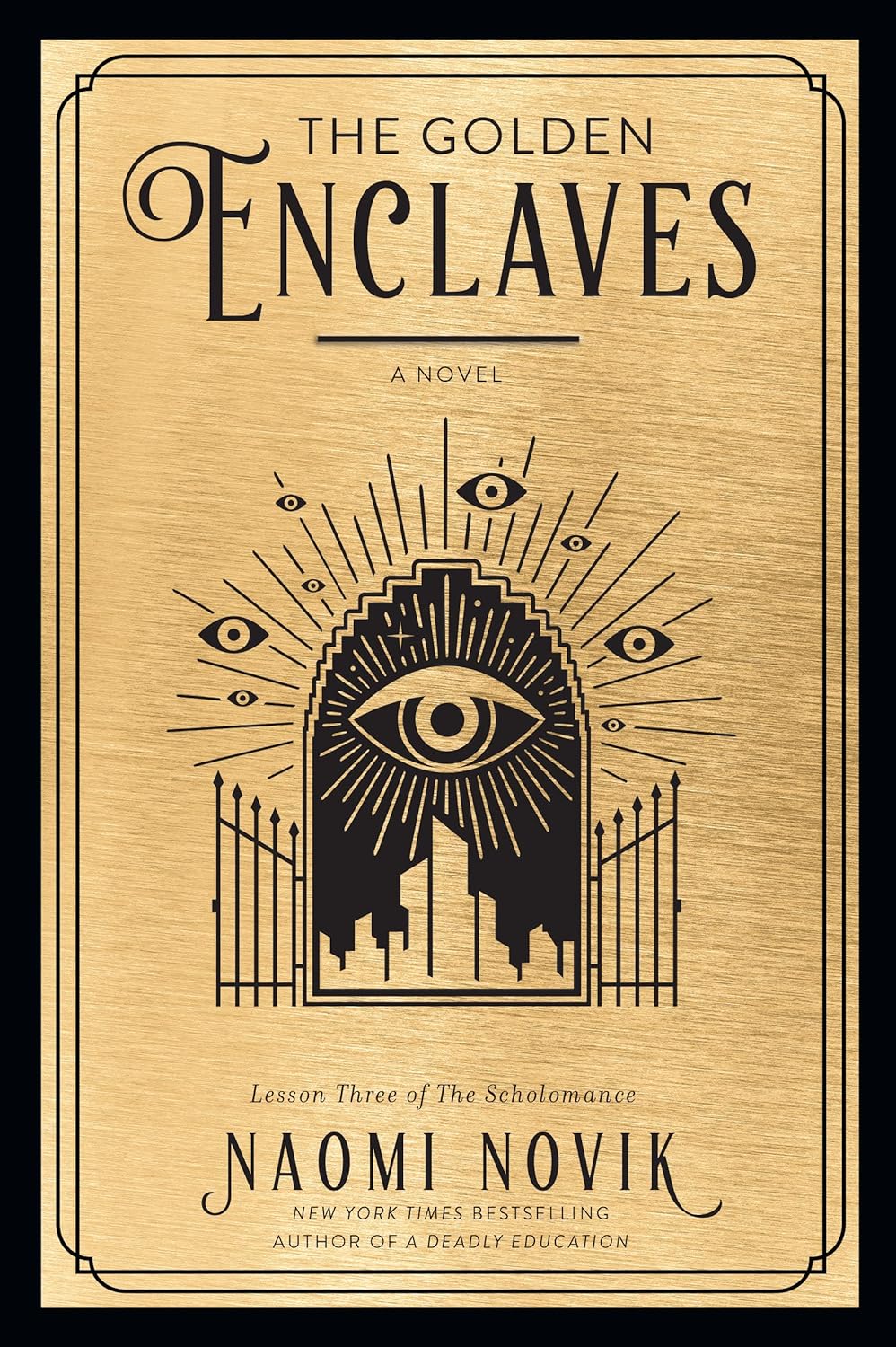
Book two of the Scholomance series was every bit as thrilling and engaging as book one. I love our grumpy, standoffish teddy bear of a protagonist.

El had good character development in A Deadly Education; now she’s continuing to develop as a person, both because she’s a teenager (coming of age) and because she’s made friends for the first time in her life. She’s reluctant to believe in this, because she’s endured a lifetime of trauma at the hands of almost everyone she’s ever known. Her new friends and allies do have something to gain from working with her at graduation, now that her power as a wizard is becoming more widely known, so she’s not entirely wrong to consider that this may motivate their friendship; but the reader can see better than she can that their friendship is real, too. It’s poignant to see such a sweet but enormously curmudgeonly, damaged, dear kid struggle to accept that people might actually care about her.

The privileges of class and nationality at work here, the power structures that are most invisible to those in power, and the injustice of it all, are more overtly at the center of this book. I think there are some good magical parallels to our real world here that can be instructive but also entertaining and fit neatly into the fantastical wizard-y world of Novik’s imagination, which is prodigious, by the way; this is expert-level worldbuilding. Late in the book the focus begins to move beyond the Scholomance to consider the whole world, which is clearly where book three will take us; this one ends on another final-line cliffhanger (!), so I’ll be getting there fairly quickly.

Perhaps because they were both Liz recommendations, I am reminded of the Murderbot series here, which also featured an outsider first-person narrator who is actually a loveable marshmallow on the inside but puts forward a hard, aggressively antisocial exterior. Despite being mostly rejected by their respective societies, both are driven to right the big wrongs. I do love this set-up, and I love El for being a hard-nosed, sarcastic badass.

In this installment, I actually questioned the YA label. The series does star teenagers, and deal with coming-of-age problems (therefore YA). On the other hand, it also deals with some very dark themes, heavy enough that some readers move it out of the YA category; but after some consideration, I don’t think that’s necessarily a disqualifier. It’s definitely for older kids, not least because there’s some (non-graphic) sex in this one. Maybe the line between YA and adult is blurred; certainly it depends on the reader. There’s no question that these are books for adults (hi), but I think they’re also books for young adults who are up for serious thinking on dark subjects, and some really good writing. This is a step adultward from Hunger Games, which are however very fine books in their own right. Who’s to say what kids should read, anyway? My parents didn’t seem to me to monitor my reading much, and I definitely read some stuff beyond my comprehension at a young age, and all that seems to have done is whet my fire. As ever, your mileage may vary.


Rating: 8 glaciers.

A Deadly Education by Naomi Novik

Another perfect recommendation from Liz, A Deadly Education is narrated by El, short for Galadriel, a wizard-in-training at the Scholomance. Her world looks much like ours, but you and I would qualify as ‘mundanes’ – people who don’t see or believe in magic. El is in school to learn spells and tricks and control, and as an independent wizard kid, possibly to earn an invitation to join an enclave. Wizards banded together in enclaves are much safer than indies like El, whose mother raised her in a yurt on a (mundane) commune in the Welsh countryside. But her mother Gwen is much beloved, a talented healer and source of all things good, while El’s affinity or tendency is toward large-scale destruction, as in mass murder. She is not a bad person: in fact she has spent her nearly three years in school working hard to keep her affinity in check, hiding the true extent of her powers, and making no friends with her eternally sour attitude. The tension within El between her natural affinity (murderous) and her value system (protective and good) is one of the central conflicts of this story.

Now the school itself: the Scholomance is full of terrors, like mals (short for maleficaria), monsters of all sorts; they live in the in-between spaces so that it’s dangerous to go anywhere alone, even to the bathroom, which is hard on a loner like El. Each year the massive, circular, magical space rotates and ratchets around so that the freshman dorms move down to become sophomore dorms, etc., and everyone gets closer to graduation, which is a euphemism for the seniors being dumped into a space filled with mals where they’ll have to fight their way out to real-world survival. Many of them won’t make it. Thus are your four years at the Scholomance taken up with working to form alliances to help you through graduation, unless you were lucky to come in an enclave kid from the start, with privileges and protections built in.

This accounts for several other intriguing conflicts within the novel: class and classism are up for debate within the enclave system. School in general is filled with petty jealousies and social politics, in ways recognizable to those of us who attended mundane high schools, and with the essential addition of life-or-death machinations re: mals and magic. There are plenty of larger questions about right and wrong and personal agency and what ends justify what means, but none of this is overtly or pedantically the point of the story: this is a page-turning, deliciously readable story of one awkward, socially ill-adjusted, fundamentally sweet but somehow also deadly teenager. El wants to secure her safe place in the world, but she really doesn’t want to hurt anybody. (Well, sometimes. She has a bit of a temper, and she does take a lot of abuse.) She also really wants friends, although she wouldn’t be quick to admit it.

It’s a great story, with some great secondary characters, including those cautiously interested in working with El, and the enigmatic oaf who wants to protect her. By the final chapters (which include some great action/battle sequences to boot) I was hooked and cheering. The last six words of the novel (!) contain a bombshell, and I cannot wait to start book two of this trilogy. Strongly recommend this one for awesome female lead characters, intrigue and world-building, fun magic, and poignant human drama.


Rating: 8 argonet teeth.

Emily Wilde’s Encyclopaedia of Faeries by Heather Fawcett

This was a fun one. Emily Wilde is an academic, and a bit of a type: grumpy, antisocial, deeply socially awkward and mostly unbothered about it; she is passionate about her work in the field of dryadology, which is faeries, or the Folk. Her hair is absolutely without exception a mess, even under the influence of magic. We meet her en route to do a season of fieldwork in the very remote, far northern village of Hrafnsvik, whose faeries, known as the “Hidden Ones,” are poorly documented. The research she hopes to accomplish here will complete the work of a decade or more, her Encyclopaedia of Faeries, whose publication should cement her academic reputation and finally get her out of adjunct work and into a position with tenure. (Those of you who know my personal life these days will hear me chuckle in bitter recognition.) This book takes the form of her journal entries, intended as notes for her professional work and as “record for those scholars who come after me should I be captured by the Folk.” Which, mild spoiler, she will be.

Emily arrives in Hrafnsvik with her loyal dog Shadow but fails to immediately thrive, because of her clumsiness with the locals (whose help she needs, whether she acknowledges it or not) and unfamiliarity with the climate (very cold). A few small quibbles with the novel’s consistency here: Emily is proud of her past expeditions into the field, which have ranged far and wide; she is far better with fieldwork than she is at working with other mortals. “I am used to humble accommodations and humble folks–I once slept in a farmer’s cheese shed in Andalusia.” But she’s also never started a fire (?!) and doesn’t know where to begin, and can’t figure out how to split wood (certainly an acquired skill; but her inability to jump in and begin feels like it belies an experience ‘in the field’). She is assessed as an ‘indoors type’ by a sneering local, at which she bristles but doesn’t disagree. And yet she does some massive mountain hikes in the course of her research; she estimates that her daily limit is twenty miles, and in precipitous conditions. In a word, these feel like inconsistencies in the character: is she an indoors type who is unable to light a fire? or is she an intrepid mountain hiker and experienced field researcher? (There is also a woman who mourns the loss of her husband. But then her daughter comes home to both parents.) Small details, perhaps, but they catch my brain distractingly. There is still much to love, however.

After Emily’s early struggles in Hrafnsvik, she is both assisted and further irritated by a new arrival: her colleague Wendell Bambleby. Famous, handsome, and well regarded in the field – if a bit academically lazy, in Emily’s view – he decides inexplicably to crash her fieldwork party, tidying up her lodgings, charming the locals, and generally causing trouble. (To highlight their different personalities, one of his first nights in town was “the most enjoyable evening I have spent in Hrafnsvik, as the villagers largely forgot about my existence amidst the gale-force winds of Bambleby’s personality. I was delighted to sit in the corner with my food and a book and speak to no one.”) The challenging local community, the region’s mysterious and intoxicating Folk, and Bambleby – both obnoxious and somehow appealing – combine to offer Emily chances she’s never really had before, in terms of research, friendship, and romance.

The result is funny, fun, frequently silly, and also suspenseful. Emily is definitely a type (the well-meaning but curmudgeonly professor), but still charming; her new acquaintances include mortals and faeries and at least one frightening faery king. Even Shadow, the loveable loyal hound, is more than he at first seems. I loved the worldbuilding aspect of dryadology, for example, the concept of oíche sidhe, a housekeeping faery driven mad by disorder. The device of Emily’s journal means we get appended faery tales, which was fun. While the Hrafnsvik story is neatly wrapped up, Emily’s own ends on a bit of a cliffhanger; this novel is book 1 in a series, and despite some small quibbles, I’m in for book 2.


Rating: 7 needle-fingers.

The World We Make by N.K. Jemisin

It’s been nearly three years since I read The City We Became, and I wish I’d spent a few minutes reviewing that one first. I still felt close to the avatars of New York’s boroughs, but New York himself (he goes by Neek, as in NYC if you pronounce the Y like ‘ee’) felt less familiar, and I’d lost track of some of the rules of Jemisin’s carefully constructed world. For slightly better results, you might want to keep book 1 a little handier than I did here, but it was still a hell of a ride.

Highlights include the personalities themselves, their relationships, and the final action scene(s). I remembered loving Manny (Manhattan), Brooklyn and Bronco (the Bronx); I feel like we get to know Padmini (Queens) better here, and I really enjoyed that. I applaud Jemisin’s work with Aislyn, the bigoted Karen-in-training avatar for Staten Island; she is unlikeable but complicated enough that the reader grudgingly sympathizes, which is a feat (and an exercise in patience and empathy that some might have excused the author for not engaging in). These avatars have had time since the last book’s action to settle in to relationships among themselves in ways that are pleasing; the characters were strong to begin with but they perform best when they play off each other (true of all characters, probably). Then there are the avatars of other cities around the world: I imagine it must have been so fun to build characters for places like London, Tokyo, Istanbul, Paris, Budapest, Kinshasa, and Amsterdam… because this novel ends up in a massive showdown. In its course, we (and our avatars) learn more about the rules of the world of living cities and their great Enemy. The threat, as threats do, grows larger and then imminent, and a major brawl ensues. This series was originally billed as a trilogy, and actually I still thought it so at book’s end; it was only in Jemisin’s acknowledgments that I learned we’re done here. I do think the ending allows room for more if she finds her energies refilled, but I understand the effects of the pandemic and Trump’s evil on her intended storytelling, and (not that she needed my permission) I can grant her this ending, too.

Three years ago, when I read The City We Became, Jemisin was new to me. Now I return to this series having since read every novel Jemisin has ever written.* With this perspective, the Great Cities duology feels both familiar and very different from her other work. This one is set in the most recognizable of her fictional worlds, closest to our own real one. The characters are modern, urban, fresh and real-world-adjacent, while the characters in her other outstanding works are realistic but recognizably otherworldly. I don’t think I have a preference, but it’s a different effect. I guess for readers more reluctant to venture into proper sci fi/fantasy, this urban version might feel friendlier.


*I have not yet read How Long ’til Black Future Month?, her short story collection, which I erroneously thought comprised works by other authors that she’d collected and edited. I would have gotten around to that eventually. But it is in fact all her own work, which means I need to get there soon.


I love the action and attitude of these living cities, and Jemisin is an important figure in my lifetime of reading. Can’t wait for more – whatever she does.


Rating: 8 sticky toffee puddings.

The Very Secret Society of Irregular Witches by Sangu Mandanna

I no longer remember where I got this recommendation, but it was a *great* one.

In the opening pages we meet Mika Moon, a young Indian-born witch living in modern-day England. She was raised by a quickly-turning-over series of tutors and nannies, who were in turn employed by an elder witch named Primrose. Primrose is the keeper of the Rules for witches: in a nutshell, witches live in secret and in minimal contact with one another, because witches together mean too much magical dangerously combining in small spaces. Mika is lonely. As a relief valve for her enthusiasm for witchiness, she releases videos on her YouTube channel in which she brews potions and casts spells: it’s not meant to be taken seriously, of course. So she’s alarmed to be caught out by a strange offer to tutor three young witches at a mysterious estate called Nowhere House.

Mika struggles to balance her own strong desire for companionship, community, even family, and her passion for her work, with her grudging respect for Primrose’s Rules. Three little witches in one space should be very dangerous indeed, especially because (like young skunks!) they’re not yet in full control of their powers. Nowhere House turns out to be magical in many ways for Mika, though. She is just beginning to find the kind of kinship she feared would never be an option for someone like her – someone different – when it turns out there are still more layers of secrets than she’d realized.

The Very Secret Society of Irregular Witches is a lovely book. With themes involving outsiderness and the search for belonging, the risks of relating to other people, built families, passion for one’s calling, and every kind of love, it’s a beautiful, affirming study in humanity. Central characters show a nice diversity in age, ethnicity and sexuality. Especially with its realistic, fully-formed child characters, it feels like it wants to be friendly to young adults (such positive messages!), and I was going to classify it as such for nearly 300 pages – at which point there occurred a pretty heavy sex scene, so keep that in mind.

I’d recommend this to anyone – even kids if you’re ready to expose them to sex! – and am anxious to see more from Mandanna. I am so charmed.


Rating: 9 star fragments.

The Shadowed Sun by N.K. Jemisin

It’s getting hard to keep track of (let alone rank) the Jemisin novels I’ve read, but this feels like one of the best. I was absorbed by The Killing Moon (book one in this duology), but this feels better still. We’ve returned to the same world, where Hananja is the most revered Goddess in Gujaareh. We’ve kept the systems – for example, Hananja’s worshippers following the four Paths to become Sharers, Teachers, Sentinels and Gatherers; but now, ten years after the action of book one, Kisua rules Gujaareh as an occupying force. Sunandi, who we know from book one, returns as Kisuati governess of Gujaareh; despite her role as occupier, she retains a certain sympathy and understanding for those she rules over, and an uneasy near-friendhip with the Gatherer Nijiri (also returning from the earlier book). Our protagonist is new: Hanani is a Sharer-Apprentice, the first woman to serve on any of the four Paths (the Sisters are an unofficial fifth route of service, but not as respected or formalized in the same way on the Council). Hanani experiences the prejudices and underestimation you would expect as the first woman in her world, but she soldiers on, so to speak.

Both within the city of Gujaareh and outside of it, revolution is brewing. The occupiers’ forces have begun to step out of line, the locals have begun to chafe, uppercaste nobility are angling for advantages, and a would-be prince of the Sunset Lineage has surfaced, living with the nomadic and so-called barbarian Banbarra tribes of the desert. Meanwhile, a nightmare plague (literally – it is spread, and kills, in dreams) is racing through the city, even infiltrating the Hetawa (Hananja’s church). In an unlikely turn, Sharer-Apprentice Hanani is given an opportunity to prove herself through a most difficult trial, which lands her in the desert, in a canyon full of Banbarra tents, and in the company of Wanahomen, heir of the Sunset Lineage.

Wana is a prickly one, and despite the lingering traces of Hananja’s Law and Wisdom in his memory and his heart, he has been with the Banbarra long enough to be quite a cultural leap away from Hanani’s devout obedience to her faith. (Hint: the “barbarians” are in some ways the more enlightened.) The two are bound together by a common goal to save Gujaareh, and soon by shared traumas and a bit of something like chemistry to boot. They will struggle sometimes against each other but often together, both learning about themselves and from the other. They grow into stronger versions of themselves in hopes of saving their shared homeland.

Wana is an interesting and eventually sympathetic (although never perfect) character, but Hanani is the star, followed by other women she meets along the way, including Wana’s mother and his former lover, a really fun one who helps outfit Hanani with Banbarra clothing, ornamentation, wealth and customs. Hanani fears that as the first and only woman in her line of work, any mistake she makes will reflect on her entire gender (isn’t that familiar), but eventually learns that this also means she gets to chart a course no one’s ever known. I love what she does with that.

Reading these two books in proper sequence is a must, and familiarity with the world of the first absolutely enriches the second. This was one of the deepest, richest pieces of fantasy reading I’ve done lately. Only wish there were more.


Rating: 8 polished rubies.