The Magician’s Daughter by H. G. Parry

Liz always recommends winners, but this one is the best of the year so far.

The Magician’s Daughter is a dream of a novel about magic, family, trust, coming of age, a changing world, and figuring out what’s right (or the closest we can come) and what’s wrong. I confess I am in danger of being suggestible by the Alix E. Harrow blurb on the cover of my edition, which reads in part: “a brand-new classic, both wholly original and wonderfully nostalgic.” I read that before I read the book, so there’s a danger there. But I think she got it right: there is both the tried and true and familiar here, and something fresh and new. I loved it so much. And this may be in part the right book at the right time, but I fell into it in ways I needed to.

Biddy has only ever known life on the island of Hy-Brasil, where she lives with her surrogate father figure, a mage named Rowen, and his familiar Hutchincroft, who sometimes takes human form but mostly lives as a golden-colored rabbit. She is now about sixteen, or seventeen: they can’t be sure, of course. She’s always known the story, that she was found shipwrecked alone in a small boat, which had been very unusually allowed to drift near Hy-Brasil. Off the coast of Ireland, beyond the Aran Islands, the magical island is only detectible every seven years; to accept the small craft that bought her there as an infant has always meant to Biddy (in her secret thoughts) that there must be something special about her. She might not have magic as Rowan does, but she hoped she was meant for big things.

And so in her teenaged years, it has begun to chafe that Rowan won’t let her leave the island. And he’s been leaving himself, more and more, in his form as a raven, out all night and sometimes even returning hurt. The outside world seems to be unraveling in some way, and Biddy is ill equipped to understand or help, being without magic and forbidden and unable to travel, but change is afoot…

Eventually Biddy and the reader learn that magic has been slowly leaving the world. The British Council of mages has seen upheavals in the last seventy years (mages live a long time, and this is all easily within Rowan’s experience), and those in power just now are not necessarily doing the kind of good work Rowan (and Biddy) believe in. It is now the year 1912, and Biddy is ready to step off her island for the first time in her memory, to take some serious risks. On the streets of London, she sees poverty and exploitation as well as overwhelming numbers of people (and intriguing fashion, which she’s always been curious about). She meets some looming figures from Rowan’s past, and the character of her beloved guardian gets somewhat complicated by these new perspectives. Especially in the Rookwood Asylum for Destitute Girls, she sees suffering and injustice like she’d never comprehended. There is much wrong in this larger world, and even all the magic one could dream of couldn’t fix it all, but with magic leaving the world things are worse than they should be. What can an orphan girl with no magic of her own possibly do? But with Rowan in profound danger, Biddy will have to try.

There is a touch of the fairy tale here, a dose of historical fiction, and lots of magical fantasy elements. Parry excels at world-building and realism. I love the sense that this could all be real, that there could be little hints and strains of magic in this real world that we regular folk are just not accustomed to noticing. Mages, like the rest of us, are susceptible to jealousies and the corruptions of power. There is a strong hint at the end that the world is about to see some larger problems – and again, this is 1912, so that is very believable foreshadowing. I desperately want the sequel to this lovely, absorbing novel! And will be investigating Parry’s backlist.

I needed the escape offered by this novel at this precise time that I picked it up, and am calling it the best book I’ve read this year. Thank you again and always, Liz. (I’m typing this review on your birthday although it won’t publish for some weeks.) Hugs and magic.


Rating: 10 hairstyles.

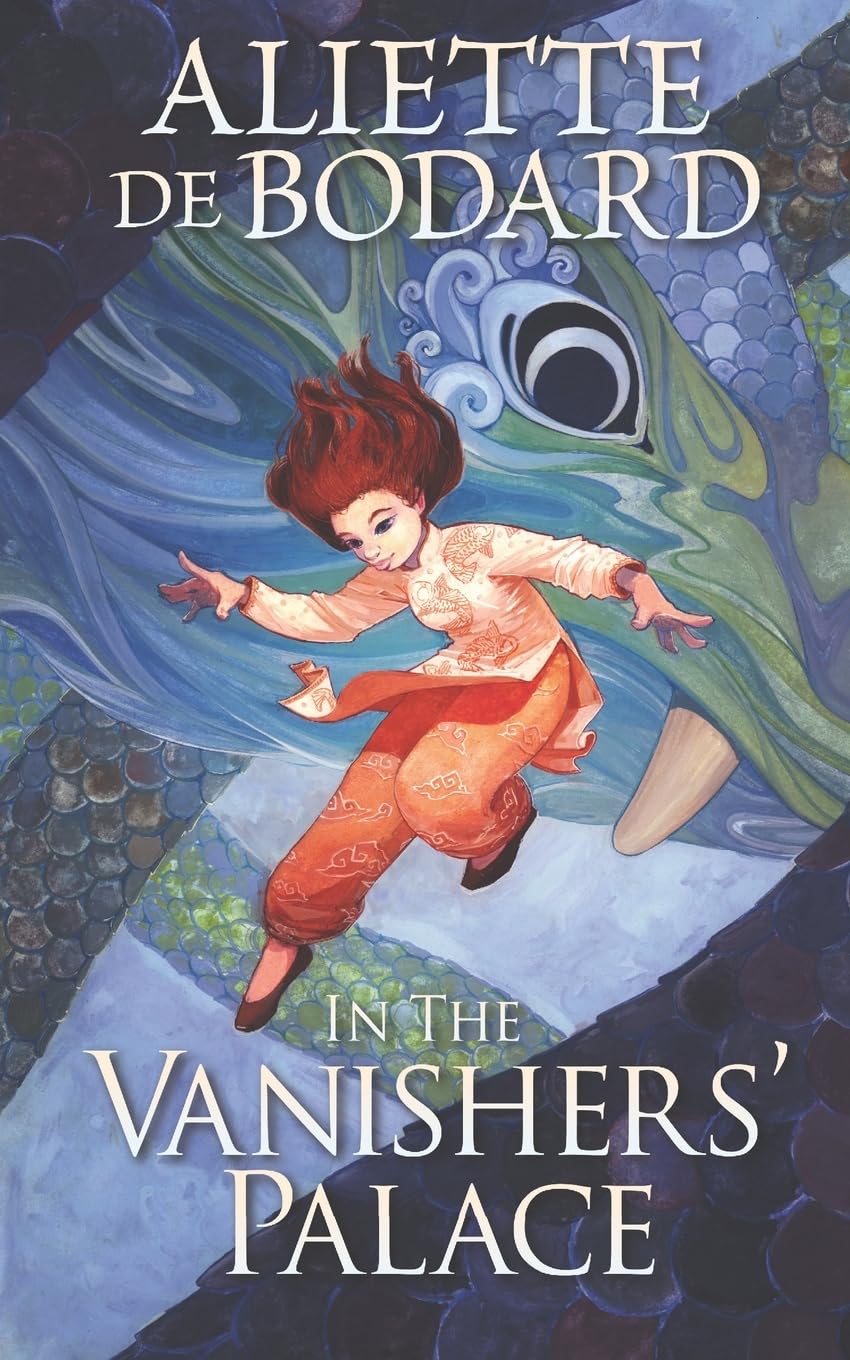
In the Vanishers’ Palace by Aliette de Bodard

This fantasy novel(la) comes billed as a reimagined, queer retelling of Beauty and the Beast. Perhaps I’m just working at a great distance from that original, but it didn’t recall it strongly for me. There is definitely a young girl kept captive in a palace by a being that’s understood to be a monster, and their relationship changes. The palace itself may have some powers. I see the parallels, but would never have thought of Beauty if I hadn’t been told to.

All of which is neither here nor there and has no bearing, for me, on enjoyment of the book. (Novella? At almost 200 pages, it might be pushing novella-length – these things are so tricky to define! – but it felt that contained, to me.)

Yên and her mother live in a somber village in a post-apocalyptic world, in which creatures called the Vanishers have (yes) vanished, but their legacy lingers: mysterious viruses, illnesses, and spirits, dangers lurking everywhere. Yên has failed as a scholar; her mother has value to the village as a healer, but as her mother’s just-mediocre assistant, Yên’s future is not assured. It does not surprise her to be sold away to pay off the village’s debts, to a frightening dragon: everyone expects she will be tortured to death by her new master, Vu Côn, but it turns out that Vu Côn (who can shape-shift between human and dragon forms) has other needs. She is the mother of intelligent, willful twins. And Yên, who had been teacher to her village’s children (apparently this was not judged a value??!), finds herself with new pupils.

Vu Côn and her children live in an abandoned Vanishers’ palace, a place of disconcerting, Escheresque, physically impossible dimensions and movements. The twins, Thông and Liên, possess powerful magic, and being nonhuman, as well as the children of her master, they give Yên different challenges than she’s faced with the village children. But they are children, nonetheless, clever and respectful of their new teacher (if headstrong), and she does care for them. Her feelings for Vu Côn are more complicated, blending desire with fear and resentment, and it appears this conflict is mutual.

The dragon’s eyes were a light grey, the color of storm clouds gathering. She was looking at Yên with an expression that was half-irritation, half-hunger, as if she would gobble Yên whole, given half a chance.

And what scared Yên most? This might, in the end, be just what she longed for.

Yên is dissatisfied living in the frightening Vanishers’ palace. She misses her mother and fears for her mother’s safety in their village; she misses home and knows it is unavailable to her, as the village elders who sold her away would never allow her return. She doesn’t know where to turn. And the readers understand before Yên does that there are deeper, darker secrets in the Vanishers’ palace than she’s yet discovered. But there are opportunities, too.

It’s a curious fantasy world, offering familiar elements (as they do) of our human desires and conflicts, but always with a twist – shape-shifting dragons, sure, but also, for example: Vu Côn has a magnetic sex appeal for our protagonist, but where I’m accustomed to seeing this expressed as heat, Yên experiences Vu Côn’s dragon-body as cold, wet, briny, and very sexy in these elements. That’s a new one for me, and I don’t find it easily accessible: “sea salt and cold, tight air, and a faint aftertaste like algae,” “wet cold creeping up her skin like fingers” – slimy, even! It’s an interesting twist, and one where I have to just trust in Yên’s tastes for Yên. But that’s what fiction asks of us, in different ways, right?

This was a fascinating adventure for me, in the ways that it did and did not fit into my expectations. And in the end, it calls upon some useful universals: big thinking about right and wrong, the way we relate to lover, friend, family, and community, the yearning for self-actualization and belonging. Dragons? Sure. I find Aliette de Bodard a lively imagination and I liked this punchy tale.


Rating: 7 strokes.

The West Passage by Jared Pechaček

Wildly imaginative world-building, a spellbinding plot, and profoundly weird characters make this fantasy debut a memorable adventure.

The West Passage by Jared Pechaček introduces a marvelously strange cast of characters struggling against outsized forces in a world both reminiscent of medieval Europe and unlike anything readers will recognize.

Pechaček’s teenaged protagonists are Pell, an apprentice to the Mother of Grey, and Kew, apprentice to the Guardian. One has trained in stories, songs, history, and rituals for births and deaths, the other in protection from the Beast. They live in Grey House, one of the five towers in an enormous palace that can take days to cross. Gargantuan, monstrous Ladies rule over the looming, decaying towers. The Ladies and their roles have changed and shifted slowly over many eras, their origins almost beyond all memory. Upon the deaths of the Mother and the Guardian, both Pell and Kew are thrust into positions they aren’t quite prepared for. Before the Beast rises again, for the first time in an era or more, they must each quest beyond Grey to save the world they know.

Kew departs first, striding fearfully with his books and little else down the West Passage. In just the early pages of his adventure, he meets a sort of trout-person and a creature with rabbit ears, battles with jackals, and rides in a lantern that moves to a whistle. Pell encounters apes and a crazed tutor, befriends a Butler Itinerant riding a hollowman, and collects an unlikely stowaway. Genders are changeable, and Ladies as well as wheelbarrows can hatch from eggs. Political machinations dating back to the “time of songs” are still at work in ways difficult for these protagonists to comprehend. “Was there no transfer of power that did not involve destroying the old? It seemed now that everything he knew about the palace’s history was the merest thread in a tapestry bigger than his mind could encompass.”

Pechaček provides detailed descriptions of otherworldly creatures: “Three corresponding shoulders sprouted beneath them, leading to three arms, though one was severed just above the elbow and capped with chased gold. The parts of her that were not talon-like were the same glassy material as her hands.” The effect is often disorienting but always fascinating, and despite extreme variations from the “real” world, questions about power structures and agency remain relevant. Pell and Kew have been brought up to uphold tradition and ritual, but to save the world, they must grapple with the possibility of change, and of choice.

The West Passage is an absorbing tale of political intrigue, touching comings-of-age, and a mind-bending phantasmagoria.


This review originally ran in the May 3, 2024 issue of Shelf Awareness for the Book Trade. To subscribe, click here.


Rating: 7 leaves.

Gods of Jade and Shadow by Silvia Moreno-Garcia

A little bit of a fairy tale retold, relying more on Mayan mythology, recast in 1920s Mexico: culture, myth, and universal coming-of-age. I found it absorbing and will read more by this author (helped along by the teaser chapters at back of book from one of her other novels!).

We meet Casiopea when she is in her teens. She still thinks often of her father, a sensitive poet who taught her about the stars and named her for a constellation. Since his death, she and her mother have returned to her mother’s family home, where they are very much treated as poor relations, Casiopea doing a lot of scrubbing on her knees while harshly spoken to. Her grandfather is harsh, her aunts dismissive, but it is her cousin Martín who is cruelest. She is well aware of the Cinderella story and would prefer not to be framed this way–“she had decided it would be nonsense to configure herself into a tragic heroine”–but the reader sees it too. Instead, she resist self-pity, aims to never let her tormentors see her cry, and dreams secretly of escaping her small-minded small town and returning to her father’s city of Mérida.

She gets there by the most unexpected of paths: she accidentally releases a god of death, Hun-Kamé, who has been long imprisoned in a chest in her grandfather’s bedroom. With a fragment of his bone imbedded in her thumb, they are bound together. Hun-Kamé, dethroned and locked up by his twin brother, is missing a few key components–eye, ear, finger, and necklace–without which he cannot be. In his weakened state, Hun-Kamé needs the connection with Casiopea to move and live and make a bid for redemption, although this bond will make him increasingly mortal over time. And Casiopea will weaken and die if he does not remove the bone. But in the meantime, she gains a traveling companion, a meaningful quest, an adventure.

As a traveling companion, Hun-Kamé can be irksome; he has a tendency to boss her around, like everyone else in her world does, and servitude and submissiveness have never come easily to Casiopea. She is not afraid to work hard, but does not respond well to peremptory orders. She has to remind herself that this is a god–especially when traveling companion begins to feel like friend, something she’s really never had, and then even like something more. For his part, Hun-Kamé makes an effort to treat his traveling partner with respect. They have something, surprisingly, in common: both know the world mostly only at a remove, she from books, he from a distant deity’s omnipotence.

There is a lot to love about this story, several layers. Casiopea is a fun heroine: plucky, exasperated, curious about the world and yearning for fresh new experiences, yet concerned about breaking free of the rather conservative lessons she’s been taking in for a lifetime. The wider world is in flux: especially the cities she visits, like Mérida, Mexico City, and Tijuana, are full of music, fast dancing, and short-haired women in short dresses, all considered scandalous in the dusty village where Casiopea has spent her Cinderella years. In the company of a god who can pick up rocks off the ground and make them appear as coins, she suddenly has access to (for example) good things to eat, and I really enjoyed the repeated scenes where the mortal teenager is hungry and the god sort of sighs and patiently visits one café or restaurant after another even though food is not really his thing.

So we have a good-hearted, mature, responsible teenager–who is still a teenager–on a very important quest, the implications of which she and we learn only gradually, but also learning about the world, which is filled with cars, nice clothes, appealing snacks, flappers and ballrooms, and oh yes, a handsome god who is becoming part-mortal and therefore increasingly relatable. But also, because we’re drawing on Mayan myth, plenty of blood and monsters and decapitation and the highest of stakes. (Casiopea is as horrified as you are). Romance, mythology, violence, humor, dances and dresses, and family drama: in a fitting parallel, Hun-Kamé’s rival twin chooses as his own mortal champion the bumbling, cruel Martín, who is unlikeable but only human in his own struggles, to face off against Casiopea. It gets harder and harder to see how these characters will fight their way out of a pickle that involves fate and gods and a truly horrifying underworld, but read on til the end.

I love every bit of it, and got lost in this unique world. Can’t wait for more.


Rating: 7 waves.

Emily Wilde’s Map of the Otherlands by Heather Fawcett

This is book 2 in a series, following Emily Wilde’s Encyclopaedia of Faeries.


This review contains spoilers for book 1.


Having wrapped up adventures in Hrafnsvik, Emily has returned to Cambridge and a more comfortable *tenured* position there. Her nineteen-year-old niece, Ariadne, has arrived on the scene as a student, as Emily’s self-appointed assistant, and as a fan and annoyance. Wendell remains nearby, also a fan: his proposal (from near the end of book 1) remains an open question. Now we know his own courtly-faerie identity, it also transpires that would-be assassins have begun to hound him, to reduce his threat to a distant and fearsome fae crown. Meanwhile, an antagonistic department head (ha) is also hounding Wendell and Emily both, seemingly out of some combination of suspicion about their academic integrity and a sense of late-career threat. Obviously, then (that is sarcasm), the whole troop winds up traveling together – Emily, Wendell, Ariadne, and the grumpy Dr. Farris Rose – to a tiny village in the Alps where a controversial dryadologist named Danielle de Grey disappeared some 50 years ago.

This returns readers to a little-populated setting Fawcett clearly favors. Not quite a closed room, the village and surrounding natural world still offer a useful limitation on outside distractions. Compared to Hrafnsvik from the last book, the residents of St. Liesl play a smaller role in this novel’s cast. It keeps that character list neat: Emily (still curmudgeonly, genius, deeply socially awkward, and more caring than she’d like us to know), Wendell (hedonistic, lazy, compulsively neat, and in love), Ariadne (enthusiastic and committed, but oh, young), and Rose (who may have something to offer, if he could get past his own unpleasantness), as well as the famed de Grey and the lovelorn scholar who has chased her, in turn, into misty faerie worlds. With this limited cast, Fawcett does well with humor and the tension Emily feels about her good friend and would-be lover. The fae creatures she studies continue to be a diverse and diverting bit of world-building. Action and development occasionally felt a bit rushed to me, more than I remember from book 1, but it was still a good time, and this is a book with momentum, that motivates the reader to stay up for just one or two more chapters. Also, I’m still pleased by the mild snark about academia, and the quirk of Emily’s character that she’s always thinking about what a good paper or conference presentation her current adventure will make, no matter how dire as it happens. I’m in for book 3.


Rating: 7 carrots.

The Mermaid, the Witch, and the Sea by Maggie Tokuda-Hall

There’s a little bit of everything in this unusual fantasy novel for older kids or young adults (or any of us, obviously). Sweet, heartwarming, and surprisingly bloody, The Mermaid, the Witch and the Sea offers mermaids, pirates, and young love. Imagine a bit of Treasure Island, but gender-bending and with a greater emphasis on political workings and class divisions. And magic.

We open with a murder on a pirate ship, then shift to high tea in a house of wealth and privilege. In the first scene, a teenaged boy named Florian earns his keep, having gambled on a life of piracy to save him and his brother from a life of deprivation and scant survival on the streets of the Imperial capital city. In the second, a girl named Evelyn chafes at the bounds of her household, where she enjoys status but not the love of her parents, who plan to send her away to be married to a man none of the family has ever met. Evelyn winds up on the same ship as Florian, where loyalties are split between factions supporting the Empire (who have colonized almost all of the known world, to the discontent of many) and the Pirate Supreme, who serves the Sea. “The Pirate Supreme’s forces were the only thing standing in the way of complete Imperial rule on the open sea. If pirates could still disrupt the merchants, still stymie the trade routes, then the Imperialists could not claim full control. Every robbery, every kidnapping, every galleon destroyed was a protest against the Emperor.” Some loyalties have yet to reveal themselves. And oh, Florian is also Flora, whose pronouns and identity as ‘boy’ or ‘girl’ shift throughout the story. “Both, maybe, but not neither.” “Both were equally true to her” (or him); “neither told the whole story.” Florian is Black and Evelyn is something like Japanese, although these seem to be descriptive details rather than identities that affect status or prejudice in their world.

Flora has lived life on the margins, making hard choices, fighting for life in the most basic ways. Evelyn has suffered a different kind of privation, unloved and lacking agency, but has never imagined the kinds of challenges Flora has faced. The two have much to learn from each other. And I haven’t even mentioned the effects of mermaid blood or its price on the open market, the scarcity of witches in Imperial colonies, or the far-seeing powers of a conscious Sea.

Delightful, weird, fanciful, queer coming-of-age with murder and magic. Violence, rather than sex, may recommend a readership in their teens more than their tweens, depending on blood tolerance, but the themes are solid: finding oneself, living one’s truth, navigating ethical puzzles, being a good friend. And it’s a page-turner to boot.


Rating: 7 haircuts.

The Golden Enclaves by Naomi Novik

**Spoiler-Free!**

Following A Deadly Education and The Last Graduate, The Golden Enclaves wraps up the Scholomance series. I am very pleased with this conclusion and the whole series. For spoilers’ sake, this review includes practically no plot summary.

As a series finale, The Golden Enclaves takes on a lot, and involves a ton of action, ranging very widely in the ‘true’ geographic world as well as in the void and the magical spaces that populate Novik’s imagined world. A number of characters take great steps; this is indeed a coming-of-age for El, who has graduated from the Scholomance and achieved some real victories, but only to step out into a larger world where the monsters are decided not all neatly taken care of. She’s suffering some losses, not least in realizing the limits of her powers: she is one of the most powerful wizards ever, but there are still limits. We see her take less advantage of the friendships and alliances we’ve seen her form up til now, but also find news ones and/or revive some that have lain dormant.

I love about this whole series that it offers commentary on class divisions and the ethics of who gets to be safe and cared for in the world. Those themes are strengthened here, and complicated. There is a very pointed conflict of interests that she calls a trolley problem, of the highest order; El must face that she cannot (so to speak) save them all, that every choice has a cost. In the face of this frustration, she wavers, considers giving up. We have learned that El is incredibly strong and strong-willed; she doesn’t give up easily. But we have also never seen her tested like this.

I love the characters, including one or two who are still ‘rising’, coming to center stage. I love El herself so dearly; she struggles so hard with this book, even after having accepted help and friendship, and her struggles often yield some good snarky humor and fun amid the pathos. Novik has enormous world-building power, which was evidenced at the series’ start but is still at play here, because our understanding of the world (and El’s understanding of it!) must expand considerably in this book. I’d recommend her to anyone.


Rating: 8 bricks.

Mr. Fox by Helen Oyeyemi

Of the Oyeyemis, this one leans toward the more accessible for me, which is not to say I entirely understood what was going on, but I had a lower rate of whaaat?? than in some cases. I’m still not sure what it is about this author that although she frequently bewilders me I’m still on board.

Mr. Fox is, in most cases, a writer. Mary Foxe is his creation: a fictional character, or a muse, or an imaginary friend. There is also a Mrs. Fox, Daphne, who is married to Mr. Fox in the (if you will) real world; in some versions she is his third wife. She is jealous of Mary Foxe, whose existence is often in some question. There are various iterations of these circumstances throughout the book; it claims to be a novel (it’s right there on the cover!) but I would buy it as a collection of linked stories. Sometimes there are literal foxes. Often there is some reference, if oblique, to fairy tales. I don’t entirely agree with the back-of-book blurb’s description of what happens here, which is interesting. It is possible that one of us is wrong, of course, me or the blurb-writer–likely me, although I’ve seen the other happen!–but I think it’s possible that Oyeyemi has left things a bit up in the air.

I thought we had an organizing principle, briefly, in the idea that Mary was pushing Mr. Fox to do less killing off of his characters, particularly his female characters. (He is not an especially likeable man, and this is one manifestation of something unpleasant about his attitude toward women.)

What you’re doing is building a horrible kind of logic. People read what you write and they say, ‘Yes, he is talking about things that really happen,’ and they keep reading, and it makes sense to them. You’re explaining things that can’t be defended, and the explanations themselves are mad, just bizarre–but you offer them with such confidence. It was because she kept the chain on the door; it was because he needed to let off steam after a hard day’s scraping and bowing at work; it was because she was irritating and stupid; it was because she lied to him, made a fool of him; it was because she had to die, just had to, it makes dramatic sense; it was because ‘nothing is more poetic than the death of a beautiful woman’; it was because of this, it was because of that. It’s obscene to make such things reasonable.

I would have been interested in this guiding principle for the novel, but that is not this novel. It’s only a thread.

I’m going to stop saying much about Oyeyemi’s books. I more or less understood this one and it was an interesting ride. I’ll read another. If you know of a class I could sign up for online to help these books make more sense, I would pay for such a class (no joking).


Rating: 8 fountain pens.

Starling House by Alix E. Harrow

I still love Alix Harrow! Starling House has been much anticipated, and I think it fits neatly into her body of work, combining fantasy and whimsy with darkness and grit, as well as romance and a touch of sweet, but not so much that you don’t still feel the hard bite underneath. This protagonist reminds me quite a bit of Chuck Wendig’s Miriam Black; she’s hard-edged and a resolute loner, even though her heart is much softer than she’ll allow. She’s rough and dirty and antisocial, damaged but so strong.

I’m a cheat and a liar, a trickster and a tale-teller, a girl born on the ugly underside of everything. I’m nobody, just like my mother before me.

Her name is Opal. No last name, or whichever one she’s chosen for herself in the moment, like her mother before her. Her mother died when Opal was fifteen, and she’s been parenting her little brother–who was only five–ever since. Jasper is her only priority in life.

I’m a high-school dropout with a part-time job at Tractor Supply, bad teeth, and a brother who deserves better than this dead-end bad-luck bullshit town… People like me have to make two lists: what they need and what they want. You keep the first list short, if you’re smart, and you burn the second one. Mom never got the trick of it–she was always wanting and striving, longing and lusting and craving right up until she wasn’t–but I’m a quick learner. I have one list, with one thing on it, and it keeps me plenty busy.

Jasper is smart and talented, and his debilitating asthma is a bad match for the coal town of Eden, Kentucky. Opal is determined to get him out.

But she is distracted by the magnetic pull of the Starling House, a mysterious old haunted mansion that you can’t see from the road, but this doesn’t stop Opal from dreaming about it. One day she just sort of allows her body to take her there, and she meets its latest enigma of an owner/resident: Arthur Starling, an unkempt, haunted man about her own age. They both know Opal should steer clear of the House, but the House has a consciousness of its own, and once the seal has been cracked–contact made–her life is irrevocably intertwined with Arthur’s, and the House itself, and its weird and inexplicable history. The Starling House, it seems increasingly clear, is all bound up with the town of Eden and the terrible bad luck and sin and crime and hopelessness that Opal wants so badly to free Jasper from.

This is a novel that focuses on place, history, what it means to belong, to stay or to leave, and the meaning of home. Eden’s history includes coal mining, slavery, exploitation, and class divisions. The Starling family has been around for generations, and their role is ever-changing and unclear; the Gravely family has been around just as long, and they are the wealthy coal and power magnates, handing out favors around town or made of pure evil, depending on your perspective. There are a host of other compelling characters, including a loveable motel owner and an even more loveable librarian and a country cop who, again, falls somewhere between doofy and evil. I quite like Jasper, too. Harrow is good with characters, although not all of these are equally well developed.

So, a strong sense of place and a big role for place to play in the narrative. Great characters, with cleverness and snark and grit. And an emphasis on the power of storytelling, and questions about story versus history. “I told myself that writing down somebody else’s story wasn’t as bad as making up my own, the way repeating a lie isn’t as bad as telling one.” “I know that part of the story must be made up, because there’s no such thing as curses or cracks in the world, but maybe that’s all a good ghost story is: a way of handing out consequences to the people who never got them in real life.” “I saw this old map of the Mississippi once. The cartographer drew the river as it actually is, but he also drew all the previous routes and channels the river had taken over the last thousand years. The result was a mess of lines and labels, a tangle of rivers that no longer existed except for the faint scars they left behind. It was difficult to make out the true shape of the river beneath the weight of its own ghosts… That’s how the history of Starling House feels to me now, like a story told so many times the truth is obscured, caught only in slantwise glimpses. Maybe that’s how every history is.”

Finally, at the heart of Starling House is a mystery about power dynamics and the very nature of reality–as well as monsters, imagination, dreams and hopes and hopelessness, family, connections and home, and even romance. It’s a wild ride of a good time. I’m enchanted.


Rating: 8 Ale-8s.

Her Majesty’s Royal Coven by Juno Dawson

This very sweet story of witches, female friendship, intrigue, and coming of age was recommended by Liz. It’s a fun combination of some pedestrian features of regular life – government bureaucracy, for example – with witchcraft and magic. We first meet a group of young girls on the cusp of being inducted into the adult witch’s world of the coven; then we flash forward to find them navigating that adult world in very different ways. Witches can be people of color and queer people, struggling with what that means for any of us in the real, mundane world, as well as the parallel prejudices and oversights of witches (who might be magic but are also just people). Niamh is mourning her late fiancé and just wants to keep her veterinarian practice going smoothly, but she also can’t turn down a young warlock (or witch) in need. Elle has all but renounced her powers, enjoying her cookie-cutter life as wife and mother, until her teenaged daughter shows signs that she’s got powers of her own. Leonie runs an important intersectional coven, with the support of her beloved girlfriend Chinara, but Chinara wants a baby and Leonie’s not sure she’s ready. And Helena… well, her role as High Priestess of Her Majesty’s Royal Coven may be her logical due. Or it may be just a bit much for her. A dire prophecy appears on the horizon, and these four old friends will be hard pressed to handle it each in her own way, to say nothing of how they relate to one another.

It’s really a clever, charming, smart, modern story. These four very different women are just muddling through life as any of us does, magical powers notwithstanding. They parent, find romance, make hard choices, try to do good, and maintain important old friendships – or let them go when they no longer serve. They have to wrestle with bigotry, and they fight for what’s right. They are sweet and strong. And this novel is the first in a trilogy! Thanks for the recommendation, Liz.


Rating: 7 kittens.