The Curious Case of Benjamin Button by F. Scott Fitzgerald

I was vaguely aware that the movie of several years ago was based on a book by F. Scott Fitzgerald. A new copy (the movie tie-in one, of course) crossed my desk at the library and I cracked it open. It’s a short story, as it turns out, just a little thing that they presumably built upon a great deal for the movie. I did not see the movie (I see very few movies), but I got the impression that it was more of a love story. This is not so of Fitzgerald’s original.

In the year 1860, Roger Button is dismayed, horrified and disgusted that his wife gives birth not to a screaming, red-faced infant but an old man, with the appearance of a 70-year-old. (And thus ends the role of Mrs. Roger Button in this story, strangely.) The little old manbaby is mildly disappointed, as well, with the strange reactions of his parents and, indeed, the world at large. Mr. Button tries to make Benjamin play with toys and other little boys, but neither man is pleased with the results. Benjamin is driven out of kindergarten by the disapproval of the teacher, but eventually finds a happy place at his grandfather’s side, smoking cigars and discussing what is wrong with the world today.

As the years pass, Benjamin grows younger. Roger sends him off to college at Yale, where he passes the examination but is turned away for his appearance: he looks like a man of fifty, despite being just 18. This works out fine, however, because he and his father get along swimmingly and find that they have much in common. Benjamin goes to work in the family business and makes a great success. He meets an attractive young woman at a dance and miraculously, she is attracted to 50-year-old men! (I can’t help but observe that male authors like to write this fantasy) and they marry. But as the years pass, he finds her unattractive as she ages, and she is exasperated by his appearing younger and younger. She seems to take this personally. He becomes a real man about town, going out, charming the young ladies, partying, and eventually neglecting his business concerns. He goes off to the Spanish American War, and earns a rank of lieutenant-colonel. Upon his return, he is feeling so young and spry that he gives college another whirl, this time at Harvard. In his freshman year he is a big hit, mature for his age, the star of the football team; but by his senior year, he finds the classes hard and he can no longer play football because his peers are bigger and stronger.

When he returns home, his wife has taken off, so Benjamin moves in with his son. The years pass, and a grandchild is born, and Benjamin becomes young enough to play with his grandson as peers. They attend kindergarten together, until the grandson moves on to first grade and Benjamin remains in kindergarten… until, in his third year, this becomes too challenging for him and he retires to be cared for by a nursemaid. He ends his life as an infant in a cradle, unaware of his surroundings.

It is a strange tale, imaginative, and well told; Fitzgerald knows his way around a phrase. There is a wryly funny tone to the early parts, with Roger Button trying to make an infant and a little boy out of an old man. Later, sadness becomes the dominant sentiment. There is an episode when the Army calls Benjamin back in for service, as a general; but when he shows up as a 13-year-old (or thereabouts) boy in a general’s uniform, he is laughed at and turned away in tears. Towards the end, as Benjamin begins to lose hold of his memories of the good times (newlywed happiness, military glory, playing football at Harvard), I thought of Flowers for Algernon.

This is a short, easy, very worthwhile story by a fine storyteller, and I recommend it. I do not feel especially interested in the movie which I fear is different, not as good, likely to disappoint – and maybe I’m wrong, but that’s my pro-book prejudice, and probably explains why I don’t watch more movies. Anybody have a movie review for me? Anybody both read and watched, and can make a comparison?


Rating: 5 buttons.

preview chapter: Doctor Sleep by Stephen King (audio)

As noted yesterday, there is a teaser chapter at the end of Stephen King’s The Wind Through the Keyhole for his upcoming book, Doctor Sleep. I am giving this one chapter its own post here because it grabbed me hard. Good job, Mr. King, you have me salivating for a book that’s not out til 2013. Thanks.

Doctor Sleep will be a sequel to King’s huge 1977 hit, The Shining, upon which was based the 1980 Stanley Kubrick / Jack Nicholson movie by the same name. I have neither read nor watched The Shining, but after listening to King’s reading of the first chapter of Doctor Sleep, I will. I have a copy of the audiobook (sadly, not read by King) on its way to me now. I got the storyline of both the book and the movie, and the differences between the two, off Wikipedia. I won’t regurgitate what I read; if you too need the background, go read up (bookmovie).

Doctor Sleep opens with Danny Torrance seeing dead people again, a few years after the death of his father and other frightening events at the Overlook Hotel. Dick Hallorann comes to town to help him deal with the trauma and the apparently very real risk of the ghosts (are they ghosts? these decaying corpses?) doing him bodily harm. Dick arms young Danny with a tool to protect himself, but the chapter ends with a sort of “and then they were safe… or were they?” moment. Oh the suspense!

Here I am pimping Stephen King, I suppose, and I don’t think he needs my help. But just the one chapter held my interest so thoroughly that it began to eclipse the wonderful Wind Through the Keyhole that I had just finished. I am impressed, am I intrigued, I am seeking out more Stephen King. Check him out.

The Wind Through the Keyhole by Stephen King (audio)

Edit – Update! I’ve just linked up to The Stephen King Project blog, where we’re being encouraged to read King (or listen!) and share our reviews. Thanks Natalie for the reminder. I didn’t join on purpose with a plan or anything, but I’m happy to be here now. …and back to the book review.

My word, this is lovely. I have never been disappointed in Stephen King, but this is definitely my favorite of those I’ve read. The Wind Through the Keyhole is part of the Dark Tower series, to which I am new, and therefore I appreciates the introductory remarks, in which King notes that it is not necessary to have read others in the series, but it would help to know a few facts about MidWorld, which he then relates. It’s true: I didn’t have any trouble following the action or keeping track of the rules of this alternate world.

King employs the story-within-a-story format here, and puts it inside another story for good measure. I got so immersed in the innermost story, about young Tim and his frightening journey into the forest in the starkblast, that when it ended I expected the book to end! I suppose it might have been jarring to then return to the story of young Bill and the skinman (which is in turn being told to the characters of the outermost story), but it wasn’t. I was just relieved that there was more to hear.

Stephen King reads this audiobook himself, and does it beautifully. I have listened to a handful of author-narrated audiobooks, and they have all been great. The actors, or professional narrators, are often wonderful as well, but some of these authors do amazing jobs too. Barbara Kingsolver’s reading of The Lacuna was extremely impressive, because of all the different accents necessary. It makes me marvel that a person can be such a talented artist in two different media! But I’m getting off track. Stephen King does a great narration, everything felt very real, and I was comforted knowing that the names of his imaginary lands and people were pronounced just as the author imagined them in his head.

So what is this book about? It opens with Roland Deschain and his traveling companions, chatting on the road to who-knows-where (presumably this is part of a larger storyline that I would know if I were reading the series). A particularly strange and threatening storm called a starkblast is coming, and they seek shelter, and find themselves up all night in the howling wind; so Roland agrees to tell them a story. This is where we leave the outermost story and enter the middle-layer story.

Roland is a young man and a novice gunslinger. I quote Stephen King’s foreward: a gunslinger is “one of a small band that tries to keep order in an increasingly lawless world. If you think of the gunslingers of Gilead as a strange combination of knights errant and territorial marshals in the Old West, you’ll be close to the mark.” He has just lost his mother – killed her, in fact, in an obviously traumatic incident that is only alluded to in this book – when he takes a trip with fellow youngster gunslinger, Jamie, to solve a mysterious series of bloody murders in a small mining town. It is theorized that the murders are being committed by a skinman, a shapeshifter. Roland befriends a young boy, Bill, who has witnessed his father’s murder, takes pity on him, and sits down to tell him a story Roland’s mother used to tell him when he was a little boy. This is the innermost story, and it is called – what do you know – The Wind in the Keyhole.

Once upon a time, in an ironwood-logging town called Tree, Big Ross is killed by a dragon in the woods. His partner, Big Kells, marries Ross’s widow Nell, and becomes stepfather to the boy Tim. Tim’s story is an adventure and sort of a dark and frightening fairy tale. He finds out a sinister secret about his stepfather and takes a journey deep into the treacherous forest where his father was killed; he encounters strange creatures, dragons, fairies, tigers, good magic and bad magic. This innermost story is the one we spend the most time with, and is set in a marvelous otherworldly world, fully developed, filled with creatures and characters and conventions and rules, fascinating and glorious and strange and scary, but also rather sweet.

Roland concludes the telling of The Wind Through the Keyhole to Bill, and then concludes the telling of Bill’s story to his companions, so that we close the stories we’ve opened and finish back with the elder Roland and his companions weathering the starkblast. There is a sense of circularity, and completeness.

The outermost story, of Roland and his fellow travelers, is engaging and also set in another world (MidWorld) I found interesting and would like to hear more about. The middle-layer story, of the young Roland seeking the skinman, involves some good old-fashioned detective skills and has a satisfying conclusion. But the story of young Tim and his quest through the forest was clearly the star. I was entranced, and sorry it was over. I shall be searching out more King, without a doubt! And I appreciated his narration, as I said earlier; I hope he’ll continue to narrate his audiobooks.

Stay tuned: tomorrow I’ll tell you about the teaser chapter for an upcoming book that was included at the end of this one.


Rating: 7 puppy dogs.

Blackbirds by Chuck Wendig

My paperback copy of Blackbirds instructs me (on the back cover, at the top, near the spine) to “file under Urban Fantasy.” I am a fan of these labels, not least as a librarian (!), especially with a book like this one that deviates from my usual genres a little bit. (My usual genres, if you’re a new reader, are mystery/thriller and various nonfiction, especially biography/memoir and nature writing.) So, this is fantasy. Urban. With paranormal aspects. And a very dark tone.

Miriam Black knows when and how people will die. All it takes is skin-on-skin contact. Shake her hand, bump her bare arm on the bus, and she sees your final minutes or moments in a flash. This is, not surprisingly, disturbing and traumatic for Miriam, but she’s learned how to make it work for her. She describes herself as a vulture, not a falcon: she doesn’t cause death (indeed, when she’s tried to stop it, she can’t, and often makes things worse), but she feeds off it. At the very least, she’ll rob the corpse.

This has gone on for a number of years at the opening scene of Blackbirds, and Miriam has developed a cynical, detached outlook that allows her to view death without so much internal damage. Of course, she’s experienced trauma in her life, not all of it linked to her unique gift. But then two forces impact the carefully orchestrated system she’s worked out. First, she meets a man – a nice man, in fact – and shakes his hand, and sees something she’s never seen before: a death scene in which she plays a role. Next, she meets another man who knows what she is and what she can do, and wraps her up in his own con.

The chronology of this story jumps around, which is a format not all readers appreciate, I know; but I think it works nicely here. We follow Miriam through “real time” in main chapters, and spliced in between are interludes, in which we hear her story as told to a young journalist, and the stories of other characters as told to Miriam. Chronology is further confused by the time-travel element in Miriam’s vision. Well, it’s not time travel, but it is a brief view of future events: she sees what happens and knows exactly when, without the benefit of knowing where or why. So we know what we’re rushing up to, but not how to get there.

This is a fast-paced, tremendously suspenseful read. I read it through in one sitting. [Warning: make time for this.] The sense of time passing, of momentum, is great. I couldn’t put this book down and halt the progression of Miriam’s fate; the stakes were too high! While there’s a feeling of inevitability, the ending applies a twist. I loved the dark atmosphere, too. Miriam is damaged, foul-mouthed, crude, but good-hearted and vulnerable, like so many great hero-villains. [While not entirely like any of them, Miriam evokes certain elements of Jack Reacher, Dave Robicheaux, Harry Bosch, Lizbeth Salander, and Mallory.*] In fact, my pleasant-surprise-observation is that this book is more similar to some of my murder mystery/thriller favorites than I expected. I think I feared a gothic blood-sucking-evil-death darkness and/or horror elements that would be too much for me, but instead I find this a great crossover read, and will be seeking more Wendig. Apparently there is a sequel coming soon! I am anxious!


*Fictional characters written by, respectively, Lee Child, James Lee Burke, Michael Connelly, Stieg Larsson, and Carol O’Connell.


Rating: 8 deadly daydreams.

Teaser Tuesdays: Blackbirds by Chuck Wendig

Teaser Tuesdays is a weekly bookish meme, hosted by MizB of Should Be Reading. Anyone can play along! Just open your current read to a random page and share a few sentences. Be careful not to include spoilers!

I’ve been a fan of Chuck Wendig’s blog for some time, but just now got around to reading one of his books, Blackbirds. And it was fabulous! Here’s a taste:

Miriam’s been walking for a half-hour, and the thoughts that run through her mind have serious legs. Terrible thoughts jog swift laps.

Is that not a great line? This is actually an example of one of the details of Wendig’s writing that I appreciate: the personification of things like, well, thoughts. It’s evocative. Miriam is just the kind of character I find fascinating, too: cynical, damaged, tough but vulnerable, and of course, well-developed. (As a character. Not in her bosom.)

And what are you reading today?

Tales from Watership Down by Richard Adams

in lieu of a cover shot, since mine is a plain hardback missing its dust jacket, I give you one of the fine illustrations from within.

As I noted in my book beginning post last week, I am taking this one out of order, since I have not yet read Watership Down. That original is a well-regarded fable or heroic tale about a group of rabbits overcoming odds to start a new life; these Tales are a late sequel (published more than 20 years after the original), and come in the form of a collection of short stories. They include the fables that the rabbits of Watership Down live with (their own cultural mythology, if you will) as well as stories involving the rabbits of the present day. They are sweet and curious; Adams includes a lapine glossary and gives these anthropomorphized bunnies their own societal norms and shared history. Some of these tales resembled some of the other great heroic myths in our own culture’s tradition; I thought of the ancient Greeks, for instance, because there is some question of god’s (or gods’) interference in the lives of mortals (rabbits). The stories were interesting, somewhat familiar in themes but engrossing. In a nutshell, I enjoyed them very much; they made for a quick, easy, entertaining, evocative session. The emotions that the rabbits feel – courage, fear, love, concern, friendship, curiousity – were very real, and I cared about the characters. Oh, and they have such lovely names! That said, I definitely felt the hole left by my failure to read Watership Down first, and think that that would have enriched the experience. Big events are referred to and not explained; I feel confident that’s what the first book did. So, recommended, but probably not until you’ve read the original, which I shall look forward to doing.


Rating: 5 bunny ears (probably more if I had read the first book first).

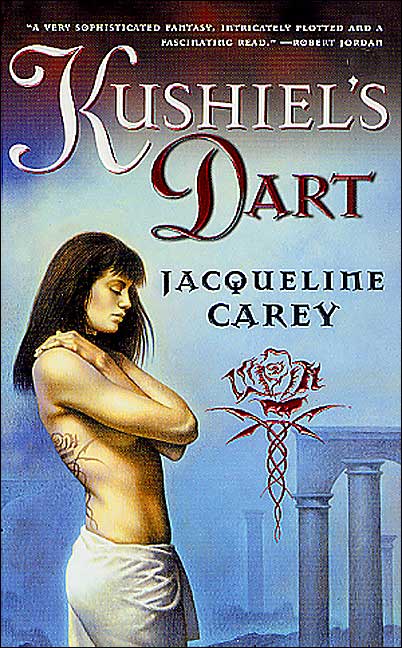
Kushiel’s Dart by Jacqueline Carey

Yet another hit for Amy, my sci-fi friend. She’s 4-for-4 now, by my memory: first she gave me a (rare!) copy of Thank Heaven Fasting (the non-sci-fi outlier); then lent me The Hemingway Hoax; then recommended Soulless and now Kushiel’s Dart.

This is truly an epic masterpiece of world-building. I will go so far as to mention J.R.R. Tolkien.

I am a little bit challenged to categorize this story further; sci-fi I suppose it is. It is also speculative fiction? These genres are a little out of my league! There is some romance; there is plenty of sex. There is political and courtly intrigue. Think Tolkien for the world-building, and then add Philippa Gregory for the courtly intrigue and playful sex, even Sharon Kay Penman’s attention to detail; but it’s never slow! Oh no, I read these 901 pages (901!) in a two-day weekend. Many long hours and some lost sleep, but well worth it.

I don’t expect to be able to do much with plot summation, but I’ll try and give you a taste. The people of Terre d’Ange worship the demigod Elua and his Companions; the words he gave them to live by are, “love as thou wilt.” Love – or more to the point, sex – is considered a form of worship, and an entire class of men and women are raised from birth to be Servants of Naamah, the goddess-prostitute. They’re trained, then, in courtly manners as well as sexual tricks, which they perform for fees until the House that trained them has been paid off, and then they are free to continue in business for themselves or to pursue whatever path they choose.

Phèdre would have belonged to one of the Houses of the Servants of Naamah, but she was born flawed, or marked, by the dart of Kushiel, the one of Elua’s companions who loves pain. For her, pain and pleasure are forever linked. She is raised by an individual, not a House, and trained for a specialized kind of service, one that combines pain and degradation with sex. Her patron/caregiver/adopted parent is Anafiel Delaunay, and he has more in mind than the profits of her work; he trains her not only as a very high-class courtesan, but as an information-gathering multilingual scholar-spy. It is unclear to the young Phèdre what Anafiel’s political goals are, but she is very talented at playing her own role in his game, and she is deeply committed. Anafiel is a beloved father figure.

All of this transpires in the first third or less of the book, but I’ll stop here. Phèdre gets involved in matters of state much larger than she could ever have expected, and it will take all her formidable skills to protect herself and those she loves – and maybe, to save her nation.

I found Kushiel’s Dart to be incredibly engrossing. I couldn’t put this book down; I just couldn’t bear to leave Phèdre in a predicament. I came to love and root for her companions; I was invested in this story. I recommend it to anyone who likes to get lost in another world – and the world of Terre d’Ange and her neighboring nations is most definitely “other,” although there are recognizable traces of our own.

Amy tells me that this is the first in a trilogy, and there are three trilogies; but she assures us that each trilogy stands alone. This first installment stands alone outstandingly well too, although I won’t say you won’t be tempted to keep reading further! She also assures us that the books, if anything, improve as the series develop. All good news there.

Has anyone else discovered these outstanding epic novels? Anyone tempted to? I recommend!

vocabulary lessons: The Great Night

Sometimes I learn a lot of new words from a book. For bookmarks, I don’t use pretty bits that were designed for use as bookmarks; I use scraps of paper (usually, something that’s been printed on one side and discarded, which I then cut into quarter-pages for just this purpose). I try to carry a pen, and I take notes on the bookmark about questions I have, or passages I might want to come back to later. This way, I can look up that reference to a book, movie, or person I wasn’t familiar with; I can quote a passage in a blog post; or I can look up the meaning of unfamiliar words and go back and reread the sentence with a new understanding.

The Great Night was full of learning opportunities – so much so, that I thought I’d share them here.

Monchhichi – okay, maybe everyone knew this one but me. Apparently a Monchhichi doll is a Japanese stuffed monkey with a certain “look” to it, thus the usage: “…might… run into a girl with a Monchhichi hairdo who could demonstrate that it didn’t matter at all…”

cosmesis – the preservation, restoration, or bestowing of bodily beauty. (very appropriate for fairy-land?) “So she did magic instead, scene by scene, working a sort of dual cosmesis upon the players and the play…”

irenic – tending to promote peace or reconciliation; peaceful or conciliatory. “…her wild spasms contrasting with the irenic strains of the music.”

capacitous – having large or exemplary capacity. “How odd, she thought, and how horrible to see them still there, slosh full of tears and regret, but no more capacitous, and perhaps not as full, as her own.”

These were all so very new to me! (And I had to look up the movie Soylent Green, too. Fairly integral to the plot, actually.) I love learning while I read. Have you spotted any new words lately?

The Great Night by Chris Adrian

This book is billed as a modern-day retelling of Shakespeare’s A Midsummer Night’s Dream, which sounds fairly ambitious. The original classic is far too much to mess around with lightly. I find it beautiful, haunting, magical, and surprisingly accessible; I think anyone and everyone should be able to enjoy a production of this play, which might not be true of all the bard’s work, no matter how wonderful. But I have to give Adrian full credit: I feel that he created something new out of it, definitely a recognizable retelling, but something new and beautiful in its own way, very different and very wonderful too.

Three young people, Henry, Will, and Molly, are all (separately) lost in Buena Vista Park in San Francisco at dusk on midsummer night’s eve. All three were on their way to the same party which none really wanted to attend; all three are tenuously connected without actually knowing one another; and all three are quite neurotic in their own ways. Meanwhile, Titania is grief-stricken, having lost her Boy to leukemia (and being unfamiliar with the mortal concept of death), and then having lost Oberon, who left her when they quarreled in their shared grief. In despair and resignation, she releases Puck from his bond of servitude, and he rages as the Beast throughout the park. Also meanwhile, a troupe of homeless aspiring actors meet to rehearse a musical play, but are separated, as the fairies come out to frolic, or flee Puck, or make mischief.

Chapter by chapter we get inside the heads of the three mortal lovers, and sometimes of Titania too. The character development is exquisite; I loved learning more about the histories of Will, Molly, and Henry, and gradually putting together the clues and learning how they’re interconnected and where their respective neuroses might have come from. The depth of these complex, nuanced, disturbed characters might have been my most favorite part of this book.

Titania gets substantially more development, too. The lengthened and deepened relationship with the Boy, and his battle with cancer, allow for her to mature and look outside herself in ways that a fairy queen would not normally be called to do. Even Puck gets a more significant personality, and desires of his own.

Part fairy tale – of course – The Great Night has all the magic and all the lavish scenery that Shakespeare’s Titania & Oberon could have wanted, helped along by the alternately lush & misty San Francisco parkland. As in the play, there are disturbing moments; but these are fully fleshed out. I guess the great difference here is that this is a lengthy novel (~300 pages) with all the exposition that comes with this format, and there is simply less opportunity in a slim play for this kind of development. But Adrian’s work is darker, and more graphic. (There is Sex. Seriously.) The ending is not lighthearted and happy as it is in A Midsummer Night’s Dream. Among the mortal characters, we meet a tree doctor; men and women recovering from the suicides of loved ones; and the mess that OCD can make of a life; the lovers are gay and straight but always damaged. But the worlds are so fully realized… and the three youth are so fully developed, I ached for them. When every chapter closed, I regretted leaving that chapter’s focus character, but was happy to reunite with the next.

This was one of those books I was very sorry to see the end of. I wish there were more. Luckily, Adrian has written other books!

I recommend The Great Night. Certainly nothing is taken away from Shakespeare’s masterpiece; but this is a different realization of the same story-skeleton, in a different format, and it is absolutely an accomplishment all by itself.

Teaser Tuesdays: The Great Night by Chris Adrian

Teaser Tuesdays is a weekly bookish meme, hosted by MizB of Should Be Reading. Anyone can play along! Just do the following:

* Grab your current read
* Open to a random page
* Share two “teaser” sentences from somewhere on that page
* BE CAREFUL NOT TO INCLUDE SPOILERS! (make sure that what you share doesn’t give too much away! You don’t want to ruin the book for others!)
* Share the title & author, too, so that other TT participants can add the book to their TBR Lists if they like your teasers!

This is the modern-day re-telling of Shakespeare’s A Midsummer Night’s Dream, in which three young people wander into a San Francisco park at dusk and have adventures while Titania searches for her lost love, Oberon, who left her when they fought following the death of their Boy. So far I’m finding it to be a beautiful, evocative painting of a book. I like.

From page 146:

There was another, grander room beyond them, a cozier hall than the last, only about half as big, with grass on the floors and flowers on the walls, and a ceiling hung with hundreds of little colored lanterns. It was empty of furniture except for a table the size of a flatbed truck piled with food and surrounded by chairs of every conceivable size, and empty of people except for the girl, who had called herself Eleanor Roosevelt. She was sprawled in a chair with a bottle of wine in her hand.

“You all again,” she said.