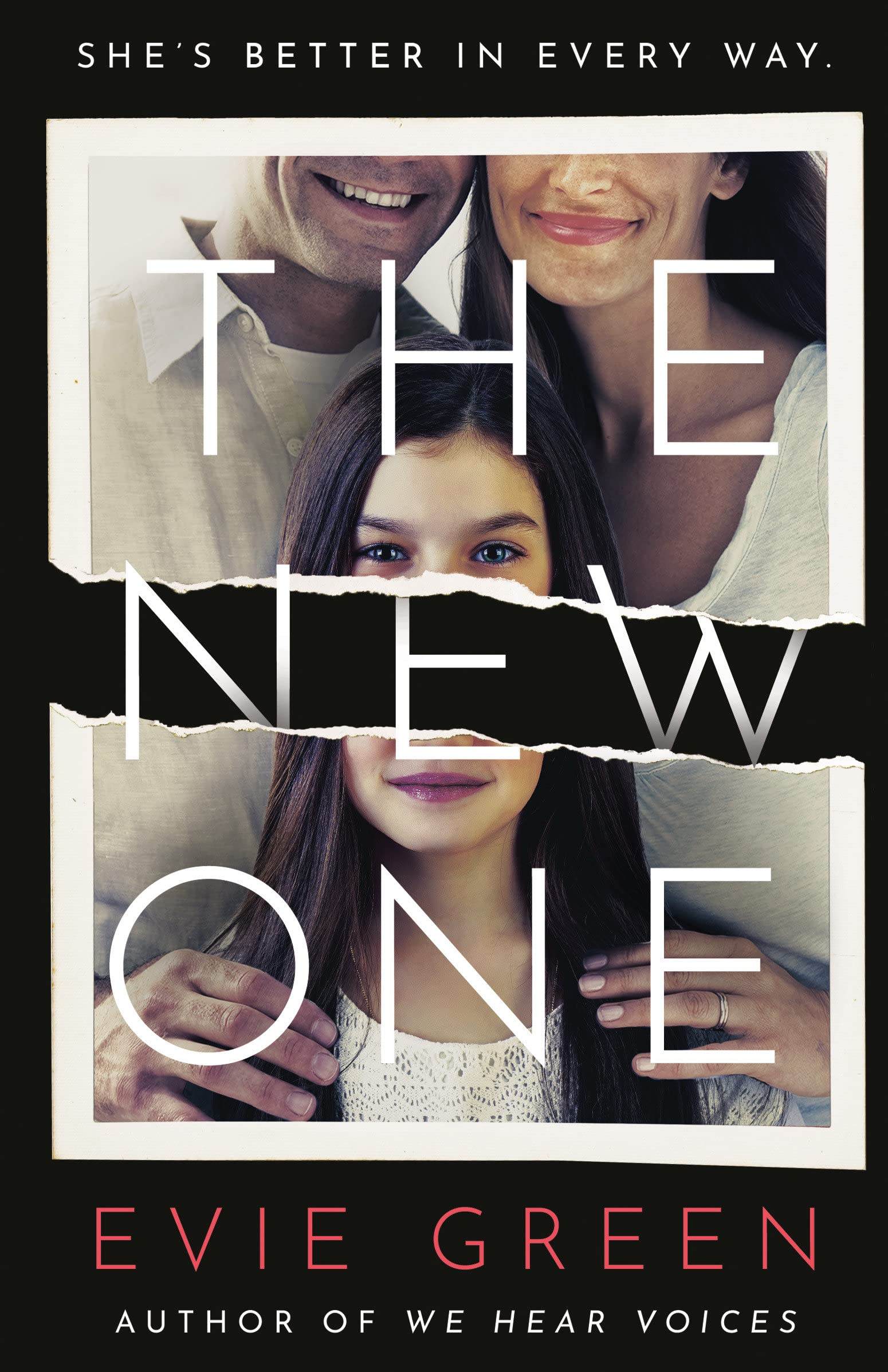
The New One by Evie Green

Artificial intelligence, family troubles, love and aspiration combine for a delightfully suspenseful novel of secrets and betrayal.

In The New One, Evie Green (We Hear Voices) takes readers on a propulsive journey through grief, loss and secrets kept by those we love. This compelling novel will have readers up all night, following the tribulations of a struggling family offered a great gift–or possibly a curse.

Scarlett, the Trelawneys’ daughter, was a perfect angel–brilliant, beautiful, sweet, gifted–until she turned 13. She then becomes a terror: lying, staying out late at night, neglecting her schoolwork. “They had become a shouty family,” Green writes. “They all yelled at one another every day, and [Tamsyn] had no idea how to stop.” In near-future Cornwall, Scarlett’s parents, Tamsyn and Ed, are barely surviving in their humble camper: Ed works nights, and Tamsyn is up early mornings, “a peasant working in fields.” They subsist on stolen cauliflowers and rarely speak to each other (without shouting). Then tragedy strikes: Scarlett is left lying in a hospital bed in a coma, and Tamsyn fears she’ll never see her daughter conscious again. Just as their insurance runs out, they receive an offer that seems a mix of magic, miracle and horror: while a company called VitaNova rebuilds their daughter, the comatose Scarlett will receive the finest medical care, and her parents will be granted a fully funded fresh start in Geneva, Switzerland. Scarlett, now named Sophie (her middle name), is part human clone and part AI. She shares Scarlett’s memories and gifts, although with the traumatic past year erased, and has been augmented with a better knowledge of French and physics–and a perfect, innocent love for her parents.

Most of the story is told from Tamsyn’s point of view, with brief ventures into the perspectives of the other members of her family. Tamsyn is unsure of her manufactured daughter: this new one is so like her darling Scarlett that she’s impossible not to love. But Tamsyn grasps what Ed seems not to: their real, true, original daughter still lies unconscious, and every bond with Sophie represents a small betrayal.

The New One‘s creepy Stepford atmosphere is not to be underestimated. Readers can see what even Tamsyn cannot: Sophie understands more than she seems to, and her best interests and Scarlett’s may not align. Ed is keeping secrets. Geneva is a bit too perfect. Green’s (aka British author Emily Barr) prose is compulsively readable, her characters disarming and capable of great mystery. The New One is deliciously disturbing, engrossing and surprising at its every turn. This not-to-be-missed novel of family dynamics and what it really means to be human and to love is both pleasurably escapist and thought-provoking.


This review originally ran in the February 23, 2023 issue of Shelf Awareness for the Book Trade. To subscribe, click here.


Rating: 8 DVDs.

What Happened to Ruthy Ramirez by Claire Jimenez

This debut novel about a family still searching for a long-missing daughter and sister brims with voice, attitude and yearning.

Claire Jimenez’s first novel, What Happened to Ruthy Ramirez, brings to life a close but troubled Puerto Rican family in Staten Island, N.Y., carrying on but rocked by loss. “The five of us seem normal for a while, up until Ruthy turns thirteen and disappears…. Draw my mother sixty-two pounds later. Give her diabetes. Kill my dad. Cut a hole in the middle of the timeline. Eliminate the canvas. Destroy any type of logic. There is no such thing now as a map.” No one ever figured out what happened on the day Ruthy didn’t come home from track practice on the S48 bus as expected.

More than a decade later, Nina, the baby, is “blessed with the brilliant luck of graduating [from college] into the 2008 recession,” the first in her family to attend college but now returned home to live with her mother and work at the mall selling lingerie. Jessica, the eldest, lives with her boyfriend and their baby; she works as a patient care technician at the hospital, harried and tired but proud of her work. Their mother, Dolores, depends on her relationship with God and the church. What Happened to Ruthy Ramirez unfolds in alternating chapters, through the first-person perspectives of these four central characters: Nina, Jessica and Dolores in the late 2000s and the stormy, troubled 13-year-old Ruthy in 1996 when she disappeared. The latter is all attitude: You really want to know what happened to Ruthy Ramirez, she asks? Most people “think they got it all figured out, about who I am and what happened. Whatever, who cares? Not me, I promise you.” She describes the day it happened, the schoolgirl dramas and fights, whose pain appears superficial only from the outside. Years later, her sisters and mother struggle with everyday life and with moving on–until the day Jessica believes she sees Ruthy’s face on a sordid reality TV show: the woman shares the missing girl’s beauty mark, her laugh, the toss of her head, a couple of key phrases. And the remaining Ramirez family is off on a mission to recover their lost member.

One of Jimenez’s greatest achievements lies in the individual voices of her narrators, crackling with life, wit, humor, pain and personality. Jessica and Nina wrestle with the complicated love they feel for their family; Dolores rants in a well-meaning but frustrated one-sided conversation with her God; Ruthy oozes teenaged bravado and angst. Readers will be tugged by hope and despair alongside these true-to-life characters. In the end, What Happened to Ruthy Ramirez offers observations about race, class, family and the fate of missing girls beyond its title character.


This review originally ran in the February 7, 2023 issue of Shelf Awareness for the Book Trade. To subscribe, click here.


Rating: 7 grilled cheese sandwiches from the school cafeteria.

Lookout by Christine Byl

This astonishing novel of work, love, community and forgiveness in 20th-century rural Montana will leave readers forever changed for the better.

Christine Byl’s Lookout is an unforgettable novel, both stunning and subtle, written with nuance and compassion. With all the down-to-earth lyricism displayed in her memoir, Dirt Work: An Education in the Woods, Byl transports readers to rural Montana in the 1980s, ’90s and 2000s, where the Kinzler family lives, works and loves. These characters, whose bonds are gorgeously rendered and even inspirational in their imperfections, are deeply lovable.

Josiah Kinzler’s family history includes alcoholism and suicide; he is alone in the world before he is 20 but possesses land, skills, a work ethic and strong ties to his neighbors. He marries Margaret Blanchard. Together they eke out a living in her father’s hardware store and eventually through Josiah’s highly regarded furniture-making and woodworking. Their two daughters, Louisa and Cody, are remarkably different from one another but as fiercely loving as their parents. The family will grow into nontraditional shapes, but its members never lose their commitment to one another. Each is complicated, fully developed and sensitively drawn.

Chapters shift between a third-person perspective and the first-person voices of various characters–not only the central Kinzlers but also various members of their community. In this way, Byl offers triangulations on events and characters. These secondary characters’ perspectives enrich the story enormously, as when a neighbor who has known Josiah from childhood observes the latter’s marriage and fatherhood: “He loves those girls, and I can see his ease with them that I have not found with my own sons.” Montana in the 1980s and ’90s is not without its problems: gay characters struggle to find acceptance, and American Indians’ claims to the land are dismissed. Families and individuals struggle with mental illness and addiction. But Byl treats the people and their problems–even the shortsighted ones–with grace and frankness. Frequently, characters do the same for one another.

Lookout, which contains evocative expressions of love, is lush in its descriptions of relationships, the natural world and Josiah’s exquisite woodworking. Byl writes with an attention to the details of her characters and setting: “A heavy snow in early May buried pasqueflowers and daffodils and the barely rising shoots that would become the season’s crops, but by the end of the month, the sun lit up like a match.” Cody and her father are similarly laconic and watchful; they share a special bond, as displayed in a stunningly beautiful scene in which he proudly watches her run a chainsaw just as she was taught. Many of the relationships and family systems represented are unconventional–but sensitive and thoughtful. Lookout specializes in the quiet observation of transcendent truths about many facets of life.


This review originally ran in the January 26, 2023 issue of Shelf Awareness for the Book Trade. To subscribe, click here.


Rating: 10 dried pansy petals.

The Same River Twice by Chris Offutt

First book I’ve read in the new year and it is a big winner. I read Offutt’s No Heroes some years ago, and I have a few clear memories of it – and I gave it an 8 – but I have to say it’s faded some since then. This one, I think, will be different. From the first pages he had me nodding along in recognition and agreement, when I wasn’t laughing til my sides split. This is a remarkable book in several ways.

For one thing, as an example of craft and structure in memoir, I appreciated the format: alternate chapters switch between two timelines, one (the narrator’s present) in which his wife is pregnant (with the courtship & marriage compressed at the start), and an earlier one in which the younger man leaves his home in the eastern Kentucky hills and travels for more than a decade around the country as an itinerant, not to say bum, short-term laborer and modestly aspiring artist. In the end, this is a memoir of becoming a father. The younger Offutt’s travels, bumbles, attempts at self-destruction eventually make him the man (for better or worse) who meets Rita, marries, and enters on purpose but somewhat reluctantly into the pregnancy that defines the narrative present. When the two timelines meet at the book’s end there is, again, heavy compression, rushing us through Rita-to-pregnancy; I can sense some readers protesting at that rush, but I think it suits the scope of this book. True memoirists have at least several memoirs in them; there’s a piece of Bernard Cooper wisdom on this topic. The Same River Twice is about Offutt becoming a father within himself. It’s not so much about Rita, who in these pages is a lovely and likeable person but mostly remains off-page.

In his roamings of the country, Offutt recalls Blue Highways (maybe even On the Road) but with perhaps more angst – or at least angst that felt more familiar to my own – and definitely more laughs. I could hardly breathe at Offutt’s first couple of sexual encounters, and his adventures in the Florida swamp had me pretty riveted. This is some of the best humor writing I’ve seen in some time.

And on the other hand, in the later timeline, a more mature and serious-voiced narrator (who nonetheless self-deprecates) walks alone in the floodplain woods near his and Rita’s rental home on a dirt road on the Iowa River. This man is contemplative and highly observant of the natural world. He’s struggling with pending fatherhood; he always wanted children but felt less ready than Rita. She worried about her age, while he worried that he still lacked stable employment (he’s trying to sell his writing) and general responsible adulthood. When Rita becomes pregnant, he feels pride, relief, and happiness that she is happy; he feels terrified of the responsibility, and selfishly (he’d say) sorry to lose his freedom. He’s afraid he’ll damage his child; his father has always said he comes from a long line of bad fathers. Fear, in fact, is paramount. “I fear the loss of independence although I didn’t do so well alone.” He’s on a journey to learn about pregnancy and babies, partly through library books and an ill-fated hospital-based Lamaze class, but also via walks in the woods, where he watches the natural world cycle through life and death. Seamlessly integrated facts about biology and natural and human history add to his musings. If the earlier hapless-bum episodes are woeful and hilarious, the older man is quietly thoughtful and wise (even if he denies it). I thought there were some fascinating observations about what it means to be a parent. (I am not a parent. I did call up a few friends to discuss their experiences.)

Let me also note, I found Offutt because of my connection to writing in Appalachia. Relatively little of this book is set there: we see young Offutt leave as a teen, with two brief returns (one for recuperation from injury, one under great duress for his brother’s wedding); otherwise he is all over the country or settling in Iowa. But eastern Kentucky looms throughout; it’s what he’s escaping and it continues to define him, most obviously in the accent that other people feel marks him as a type.

Where I’m from, the foothills of southern Appalachia are humped like a kicked rug, full of steep furrows. Families live scattered among the ridges and hollows in tiny communities containing no formal elements save a post office… Our hills are the most isolated area of America, the subject of countless doctoral theses. It’s an odd sensation to read about yourself as counterpart to the aborigine or Eskimo*. If VISTA wasn’t bothering us, some clown was running around the hills with a tape recorder. Strangers told us we spoke Elizabethan English, that we were contemporary ancestors to everyone else. They told us the correct way to pronounce “Appalachia,” as if we didn’t know where we’d been living for the past three hundred years.

This is a narrator who then travels to, of all places, Manhattan, where he has to relearn how to walk to accommodate the traffic of other people doing the same thing near him. After some hours on a bench watching New Yorkers walk near each other, he concludes his stride is too long and regular for the environment; the locals use quick, short steps, like dancing. “As long as I concentrated, everything was jake, but the minute my attention wavered, my gait lengthened and someone’s legs entangled with mine.”

Offutt makes repeated references to Kentucky’s Daniel Boone and explorer-to-America Christopher Columbus, as he styles himself also an explorer and a frontiersman, but without the aggrandizement that implies. “Two hundred years back, someone asked Boone if he had ever been lost. He answered no, but that he’d once been bewildered for three days. I knew exactly how he felt.” On returning home for the brother’s wedding: “After Columbus’s third trip across the sea, he was brought home in manacles and chains. I knew how he felt.” The aspiring-writer Offutt is a funny thread: he journals compulsively, copiously, but despite defining himself as a poet for a long stretch, writes no poetry. (He also decides to be a painter and a screenwriter at different points without actually producing any art.) I loved this bit:

My adherence to the jounal slid into a strange realm where I viewed my immediate interactions as a form of living diary. If riding a bicycle through a snowstorm sounded like good material for the journal, I borrowed a bike in a blizzard. The actual ride didn’t matter. What I did was try to observe myself as carefully as possible, while simultaneously imagining myself writing everything down later.

If that doesn’t sound like a social media obsession before its time, I don’t know what does.

Offutt is a gorgeous writer of prose. The subject matter – family dynamics and stress, the natural world, travel and restlessness, the meaning of life, place and particularly Appalachia, the angst of trying to be a writer – certainly speaks to me. An entire chapter is devoted to the importance of names (a special interest of mine). But the writing is notable for its own sake. Check out this metaphor-to-simile turn: “The sky was a gray flannel blanket like a watercolor background with too much paint.” And metaphor plus anthimeria: “The riverbank is a crouching porcupine, bare tree limbs quilling the sky.” This is probably my favorite travels-in-America chronicle yet, and I’ve read a few. I’ll be thinking about this one.


Rating: 9 tracks.

*this book was published in 1993.

Boy, Snow, Bird by Helen Oyeyemi

My third Oyeyemi. She is brilliant and fascinating; her books have a momentum of their own. I am often left with the sense that she is smarter than me, that more is happening here than I was able to grasp. Gingerbread was the novel of hers that I most enjoyed, The Icarus Girl was the most confusing, and this one fits in the middle of the list by both measures.

I am going to keep this summary pretty brief, because there are some good-sized spoilers in the novel. We meet our protagonist, Boy Novak, when she is in her late teens. She has white-blond hair, a face somewhere between ‘harsh’ and ‘fine-boned,’ and a fascination with mirrors. She speaks to other versions of herself in them. She may be lonely. She lives in Manhattan with her father, a rat catcher and seriously abusive, until she runs away at age 20. She takes the last bus of the night to the end of the line, arriving in Flax Hill, Massachusetts in 1953 with few possessions, but she is able to start fresh, making friends, dating, working odd jobs, eventually marrying a man with a craft, a family, and a dear daughter named Snow. Part One is told in Boy’s first-person voice, but Parts Two and Three will shift perspective.

I can go no further with summary. The setting remains chiefly in Flax Hill, with exposition traveling to Boston, Mississippi, and back to New York. Oyeyemi’s characters are completely fascinating; among the secondary characters I love most are Mia, a driven journalist and free-thinker, and Mrs. Fletcher, who runs a bookshop and acts as a bit of a community mentor. Boy, Snow, Bird is concerned with race and gender identity, the true nature of love, family dynamics, damage and forgiveness, sisterhood, motherhood, and national and societal patterns around race and racism. It is billed as a bit of a riff on the Snow White tale, but is not exactly a retelling. There is the girl Snow; there is a stepmother who is (at one point) accused of evil; there is something strange going on with mirrors, and not only for Boy. There is definitely some commentary on vanity, beauty, and the shaping of family by these means. But it strays quite far from the fairy tale. Actually, this would be an awfully interesting one to study alongside stricter retellings. I feel unable to say more.

There are lots of images and concepts that I’m going to keep revisiting. I’m not sure I got it all: not always a comfortable feeling, but certainly a stimulating one. No question, I’m going to continue my study of Oyeyemi. Stay tuned. I do recommend this one, and feel free to come back and explain it to me.


Rating: 7 records.

Homegoing by Yaa Gyasi

I’ve had this one on my list(s) for a while now, but as it increasingly appeared in credits from books I enjoyed – as inspiration, as research, as most admired – I knew I needed to get to it sooner. Homegoing deserves the accolades. It’s both expansive and easy to read, in how beautifully it flows – although the subject matter is not generally easy.

There’s a helpful family tree in the front matter, as in These Ghosts are Family (which is one that refers to this book in an interview with the author at the end). This lets readers track the connections as we move through generations. Each chapter is titled for the character it focuses on, and each character appears in the family tree; they are featured chronologically across centuries. At the head of this tree is a woman called Maame who lived in what is now Ghana in the mid-1700s. We slowly learn that she had two husbands and two daughters at two different points in her life in Fante and Asante territories respectively. The daughters, Esi and Effia, did not know about each other, and their lives led in different directions. Near the novel’s beginning they are found under the same roof but in very different circumstances: one as the wife of a white British slaver, the other imprisoned in the dungeon underground. One is able to stay in her home region (Gold Coast as a British colony), while the other is kidnapped and carried across an ocean to become a slave in America. Later chapters follow their descendants until more or less contemporary times – everyone on the family tree gets a focus chapter except for Maame herself, whose story we learn only in pieces. These lives are filled with color and detail and struggle and pain, and love and music and beauty; in every iteration they continue to witness racism, colorism and the enduring legacies of slavery and colonialism, in different ways. I of course failed to mark the quotation that said so eloquently how the same prejudices were ongoing but in subtler and more insidious ways in later times than they had been in slavery’s heyday.

Homegoing is a beautiful, absorbing novel. Every one of the featured lives is so finely wrought, I spent at least half the book lost in each of them individually; it took me most of the book to begin anticipating their connections, although I was aware of those connections all along. They are all filled with such detail and richness, but it is possible that earlier chapters stand alone more securely than later ones. Some readers call this a novel in connected stories, and I do feel that each character’s story is a whole work in itself. But there’s no question in my mind that it is more novel than collection.

Aside from realistic portrayals of lives across a remarkable span of years and locations, Gyasi also offers threads of something mythic or otherworldly: there are persistent suggestions that this family may be cursed by ill luck and fire, and its members may have a special gift of foresight. Indeed, some coincidences are difficult to explain. On the more real-world side, Homegoing is very much about the legacy of slavery from African roots to American “improvement” of the system. It has big thoughts and observations to make while still being first a story about individual people.

The New Yorker is rather harder on this book in Laura Miller’s review, and I confess that she has some points, particularly about typing in the American characters versus the African ones. The larger impression I walk away with is much more positive than Miller’s seems to have been. But I am entirely on board with her optimism about Gyasi’s future work.


Rating: 9 cocoa nuts.

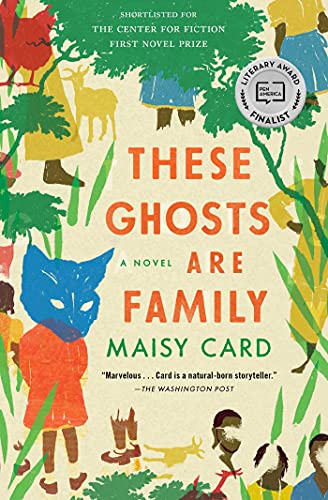
These Ghosts Are Family by Maisie Card

This was a fascinating journey. These Ghosts Are Family follows a family for generations, from slavery in Jamaica, through emancipation and decades of struggle with old class systems, immigration to London and New York, through permutations of relations, including a fresh start with a new identity (or, if you like, identity theft). The timeline jumps around and the focus and point of view shift, so that readers see this extended family at different times and from different perspectives. Issues of class, race and colorism and the relationships between privileged and less privileged classes, including but not limited to enslavement, will be obvious themes; we know that rape and issues of gender arise under these conditions too. The characters are infinitely fascinating. I was not so much expecting the question of supernatural elements: duppies or ghosts and Ol’ Hige, “a Caribbean version of a vampire story.” By the book’s end, I was left reeling with all the possibilities. There is plenty of heaviness: children abused, spouses failing to see eye to eye, parents and children letting each other down. But there are some quietly loving relationships scattered throughout. As I close the final pages, I’m a bit at a loss because there’s so much to consider. (And because we ended with a decidedly weird trio of spooky vampire children living in the woods.)

The book begins with a family tree, which I did refer to throughout. It presented me with a confusion that was answered on the first page. I’m going to spoil that one here because, again, first page of the novel (and it’s also given away on the back of the book and in most blurbs): the aged Stanford Solomon reveals, on his deathbed, that in fact he is (or was) also Abel Paisley, presumed dead some thirty-five years ago, at which point he took the identity of his friend Stanford. “Stanford” has both a wife and daughter and another daughter out of wedlock, all in New York; Abel left behind a wife and two children in Jamaica when he supposedly died. Stanford/Abel’s revelation obviously affects those around him. But I’m going to diverge from the blurbs here, and say that this is not the event around which the book revolves, and by its end, Stanford is by no means the central character. Rather, he is one branch on the family tree that is the book’s center. He’s just one link, and I don’t think he earns the role the blurb says he plays. Rather, I find the book more about larger patterns – slavery, class and race and colorism following slavery, migration and immigration, gender roles, the persistent damages of all these institutions and systems, trauma, and family dynamics. It’s about the multiple generations of this single family, for sure, but their combined story is very much about those larger patterns and systems. There’s nothing preachy or intentional-feeling about this, but the Paisley/Stanford family is inextricable from larger issues. I put Stanford/Abel at its center only in that he opens the book and occurs at the more-or-less center of the family tree as we find it here. The book ends somewhere very different, and that feels right.

In between, the story is told by numerous voices spanning some 200 years. That multiplicity of voices was a great choice for this story. (I have just said the same about a brilliant novel whose review is still forthcoming: Lookout by Christine Byl.) I love the kaleidoscopic or triangulated perspective on events offered by the different views. And for a novel whose focus is so broad – generations of a family across continents, countries, and centuries – it makes sense to move around like this. I guess such a big story told by one voice (with some kind of time-traveling power, I suppose) would be a different kind of accomplishment, and I can imagine it done beautifully, but Card’s choice feels just perfect here. The multiple voices also allow her to give us different dialects, which add to the texture and richness of the whole.

This adventure into these varied lives is expertly done, not always comfortable because of the subject matter, but engrossing and well worth the immersive experience. Card is a talent.


Rating: 7 names.

The Minuscule Mansion of Myra Malone by Audrey Burges

This captivating novel of miniature furniture and big themes braids strong friendships, romance, family ties and the importance of stepping outside of one’s comfort zone.

Audrey Burges’s The Minuscule Mansion of Myra Malone charmingly combines threads of magic, whimsy, romance, grief and loss in a debut novel of great feeling.

Readers first meets 30-something Myra in 2015 in the Arizona mountains, where she lives in the attic of her late grandfather’s cabin. She is regularly visited by her best friend Gwen, who forms Myra’s main link with the outside world–along with the website by which hundreds of thousands of followers know the Mansion, Myra’s life’s work and greatest love. She inherited the large, highly detailed, finely wrought miniature (don’t call it a dollhouse!) from her beloved step-grandmother, Trixie, who, along with Grampa Lou, taught her sewing, woodworking, painting and sculpting. “I know what gemstones look like water and what pen can draw the most convincing chain stitch on a washcloth that’s too small to sew. I can be eclectic or traditional, modern or romantic, and the Mansion absorbs those dreams into its walls.” In flashbacks, the novel also reveals a very young Myra in her loving relationship with Trixie, until the older woman’s tragic death on Myra’s fifth birthday. Other chapters introduce a woman returning to her stately home in Virginia in the 1930s. And in 2015 Virginia, a young man named Alex discovers Myra’s website, “The Minuscule Mansion of Myra Malone,” and the miniature Mansion itself, which is, shockingly, a perfect match to the riverside family estate where he lives alone.

Interspersed with chapters alternating between Arizona and Virginia are short essays that Myra posts on her blog: “I’ll set out with the simplest plans, a minor tweak, and wind up with a choice between full-scale renovations and a shift of perspective. An attitude adjustment or a gut job.” These many threads form a rich portrait of several easy-to-like characters.

Myra still grieves the loss of her Grandpa Lou and especially Trixie, whose skills in making miniatures she honors in continuing to curate the Mansion, painstakingly redecorating room by room. She is a recluse, but the Mansion’s website offers a rare and rich connection to the outside world; her followers view the Mansion as both escape and refuge. Then Myra is threatened with eviction, and her carefully guarded small world tilts. Things begin moving around in Alex’s home and in Myra’s miniature version–piano music emanating from a room without a piano; things that go bump in the night. The keepers of both houses must reassess their relationships to their homes and to the larger world, and it may take more than Gwen’s prodigious business savvy to save the Mansion.

Burges carefully constructs her plot with as much quirkiness and love as any of Myra’s miniatures. With sympathetic characters, high stakes and winning miniature chifforobes, The Minuscule Mansion of Myra Malone is dreamy, sweet and satisfying.


This review originally ran in the November 29, 2022 issue of Shelf Awareness for the Book Trade. To subscribe, click here.


Rating: 8 hairpin legs.

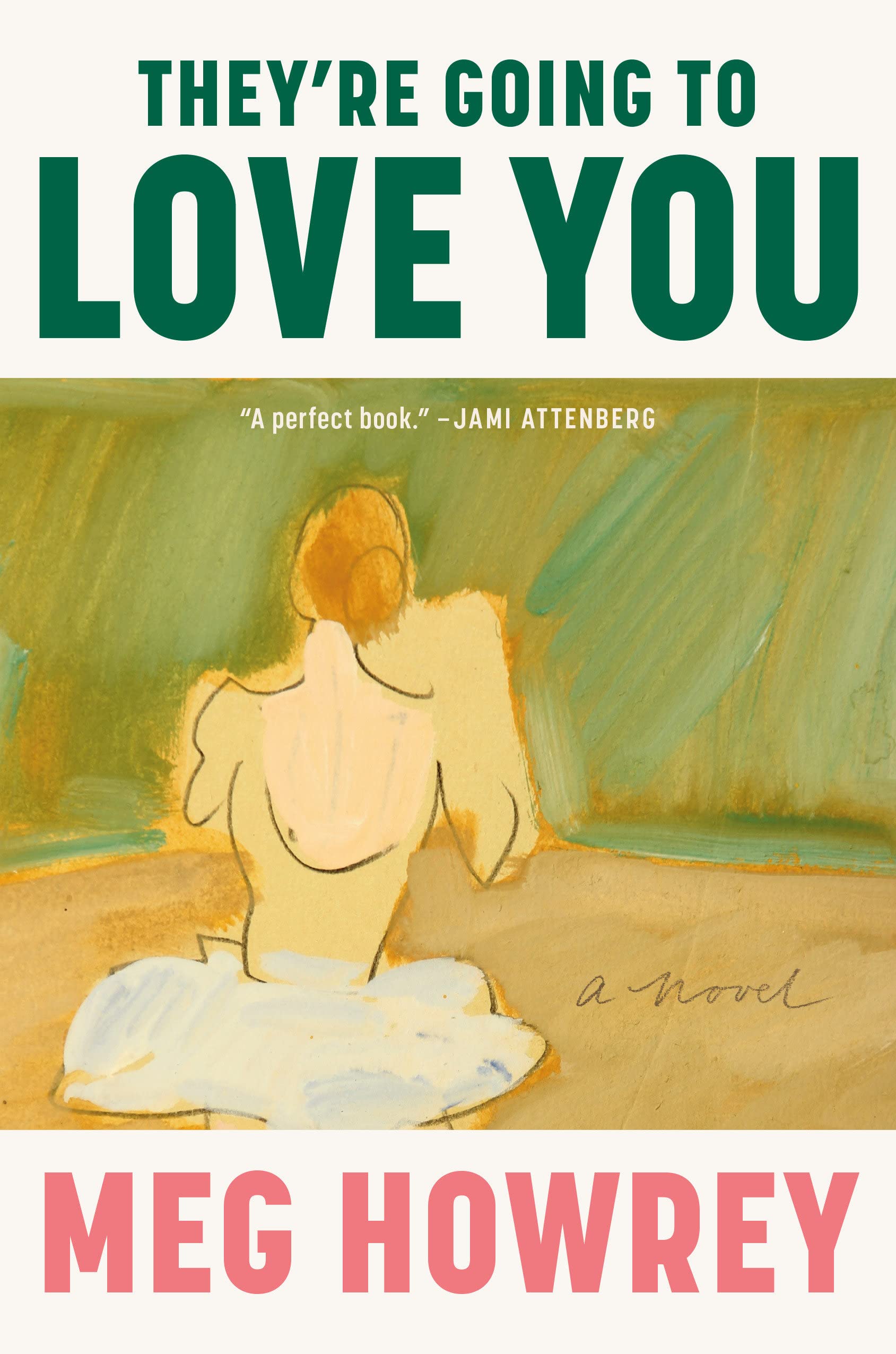
They’re Going to Love You by Meg Howrey

This gorgeous, heartbreaking novel movingly evokes family ties and betrayal, love and forgiveness against a backdrop of professional ballet.

They’re Going to Love You by Meg Howrey (Blind Sight; The Cranes Dance) is an unforgettable novel of scintillating beauty and heart-buckling pain about ballet, loyalty, forgiveness and the many forms of love.

Carlisle grows up feeling distant from her mother, with whom she lives most of the time in Ohio, and with a deep and yearning love for her father and, even more, for her father’s partner, James. When she stays with Robert and James at their Bank Street apartment in Greenwich Village, Carlisle basks in the arts education James shares with her. She’s been born into ballet: her mother a former professional dancer, her father briefly the same before managing ballet companies and festivals. James still teaches ballet. Carlisle loves dance and works hard, but tops six feet tall in high school, “the height that–for a woman–is rarely allowed to pass without comment in the outside world, let alone the ballet one.” (There may be other shortcomings as well.) By her early 40s, she is one of the first women to make it as a successful-but-struggling choreographer. She’s been estranged from Robert and James for 19 years when she gets the call that her father is dying.

The estrangement began with a betrayal that takes most of the novel to reveal. Carlisle’s first-person narrative bounces between the present, as she delays and eventually travels back to Bank Street to her father’s deathbed, and the past, her coming-of-age years as a visitor to Bank Street during the 1980s AIDS crisis. James is a mentor and a hero. “My father, I love, and James I sort of want to be. Maybe I mean: have?” It is a young person’s love, pure, ardent and jealous, wrecked by a mysterious episode that shapes the rest of Carlisle’s life–absolutely including her choreography career. Naturally, along with James’s news about Robert’s pending death comes a big opportunity to compose a modern version of the classical ballet Firebird. Carlisle both knows this is a big chance (maybe the big chance) and resists it. The reader will understand before Carlisle does that Firebird and her relationship with her father are part of the same wound.

Meg Howrey’s writing is dazzlingly, mind-bendingly good, and so true it hurts. She considers ballet, music, the artist’s drive to create, being a woman in a man’s world, desire and betrayal, family and the bottomless, haunting hunger to belong (“Are any of these questions danceable?”; “Emotions have a way of collecting and hardening inside us, like neglected grease. We are all smoking stoves”; “There might be undanceable truths.”) Her prose can be as funny and pithy as it is poignant and grand. They’re Going to Love You tackles a broad range of themes, but Howrey is superlatively up to the task. As Carlisle grows from longing, awkward youth to lonely, gifted working artist, Howrey conjures “all this gorgeous, unrepeatable wreckage” in spectacular fashion. Readers will laugh and cry and be changed.


This review originally ran in the October 13, 2022 issue of Shelf Awareness for the Book Trade. To subscribe, click here.


Rating: 9 gorgon pearls.

Mother Country by Jacinda Townsend

To crib a disclosure I found over at Tor.com: “The author is a friend, but if I didn’t like her book, I just wouldn’t review it here.”


And what, after all, to make of a choice?

Shannon is an American woman traveling, for the second time, in Morocco with her husband Vladimir, “a man she felt she could never know from Adam.” They have their troubles: Shannon suffers severe chronic pain following a serious car wreck; she is hiding substantial student and medical debt from her husband, who is wealthy, distant and not terribly likeable. They are unable to get pregnant (for layers of reasons and with layers of results, including Shannon’s increasing baby fever). Shannon is privileged but more or less miserable, between the pain, her marijuana habit (hidden from Vladimir), the traumas of her own upbringing, and her desire for what she can’t have. She feels a bit lost, “but it was a nice lost, like being found was just around the corner in some dusty recess of the medina.”

Souria is a teenager from Mauritania, where she has been beset: her mother dead, she is kidnapped and enslaved; escapes, is enslaved again, escapes again; arrives in Marrakech friendless and pregnant, where the abuses persist until she escapes to begin a hard, simple life under her own power in Essaouira, “that frat boy of Moroccan cities” on the coast. She names her daughter Yumni, “good fortune. Success in this life,” and the child is happy and deeply loved.

To Shannon’s American eyes, however, she appears dirty and free-ranging on the sidewalks outside the shop where Souria works. And so the older, richer woman just… takes her. Vladimir’s money and their American passports transform Yumni to an American adopted daughter. The two women look remarkably alike; the child looks like her adoptive mother, such that the other parents in Louisville assume she is Shannon’s own.

I love this novel for its use of repeated lines and concepts, and questions about the nature of choice. The two threads, which eventually meet, are mostly told in the close third person perspectives of Shannon and Souria, although we get brief glimpses of Vladimir and of Yumni (later Mardi). These two main characters are well developed, but I judge them not equally sympathetic: Shannon’s life has certainly been difficult, but I judge her more harshly in the end than I do Souria, who’s had fewer options. There are parallels, though, and both women have the complexity of being neither martyr nor villain. The stories are well told, and the plot is heartbreaking, but the novel is character driven in the end, as well as being about those choices we are cued to in the first line. Secondary characters are delightfully drawn as well, which I always appreciate.

The title teases us, at first, to think about the Black American couple traveling to Africa, but it’s also a hint to themes about motherhood. The child at center winds up with something like two mothers, although a little short on fathers – her biological father is more or less a rapist and more or less unknown, and Vladimir is neither cut out for nor in love with the role. Shannon’s mother is not a benevolent force, and the loss of Souria’s mother when she was young is directly linked to what happens to her from then on. The country of Morocco is important as setting, as cultural backdrop, as a place where Shannon and Vladimir can take what they want. (I also happen to know it’s an important place in the life of the novelist, which maybe doesn’t figure in the novel, except that this writer knows her subject well.)

There are capital-I Issues here, like trafficking, colorism, American privilege, and meditations on motherhood. I don’t find the ethical question to be terribly puzzling – I think kidnapping is wrong whether it’s Souria or her daughter being taken. White Americans adopting African babies creates a problematic picture that’s too easy; I appreciate Shannon’s more complicated role as Black American, and with her own traumas and challenges. The male-female relationships are both beautifully drawn and upsetting in how universally problematic they are.

Jacinda Townsend has perhaps topped her lovely, musical Saint Monkey. This is a beauty, and timely, wise, and real.


Rating: 8 bears.