The Axeman’s Carnival by Catherine Chidgey

Told in the voice of a magpie, with humor and wisdom, this unflinching portrait of nature picks at the thin veil between the elemental violence and drama of both human and animal worlds.

Catherine Chidgey (Pet; Remote Sympathy) offers a singular combination of compassion, desperation, dark humor, and slow-building terror with The Axeman’s Carnival, set in rural high-country New Zealand. The story is told through the unusual perspective of a magpie fallen from the nest and rescued by a woman named Marnie, who lives on Wilderness Road with her husband, Rob, a sheep farmer and competitive axeman. They’re “under a lot of pressure,” a refrain that contributes to a general sense of foreboding: a drought threatens their livelihood; Marnie mourns a lost pregnancy; she is isolated from the world beyond their farm. An ominous thread runs through their lives in ways that readers gradually become aware of.

The narrator shares memories of being in the eggshell, occupying the nest with his sister and brothers. “She lifted me into her pillowed palm” and a relationship begins. Marnie releases the magpie to his flock, but he chooses to return to the woman he adores; she names him Tama, and posts his pictures to the Internet, which gains Tama a following. The sheep station suffers setbacks, and Rob’s temper and drinking become increasingly menacing, even as he trains for the annual competition where he hopes to win his 10th golden axe, which will offer both the affirmation he craves and a badly needed monetary prize. Tama’s Internet fame presents a financial opportunity for the family, but also puts them in the public eye, with new risks. Tama’s view of events is curious, in both senses of the word; “that was how houses worked,” he repeatedly notes, with each strange or sinister observation.

Magpies are very smart birds. Tama relates the story with humor and wisdom. He mimics human speech and understands it well enough to communicate, and the reader benefits from his viewpoint as he describes events, with grim foreshadowing. “When I think about what happened later, I remember that day,” he says, of various small violences. “Rob honed an axe with his honing stone…. He ran the blade through the hair on his forearm to test the sharpness, and we watched his crime show about shapely murdered women with torn-off clothes who’d let their attackers in their front doors.” Rob’s temper, his taste for crime shows and murdered women, his axes and admirable strength, his jealousy and Marnie’s fear, all contribute to the reader’s trepidation of what is to come. But The Axeman’s Carnival has tricks up its sleeve, and Tama himself should not be underestimated.


This review originally ran in the June 18, 2024 issue of Shelf Awareness for the Book Trade. To subscribe, click here.


Rating: 8 cashews.

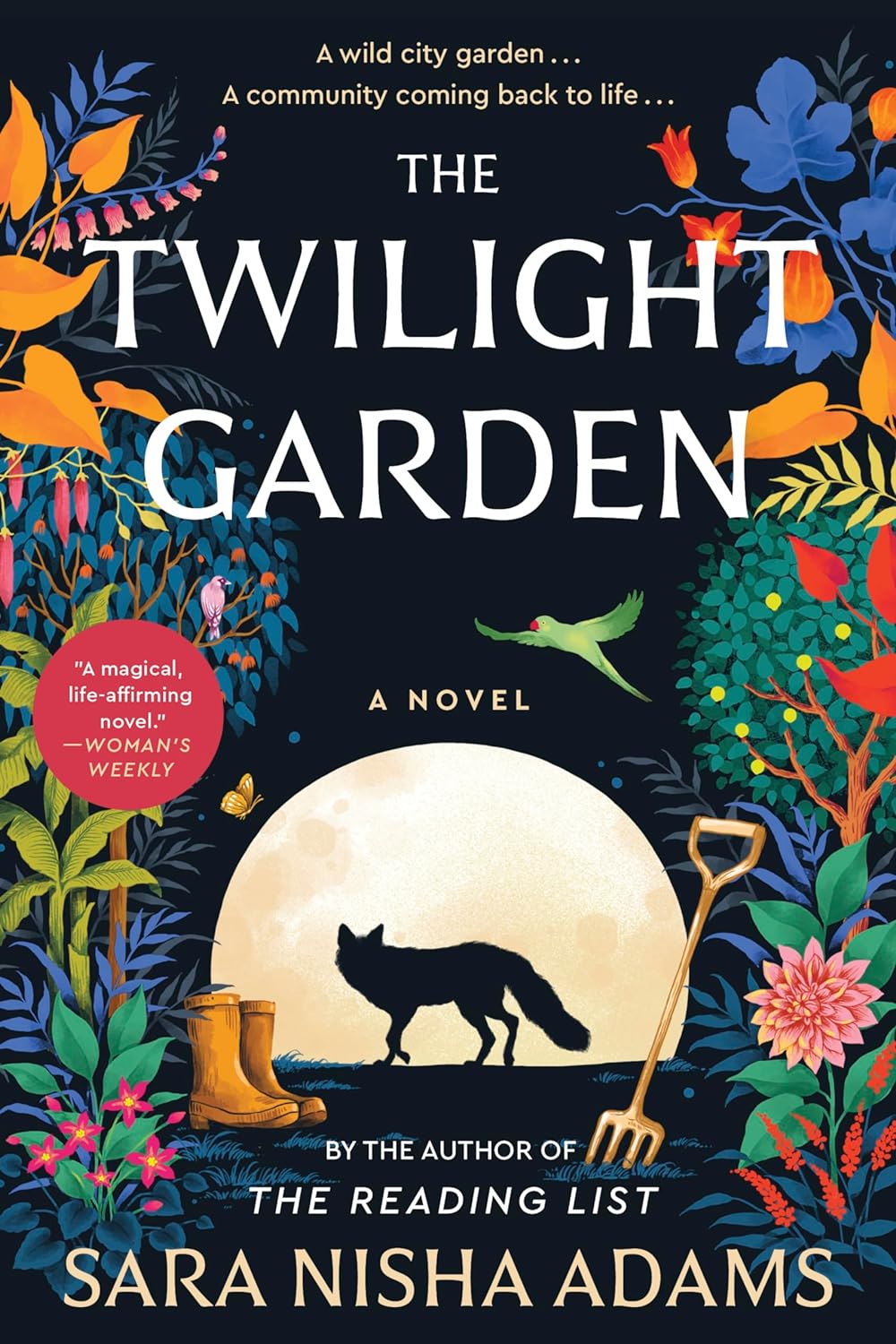
The Twilight Garden by Sara Nisha Adams

From the author of The Reading List comes a pleasingly similar, sweet novel of unexpected connections. In a shared garden in London, two sets of neighbors in two timelines (2018-19 and the 1970s and 80s) navigate conflict, build community, share love and struggles, and grow flowers, food, and strong bonds. It’s an optimistic story, which I perhaps don’t get enough of in my life.

I’m thinking of both this and Adams’ first novel as sort of meet-cute, enemies-to-friends stories, with rom-com sweetness but where the relationships that form are not romantic. Rather, neighbors and community members come together, across diversity in age, gender, sexuality, and race, and form deep and meaningful friendships and built families, caring for each other in profound but not romantic ways. There are romances among the cast of characters, but not in the relationships whose trajectory defines the novel. I’m thinking of these as non-romantic love stories, a genre I’ve not thought about before but am trying to define here.

We first meet two neighbors in contemporary London. Winston is a young Indian immigrant who has lived in his rental home for some years with his partner, Lewis, although their relationship seems to be drawing to a close. He’s lonely, disconnected, and a bit depressed, although his work in a nearby convenience store offers a wholesome and healthy dose of community connection. “He was always chatting to customers in the shop, but when it came to the neighbors on his road, he barely knew faces, let alone names.”

Bernice has just moved in next door, newly divorced, with her ten-year-old son Seb. She is white, well-off, privileged, uptight. Because chapters alternate between their perspectives, the reader knows that each is suffering their own private pains, but to one another, Winston and Bernice are each the nightmare neighbor. Their conflict centers around a shared garden, which Winston has treated as a private sanctuary and Bernice views as a death trap for her son. This garden, now in disrepair, transports readers back to the earlier timeline and two additional protagonists.

Maya first moved in (to what is now Winston’s home) with her husband Prem when they were newly arrived from India. They were soon joined by a daughter, Hiral. Next door (in what is now Bernice and Seb’s home) an older woman named Alma lived in the house she’d been raised in. Initially prickly, and permanently ornery, Alma becomes a dear friend to Maya’s family, a relationship that began in the garden. Alma is a very serious gardener and a bit of a control freak, but Maya encourages her to accept help from their community, and they wind up very much a neighborhood hub for food, fellowship, work, mutual support. In Winston and Bernice’s time, mysterious missives inspire the feuding neighbors to attempt reawakening the rich shared garden of years past, and the bonds of community come, slowly, along with it.

This story is deeply sweet, perhaps approaching what my mother would call ‘precious,’ but never getting there. There are no bad guys, although there are some bad behaviors; instead, these are humans who suffer and sometimes handle it poorly, but feel badly about it and try harder next time. The loves (familial, friendly, and romantic) are real and deep. I cried several times. It felt wholesome and good. There is tremendous diversity here in several senses, and closeness is possible across all those lines when humans reach out and make efforts, or when there is real need. It’s a lovely, hopeful version of the world, and I’m here for more of it.


Rating: 9 banana leaves.

Fire Exit by Morgan Talty

On the boundary of Maine’s Penobscot reservation, a solitary man wrestles with questions of truth, family history, and what is owed to the next generation.

Fire Exit by Morgan Talty (Night of the Living Rez) centers on one man navigating issues of family: the death of his father figure, his mother’s lifelong and worsening health conditions, the daughter he knows only from afar and who doesn’t know who he is. In hardscrabble circumstances, surrounded by poverty, alcoholism, and family violence, he wishes to give his daughter a meaningful gift: the truth. Stark and tender, Talty’s debut novel compassionately addresses tough choices in matters of family and love.

Charles Lamosway has grown up on the Penobscot reservation in Maine, but does not have Native American blood. Although very close to his Native stepfather, Frederick, whom he generally refers to as father, his biological parentage meant he had to move off the reservation when he came of age. Frederick purchased land and helped to build the house where Charles lives now, just across the river. Largely isolated with few friends, Charles watches from his porch the family on the other side: Mary, Roger, and their daughter, Elizabeth. Charles is Elizabeth’s biological father, a secret he has kept at Mary’s request. But as he ages, and as his mother Louise’s health worsens, he feels increasingly that Elizabeth, now an adult, must know the truth.

Charles insists, “Maybe her body and mind know something is missing.” This urge becomes a fixation, a bodily need. Elizabeth faces medical problems, and he is convinced she needs the truth–including Louise’s medical history–to survive: “I felt she should know her body was special, and she should know its history, especially the one it would not tell her and the one she could not see. And I decided to tell what I knew, because she deserved to know it.” But it is just possible that what Charles sees as necessary will have an entirely different outcome from what he intends.

Fire Exit is concerned with bodies, with visceral needs not only for food and shelter but for truth. Louise’s failing body and mind are wrapped up with unresolved questions about Frederick’s death. Talty’s tersely poetic, descriptive prose grounds this story in the physical: “Between the river’s flow and the summer breeze rippling hard-to-see leaves and the sound my scraping shoe made on the porch, I heard night silence. I heard the workings of my inner body, the pump of my heart and the expanding of my lungs.” In Maine’s harsh winters, Talty’s characters face elemental as well as human dangers.

This first novel grapples with family issues and hard choices about love and responsibility; blood, culture, and belonging. It is an utterly absorbing story, always firmly rooted in the corporeal; tough, honest, but not bitter.


This review originally ran in the March 28, 2024 issue of Shelf Awareness for the Book Trade. To subscribe, click here.


Rating: 7 loads of laundry.

Nothing’s Ever the Same by Cyn Vargas

With a remarkably true-to-life adolescent narrator, this novella charts the large and small traumas that accompany a girl’s coming of age.

Cyn Vargas’s Nothing’s Ever the Same is a starkly honest coming-of-age story told in the disarming voice of its 13-year-old protagonist. Simple but moving, this novella documents events that are traumatic but not unusual, thus marking the kinds of pain that are heartrending, as well as common, for a child approaching young adulthood.

“The first time I saw my mom cry was after my dad’s heart attack,” Itzel begins in the opening chapter, “Angioplasty and Piñatas.” The heart attack comes during preparation for her 13th birthday party. After a brief hospital stay, he comes home and improves quickly. But this event, coming at an important symbolic point in Itzel’s adolescence, is the first of a number of upheavals, as Vargas’s title suggests.

Itzel’s beloved father recovers from his heart attack, but something feels off. “Dad was different, like moving the lamp… the light and shadows hit in a different way that made all that I was used to seem a little strange.” The family suffers one loss and then another. Itzel explores new feelings for her best friend. And then she sees something that will change the course of life for her entire family. “I shut my eyes tight to make it go away like erasing the wrong answer on a test, but I still saw… the wrong answer etched into the paper though the lead was brushed away.” What to do with her new knowledge? Who to blame? As the known routine is uprooted for Itzel and her parents, she has to navigate redefining relationships. While the circumstances of these changes for Itzel are specific and acute, her experience reflects universal elements of being a teenager: disappointment, betrayal, discovery, acceptance, and always, unavoidably, change.

Vargas (On the Way) gives Itzel a straightforward storytelling voice, often naïve but also sharp-eyed. She is clever, thoughtful, and quick to question what she or others have done wrong to bring pain and difficulty to her family. Her father, mother, Tia Amelia, and best friend Fred are characters sketched only briefly in Itzel’s telling, but each has personality and redeeming qualities even when making mistakes. The author behind the narrator commands this story with a quiet compassion. Nothing’s Ever the Same is a work of restraint and understatement, its young narrator capable of stoic relating of events as well as emotional reaction. The effect is deeply moving.


This review originally ran in the March 14, 2024 issue of Shelf Awareness for the Book Trade. To subscribe, click here.


Rating: 7 cups of orange soda.

repost: No Son of Mine by Jonathan Corcoran

This is a repost of an earlier review, because this moving book has just become available today.


Disclosure: Jon has taught as guest faculty in my MFA program. I admire his work and he is a dear friend.


I found this memoir remarkable. It encompasses much in terms of its time span and the bigger events in the world, and Jon accomplishes something special by being raw and vulnerable, and never self-indulgent. I think the struggles he portrays here will offer something to any reader, because we are all struggling to navigate even the closest of relationships. I am impressed by the writing in terms of that larger storytelling and meaning-making, as well as line by line.

Corcoran grew up in a small town in West Virginia that is just a few minutes’ drive from where I live now. (It’s always a little exciting to read a place written well that you personally know, and I did enjoy that part here. Elkins is not perfect, but I think this author has handled it with respect for both positive and negative qualities.) As a gay kid, he suffered in the town, in the evangelical church his family attended, and in his family itself. He did some secretive explorations of sexuality in West Virginia (not too dissimilar, I think, from those in The Rope Swing, which is however fiction), but did not live as an openly gay man until he left for college at Brown University. Coming from poverty, Brown was both a great accomplishment and a shock: a wider world, but rarified, and Jon was a foreigner to many of his peers and professors there. It’s at Brown that he met Sam.

In his second year at Brown, Jon is in Portland, Maine, with his boyfriend, Sam, meeting Sam’s family for the first time. It’s his twentieth birthday when his mother calls, seething with what she’s discovered. Jon confirms that he is gay. “You are no longer my son,” she says, and she hangs up. This leaves him traumatized, trying to finish college with no financial or emotional or any other kind of support, with no family, and no options, surrounded by Ivy League administrators whose understanding of what all this means is so poor that he is advised to take a year off and travel. His mother spends the next six months calling in the early morning and waking him up to tell him he will die of AIDS or go to hell, or both.

Jon and his mother spend years–fifteen years, the rest of her life–being estranged and trying again, having massive, blow-up fights and years of silence, and abuse and toxicity and cautious attempts at peace and acceptance. Her bad behavior is horribly, shockingly bad. But tangled up with the bad is the fact that this is his mother, his caretaker, whom he has loved, and who still (somewhere, twistedly) loves him, and misses him when they are on the outs. It’s a level of trauma that’s hard to fathom if you haven’t lived it. But as a narrator, he does a good job of describing its effects, including a mistrust of memory and various physical ailments. It also poses some challenges for his relationship with Sam, which will continue until they eventually marry, and into the present.

This is a memoir of trying to reconcile a parent that the narrator loves, his memories of her and of his hometown, with the pain inflicted at the hands of that same person (and place). It’s all a puzzle, to question the causes, to wonder how much forgiveness is due to such a figure. It’s a memoir that is also an assay, both a personal narrative and an exploration of ideas. “…some part of my brain is perpetually trying to explain her actions, to find the root cause for them, and what this really comes dangerously close to is the notion that her actions have an excuse, that if I searched hard and long enough the hurt and pain she caused me can be written away. But she hurt more, a voice says, and I don’t doubt that. So here I am, operating the world’s worst justice system from the recesses of my brain.” “I do not know how to balance all the pain she caused with all the pain she felt.”

There’s a lot to appreciate here, and a lot of wisdom that I think will help just about anybody. Not to say answers, but wise observations about one man’s experience. Most of us are wrestling with difficult, tangled-up relationships where abuse and love meet; many of us are struggling with what to take and what to leave about a family or a place. “I hear her laugh, hear the crinkle of her dyed-blonde hair. I rub her cracked feet, feel her hand on my back. I smell her nicotine fingers. There is her cup of Lipton tea in the little ceramic mug that is white with flowers around the brim. I taste the milky black tea. And I say, I don’t want to lose this all. I don’t want to lose what made me.” There is also some lovely writing here. If the story itself is often difficult, there’s a remarkable amount of grace, beauty, and hope. I think it’s a book for anybody and everybody. Thank you, Jon, for sharing so much in a way that feels both raw and wide-open, and careful and thoughtful. I’m awed.


Rating: 9 paper bags.

A Wounded Deer Leaps Highest by Charlie J. Stephens

In a town beset by poverty and violence, an unusual child turns to the natural world for comfort in this novel of suffering and tenderness.

A Wounded Deer Leaps Highest is a heart-wrenching first novel by Charlie J. Stephens that incorporates moments of beauty in a traumatizing coming-of-age tale. In the 1980s, eight-year-old Smokey Washington lives with their mother in Moss River, Oregon, a small town beset by poverty, violence, and a shortage of options for improving one’s lot, but surrounded by vibrant natural life. As Smokey’s situation worsens, they turn increasingly toward that outside world, seeking solace in dirt, deer, and trees. The tragedies that befall Smokey and their family and neighbors will disturb even jaded and strong-stomached readers, but notes of stark truth and tenderness filter through. A will to live pervades these pages from beginning to end.

Moss River is inundated with violence against women and children, from the opening scene (“Stop TJ, you’re hurting me”) through a PBS special about the death of a mother gazelle (“It’s just the rules of nature”), and throughout Smokey’s childhood. Smokey’s mom dates a series of men who hurt her and hurt Smokey, a child who engages with animals and the outdoors more than with people, and who doesn’t fall into a gender binary. With a friend, Smokey wonders, at the sound of a gunshot, “which of the men we know might have shot the gun and who he might have shot. We worried about our moms with their bruises and their need….”

Stephens gives the child narrator a wise, inquisitive voice that feels perfectly suited to Smokey’s age and distinctive personality. Through Smokey’s point of view, readers follow an increasingly grim story, dreading the multiplying wounds that begin to feel inevitable. While Mom tries to care for Smokey, she cannot always protect them; nevertheless, she is a woman with moments of startling, defiant strength.

Smokey’s descriptions and perspective are insightful, often surprising, and lovely. Mom drinks steaming coffee and smokes Lucky Strikes; Smokey wonders if “evaporating the things she loves is her most practiced spell.” Smokey sees her as a crow in her black jacket; for themself, they hope to grow up and become a deer. In a world with few apparent escape routes, the woods hold great appeal. “I want to spend more time low to the ground…. I want my animal body. I want to get it back.”

A Wounded Deer Leaps Highest offers a harrowing and wholly realistic story of suffering, but also a message about resiliency, the healing power of nature, and simple survival. “Being alive can sometimes feel like a miracle, even as you let it go.” Stephens’s debut will shock its readers with love, pain, and fresh perspective.


This review originally ran in the February 2, 2024 issue of Shelf Awareness for the Book Trade. To subscribe, click here.


Rating: 7 darting eyes.

Maximum Shelf: The Safekeep by Yael van der Wouden

Maximum Shelf is the weekly Shelf Awareness feature focusing on an upcoming title we love and believe will be a great handselling opportunity for booksellers everywhere. The features are written by our editors and reviewers and the publisher has helped support the issue.

This review was published by Shelf Awareness on January 17, 2024.


Yael van der Wouden’s first novel, The Safekeep, explores the rural Dutch landscape in the years following World War II through the life of a lonely, sheltered woman reluctantly forging new bonds. In what is largely a closed-in, personal story with a solitary protagonist, van der Wouden also examines larger issues in the social context of Dutch postwar society.

The story is set in 1961, in a rural Dutch province that has largely recovered from war, on its surface. Isabel has spent her life tucked away in the house where her family relocated from Amsterdam during the war. An uncle found the place for them, and 11-year-old Isabel took up residence with her mother, younger brother Hendrik and elder brother Louis. Eventually, their mother died and the brothers moved away, but Isabel stayed, believing there was nowhere else for her. She keeps the house meticulously, polishing dishes and micromanaging a series of beleaguered maids. “She belonged to the house in the sense that she had nothing else, no other life than the house, but the house, by itself, did not belong to her.” She lunches occasionally with Hendrik, less often with Louis. In her lonely, strictly regimented life, the house is Isabel’s constant, the thing she can control, her greatest comfort.

The Safekeep opens in her garden. While digging out late-season vegetables, Isabel finds a shard of broken ceramic, “Blue flowers along the inch of a rim, the suggestion of a hare’s leg where the crockery had broken. It had once been a plate, which was part of a set–her mother’s favourite…. There was no explanation for the broken piece, for where it had come from and why it had been buried. None of Mother’s plates had ever gone missing.” This beginning offers an early clue that Isabel’s understanding of the house and its contents, of her own personal history, may be flawed.

Further disruptions follow. Hendrik, a steadfast supporter of his solitary sister, nevertheless lives a life she hasn’t come to terms with. He lives with a man; this makes Isabel uncomfortable. Worse, Louis brings yet another young woman, Eva, to a dinner with his siblings. Eva sets Isabel on edge for reasons Isabel does not understand. Additionally, any serious liaison for Louis implies a threat to Isabel, who is permitted to stay in the house only until Louis (its intended inheritor) settles down to start a family. Worse yet, at Louis’s insistence, Eva comes to stay at the house with Isabel while he is on a trip: Isabel is horrified to be made to share her space with a woman she despises.

The tension in the house rises to a nearly unbearable pitch. Isabel habitually suspects her maids of stealing, and now suspects Eva, whose own history is murky, as well. Isabel obsessively inventories china dishes, silverware, and items of décor, counting spoons and watching Eva’s every move. She cleans and displays and relocates the mysterious shard of plate from the garden, imbuing this small object with outsized power. Eva’s presence continues to feel inexplicable. Louis’s return from abroad, to collect Isabel’s unwanted houseguest, is delayed. Tensions continue to build.

Van der Wouden excels in surprises, including changes in tone. The Safekeep remains, almost in its entirety, nearly claustrophobic in its focus on Isabel’s commitment to her family home. “Bound to the house, [Hendrik] said. As if it was a tether and not a shelter. And not her own love, too.” But this tightly bound, insular story of one woman’s struggle finally zooms out, with near dizzying quickness, to engage with larger questions. An old friend of Isabel’s mother is preoccupied with a dish that was given to her “to keep” before the war, by a neighbor who now wants it back. This friend believes it is hers now; the neighbor disagrees. “What does it matter, gifting, keeping? She gave it to me. It was a terrible time. She was gone for years.” As its title hints, van der Wouden’s novel will puzzle over various meanings of safekeeping. Likewise, the sparsely populated story is punctuated by passages of erotic writing that surprise as much by their loveliness as by their departure from the book’s otherwise lonely atmosphere. Not only the story of one family’s struggle or Isabel’s quiet pain, The Safekeep addresses themes of yearning, possession, the difficulties of Dutch recovery from World War II and of same-sex couples’ experiences in a society still regaining its feet.

In the end, like a country recovering from a trauma, Isabel must step outside her space of comfort and familiarity in order to learn and grow. “Isabel tested one [of the frozen canals] with her foot, and found it solid, and then stood on it in wonder: a miracle, she thought, to stand so solidly on what could also engulf you.” Van der Wouden communicates and implies much with a minimalist style that is often quietly, shockingly, beautiful. “The shadows lifted as though they’d only been glimpsed under the hem of a skirt–the lift on an arm, secrets of the body that only unfolded for the night.” The Safekeep is a slow-burning, deceptively austere novel, whose subtle, crafty questions and lovely, lyric style will follow the reader long after its conclusion.


Rating: 8 pears.

Come back Friday for my interview with van der Wouden.

No Son of Mine by Jonathan Corcoran

Disclosure: Jon has taught as guest faculty in my MFA program. I admire his work and he is a dear friend.


Also, I am teasing you about a book that will not be published for months (April 1 of this year, no foolin’), but I’ll repost then to remind you.

Now on to the show.


I found this memoir remarkable. It encompasses much in terms of its time span and the bigger events in the world, and Jon accomplishes something special by being raw and vulnerable, and never self-indulgent. I think the struggles he portrays here will offer something to any reader, because we are all struggling to navigate even the closest of relationships. I am impressed by the writing in terms of that larger storytelling and meaning-making, as well as line by line.

Corcoran grew up in a small town in West Virginia that is just a few minutes’ drive from where I live now. (It’s always a little exciting to read a place written well that you personally know, and I did enjoy that part here. Elkins is not perfect, but I think this author has handled it with respect for both positive and negative qualities.) As a gay kid, he suffered in the town, in the evangelical church his family attended, and in his family itself. He did some secretive explorations of sexuality in West Virginia (not too dissimilar, I think, from those in The Rope Swing, which is however fiction), but did not live as an openly gay man until he left for college at Brown University. Coming from poverty, Brown was both a great accomplishment and a shock: a wider world, but rarified, and Jon was a foreigner to many of his peers and professors there. It’s at Brown that he met Sam.

In his second year at Brown, Jon is in Portland, Maine, with his boyfriend, Sam, meeting Sam’s family for the first time. It’s his twentieth birthday when his mother calls, seething with what she’s discovered. Jon confirms that he is gay. “You are no longer my son,” she says, and she hangs up. This leaves him traumatized, trying to finish college with no financial or emotional or any other kind of support, with no family, and no options, surrounded by Ivy League administrators whose understanding of what all this means is so poor that he is advised to take a year off and travel. His mother spends the next six months calling in the early morning and waking him up to tell him he will die of AIDS or go to hell, or both.

Jon and his mother spend years–fifteen years, the rest of her life–being estranged and trying again, having massive, blow-up fights and years of silence, and abuse and toxicity and cautious attempts at peace and acceptance. Her bad behavior is horribly, shockingly bad. But tangled up with the bad is the fact that this is his mother, his caretaker, whom he has loved, and who still (somewhere, twistedly) loves him, and misses him when they are on the outs. It’s a level of trauma that’s hard to fathom if you haven’t lived it. But as a narrator, he does a good job of describing its effects, including a mistrust of memory and various physical ailments. It also poses some challenges for his relationship with Sam, which will continue until they eventually marry, and into the present.

This is a memoir of trying to reconcile a parent that the narrator loves, his memories of her and of his hometown, with the pain inflicted at the hands of that same person (and place). It’s all a puzzle, to question the causes, to wonder how much forgiveness is due to such a figure. It’s a memoir that is also an assay, both a personal narrative and an exploration of ideas. “…some part of my brain is perpetually trying to explain her actions, to find the root cause for them, and what this really comes dangerously close to is the notion that her actions have an excuse, that if I searched hard and long enough the hurt and pain she caused me can be written away. But she hurt more, a voice says, and I don’t doubt that. So here I am, operating the world’s worst justice system from the recesses of my brain.” “I do not know how to balance all the pain she caused with all the pain she felt.”

There’s a lot to appreciate here, and a lot of wisdom that I think will help just about anybody. Not to say answers, but wise observations about one man’s experience. Most of us are wrestling with difficult, tangled-up relationships where abuse and love meet; many of us are struggling with what to take and what to leave about a family or a place. “I hear her laugh, hear the crinkle of her dyed-blonde hair. I rub her cracked feet, feel her hand on my back. I smell her nicotine fingers. There is her cup of Lipton tea in the little ceramic mug that is white with flowers around the brim. I taste the milky black tea. And I say, I don’t want to lose this all. I don’t want to lose what made me.” There is also some lovely writing here. If the story itself is often difficult, there’s a remarkable amount of grace, beauty, and hope. I think it’s a book for anybody and everybody. Thank you, Jon, for sharing so much in a way that feels both raw and wide-open, and careful and thoughtful. I’m awed.


Rating: 9 paper bags.

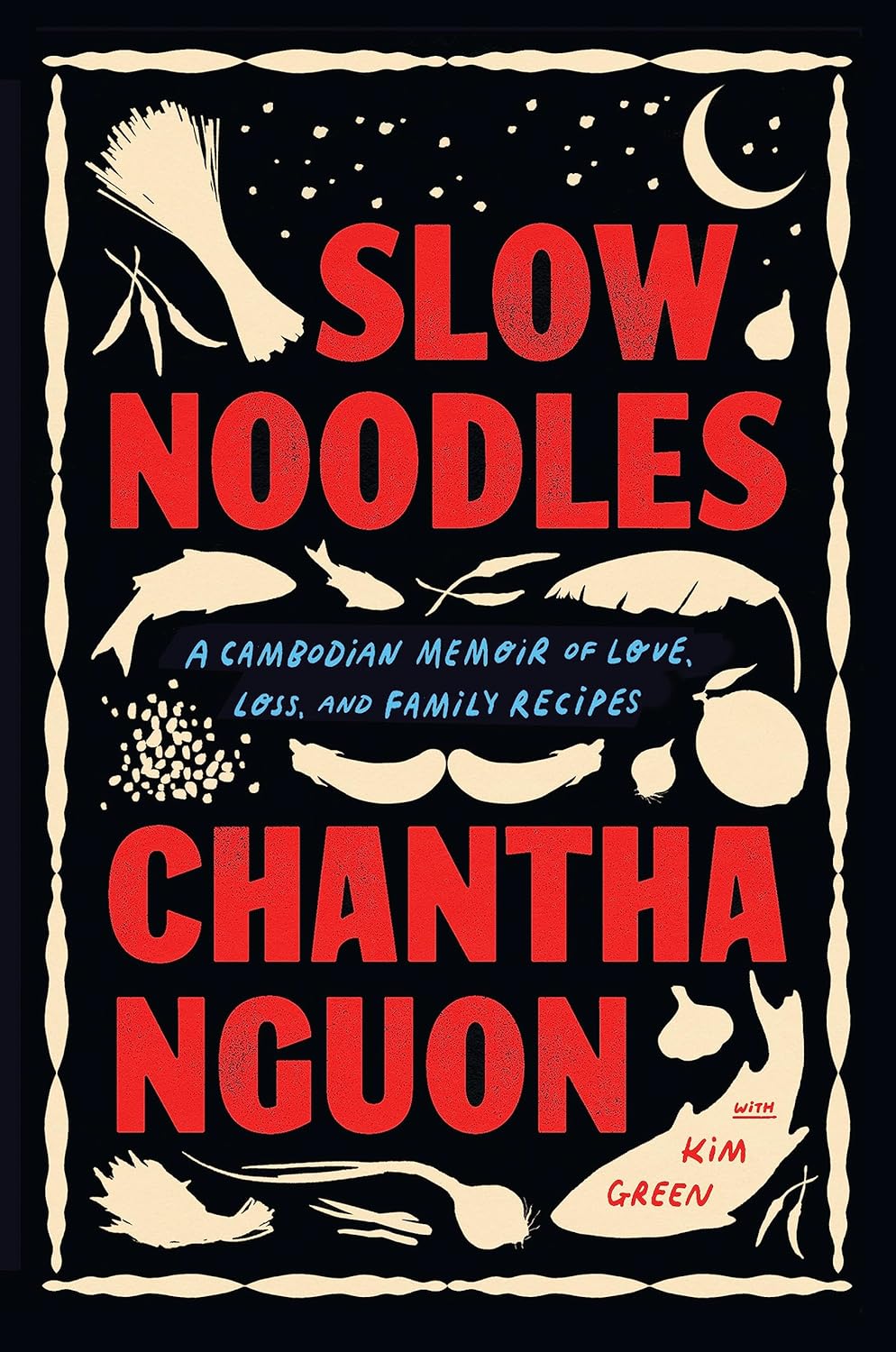
Slow Noodles: A Cambodian Memoir of Love, Loss, and Family Recipes by Chantha Nguon & Kim Green

This memoir of food, family, feminism, and Cambodian history, which includes enticing cookbook-quality recipes, is breathtaking in its emotional resonance and lovely writing.

Slow Noodles: A Cambodian Memoir of Love, Loss, and Family Recipes tells a story that is, by turns, heart-wrenching, inspiring, harrowing, and mouthwatering. Chantha Nguon’s memoir, written with Kim Green, encompasses both world history and an intimate personal account. Nguon, born the youngest child in a comfortable family in Cambodia’s Battambang, had nine years of soft living and good eating before Pol Pot reset time to Year Zero in the 1970s. Moving first to Saigon, where she weathered the end of the Vietnam War, and then escaping as a refugee into Thailand, Nguon gradually lost everyone she loved, ending with her mother’s death when Nguon was 23. She was a food-focused young child with a mother who took cooking very seriously; she became a young refugee in peril of starvation. For Nguon, rationing or missing entirely the most basic of ingredients is not only a literal life-or-death issue but also symbolically life-altering. With the loss of her family and, to some extent, her culture, she views herself as a repository of recipes, culinary knowledge, memories, pain, and strength.

Food metaphors enrich this book, which sparkles with poignant, deeply lovely writing: “The green-fresh fragrance of young rice is as lovely and fleeting as childhood itself.” Nguon’s mother “taught [her] the art of rebelling as quietly as a whisper of silk.” Twenty-two recipes learned from Nguon’s beloved mother, or developed throughout her own accomplished cooking life, are included, with clear instructions and helpful notes on ingredients (and accompanied by a glossary for potentially unfamiliar terms). These are joined by cleverly figurative recipes, such as the recipe for silken rebellion, which begins: “Find the pockets of freedom available to you. Exploit loopholes.”

By the end of the story, Nguon has transformed into an impressive woman, acting as her husband’s equal (a radical concept, encouraged by her quietly rebellious mother) and a fierce advocate for social change. Nguon, who becomes a staunch feminist, eventually undertakes medical and humanitarian work with AIDS patients and sex workers, fights for education and independence for Cambodian women, and with her husband, founds the Stung Treng Women’s Development Center in rural Cambodia.

Nguon’s titular noodles contribute enormous metaphorical meaning. In her childhood household, slow and proper cooking was prioritized (“my mother despised the flavor of shortcuts”). In Thai refugee camps and in the Cambodian jungle, instant noodles became a prized delicacy. And by the memoir’s end, this thoughtful narrator has integrated these experiences, valuing both the careful preparation of fine foods and the stark relief of basic nutrition. Slow Noodles is a rare gem of a story, gorgeously written, humble and stirring, and packed with tempting recipes.


This review originally ran in the December 14, 2023 issue of Shelf Awareness for the Book Trade. To subscribe, click here.


Rating: 9 silk threads.

Dear Sister: A Memoir of Secrets, Survival, and Unbreakable Bonds by Michelle Horton

The heartbreaking story of a woman incarcerated for killing her abuser, told by her sister, highlights systemic wrongs and the resilience of a family in trauma.

Dear Sister: A Memoir of Secrets, Survival, and Unbreakable Bonds is a harrowing story, a call to action, and a love letter between sisters.

In their 20s, Michelle Horton and her sister, Nikki, were very close, working together to raise Nikki’s two children and Horton’s son. Horton thought she knew everything about her sister’s life, and so was entirely caught off guard by the emergency call. Her niece and nephew’s father was dead. Nikki had killed him. He had been abusing her horrifically for years, and many members of the community had known it, had been working actively to get Nikki out. Horton was told to come and pick up her sister’s children, ages two and four, immediately.

In the months and years that followed, Horton’s life was consumed by the work of single-parenting three children while raising money for her sister’s legal defense, becoming an amateur expert on criminal law and the psychology of abuse, and advocating for survivors’ rights. The high-profile 2019 case of Nikki Addimando resulted in her conviction of second-degree murder and a sentence of 19 years to life in prison. Despite extensive evidence, the judge concluded that Nikki was not a victim of abuse.

Horton’s narrative (with supporting evidence) is available elsewhere, but she additionally brings to her memoir a close, personal account of Nikki’s trauma and that of the three children involved, the deep connection between sisters, and the continuing failure of the legal system adequately to handle abuse victims when they appear as criminal defendants. Horton delves into the sisters’ childhood, including earlier instances of abuse, and the culture in which so many–including the author–failed to recognize the signs of Nikki’s suffering. Keeping silent about her abuse did not serve Nikki in the end, but Horton observes that other victims will not be encouraged by Nikki’s experience to speak up.

The stories Horton relates are heartbreaking. She does not shy away from graphic descriptions of the brutal abuse Nikki experienced, which some readers will find difficult to read. These details do not feel gratuitous, but rather central to the painful but necessary account Horton offers. Her concern extends beyond her own family, to other victims of intimate partner violence who enter the justice system as criminals. Dear Sister is not only Horton’s story and Nikki’s story, but also an urgent appeal for reform. Heartfelt, disturbing, but ultimately hopeful, this memoir is an important part of an ongoing conversation, and a tribute to sisterhood.


This review originally ran in the November 20, 2023 issue of Shelf Awareness for the Book Trade. To subscribe, click here.


Rating: 7 half-tubes of toothpaste.