Frighten the Horses by Oliver Radclyffe

Oliver Radclyffe’s memoir, Frighten the Horses, is an arrestingly forthright and open account of self-realization, a portrait of a transgender experience that is beautiful, honest, and raw.

After an absorbing, funny opening scene, Radclyffe rewinds to a less happy time. Readers accompany him on a difficult path as he spent the first four decades of his life trying to live up to expectations. His British upper-class childhood was privileged but disjointed. On brief occasions in boarding school, art school, and while riding motorcycles, he felt like one of the boys, but never felt he truly fit in. He became a housewife of status, then immigrated to the Connecticut suburbs and soon found himself raising four children and a golden retriever puppy. But something had always been off, and the memoir moves back and forth in time to portray Radclyffe’s anxiety and soul-searching. He eventually comes out as lesbian, divorces, and comes out as a transgender man.

These events and discoveries are presented in scenes with color, detail, and dialogue, and Radclyffe’s writing style is smooth, relatable, and effortless to read. With humor and compassion for himself and others, Radclyffe describes his own resistance to and acceptance of his gender and sexuality as he wrestles with the complexities of gender identity, sexual orientation, feminism, class, and family dynamics. This disarming, gorgeously written, and generously vulnerable memoir uses imagery to great effect. In sharing this individual narrative, Radclyffe expands and advances the way trans experiences are represented in literature. Smart and incisive, Frighten the Horses is unforgettable.


This review originally ran in the September 20, 2024 issue of Shelf Awareness for Readers. To subscribe, click here, and you’ll receive two issues per week of book reviews and other bookish news.


Rating: 9 steps.

Come back Friday for my interview with Oliver Radclyffe! I’m really excited about this one.

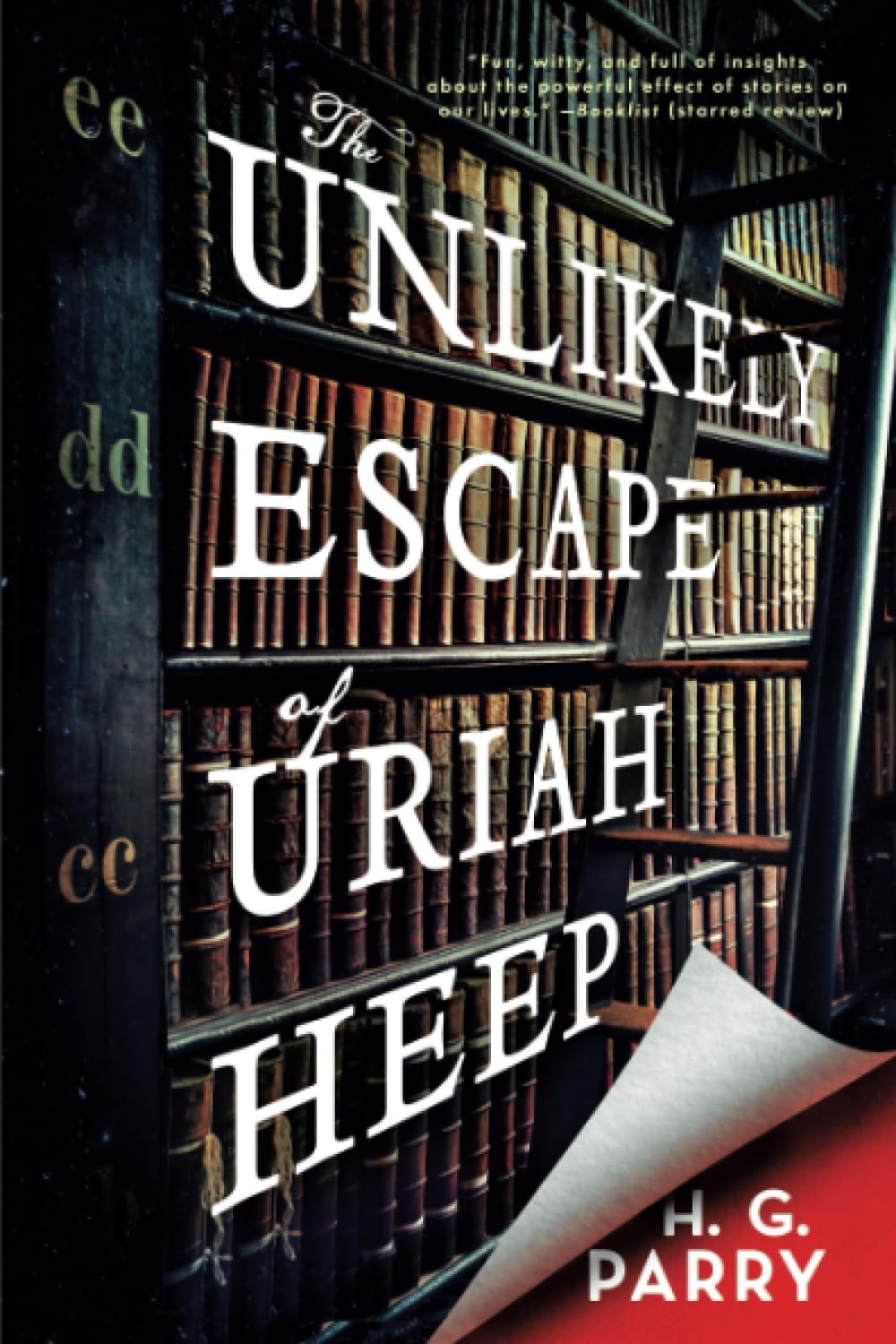
The Unlikely Escape of Uriah Heep by H. G. Parry

A booklover’s dream, this astonishingly great debut novel focuses on family and the power of story in a world of magic, imagination, and serious literary criticism. In Wellington, New Zealand, Rob Sutherland is a hardworking lawyer with a lovely partner, Lydia, and a trying younger brother, Charley, known to his colleagues as Dr. Charles Sutherland. Rob is longsuffering: Charley keeps calling him, often in the middle of the night, to come up to work (Charley teaches at Prince Albert University) and help him catch the characters he’s accidentally released from books so he can put them back. Rob has always had complicated feelings for Charley: he loves his little brother and wants to keep him safe, but he definitely stays annoyed with him much of the time, too. Though four years younger, Charley was a prodigy, who went off to Oxford University the same year that Rob went off to Prince Albert. Rob would have been considered intelligent in most families, but felt overshadowed by a child who read Dickens when he was two years old. One of this novel’s central threads is the challenge of an adult relationship between brothers, with a touch of sibling rivalry, many old wounds, and a persistent bond of love, loyalty, and protectiveness that runs in both directions.

So: Charley is a genius, of the scattered, distant, dreamy type, who keeps accidentally bringing fictional (and nonfictional!) characters out of books. It can get messy. Rob is the exasperated big brother who keeps helping clean up messes – not always in the best of humors. Then the messes get much bigger, beyond anything that Rob or Charley is prepared to deal with – out of their control, and, it eventually becomes clear, outside of Charley’s causing. But Charley, and eventually Rob, do decide that it’s within their responsibility to try to save Wellington, or the world.

This is a story filled with vibrant characters, and that plays with the layers of what ‘character’ can mean. Some are Parry’s (her characters’) interpretations of those written by others, including the title character, Uriah Heep, who comes from David Copperfield and is thus originally Dickens’s, now read by Charley (and Parry). Some are Parry’s originals but, within this book, credited to another (fictional) author. [The indomitable Millie Radcliffe-Dix comes from The Adventures of Millie Radcliffe-Dix, Girl Detective, which unfortunately do not exist in this world I’m out here living in.] And some, like Charley himself, are the inventions of this book. It quickly gets to be a lot, but gosh, in the most fun ways. Again: there was never such a booklover’s book.

The title of The Unlikely Escape of Uriah Heep refers to a character who is not even one of the top five or ten most important in the book – although he is the character at large in the opening scene, when Charley calls Rob in the middle of the night (again). He will reappear periodically. In some ways, Dr. Charles Sutherland is the main character of the book – he has the splashiest powers, and the central conflict rages around him; mysteries wreathe his past; he will have great choices to makes. But it is Rob who narrates the bulk of the book (with a few interludes as exception). In part, I think this is because there is a heavy emphasis, in this world and in this telling, on how one person’s “reading” of another impacts the person being read. Rob’s perspective on Charley matters a great deal. I think Parry’s choice of Rob as narrator is interesting; it shifts the reader’s reading, in similar ways. Whose stories do we matter in? As Dr. Frankenstein tells us: “What you need to understand about protagonists… is that we’re all busy with our own plots. We can’t help it; we’re not used to sharing our stories.” If that’s not a lesson for the real world, I don’t know what is.

I’m still reeling and will enjoy thinking about what this book has shown me as I move through my world and reading. I think it has the potential to be one of those that shifts how I think about it all – which is a big accomplishment. Also, everything Parry writes plunges me deeply and pleasurably into other worlds, which I love. I finished this book and dived directly into another big thick one of hers. Do recommend.


Rating: 9 doors.

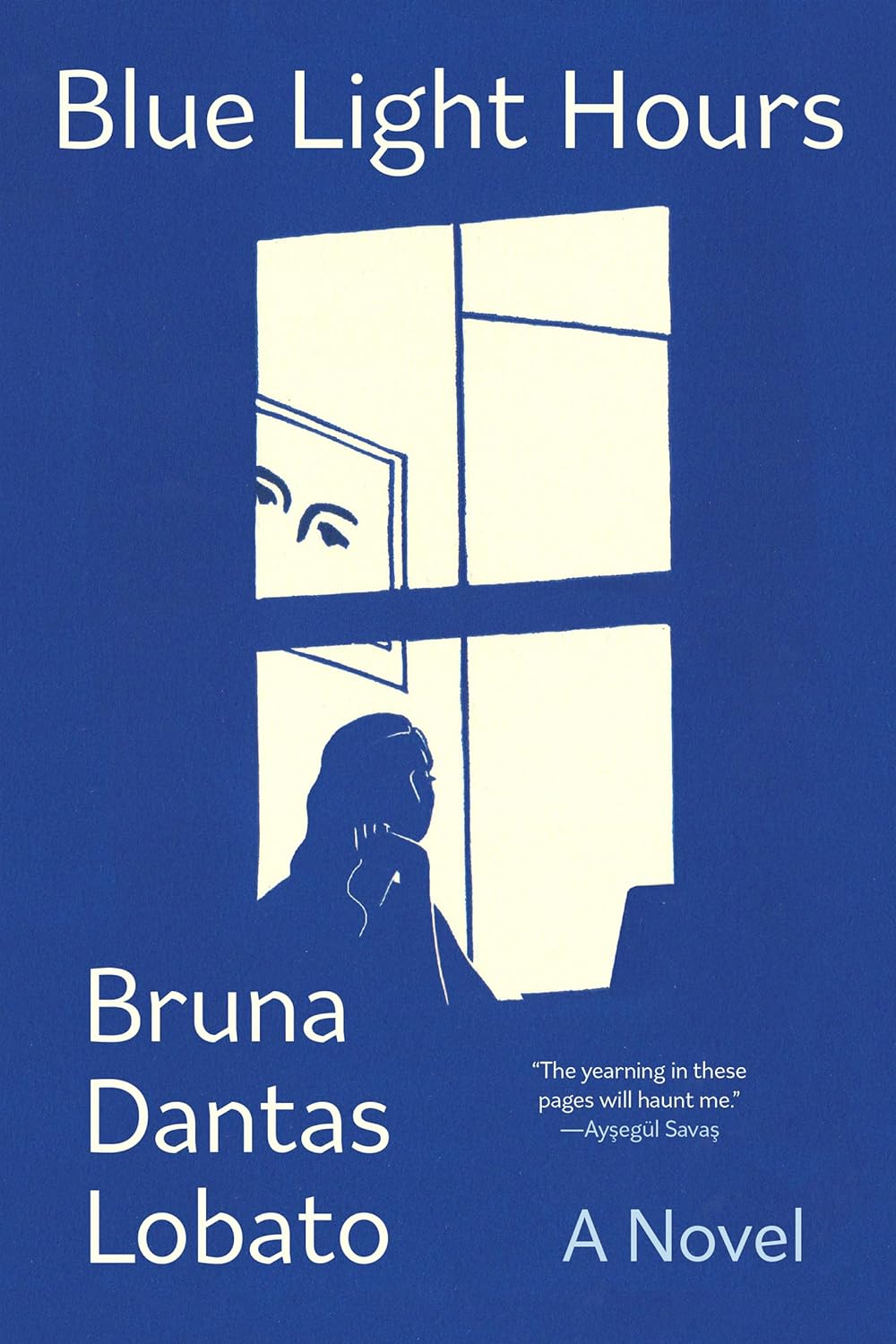
Blue Light Hours by Bruna Dantas Lobato

A mother and daughter separated by continents navigate distance and intimacy through the “miraculous blue light” of video calls in this haunting debut.

National Book Award-winning translator Bruna Dantas Lobato makes her authorial debut with Blue Light Hours, a subtle, contemplative story of a mother and daughter divided by 4,000 miles, who come together via screentime and memory. With love, care, quiet humor, and pervasive yearning, this thoughtful story explores the dilemmas of coming of age and leaving home, the tension between separation and connection.

On a full scholarship, the daughter departs her home in Natal, Brazil, “prepared to brave the world, even if it hurt me,” for a liberal arts college in a remote part of Vermont, leaving behind a mother who suffers from insomnia, migraines, and depression. The daughter navigates unfamiliar culture, food, and language, while the mother observes her first Christmas alone. The daughter feels guilt, torn between two very different lives. “I stared into my green tea, wishing someone… had warned me about how hard it would be to leave, how hard to stay.” Both women rely on their Skype calls: “On the shiny blue screen, there was my mother, my friend, the only person who always knew me.”

This story is told in three sections, “Daughter,” “Mother,” and “Reunion,” but “Daughter” occupies the bulk of the book, so that readers see her loneliness and her striving to make a new life work, even as she worries about what she’s left behind. “Daughter” is also the only section told in first-person perspective, while “Mother” identifies that character only as “the mother,” although both protagonists remain nameless. In “Reunion,” the mother travels to New York City and they make Grandma’s chicken soup together, “dipping pieces of bread into their old lives.” A moving passage details the items in the daughter’s bathroom, all the gadgets and conveniences that are unfamiliar to the mother, and the mother’s brief wish for the simpler bathroom of home. “But when she turned the crystal knob on the bathroom door and saw her daughter at the end of the hallway, sifting powdered sugar on French toast with a wand, she couldn’t help but take the wish back. She couldn’t resist thinking that things were perfect just as they were, golden faucets and all, without any gleaming glass between them.”

Blue Light Hours documents with wisdom and tenderness what is gained and lost when one leaves a home to build another, and the less universal experience of putting a 27-hour flight between mother and child. It tells painful, beautiful truths: with independence comes loneliness as well as freedom, and raising a daughter also involves losing her. Dantas Lobato’s careful, lovely prose will linger long after these pages end.


This review originally ran in the August 15, 2024 issue of Shelf Awareness for the Book Trade. To subscribe, click here.


Rating: 7 electric toothbrushes.

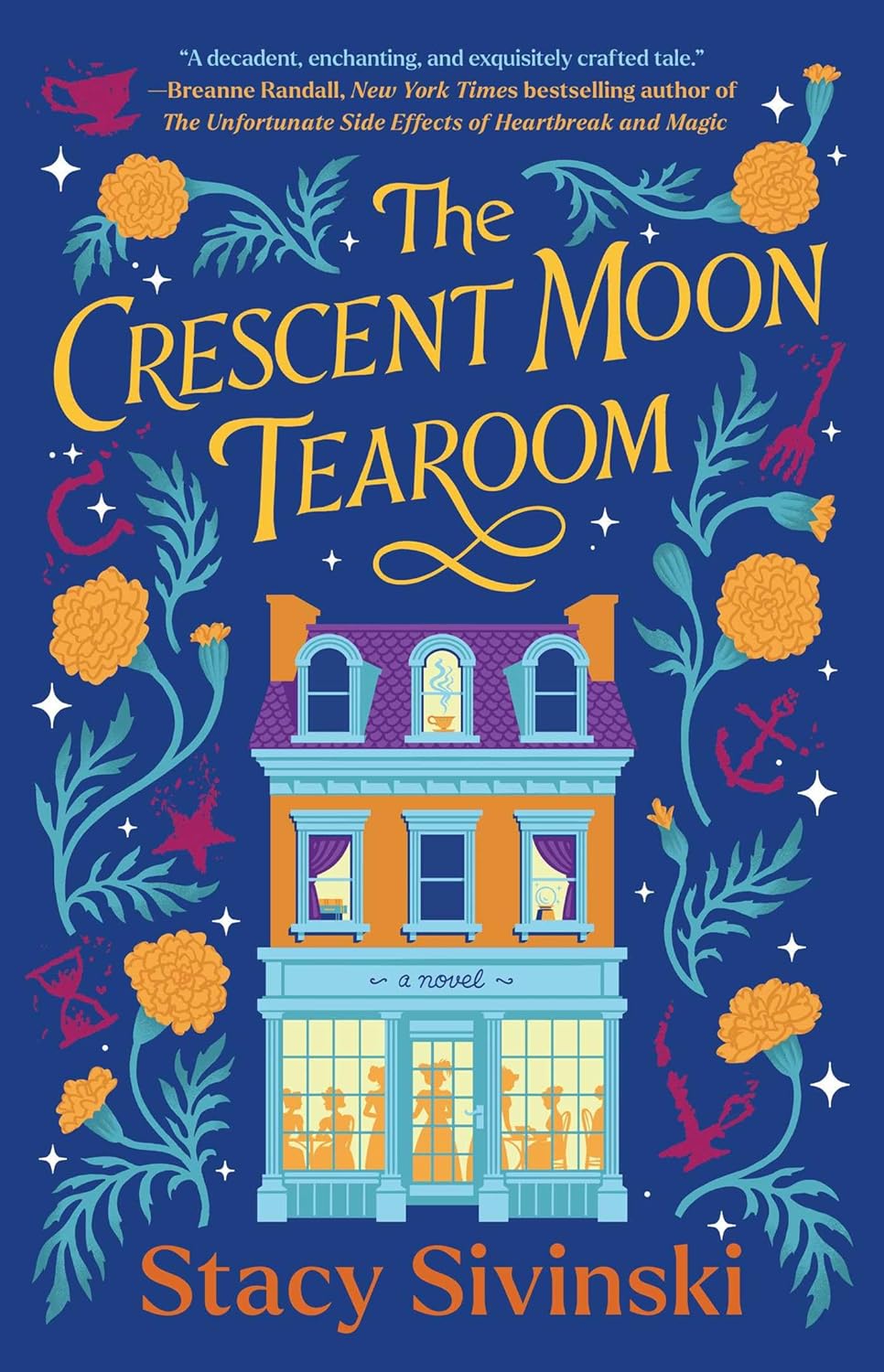
The Crescent Moon Tearoom by Stacy Sivinski

This entrancing debut stars triplet witches who can see the future, but must work together and individually to grasp their own.

Stacy Sivinski’s first novel, The Crescent Moon Tearoom, is a sweet, wise balm of a story about family, change, and coming into oneself.

The Quigley triplets, Anne, Violet, and Beatrix, have always been close. Their beloved mother was a powerful Diviner, able to read the future in various signs. Her daughters put the same skill to use in the Crescent Moon Tearoom, where the three young witches sell magical teas and delectable baked goods and tell fortunes to hordes of Chicago’s women and witches. The tearoom (run out of the family home, itself an endearing character with a will and magic of its own) does a booming business, but all is not well with the Quigley sisters. A challenge comes from the Council of Witches: the younger three must help three older witches discover their Tasks, which is a witch’s very reason for existence and is imperative to complete before a witch passes, or she’s “doomed to linger as a spirit for all eternity.” If they fail, the Council will close their shop. The events entwine with a potential curse on the sisters, threatening to undo everything the sisters love.

Although nearly identical in appearance, the Quigleys are quite different individuals. Their mother used to say, “Violet has her head in the clouds, and Beatrix’s nose is in a book. But [Anne’s] feet are always planted firmly on the ground.” While Violet (the family baker) is volatile and in constant, foot-tapping motion, Beatrix is shy and dreamy. Anne is the caretaker, the brewer of teas, and has secretly been holding back her own magical powers so as not to surpass her sisters. They “had been locked in their web of affection and dependence for so long now. Their bonds had taken shape during childhood and seemed to be coated in bronze.” As they struggle with the ominous Council’s extraordinary demands, their differences are highlighted, even as each sister finds opportunities for new growth.

Sivinski’s droll telling details the lovable Quigleys with all their quirk and charm, each with their own moving emotional arc. Chapters are headed with signs and symbols, as one might find in tea leaves at the bottom of a cup, with brief descriptions of their meaning: a fan suggests flirting with temptation; a bat foreshadows a fruitless endeavor. Each line captivates: “As seers, the Quigleys had long ago accepted that questioning what they saw in the remnants of their customers’ tea was about as useful as trying to wash cherry jelly out of a silk blouse.” With its sweetness, realistic challenges, and satisfying resolution, The Crescent Moon Tearoom is a rare pleasure. Readers will miss the Quigley sisters at this novel’s end.


This review originally ran in the July 26, 2024 issue of Shelf Awareness for the Book Trade. To subscribe, click here.


Rating: 8 petals.

Case Histories by Kate Atkinson

Unusually for me, I watched the television series first, and it is a striking series, and obviously colored my imaginings while reading this novel. It might have been desirable (for the usual reasons) to do it in the other order, but gosh, I think this is a rare case of each enriching the other. (Also, it has been long enough that I was still able to find surprises while reading. It pays to be forgetful if you read and reread mysteries.)

This is a brilliant novel. I love everything about it. It feels a touch genre-bendy, with the title and the three different cases intertwined, although it is of course not unheard of to see a PI or detective involved with multiple cases at once. Case Histories introduces three distinct mysteries before we meet Jackson Brodie, a retired military policeman and regular copper now working on his own. He has a grumpy receptionist, a recently remarried ex-wife, and an eight-year-old daughter he’s crazy about. He runs, off and on smokes cigarettes, and listens to moody American female country music stars (Emmylou Harris, Lucinda Williams, Allison Moorer). He’s from the north of England but now lives, and the novel is set, in Cambridge, a location with lots to contribute to the story. (I looked it up and confirmed my confusion about location: the TV series is set in Edinburgh. Also an impactful setting, but boy, they threw me off with that one. Cambridge does so much work here though! Was it too challenging to film there?) Jackson has enough to worry about with his divorce and entirely real dental problems–he’s become a regular with a heavy-breathing, magnetic dentist named Sharon, although it’s unclear if she is in on the sexual tension between them–but some earlier traumas are also at work upon our protagonist, that the reader will only find out about late in the book.

I called Jackson the protagonist and I do feel that way (although maybe, again, influenced by the TV show), but there are a few other issues percolating too. Mr. Wyre mourns his younger (and undeniably favorite daughter), murdered in his office while he was briefly away, several years ago. The crime remains unsolved. A woman with a shadowy past makes yet another fresh start. The Land sisters, Julia and Amelia, go through their father’s house after his death and find a clue in the long-ago disappearance of the youngest sister, Olivia. (They consider themselves the two remaining Land sisters of four, even though Sylvia is alive and well, in a convent.) Steve Spencer believes his wife is cheating on him. A wealthy, obnoxious elderly widow named Binky Rain is convinced someone is stealing her cats. A young homeless woman with yellow hair crosses paths repeatedly with multiple characters, asking “Can you help me?” All of these large and small worries, crimes, puzzles will become Jackson’s problem in one way or another. He is long-suffering (and the toothaches don’t help), a bit hapless, but good. His relationship with his daughter Marlee is very sweet.

I think one of the things I love about this book is the layers of personality that the main characters and even some of the less-central ones exhibit. Jackson’s dental troubles, the country music he prefers, his frustrations with his ex, his running (which I think played a larger role on television than it does here), fill him out. The Land sisters are both pathos-ridden and hysterically funny. Marlee is a gem. Jackson’s old buddy Howell remains mostly theoretical, off-screen, but appears for a brief, funny scene in the hospital, where Jackson concedes, “he supposed his daughter would be pretty safe on a sheep farm in the middle of nowhere, surrounded by Russian gangsters.” Case Histories is like that: off-kilter, random, funny, emotive in the still-waters sort of way, concerned with profound ills but also basically good folks. Steeped in the kinds of details that make these things work. I can’t wait to read more Jackson Brodie.


Rating: 9 sweets.

The Magician’s Daughter by H. G. Parry

Liz always recommends winners, but this one is the best of the year so far.

The Magician’s Daughter is a dream of a novel about magic, family, trust, coming of age, a changing world, and figuring out what’s right (or the closest we can come) and what’s wrong. I confess I am in danger of being suggestible by the Alix E. Harrow blurb on the cover of my edition, which reads in part: “a brand-new classic, both wholly original and wonderfully nostalgic.” I read that before I read the book, so there’s a danger there. But I think she got it right: there is both the tried and true and familiar here, and something fresh and new. I loved it so much. And this may be in part the right book at the right time, but I fell into it in ways I needed to.

Biddy has only ever known life on the island of Hy-Brasil, where she lives with her surrogate father figure, a mage named Rowen, and his familiar Hutchincroft, who sometimes takes human form but mostly lives as a golden-colored rabbit. She is now about sixteen, or seventeen: they can’t be sure, of course. She’s always known the story, that she was found shipwrecked alone in a small boat, which had been very unusually allowed to drift near Hy-Brasil. Off the coast of Ireland, beyond the Aran Islands, the magical island is only detectible every seven years; to accept the small craft that bought her there as an infant has always meant to Biddy (in her secret thoughts) that there must be something special about her. She might not have magic as Rowan does, but she hoped she was meant for big things.

And so in her teenaged years, it has begun to chafe that Rowan won’t let her leave the island. And he’s been leaving himself, more and more, in his form as a raven, out all night and sometimes even returning hurt. The outside world seems to be unraveling in some way, and Biddy is ill equipped to understand or help, being without magic and forbidden and unable to travel, but change is afoot…

Eventually Biddy and the reader learn that magic has been slowly leaving the world. The British Council of mages has seen upheavals in the last seventy years (mages live a long time, and this is all easily within Rowan’s experience), and those in power just now are not necessarily doing the kind of good work Rowan (and Biddy) believe in. It is now the year 1912, and Biddy is ready to step off her island for the first time in her memory, to take some serious risks. On the streets of London, she sees poverty and exploitation as well as overwhelming numbers of people (and intriguing fashion, which she’s always been curious about). She meets some looming figures from Rowan’s past, and the character of her beloved guardian gets somewhat complicated by these new perspectives. Especially in the Rookwood Asylum for Destitute Girls, she sees suffering and injustice like she’d never comprehended. There is much wrong in this larger world, and even all the magic one could dream of couldn’t fix it all, but with magic leaving the world things are worse than they should be. What can an orphan girl with no magic of her own possibly do? But with Rowan in profound danger, Biddy will have to try.

There is a touch of the fairy tale here, a dose of historical fiction, and lots of magical fantasy elements. Parry excels at world-building and realism. I love the sense that this could all be real, that there could be little hints and strains of magic in this real world that we regular folk are just not accustomed to noticing. Mages, like the rest of us, are susceptible to jealousies and the corruptions of power. There is a strong hint at the end that the world is about to see some larger problems – and again, this is 1912, so that is very believable foreshadowing. I desperately want the sequel to this lovely, absorbing novel! And will be investigating Parry’s backlist.

I needed the escape offered by this novel at this precise time that I picked it up, and am calling it the best book I’ve read this year. Thank you again and always, Liz. (I’m typing this review on your birthday although it won’t publish for some weeks.) Hugs and magic.


Rating: 10 hairstyles.

The Axeman’s Carnival by Catherine Chidgey

Told in the voice of a magpie, with humor and wisdom, this unflinching portrait of nature picks at the thin veil between the elemental violence and drama of both human and animal worlds.

Catherine Chidgey (Pet; Remote Sympathy) offers a singular combination of compassion, desperation, dark humor, and slow-building terror with The Axeman’s Carnival, set in rural high-country New Zealand. The story is told through the unusual perspective of a magpie fallen from the nest and rescued by a woman named Marnie, who lives on Wilderness Road with her husband, Rob, a sheep farmer and competitive axeman. They’re “under a lot of pressure,” a refrain that contributes to a general sense of foreboding: a drought threatens their livelihood; Marnie mourns a lost pregnancy; she is isolated from the world beyond their farm. An ominous thread runs through their lives in ways that readers gradually become aware of.

The narrator shares memories of being in the eggshell, occupying the nest with his sister and brothers. “She lifted me into her pillowed palm” and a relationship begins. Marnie releases the magpie to his flock, but he chooses to return to the woman he adores; she names him Tama, and posts his pictures to the Internet, which gains Tama a following. The sheep station suffers setbacks, and Rob’s temper and drinking become increasingly menacing, even as he trains for the annual competition where he hopes to win his 10th golden axe, which will offer both the affirmation he craves and a badly needed monetary prize. Tama’s Internet fame presents a financial opportunity for the family, but also puts them in the public eye, with new risks. Tama’s view of events is curious, in both senses of the word; “that was how houses worked,” he repeatedly notes, with each strange or sinister observation.

Magpies are very smart birds. Tama relates the story with humor and wisdom. He mimics human speech and understands it well enough to communicate, and the reader benefits from his viewpoint as he describes events, with grim foreshadowing. “When I think about what happened later, I remember that day,” he says, of various small violences. “Rob honed an axe with his honing stone…. He ran the blade through the hair on his forearm to test the sharpness, and we watched his crime show about shapely murdered women with torn-off clothes who’d let their attackers in their front doors.” Rob’s temper, his taste for crime shows and murdered women, his axes and admirable strength, his jealousy and Marnie’s fear, all contribute to the reader’s trepidation of what is to come. But The Axeman’s Carnival has tricks up its sleeve, and Tama himself should not be underestimated.


This review originally ran in the June 18, 2024 issue of Shelf Awareness for the Book Trade. To subscribe, click here.


Rating: 8 cashews.

The Twilight Garden by Sara Nisha Adams

From the author of The Reading List comes a pleasingly similar, sweet novel of unexpected connections. In a shared garden in London, two sets of neighbors in two timelines (2018-19 and the 1970s and 80s) navigate conflict, build community, share love and struggles, and grow flowers, food, and strong bonds. It’s an optimistic story, which I perhaps don’t get enough of in my life.

I’m thinking of both this and Adams’ first novel as sort of meet-cute, enemies-to-friends stories, with rom-com sweetness but where the relationships that form are not romantic. Rather, neighbors and community members come together, across diversity in age, gender, sexuality, and race, and form deep and meaningful friendships and built families, caring for each other in profound but not romantic ways. There are romances among the cast of characters, but not in the relationships whose trajectory defines the novel. I’m thinking of these as non-romantic love stories, a genre I’ve not thought about before but am trying to define here.

We first meet two neighbors in contemporary London. Winston is a young Indian immigrant who has lived in his rental home for some years with his partner, Lewis, although their relationship seems to be drawing to a close. He’s lonely, disconnected, and a bit depressed, although his work in a nearby convenience store offers a wholesome and healthy dose of community connection. “He was always chatting to customers in the shop, but when it came to the neighbors on his road, he barely knew faces, let alone names.”

Bernice has just moved in next door, newly divorced, with her ten-year-old son Seb. She is white, well-off, privileged, uptight. Because chapters alternate between their perspectives, the reader knows that each is suffering their own private pains, but to one another, Winston and Bernice are each the nightmare neighbor. Their conflict centers around a shared garden, which Winston has treated as a private sanctuary and Bernice views as a death trap for her son. This garden, now in disrepair, transports readers back to the earlier timeline and two additional protagonists.

Maya first moved in (to what is now Winston’s home) with her husband Prem when they were newly arrived from India. They were soon joined by a daughter, Hiral. Next door (in what is now Bernice and Seb’s home) an older woman named Alma lived in the house she’d been raised in. Initially prickly, and permanently ornery, Alma becomes a dear friend to Maya’s family, a relationship that began in the garden. Alma is a very serious gardener and a bit of a control freak, but Maya encourages her to accept help from their community, and they wind up very much a neighborhood hub for food, fellowship, work, mutual support. In Winston and Bernice’s time, mysterious missives inspire the feuding neighbors to attempt reawakening the rich shared garden of years past, and the bonds of community come, slowly, along with it.

This story is deeply sweet, perhaps approaching what my mother would call ‘precious,’ but never getting there. There are no bad guys, although there are some bad behaviors; instead, these are humans who suffer and sometimes handle it poorly, but feel badly about it and try harder next time. The loves (familial, friendly, and romantic) are real and deep. I cried several times. It felt wholesome and good. There is tremendous diversity here in several senses, and closeness is possible across all those lines when humans reach out and make efforts, or when there is real need. It’s a lovely, hopeful version of the world, and I’m here for more of it.


Rating: 9 banana leaves.

Fire Exit by Morgan Talty

On the boundary of Maine’s Penobscot reservation, a solitary man wrestles with questions of truth, family history, and what is owed to the next generation.

Fire Exit by Morgan Talty (Night of the Living Rez) centers on one man navigating issues of family: the death of his father figure, his mother’s lifelong and worsening health conditions, the daughter he knows only from afar and who doesn’t know who he is. In hardscrabble circumstances, surrounded by poverty, alcoholism, and family violence, he wishes to give his daughter a meaningful gift: the truth. Stark and tender, Talty’s debut novel compassionately addresses tough choices in matters of family and love.

Charles Lamosway has grown up on the Penobscot reservation in Maine, but does not have Native American blood. Although very close to his Native stepfather, Frederick, whom he generally refers to as father, his biological parentage meant he had to move off the reservation when he came of age. Frederick purchased land and helped to build the house where Charles lives now, just across the river. Largely isolated with few friends, Charles watches from his porch the family on the other side: Mary, Roger, and their daughter, Elizabeth. Charles is Elizabeth’s biological father, a secret he has kept at Mary’s request. But as he ages, and as his mother Louise’s health worsens, he feels increasingly that Elizabeth, now an adult, must know the truth.

Charles insists, “Maybe her body and mind know something is missing.” This urge becomes a fixation, a bodily need. Elizabeth faces medical problems, and he is convinced she needs the truth–including Louise’s medical history–to survive: “I felt she should know her body was special, and she should know its history, especially the one it would not tell her and the one she could not see. And I decided to tell what I knew, because she deserved to know it.” But it is just possible that what Charles sees as necessary will have an entirely different outcome from what he intends.

Fire Exit is concerned with bodies, with visceral needs not only for food and shelter but for truth. Louise’s failing body and mind are wrapped up with unresolved questions about Frederick’s death. Talty’s tersely poetic, descriptive prose grounds this story in the physical: “Between the river’s flow and the summer breeze rippling hard-to-see leaves and the sound my scraping shoe made on the porch, I heard night silence. I heard the workings of my inner body, the pump of my heart and the expanding of my lungs.” In Maine’s harsh winters, Talty’s characters face elemental as well as human dangers.

This first novel grapples with family issues and hard choices about love and responsibility; blood, culture, and belonging. It is an utterly absorbing story, always firmly rooted in the corporeal; tough, honest, but not bitter.


This review originally ran in the March 28, 2024 issue of Shelf Awareness for the Book Trade. To subscribe, click here.


Rating: 7 loads of laundry.

Nothing’s Ever the Same by Cyn Vargas

With a remarkably true-to-life adolescent narrator, this novella charts the large and small traumas that accompany a girl’s coming of age.

Cyn Vargas’s Nothing’s Ever the Same is a starkly honest coming-of-age story told in the disarming voice of its 13-year-old protagonist. Simple but moving, this novella documents events that are traumatic but not unusual, thus marking the kinds of pain that are heartrending, as well as common, for a child approaching young adulthood.

“The first time I saw my mom cry was after my dad’s heart attack,” Itzel begins in the opening chapter, “Angioplasty and Piñatas.” The heart attack comes during preparation for her 13th birthday party. After a brief hospital stay, he comes home and improves quickly. But this event, coming at an important symbolic point in Itzel’s adolescence, is the first of a number of upheavals, as Vargas’s title suggests.

Itzel’s beloved father recovers from his heart attack, but something feels off. “Dad was different, like moving the lamp… the light and shadows hit in a different way that made all that I was used to seem a little strange.” The family suffers one loss and then another. Itzel explores new feelings for her best friend. And then she sees something that will change the course of life for her entire family. “I shut my eyes tight to make it go away like erasing the wrong answer on a test, but I still saw… the wrong answer etched into the paper though the lead was brushed away.” What to do with her new knowledge? Who to blame? As the known routine is uprooted for Itzel and her parents, she has to navigate redefining relationships. While the circumstances of these changes for Itzel are specific and acute, her experience reflects universal elements of being a teenager: disappointment, betrayal, discovery, acceptance, and always, unavoidably, change.

Vargas (On the Way) gives Itzel a straightforward storytelling voice, often naïve but also sharp-eyed. She is clever, thoughtful, and quick to question what she or others have done wrong to bring pain and difficulty to her family. Her father, mother, Tia Amelia, and best friend Fred are characters sketched only briefly in Itzel’s telling, but each has personality and redeeming qualities even when making mistakes. The author behind the narrator commands this story with a quiet compassion. Nothing’s Ever the Same is a work of restraint and understatement, its young narrator capable of stoic relating of events as well as emotional reaction. The effect is deeply moving.


This review originally ran in the March 14, 2024 issue of Shelf Awareness for the Book Trade. To subscribe, click here.


Rating: 7 cups of orange soda.