Girls with Long Shadows by Tennessee Hill

Identical triplet girls are linked to tragedies across generations in this evocative first novel set along the swampy Texas Gulf Coast.

Tennessee Hill’s first novel, Girls with Long Shadows, is a dreamy, atmospheric tale of sisterhood and coming-of-age in the fictional town of Longshadow, on the Texas Gulf Coast. Nineteen-year-old triplets Baby A, Baby B, and Baby C were orphaned when their mother died in childbirth; their father’s identity remains a mystery. But they have always known family in the form of their loving but distant Gram (“Manatee” to the townsfolk, for her swimming prowess) and their adopted, nearly deaf younger brother, Gull. The whole town looks askance at the girls, spookily identical and associated with their mother’s early death. The family’s golf course, Bayou Bloom, provides respite, and the bayou itself (where Gram takes a daily swim, joined sometimes by one or more of the girls) offers a connection to nature, its fecundity and floods. Then one fateful summer, an act of violence, combining desire and objectification, ruptures the triplets, the family, and the town.

A tautly plotted Southern gothic, Girls with Long Shadows takes a distinctive perspective in Baby B’s elegiac narration. “That weekend something gurgled beneath, rattled us where we stood.” And: “Even before the worst of what that summer would bring was upon us, I began to mourn the girls we had been.” Baby B speaks as “we” as often as “I.” Only a few people other than themselves can tell the girls apart; even the boys they date may not make the effort. And intermittently the perspective shifts to a “Front Porch Chorus,” in which the town speaks collectively, observing the girls from without: “They’re a blur we never bothered to untangle.” This lack of distinction is both a wound for the triplets and an indelible part of their identity. They feel each other’s sensations and know that this is a boon. Without that link, they would be less themselves. In the eyes of the town, however, they are less human for being undifferentiated, more object or mirror. “All those boys touching all of us at the same time, hands on hands on bodies on hands. It wasn’t even that Pete was the one touching me, it was all of them, their inability to leave us be.”

Encompassing a single summer in the dripping, humid South, Hill’s haunting debut deals in lyricism and tragedy as it considers the harm done to young women by the outside gaze.


This review originally ran in the March 31, 2025 issue of Shelf Awareness for the Book Trade. To subscribe, click here.


Rating: 7 bikini tops.

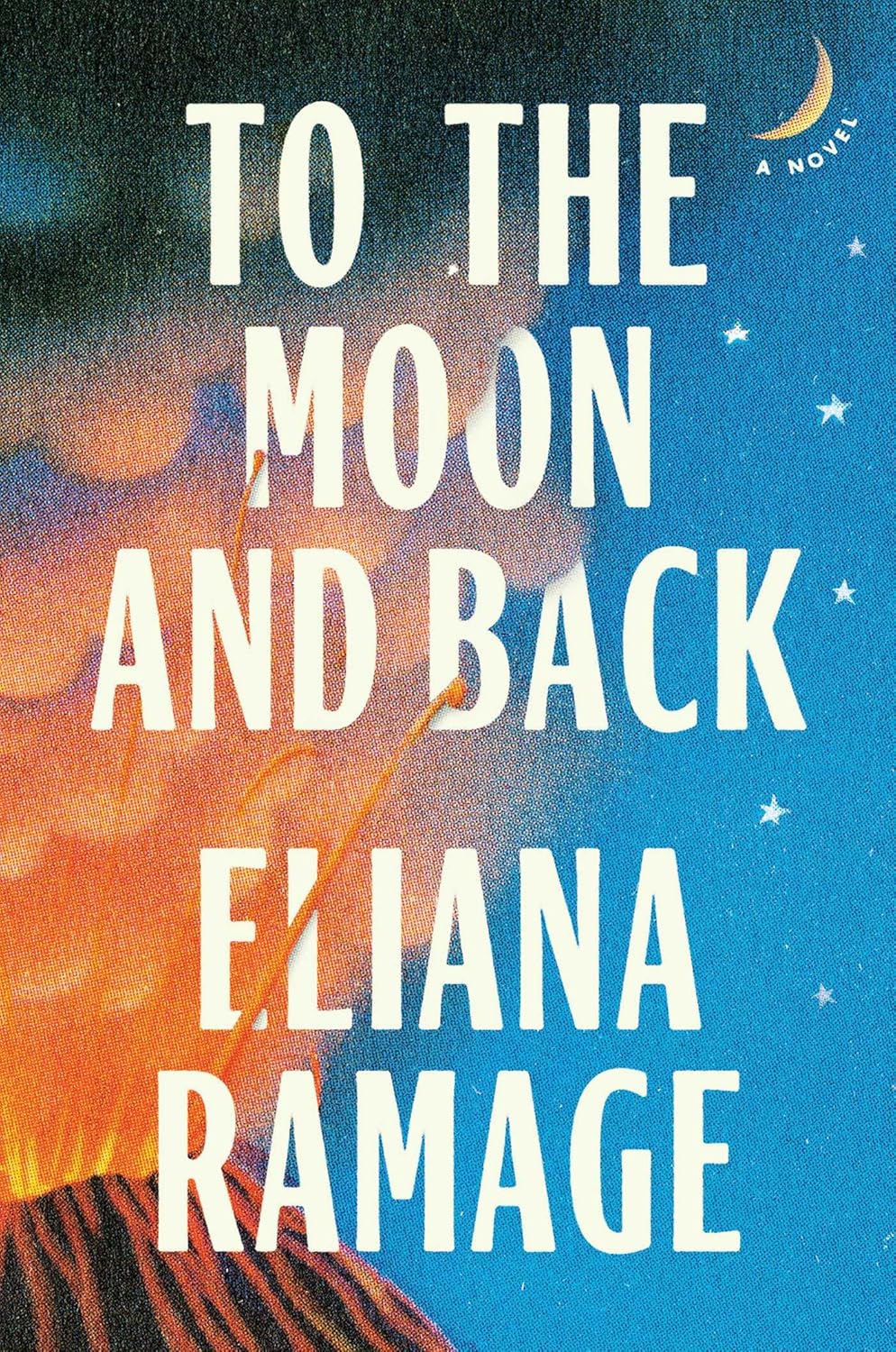
Maximum Shelf: To the Moon and Back by Eliana Ramage

Maximum Shelf is the weekly Shelf Awareness feature focusing on an upcoming title we love and believe will be a great handselling opportunity for booksellers everywhere. The features are written by our editors and reviewers and the publisher has helped support the issue.

This review was published by Shelf Awareness on March 25, 2025.


Eliana Ramage’s debut, To the Moon and Back, is a far-reaching, ever-surprising, intricate novel about identity, family, ambitions, career, romance and, yes, astronomy.

When readers meet Steph Harper, she is almost six years old. “I imagine her terrified. Our mother. Two children in the backseat. She drove like a woman followed, even after we left him at the foot of that tall hill. There was blood there, back in Texas, and tiny shards of glass still covered my sister.” Their mother, Hannah, is in flight from a vague threat–abuse, trauma–with her two little girls in tow. Precocious Steph is already developing her obsession with astronomy. Kayla is just a baby, sparkling in broken glass but unscathed by what haunts the others: “Our mother would never have Kayla’s confidence because Kayla had no memory of another self. Of another place. Of what was possible, here on earth. Maybe what was wrong with our mother was also wrong with me.”

From Texas, the fragile family resettles in the Cherokee Nation, in Tahlequah, where Hannah hopes to recover community and reclaim her heritage. Steph and Kayla learn to speak Cherokee. Steph watches the sky and fine-tunes her plans to become an astronaut: when readers meet her for the second time, she is 13 and concerned only with getting into Exeter Academy, which she hopes will put her on course for Harvard and then NASA. She studies the biographies of astronauts and the hard science she will need, with the help of a telescope gifted to her by her mother’s new boyfriend, Brett. “It had been my goal to understand the origins of earth, the universe, and everything in it by my fourteenth birthday. I was behind schedule.” This dream is what gives Steph’s life focus; she needs this to live. “I’d picture an astronaut watching me back. Some astronaut would call his daughter through mission control and she’d say tell me what you see and he’d say oh, the Northern Hemisphere, North America, and that would be true, but also true was Oklahoma, a field, a tree. A girl alone, looking up.” It is also true that the dream, which in some ways saves her, may be what keeps her from finding happiness in relationships on Earth: with her mother, her sister, or the love of her life.

Distracting her along the way are her feelings for girls, which she suspects will not be appreciated in Tahlequah: “If I could figure out the money and the applications and the getting myself to college, I decided I would be gay. Or bi, maybe? At schools like Harvard, they let you figure that out.”

As Steph moves from Tahlequah to Hollis College in rural Connecticut, a parallel character is introduced. She was named Della Owens at birth, when she was adopted by a Mormon couple in Provo, Utah. But as the center of a legal case resting upon the Indian Child Welfare Act, she became known as Baby D. Many Native Americans believe she belongs with her people. Della’s path intersects Steph’s when they find themselves at Hollis together, and they will intertwine from there, coming of age in parallel and navigating romance, Native heritage, and ambition.

For a portion of the book, Della’s first-person voice alternates chapter-by-chapter with Steph’s, which otherwise dominates. Later, these perspectives are joined by various epistolary elements: e-mails, social media posts, text messages. To the Moon and Back excels in surprise; these points of view are only one area in which Ramage takes her reader in unexpected directions, geographically and otherwise. The novel is gloriously expansive, epic, and sweeping. It covers just a couple of decades, from 1995 to 2017, although the history of previous generations certainly comes to bear on the present timeline. But like Steph herself, the story keeps reaching beyond its expected limits. It is not only a coming-of-age story, but also about a variety of Native American experiences, and about queer experiences and those intersections. It’s about lofty goals, astronomy, and yearning. Just when readers grasp the enormity of Steph’s single-minded focus on becoming an astronaut, she reaches further, to becoming a better human being. The events of Steph’s life are often sensational, but always, in Ramage’s expert storytelling, believable.

So many threads would be too much for a less skilled writer to wrangle, but these characters are developed with such steady pacing, depth, and perfect detail that they always feel natural. A plot summary with spoilers would sound, perhaps, absurd. But To the Moon and Back is anything but. It is a complex, absorbing, thought-provoking novel, compulsively readable. Steph is exceptionally eccentric, and her story is also universal, all-encompassing. Her impressive character arc comes, eventually, to wisdom and an unlikely peace: “I want to love the universe, even if I don’t know what it is. I do not have to know what it is.” Readers will be enriched for having shared these pages with her.


Rating: 9 M&Ms.

Come back Monday for my interview with Ramage.

Bad Nature by Ariel Courage

Bleakly funny, gloomy, and magnetic, this novel’s revenge-fueled, terminal road trip will tender surprising truths.

Ariel Courage presents a provocative, hypnotic excursion with her debut novel, Bad Nature, which offers a road trip, a revenge fantasy, and a snarky sendup of American culture.

Courage’s mesmerizingly repellent protagonist, Hester, is a successful lawyer with money to burn–one form of revenge upon her “impracticable, unprofitable” upbringing–and an antiseptic lifestyle kept up by a personal trainer, a dermatologist, a cosmetic dentist, and other professionals. In her nondescript but designer-decorated Manhattan condo, she has regular, emotionless sex with the “objectively repulsive” building super.

Hester relates early in her narrative: “I was always going to kill my father.” This intention shifts from someday to immediate when, just after her 40th birthday, she receives a breast cancer diagnosis. The oncologist tells her that, without treatment, she has six months to live. With characteristic, practiced detachment, Hester quits her job and leaves Manhattan in her Jaguar E-type, aiming for her long-estranged father’s new home in Death Valley. She will kill him and then herself with the gun in her glove box. Simple.

Hester’s cross-country road trip is beset with trouble. She loses the E-type to theft at a Philadelphia rest stop, and with it, her gun and her mother’s ashes. The first lesson that her wealth–an important feature of her constructed armor–will not solve all her problems comes when she must settle for an insultingly affordable rental car. She picks up a hitchhiker: “what my mother had euphemistically called an urban outdoorsman and what in college I would’ve called a crustpunk.” This young man, John, becomes her unlikely companion on a convoluted and indirect route toward the eventual destination. John is a principled traveler: eschewing consumerism, he photographs Superfund sites, documenting destruction. Stops along the way include Hester’s (only) ex-boyfriend from college and a friend (likewise) from high school, with disappointing if predictable results. Hester gets sicker. The outcome of her larger journey is less easy to guess.

Caustic Hester is aware she has “daddy issues” but “I’d rather pluck his eyeballs out with a fork and eat them jellied on toast than endure five minutes of therapy.” Her first-person voice is deeply sarcastic, darkly funny, and almost entirely self-aware. Bad Nature‘s title offers commentary on Hester’s terminal cancer (and her mother’s), on the violent impulses of her hated father (and her own), on the environmental devastation John is called to witness. Even more than wealth, rigorous self-grooming, and personal aloofness, Hester’s carefully cultivated cynicism is her final weapon, and its potential loss might be the most painful and surprising part of this madcap expedition. Courage delights and challenges with this mashup of emotions, until readers may be surprised, in turn, to care about Hester after all.


This review originally ran in the March 6, 2025 issue of Shelf Awareness for the Book Trade. To subscribe, click here.


Rating: 7 dirty fingernails.

The Bones Beneath My Skin by TJ Klune

Just out from TJ Klune, The Bones Beneath My Skin is a standalone adult novel with loneliness, yearning, darkness, sweetness, queer love and sex, and discovery of new forms of family. There is a bit of a formula here in terms of the combination of those elements, but I don’t intend any of the negative connotation that often accompanies the idea of a formula. I appreciate that I can turn to Klune for a familiar blend of heartbreak and happy ending with characters who are messy but also the kinds of people I’d like to call friends.

In his Author’s Note, Klune calls this an ‘action movie in book form.’ A former publisher accused this manuscript of being different and weird: “but then, I’m the guy who made a socially anxious vacuum cleaner named Rambo into a main character” (check it out).

Nate Cartwright is on the road. The reader learns gradually: that he is driving the old truck recently inherited from his father, to the cabin recently inherited from his mother, both of whom just died of a murder-suicide after a lengthy estrangement from Nate, who they disowned when they discovered he was gay. He has lost his job and everything else that mattered to his old life in Washington, D.C. (not much); he’s headed to the cabin, lakeside in rural Oregon, without much of a plan but to unplug and regroup. But when he arrives at Herschel Lake, the cabin is not unoccupied. Instead, he finds a huge, intimidating man with a huge gun, accompanied by a tiny, lovely, friendly, extremely strange little girl. The man is Alex. The little girl is Art, short for Artemis Darth Vader. Nate tells her that’s not a real name. She corrects him.

This odd trio joins up. Art and Alex have already bonded firmly as allies, against long odds; Nate is late to the party, but fits in, as a lonely oddball with a tendency toward deeply felt loyalties. In a series of extremely unlikely events, Nate learns that his new… friends?… may not be all that they appear. But still he chooses to go all in.

With hints of Men in Black and ET, Nate, Alex, and Art go rocketing across the country, fleeing shadowy government forces and conspiracy theorists, harboring secrets beyond the theorists’ imagining, wanting only to be safe and together with those they love. Klune’s website calls it “a supernatural road-trip thriller featuring an extraordinary young girl and her two unlikely protectors on the run from cultists and the government.” I love Klune’s rather trademark focus on protecting kids as a central, undeniably wholesome focus, even amid some very adult concerns (and passions). As with other recent novels of his that I’ve enjoyed, this one left me looking for more featuring these flawed but loveable characters. I really loved the ending. Still following this author anywhere.


Rating: 8 slices of bacon.

rerun: She Got Up Off the Couch by Haven Kimmel

I have never stopped thinking about this masterful character profile / biography / memoir / feat of creative nonfiction by Havel Kimmel, and I’m very pleased to share it with you here, again. There was also a reread post, from when I was doing my MFA, and even as I write these words, I wish I had time for a reread now. (I am, for the record, really enjoying TJ Klune’s latest, so no regrets there, and stay tuned. Here’s to authors we love who keeping writing new work.)

couchThis book follows A Girl Named Zippy, and I adore Kimmel’s explanation in her Preface: that she would definitely never write a sequel to Zippy, but that people kept on asking her if her mother ever got up off the couch; and here we are. This is an extension of that first memoir, then, with the focus being not on the girl called Zippy (Haven Kimmel herself) but on her mother, who in that first volume was a somewhat shapeless woman who mostly inhabited the couch and read a lot, talked on the phone, watched television, and didn’t worry too much about her children. This is told not unlovingly, but as fact. Zippy’s childhood is on balance awfully joyful and fun, and although a critical adult’s eye might point out lots of points of minor neglect, she clearly loves her family very much. This tone is continued in She Got Up Off the Couch. The family and each of its members is still, realistically, flawed, but lovable and well-loved. Kimmel’s brother is now mostly absent, with a family of his own; her sister marries and has two babies; her father finds work as a sheriff’s deputy (or similar job title); but her mother’s is the great change of this second memoir. This was, what, the late 1970’s I suppose, in a tiny Indiana town of a few hundred people. Zippy’s dad, Bob Jarvis, holds the keys: her mother Delonda doesn’t know how to drive. This will work as a fine metaphor (and indeed is part of the literal action), as Delonda calls a phone number on a television commercial to look into going to college. She wrangles a ride into the next town over for an entrance exam, which places her out of fully 40 hours of college credits. Under Bob’s clear disapproval – he says of the woman who takes Delonda to her test, “time was, a woman wouldn’t have gotten in a man’s marriage that way” – she persists in attending classes, studying, reading, talking to new people, and in 23 months, graduates summa cum laude – and continues on to graduate school. Eventually she earns a Master’s degree in English and becomes a high school teacher. This is all a stunning change. Along the way, to get to school and back, she learns how to drive and purchases a vehicle that is, in itself, a good joke.

She Got Up Off the Couch also follows the format of A Girl Named Zippy: chapters jump around, more as connected anecdotes than as clear narrative. Each chapter stands alone admirably as a hilarious or heartfelt – usually both – nugget of tears, joy, preadolescent confusion, and filial love. [In fact, as soon as I finish writing this review I’m off to read my favorite chapter out loud to Husband, if he’ll let me, while he smokes a brisket in the backyard. If you’re curious, it’s called “Treasure,” and is about a hippie college student hiking cross-country who camps out in the Jarvis backyard for a few days. It’s hilarious and heart-wrenching.] It’s a great structure, this anecdotal style. If I ever write my own mother’s biography, which I keep dreaming about, I have something similar in mind. Yes, there are odd characters that the reader of just one chapter would wrinkle her forehead at; but this is true of the whole book, too. Zippy has had an odd and happy life, and that’s exactly why we enjoy reading about it.

Zippy herself, naturally, also grows and changes in this book. Delonda is our star and makes the most life-changing journey. Kimmel writes in her preface, “I will never do anything half so grand or important,” and I know exactly what she means: the decision of Delonda and other women of her time who broke out of where they were told they belonged have done something for the women of my generation that we are now saved from having to do, if that makes any sense. It is something I’ve long felt about my own mother. But I was saying that Zippy continues to grow up: we see more of her engaging and eccentric friends, Rose and Julie Ann, and we meet a new friend, Jeanne Ann. And when she gets a nephew and then a niece, Zippy becomes hopelessly devoted. The blizzard that sweeps through when her niece is long overdue and panics the family is, again, funny and riveting at the same time.

I’ve now read everything that Haven Kimmel has written except for every single one of her blog posts, and that one children’s book. I hope she is getting to work right now on another book – fiction or non, more Haven Kimmel, stat.

I love it. Funny, true, humble, real.


Rating: 9 cherry-red polyester suits.

Nothing to See Here by Kevin Wilson

Thanks to Liz for this one! I’ve had this on my shelf for a few… years? since she recommended it. I really enjoyed it. It was fun, and absurd, and sweet, and funny, and then quite poignant. Unique. I’m pleased.

Lillian comes from a life of not much money, love, or opportunity. She works hard for a scholarship to a fancy private school, where she makes one essential friend: Madison is from the kind of wealth where just almost literally anything is possible. They match each other’s weird, that one year. Then Madison gets busted with coke, and it’s all a bit foregone: Madison’s father pays off Lillian’s mother. Lillian takes the fall. She goes back to her depressed and depressing little life. Madison’s star continues to rise. When we meet Lillian, she’s working a series of shit jobs, pen-palling with Madison, who is now married to a senator, with a perfect little boy “who looked like an expensive teddy bear that had turned human.” Madison sends her $50 and tells her to come on down to Franklin, Tennessee “because she had an interesting job opportunity for me.” Lillian gets on a bus.

Senator Roberts was married before Madison. His ex-wife has just died. And left behind are his elder children, ten-year-old twins named Bessie and Roland. Lillian, who has no prior experience, expertise, or interest in childcare, is to take them on as charges. She has to keep them safe and relatively happy and oh yea, very private and low-key, because Senator Roberts is hoping to become Secretary of State in the near future, and the twins are a little different. They spontaneously combust. They are uninjured by this event, but their clothes burn off, as does everything around them. The Senator doesn’t need this kind of publicity.

And before Lillian can get used to limitless bacon sandwiches on demand (the Roberts estate employs a large staff, including an outstanding if weird chef named Mary), she is reinstalled in the guest house behind the mansion, which has been retrofitted to house small, recalcitrant fire children.

I love absurdism when it is reality-adjacent and also sweet and odd and fun, which this is, although it is also sad stuff. I love a literalization: the two children in Lillian’s care have been hurt by their life so far. They are a little damaged, slow to trust, quick to combust. Lillian is a bit that way, herself, but her combustion isn’t literal, where the twins’ is. Especially late in the story, Nothing to See Here gets to be about what it means to love someone, to choose to love someone and to take care of them. Lillian is not a parent, but she is as smitten and as wrecked as any parent, and as far at sea. “There was so much that I should have been doing, that I could have been doing, but not a fucking thing made sense to me. I just fed them, made them wash their hands, listened to whatever nonsense they wanted to tell me. I took care of them, you know?”

I should find some more Kevin Wilson. Outstanding.


Rating: 8 bounces.

I Leave It Up to You by Jinwoo Chong

A young man wakes up from a coma and returns to the family, and the family sushi restaurant, that he’d left behind, with comical, heart-wrenching, hopeful results.

I Leave It Up to You by Jinwoo Chong (Flux) is a funny, bittersweet, heartwarming story about family, love, and making every minute count.

Readers first meet Jack Jr. in what he is slow to realize is a hospital room. He wakes up intubated and gagging. He’s confused about his whereabouts and circumstances, and he asks for his husband. His nurse is thrown into a full panic: Jack Jr. has been in a coma for 23 months and was not expected to regain consciousness.

No one will answer when he asks for his husband. Jack Jr. has missed his 30th birthday and the first 18 months or so of the Covid-19 pandemic. A few weeks into this remarkable recovery, he returns home, not to his Manhattan apartment, but to his father’s home in New Jersey. He goes back to the family business, a struggling Korean-Japanese sushi restaurant, which was once meant to be his life’s work and which he has not seen in 12 years. Jack Jr. has lost everything, and he finds himself in an unfamiliar, masked world. For much of the narrative, the old wounds he was avoiding–that he will now have to face–remain shrouded from the reader.

Jack Jr.’s kind and loving Appa (father) is a passionate sushi chef and workaholic; his Umma (mother) is private, reserved, and fiercely loyal; his especially estranged brother, James, is a recovering alcoholic with a dear wife and a new baby to join the teenaged nephew that Jack Jr. barely knows. Wise, gawky, 16-year-old Juno is perhaps the member of his family that Jack Jr. best connects with. And then there is Emil, formerly Jack Jr.’s nurse, and now potentially poised to become something more. Through these endearing characters, Jack Jr. considers that perhaps “there was more to loving something than smiling at it.”

In Jack Jr.’s first-person voice, these mysterious, painful new challenges are wrenching, but his love for his wacky family, and theirs for him, are unmistakable throughout. Alongside the flavors of carefully prepared nigiri, dak juk, soy, ponzu, and plenty of pork belly, humor and off-kilter love shine brightly in this tale of realizing what’s really important and making the most of one’s own time. The title of I Leave It Up to You refers to a translation of omakase, the Japanese dining tradition of asking for the chef’s choice, and also nods to the novel’s sweet attention to the care of self and others. While recovering from his physical injuries, Jack Jr. must also navigate old fractures with a family he hasn’t seen in years, let go of a relationship with no closure, and remain open to a surprisingly promising future. The story winds up delightfully warm and soothing, for all the bumps along the way.


This review originally ran in the January 31, 2025 issue of Shelf Awareness for the Book Trade. To subscribe, click here.


Rating: 8 bowls of juk.

A House for Miss Pauline by Diana McCaulay

Near her 100th birthday, a rural Jamaican woman faces the good works and wrongdoings of her own life and her island’s history in this richly written novel of vivid characters and big themes.

Diana McCaulay’s sixth novel, A House for Miss Pauline, features an indomitable 99-year-old woman in rural Jamaica, trying to reconcile rights and wrongs near the end of a long life. Miss Pauline exhibits a brave honesty that endears her to readers as she wrestles with not only her own actions but centuries of wrongdoings on an island steeped in sugar and slavery. Kingston native McCaulay (Gone to Drift) evokes a rich setting through the food, climate, and other details, such as her characters’ Jamaican patwa, which brings them to vibrant life.

Miss Pauline is less than a month away from her 100th birthday when the stones of her home begin to shiver, shake, whisper, and howl to her. She has lived in the village of Mason Hall in Jamaica’s St. Mary parish all her life, having borne two children with her beloved (long-dead) partner, had many friends and lovers, and been an elder to the town. The village is built largely of stone salvaged from a plantation big house Miss Pauline once discovered and designated for reuse in building her own home and many other structures.

In this literal and symbolic rebuilding, she led her community in reclaiming what had been stolen: land, human lives, freedom. She is certain now that the stones are prompting her to reckon with her own life’s work: community building, but also the unresolved disappearance of a white man who came to Mason Hall decades ago to challenge Miss Pauline for the ownership of her land. A House for Miss Pauline is a deeply captivating story of one complicated, admirable life and the nuanced history of Jamaica. It grapples with how people are connected to place, and how that plays a role in the concept of land ownership and responsibility. “Does the cotton tree judge her for what she did? Surely it has seen worse? How to evaluate crimes, one against the other?”

Miss Pauline turns first to her granddaughter in New York, and then enlists a local teen, Lamont, for help with the mysteries of the Internet and a smartphone. Lamont, who’s alone in life, will play a role beyond research assistant for the near-centenarian, prompting consideration of what constitutes family. In her attempts to establish the future of her home and her land, Miss Pauline will also face surprises about her own history: “Maybe you have to go into the past to make the present right. Maybe the long ago is demanding something of the here and now.” Thoughtful, defiant, and just, the frightened but fierce Miss Pauline is uncowed in the face of youth and change; she’s a hero for readers of all backgrounds.


This review originally ran in the January 17, 2025 issue of Shelf Awareness for the Book Trade. To subscribe, click here.


Rating: 7 panganat.

Margo’s Got Money Troubles by Rufi Thorpe

This book was an utter delight. I laughed and felt all the way through it and would follow Margo into her next chapters with enthusiasm.

Margo is a nineteen-year-old freshman at a junior college when we first meet her. She’s a bit directionless, studying English because she likes it, waitressing in her spare time. She’s been having an affair with her English professor, out of a sort of passive curiosity, not even because she particularly likes him (“this whole affair had seemed to be kind of his thing”), although she does like him praising her writing. When she finds out she’s pregnant, the professor (married with children) assumes she will have an abortion; so does her mother and her best friend from high school. Initially in contrarian reaction to those assumption, Margo refuses. She finds she wants her baby, and doesn’t care a bit that Mark (the professor, with whom she had sex just five times) doesn’t. After the birth of a son she names Bodhi, in short order, two of Margo’s three roommates move out, leaving her with a massive rent due, and she loses her job. Her mother refuses to babysit. She doesn’t know what to do. She leaves a voicemail for her father: formerly a pro wrestler, and since then a promoter/manager, married with five children, he’s been absent for much of Margo’s life, amiable and distantly loving but not much around (because work, and what Margo calls his real children). But in an unexpected turn, when she calls on him for help, Jinx shows up on Margo’s doorstep. Revealing that he is finally getting a divorce (something Margo’s mother wished and waited for for all these years–but now she’s recently engaged to a youth group leader…), Jinx moves in with Margo, helping to pay rent, caring for Bodhi like a pro, and quite by accident giving her an idea out of left field: Margo sets herself up an OnlyFans account. Things just get wackier from here.

This book is filled with characters. Jinx, the retired wrestler persona, is a study in contrasts: he fills his room with books, a ficus tree, and a sleeping bag, nothing else. He loves cleaning and cooking fancy meals. He is both inspired to violence and a calming, philosophical presence. Margo’s other remaining roommate, Suzie, is a LARP and cosplay enthusiast, and will turn out to be a great friend to Margo after a long stretch of cohabitating without getting to know each other. Everyone the reader meets could be a protagonist unto themselves.

But the reason Liz sent me to this book (with some hesitation) was the narrative voice, the set of points of view in which it’s written, and the literary references and styling. Margo was briefly an English student, remember? The novel is told in a really fun, tricky perspective: it moves between first and third person voices, but actually both are first person, because even when it’s in third person, Margo is there as the *writer* to say, I have to tell this in third person because I need the emotional distance, basically. So it’s a bit sneaky. Even better, there’s a scene from English class in which she makes the smart observation about a story they’ve read, in which the same tricky half-hidden first-posing-as-third-person voice is used. Meta, and clever, and probably not for every reader. I love it.

This is a story that surprises at every turn. It’s hilarious, it’s heartfelt, it’s deeply sweet, it can be upsetting; many of its details are sordid, but there remains a sense of stalwart pushing on. It’s a (perhaps) surprisingly wise story. Margo learns all kinds of big lessons: there are no heroes or villains; we’re all just muddling through; love may not conquer all but can do a lot. There’s no changing anyone; “they were like chess pieces: they moved how they moved. If you wanted to win, you couldn’t dwell on how you wished they’d move…” She grows. “I hadn’t expected infidelity to be about cuddling or drug addiction to be about eating Milky Ways.” Life throws what it throws, and these strong, wacky, loving characters carry on. It’s quite empowering, even if Margo’s predicament is not one we’d quite choose on purpose.

I loved every minute of this adventure. Thanks, Liz.


Rating: 8 tiny gossamer shreds of roast beef.

The Garden by Nick Newman

This eerie, thought-provoking novel combines sisterly love and end-of-the-world horrors in an unforgettable pairing.

Nick Newman’s The Garden is a shape-shifting novel, an enigmatic fable that twists slowly into a more sinister dystopian narrative with a surprising turn at the end. The questions it asks and the hard truths its protagonists turn away from will keep readers intrigued.

Evelyn and her younger sister, Lily, have lived in the garden all their lives, more or less. They remember little from before, although in the early years there were parties, their father holding court, their mother overseeing. Then the people went away, and the gates were locked, as were the doors to the bulk of the sprawling house. The sisters live now out of the kitchen, which “still [feels] too large,” and in the garden, where they keep bees and a few aging chickens and grow vegetables, herbs, and flowers. Their mother’s handwritten almanac directs their daily work, which is getting harder as their bodies grow older, but the garden provides everything they need and nothing is expected to change–until it does.

The sisters haltingly identify the creature that appears in their kitchen, stealing their honey, as a boy. Aside from its sheer novelty, the situation is frightening. The boy is unknown and therefore unsafe, a curiosity and a threat. “You know what boys turn into, don’t you, Sissie?” Lily speculates, “He’s probably poisonous.” But Evelyn considers, “Boys did become men, Lily was right about that, but what her sister actually had in mind, she did not know. A cocoon, perhaps. A chrysalis… Evelyn could not deny a perverse desire to learn firsthand, to feed and water the grub and see what it might grow into.” As they wrestle with this new challenge in their long-immutable garden–perhaps less an Eden than a prison–the sisters find themselves facing new choices and turning against each other in new ways.

Newman’s gifts lie in the quiet accumulation of his novel’s unsettled atmosphere, its changeable nature. The garden provides food, sustenance, and floral beauty; it is also constantly threatened by dust storms capable of burying the known world. Readers know both more and less than Evelyn and Lily do, and knowledge and its absence are increasingly terrifying, especially as the sisters begin to confront long-buried secrets about their own past. The possible and the inexorable collide in this parable of change, which probes the promises and terrors of personal choice and portrays various approaches to possibility. “The vagueness of their mother’s threats had made a blank space… and only now was Evelyn realizing that she and her sister saw that blankness quite differently. It excited Lily. It terrified Evelyn.” The dystopia it represents may be more real than readers originally understand.


This review originally ran in the January 7, 2025 issue of Shelf Awareness for the Book Trade. To subscribe, click here.


Rating: 7 marigolds.