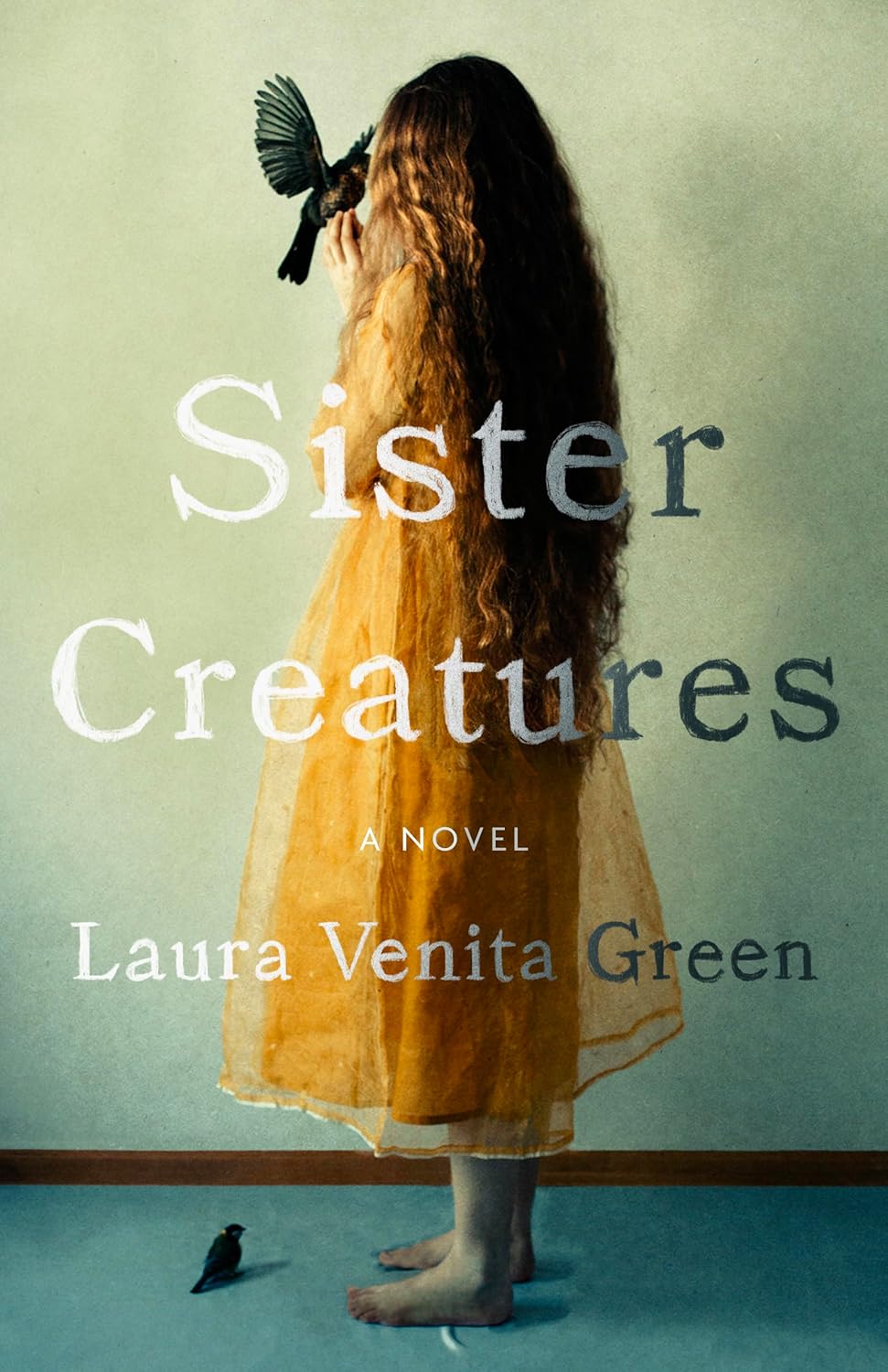
Sister Creatures by Laura Venita Green

From rural Louisiana to locations around the globe, the same problems and secrets follow a quartet of girls-become-women in this arresting, unnerving, and wise debut novel.

With Sister Creatures, Laura Venita Green invites her reader to navigate a shape-shifting world, beginning in rural Louisiana and ranging overseas and into starscapes and imagination. Rotating among a small group of girls and women, this imaginative narrative muddies the line between the novel’s real world and a fictional one within it. The result is dreamy, often disturbing, and hauntingly unforgettable.

In the opening scene, Tess uses her isolated job as a live-in nanny to hide away from the life she feels has already cratered, at age 20, with her heavy drinking. A neighboring teenager, Gail, makes a disquieting appearance: she is clearly not well, perhaps in danger, but rejects Tess’s half-hearted offer to help. The older girl “hat[es] how relieved she felt not to have to deal with anything.” Gail’s plight becomes a legend to the other characters until she makes a reappearance as an adult at the novel’s end. Meanwhile, Tess grows up and has a daughter of her own, lives around the world as part of a military family, but struggles to escape the problems she hid from in Pinecreek, La. Her former best friend, Lainey, leaves Louisiana as well, resulting in permanent banishment at the hands of a troubled younger sister. Another young woman, Olivia, wrestles with the local options, characterized as “Jesus and booze,” and with a sexuality not likely to be tolerated there. And then there is a recurring character whose entire reality seems in question. While they all choose to leave Pinecreek, the struggles that originate in their shared hometown follow these characters to Munich, Baltimore, New York City, and beyond.

In their parallel comings-of-age, and across generations, Green’s characters thread their paths between love and spite, affection and abuse. Their loose connections and jumps in chronology reward close attention, contributing to a slightly off-balance reader experience that is very much a part of the novel’s atmosphere. Sister Creatures blurs the concepts of reality and of right and wrong. Are the woods–of Louisiana, Maryland, or Bavaria–sanctuary or threat? Who is real and who is made up? Green’s narrative offers a strong literary bent, as characters interact with “The Yellow Wallpaper,” old fairy tales, misogyny, motherhood, and their own creative pursuits. They hurt each other, but they help each other, too; this is a novel ruled by nuance and surreality as well as the all-too-real.

Sister Creatures is often unsettling, but pairs moments of great sweetness alongside discomfiting ones. This novel remains thought-provoking long after its final pages.


This review originally ran in the August 12, 2025 issue of Shelf Awareness for the Book Trade. To subscribe, click here.


Rating: 7 cut-out musical notes.

The Islands of Elsewhere by Heather Fawcett

Another sweet, feel-good, funny, wholesome, middle-grade book by Heather Fawcett. I believe I have just one left in this age range, after which (if she’s not published more!) I’ll have to return to the Emily Wilde series to get my fill, and refresh my memory on how Fawcett matures her characters (and subject matters) for adult readers. I’m really enjoying just swimming in her imagination.

The Islands of Elsewhere stars the three Snolly sisters, but especially the middle sister, Bee. Eldest Hattie likes math, money, and being bossy; youngest Plum never stops moving, likes all sports, and generally teams up with Hattie, especially in their shared love of witches, fairies, and all things magic. Plum prefers to wear a costume, always: some of them store-bought Halloween costumes, many handmade by their loving Mom, who works for and performs in the theatre. And then there’s Bee, who appreciates science, especially botany, and is ever annoyed by her sisters’ belief in dreamy magical nonsense. Their toddler brother Dore rounds out the small family. Dad is mostly off-screen, but he and his girlfriend get along great with Mom, and he’ll be picking up the sisters for a camping trip in a few weeks’ time.

But first, Mom and the four kids are off to stay with Granddaddy at his home on the beach. They haven’t been there in a long time – Bee was too young to remember the last time. The sisters are delighted to arrive and discover that he lives right on the ocean! And his property includes an island – no, three islands! Fairy Island, Little Fairy, and Ghost come with some fascinating, even sinister stories in the little community of Misty Cove. The girls will have plenty to keep them busy: Hattie is practicing for a sandcastle contest that she intends to win (with a grand prize of one hundred and seventy five dollars!), Bee’s collecting new specimens of leaves and flowers, and Plum finds costume inspiration in the new setting: she wants to be a seal next, among other things. But there’s also a sadder reason for their visit. Beloved Granddaddy, an accomplished surfer and prolific and inventive baker of chocolate chip cookies, is having trouble with his memory. Mom is afraid he may not be able to live on his own for much longer.

The girls hatch a plan. If they can find the hidden treasure rumored to have been hidden away by their great-great-grandmother – an actual pirate – maybe they can afford to all live with Granddaddy from now on. The Snolly sisters must band together to search the fabled islands, and deal with octopuses, surly islanders, and the possible ghost of a witch along the way.

I loved the family dynamics here, which are nontraditional in some ways but always loving and positive. I loved the sibling relationships, and the earnest attempt to save the day. I loved Granddaddy’s quest for the perfect chocolate chip cookie, which includes everything from gum drops to Halloween candy to pumpkin pie, and maybe even octopus? It’s just all good clean fun, but not so clean as to be stuffy. In between heavier reads, I will take Fawcett’s younger-reader offerings any day. I hope she’s still hard at work. Hugs to Bee and the rest.


Rating: 7 unexpected ingredients.

No Ordinary Bird: Drug Smuggling, a Plane Crash, and a Daughter’s Quest for the Truth by Artis Henderson

A daughter’s study of her father’s life and death artfully reveals intrigue, astonishing slices of world history, and a loving but flawed man.

In June of 1985, a small private plane, a Piper Cub, crashed on its owner’s property in northern Georgia. The pilot, Lamar Chester, was killed. His only passenger, his five-year-old daughter, AJ, sustained severe injuries but lived. In death, Lamar escaped prosecution as a marijuana smuggler. His widow, hoping to protect her child, removed the young AJ from the life she’d known, isolating them from family and friends who had been involved in the smuggling business. AJ grew up to be Artis Henderson (Unremarried Widow), who spent decades turned away from her father’s story, interpreting her mother’s silence as shame. Her eventual readiness to examine the truth of her father’s life, their brief but loving relationship, and his end has resulted in No Ordinary Bird: Drug Smuggling, a Plane Crash, and a Daughter’s Quest for the Truth, which combines investigation and personal excavation in a searing, moving memoir.

In their few years together, Lamar made a strong impression on his youngest child, one that has been enriched by her later research. She remembers him as a loving and beloved father, and deeply charismatic, although his attitudes toward women in particular appear problematic through a modern lens. Henderson is thoughtful about such judgments, and careful in considering her father’s upbringing as a factor in his life. And a wild life it was, with an early marriage yielding three surviving children and one lost; divorce and remarriage; and a colorful career as a pilot, smuggler, and ostentatious party boy in 1970s Miami. Increasing profits and outward success allowed Lamar to acquire ever-more-impressive possessions, and he became involved in ever-more-risky ventures, until he faced federal prosecution and the plane crash that killed him.

Henderson’s work is both investigatory and personal: “I’m grappling with this story as much as I’m reporting it.” She loved her father, sympathizes with the demons he faced, and remembers a childhood of “uncomplicated happiness. My father made me feel safe and protected.” She trusts that there was a time when, “to him, the line between the good guys and the bad guys was still very clear,” but also realizes that he made choices that endangered his family and, she concludes, led to his own death. No Ordinary Bird is a loving portrait that benefits from the nuance of understanding that, as Lamar liked to say, “you can’t tell the good guys from the bad guys.” It is both research-based inquiry–involving travel to Miami, Georgia, Colombia, Nicaragua, Iran, and beyond–and also a memoir of family, love, and risk. Henderson excels at the subtlety required by such a story, and her telling is intriguing, painful, and cathartic.


This review originally ran in the July 18, 2025 issue of Shelf Awareness for the Book Trade. To subscribe, click here.


Rating: 8 bear claws.

The True True Story of Raja the Gullible (and His Mother) by Rabih Alameddine

An especially wry, wise, comic style distinguishes this unforgettable tale of national trauma, community, familial love, and forgiveness.

The True True Story of Raja the Gullible (and His Mother) is a novel as expansive, funny, and poignant as its title promises. With his signature wit and irreverence, Rabih Alameddine (The Angel of History; The Wrong End of the Telescope; An Unnecessary Woman) charts decades of Beiruti history and trauma through the life of his narrator, Raja, a reclusive, aging teacher of French philosophy.

The novel opens and closes in 2023, when Raja shares his apartment with his overbearing but deeply endearing mother, Zalfa. The bulk of its sections jump back in time: to the pre-civil-war 1960s, Lebanon’s civil war in 1975, the banking collapse and Covid-19 epidemic, and Raja’s ill-fated trip to the United States for an artists’ residency in Virginia. (He should have more fully recognized how suspicious the invitation was: he had written a book 25 years earlier, but “I’m not a writer, not really. I wrote a book, that was it. It was an accident.”) Writer or no, Raja is a knowing, purposeful narrator, teasing his reader with what is to come, defending his story’s chronological shifts: “A tale has many tails, and many heads, particularly if it’s true. Like life, it is a river with many branches, rivulets, creeks….” Self-aware and self-deprecating, Raja names himself the Gullible, the Imbecile, the Neurotic Clown, the Dimwit. His mother is “Raja the Gullible’s Tormentor.” “Deciphering [her] was a feat that would have surely flummoxed Hercules–my mother as the unthinkably impossible thirteenth task.” They bicker constantly, foul-mouthed but fiercely loving.

In past timelines, the reader learns of Raja’s troubled childhood as a gay younger son, bullied by much of his family, especially Aunt Yasmine, “the wickedest witch of the Middle East.” During the civil war, in his teens, he is held captive for weeks by a schoolmate and soldier with whom he begins a sexual relationship that is part experimentation, part Stockholm syndrome. He describes his accidental path to teaching, 36 years of it; he refers to his students as his “brats,” but his care for them and, even more, theirs for him will become gradually apparent. Amid terrible events, like the port explosion of 2020, Raja’s mother befriends a neighborhood crime boss named Madame Taweel: “Only my mother would find a mentor at eighty-two, let alone the most inappropriate one.” Bawdy, rude, and impossibly sweet, with “a laugh so delightful, so impetuous, so luminous,” Raja’s mother is the indomitable star of this loving, heartwrenching novel.


This review originally ran in the July 14, 2025 issue of Shelf Awareness for the Book Trade. To subscribe, click here.


Rating: 7 cans of tuna.

Lessons in Magic and Disaster by Charlie Jane Anders

Adult daughter and mother, both struggling and bickering, work to come together with magic spells, an impossible dissertation, and lots of love.


“Jamie has never known what to say to her mother. And now–when it matters most of all, when she’s on a rescue mission–she knows even less.”

At the start of Charlie Jane Anders’s Lessons in Magic and Disaster, Jamie’s mother, Serena, is struggling. Since the death of her wife, Mae, six years ago, simultaneous with Serena’s career imploding, Serena has been holed up with her grief in a one-room schoolhouse in the woods. Now Jamie, wrestling with her dissertation on 18th-century literature, has decided enough is enough. In the interest of pulling Serena out of her black hole, Jamie’s finally going to tell her mom her big secret: Jamie is a witch.

But her attempt to teach Serena some nice, wholesome, positivity-based magic misfires, because Serena is prickly, powerful, and pissed at the world. Learning magic proves hazardous, to her and to Jamie. There are also ill effects on Jamie’s partner, Ro, an endlessly patient and lovely person whom Jamie values above all–although she’s yet to tell Ro about her magic. Meanwhile, the college where Jamie studies and teaches is once more threatening to cut her already pitiful stipend, she’s at a sticking point on her dissertation, and her undergraduate students can be terrifying. But she’s just discovered a previously unknown document that might decide the authorship of a novel at the heart of her research. And with Serena’s frighteningly intense powers, it is both scary and tempting to consider what Jamie might do.

As the younger witch attempts to teach her mother the rules of magic (which self-taught Jamie has defined for herself), both women must confront relationships past and present, with each other and with their partners. In flashback sections, Serena’s early years with Mae offer heartbreakingly sweet and thought-provoking reflections on love and childrearing. Jamie’s present life with Ro, a Ph.D. candidate in economics, is nerdy and deeply loving, strongly rooted in intentional reinvention of traditional roles. Serena and Jamie are a prickly and troubled mother/daughter duo, but both are earnestly trying to come together. They will face challenges to their love as well as to their personal safety, as the stakes rise in a world of bigotry and social injustice, but they will also form stronger bonds with each other and other strong women.

Anders (Never Say You Can’t Survive; All the Birds in the Sky) excels at dialogue and the portrayal of relationships both loving and thorny. Her characters face profoundly serious dangers, but there are frequent notes of levity, joy, fun, and intimacy throughout. Lessons in Magic and Disaster features the magic of spells and charms but also that of human connection, and readers will be richer for the experience.


This review originally ran in the July 3, 2025 issue of Shelf Awareness for the Book Trade. To subscribe, click here.


Rating: 8 slices of chocolate fudge cake.

A Galaxy of Whales by Heather Fawcett

I needed this little break in between heavier reads, and I love knowing I can turn to Heather Fawcett to scratch that itch. A Galaxy of Whales is offered for readers ages 8-12, and features 11-year-old Fern, who is having a difficult summer. Her best friend Ivy has been pulling away from her, spending more time with other friends. Her family’s business, Worthwhale Tours, is in some trouble. Their main rivals, Whale of Fortune, are also their next-door neighbors, the Roys; and 11-year-old Jasper Roy is especially annoying to Fern. Her one-year-older brother Hamish is always buried in a Space Dragons book – also annoying. Worst of all, Fern still misses her father. “Maybe if your dad had died three years and two months ago, you shouldn’t be sad enough to cry anymore.” She’s not sure.

Then she learns about the youth wildlife photography contest. It’s perfect: if she wins, her photo will be on the front page of the paper. It might be enough to win Ivy back. The prize money could help the family business. She could defeat Jasper, who wants to enter the contest as well, despite not being into photography at all. And photography is absolutely Fern’s thing – the thing she shared with her father, whose camera and gear she takes with her everywhere, who taught her everything she knows. She has to win.

Just off Fern’s little Pacific Northwest town of Goose Beach, on the Salish Sea, there is a famed pod of endangered killer whales that she knows is just the right subject for her award-winning shot. But they’re hard to track, and time is running out. Fern tries to work together with Ivy, who is clearly not all that interested. She tries to work with Hamish, who is decidedly indoorsy, not a natural wildlife photography assistant. Finally, she resorts to working with Jasper, the enemy – unless he’s becoming her new best friend.

In this momentous summer between fifth and sixth grades, Fern learns a lot about family, friendship, whales, astronomy, and how to continue to navigate grief. A Galaxy of Whales offers these lessons organically and sweetly, in just the sort of package I was looking for: wholesome and loving.


Rating: 8 ice cream sandwiches.

The School Between Winter and Fairyland by Heather Fawcett

Can’t get enough Heather Fawcett; I’m powering through her books for younger readers. This is offered to ages 8-12. Autumn Malog is twelve years old when we meet her. She serves as a beastkeeper for the Inglenook School for young magicians, as the Malogs always have. It is a humble role, and she’s a little wistful for the magicians’ cloaks and privileges and learning, but you can’t change what you come from. And anyway, she’s far more concerned about her twin brother, Winter, who has been missing for nearly a year now, presumed dead by everyone but Autumn. She has always been able to feel Winter and his whereabouts; she can’t tell where he is now, but she is sure that he still is. “Nobody believed her, and she couldn’t really blame them. It sounded far-fetched even to her. So, rather than trying to convince anyone, she set about gathering evidence.” Autumn is no-nonsense like that. Better to get it done than to muck about. She is burdened with three useless older brothers, and the family is rounded out by Gran, even more no-nonsense than Autumn, unsentimental, but gifted in her care of the monsters that the family keeps safe and healthy for Inglenook.

Then Autumn encounters Cai Morrigan, one of Inglenook’s most famous students ever. Just twelve years old, he is prophesied to save their kingdom from the Hollow Dragon. But he is less impressive up close than his reputation would have it; and he shares with Autumn his great secret: he is terrified of dragons, to the point of fainting within dozens of yards of them. He asks for her help, and Autumn in turn asks him to help her find Winter. These two quests will bond the two young people, and offer bigger, more existential challenges than either anticipates.

I love this wholesome story about toughness, finding one’s tribe, and when to accept and when to push back against the limitations life proposes. It is also about friendship as well as familial love. And fanciful monsters, and plucky heroes, and the call of the forest. All good things, compellingly told. I will continue to live in Fawcett worlds as long as she creates them.


Rating: 7 slices of seabread.

We Lie Here by Rachel Howzell Hall

This tense, suspenseful thriller slipped easily along with the momentum of a well-designed plot, for the most part. There were a few hiccups in the late-middle for this reader, but the finish got me, and this author deserves a hat tip for the big reveal which in hindsight feels almost obvious, but I never did see it coming.

We meet Yara Marie Gibson when she’s on her way back to Palmdale from Los Angeles. L.A. holds her moderately successful (it’s still early) career as a writer for television, her awesome boyfriend Shane, and her young-adult life; Palmdale, in the Antelope Valley in northern Los Angeles County, is home, and it’s trying to kill her. The novel’s first line is “The city of Palmdale takes my breath away,” and she means it literally. Yara suffers from severe asthma and allergies, worsened by anxiety, which is in turn worsened by her family in general and her mother in particular, plus the fact that her mother and sister smoke cigarettes every waking moment, and indoors. Yara is highly motivated by the party she’s throwing for her parents’ twentieth wedding anniversary, a very elaborate affair for which she’s footing the bill; nobody even pretends that her younger sister Dominique is not her mother’s favorite, but Yara is driven to give her parents this gift. Her father seems loving, but Barbara Gibson (who goes by a multitude of nicknames in Yara’s first-person narrative) is the sort of figure who sucks all the oxygen out of a room – this works metaphorically as well as in the sense that Yara, again, cannot breathe here…

These 400 pages take place over just a week or so, as Yara prepares for the party while choking to death in her childhood bedroom, and a series of strange events and characters arise: mysterious long-lost family members show up and disappear, threatening messages new and old come to light, bodies are found. There are numerous fights and shouty phone calls, and old secrets from before her parents’ marriage come to light. The Gibsons are a family with some messes and dysfunction–in other words, perfectly normal, if not perfectly healthy. They are also “the only Black family on the block,” and Yara is always aware of the impact of race on her life and safety. There are links to old Black Hollywood royalty, and racism both then and now.

A plot element that threw me for much of the book was Yara’s amateur sleuthing, which is accepted as natural by so many characters, including an old friend of hers who is a sheriff’s deputy. It didn’t quite follow for me that Yara’s job as a writer for a fictional TV crime show, and her blood relationship to a recently deceased woman (potentially a murder in which Yara would be a suspect), would qualify her to get the inside information she receives from such an official source; I expected a little more leave-it-to-the-professionals. This was a minor sticking point, but it lasted long enough for me (a hundred pages or more?) to impact my experience of the book. A lot of Yara’s personality, bless her heart, is her anxiety, forgetfulness, and breathing difficulties. And (highlight white text to reveal spoilers): at the discovery that her father was married before he married her mother, Yara’s reaction is more violent than I found likely. I mean, I guess she might have heard of this before, but the way she flips out felt outsized to me. I did pause and remind myself that we don’t all react to anything in the same way; and it’s clear that Yara’s parents’ marriage carries a lot of weight for her, thus this big party. Ah well. I coached myself through it.

As I said, in the middle portion of the book, there were some draggy bits – especially as I dealt with these small but persistent questions. But it does pick back up again! My experience of the novel’s opening pages was electric: Hall grabbed me with scene, dialog, sensory detail, and a strong sense of place, and anxiety about family is pretty universally relatable; it was a great start. And by the big crescendo and denouement (including a compelling epilogue), we were right back on track and on pace. It was an enjoyable fictional world to sink into, overall: escapism, suspense, momentum. Not perfect, but well worth the price of admission.


Rating: 6-and-a-half puffs on the inhaler.

The Usual Desire to Kill by Camilla Barnes

A quick-witted, quintessentially English domestic comedy drama set in an old manor in rural France explores the baggage-laden relationship between two sisters and their elderly parents.

As I sometimes do, today I’m just going to repost the review that sold me this book, written by one of my colleagues at Shelf Awareness (Pro edition, March 11, 2025). I’ve added a few of my own notes at the end.

Set in a dilapidated old French country manor, The Usual Desire to Kill by Camilla Barnes is a quietly dazzling, sharp-witted generational drama featuring the family of an aging couple from Oxford, England, long settled in rural France. As families go, this one has more than its fair share of quirky personalities, which makes for a delightful story. Narrating it all is their daughter Miranda, a theater actress in Paris whose visits home leave her utterly exasperated.

Barnes is a British-French stage writer with a flair for superb dialogue and bitingly clever insight into the baggage-laden relationship between almost-50 Miranda, her sister, Charlotte, and their Mum and Dad. The parents, spectacularly ill-matched, spend much of their time talking at cross purposes. Human relationships are tricky for Dad; he much prefers animals, so Miranda’s visits invariably involve serving as translator and umpire between her parents. Yet no matter the state of Mum’s bad hip or whether Dad has his hearing aids in, they are always up for a game of tennis and are united in their fondness for wine and pudding.

Meanwhile, the siblings must contend with the nagging rivalries that pursued them into adulthood and their parents’ “insanely irritating” idiosyncrasies. They are also determined to uncover a potentially scandalous incident concerning Dad’s flamboyant American friend Barbara. The cast is rounded out by the Miranda’s daughter, Alice, and various animals who play supporting roles in the daily life of Miranda’s parents. The erratically furnished family residence, La Forgerie, houses two llamas, ducks, chickens, and a pair of entitled cats who dine alongside their masters in theatrically grand formality every evening.

The novel’s structure marks an entertaining departure from convention. Sprinkled in between e-mails from Miranda to Charlotte venting about her trips to La Forgerie are scenes that take the form of a play and old letters Mum started writing when she was an undergraduate student at Oxford. Miranda’s mother is clearly the star of Barnes’s debut, an intelligent matriarch with thwarted ambitions who doesn’t let logic, reality, or her husband’s maddeningly circular philosophical arguments get in the way of her agenda. And once Mum’s guard is down with the help of post-surgery wooziness, her secrets come tumbling out, each revelation a missing piece of the puzzle that is Miranda and Charlotte’s mother.

Relishing this quintessentially English domestic comedy, readers peeking below the surface will be astonished by the complex generational and emotional undercurrents guiding Barnes’s memorable characters.

–Shahina Piyarali

The tone of the book is frequently very funny, in a snarky, frustrated way, but overall quite sad. The adult daughters, Miranda and Charlotte, long for better connection. Alice wonders what it would be like to have a bit more family. Mum (who is nameless??) strikes us on the page as quite unlikeable, but her youthful letters reveal to the reader what the rest of her family cannot see: she has had, oh, such disappointments. It makes her significantly more sympathetic, if not likeable, and gives the whole thing a strong streak of tragedy. Dad (who does have a name: Peter) is certainly exasperating, with his reliance on logic and philosophy and staunch refusal to do people, but I found him amusing, even accidentally charming; I guess I’m guilty, like Miranda, in Charlotte’s eyes, of taking his side… (from the book itself this time:)

He only did things that he could do very well, and then did them brilliantly. If he couldn’t do something well enough, he simply didn’t try to do it. Other people was one of those things.

Dad is indeed most comfortable with his animals (or battling brambles), and I thought the llamas (et al) were another pleasing note. So: overall I found this book often funny, certainly insightful, apt, and even brilliant – but with a strong thread of sadness. Such is life.

Very good.


Rating: 7 numbered eggs.

The Tiny Things Are Heavier by Esther Ifesinachi Okonkwo

A young Nigerian woman seeks home and belonging in a network of troubled relationships.

Esther Ifesinachi Okonkwo’s The Tiny Things Are Heavier is an expansive first novel about a woman searching for home, love, and belonging. Sommy is a Nigerian immigrant to the United States, a graduate student in literature, a sister, a daughter, a lover, a friend–but all of this leaves her still seeking a sense of identity.

Sommy left for graduate school in Iowa just weeks after her beloved brother Mezie’s suicide attempt. She feels isolated in the cold Midwest and tormented by guilt; Mezie will not take her calls. Eventually Sommy makes a few friends, and deepens and complicates her relationship with her roommate, Bayo, a fellow native of Lagos with a boisterous personality she is slow to appreciate. Then she meets Bryan, a biracial American with a Nigerian father he never knew. She struggles at first to interpret his interest: “She can’t say whether he’s flirting back. If he were a real Nigerian, she would know for sure.”

Their relationship proceeds slowly and then, after a rocky recovery from an early challenge, quickly. Sommy finds Bryan magnetic: handsome, wealthy, and a talented writer. In their second year together, they travel to Nigeria. It’s Sommy’s first time home, and the first time she’s seen or spoken with her brother since his suicide attempt. It’s Bryan’s first time in Nigeria. They search for his father, and Sommy shows Bryan her family, her neighborhood, her home. But a series of events culminating in a shocking tragedy causes Sommy to reassess her most important relationships and to call her core values into question. She is forced to consider yet again what it would mean to find a sense of belonging and home.

Okonkwo makes a wise choice to tell this story through Sommy’s compelling close third-person point of view, which portrays her as anxious and exasperated, strong-willed and intelligent, cynical and devoted. She loves her home even as she works to escape it. “If life, she thinks, its surprises, the slices of deep joy contained, its ruggedness and impliability, its contradictions, the implosion of it, the nonsense of it, were a physical place, it would be Lagos.” In returning, Sommy feels “the loss of a place for which to pine. She had gone home, and home did not feel like home.” Through Sommy’s experiences in Nigeria and in Iowa, Okonkwo asks her readers to reflect upon class, privilege, race, gender, and their interlocking power structures, as well as the importance of place to one’s sense of self. The Tiny Things Are Heavier is thought-provoking and unforgettable.


This review originally ran in the May 13, 2025 issue of Shelf Awareness for the Book Trade. To subscribe, click here.


Rating: 7 bottles.