We Were Brothers by Barry Moser

This reflective memoir of brotherhood, the evils of racism and sibling spats is as finely illustrated as it is well told, and will please diverse readers.

we were brothers

Book designer and illustrator Barry Moser and his brother, Tommy, grew up in the Tennessee country surrounding Chattanooga in the Jim Crow era. As boys, they were never close, and shared more physical conflict than anything else. As men, they grew further apart, disagreeing about everything from food to politics, as Barry renounced the racism they were raised with and Tommy did not. Only near the very end of Tommy’s life did they begin to communicate meaningfully and build the beginning of a relationship that would be cut short. We Were Brothers is Barry’s memoir of regret and remembrance.

The story of these two young men, and the times in which they lived, is plainly depicted. Moser’s narrative tone is straightforward in its observations from the perspective of small children, but the wisdom of the older man shines quietly through. For example, he wonders at his mother’s friendship with a black neighbor, who was accepted in many ways almost as family, but still expected to act differently in front of certain company; the family’s ingrained racism is inexplicable in this context, but never questioned. The young boys have a playmate who is black: he is mistreated in ways that do not resonate with the childhood Barry, but in adulthood he cannot remember that boy without tears.

After many disagreements and fistfights, the brothers go their separate ways, with Tommy joining the military while Barry went to college. Barry came to view the anti-Vietnam War movement with sympathy, reassessed his family’s racist views and left the South, while Tommy stayed. In his late 50s, Barry takes a phone call from his estranged brother that ends in racial epithets. Barry hangs up on Tommy, and their discord appears permanent. But then they begin writing letters, in which each man shares his hurts and disappointments. The first few letters, reproduced in the book, seem promising of a new era of openness, understanding and allowance for past mistakes. And then Tommy dies.

Moser’s deceptively simple story is accompanied by his own extraordinarily lovely drawings of the characters and places in question, so that the reader gains a visual glimpse into the people he evokes. We Were Brothers skillfully displays an introspective quality as the older man looks back with regret over a relationship he never had, and with appreciation for one briefly shared. Moser’s understated style only reinforces that musing tone. In the end, even as the painful brotherhood he recalls echoes the evils of a racist time and place, Moser’s calmly gentle, elegiac storytelling voice paints a picture that is loving as well as remorseful.


This review originally ran in the October 6, 2015 issue of Shelf Awareness for the Book Trade. To subscribe, click here.


Rating: 7 wished-for letters.

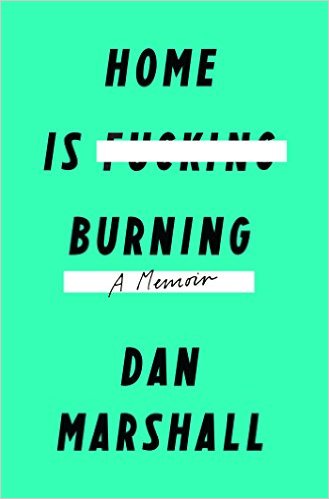
Maximum Shelf: Home is Burning by Dan Marshall

Maximum Shelf is the weekly Shelf Awareness feature focusing on an upcoming title we love and believe will be a great handselling opportunity for booksellers everywhere. The features are written by our editors and reviewers and the publisher has helped support the issue.

This review was published by Shelf Awareness on September 2, 2015.


home is burningDan Marshall’s life was pretty heavy on privilege. A self-described spoiled white kid with money, he grew up in Salt Lake City and then graduated from UC Berkeley, and was busy enjoying his first real job in Los Angeles and his first real girlfriend, Abby. His family–mom, dad and four siblings–wasn’t perfect, but they were happy, loving and shared a strong if quirky sense of humor, based on fart jokes and four-letter words. His mother had had “terminal” cancer well managed for nearly 15 years. Then came the phone call, while Dan was on vacation with Abby, announcing that his capable, marathon-running father had been diagnosed with something called ALS.

ALS stands for amyotrophic lateral sclerosis, more commonly known as Lou Gehrig’s disease. It’s a terminal neurodegenerative disease that kills off motor neurons, eventually depriving the person affected of the ability to move his own limbs, eat, speak, and breathe. Dan was slow to accept the gravity of the diagnosis, but under pressure from the family, after several months, he takes a leave of absence from his job to move home at age 25 to help out around the house. Home Is Burning is his memoir of caring for two terminally ill parents at once while dealing with a houseful of rowdy siblings with problems of their own. His story is unavoidably terribly sad, but peppered with sex, drugs both prescribed and recreational, copious foul language, lots of alcohol, and deep and abiding love, the Marshall family saga is surprisingly sweet and funny as well.

Although Dan describes them as spoiled and rich, the Marshalls have had their fair share of misfortunes, from mother Debi’s cancer diagnosis and years of chemotherapy treatments to cerebral palsy and Asperger’s syndrome among the children. The eldest sibling, Tiffany, who took over some parenting duties as a teenager when Debi was sick, had become an overachiever apparently teetering at the edge of a nervous breakdown. Greg was a successful college student in Chicago, enjoying his freedom after finally coming out of the closet. Still in high school were Chelsea, a socially awkward ballerina and serious student, and Michelle, a budding alcoholic in a disturbing relationship with her soccer coach. Dan was the second child, and the last to move back to Salt Lake City for their father Bob’s remaining time, which would more likely be measured in months than years.

Dan lingered in the denial stage of the grief process. With the whole family, he’d watched Bob run his last marathon in Boston, in a time nearly twice that which he’d run to qualify. But when Dan moves home, he is dismayed to see how much his father has already deteriorated. With Tiffany living nearby but on her own, “the little girls” still in high school, and Debi inconveniently faced with her toughest round of chemo treatments yet, the bulk of Bob’s caregiving duties falls to Dan and Greg. Together they help him bathe and use the bathroom as he loses the use of his arms. They feed him through his gastrointestinal tube, and take him for walks in a wheelchair as his legs lose their strength. They hook him up periodically to his BiPAP (bilevel positive airway pressure) machine, which helps push air through his lungs. Bob chooses to delay his tracheotomy surgery–which would attach him to a respirator for the rest of his days, and quite possibly end his ability to speak–to attend his own mother’s funeral; but the ill-advised delay ends with a rush to the hospital when his breathing fails, and the procedure takes place under emergency conditions. Happily, Bob retains his speech.

For all Dan and Greg’s love and good intentions, their caregiving is sometimes alarmingly poor: Bob is dropped on the floor, his respirator tubes cracked and broken. He might be considered lucky to survive his family’s care. The household begins to fall apart: Michelle passes out in her own vomit with increasing frequency as the cats pee all over their three-story home, which has been pulled apart by construction to install an elevator and widen doorways. Dan begins drinking more heavily; Abby breaks up with him; Greg takes a full-time job, putting more pressure on Dan; Debi’s behavior grows ever more erratic, with the mental effects of her chemotherapy, her distress at losing her husband, and a new addiction to pain pills. Dan’s outlook and storytelling throughout these mounting stressors is singular. He is remarkably candid about his frustrations and resentments: he loves his father enormously, calling him his buddy, his pal, his road map through life, and describing the effortless quality time shared and advice given–but he is angry to have his own social freedoms curtailed.

The tone of Dan’s writing in this painful period, however, is astonishingly funny, loving, even lighthearted. As he moves back and forth between agony, grief and anger, he displays a fun-loving, off-color, morbid sense of humor and an almost apologetically sweet expression of love for his entire imperfect family and especially their hero, their rock, Bob. Dan interjects his narrative with fantasies in which Debi’s hair grows back, Chelsea doesn’t giggle inappropriately at looming death, Michelle doesn’t marry her soccer coach, Bob stands up and takes himself to the toilet and goes for a good long run in the mountains.

Many stories have been written about terminal illnesses, degrading deaths, and families in grief; but the loving portraits painted here of outrageous and colorful characters joking in the face of ugliness may be unique. As Bob approaches his final chapter, readers will certainly cry, but they will laugh as well. Home Is Burning is a strangely packaged gift: love and pain, death and life, sex jokes, fart jokes and plenty of booze make up an extraordinarily heartwarming love letter from “a sad dude with a big heart who really loves his dad.” In its sad ending there is unlikely joy.


Rating: 9 brimming glasses of wine.

Come back tomorrow for my interview with Marshall.

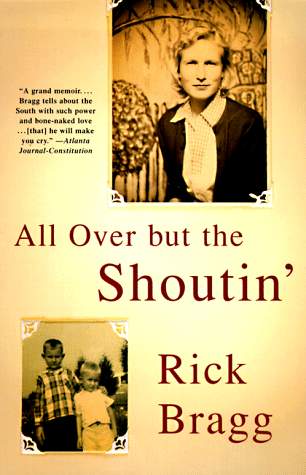
All Over But the Shoutin’ by Rick Bragg

all overRick Bragg’s first book is a memoir of his own life, his upbringing and the road to a successful journalism career with the New York Times, complete even with a Pulitzer. It’s also the story of his family: his father, almost completely absent from Bragg’s life and from the book; his mother, the driving force of grace and hard work and love; his brothers; his people from poor rural Alabama. It’s a beautiful book, humbly honest, piercingly devoted to Momma, and redolent with smells and tastes and sights and sounds. As a way of honoring those he wants to remember and honor – centrally his mother – I think it’s devastatingly effective. It’s also a fine piece of writing, triumphantly fine, and a fascinating story.

People are often driven, with a book like this that is so securely rooted in such a unique place, to make statements about whether it could have been born of any other place. Me, I don’t feel up for that argument. But if Bragg’s skill had come out of Pennsylvania, he would at least have written a very different book.

I loved learning about and learning to love the place Bragg is from – northeastern Alabama – and I appreciate his understanding of nuance, of complicated feelings, of the possibility for both ugly legacies and beautiful virtues coming from the same place.

I found it interesting, and it kept his story from being unrelievedly gorgeous or unrelievedly painful, in a book so filled with “living and dying and that fragile, shivering place in between,” that he is able simultaneously to show that he has lived a charmed life. This was a new concept to me, of such good and ill luck coming in the same breath. For instance, when Bragg became national correspondent in the South, to the New York Times:

It was a marriage so perfect, in my mind’s eye, that I was almost surprised when I got a cold, or stubbed my toe, or got a parking ticket, because such things do not belong in dreams.

Momma used to drag her middle son, who she called Ricky, up and down the rows of cotton on her sack as she picked. He increased the weight of the load she bore, but she loved him, and his brothers, and she did for them as best she could, and this is the story, among other things, of Bragg doing his best by her in return. It’s a deeply sweet story, and although sometimes gruffly told, he never takes that tone when writing about her.

Bragg’s father, on the other hand, was an alcoholic abuser who left his family defenseless repeatedly and apparently without compunction. He was also a traumatized war veteran who on his deathbed gave his son a touching gift and a story. I said earlier that he’s mostly absent throughout, but his shadow is there.

I can’t do this book justice. It’s too good. Go see for yourself.


Rating: 10 assumptions tested.

guest review: All the Wrong Places by Philip Connors, from Tassava

My buddy Tassava read both of Philip Connors’s books after I did, and he loved both, as I did. He had a different final conclusion, however. Here is the beginning of his review of the second, All the Wrong Places.
wrong places

Last year, Julia had recommended that I read Connors’ first book, Fire Season, a long essay on his work at a lookout in a fire tower in a huge wilderness area in New Mexico. Both a reflection on a solitary endeavor and a historical and philosophical examination of the nature of wildness, Fire Season is exceptionally good, and well worth the time of anyone who enjoys memoir or nature writing.

All the Wrong Places is a kind of prequel to Fire Season, a partial explanation of why Connors abandoned a good life and career in New York City for the isolation and inwardness of the fire tower. In brief, the second book is the story of Connors’ efforts to understand how his older brother, Dan, came to commit suicide, more or less out of the blue.

…You can read the rest of Tassava’s review here. And, my review of same.

Thanks, Tassava, for your contribution.

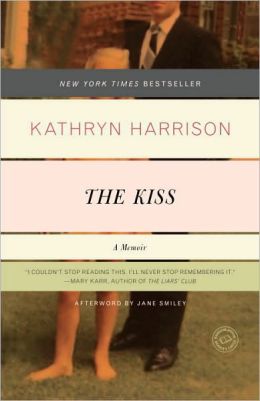
The Kiss by Kathryn Harrison

kissThe Kiss came recommended as a powerfully told memoir, the artful representation of a shocking story that does not rely upon its sensational nature to make an impact, but showcases the author’s craft. All this is true, and I am left feeling very impressed and somewhat reeling, from both the story itself and the writing.

Kathryn Harrison was raised by her mother’s parents, her mother an on-and-off presence in her life who never gives her the love she longs for. She meets her father only twice while she is growing up; his third visit, when she has just turned 20, marks the beginning of a new stage. When he kisses her goodbye at the airport, the air goes electric, and they begin an incestuous affair that will last years and cause the rest of her life to wither. Their relationship is obsessive and controlling: in other words, awfully unhealthy, even if they were not father and daughter; and it will damage her forever.

Clearly there is shock value, and the potential for merely prurient appeal. But Harrison does not let the salacious subject matter carry her book. She examines her troubled childhood, her need for love, her search for herself, and sees in hindsight the way she was preyed upon. Her father is a preacher, who argues that God wants them to be together sexually.

I never question his sanity; although I will come to the point where it is less painful to regard my father as crazy than to conclude that he has been so canny in judgment of my character and its frailties that he knows exactly what language to use, what noose of words to cast around my neck.

She studies her story, and muses on it, and the result is a work of craft, not of voyeurism.

It is still disturbing, make no mistake. You will shiver and flinch, because she doesn’t turn away from the ugly bits – and they don’t all involve her father; there is also the one with the kittens, and the scene in which Harrison’s unloving mother takes her to a doctor to have her hymen broken with medical implements. (Seriously.) But it is also, strangely, beautiful. As a writer, I am here to take notes and see how she does this thing: tells this horrifying story with grace and insight and art. I don’t really understand it, although I hope to.


Rating: 8 photographs.

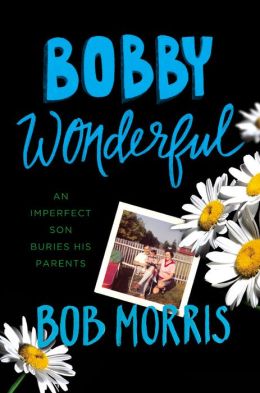
Bobby Wonderful: An Imperfect Son Buries His Parents by Bob Morris

A son’s memoir of love and endings, despite his shortcomings and mistakes.

bobby wonderful

Bob Morris (Assisted Loving; Crispin the Terrible) loved his parents very much, even if he was not always the ideal son. His older brother, Jeff, played that role; Bob was less reliable.

When his mother died, her last garbled word was his name: Bobby. As his father died several years later, he cried out: “Wonderful!” As Morris relives and reconsiders those difficult experiences–caring for each of his parents (more or less), witnessing and helping to make decisions about the ends their lives–he pairs those final words to make the title of his searingly candid memoir, Bobby Wonderful.

Morris is on a much-needed vacation in Scotland, tasting whiskies and forgetting his cares, when he gets the call to come home for his mother’s last days. His first reaction is resentment; the scarf he brings her as a souvenir is a knockoff of the first one he considered. Still, he was there, with Jeff. In the years that follow, Morris helps his father learn to date again and encourages his independence, in part because Morris is busy trying to enjoy his own life. When his father attempts suicide, though, Morris is forced to face uncomfortable questions about his father’s end-of-life wishes, his own devotion and what it means to be a good son.

Morris’s struggles are sensitively told, deeply moving and highly relevant in a world where more and more people face situations like his. Bobby Wonderful is a gift of a book: an often funny but also perfectly serious contemplation of living and dying well.


This review originally ran in the June 12, 2015 issue of Shelf Awareness for Readers. To subscribe, click here, and you’ll receive two issues per week of book reviews and other bookish fun!


Rating: 7 performances.

The Light of the World by Elizabeth Alexander

Moving, charming, delicately lovely, this memoir of a husband’s death offers solace and even joy.

light world

Poet Elizabeth Alexander (Crave Radiance; the 2009 Inaugural Poem) was enjoying a loving, creative, exultant and full life with her husband, Ficre Ghebreyesus, and their two sons, when Ficre died suddenly. The Light of the World is her record of that man–a husband and father, an artist, activist and chef–and of Alexander’s grief and gratitude for the years she shared with him and the love and family they made.

This astonishing and naturally poetic memoir of love and loss is vivid and abundant with sensory detail and bright color. Alexander includes recipes–Ficre’s, and those that comforted her after his death; gives evocative descriptions of his paintings and the food and music they both loved; counts his scars; and recounts her dreams of him. But The Light of the World is not a dream itself: Alexander is lucid and absolutely present. Perhaps to ward off the end it threatens, the story she sets out to tell starts, and starts again, and starts again: at their respective mothers’ pregnancies; at Ficre’s 50th birthday, the week of his death; when they met at a coffee shop in 1996. Alexander then resolutely travels through the tragic center of her story and into the life that follows, when her family of four becomes “a three-legged table,” as she phrased it in her first poem afterwards. In this tender, perceptive portrayal, Ficre comes alive again: an Eritrean native, a peace-lover born into war, a painter also accomplished in photography, collage and sculpture, an eager reader fluent in seven languages and who “could say hello and thank you in literally dozens of other[s],” an activist and member of African, African-American and global communities. “Your life is just like a foreign film!” a friend rightly exclaims, and Alexander’s is just the voice to portray his broadly informed, musical, painterly existence.

Short chapters and language of unrivalled beauty ease a sad story, and Alexander and her sons do make a joyful noise in the end. She feels that she carries “a Santa’s sack of gifts” of Ficre’s thoughts and impressions that belong to her alone; she celebrates the time they had. Their shared dreams, scars, meals, songs, dances, history and family are fittingly and exquisitely honored here.


This review originally ran as a *starred review* in the April 23, 2015 issue of Shelf Awareness for the Book Trade. To subscribe, click here.


Rating: 9 red lentils.

The Love Song of Miss Queenie Hennessy by Rachel Joyce

A companion to The Unlikely Pilgrimage of Harold Fry, and every bit as affecting, sweet and sad.

love song

Rachel Joyce’s The Unlikely Pilgrimage of Harold Fry won many fans with its bumbling but likable protagonist and his improbable journey across England and through his own troubled life. Harold appears off-screen in The Love Song of Miss Queenie Hennessey, in which Queenie replies to the postcards he sent her in Pilgrimage. Readers will be delighted to rediscover the action of the first book, from a very different perspective and with considerable added detail on Queenie’s side. Those considering Pilgrimage should definitely start there, as Love Song comprises one big spoiler. However, it’s not necessary to have read the first to enjoy this second novel.

Love Song begins when Queenie receives Harold’s first postcard. She has written to him from hospice care, sharing the news of her impending death. Harold sets out to visit, asking her to await his arrival. Queenie is startled and alarmed. She has kept an old secret from Harold that she had intended to take with her; she now decides she needs to come clean.

Joyce alternates among three timelines: in real time, as Queenie waits for Harold while composing a long letter of explanation; their separation 20 years ago, when she fled life’s complications; and their original meeting and developing friendship. While the present-day setting is inarguably dour, the action in all three stories is fresh, compelling and deeply emotional, and Queenie’s fellow residents create a charming little world of their own. Just as in Pilgrimage, a major revelation at the end amplifies the impact of an already powerful book.


This review originally ran in the March 10, 2015 issue of Shelf Awareness for Readers. To subscribe, click here, and you’ll receive two issues per week of book reviews and other bookish fun!


Rating: 8 painted nails.

We Are All Completely Beside Ourselves by Karen Joy Fowler (audio)

**AVOID SPOILERS!** (There are none below.) As a commenter pointed out, there may be spoilers even on the dust jacket or other coverings for the book or audiobook itself. Proceed cautiously. Just trust me and read the book itself.


beside

This is one of those with a big reveal to it that *makes* the book. For the love of whatever you love, please, avoid all discussion of We Are All Completely Beside Ourselves until you read it. Excepting this review, of course, which promises to be spoiler-free and is therefore safe, and brief.

I’m glad Liz recommended this one to me, on audio specifically, and I shall do the same. Get the audiobook, which is beautifully and feelingly narrated by Orlagh Cassidy. Our young female protagonist/narrator Rosemary is a little troubled, but likeable right from the start. She uses the unusual second-person voice, breaking down the fourth wall to talk directly to her audience: “you may have the impression from what I’ve just said, that… but here’s another thing I’d like you to know…” Her story is compelling from the beginning, and involves a number of different threads and an occasionally disjointed timeline. I don’t know what else I can tell you without giving it all away. It’s about family, self-determination, the nature of memory. Life. You will laugh and be amazed. Go out and get this book now, and don’t let anybody tell you anything about it. Oh – a little bird told me Karen Joy Fowler gave away the big secret in a book talk somewhere. She is an outstanding writer, but apparently a potentially disastrous speaker. Avoid her talks til you’ve read the book. Go read the book. That’s all.


Rating: 8 studies quoted.

All the Wrong Places by Philip Connors

Two disclosures on this one: I read an advanced reader’s copy; and I consider the author a friend.


wrong placesFrom the author of Fire Season which I loved so much (first-ever 10 out of 10 here at pagesofjulia) comes a newer and even more personal story. Connors’s first book was about life as a fire lookout in the Gila Wilderness; we learned a great deal about the author himself, including some of the demons he’s fought in his life; but we also learned a lot about federal fire management (historical and present), the flora, fauna and atmosphere of the Gila, and what it’s like to balance the isolation involved in a profession I’d never heard of before, a profession “in its twilight.” It was both a deeply personal book, and a book about the world.

By contrast, All the Wrong Places is a singularly personal story. As briefly mentioned in Fire Season, Connors had a younger brother named Dan, who killed himself when they were both in their early twenties. Connors has written about this event and its aftermath in a few articles since; and now, in book-length form. I can only imagine it was difficult, writing a book about long-term pain.

This story follows Connors from the University of Montana, where he was enrolled at the time of the suicide, through his years working in New York for the Wall Street Journal (which considering his politics is a serious conflict in itself); his experience there during the events of September 11; and his path to becoming a fire lookout. The essence of the book, the questions it asks and tries to answer, are why? and how do I deal with this; who am I to become in this aftermath? He tries to investigate his brother’s death, his decision and final moments; but more than that question, All the Wrong Places considers what Connors will be in his own life, how this effects him, how to deal & recover. It would be too pat for Connors to put a full stop to that questioning, but he does come to some place of …if not conclusion, maybe a degree of acceptance. If not redemption, peace.

Connors’s writing has many strengths, but in this case, the greatest may be his ability to be sometimes, astonishingly, funny even while handling this shocking pain and terrible tragedy. He remains lyrical in the oddest, or most difficult, circumstances. In studying the collected notes of a man obsessed with McDonald’s, who’d visited over 1,000 of them and scrupulously recorded their nuances:

Their banal repetition had a strange poetry to it, a kind of Whitmanesque list-making for the end of the millennium; in almost every instance he’d noted what he’d eaten, and the thought of all those empty calories, millions and millions of them, staggered me.

This poetic description of the absurd and vaguely ghastly, in itself, is oddly satisfying. There’s something intriguing going on there.

In other words, his writing is as fine as ever, humorous and thoughtful and touching, and I hadn’t realized how much I’d missed his voice, which is thoroughly recognizable and comforting.

But less comforting, again, is the subject matter at hand, so painful, and so personal. It’s astounding to think about baring oneself to this extent to anyone willing to buy a book at a bookstore. I consider Phil Connors a friend: after I loved his first book he wrote to me, we corresponded a bit, and then Husband and I got to meet him in person too. I thought I knew him moderately well, but learned so much more in this book. I wonder how that colors my reaction; it’s closer to home this way. The pain of others can be paralyzing; and frankly it’s easier with a degree of remove, as in my former job at a cancer hospital, where my library patrons were held at a professional distance (even though we talked about some pretty personal stuff). I want to compliment Connors’s “bravery” in telling this story, but that feels too simplistic (and I bet he’d brush off the compliment). I’m getting less eloquent here, I know. Thank you, Phil, for sharing your story. I found it riveting, I’m so glad you’re okay, and even though this may not have been your goal, I think it might help some other people.


Rating: 9 faxes.

I read an advanced reader’s copy of this book, which is subject to changes before publication. All the Wrong Places will be published in February 2015.