A Distant Heartbeat: A War, a Disappearance, and a Family’s Secrets by Eunice Lipton

An inquisitive memoir investigates the author’s uncle, who was killed in the Abraham Lincoln Brigade in the Spanish Civil War.

distant heartbeat

Eunice Lipton grew up with an awareness of her uncle Dave that was specific and conflicted in emotional tone, and vague in points of fact. She knew he’d been in the Abraham Lincoln Brigade in the Spanish Civil War, and killed in action when he was 22. His brother Phil says, “Dave died for something. He was somebody.” His brother Louis, the author’s father, says he died for nothing. The author’s mother says he was the nicest man she ever knew. A Distant Heartbeat asks: Who was Dave Lipton? Why did this respectful son lie, tell his parents he would be working at a hotel in the Catskills, and then go to Spain? What does his story have to offer history?

Dave Lipton (formerly Lifshitz) was a Latvian Jewish immigrant, immersed in leftist youth politics in 1930s New York City. Surrounded by peers whose convictions mirrored his, Dave was one of very few to join that foreign war. His niece, born after his death, grew up with only scraps of his life and death: the repeated refrains of family members–died for nothing, died for something–and a few photos discovered in her childhood. She speaks to surviving veterans and friends of Dave, travels to an International Brigades reunion in Spain, studies letters and archival photographs. She finds more questions: What is the nature and cause of familial betrayal? Who was Dave’s mystery companion? In the end, Lipton’s research and musings offer only fleeting conclusions about family and principles, in a precise, elegiac journey through history, family tensions and human drama.


This review originally ran in the April 8, 2016 issue of Shelf Awareness for Readers. To subscribe, click here, and you’ll receive two issues per week of book reviews and other bookish news.


Rating: 7 photographs.

Alligator Candy by David Kushner

This tender, intimate memoir probes the childhood murder of the author’s older brother.

alligator candy

On a Sunday afternoon in 1973, 11-year-old Jon Kushner rode his bike through the woods to the 7-Eleven. His four-year-old brother, David, had asked for one kind of candy in particular. Jon’s family never saw him alive again. Journalist David Kushner still struggles to fathom his brother’s murder and his family’s experience; Alligator Candy is his memoir of investigation and connection.

Kushner lovingly portrays his hippie parents, eldest brother and Jon, who struggled with an auditory deficit disorder and was known for his compassion. Their community in Tampa, Fla., included activists and academics, and emphasized freedom and the outdoors. It was perfectly natural for a boy to ride alone through the woods. Jon’s murder presaged an end to the “ability of kids to simply get on their bikes and go,” as one family friend put it.

Alligator Candy explores how a family and community survive loss. The twin terrors of not knowing fully what happened versus knowing the horrific details of exactly what was done to Jon comprise only two reasons that this is a painful story. However, Kushner can also be funny, and he skillfully captures a child’s innocent curiosity, even in loss. He writes so simply, but this is deceptive. Alligator Candy is sensitive, insightful and understated.

Forty years later, Kushner (Bones of Marianna; Masters of Doom) still struggles with grief, isolation and guilt. In writing Alligator Candy, however, he discovers certain details of his brother’s case for the first time, begins to comprehend his family’s coping methods and, finally, achieves a long-sought connection with Jon.


This review originally ran in the March 25, 2016 issue of Shelf Awareness for Readers. To subscribe, click here, and you’ll receive two issues per week of book reviews and other bookish news.


Rating: 7 pieces of gum.

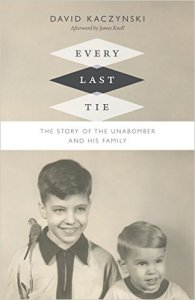
Every Last Tie: The Story of the Unabomber and His Family by David Kaczynski

David Kaczynski’s contemplation of his brother’s life and crimes is sensitive and skillfully composed, with broad appeal.

every last tie

David Kaczynski is a poet, a former English teacher, an impassioned opponent of the death penalty and the younger brother of Ted Kaczynski, better known to the world as the Unabomber. In Every Last Tie, he contemplates “loving memories and painful outcomes,” hoping to illuminate his brother’s and his own experiences.

Some of David’s message involves correcting misconceptions. For example, he says it was not his heroism but his wife Linda’s compassionate and principled actions that identified the Unabomber. He relates the process of recognizing Ted’s voice in the Unabomber’s manifesto: Linda’s concern, David’s denial, the careful considerations they conducted together and the final decision–betrayal of his brother or betrayal of yet more innocent lives. David often contemplates such difficult questions as how to explain Ted Kaczynski’s illness and actions, coming from a family that David portrays as caring, close and committed to education and integrity. He characterizes Ted as a loving older brother increasingly withdrawn from society, a tortured genius and, finally, a mentally ill man David no longer understands. The decision to identify his brother still prickles. “Ted’s cruelty stigmatizes my good name; but my reputation for goodness comes at his expense. Like all contrived opposites, we reinforce one another.”

Every Last Tie is beautifully written, searingly honest, in no way the sensational tell-all it might have been, but a careful exercise–sometimes emotional, sometimes intellectual–in self-examination. David clearly wants to pile praise on his beloved parents, but chooses to consider their complexities, seeking truth over comfort. The result contains a certain amount of psychological analysis (especially in a thorough afterword by James L. Knoll IV, a forensic psychiatrist who has both studied Ted Kaczynski’s case and come to know David well), but the book is also a meditation on notions of family, “the premise that a brother shows you who you are–and who you are not.” David struggles to reconcile the brother he loved and the serial killer he turned in, but does not belabor the point, choosing instead to remember and share what he knows, and acknowledge the mystery. Knoll’s afterword makes a more pointed criticism of the United States’ “nonsystem” of mental health care.

This slim, intriguing book is the story of a family whose two sons lead different lives. David Kaczynski’s voice is quietly thoughtful, and his writing is lovely; he ranges from family anecdote to psychological puzzle to philosophical musing while retaining an even tone. Every Last Tie is both a straightforward story and a complex consideration of an extremely difficult one.


This review originally ran in the January 26, 2016 issue of Shelf Awareness for the Book Trade. To subscribe, click here.


Rating: 8 letters.

The Family Tree: A Lynching in Georgia, a Legacy of Secrets, and My Search for the Truth by Karen Branan

A journalist’s research uncovers her own family history and connections to a horrifying hate crime.

family tree

In researching her family history in the little town of Hamilton, Ga., investigative journalist Karen Branan was surprised to find connections to a 1912 lynching. A nephew of her great-grandfather, the sheriff, was murdered. Days later, a local mob killed three black men and a black woman. Branan digs deeper, expecting to find her forebears innocent of violence. The evidence is far more complex in The Family Tree: A Lynching in Georgia, a Legacy of Secrets, and My Search for the Truth.

In a town where nearly everyone has been related by blood or marriage for generations, Branan’s family variously turned a blind eye to the murders, or directly participated. She finds herself related not only to the white mob, but to at least one of the black victims as well. Every new piece of information complicates the story and startles her further, until she has to address her most basic understanding of the world. “I began this journey believing myself to be an unflinching investigative reporter and a nonracist,” Branan writes, but must confront a bias in favor of her own family. Admirably, she examines herself and the preconceptions she brings, even to the pursuit of racial justice.

The Family Tree offers an in-depth study of the history of Southern race relations, particularly in Georgia. The narrative of the lynching is told thrillingly, the background more dryly, but it is Branan’s personal perspective and soul-searching that makes this history insightful, relevant and memorable.


This review originally ran in the January 19, 2016 issue of Shelf Awareness for Readers. To subscribe, click here, and you’ll receive two issues per week of book reviews and other bookish news.


Rating: 6 liaisons.

The Year of Magical Thinking by Joan Didion (audio)

I said I was laying off the audiobooks, because my present life & schedule don’t allow for enough listening time. But then I picked up another, and another. Among other things, I’ve hurt my knee again and am back in the gym. But you’re not here to hear about my knee.

year of magical thinkingI’m so glad I tuned into The Year of Magical Thinking. It’s not a feel-good story: it tracks the year in Joan Didion’s life following her husband’s death, and maps her experience with grief. It’s almost New Year’s, and Joan and husband John have been visiting their daughter in the hospital, where she is unconscious with a life-threatening case of pneumonia and septic shock. On December 30, 2003, he collapses at the dinner table, is rushed to the hospital and pronounced dead that night. John is John Gregory Dunne, also an accomplished writer, and their lifestyle has always kept them very close: working from home, together, consulting on every aspect of their lives, from work, food, family and world events to the most insignificant details. Didion is of course, obviously, shocked and unmoored. During the year that follows she experiences different types of grief, shock and bafflement. This book is a little like a diary of that time, which it charts chronologically, ending one year and one day after John’s death.

Along the way, she nimbly weaves in the research she performs on related subjects within psychology, medicine and anthropology: research on grief, on cultural relationships with death and dying, and on medical issues, as she tries to understand when, how and why John died. This last is a surprisingly opaque question, covering the time between his collapse and the doctor’s pronouncement about an hour and a half later. What had been done in the interim? What could have been done? She examines the reports of the ambulance team, the nurses and the ER doctor.

And to compound the complicated and tragic story, daughter Quintana spends most of this year in and out of hospitals, near death on multiple occasions. What we know, although Didion at the time of writing does not, is that Quintana died within the year after the book’s timeline closes. Her later memoir, Blue Nights, covers that personal loss. I haven’t read that one – yet.

The difficulty of this book, then, is obvious: it is filled with sad stuff. Didion is a deft and clever writer, though. We see more than a little joy, although much of it is remembered. We see a strong family, and we see good times. The entwining of personal experience (past and present) and research is beautifully done. Didion uses repeated phrases to draw her reader along the book’s line, to tie everything together. It’s a lovely piece of work, although I did have to turn away when I had a particularly bad day. The subject matter is what it is.

My one criticism is that Didion fails to recognize and acknowledge a certain privilege: that her life is set against the Ritz, the Royal Hawaiian Hotel in Honolulu, the fancy home in Malibu, Chanel, Brooks Brothers, an endless parade of the food, clothing, and scenery of her choice and at her command. This privilege, compounded by her failure to acknowledge it (is it possible she is unaware?), distanced me from her. She is both a fine writer and a complex and sympathetic person; it is my instinct to identify with her, and that is where this memoir shines; but that effect is lessened by her experience of the world to which she is apparently blind. Near the end, she describes a difficulty early in her marriage, when she and John had made a $50,000 down payment on a house in an L.A. suburb but hadn’t yet sold their home in Malibu: where would the money come from? They go to a luxury resort in Hawaii to think it out, then find that the Malibu home has an acceptable offer. She does speak briefly to the irony of the Hawaiian brainstorming session. We could call this a partial exception to my complaint. The episode still comes off a little tone-deaf, though.

This is a fairly small criticism. Because of this privileged position, Didion lost a few degrees of identification with her reader. On the whole, though, she is a sympathetic and fully realized character. Her story is shocking but true; it is beautifully structured and well written, and I will definitely read more Didion.

Barbara Caruso’s narration felt spot-on to me.


Rating: 7 leis.

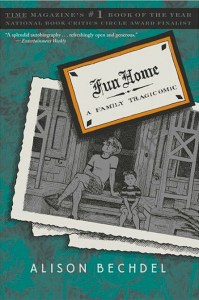
Fun Home: A Family Tragicomic by Alison Bechdel

fun homeFun Home won awards and got more attention than Bechdel’s later Are You My Mother?, which I loved, so this was an obvious choice and yes, I will add my praise to the chorus.

This is a memoir centering around Bechdel’s father Bruce, her own discovery that she is a lesbian and her coming out to her parents, which is immediately followed by the discovery that her father is gay, too, shortly before he kills himself just weeks later. (The evidence is inconclusive, but she makes a good argument for her conviction, that it was suicide.) The title is a reference to the family business, which is a small-town funeral home that they call ‘Fun Home.’ That’s a lot, right? It is also a memoir in graphic form, and I am crazy about Bechdel’s technique, which combines dialog (speech boxes for the characters in her panels) with a voiceover-style narrative in different boxes that sort of caption those same panels. It’s astonishing how much can be communicated in pictorial form.

Despite the often heavy subject matter, Bechdel is often laugh-out-loud funny, while also taking her material seriously. She beautifully evokes the absurdity of many different elements of her story. Bruce is a passionate restorer of historic homes, down to all the details, the bizarrely frothy, lacy, heavy decor. This is both hilarious and pathological. He “treated his furniture like children, and his children like furniture.” Bechdel and her father are most intimate when they share books and reading (note that this is an intimacy with decided remove). Bruce works as an English teacher as well as a funeral director; and two thematic elements of the book are death and books. Bechdel is best able to understand and characterize her parents when viewing them through the lens of literature: her father as Icarus, then Daedalus, then a character from Fitzgerald; her mother one from Henry James. “I employ these allusions to James and Fitzgerald not only as descriptive devices, but because my parents are most real to me in fictional terms.” On the other end of the cultural spectrum, as a child Bechdel confused her family with the Addams family.

The reader has a different experience of the story than she does, because we find out earlier than she does the big reveal – that her father has had relationships with men and boys. But she still has us share in mixed feelings of relief, shock, perplexity.

The story is weird, fascinating, and moving; Bechdel has a gimlet eye for the psychological struggle in each chapter of it; the structure of this book – the disordered chronology and release of facts – is a smart puzzle. But the art is what completes the perfection: I’m still reeling from, and trying to comprehend, how precisely she uses visual images (with those careful text additions) to communicate. I can’t adequately articulate it, but this is a special, a uniquely wonderful way to tell a uniquely interesting story. One to study.


Rating: 9 books, of course.

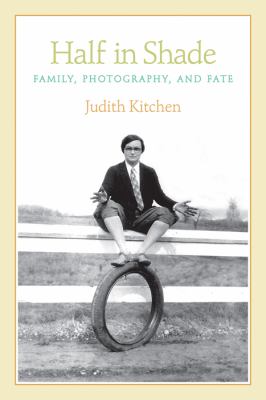
Half in Shade: Family, Photography and Fate by Judith Kitchen

This is a complex one. Judith Kitchen has inherited dusty boxes of old photographs, belonging to her family and stretching back over generations. Some of the black-and-white figures she finds there are labeled, or recognizable to her; but many are strangers. In a series of short pieces – meditations, essays, ramblings, experimental forms – she wonders over these photographs. Sometimes she uses her imagination to tell their stories; sometimes she uses research.

She is also being treated for cancer, and the narrative of surgery, chemotherapy, and radiation responds to the history she researches and creates. She plays with concepts. Every photograph has an unseen character, the one behind the camera; who was he or she, what did he or she see? In looking back into time, she can see both more and less than the characters in these pictures. They know one another, they know where they are, and oftentimes Kitchen does not. But she knows what Paris in 1939 has looming over it. She knows what will come.

My reactions to these pieces varied. Kitchen is a poet, and she wanders into a sort of free-form poetry that reminds me of abstract art: I understand that the people around me see and interpret a great deal that is hidden from me. I wonder if I’m not smart enough for the appreciation of this art. I like Kitchen best when she says what she means, playing with language a little along the way. The more abstract she gets, the less I comprehend. I don’t think my mind works the same way hers does.

But I like what she did with the idea of photography, the examination of light and exposure, the questions about how certain confounding photos (like the young woman surrounded by handled objects before a snowy lake) were posed, arranged, intended, carried out. I like what she did with history, and family history, and the uncertainties we have to accept. I love the artistry of this sentence:

The clapboard’s horizontal plane cuts through the outlines of their lives as they stand facing us across the intervening years, chance encounter that will fuse her rough pinked hem, his knot at ease, our own unbridled mysteries.

The homonym of knot, the rhyme of ease and mysteries.

Half in Shade is a complicated thing and contains many different opportunities to delve in. I’m not sure I’m up to it, at least not on my own. I think this is a class someone could teach for a whole semester. Recommended for people who understand and like Faulkner.


Rating: 7 second looks.

Maximum Shelf: The Sound of Gravel by Ruth Wariner

Maximum Shelf is the weekly Shelf Awareness feature focusing on an upcoming title we love and believe will be a great handselling opportunity for booksellers everywhere. The features are written by our editors and reviewers and the publisher has helped support the issue.

This review was published by Shelf Awareness on November 29, 2015.


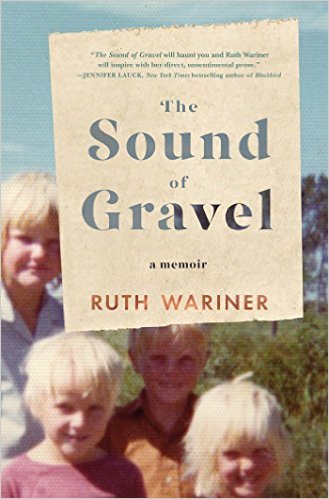
sound of gravelIn The Sound of Gravel, Ruth Wariner tells of growing up in a Mormon polygamist colony in the state of Chihuahua, Mexico. Her childhood was filled with sad and shocking hardships, some painfully difficult to read. But Wariner’s tone is never self-pitying, and her love for her mother and siblings imbues a distressing memoir with nuance, and eventual relief.

Ruth’s mother, Kathy, became the fifth wife of Joel LeBaron when she was 17 years old. Joel’s father founded Colonia LeBaron in Mexico because the practice of plural marriage was better tolerated there than in the United States. Ruth was Kathy’s fourth child and Joel’s 39th. He died just three months after Ruth’s birth–murdered by his brother over a conflict about church authority. Kathy remarried a man named Lane and bore another six children with him. Ruth was the eldest nondisabled female child and, over the years, many domestic duties, including childcare, fell to her.

The Sound of Gravel begins with the family history of the LeBarons, whose status as church leaders impressed the young Ruth, and with Kathy’s personal history, as told to her daughter. The earliest scenes Ruth relates from her own memory find her at age five, and introduce her siblings: Audrey, the eldest, with a disability that remained undiagnosed for years and that led to occasional violence against the other children; Matt, a responsible boy; Luke, good-natured but developmentally delayed; and the baby, Aaron. Later the family grows as Meri, Micah, Leah, Elena and Holly are born. Lane, Ruth’s stepfather, promises to complete Kathy’s family’s dwelling and add a showerhead, electricity and other longed-for luxuries, but is slow to do so. Lane’s first wife and her children receive preference as to the basics, in the tradition of the LeBaron church. Ruth dislikes Lane early on, for his failure to support her mother as well as his harsh discipline. From an early age, Ruth sees her mother’s conflicts and jealousies with her sister wives, and worries that plural marriage looks more like misery than the holy state her church teaches it to be.

Ruth grows up quickly as the household swells in size. The family moves around: Kathy leaves Lane after he beats her, and moves to the United States where her parents live, but returns to him. Lane relocates his families as they seek work: they harvest and sell pine nuts in New Mexico, camp out in El Paso, and smuggle undocumented Mexican workers across the border under the children’s makeshift bed in a camper. But Kathy, Ruth and the other children always return to Colonia LeBaron because, Kathy says, “this is where you kids belong.”

The poverty and poor living conditions that come with Kathy’s choices are based on her religion, her devotion to and dependence on Lane, and a belief that the United States is a Babylon “standing between us and our connection to God.” Squeezing a living out of food stamps and Lane’s meager earnings–shared among four wives and an uncounted number of children–means mostly subsisting on beans and rice. The children are pulled out of school in their early teens–Ruth at age 14–because “Mom insisted that it was more important for me to be around to help her take care of the house and the kids.” But the most heartbreaking aspect of Ruth’s childhood is Lane’s sexual abuse, which continues for years even as Ruth repeatedly reports him to her mother. Kathy exhorts Ruth to forgive and move on; but even a town tribunal fails to stop the abuse. The community’s betrayal of its children is an especially disturbing phenomenon in a story filled with the tragedy and woes of day-to-day hardships of poverty, the absence of creature comforts, illness and accidental death.

However, through it all flows Ruth Wariner’s careful, loving portrait of her mother, a woman doing her best with limited options, believing that her church knows best. Despite her profound anger at her mother’s failure to protect her from Lane, Ruth understands that she is loved, and deeply loves her mother in return. “I realized how little she had asked of the world, and how even that had been too much for the world to give.” She reflects that “Mom couldn’t teach me that because she didn’t know herself. She couldn’t show me how to be happy, only how to barely survive.” These and other contemplations establish Ruth as a wise and thoughtful narrator.

The Sound of Gravel is straightforwardly told, in chronological order and with little lyrical adornment. Its power lies in the facts of the story, which is deeply affecting both in its horrors and in its redemptive conclusion. At the end, when Ruth saves herself and her sisters by escaping Colonia LeBaron, she has earned the reader’s sympathy and respect, and an identity beyond that of survivor.


Rating: 8 babies (and counting).

Come back on Monday for my interview with Wariner.

Refuge: An Unnatural History of Family and Place by Terry Tempest Williams

I am slowly, painfully discovering that my refuge is not found in my mother, my grandmother, or even the birds of Bear River. My refuge exists in my capacity to love. If I can learn to love death then I can begin to find refuge in change.

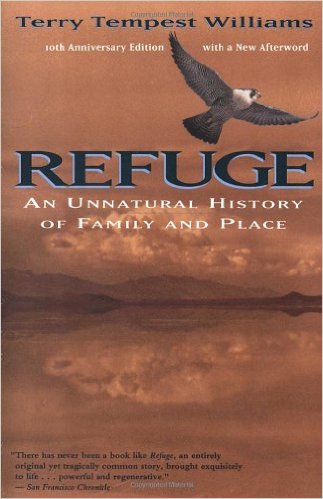
refugeWhen I read this book, I was continually reminded of the first Terry Tempest Williams book that I loved, as a child: Pieces of White Shell. I knew immediately that I would need to follow this book with a reread of that one. For me, Refuge is the more personal, more intimate, more grown-up and more exacting version of the kinds of things I found in Pieces of White Shell. I think I found this one more difficult, more thought-provoking and challenging; the other was both sparer, and offered clearer, more accessible comforts. Refuge is stripped, exposed pain. If there are balms for its wounds, they are more complex. Pieces of White Shell is metaphorical, symbolic, spiritual, seeking wisdom and humbly finding some of it; Refuge is bared emotions and loss. It is many birds. Each chapter is headed by the name of a bird – burrowing owls, killdeer, sanderlings, avocets and stilts, on and on – and by a level of Great Salt Lake.

Over the years in which the story of Refuge takes place, Great Salt Lake rises beyond its usual depths and boundaries. I learned in this reading that this Lake is shallow and covers a great area; therefore a few feet of rise can cover miles, and cause great destruction. Terry Tempest Williams saw her mother die of cancer as she saw her beloved Bear River Migratory Bird Refuge overtaken by saltwater, the birds displaced and many of them lost. In Refuge, she meditates on both losses and the relationship between them, how the Refuge offers refuge to her and to her mother, how they are linked – birds and women (clearly presaging her later When Women Were Birds), people and place (Terry’s Mormon family with the Great Basin and Utah), the cancer that runs in her family (“the clan of one-breasted women”) and their home (neighboring nuclear test sites).

Refuge involves nature, of course, and Terry educates us with precision about the birds she loves. It involves people, and society, and our interactions. It is beautifully written, with poetry, and with liberal gaps in which the reader may draw her own connections. Terry has an imaginative and generously interpretive mind, more so than mine.

The cancer process is not unlike the creative process. Ideas emerge slowly, quietly, invisibly at first. They are most often abnormal thoughts, thoughts that disrupt the quotidian, the accustomed. They divide and multiply, become invasive. With time, they congeal, consolidate, and make themselves conscious. An ideas surfaces and demands total attention. I take it from my body and give it away.

She finds wisdom in the world, as her mother and grandmother did; and of course, centrally, she finds refuge, which is not quite to say recovery or redemption, although those arguments can be made.

Terry Tempest Williams is a lovely writer. The story of her mother’s life and death, their relationship, and the difficulties and beauty of letting go, are all well accompanied by the pain and beauty of the migratory birds of the Great Basin that Terry knows well.


Rating: 7 phalaropes.

Body Toxic: An Environmental Memoir by Susanne Antonetta

Body Toxic is a striking book, both in the story it has to tell and in the manner in which it’s told. I am impressed, and challenged. It’s complicated.

body toxicSusanne Antonetta grew up in New Jersey, in the Pine Barrens region, a bogland unique in several senses: culturally isolated, and environmentally contaminated on a shocking, unimaginable scale. She and other members of her family have suffered from a list of medical complaints: asthma, endometriosis, a double uterus, growths on the liver, allergies, tumors and cysts, sterility, seizures, manic depression, various cancers; an extremely rare quadruple pregnancy that ended in miscarriage. The families she is descended from include Italian immigrants and those from Barbados, who nevertheless self-identify as English. Both sides of her family exhibit a predilection for silence, non-communication or the glossing over of undesirable details. The legacies Antonetta has inherited, then, are many and complex: cultural (in terms of countries of origin, and the culture of the New Jersey Pine Barrens, and immediate family cultures), environmental and medical (oh, the prodigious and horrifying list), and psychological (mental illness and perspective on the world). Oh, and Susanne Antonetta is not her real name, but an “alter ego”: “I’ve used five or six different pseudonyms in my life. The name I’m using now is not my name but the name of a recovered female relative, a lost woman, and as a recovered woman she’s just a skeleton that must be fleshed out by the same process of fantasizing and filling in that I resist.” Indeed, identity – multiple identities, our attempts to define ourselves and others’ attempts to define us – is another theme throughout.

And that is the complexity of this book, that so much is going on. The story is itself obviously gripping, and brimming with evocative and provocative anecdote. Indeed, Antonetta tells us, “I wrote a piece about the miscarriage and an editor sent it back, calling it ‘raw.’ He suggested I lose the death or the multiple pregnancy, or both… The poem of this body is a bad poem, trite.” The enormous irony, of course, being that she can’t “lose” the death or the multiple pregnancy, or countless other maladies, complaints. All this material aside, though, Body Toxic shines entirely for another reason too: the writing is bold and nuanced, presses and pulls back, reflecting a little the manic depression (or, these days, bipolar disorder) that also waxes and wanes throughout Antonetta’s story. It is, of course, poetic: the author is an acclaimed poet as well, under the name Suzanne Paola.

There are so many threads. Business and government disposed of chemical and radiation waste in Antonetta’s childhood beaches and bogs, through a combination of ignorant, unethical and criminal irresponsibility. (Thus Rachel Carson is named by comparison.) Antonetta’s extended family makes a series of decisions about how to live in this environment, in which they were underinformed but also trusting, stubborn, or willfully ignored the signs. (They mostly still won’t talk about the negative effects.) The family incubates a sexist tradition, favoring the eldest, male grandchild, repeatedly reminding Antonetta explicitly and implicitly of her “place.” She explores her identity as woman: “I spent a lot of my eleventh and twelfth years pining for my menstruation to begin. I can’t remember why”; and later in her inability to reproduce, and what this means for the family at large. (When her family visits relatives back in the Italian community of her father’s origin, his cousin tells him, “You have big children, but I have grandchildren.” There is an implied failure there, which Antonetta ascribes to environmental poisoning, but the family seems to ascribe to Antonetta herself.) There is the fallibility of memory, a theme so common to memoir but one I never tire of, because it – like memory – is different in each interpretation: each memoirist has something new to say. In this case, Antonetta did a lot of drugs, presumably compounding the muddiness of some of her early memories; luckily she was an avid journaler, which allows her to interrogate those documents, artifacts of a young woman she barely knows, itself an interesting and fruitful technique. And then there are all those identities. I love the idea of her father constantly referencing “my daughter” when speaking to her: she finally lets his declarations about that daughter stand, having realized that her father’s daughter is a different person from herself.

I could keep going. This was the challenge and the allure of this book, and the reason I will not quickly forget it: many threads, many layers, told in an ever-evolving voice, ebbing and flowing. The meandering structure made me work to pull it all together, but it was worth it.

I am taking a writing class from the author (under another name, that of the poet, Suzanne Paola) in the coming months, which is why I came to this book in the first place, and now I am both more excited than ever, and intimidated. I recommend Body Toxic for a reading experience to get lost in; for a richly fertile field of topics for discussion with family, book clubs, community groups; for the study of craft; and for the story it (quite disturbingly) tells about the New Jersey Pine Barrens, immigrant experiences, and one woman’s outlandish life.


Rating: 8 newspaper clippings.