Street Shadows by Jerald Walker

Before he wrote The World in Flames, Jerald Walker wrote this memoir-in-essays focused on a later part of his life, when he was navigating a growth from a series of performed roles, most dramatically that of a Chicago inner-city gangster, to college professor and married father of two. This book only touches upon that supremely weird upbringing (black child of blind black parents in a white supremacist doomsday cult, whew), concentrating instead on the period from young adulthood into, say, early middle age. Central to this arc, unsurprisingly, is his evolution of understanding race, which remains incomplete for the narrator at the time in which he’s writing.

The essays included here are both narratives from a life and traditional essays that explore questions in the narrator’s mind. I noted their organization, which generally alternates between the more distant past (a youth filled with mistakes) and the apparent present (or “narrative present”–not without its ongoing mistakes, but with an emphasis on self-awareness and attempts to understand and improve). The next step that seems natural to me, which I have not (yet) taken, would be to examine each essay for its content in terms of narrative vs. traditional assay/thinking on the page. I have a hunch there may be an organizational trick on that level, too.

I found these essays thought-provoking, engaging, and easy-to-read, a trifecta much harder than it looks. There was something a little effortful for me, though, that I’m having trouble articulating. It’s like I can catch just a glimpse of the writer in the background, building his work, on purpose. The essays that most blow me away have a feeling of effortlessness to me, like there’s no writer at all–a narrator, but no writer, no craftsman. Think of E.B. White, or Eula Biss, or Joan Didion. I’ll be hard at work trying to figure out what makes the difference I’m talking about. And for the record, I think it’s a matter of taste: I know readers who prefer the more crafted-feeling essay to the more obscurely drawn one (I’m thinking of Eula Biss’s subtle through-lines).

Feel free to ignore the above confused paragraph, though, and take this recommendation: Street Shadows is a remarkable work on several levels, including its organization, its storytelling style, and the intense and important subject matter Walker is moved to address.


Rating: 8 photographs taped to the door.

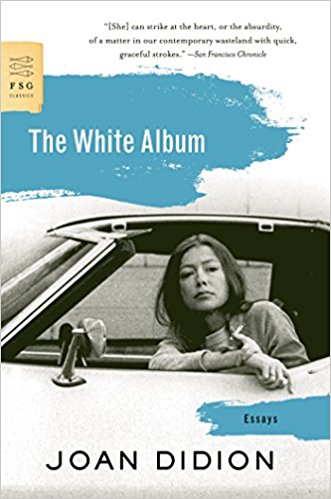
The White Album by Joan Didion

The essays in this collection range over diverse subjects, but as a whole are concerned with American culture, and the Sixties (as Didion capitalizes). Frequent topics include travel, especially air travel, and crime. She always pays close attention to place.

Some essays have aged better than others, but all display Didion’s close focus, instinct for detail, and precise syntax. She also has a knack for surprising endings; it would be interesting to study her for her endings alone. I think she’s very good at time and place, that is, setting us in a recognizable time and place with cultural markers. (This may be an unexpected comparison, but she reminds me of Stephen King in this way: think about 11/22/63.) My advisor Kim points out that she uses clothing and architecture to great effect, and I think that’s part of it.

I am especially interested in the title essay and “At the Dam.” “The White Album” begins with the memorable line, “We tell ourselves stories in order to live.” [Somewhere I have a list of such assertions–that narrative is life–and I think the late, great Brian Doyle figures heavily on it. I wish I had a transcript of an interview he gave onstage for a certain radio show in Bellingham.] This segmented essay, in 37 pages and 15 numbered sections, ranges through the United States (and particularly California) of the Sixties, name-dropping if you will: Huey Newton, Jim Morrison, Janis Joplin, Charles Manson, and more, linking these cultural markers with Didion’s own personal experiences. “At the Dam” is a mere five paragraphs long, but offers an incisive study of a place, the Hoover Dam: its history, its engineering, its cultural relevance, its place in a larger physical and metaphysical world. It makes one of those surprising shifts in scope at the end that gives it a profundity, as if the Hoover Dam needed emphasis.

I’ll be reading more Didion. She is an impressive and craft-y essayist, in that her work feels both crafted–put together–and naturally occurring. She is a master of detail and cultural markers. I’ve got a lot to learn from her, and she is an easy, enjoyable read, to boot.


Rating: 7 lifeguards.

The Business of Memory: The Art of Remembering in an Age of Forgetting ed. by Charles Baxter

Baxter solicited essays from established writers and thinkers about memory in an age of information glut, and was surprised by the extent to which they wrote about forgetting, rather than memory. The result is a remarkable variety of personal stories from life and from writing, and a variety of approaches to memory and its partner, forgetting. Not only models of essay form, these can also function as prompts on the topic.

I was quite taken with The Business of Memory, on the whole, but it was a little uneven from essay to essay, in terms of my personal responses. In the end, I decided this was a strength, or a feature of a collection like this.

I was also initially a little confused about whether to call this a craft book, but decided it’s not; it’s an essay collection about memory, by writers and approaching the problems at the intersection of writing and memory, but it’s not intended to be instructive. These are musings, meditations and personal stories. I made a list of those I liked best–a good long list. And as I review them, I see that I like how they each tell a story, a narrative, of personal experience. They touch on memory very differently.

On the other hand, I had some less-favorites. James McPhersons’s essay struck me as pompous, and I took serious issue with his dismissive statement that “women in this elite are guarded from the haphazard intrusions of Eros by the growing number of company sexual-harassment codes”–like, problem solved! And Alvin Greenberg’s gave me trouble: I really appreciated the efforts his essay made to interrogate memory, but I didn’t enjoy his jokey tone. (Also, I’m a huge hypocrite here, but too many parentheticals!) And Steve Erickson’s rambling story struck me as a little bit frantic and confused–as he confesses to feeling.

These reactions teach me that an essay collection can and perhaps should be varied. I appreciate how far these essays (all responses to the same prompt) range, and it feels right that they touched me so differently. Another reader would have different responses, and be differently well-served. I like that idea. I ended up annotating Greenberg’s essay that gave me such a complicated response, because I appreciated my ambivalence.

My favorite essays were these, in order of appearance.

  • Sylvia Watanabe’s “A Book of Names” describes her upbringing in Hawaii, where her father studied bugs, where she learned the importance of naming things to make meaning. She observes her father, and others, losing their memory, and offers a particular cultural understanding of the importance of both names and memory. When she left for graduate school, her grandmother protested: “Don’t go, there will be strangers there, you’ll forget who you are.” It is a lovely essay filled with metaphor, meaning, and images.
  • Victoria Morrow’s “Don’t Look” is haunted. The narrator is a still-young woman investigating her brother’s death, which she has almost entirely filed away, “forgotten” in a defense against trauma. He had always forbidden her to look at him (literally), and now she has failed to see his death.
  • Karen Brennan’s “Dream, Memory, Story, and the Recovery of Narrative” describes her daughter’s traumatic brain injury and subsequent struggles with memory. She describes several dreams, questioning their relationship to reality, and the form of the essay takes on a certain dream-sequence quality in digressions from a mostly-straightforward narrative telling. I appreciated the personal nature and immediacy of this story, and was especially struck by Brennan’s observations about her instinctive turning to narrative to help her daughter. “At some point I hit upon the idea that what I could do for Rachel that her therapists could not do, perhaps, as feelingly, is offer her help with storymaking, with narrative.” “I felt that had I been lying there in some kind of netherworld, I would want a story that made sense.” This is so evocative to me, to think about our individual responses to trauma and how we think it right to help. Some people would deliver endless casseroles. This writer, naturally, wants to provide story. (I also want to say that I had Karen Brennan mixed up with Karen Branan, which gave me a little cognitive dissonance.)
  • I first read Bernard Cooper‘s “Marketing Memory” early in my formal creative writing education, a few years ago. It was interesting to see how differently I read it now. I very much appreciated the essay then, and do now, but differently. Cooper, after the publication of Truth Serum, was alarmed and surprised at the public’s interest in and knowledge of certain personal details which he’d put into his book. When I first read this, I thought it a little naive and disingenuous for him to be so surprised: he’d written about it. But his argument, that he had perceived himself mining experience for material for art, paying attention to crafted language rather than content, makes more sense to me now that I’ve done a little more of that work myself. Also, I’m still in love with Maps to Anywhere.
  • Patricia Hampl’s “Other People’s Secrets” does interesting and hard work examining the writer’s arguable right to write other people’s secrets–here, her mother’s epilepsy. I am alarmed to read that she has a whole file filled with letters from people cutting her out of their lives for the crime of writing their secrets. Eek.
  • Charles Baxter’s “Shame and Forgetting in the Information Age” is a good example of what I respond to in this book as a reader. His essay has four parts, the first about his late brother Tom, the latter three taking more intellectual, theoretical subjects. I marked this essay as among my favorites, but on looking again, it’s really the story of Tom, a loved and loveable and tragic character, that I’m drawn to. Baxter’s words on shame and forgetting in an information-saturated age (and this book was published in 1999! how different now!) are of course wise and valuable; but they don’t sparkle for me like the story of the fallen loved one.

It’s a fine collection, thought-provoking all over the place and in so many ways. I love the diversity here, and would be so curious to hear how other readers responded differently, because I think that’s the beauty of a collection like this: a collection of voices and approaches. I feel certain there’s something here for everyone.


Rating: 9 clean T-shirts for Michael.

“Goodbye to All That” by Joan Didion

This essay appears in the Didion collection Slouching Towards Bethlehem, but I actually accessed it online, and you can too: here.

From the Essays of E.B. White, particularly “Here Is New York” and “Good-bye to Forty-eighth Street,” and a little bit from “On a Florida Key,” I got swept over to this essay, because I wanted to figure out how they did place so particularly. That is, the particularity of a place, but the fact too that it’s so personal, that even the one Florida Key in the one year when White was there is not the same for anyone else as it was for him. I annotated this essay for the place-details Didion uses, and her zooming in and out.

“Goodbye to All That” is about a time in Didion’s life when she had a relationship with a place. She moved to New York City in the mid-1950s, and away again in the mid-1960s; she writes here of New York “beginning” and “ending” for her. The story of the essay is of the way the specialness of the place ended for her, what she could see from one end of the experience that she couldn’t see from the other. It is a fine blend of particular details and of generalities, or philosophical statements, such as: “one of the mixed blessings of being twenty and twenty-one and even twenty-three is the conviction that nothing like this, all evidence to the contrary notwithstanding, has ever happened to anyone before.” Or, that New York is “a city for only the very young.” There is a definite “Paris is a moveable feast” tone: elegiac, loving of a particular experience indelibly aligned with time and place.

In just over ten pages, Didion memorializes the New York City she loved upon arrival. It is a lovely study of this place, peppered with anecdotes and scenes–parties, snips of dialog–as well as those generalized philosophies; and it retains a feeling of pulled-back nostalgia and reflection. Didion’s choice of details creates that place that is so particular and personal. “When I first saw New York I was twenty, and it was summertime, and I got off a DC-7 at the old Idlewild temporary terminal in a new dress which had seemed very smart in Sacramento but seemed less smart already… and the warm air smelled of mildew…” The hotel room in the second paragraph super-cooled to thirty-five degrees, and the young Didion’s fear to call for help “because I did not know how much to tip whoever might come–was anyone ever so young?” (A lovely aside, addressing the reader there, and again maintaining a reflective distance in time.) The bridge viewed from the window. These details continue to make the place of this essay a specific place–the Triborough bridge, all the street names and addresses named as “the Nineties” and “the Eighties”–but they also give it sensory specificity: “I could smell lilac and garbage and expensive perfume.”

I can’t wait to read more Didion. Up next is The White Album.


Rating: 9 new cabinets.

Essays of E.B. White

Ah, E.B. White. You know him as the author of Charlotte’s Web and Stuart Little, and as half of Strunk & White, as in The Elements of Style. He wrote for The New Yorker for some six decades, and is one of our finest essayists. This is an important collection, then, and one that my semester advisor Kim Kupperman thought was important to my work.

White’s essays are arranged by subject categories (farm, city, planet, memories, etc.) and cover some forty to fifty years, although unfortunately not all are dated. This essential selection proves his ease and artistry with the form. His prose is conversational, familiar, funny, and serious, but does not take itself too seriously; he is an absolutely likeable narrator, and this collection is both a guide to the United States at various points in history, and simultaneously timeless.

White’s prose is so easygoing; it sounds effortless, but of course we know that’s some of the hardest prose to write. The hardest part of reading so many near-perfect pieces is figuring out what to annotate. But finally I returned to the first essay that made me sort of take in breath at its close, because of its structure and its return: “Coon Tree.”

As White famously writes in his Foreword, the essayist puts on many different shirts when he sits down to write (“philosopher, scold, jester, raconteur, confidant, pundit, devil’s advocate, enthusiast”). But if he can be said to have a single style, it’s what I think of as the classical essayist’s. He appears to ramble across subjects and moods, but this meandering is deceptive; the essay does have a unifying theme or message, even if he seems to wander aimlessly. “Coon Tree” displayed this skill the best, for me, so I annotated it for its structure.

Additionally, I was especially enamored of “Here Is New York” (of course, place), particularly the passage in the second paragraph where he lists places and their distances: “I am twenty-two blocks from where Rudolph Valentino lay in state…” This reminds me of Joseph Mitchell’s meticulous but not tiresome cataloging of the little details that make a place.

But I could go on, when in fact what I mean to recommend to you is: read anything by E.B. White–anything at all, but these Essays make an excellent starting point.


Rating: 9 of the mildest zephyrs.

Inventing the Truth: The Art and Craft of Memoir ed. by William Zinsser

I don’t remember when I got this book; I’ve had it for quite some time. (I also have Zinsser’s How to Write a Memoir waiting for me on the massive and daunting to-be-read shelf.) I finally opened Inventing the Truth to read Annie Dillard’s essay, “To Fashion a Text,” that Kim Kupperman assigned me; but I found I couldn’t put it down. I went back to the beginning and read the whole thing through, and I think it’s an excellent collection.

Zinsser approaches “the age of the memoir” beginning with a series of craft talks in 1986. These talks, transcribed, are joined by later additions to form this collection of nine craft essays, all originally delivered orally (whether to an audience or in interview format with Zinsser) by nine writers including Dillard, Toni Morrison, Frank McCourt and Henry Louis Gates, Jr. They talk about what they want to talk about, so the subjects vary somewhat but all address how to write memoir from very different angles. Their delivery, perhaps because originally oral, is consistently enjoyable, and the content is very useful, practical, nuts-and-bolts; it also offers insights into the writing of masterpieces like Beloved. Not to be outdone, Zinsser’s introduction is a lovely piece of prose in itself, and presents a nearly perfect review of what the book in turn contains.

I made a bunch of notes, and am interested in particular in reading Alfred Kazin’s A Walker in the City. A few details that especially fascinated me: that Toni Morrison considers the work of her fiction to be “trying to fill in the blanks that the slave narratives left.” And then the concept that when the straightened Mississippi River “floods” its old path, it’s not really flooding at all, but remembering: where have I heard this before? Lovely! I wonder if these essays–all of them!–struck me so nicely because they were originally delivered orally. I have always been interested in the idea of oral histories or oral storytelling.

This was a deeply enjoyable book, obviously recommended for anyone struggling with the writing of memoir, but actually it should be appealing to general readers, too, especially those impressed by the work of Dillard, Morrison, et al. Perfectly pleasant reading.


Rating: 8 Rorschachs.

The Essayist’s Dilemma (Occasional Papers on the Essay: Practice and Form, from Welcome Table Press) by Marcia Aldrich, Lucy Ferriss, Kim Dana Kupperman, and E.J. Levy

Disclosure: Kim Dana Kupperman, one of four contributors to this pamphlet and founder of the press, is currently my semester advisor.


This paper is available for free download here.

I expected a rather dry read, a how-to, a craft book(let), in short. Instead I found a brief, punchy discussion, in four voices, of something that matters to me. It was quick and fun to read. I’m so sorry I doubted.

This is such a brief piece of work that I’m in danger of writing more in review than there is to review, but here goes. Marcia Aldrich’s introduction sets up the dilemma: publishers don’t like essay collections; essay is a dirty word; essayists have trouble getting published as such. (Examples given.) Lucy Ferriss responds with “The Parts and Whole”: the idea of needing to group a collection around an idea, to make the whole greater than the sum of the parts, is not such a bad challenge, and one that can yield good results. We should not resist this push. Kim Kupperman, in “An Essayist’s Dilemma,” shares the journey (I just used that word because Kim hates it. Sorry, Kim)… the evolution her book I Just Lately Started Buying Wings experienced on its way to the form in which I read it. As she sums up: “a question, a taking apart and reassembling, a husband’s instinct, a poem’s fever, an editorial directive, and, finally, a return to an original idea.” Finally, E.J. Levy writes “In Defense of Incoherence”: she quite likes a thoroughly disconnected essay collection, thank you, and screw commercial concerns.

It’s all good, useful stuff. I think it’s true, that essay collections are unpopular with publishers, because they are unpopular with the (profitable) general readership. Ferriss’s argument makes perfect sense to me, perhaps because my mind works the same way, or I believe the same thing she seems to: that an overarching and unifying idea (or the dreaded theme) is a good thing. This is very much the concept that Levy argues directly against in her piece. As a reader, I am much more like the profitable general reader than I am like Levy. I prefer unity. In fact, I have long resisted reading essay collections, especially when they are presented as miscellany. I realize how damning an admission this is: I hope to write and even publish essays; but I don’t want to buy or read them. Well, it’s a little less damning than that, because I hope to write and publish a memoir-in-essays, or a decidedly connected collection.

Kim, as I read her, does not take a position on whether connectedness is desirable or no. I loved reading the story of Wings; it was the perfect example to learn from, since I studied this and her later memoir rather closely and have been getting to know the author herself some. (Also, its organization is a little unusual, or complicated, but clearly it has an organization.)

Although I don’t read and think the way Levy does, I enjoyed reading her opinion – especially as she called in Fisher’s Consider the Oyster:

I’m a fan of M.F.K. Fisher’s work, but by the time I’m on the fifth oyster in Consider the Oyster, I’m queasy. It’s nto that such a strategy can’t work, but that it makes me suspect that the essayist was considering something other than the oyster–a check from a publisher maybe, the adorableness of her own conceit.

My first thought was, Levy does not like oysters as much as I do. I’d love the opportunity to discover how many oysters it would take to make me queasy! I haven’t found it yet. Seriously, I see her point; but I guess I also found Fisher’s conceit adorable, enough to be unbothered by it. Maybe it’s just how much I like oysters.

Perhaps the greater point here is that we all, always, still, have different preferences. I agree with the thesis of this pamphlet (as I see it), that a preference for a disconnected miscellany of essays is less universal than an appreciation of connected collections (or books with narrative arcs, like memoirs). And I’m on the side of the majority here. That will make it harder to publish the unconnected. I hope it still happens, because I desire a multitude of options and value the tastes of the minority; but I agree with the majority, taste-wise, and with the problem presented here.

I guess the most optimistic thought I have to offer is: this is why we have Welcome Table Press, Kim Kupperman’s small press that publishes weird little essay things that perhaps no one else wants; and thank goodness for that, and for all the other small presses that publish the minority’s desires. It’s The Long Tail all over again, and I’m in favor of it.


Rating: 9 brief and well-stated arguments.

Still Life with Oysters and Lemon by Mark Doty

I came to this book originally some time ago, from Paul Liscky’s The Narrow Door, though they only subtly name one another. It was a happy continuance when Kim Kupperman recommended it. And, I have a thing about oysters. This book is not terribly much about oysters, mind you, but it still attracted me.

Doty’s Still Life with Oysters and Lemon is a lovely meditation on a single still life painting which shares the book’s title; but it is also a study of still lifes in general, and a thoughtful retrospection ranging through the author’s life and loves by way of a handful of objects, and finally a study on the topic of attention. Doty returns to the idea that we seek both intimacy and independence, both belonging and exploration, both the comfort of home and the risk and excitement of travel. Interesting as ekphrasis, as study of duality, and as biography in objects–even as a lyric list essay, broadly defined. I found it interesting to note all the references he makes to other paintings and other art forms (chiefly poetry). Also lovely writing, although this will surprise no one who knows Doty as a poet.

Another of my continuing obsessions–even more than oysters–is things or stuff. Think Guy Clark’s song “Stuff That Works” or Scott Russell Sanders’ essay “Buckeye.” I really appreciated the attention Doty pays to things in this very short book. It was a rewarding immersion, and I recommend him.


Rating: 8 quinces.

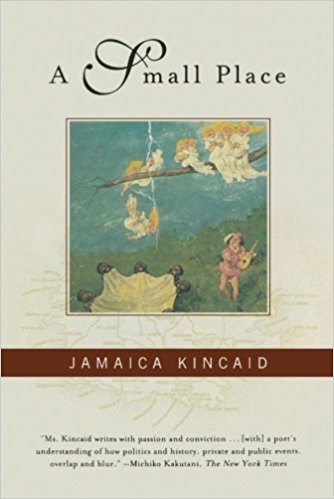
A Small Place by Jamaica Kincaid

A Small Place is a medium-longform essay (81 pages), published here in book form, about Kincaid’s home island of Antigua. Kincaid uses a second-person address to a “you” that stands in for North American or European white people, the unpleasant tourists and descendants of colonialists she observes visiting Antigua. On the surface she is concerned with place–what is Antigua–but the essay is equally concerned with race, empire, and history, and unafraid of long parenthetical asides. I was assigned to read this for its help with writing about place, and so for me the final four-page section describing Antigua as physical place is perhaps most interesting, from a craft standpoint. (Or perhaps I should reconsider what it means that this physical description is the part that seems most place-based to me. What defines a place? Its physicality, or its people and its history?)

It’s also remarkable for Kincaid’s strong, strident voice, and for those long parentheticals. It should go without saying that A Small Place makes a fine introduction to Antigua itself, too.


Rating: 7 brand-new Japanese-made vehicles.

Consider the Oyster by M.F.K. Fisher

I regret it took me so long to read this slim, delightful collection. M.F.K. Fisher is a very fine essayist, known for her food writing but a clever, funny, thoughtful voice in general. Warning: these delicious little pieces will make you hungry (if you have any taste at all for my favorite bivalve).

Obviously I read this book for my own essay about pearls and oysters which I’ve been working on for years… but it was an absolutely pleasure all around. Consider the Oyster has an original copyright date of 1941, and you can hear its era here and there; but overall, I think it ages really well.

Under 100 pages, and all about oysters. Short essays cover oyster sex; the seasonal nature (or not!) of edible oysters; a great many recipes from throughout history and around the world, with Fisher’s commentary; pearls; the oyster as aphrodisiac; regionalism; and more. Fisher is mostly but not entirely concerned with oysters as eaten by humans. Her writing is pithy, charming, humorous and very smart. She is a real personality, and I am a real fan.

Really, folks. What a short, accessible, but so clever little book this is. You should really pick it up, unless oysters totally disgust you, in which case you still should, because it will educate and probably humor you just the same.


Synchronicity: one of the back-cover blurbs here is credited to Clifton Fadiman, who is himself the subject of one of the next books on my list (for the Shelf), The Wine Lover’s Daughter by Anne Fadiman (author of The Spirit Catches You and You Fall Down, which was one of the first books I personally recognized as “creative nonfiction” as I was beginning to conceive of the genre). Everything is circular. Like a pearl.


Rating: 8 pearls, naturally.