“A Native Hill” by Wendell Berry

In preparation for an upcoming visit to Kentucky, and because he appears everywhere around me and I have not devoted the time yet: Wendell Berry.

More than a year ago, my father bought me a copy of the new collection, The World-Ending Fire, selected and with an introduction by Paul Kingsnorth (who I do appreciate). I regret that I have not made time for it yet; and it’s currently boxed up in a storage unit (along with so many other excellent books) and unavailable to me. But Pops still set me up with some reading, beginning with an email explaining his selections, and outlining some of Berry’s major themes: sense of place; tragedies of American history; the urban-rural divide; humility; soil; honest work; naturalism; spirituality. Then he had me read Kingsnorth’s introduction to the new collection, and one noteworthy Berry essay: “A Native Hill.”

As an overall, obviously I appreciate Wendell Berry. All the right ingredients are there: strong attachment to place, defense of the land, argument against larger society, thoughtful, lovely prose. I had always assumed I would appreciate Berry. Also, I’ve heard that he can be difficult, and dated. Kingsnorth notes in his introduction that Berry’s writing technology of choice is, firmly, the pencil: I have no problem with tried and true technologies (recall Boyle). But I am a bit pricklier about gender and race, for example. Berry (like so many) uses “man” to stand for all humanity. And he is still using “Negro” in this essay, which admittedly was published in 1968. But one notices these things, in 2019.

This reading didn’t surprise me much, then. I found a few things to quibble with, which I will lay out below. But overall, I’m going to keep reading and appreciating this man, while reserving the right to quibble.

Here are a series of quotations I marked as I read, which I’m going to let stand as my review.

Why should I love one place so much more than any other? What could be the meaning or the use of such love?

Way to jump right in and steal my heart. Why, indeed? You, faithful blog reader (thank goodness for you), know how much place matters to me as a reader and as a writer. It consumes my thoughts and dreams.

About the truism that “you can’t go home again”:

But I knew also that as the sentence was spoken to me it bore a self-dramatizing sentimentality that was absurd. Home–the place, the countryside–was still there, still pretty much as I left it, and there was not a reason in the world I could not go back to it if I wanted to.

Well lucky you, Berry, but you do realize not everyone has the luxury of this experience? The places that are left untouched from our childhoods are fewer and fewer. Mine is not still there pretty much as I left it, at all. Dog help us, they tore down Fitzgerald’s.

What… made the greatest difference was the knowledge of the few square miles in Kentucky that were mine by inheritance and by birth and by the intimacy the mind makes with the place it awakens in.

Again, lucky you. And hey, I am lucky that my parents will almost certainly leave me some piece of land, but it’s not square miles, and it’s not something I was born to; it’s something they bought later in their lives and that I admire but do not feel especially close to; it’s not where I grew up. (Not for lack of effort, on my part or theirs, to make this place feel like home.) Some of these ideals are easy to live when you’re born with the right set of circumstances, hmm? And what would you say to someone whose inheritance, birth, and intimacy lay with the heart of New York City?

I had made a significant change in my relation to the place: before, it had been mine by coincidence or accident; now it was mine by choice.

and

In this awakening there has been a good deal of pain. When I lived in other places I looked on their evils with the curious eye of a traveler; I was not responsible for them; it cost me nothing to be a critic, for I had not been there long, and I did not feel that I would stay. But here, now that I am both native and citizen, there is no immunity to what is wrong. It is impossible to escape the sense that I am involved in history.

These I feel, too, with regards to Texas.

And so here, in the place I love more than any other and where I have chosen among all other places to live my life, I am more painfully divided within myself than I could be in any other place.

Because of the quotation directly above: no place we love will ever be perfect. Kentucky and Texas have their share of sins, but if one of you lives in a place that never did harm, throw your stones now.

A path is little more than a habit that comes with knowledge of a place. It is a sort of ritual of familiarity.

By contrast, a road:

Its aspiration, as we see clearly in the example of our modern freeways, is to be a bridge.

I appreciated his medium-deep dive here into paths, trails, roads, bridges, what they mean physically and metaphorically. Trails matter to me; and they make an excellent metaphor.

The pristine America that the first white men saw is a lost continent, sunk like Atlantis in the sea.

I worry about this, as another form of deifying the past, or in this case the Native Americans. Were they really doing this world no harm? I admit to the same prejudice Berry shows here, thinking that no, they did no harm. But now I wonder if that’s true? It reeks of romanticizing what we don’t understand.

It is as though I walk knee-deep in its absence.

A lovely line; I think we all know what it is to walk knee-deep in an absence of some kind; also, I’m almost certain this line was referenced by Matt Ferrence, which endears it to me again.

Near its end, this essay reminds me of Scott Russell Sanders, specifically the hawk that closes “Buckeye.” The final section of Berry’s essay offers a series of short, nearly prose-poetry segments. Third from last of these is an event that proves, for Berry, that nature knows not only peace by joy. It stars a great blue heron (parallel to Sanders’s red-tailed hawk), a bird that is important to me personally: it’s probably the first bird I learned to identify on my own, an easy one, since it’s both large and distinctive; and they have been present in many of the places I’ve traveled in this country, remote and far-flung, as well as in the urban setting of my hometown of Houston, where I used to see them fishing in the early mornings along the bayou in the Texas Medical Center as I walked from car or train station to work. This bird Berry describes as measured, deliberate, stately, “like a dignitary,” stately again – I agree on all counts – and then he sees it turn a loop-the-loop in the air, exultant, “a benediction on the evening and on the river and on me.” This transcendent moment – and Berry’s powerful prose – affected me deeply.

And then, one evening a year later, I saw it again.

Wow.

I do recommend this essay by Berry, and I will be reading more of him – though I may have to dig through that storage unit to do so.

I could not close without referring you, as Pops referred me, to “The Peace of Wild Things”. I had encountered this poem before, but Pops points out that it’s published the same year as “A Native Hill,” and condenses and distills much of the essay’s feeling. It’s worth another look, no matter how familiar you are.


Rating: 8 threads of light and sound.

shorts by Cather; Sandor; Wheeler; Irving; Chesnutt; Maren; and Bourne of National Geographic (and links followed, etc.)

Whew, a long one today – sorry, folks, but I’ve been reading.

Because I’m not busy enough (ha) I’ve been reading a few short prose pieces here and there. Some of the following come from the Library of America’s Story of the Week (an email you can sign up for for free, if you have tons of free time or are a glutton like me). One I found languishing in a file on my computer. The internet, and friends’ referrals, account for the rest.


Willa Cather’s “A Death in the Desert” was a Story of the Week, viewable here. I found it a moving story, but much more so with the context included, about Cather’s devotion to a composer who died young. As the Library of America points out, the fact that this story was published in three versions, each subsequently edited and shortened, makes it an excellent opportunity to study editing for length (if you were to go find all three). There’s something Victorian in the manners and fainting emotions in the story that is less compelling and relateable for me personally, though. I’m glad to have learned a bit more about Cather, but it’s not my favorite thing I’ve read this month.


Marjorie Sandor’s “Rhapsody in Green,” however, blows my mind. (This was the one found on my hard drive. Originally published by The Georgia Review and viewable here, if you sign up for a free account.) It is a very brief lyric essay about, yes, the color green. Sandor evokes so much via this color, and her search for an unachievable shade: color, we might think, is a visual element, but she uses touch, smell, and taste as well. On its face about this color she can’t find, this essay is also a glancing view of the narrator’s life story, at least in a few relationships and geographical locations. There are four references (in less than three pages) to a time “I fell in love when I shouldn’t have.” It is a brave and risky move to so emphasize an event that she never explains further. As we writing students say, this one would have been destroyed in workshop. But I love it, this level of tantalization, and her bold implication that no, we don’t need to know any more about it than that. There are also two references to “a/my friend who puts up with such eccentricities.” I love this epithet, this characterization, and in both cases – this, and the “fell in love when I shouldn’t have” – I appreciate the use of an intentional echo to good effect. Also, nothing I’ve said here begins to get at the loveliness, the lyricism and sensual intimacy, of Sandor’s writing. Do go check this one out.


Disclosure: Dave Wheeler is my editor at Shelf Awareness, and a friend.

I have done a poor job of keeping up with Dave’s work, and recently returned to see what I’d missed, particularly in his essays, which impress me so. I am gradually catching up now – you can see his published essays here (and more in other links on that page). And I love a lot of what Dave writes: I appreciate the short, dreamy, feeling quality of “Science for Boys”, and the inquiring mind exposed in “Death and Its Museum”. But I think my favorite essays of those I’ve read so far deal with art, and how Dave takes it in. “Two Men Kissing” and “Some Holy Ghost” each offers so much, and I’ve forwarded them to many friends.

Today, I am very pleased by “A Moment Spins on the Axis of You: The Fourth Dimension of Yayoi Kusama’s ‘Infinity Mirrors'”. Here Dave encounters Kasuma’s installation, in particular, and the grand scale of its claimed subject. But even more than the named artwork, he considers what it means to wait – for art, for anything – and what contribution waiting, or time, or the audience experience, may offer. I appreciate his voice: he speaks with authority about his own experiences, but with a humbleness as regards the world of art criticism; he can be playful even as we feel he is serious. And of course I recognize myself when he writes, “As a lifelong reader, I have cultivated a sharp sense of when I can quit a book without worrying that I have missed something of importance. As a wide-eyed novice to visual arts, I am less assured.” I think I feel something like the same thing when I try to see my own reactions to visual art: I don’t even know what I don’t know.

Perhaps recognizing myself in Dave is part of recognizing Dave, someone I know personally and enjoy talking to, however infrequently we get around to it. And maybe that enjoyment is inextricable from my appreciating his writing. Maybe you want to help me test this: go check out Dave’s work and let me know what you think.

Good, right?


Washington Irving’s “Rip Van Winkle”, another Story of the Week, was engaging enough in its descriptive power; I was interested in getting a better grasp on one of those legends that’s in our collective consciousness whether we’ve read it or not (I don’t believe I had). The misogyny in the treatment of Dame Van Winkle, and the cursory treatment of all the women in the story (none of whom, if memory serves, had names), rankled. I’m not sorry I took the time, but it wasn’t a highlight, or anything.


Charles W. Chesnutt’s “The Bouquet”, on the other hand, was both lovely and harrowing. (I went ahead and followed this link to a Wiley Cash article in Salon, where he argues for Chesnutt as genius, and I don’t disagree.) If you want to feel gutted by our national heritage where race is concerned – well, none of us does, but I feel it’s important we don’t look away, either – give this short story a try. It has a surface on which it can act as a sweetly sad and simple tale, but its depths are significant.


Disclosure: Mesha Maren regularly serves as guest faculty at West Virginia Wesleyan College in my alma mater MFA program. I consider her a friend.

I was deeply impressed with Mesha’s recent essay in Oxford American, titled “West Virginia in Transition”. She moved away as a young, closeted, queer woman, and upon moving back, she investigates the experiences of her counterparts: queer youth growing up twenty years later in her own hometown. She muses on the ways in which their lives are different and the ways in which they’re similar. It’s a story that’s important to me, because both queer communities and Appalachian ones are much on my mind. I’m glad topics like this are getting bandwidth. But also, as anyone who knows Mesha’s work will expect, it’s a gorgeously written story. “The way these ridges and hollows both cradle and cleave.” Beautifully done, and highly recommended.


Finally, my father sent me a link to this story from National Geographic: “Clotilda, ‘last American slave ship,’ discovered in Alabama.” Joel K. Bourne, Jr. brings us up to date on the recent confirmation that Clotilda has been identified where she was burned and scuttled in the Mississippi Delta after a voyage spurred by a wealthy white man’s bet that he could import slaves from Africa more than 50 years after such imports became illegal. In 1860, 109 men, women, and children survived the voyage into Mobile and were then sold into slavery. Part of what’s unique about this group of abducted Africans is that late date: Clotilda’s survivors lived long enough in some cases to be interviewed on film. They founded Africatown on the edge of Mobile, and their some of descendants live there today. When I passed through Mobile this spring, I missed Africatown. But, unknowing, I stayed in Meaher State Park, which is named after a wealthy white family, including the man who made the bet.

I found this article, accompanied by pictures and video, moving. I think it’s an important story to read and consider today. I also followed several links, like this one offering a list of destinations to visit for African American history and culture. I found a few of these on my travels this year; I’ve added to rest to my itinerary.


There is always something to keep our minds busy. I just feel lucky to have the time to follow these leads. What have you read lately?

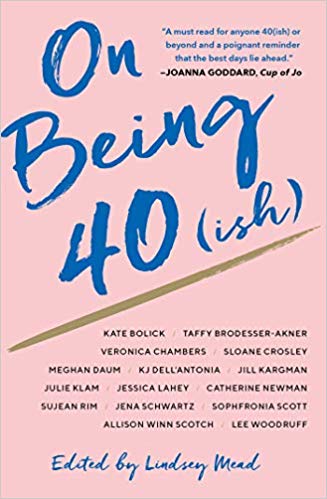
On Being 40(ish) ed. by Lindsey Mead

These collected essays about the milestone 4-0 remind readers to laugh, cry and hope.

In On Being 40(ish), 15 women muse on what being 40 years old–give or take–means in their lives. This anthology, edited by freelance writer Lindsey Mead, offers diverse viewpoints and concerns but as a whole aims to inspire. As Mead writes in her introduction, “These are not reflections on the dying of the light, but rather a full-throated celebration of what it means to be an adult woman at this moment in history.”

The contents are varied, including celebrations, uncertainties and elegies. Some writers mourn losses, some rejoice at new beginnings; some are concerned with the existential, some more lightheartedly concerned with changing appearances. Lee Woodruff writes about her mother’s 40th birthday, her own and what she hopes to pass down to her own daughters. Taffy Brodesser-Akner writes about time, which “happens no matter what you’re doing with it.” The quickness with which years pass is a theme across these essays, as is the victory involved in aging: “by forty, we know who we are,” Jill Kargman writes. “When we are young, we are diluted versions of ourselves. We become balsamic reductions as we age–our very best parts distilled and clarified.”

Allison Winn Scotch writes about accepting the unexpected when a devastating injury interrupts plans for a trip to Mexico. She closes: “I worried that my injury would upend everything. It turns out that it did.” And that’s a happy ending.

On Being 40(ish) is mostly about happy endings; or the ongoingness of life–its not ending at all, not yet. This is an anthology for women of all ages and all perspectives.


This review originally ran in the March 19, 2019 issue of Shelf Awareness for Readers. To subscribe, click here, and you’ll receive two issues per week of book reviews and other bookish news.


Rating: 6 rainbow suspenders.

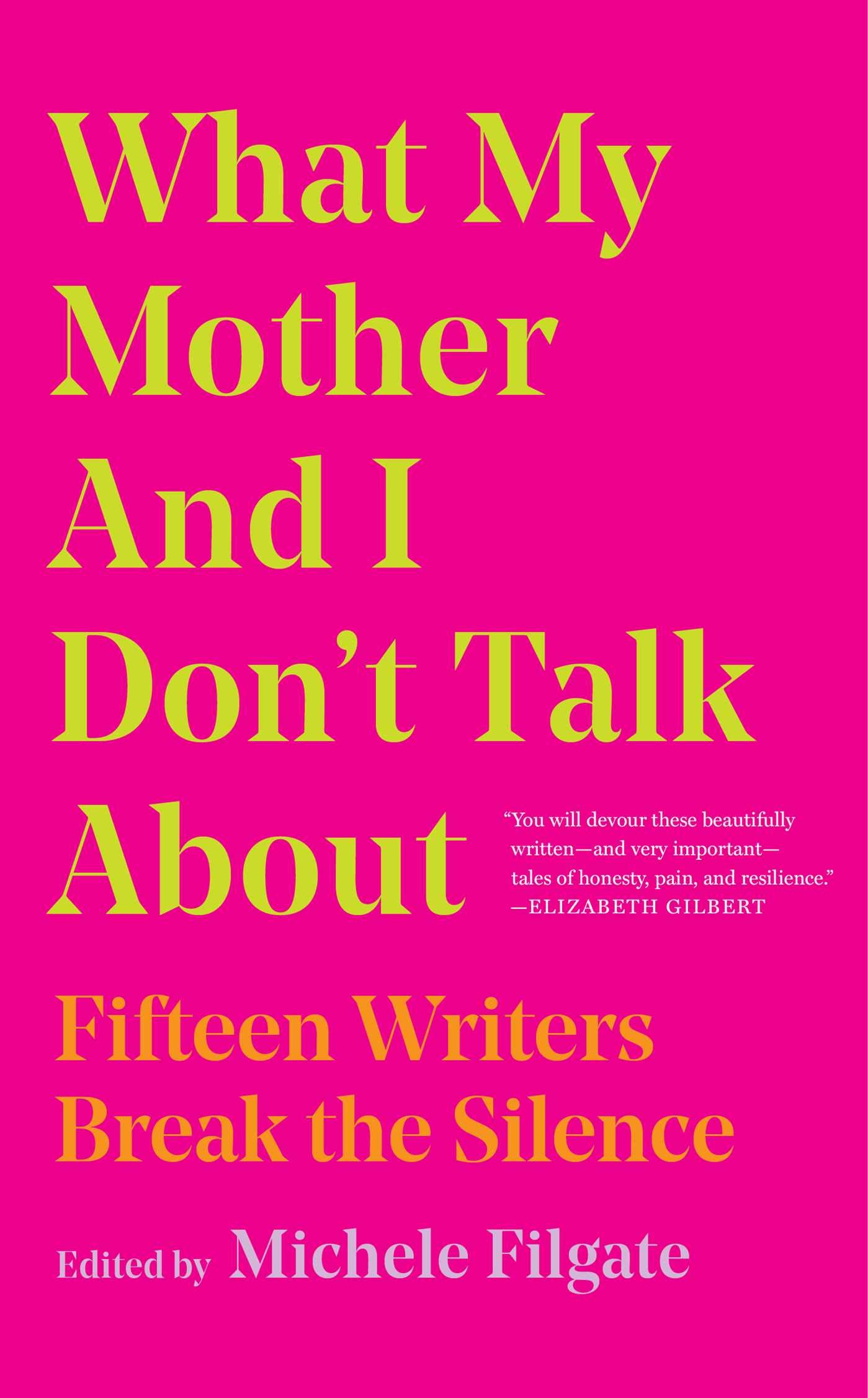
What My Mother and I Don’t Talk About: Fifteen Writers Break the Silence ed. by Michele Filgate

Diverse writers answer the title’s prompt with essays that are cutting, furious, delicate, generous and everything in between.

Literary Hub contributing editor Michele Filgate thought she was writing an essay about her stepfather’s abuse, but it turned out she was really writing about the relationship with her mother that allowed such abuse to continue. After years of work, her essay was eventually published by Longreads under the title “What My Mother and I Don’t Talk About.” Readers and writers responded strongly, and Filgate’s piece now leads this astonishing anthology.

What My Mother and I Don’t Talk About: Fifteen Writers Break the Silence follows that essay with a breathtaking range of responses. Filgate writes, “Mothers are idealized as protectors: a person who is caring and giving and who builds a person up rather than knocking them down. But very few of us can say that our mothers check all of these boxes. In many ways, a mother is set up to fail.” And while many of the essayists featured here reproach mothers who have hurt them, there are also apologies, confessions and unsolved mysteries. These essays bring many perspectives and deal in self-awareness, too.

In “Thesmophoria,” Melissa Febos considers her close relationship with her psychotherapist mother by recalling myths, chiefly that of Persephone and Demeter. “We often love the things that abduct us.” Brandon Taylor wrestles with the pain his mother has caused: “It’s strange, really, that to grasp that which has hurt you, you must trust it not to hurt you when you let it inhabit you”–or when you write about it.

Alexander Chee hides the abuse he’s suffered from his mother because of the tragedy they’ve endured together: “This is how we got each other through.” Dylan Landis seeks to understand her mother better through an old apartment building, and a possible former lover. Amid the layered traumas of race, nation and gender, Kiese Laymon asks his mother: “Can we please get better at loving each other in America?” Carmen Maria Machado finds her own conflicted feelings about parenthood linked to her mother’s harsh treatment. And André Aciman considers his deaf mother’s language, separate from words, and what it taught him.

Leslie Jamison closes the anthology with an essay exploring her mother through the eyes of an outsider to the family unit: her mother’s first husband’s unpublished novel about their marriage. It is a fitting conclusion, with that surprise perspective and a careful, loving attention to the woman who came before the mother.

These collected essays are variously rich, tender, angry, despairing and clinical. The result, greater than the sum of parts, is part paean and part denunciation, intelligent, heartfelt and wise. What My Mother and I Don’t Talk About is a shrewd, glinting collection of beauty and pain: a gift for mothers and their children.


This review originally ran in the March 19, 2019 issue of Shelf Awareness for the Book Trade. To subscribe, click here.


Rating: 8 myths.

The Absent Hand: Reimagining Our American Landscape by Suzannah Lessard

This broad social-historical consideration of American landscapes will satisfy and challenge the most serious reader.

Suzannah Lessard (The Architect of Desire) offers a broad cultural examination of place in The Absent Hand: Reimagining Our American Landscape. The result is a work of great scope that’s grounded by an interest in landscapes, the forces that shape them and how they in turn reshape us. Lessard chases big mysteries. “Always behind my readings of landscapes are the questions, Where are we…? and What is our relationship to our surroundings now?”

Lessard begins with a close description of “the village” where she lives near Albany, N.Y. She then travels outward, to visit a nearby friend and consider suburbophobia, and therefore the history of the suburbs–as foil to the city, as military defense concept, as commercial center, as “edge city.” Having considered terms like sprawl, metropolitan area, edgeless or stealth city and more, Lessard uses “atopia” to refer to landscapes “where contemporary development, directly expressing contemporary times, was unrestrained.” She is also quite interested in “online” as a place, from its origins in Cold War strategy through the option it provides as escape from real places.

Lessard is at her best when handling the ways place and people interact (Disney’s attempt to build a history theme park just south of Washington, D.C.), and on shakier ground when handling larger issues (market forces versus governmental powers). One of her finest chapters considers a mall in King of Prussia, Pa., and the tensions and challenges facing shopping malls across the country.

As Lessard shows, Cold War policy, the Depression, the legacy of slavery, racist housing policies, nuclear armament and more have all played roles in the development of the suburb and the contemporary landscape. Mixed in with these references, Lessard often cites works of art–Van Gogh, Shakespeare, Han vases–as means to understand place.

Lessard can speak from a place of economic comfort that may grate some readers, but the value of her decades of research is undeniable. The Absent Hand is often dense, as Lessard draws upon centuries of human history to make her arguments. In this ambitious work, place is examined, deconstructed and incrementally illuminated, even as our landscape changes anew.


This review originally ran in the February 19, 2019 issue of Shelf Awareness for the Book Trade. To subscribe, click here.


Rating: 5 paintings.

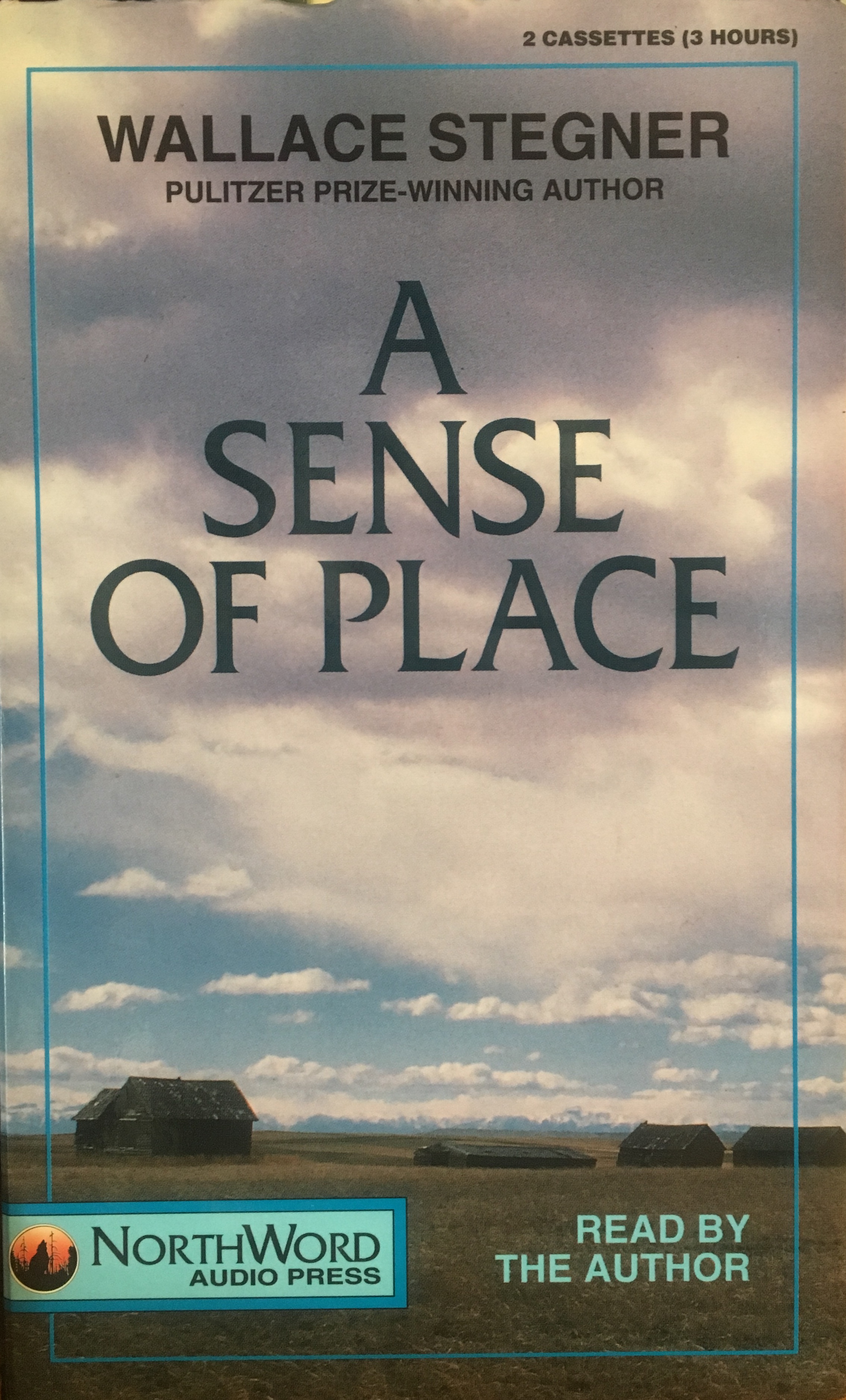
A Sense of Place by Wallace Stegner (audio)

To write about this essay collection, I must first tell you about the format.

From my research, it looks to me like the collection exists only on audio, and only on audiocassette. I bought the set of two cassette tapes some years ago, and have had them all this time, waiting for a way to listen to them. The only cassette player I could locate in my friends-and-family circle was a desktop item my father dug out of the attic for me; but its volume only goes so high, and Stegner came out of the machine so low that I could only hear him if I pressed my ear against the tape player, which I quickly tired of. (Thanks anyway, though, Pops.)

Then finally a friend bought me this outstanding gift: a cassette-to-MP3 converter! Who knew! Thank you so much, Margaret; it was a shame to use it for just the two tapes, but hopefully the guy I passed it on to gets some use out of it with his old rock tapes. Anyway, I was finally, after years of ownership, ready to listen to my Stegner as I drove north across west Texas.

And it is Stegner himself reading, which I think is a nice bonus, although he does have a bit of a somnolent monotone. The essays are not titled; he simply rolls from one into another, so that I was rarely clear on when one ended and another began, although changes of subject serve as loose guides. It’s an intriguing problem, the format of these essays and their absence from the world otherwise. I am a bit interested in transcribing them myself for posterity, if I could find the appropriate person to work with on that project. Hmm.

Now on to the essays, yes? I enjoyed listening. Stegner has a lot to offer: he has known several corners of this country very well at several times in particular, and he specializes in detail and color (literally and figuratively, as in “local color”). He can be relied upon for commentary about conservation issues, and although his positions sound a little obvious in 2019, coming from 1989. His storytelling style is soothing, especially read aloud in that drowsy voice of his. I do wish I had these on paper to read and look at; as it was, I had to let the stories and reflections wash over me, which was pleasurable, but leaves me with less to say for this review.

I made a few short recordings of lines that appealed to me. I have no idea what essays they are from.

The Wasatch in Utah… taught me the feel of safety… A man can tuck back in against mountains, the way Hemingway used to tuck back into the corner stool at Sloppy Joe’s, his back covered and all danger in front of him.

(Guess why I like that one. That would be Sloppy Joe’s in Key West; I’ve been there.)

We manage to breed saints, brutes, barbarians, and mudheads in all sorts of topographies and climates, but what country does to our way of seeing is another matter, at least for me. By and larger I do not know what I like, I like what I know.

I wish I had the line that came just before, too: his point was that topographies and climates don’t make people who are smart or stupid, moral or evil. It’s a point that’s important to me. People judged for their geographies is becoming a pet peeve of mine. And that last line: “I do not know what I like but I like what I know.” It makes sense somehow.

Every night in season [the frogs] conducted love concerts that could drown out conversation even inside the house. Stamp on the patio bricks and they fell silent so suddenly from such a crescendo of noise that the silence rang like quinine in the ears, the sort of silence I’ve heard nowhere else except in the middle of the Amazon jungle.

Silence rang like quinine! What an unexpected simile; and I’m not sure exactly what it means, not knowing what quinine sounds like in one’s ears; this is a line that I think would get picked apart by certain creative writing professors I’ve known, but I appreciate it. I don’t know what quinine rings like, but the surprise pleases me, and I’m willing to take it on faith that that was some silence, whew. Now, the Amazon jungle as a place of silence I trust a little less: I imagine a jungle being rather a noisy place, what with all the life going on there, the peeps and rustles and dripping that surely must be going on. But perhaps Stegner has been to the Amazon. I have not.

There were other startling lines, and worthwhile observations. I wish I could share the text of these essays with you. Barring that, take my word for it, unless you have a tape deck and $16.48 (which will buy you the tapes right now on that other Amazon; more from AbeBooks).

Even with all the hassles it took me to listen to A Sense of Place: worth it.


Rating: 7 names.

Scott Russell Sanders in recent Orion, Brian Doyle, and considering death

A synchronicity: my father sent me a recently published essay by Scott Russell Sanders that coincides with some reading and thinking I’ve been doing lately.

The essay occurred in the Autumn 2018 issue of Orion, which you can purchase here, but cannot read without purchasing – sorry. It’s called “At the Gates of Deep Darkness,” and it is about the dire cancer diagnosis of Sanders’s son, Jesse, who is 40 and has young children. In it, Sanders tries to navigate grief, and the intersection of his religious upbringing with his devotion to science, his love for this world and his sadness & anger at Jesse’s coming end.

It’s an essay I appreciate in many ways: for its language, its attention to detail, its careful plotting of divergent beliefs and feelings, and its place within Sanders’s body of work. I enjoyed his listing of “great pioneers such as Emerson, Thoreau, Muir, Leopold, and Carson, as well as accomplished contemporaries such as Barry Lopez, Terry Tempest Williams, Chet Raymo, John Elder, Kathleen Dean Moore, Pattiann Rogers, and David James Duncan” – what a list! – with whom he has some things in common. I really do recommend it.

But, separately, what is interesting about this as synchronicity is my recent reading of Brian Doyle’s short essay “Joyous Voladoras,” which you can read here. It was assigned by Matt Ferrence* for his seminar, and when Matt and I got a chance to talk more later, he told me it’s an excerpt (?) or vastly shortened version (?) of Doyle’s book The Wet Engine, which I have not read but of course want to. It’s about the heart – the hummingbird heart, and Doyle’s own. The book makes it clear, though, that this interest in the heart was inspired by his very young son’s need for open heart surgery.

His son survived, and is now an adult, and Doyle has since died (in 2017). When my father sent me the Sanders essay, he said it “presents us, like Doyle does, with a thoughtful writer wrestling with faith in real time in public.” Pops means Doyle wrestling with his own mortality, as he did while dying very quickly of brain cancer. But fresh off “Joyous Voladoras,” I thought of the even closer parallel, of worrying for one’s child.

Grief, obviously, is one of those universal topics. Sanders acknowledges, “In sharing this personal story, I do not mean to impose my grief on readers, for we all have more than enough griefs to bear, both public and private.” Even grief for a child is common enough. But for artists such as Sanders or Doyle, there is still something to offer. Sanders continues, “I tell of Jesse’s cancer because it has made clear to me the persistence of those questions, intuitions, fears, and longings that inspired my early devotion to church-going and Bible-reading. I still puzzle over the sources of suffering; I still experience wonder and terror and awe; I still yearn for a sense of meaning; I still seek to understand the all-encompassing wholeness to which I belong.” And onward. This is why we read, and this is why we write.

Among the lines that I marked in Sanders’s essay:

My calling of Jesse’s name is timed to the rhythm of my footsteps, my breath, my heartbeat. A mother’s heartbeat is the first sound we hear. Once outside the womb, we respond to that rhythm in the beating of drums, in the bass notes of music, in the iambic pentameter of poetry.

The heartbeat, again, took me back to Doyle and the hummingbird heart, which comes to be everyone’s heart. The unique and the universal.

Do go read Doyle – it will take only minutes, and you’ll feel so much. And consider that issue of Orion, which I imagine contains other gems than this one. Consider too the full-length Doyle book, which I’ve added to my to-do list (Dog help me). Thanks for following me on this winding path today and always.


*Matt Ferrence was a guest faculty member at this most recent residency at my MFA program, at West Virginia Wesleyan College. We really hit it off and had several good conversations; I’m glad to know him and although I haven’t read it yet, I’m confident that I can recommend his book Appalachia North, forthcoming on February 1! (There will be a review here, eventually.)

Leaping Poetry by Robert Bly

Note: I’m out of pocket during my final residency period at school. I love your comments! But it may take me several days or a week or more to respond.


I read this little collection of poems and essays for Diane Gilliam’s seminar, “As If the Top of My Head Were Taken Off: Getting More Energy Into Our Poems.” Robert Bly offers his own essays on what he believes poetry should be: that poems should leap, not plod, that they should make wild associations, that they should answer to our animal instincts. He argues that in the Christian world and particularly in “America” (by which I surmise he really means the United States), we have gotten too safe, gotten away from the leap. Alongside his own essays, Bly collects poems he admires (including one of his own), to illustrate his points.

I enjoyed many of the poems, and I found Bly’s commentary interesting, but often problematic. (Here’s where I acknowledge that this book was originally published in 1972, so we can choose to make certain allowances, if we’re so inclined.) For one thing, his assessment of contemporary poetry (more than a generation ago now) is very much defined by national borders. French poets are good; Spanish poets are “much greater”; American poets have “faltered” (in the 1940s and 50s), and are now turning to the South Americans (parse that). I can allow that there is such a thing as a national “school” of poetry or of thought, although I suspect that’s less and less true in the age of swift international communication – which is quite a bit different from 1972, of course, and is still limited by language – one of Bly’s great concerns is that not enough fine Spanish-language poetry has been translated into English (when he says “Spanish,” does he mean coming from Spain? or merely Spanish-language? how concerning). But I think to say that Spanish poets are better than French poets are better than American poets is disturbingly close to racism, or nationalism. It caused me to stumble several times. Was this okay in 1972?

Also, I find myself exasperated that Bly has collected 32 poems (and 2 epigraphs) here, and 31 of those poems (and both epigraphs) were written by men. (Thank you, Marguerite Young, for representing half the world.) I assume that I’m to conclude from this that women just about cannot write good poetry at all… I know, 1970s, but still I’m disgruntled.

As a much smaller point, I wondered at the assertion that “the desert contains almost no mammal images.” This is in the course of a very interesting essay about the “three brains” (reptile, mammal, and ‘new’), and meditation, and accessing different parts of ourselves. This essay was the part of the whole book that I most engaged with. He sets up a desired move from reptile brain to new brain, through the mammal brain, necessitating a journey to “the forest” (he uses quotation marks) and finally to the desert, where an absence of “mammal images” lets us then move to the new brain. Well, I’m intrigued, if not sold. With those quotation marks, “the forest” becomes more archetypal than literal, perhaps, and I can permit that a similarly archetypal desert has fewer mammals than an archetypal forest. But as a lover of a very real desert in particular (that has mammals in it), I stumbled, again.

Leaping Poetry is, at least, an interesting book to engage (and possibly argue) with. I haven’t even touched on his theories of poetry, since I always feel underqualified. As I say every semester about the challenging readings I’m assigned for seminars, I’m looking forward to what Diane Gilliam does with this in her class. I’m sure it will be wonderful.


Rating: 5 stains on a handkerchief.

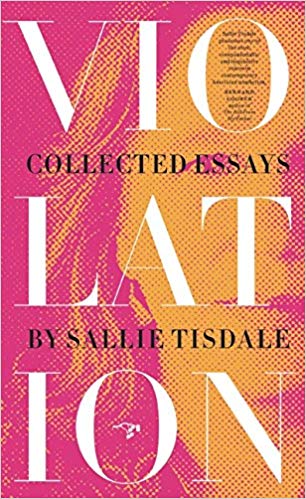
Violation: Collected Essays by Sallie Tisdale

This was a real treat, and an interesting balance between the experience of Many Circles – mind-bending, challenging, slow work – and If You Knew Then What I Know Now, which I read with pleasure in one big gulp. Violation was different from each of those, but fell just between them in its pacing. I was engaged and felt a sense of momentum throughout, but also had to stop and sit with what I was learning, or to react.

These essays span thirty years of Sallie Tisdale’s writing career, and are presented in the order in which they were published, with the final essay previously unpublished. Some of them were in progress for years before publication, but still a chronological order of a sort. While subject matters range quite a bit – elephants, flies, abortion clinics and cancer hospitals, sports, childhood and motherhood – they clearly track the evolution of one mind. Tisdale is a Buddhist, although that doesn’t come up as an explicit fact til late in the collection. She is an artist, passionate, but practically minded. She is concerned with the body, and with feminism, in different ways. I enjoyed very much getting to know her in these essays; but I also have an impression of her as a very private person, and in some ways don’t think I really got to know her very well at all.

The introduction gave me my first moment of aha! simpatico joy: “Long before I knew how to describe it, I liked ambivalence. Certainty has always seemed a bit dishonest to me.” This is so much what I feel, and it’s perhaps something I’m still working on describing, myself. It was my first, early signal that I would get along with this writer.

I really enjoy her style. She is the essayist’s essayist, or these are examples of the classical essay-as-assay: the mind wanders on the page. She is curious. She brings in a huge amount of outside research, sometimes, as when she writes about elephants and moray eels. She reminds me of Annie Dillard in the combination of immediate personal experience with science, but without the raving exuberance that Dillard often brings. Instead, Tisdale remains calm. On the other hand, the title essay is about the memoirist’s famous problem: family responses to one’s work. The nature of memory, and the question of what is ours to write about. More purely personal essays like this one require little or no research.

These essays are concerned with art and creativity, yearning, body image, and what boys and girls were allowed to do (and still are and are not allowed to do)… so many things, but not all at once. They take on really different things. And while most are alike in basic structure – discrete essays, with narrative journeys and mountains to climb and points unto themselves – one of the ones that most struck me was the segmented essay “Scars,” published in 2003, about raising a son. I loved the wordplay (of each segment’s title) and the enormous scope in a small package (just over 7 pages total). It spans a lot of time: sections are labeled with years from 1982 to 1997, and a brief note at the end says that the first section, in its original draft, was one of the first essays Tisdale wrote. I really appreciated seeing the bones of this one a little bit. And then, immediately following, comes “On Being Text,” about what it’s felt like as a writer to be included in anthologies that teach literature or writing: to read what’s said about her and about her methods and intentions. (It’s not all good.) This juxtaposition helped me again to appreciate the range in this collection.

But definitely some of my favorite essays were the two about elephants, “The Only Harmless Great Thing” and “The Birth.” The first, early in the collection (1989), is over 40 pages long, and brings in an enormous amount of scientific and historical information about elephants and zoos, and calls as well on literature and myth. It’s also personal: the narrator feels lucky to have gained back-room access to the elephants at Portland’s Washington Park Zoo. The elephants are magic, and she writes about them beautifully. This was an essay I snuggled into, fascinated and comforted by these strange creatures so loved and respected.

And then “The Birth” (2003), under ten pages, and tender and very much in-the-moment; it handles the same setting and the same (elephant and human) characters, but easily stands alone from the earlier essay too. “Elephants are so outside the size of things.” They “held up the world.” As she later does with the moray eel, Tisdale insists upon a distance from these animals: she acknowledges the temptation to feel close, to anthropomorphize, but holds herself to appreciating their otherness too. These essays are dreamy.

Tisdale is curious, thoughtful, considerate, and honest. I’m so glad that she allows this curiosity and careful consideration to range over the wide, wide world. (I didn’t even get into the lengthy treatise, “The Sutra of Maggots and Blowflies,” about much-maligned insects and Buddhism.) This was a treat, and I highly recommend it for curious readers of all kinds.


Rating: 8 sheep bot flies.

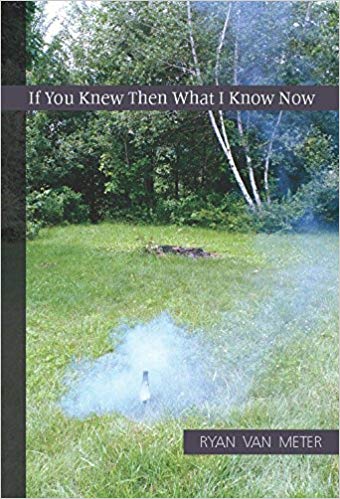
If You Knew Then What I Know Now by Ryan Van Meter

Another beautiful recommendation by Jeremy Jones. Thank you, Jeremy. And thank you Jessie for cuing me to watch this one for its organization. Jessie has not read the book, but she knew that organization of an essay collection is what I need right now and she somehow knew this was the right fit. (Trust in Jeremy, perhaps? What a fascinating, beautiful world.)

This is an essay collection about the narrator’s finding out that he is gay and eventually living as a gay man. These linked essays appear in almost perfectly chronological order, and the bulk of them take place in childhood or young adulthood (while he’s still living at home). The discovery and coming-out processes took time for this individual, and those twenty-three years (I think) therefore take up most of the book. A few essays cover his adult life after coming out; one essay (although a long one) covers an eight-year relationship, which is his first, and this is one of my favorite essays.

These pieces are nicely linked and ordered, with sensible transitions and little repeated information. Each essay within itself tends to feature repeated images or symbolism that work well to make a point, to come to a conclusion–if anything, perhaps a hair more neatly than I’d prefer, but these points are always clear, and maybe that’s the side to err on. As a collection, it’s a beautiful profile of the narrator and a life, tender and thoughtful, and admirably fair to the flawed but loved parents.

I had a few favorites, of course. The opening piece, “First,” is lovely, and I remember it – I assume Jeremy sent it to me during our semester of working together, because I don’t know where else it would have come from. It’s a quick scene, riding in the car as a small boy, and an early (anti-gay) lesson given by his mother. This is a perfect capsule: scene, scrap of dialog, reflection, and back out again. The final line of the essay reads, “We all just sit and wait and watch our own views of the road–the parents see what is ahead of us while the only thing I can look at is what we have just left behind.” Van Meter is really good at final lines. This is one that I’d say approaches the too-neat conclusion, but doesn’t quite go there. Instead, it’s a perfect summing up and cue to the reader of the meaning of this painful scene we’ve just witnessed. It inspires a sigh, a murmur of recognition.

While most essays feature narrative storytelling, with their points subtly made in the narrator’s reflection, one essay was different. “To Bear, To Carry: Notes on ‘Faggot'” is much more an assaying essay, with the narrator musing on a particular nasty word, its etymology and uses and effects in history and in his own life. There are anecdotes, but the essay concentrates on a concept and not a story. While I loved the storytelling style throughout, I thought this essay was both well-written and well-executed, and well placed in the collection. It is the one, I think, that comes out of chronological order–but that’s appropriate because it’s not nearly so rooted in the chronology of the writer’s life. It showcases a different kind of writing skill, and zooms out to give the reader a different perspective on his life. It cues us to a more zoomed-out view of that life, too: from here on the essays will cover much more time compressed in each one. Childhood has ended and adulthood has fully begun. From here, the narrator is no longer struggling to know that he is gay and come out, and begin his life; now he is living.

I think my clear-favorite essay is the one that follows. “The Goldfish History” is one of the longest in the collection, and it’s the one that compresses that eight-year relationship, using as vehicle a pet goldfish. We learn about the narrator’s best friend and that relationship, which has its troubles over the years in question. We meet the first real boyfriend and follow their romance and break-up. Through it all it is the goldfish that holds the threads together and in some very real ways, the people as well. While every essay in this collection has something to teach and much to admire, this is the one I most climbed inside of and loved.

Very readable (in one sitting, in fact, and what a relief following Goldbarth) and highly recommended, for its individual essays and for its organization overall. A tender, heartfelt, generous, brave portrayal of finding one’s way. As sometimes happens when we read personal essays, I feel like I want to be friends with the man who wrote these words.


Rating: 7 stilt-walkers.