The Fire This Time: A New Generation Speaks About Race edited by Jesmyn Ward

Poems and essays by a range of writers address race in the United States.

the fire this time

Responding to the deaths of Trayvon Martin, Michael Brown, Eric Garner, Tamir Rice, Sandra Bland and so many others, the subsequent Black Lives Matter movement and a feeling that not much has changed, Jesmyn Ward (Salvage the Bones; Men We Reaped) felt moved to build a collection of words to counter the pain and injustice she saw. Essays and poems, many of them solicited by Ward, make up The Fire This Time: A New Generation Speaks about Race. Its title, of course, answers James Baldwin’s 1963 The Fire Next Time, which addressed the same questions of being black in the United States.

Led by Ward’s powerful introduction, contributions from Natasha Trethewey, Isabel Wilkerson, Edwidge Danticat and more consider past, present and future–Legacy, Reckoning and Jubilee. Honorée Jeffers writes in defense of Phillis Wheatley’s husband, a man apparently wrongfully denigrated, and honors Wheatley’s legacy while questioning the way it’s been written by others. Kevin Young muses on Rachel Dolezal’s interpretation of race. Garnette Cadogan writes movingly of what it looks like to walk through U.S. cities as a black man. And Ward offers an essay on her own ethnic heritage.

These powerful words from a range of sources vary in specific subject matter, but all make the same vital demands: for black citizens to have true equality. The entries in the collection are a little uneven, but each is stirring in its way, and the finest among them offer poetry as well as truth.


This review originally ran in the August 9, 2016 issue of Shelf Awareness for Readers. To subscribe, click here, and you’ll receive two issues per week of book reviews and other bookish news.


Rating: 8 names.

The Believer, issue 113: Chippy (fall 2015)

A little background: I’m working on developing as a reader and a writer, and approaching another graduate degree, this time in creative writing. As part of that process, I’m trying to read more literary journals. This is something we’re told to do if we want to get published by those journals, both to familiarize ourselves with what individual publications like and seek, and to support them. Over the course of six months or so, I’ve done a decent job of acquiring a bunch of print issues, but not such a great job of reading them. This summer, my resolution is to read a journal every Tuesday.

I don’t expect I’ll be writing about every one, but those I appreciate should certainly get a little space here at pagesofjulia. And that’s why I’m writing about The Believer today.

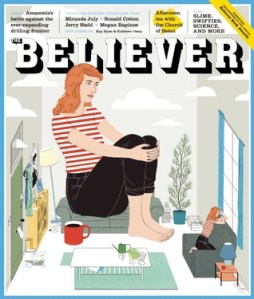
believer113The format is a little different. The table of contents is on the back cover, rather than in the first few pages. One element, the interview with Sheila Nevins (of HBO Documentary Films), is presented in pieces – “microinterviews” – spread throughout the issue. There are very few ads, and The Believer is printed on heavier, off-white paper, with nearly cardstock-weight covers. I’m sorry I don’t know the terms for these paper characteristics, but it’s got a nice feel in the hand. Oh, wait, here it is (from the website):
Each issue is perfect-bound and 128 pages, printed by friendly Canadians on recycled, acid-free, heavy-stock paper and suitable for archiving, framing in a very thick frame, or reading in the tub.

And despite the title, it’s got nothing to do with religion, or anything like that.

Also from the website, The Believer is

a bimonthly literature, arts, and culture magazine. In each issue, readers will find journalism and essays that are frequently very long, book reviews that are not necessarily timely, and interviews that are intimate, frank, and also very long.

In other words, overwhelmingly nonfictional and unafraid to go on a bit. I found the writing consistently very fine, and the widely-ranging subjects consistently fascinating. This is, in short, a magazine I want to read regularly. I am less sure that there is a place for my own writing on these pages (and if that’s self-centered, recall my original motivation in reading lit mags regularly), but that’s okay. I like finding good reading – obviously.

As to timing, I will note that the website still shows this issue, from Fall 2015, as the current issue. So I wonder a bit about their bimonthly-ness.

The highlights of issue 113, for me, included:

  • Kea Krause’s “What’s Left Behind,” about the nasty environmental disaster of a flooded copper mine on the edge of Butte, Montana. This piece made me think of Robert Michael Pyle, and hope that they know about one another.
  • Daniel Handler’s “What the Swedes Read,” a column in which he’ll read one book by each Nobel Laureate – this time, The Sovereign Sun by Odysseus Elytis, trans. by Kimon Friar. Handler’s often confused reading of these allusive poems, with frequent research digressions (“Out of my way, poem! I’m trying to understand you! Surely my loopy research was a disservice to poem and reader alike.”), really spoke to me and summed up some of my problems with poetry.
  • Ross Simonini’s interview with Miranda July finally got me really intrigued by this woman I’ve heard about here and there: now I want to check out her novel, The First Bad Man. Also, I was wowed by Simonini’s question, when July mentions that some of her early work embarrasses her: “Embarrassing because it wasn’t done well, or because it revealed something?” That is an exemplary interviewer: quick on his feet with an insightful question I wish I’d asked.

I’m excited to have discovered The Believer. I hope the missing issues of 2016 turn up, and I hope I can find the time to make this part of my regular reading.


Rating: 8 articles long enough to get lost in.

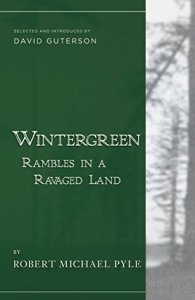
Wintergreen: Rambles in a Ravaged Land by Robert Michael Pyle

wintergreenAs I mentioned last week, I read Wintergreen in preparation for a class I am taking this very weekend from the author, Robert Michael Pyle. It was an intriguing read, and I’m looking forward to learning from the man himself.

The copy I read, borrowed from Pops, is a Pharos Edition, meaning that “one of today’s most exciting authors” hand-picked and introduced it in a reprint. Wintergreen was originally published in 1986 by Scribner; this 2015 edition is being called a 30-year anniversary, and David Guterson (The Other, Snow Falling on Cedars) brought it to Pharos.

In a word, Wintergreen is a book in defense of the ravaged land of the subtitle. That land is the Willapa Hills of southwest Washington (near where the Oregon line meets the coast), where Pyle settled after growing up in Colorado and studying in Seattle and at Yale, and some other stops along the way including Great Britain. This land is ravaged, of course, by logging; but Pyle argues that it is still beautiful, still deeply rich in natural wonders, and worth saving. Pyle is a biologist and a writer, and his style is both reverent and carefully descriptive and detailed. His tone can be occasionally irreverent and jokey; he is conversational, humble, and disarming, absolutely likable. I intend to like him, when I meet him.

In his own words,

This is the plan of the book: to describe the Willapa Hills and the wildlife they support, both native and alien; to examine the impact of intensive forestry upon the land and its life; and finally, to assay the ability of organisms (including ourselves) to survive in the aftermath of massive resource extraction. Throughout, questions of biogeography, ecology, and evolution in the wet, wintergreen world find their way into the text.

And four sections of four essays each do this work, as promised. It is kept from being overly square, in that structure, by Guterson’s intro, a Prologue, and an updated Afterword written for this 2015 edition.

I felt a great affinity for the sense of place that is so central to this work, especially because the place Pyle loves is an underdog, a humble and much-derided place. He writes,

In attending to these neglected hills I try to appreciate them for what they still are, without holding against them what they once were.

He takes his reader leisurely through what this place once was – the hugest of the huge old-growth Douglas firs et al, the ones whose stumps were repurposed as roomy homes for families – and what it is now – second-, third- and fourth-growth, and stump fields that however hold their own beauty, and remarkably biodiversity. He writes beautifully. There is undeniable poetry in the line,

The backs of old barns break and ancient boats and Studebakers deliquesce into the fundament.

Or, when introduced (and little-loved) nutria are quirkily described:

Wombatlike but generally black, they add a definite presence to an already-altered ecosystem, and they are somewhat more interesting than cows.

His audience is understood to be somewhat sympathetic to his feelings and beliefs: that the natural world deserves our protecting even while that is a rather arrogant concept; that old growth forests are special; that green is good. He takes some background knowledge for granted (first approaching the question, “what is old growth?” on page 198), but this is not much of a risk. He is right about the background his readers come to him with.

As he acknowledges in the newly-added Afterword, some of the specific details of politics, policy, and specific local conditions in the 1986 edition are a little dated now. But none are incorrect; and he brings us up to date in this Afterword. The questions I noted during my reading were well answered. Any period-specific feeling to the whole is enriching, if slightly distracting: it makes this text feel grounded in time as well as literal ground.

The pace of these 369 pages is not rushed, but indeed rambling. Patient readers, however, who love a certain level of detail and a good, rain-soaked, mature story, will be well rewarded.


Rating: 8 individually loved stumps.

The Hour of Land: A Personal Topography of America’s National Parks by Terry Tempest Williams

In this phenomenal exploration of U.S. National Parks, Terry Tempest Williams turns her smart, poetic eye to place, history, ecology, the future and how we relate to one another.

hour of land

Celebrated conservationist Terry Tempest Williams (Refuge; When Women Were Birds) commemorates the centennial of the U.S. National Park Service with The Hour of Land: A Personal Topography of America’s National Parks. In 12 chapters, she explores 12 parks, their histories and futures. Ecology forms a natural overarching theme, but Williams’s topics are variously personal, global and political. The places she visits range from Alaska to Maine to south Texas, while her subjects span still broader ground: biodiversity and water shortages; suicide and hopelessness; continuing unrest in U.S. relations with Native Americans; climate change; political prisoners from around the globe; and the legacy of the Civil War. Her writing is poetic, passionate and unexpected.

In each chapter, Williams describes a visit to a specific national park, and then investigates the place and her experience there, sometimes directly through narrative storytelling and sometimes metaphorically. She begins with Grand Teton National Park, where her family has often returned over the decades and generations. The history of that park’s founding and the establishment of the Parks system melds with her family story: “Our national parks are memory palaces where our personal histories reside.” With her father, who spent his career laying pipe for industry and development, and a park superintendent, she tours Theodore Roosevelt National Park in North Dakota. Together they birdwatch and debate the balance between fossil fuel extraction and conservation. In Acadia National Park, Williams muses that parks may be “breathing spaces for a society that increasingly holds its breath.” She finds Gettysburg National Battlefield representative of sustained resentments, pain and violence, and at Effigy Mounds National Monument, she encounters cultural heritage and controversy. To escape the pain of Gettysburg and Effigy Mounds, she heads into the desert, to Big Bend National Park.

Gates of the Arctic National Park in Alaska offers escape from a personal tragedy; Gulf Islands National Seashore, in Florida and Mississippi, reveals that the consequences of the Deepwater Horizon oil spill remain, stinking and stinging. Williams visits the exhibit by artist Ai Weiwei on Alcatraz Island in Golden Gate National Recreation Area; the recently established Cesar E. Chavez National Monument; and, of course, her home landscape of Canyonlands National Park in Utah. In Glacier National Park, where the Tempest family tries to celebrate a birthday by retracing old steps, they are instead nearly killed by in a forest fire that sweeps over the chalet where they lodge. In these travels, Williams finds beauty and distress over the future, and opines, “We continue to evolve and transform who we are in relationship to where we are.”

By turns sad, despairing, and hopeful, even thrilled in the presence of natural beauty, The Hour of Land is emotive, intelligent and well traveled. It is only right that Williams should celebrate the Park Service’s centennial with such a remarkable collection of wisdom and scintillating lines.


This review originally ran in the May 13, 2016 issue of Shelf Awareness for the Book Trade. To subscribe, click here.


Rating: 8 long views.

Notes from No Man’s Land by Eula Biss

notes from no man's landI am terribly grateful that I got to read this book with a class to help me along. That is, the same class that read Bernard Cooper’s wonderful Maps to Anywhere, about which likewise. I was once in a book club, not for very long, which I wished would go much more deeply and intellectually into very serious books. My father said back then, “it sounds like what you really want is a graduate school classroom.” I see now that he was right. This is “just” an undergraduate class, but a good one.

Notes from No Man’s Land is an essay collection that I think is most obviously about race in the United States, but it is about much more than that, too. The writer is a white woman (albeit one from a remarkably diverse family, not at all a white family), and in writing about race she takes on the voice of “the other,” always a nearly impossible thing to do sensitively, smartly and with authority, but she does it.

Like Maps to Anywhere, this is also a masterpiece of organization; we could pick apart the ordering and titling of Biss’s essays in several ways and still not be through with all she’s done here. The first and last (or next-to-last, depending on interpretation) essays are fragmented contemplations of apparently disparate subjects, that wrap this collection up intelligently. If I had to choose one word to characterize Biss, the writer, as I’ve come to know her on these pages, I would choose “smart.”

The language is poetry, too. Every word choice was considered and weighed. The connecting images are so many and complex that I can hardly begin to see how many levels this book might be read upon. Oh, and she works heavily with a sense of place: what else could I ask for? I will share a few lines, several pages apart:

I fell asleep to the distant sound of drums, which I was not always entirely sure was the distant sound of drums. Rain, blood in the body, explosions in the quarry, and frogs are all drums.

I know now that I left home and I left the drums but I didn’t leave home and I didn’t leave the drums. Sewer plates, jackhammers, subway trains, cars on the bridge, and basketballs are all drums.

And just as a sample (not to bore you), I’ll share a little of the analysis I wrote for class of Biss’s opening essay, “Time and Distance Overcome.”

I appreciated both the braided form, and all the white space.

There are three sections separated by a centered line. The longest single paragraph is about half a page long (wraps pages 5-6, about the sabotage against telephone poles that took place in Sioux Falls, SD and Oshkosh, WI). Mostly the paragraphs are just a few sentences long; five contain just one sentence each. These short, punctuated passages feel almost staccato, almost list-like. This works well for the subject matter, which begins benignly but quickly turns dark.

Biss begins with Bell’s invention of the telephone, and the reader has one expectation for the meaning of “time and distance overcome,” the title which tops this first page, where the telephone is introduced. The first section of the essay moves smoothly from telephones to telephone poles, and the resistance early telephone poles encountered. After that first break, though, the lynchings begin coming fast and thick, in short sentences that echo the choppy effect of Biss’s short, double-returned paragraphs. The first lines of this second section read:

“In 1898, in Lake Cormorant, Mississippi, a black man was hanged from a telephone pole. And in Weir City, Kansas. And in Brookhaven, Mississippi. And in Tulsa, Oklahoma, where the hanged man was riddled with bullets. In Danville, Illinois…”

This jarring delivery emphasizes the nasty jolt of the sentences’ content. Likewise, the direct leap into the new subject – no transition – increases the reader’s shock. Lynchings are shocking: this is appropriate. The short sentences and feeling of litany continues, from lynchings through race riots and from the South to the North, making clear a general rather than geographically specific trend.

The final, shortest section, at just half a page, mirrors the work of Notes from No Man’s Land as a whole. That is, it turns back around to an earlier time, Biss’s childhood, family history, and innocent view of telephone poles; there are no lynchings in this section, but there is reference: “Nothing is innocent.” Then there are the telephone poles in Nebraska that, after a heavy rain, grew small leafy branches. This image prefaces “All Apologies,” the concluding essay of the book which echoes this one in form, and concerns itself with regret, apology, the duality of responsibility/guilt, and what is owed. There is a small measure of hope in those green branches.

The most obvious thread or theme that holds this essay together is the telephone pole; the reader is prompted by the cover image. But the less obvious, more sinister themes are those that hold the book together: race relations, the complexities of varied perspectives. “The world was not waiting for the telephone.” “Even now it is an impossible idea, that we are all connected, all of us.” “But nothing, I would like to think, remains unrepentant.”

I think Biss’s opening essay shapes in miniature the work of her entire book; presages the final essay, which so nicely wraps up by recalling the opening; and uses form to emphasize subject matter. It’s an extraordinary essay in these layers of function, and I’m so glad to have her “Notes” to shed some light into her process.

I am impressed throughout with what Biss is confident enough to leave out, or point obliquely towards. I think it must take a lot of courage and self-trust (or is it trust in her reader?) to leave such subtlety on the page and not direct my gaze. “You can get it or not, all the same to me,” she seems to be saying.

This is the kind of work I very much want to study, forever.


Rating: 10 circles.

The House That Made Me: Writers Reflect on the Places and People that Defined Them edited by Grant Jarrett

Carefully curated essays take on the concept of home from varied points of view.

house made me

The House That Made Me collects essays by 19 writers reflecting on their childhood homes (or whichever home each writer has found most influential). Editor Grant Jarrett developed the idea for this anthology while contemplating his own first address via Google Earth, and he directs the contributors to that software. While the majority of essays hew close to Jarrett’s initial notion, some also riff on the concept: Roy Kesey considers those who view our homes from above, including birds, spies, angels, gods, astronauts and children climbing on roofs, as he once did.

The resulting assembly of voices offers a range of approaches and backgrounds: Kris Radish’s nostalgia for an idyllic rural community; Patricia Jabbeh Wesley’s attempts at home-building in Liberia just before civil war erupted; and the juxtaposition of Pamela Erens’s privileged upbringing on the lake in Chicago and Jeffery Renard Allen’s difficult one in that same city’s Southside. Justine Musk writes of the possibility that “a person has two homes: the place where you were born (literally, not metaphorically), and the place that fits your soul.” As she works to leave her small Canadian hometown for Los Angeles: “It’s that sense of not-belonging that can become, slowly and over time, its own kind of belonging.” While each essay is a worthy and thought-provoking piece of craft, the true achievement is in the sum of these parts, a chorus of diverse experiences that work together to define “home” in all of its possibilities.


This review originally ran in the April 22, 2016 issue of Shelf Awareness for Readers. To subscribe, click here, and you’ll receive two issues per week of book reviews and other bookish news.


Rating: 8 parachutes, for its matching my personal obsessions, these days.

Maps to Anywhere by Bernard Cooper

maps to anywhereMaps to Anywhere is a surprising, complex, lovely collection of essays. I read it for class (one of the creative nonfiction writing classes I’m taking at Western Washington University), and I wonder how I would have approached it otherwise: would I still have been quite so focused on reading like a writer, on dissecting and searching for Cooper’s process and strategies? I hope so, but I can’t say.

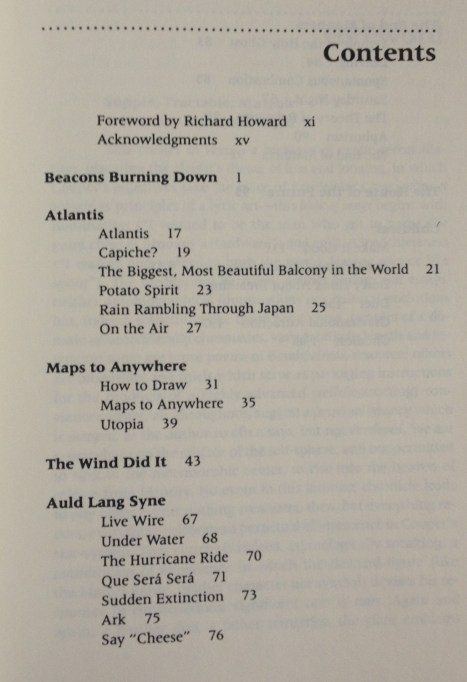
It is an impressive collection of work, and I mean ‘collection’ precisely. The essays themselves are impressive, and varied: some lyrical, including some I unequivocally call prose poems; some more narrative; some conceptual and wandering, some rooted firmly in fact, and some clearly rooted in imagination. But the method of collecting the individual essays is one of the central points of genius that caught my mind. How selected, and how arranged?

Some longer essays are their own entire section. Some sections are made up of shorter essays, and take the name of one of them.

first page of table of contents

first page of table of contents

I marveled over Cooper’s titles, and also his final lines, the way they wrap things up and the way they leave an image or a sound (or both) in the reader’s mind. He is a very aural writer: much of his work demands to be read out loud, or simply makes itself heard. I found assonance I loved, as in the line, “Can mother muster enough thrust to leave the earth in a sudden leap?” (How is this not poetry?) There were amazing concepts, intriguing stories, and a perfect evocation of an era: the U.S.’s forward-looking, plastic-happy 1950’s. In other words, so many skills: I can see why a writing class teaches this book! But again, it was the organization of the moving parts that most confounded and fascinated me. I think I understand that Cooper builds an overall movement (and a sense of movement is central to his work throughout) from a childhood self to a mature and outward-looking one. But the content of the pieces in between jump around in time; it’s far from chronological. Oh, a puzzle: I can’t entirely explain this collection to you. You should go explore it for yourself.


Rating: 9 names.

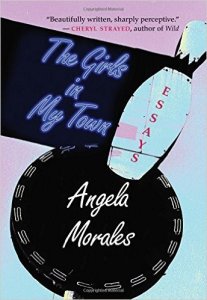
The Girls in My Town by Angela Morales

This collection of essays about a Los Angeles childhood is strongly rooted in place and universal in its themes.

girls in my town

Angela Morales’s The Girls in My Town is a collection of striking, lovely essays about her upbringing in Los Angeles. Vignettes paint a number of vivid scenes: her parents’ appliance store, and the bowling alley where she went to escape it; an elementary school where the girls demanded to be allowed to wash dishes like the boys; a room where a grandmother lay dying, as generations of children ran laps in the yard outside; the community college where Morales teaches remedial English to an ex-con with a pitiable past. These portraits, and the characterization of a larger Los Angeles, form a sense of place that enlivens and colors the collection.

Themes include family, and the changes seen over generations, as in Morales’s journey from daughter to mother, and in telling her grandparents’ stories. Recurring patterns of teen pregnancy, violence against women and girls and the fear it inspires add a tone of somber musing. A series of animal characters–the pet dogs of the author’s childhood, her own children’s pet rats, a mountain lion in the hills–bring layers to a setting both urban and wild, becoming dreamlike on her pre-dawn bike rides. Morales has a strong, lyrical voice, and her essays and anecdotes can be humorous and loving and darkly meditative as they address family, beauty and violence, loss and love. In short, this collection is as varied, charming, stark and inspiring as life itself, in Los Angeles or anywhere.


This review originally ran in the April 8, 2016 issue of Shelf Awareness for Readers. To subscribe, click here, and you’ll receive two issues per week of book reviews and other bookish news.


Rating: 8 bike rides.

Teaser Tuesdays: The Hour of Land by Terry Tempest Williams

Teaser Tuesdays is a weekly bookish meme, hosted by MizB of Should Be Reading.

Terry Tempest Williams is as wonderful as ever. As I explore her work, I keep returning to her lesser-known Pieces of White Shell as my personal preference, but The Hour of Land is a new favorite.
hour of land
In these essays, she applies her wise, poetic eye to place, history, ecology, the future, and how we relate to one another, resulting of course in phenomenal writing. Naturally I turn to her chapter on Big Bend for today’s teaser, a single line I loved.

Ocotillo is a green withheld in winter.

Keep your eyes open for this treasure to come in June.


This quotation comes from an uncorrected advance proof and is subject to change.

shorter prose: essays, etc.

I took myself away recently for a solo writer’s retreat to a cabin in the woods, on a lake, in the mountains. No phone or internet. Husband dropped me off with the two little dogs and the gear I’d need for two nights. Forty-five minutes after he left the cabin lost power, which put a damper on my reading & writing abilities; but it came back on at 1:37am. I know, because I had left all the lights switched on.

I took lots of work with me. One book completed that needed a review; the second, completed in those first minutes without power, needed a review. The next one, of which I read the half by candlelight that first night, which needed a review and prep for an author interview; four more books in reserve. Seventeen essays, 5 book excerpts, 2 lectures, 2 short stories, 1 piece of longform journalism, and 7 poems. Twenty classmates’ responses to an essay I’d submitted for workshop, representing a range of ideas for expansion and revision. One class assignment, and a broad and vast mandate to create more new work. My only other goals were to feed myself and the dogs, and take us all to go to the bathroom as necessary. I would not get through it all, of course. I had brought so much so that I could pick and choose, and not get bored. On day two, I resisted the urge to go back to the candlelit book of that first night, in favor of all those essays and other writings.

And so here we are. I will not subject you to my reviews of 17 essays, 5 book excerpts, 2 lectures, 2 short stories, 1 piece of longform journalism, and 7 poems; frankly (for this purpose, happily) they were not all worth it. There were some special ones, though. Rebecca Lee’s “The Banks of the Vistula” was shocking, invigorating, and persistent: after several days, I can’t stop thinking about it. Simultaneously, it was beautiful, and it bothers me.

The excerpt from Virginia Holman’s Rescuing Patty Hearst was likewise tantalizing, especially since my copy, for whatever reason, ends mid-sentence: that will bear further review.

Jonathan Swift’s “A Modest Proposal,” which I remember reading – can it have been in middle school? – but don’t much remember, was as wonderful as I suspected, filled to brimming, every line, with humor and of course stinging satire. Montaigne was too densely written; I’m not up for this. Robert Louis Stevenson, rendered here as Robert Lewis Stevenson (and what’s up with that?) is reliable: “An Apology for Idlers” was good and “On the Enjoyment of Unpleasant Places” was outstanding. RLS has this to offer my retreat weekend: “There is no country without some amenity–let [her] only look for it in the right spirit, and [she] will surely find.”

Flannery O’Connor’s “A Good Man Is Hard to Find” was… what? disturbing? I will need some help with this one. Brenda Miller’s “36 Holes” is beautiful, a very different sort of form and one that appeals to me: meditative, wandering, but cohesive; I will reread this. As a fan of the semicolon and general geek, I very much appreciated learning more from Paul Collins in “Has Modern Life Killed the Semicolon?“, which yields such quotations as this one from the Times of London:

The semicolon is the enemy of action; it is the agent of reflection and meditation.

(That must be why I like it so much.) And,

The semicolon allows woozy clauses to lean on each other like drunks for support.

which is less an argument for support, but a great sentence.

One of the best things* I read over the weekend was “Some Holy Ghost,” by David K. Wheeler. Full disclosure: I work with Dave; he’s my editor at Shelf Awareness. But the essay was objectively wonderful, I insist. I love everything about this piece: the structure, wherein he walks around the Art Institute of Chicago meditating on large questions while looking at paintings with specific bearing on those questions; the perfection of his phrases (Dave is also, perhaps foremost, a poet); and the themes and the job he does with them. This is an essay about religion, a subject that usually makes me twitchy, but his thoughts are accessible and revelatory.

The longform journalism is The Bones of Marianna, by David Kushner. It tells the story of a reform school in Florida, the mysteries and pain surrounding its history, and the efforts of citizens and forensic archaeologists to uncover the past. This is a riveting story, and it’s beautifully presented at the link above. Kushner’s telling is more straightforwardly journalistic than creative; I miss the voice I came to know in Alligator Candy (review to come), but this is a good read – just different.

I did not get around to the poems, so those will wait for another day.


*It will be the subject of another post on another day, but I’ll just say here that I can’t stop raving about Lily and the Octopus, a debut novel by Steven Rowley which blew me away. (This is the one begun by candlelit, and finished the second night.) It’s a startling, original piece of work and I highly recommend it.