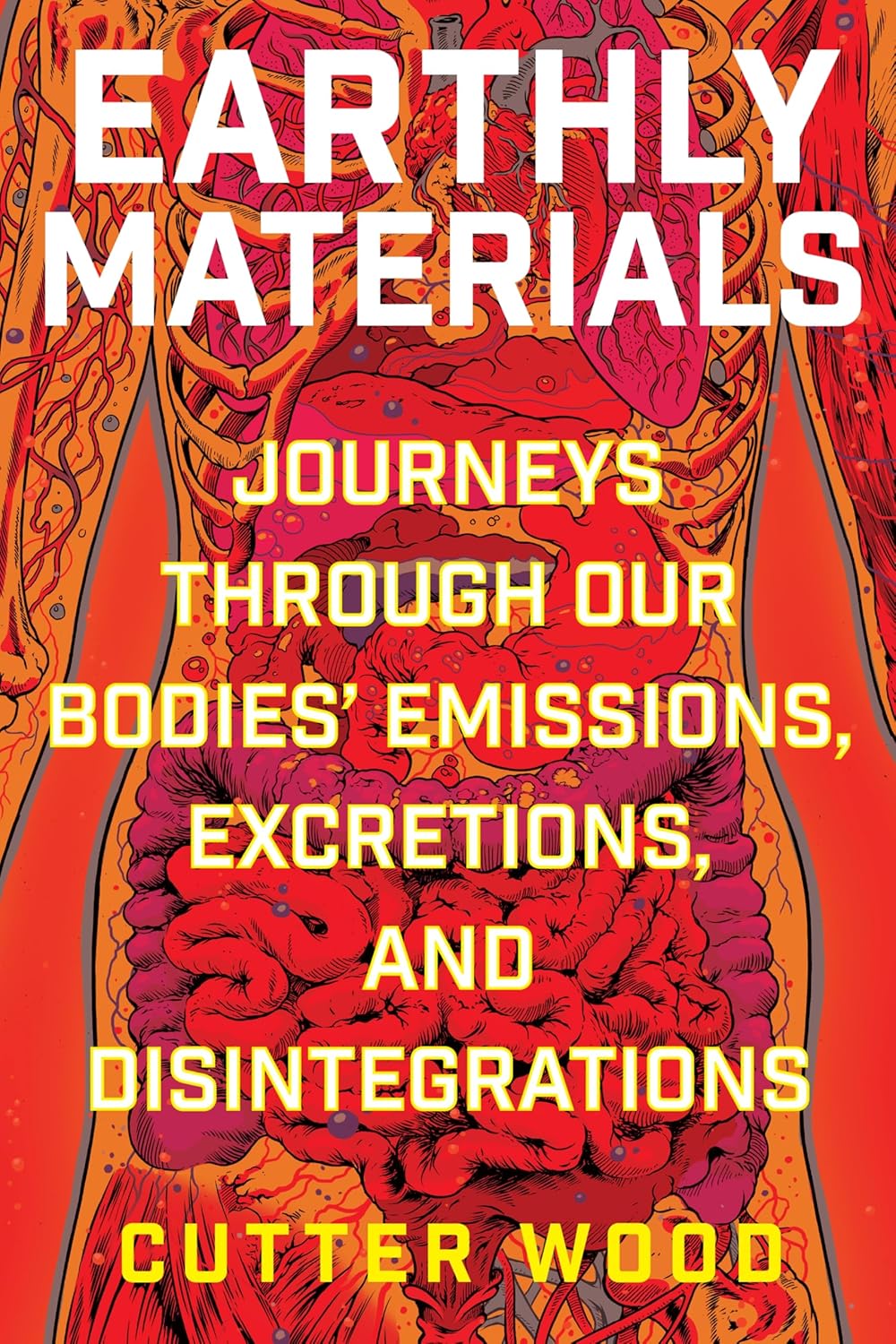
Earthly Materials: Journeys Through Our Bodies’ Emissions, Excretions, and Disintegrations by Cutter Wood

This weird, wonderful exploration considers the social, cultural, and political implications of bodily emissions as well as their science, but shines brightest in its empathetic storytelling.

Cutter Wood (Love and Death in the Sunshine State) offers a spellbinding collection of facts, observations, and musings in Earthly Materials: Journeys Through Our Bodies’ Emissions, Excretions, and Disintegrations. In 12 chapters that might be termed “essays” and Wood calls “stories,” he considers mucus, urine, blood, semen, menses, milk, flatulence, breath, feces, vomit, hair, and tears. While readers will certainly gain new and fascinating scientific knowledge, what makes Earthly Materials so special is storytelling: Wood’s compassionate, funny, earnest explorations through unexpected subject matters adjacent to bodily fluids.

At a lab at the Massachusetts Institute of Technology, he meets impassioned graduate students and views beautiful stellar-like magnifications of mucus, which resemble Hubble Telescope photographs. He discusses the political and financial implications of donating blood and delves into the discomfiting r/NoFap Reddit forum. In the absorbing true-crime case of Formula Mom, a Florida woman is investigated and sentenced to prison for creating a large-scale business that bought and sold infant formula.

Tongue-in-cheek, Wood describes the flatulence customs and practices of the preadolescent male in the Commonwealth of Pennsylvania. To explore vomit, he joins the Soul Quest Ayahuasca Church of Mother Earth and takes its sacrament. These experiences and studies often yield hilarity in Wood’s expert prose: dryly witty, comically verbose, and poignant. Wood finishes with the inexplicable tears of a Wimbledon finalist, in this thought-provoking philosophical study that exemplifies human interconnectedness through the rather surprising lens of bodily fluids and expulsions. Earthly Materials will change the way readers think about the mundane in unanticipated and transcendent ways.


This review originally ran in the May 2, 2025 issue of Shelf Awareness for Readers. To subscribe, click here, and you’ll receive two issues per week of book reviews and other bookish news.


Rating: 7 stills in the brambly Appalachian holler.

rerun: The Wet Engine: Exploring the Mad Wild Miracle of the Heart by Brian Doyle

I was going to tell you that I’ve been thinking about Brian Doyle lately, but I think that’s always so.

I do think about this essay collection a lot.

Please enjoy this review originally from late 2020 (book published in 2005).

I am back again with another Doyle, different this time but totally recognizably him.

Here are the classic Doyle elements of celebration and beauty, but amid so much pain and loss… and I have to admit, the loss of Doyle himself felt very present for me here. I continue to feel it as a significant loss to this world, both because we will get no more of his transcendent writing, and because he just seems to be the most beautiful, loving, joyful, talented person, and we don’t have enough of those; it still hurts me that we’ve lost him. And that was right under the surface of all of these essays for me, in a way that was less true of Chicago, because that book was fiction rather than nonfiction, and also because it is not quite so explicitly about life and death in the way that The Wet Engine is, so the pain was closer to the surface for me, if that tracks.

The wet engine is the heart, often but not always the human heart, and the reason Doyle focuses here is that one heart that is important to him is in danger. His son Liam (age nine at the time of writing) was born with three chambers in his heart rather than four. He had to have several open-heart surgeries when he was an infant, and so his father learned about how hearts work and he got to know some cardiologists and surgeons. And because this father was Brian Doyle, he also did some meditating on the metaphoric meanings of heart, on all the language we use (heartbreak, heartsick, hearts swelling and leaping and failing, hearts held in hands and worn on sleeves), and on mysticism and miracle and mystery and magic. He also does research: Liam’s doctor, Dr. Dave, is profiled in considerable detail, as is Dr. Dave’s wife, Linda, and his mother, Hope. (It is through Hope that we find ourselves in an internment camp – really, a concentration camp – for Japanese Americans during World War II, in Topaz, Utah. Hope was interned there as a teenager with her family for nearly three years; she graduated from high school there. “No, I am not bitter, she says. No. Bitter is no place to be. But I do not forget.”) Shorter profiles explore other doctors and pioneers in medicine and cardiology from around the world, from the early days of the science through the present (like Dr. Dave’s colleague Hagop Hovaguimian, who can never stop working because too many people need his help). The people who people this book come not only from throughout history but from all over the world, which is frequently fun and which reinforces the feeling of enormous scope that Doyle achieves. “The doctor to my left is from Australia. He speaks Australian, a smiling sunny language which takes me a minute to get the pace and rhythm of, but then we get along swell…”

The Wet Engine is a collection of linked essays that explore these and other topics: the humans involved with hearts and their stories; the nature and power of stories; the language and metaphor and soul of the heart, and its place in our mythologies; the science of the hearts of humans and other species; Liam’s own life story, and Doyle’s navigation of it as Liam’s father. Everywhere of course is Doyle’s distinctive voice and style, made up of long lists and emotional appeals and exuberance and vulnerability. There is also God here, and my regular readers know I don’t spend a lot of time reading about God, but Doyle can get away with anything: the tone of reverence is entirely appropriate here, and his explorations (“God is not a person. God is not an idea. God is the engine. God is the beat. We are distracted by the word God…”) I can easily follow. (Also I am reminded of Amy Leach.) And I appreciate that Doyle doesn’t choose just one religious or spiritual angle of approach, but that he’s interested in holiness in a multitude of traditions.

I think what I love most about this book is that it feels like it includes all the disciplines of study. There is theology, and hard science – medicine, zoology, even botany – history, social justice, the arts – music, and his own literary genius, including some superlative descriptive work and expressions of gratitude and pain. I’m pretty interested in interdisciplinarity these days, and I’m assigning my students readings that do this work, including a short passage from The Wet Engine. (Synchronicity: I’d just given them a Joseph Mitchell essay called “Goodbye, Shirley Temple,” and then read that Hope was interned at that camp with Shirley Temple’s gardener. What?? The world is a mystery.) And all of this in Doyle’s own wild style.

I cried a lot, but it’s such a beautiful, instructive book. At scarcely over 100 pages, it is one that would bear lots of study. Again I rave.


Special recognition to Matt Ferrence for making me aware of this book a few years ago, when he assigned “Joyas Volardores,” the sixth essay, for an MFA residency. That one still stands out. Thanks, Matt.


Rating: 9 knobby knees.

Personal Stereo by Rebecca Tuhus-Dubrow

The humble Walkman: “a machine for daydreaming.”

Another solid entry in the Object Lessons series. I enjoyed the examination of technology in culture, and the question of what makes something alarming, hot, obsolete, and cool again.

Rebecca Tuhus-Dubrow organizes Personal Stereo into three sections or chapters: ‘Novelty,’ ‘Norm,’ ‘Nostalgia.’ In the first, we learn about the origin of the Walkman (a term she mostly uses throughout, to mean most iterations of the thing, as Kleenex, Tupperware and Xerox stand in for off-brand versions) in postwar Japan. This means learning a bit about the origins of Sony, where various stories circulate about the Walkman’s genesis (one of Sony’s main characters apparently let it be known that he “quietly encouraged the proliferation” of these various accounts, which add to the product’s mystique). Meanwhile, a German-Brazilian claims at least parallel invention of the same concept, and he was eventually given a settlement from Sony. Complicating the legal issue is the question of whether the personal stereo constituted an invention at all, since it involved more simplification and miniaturization of preexisting technologies – removal of the recording element of a ‘tape recorder’ being key to the Walkman. The simplification bit will be relevant later in Tuhus-Dubrow’s study.

And then there was the Walkman, and the world was enraptured, in love, and enraged. What was very new was having music* personally delivered, right up against one’s earparts, according to one’s choice, in stereo, with what counted at the time as great, hifi quality. Users described the experience as dreamy, druglike. Critics did not like seeing people check out in public. There was the secrecy: what is she listening to? There was the rudeness: put on headphones and you telegraph that you don’t want to be approached! There were safety concerns: headphones were banned in some places while driving or crossing the street. And there was the larger question of social norms, of values, of the meaning of public space. Tuhus-Dubrow compares and contrasts the Walkman to the boombox (more public, loud, annoying, but also more obviously about sharing rather than checking out) and the cassette tape to the record, the CD, and the MP3. And then there is the Walkman vs. the iPod and then the smartphone, where the naysayers’ complaints about the Walkman become tenfold threats. Considering unitasker technologies against the modern smartphone: “A clock (or a record player or a Walkman) is like a charming pastry shop or produce stand, a clothing boutique or Parisian boulangerie. A smartphone is like Walmart.”

[*It wasn’t just music: consumers used their Walkmans as well for audiobooks and transcripts, exercise tapes and work, as Tuhus-Dubrow points out. But music was a big part of the impetus and the main use we all remember and think of, isn’t it?]

In ‘Nostalgia,’ Tuhus-Dubrow considers that word’s origins and the concept, then questions: why this item? (Confession: this reader had not realized there was quite so much modern excitement about the Walkman. I guess I knew the cassette tape was having a moment? For the curious, this book was published in 2017.) What confers value on a thing from the past? Partly, its associations with happy memories or better times; but that works best for those of us who experienced, and appreciated, the thing. There is much to the concept of simplification, that value of the unitasker. As much as the Walkman gave its users a sudden increase in choice, in control – whatever tape I want, wherever I go! – the iPod and then the smartphone have increased that to near infinity, and it turns out that we don’t actually want all the choices at any given moment. Also, one of those obvious-now-that-you-mention-it observations: “Technological nostalgia depends on obsolescence.” Sort of a supply/demand issue.

When the Object Lessons series gets it right, I find these little books so very satisfying. They are short enough (generally around 100 pages, or a little over) to read in a day (as I did). They offer a moderately deep dive into a thing I maybe hadn’t thought very hard about before. In the hands of the right author, even the mundane objects of the world – and this is very much the point of this series – offer opportunities to explore, study, and contemplate surprisingly diverse and often philosophical questions. Personal Stereo was a most worthwhile venture for this reader.


Rating: 7 mix tapes.

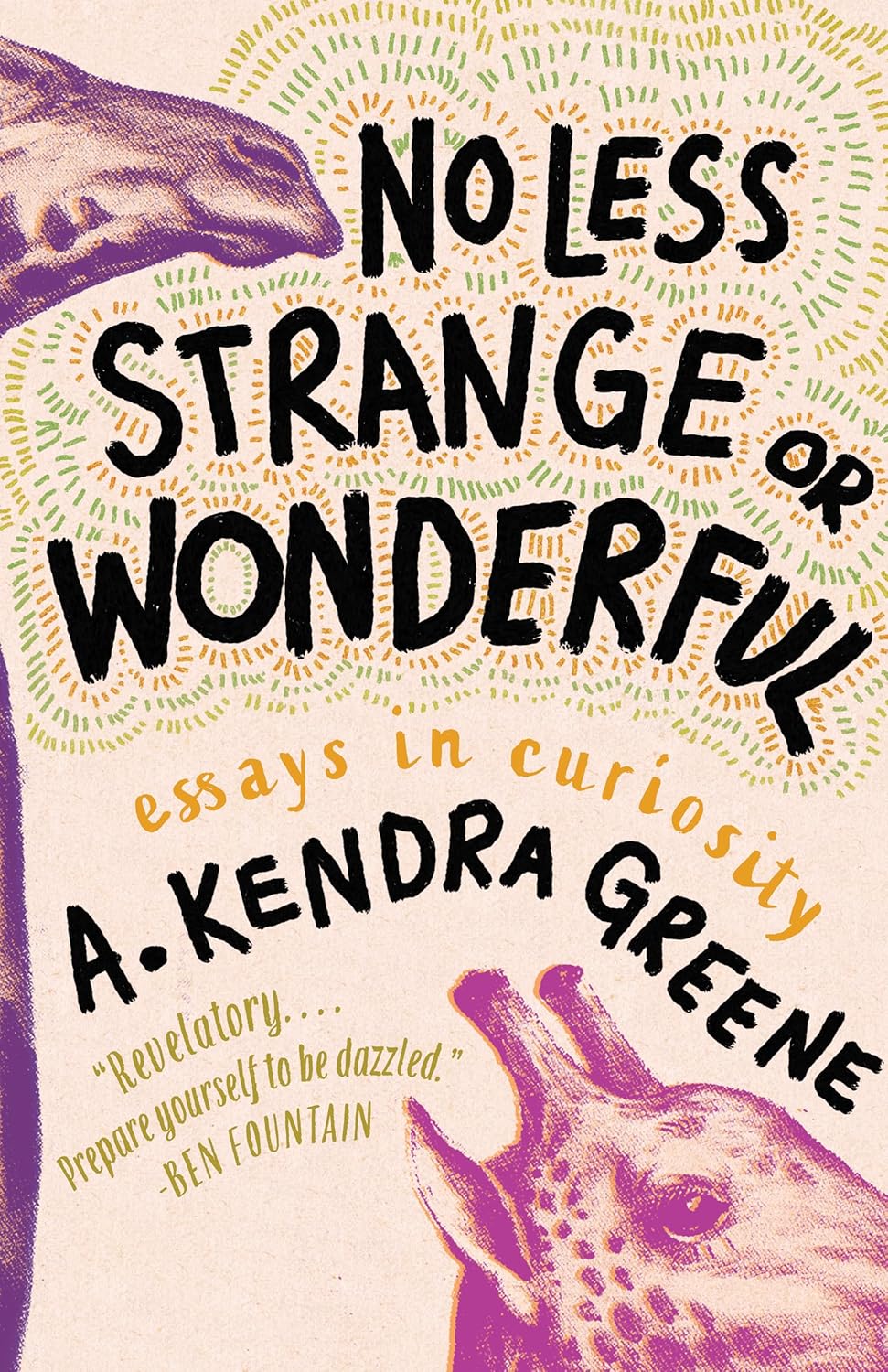
No Less Strange or Wonderful: Essays in Curiosity by A. Kendra Greene

Astonishingly imaginative, wise, and weird, the essays in this illustrated collection–featuring natural phenomena, children, death, and costuming–have the power to reshape the way one sees the world.


A. Kendra Greene (The Museum of Whales You Will Never See) offers a magical, mind-expanding selection of observations in No Less Strange or Wonderful: Essays in Curiosity. Greene employs a delightful, often childlike wonder in this collection about discovery–where she interacts with others, where humans interact with the rest of the world, and what might be made of all of it. Greene’s perspective is fresh and inventive, open to all possibilities, and the results are surprising and wondrous.

Greene’s essays vary in length and take place around the world. “Wild Chilean Baby Pears” considers a crime: in 1979, a museum visitor stole a specimen of the extinct ivory-billed woodpecker from the University of Iowa Museum of Natural History. Greene, who has been a museum visitor as well as a museum worker and a teacher, explores this act from several angles; unexpectedly, she empathizes deeply with the thief she calls “Visitor X.” “Until It Pops” details a dress made for the author out of balloons, and her experience of traveling to Chicago for Twist and Shout (the annual balloon twisters’ convention).

Brief and spellbinding, “The Two Times You Meet the Devil” describes encounters on a country road in Argentina and in a bookstore of unnamed location, respectively. “The more I think about it, the more I wonder how many times we have met, crossed paths at least, exchanged a look, and the devil has said nothing.” “The Sorcerer Has Gone to Italy” is about death, as well as rocks, valleys, turf houses, forgetting, stick-shift cars, whales, kayaks, summer staff, television, and metaphor. “People Lie to Giraffe” is about real giraffes (one in particular) as well as the likeness of a giraffe suggested by a photo of the author’s long arm and pinched fingers. It explores everything encompassed in a child’s imagination, how to make the world, and what it means to tell the truth or tell a story.

Greene is always present, participating in the action and dialogue, postulating philosophies and understandings. Greene is an artist in several media (book arts, photography, illustration), and a teacher as well as a writer; this collection is illuminated by her own illustrations and images. The scope of her essays (26 in total) is mesmerizing, her language glittering, and her ideas exuberant and profound. She says it best herself: “It is a thing the essay loves: to tend, carefully, painstakingly, to the fact of the world.” As for what we communicate with art: “everything resonant and whole and shining, all at once, perfect, every bell ringing, yes.” Yes.


This review originally ran in the January 27, 2025 issue of Shelf Awareness for the Book Trade. To subscribe, click here.


Rating: 9 sprays of bougainvillea.

The Salt of the Universe: Praise, Songs, and Improvisations by Amy Leach

Playful, celebratory, wise, impertinent, Amy Leach turns her lyricism and wit on a fundamentalist upbringing and the wealth of experiences beyond.

Amy Leach’s third book, The Salt of the Universe: Praise, Songs, and Improvisations, upholds the singular spirit of Things That Are and The Everybody Ensemble with a deepening of personal and spiritual subject matter. Whimsical, frank, funny, shrewd, and ever unpredictable, Leach’s phrasing and concepts continue to surprise, delight, and edify.

Where her previous works explored the world with curiosity, awe, an endearing silliness, and joy, The Salt of the Universe picks up with a new focus on Leach’s upbringing and the Seventh-Day Adventist Church in which she was raised. “Now, in this book, I will let my soul speak for itself… I figure I’ve heard about five thousand sermons in my life, and now… I have something to say too.” What she has to say will be familiar in tone to her established readers, but fresh in its more personal angle.

Leach remains the master of the list, especially lists of the unexpected. Look out for how Walmart has taught her to find items she was not searching for, including “inflatable bathtub neck pillows and tropical Popsicles and Guinness Baltimore Blonde and misty-scented candles and Minions whistles.” Her subjects include not only gods but music and poetry; babies generally and her own two children in particular; snake grass and daffodils; brown dwarf stars and muons; an “interior Texas” and an outdoor heart and everything in between; the wide, wide world, both the small and the large; and the wonder and wondrousness of all forms of art, life, and love. In examining her relationship with Adventism and religion in general, Leach can be drolly tongue-in-cheek, and though earnest, never unfun.

This is a serious investigation into how to live, while coming from a religion that outlaws pickles and dancing. “We know not to read Shakespeare, or Boethius, but what are we to think of Snoop Dogg or Chubby Checker?… It is so hard to be stranded in the twenty-first century with only God as our guide.” Leach has split from Adventism, rejecting the prohibitions on spicy foods, literature, and, yes, pickles (though she still refrains from eating meat), but retains her sense of marvel and reverence at the vast and varied world–the tubax, dancing robots, sloths, Edith Wharton, Bob Dylan. “The apocalypse can’t be had for the hankering but the concerto sometimes can.” She does not profess to prescribe, but will still inspire. Sincerely inquisitive and wildly, fancifully imaginative, Leach’s perspective is a gift. The Salt of the Universe may be life-changing, even life-saving.


This review originally ran in the June 7, 2024 issue of Shelf Awareness for the Book Trade. To subscribe, click here.


Rating: 9 unsuitable subordinates.

Summer Solstice by Nina MacLaughlin

Summer is the saturated season. The color floods back in. Each dip is another shot at being reborn, into summer where the world’s blood runs green.

For the summer solstice last night, I had my usual, traditional backyard fire. The traditions – my traditions – are accumulating: this time I had friends and food and drink around the fire as well. And I had a chapter from The Wheel of the Year to read (review forthcoming; it is wonderful), and I had a Nina MacLaughlin essay-book.

Six months ago I read her Winter Solstice, and now the summer one. It is the loveliest kind of homework to wake up and see what timely read I have for the day.

This little book barely clears 50 pages for the essay portion itself: perfectly sized for a same-day read, which is what I did. Now, this means I missed the advice to get up and wash one’s face in the solstice dew at dawn (also admittedly the summer solstice dawn is quite early for me). It is basically a lengthy meditation on summer and its resonances, for MacLaughlin and beyond; she has a number of works cited, mostly other works of literature (poetry, music) to which she refers, as jumping-off points for further musing. This won’t feel like ‘research’ so much in the traditional and dry-sounding way you might be thinking (although it *does* count as research!); more of a mining of other minds and cultural markers for how we think about summer, and midsummer or the solstice in particular. She does begin in early June, building into summer that way. MacLaughlin’s summer involves much swimming and waters, as well as fire, and sweat and sun and shade and fireflies (or lightning bugs) and a few other things we may hold, culturally, in common around here (several mentions are made of hot dogs). At least compared to my memory of Winter Solstice, I think there was less study of other cultural and historical handlings of the event. That could be my memory. Or it could be that Summer predated Winter by several years (ha) and the concept developed a bit in that time. This one does still offer an addendum of “Plant Matter,” featuring a few prominent plants and herbs associated with the summer solstice. I like that part.

I was not entirely surprised, in the Afterword, at MacLaughlin’s confession that she prefers winter. Again, perhaps it was just (or partly) the few years between books, but Winter Solstice felt fuller and richer to me. (Or maybe it was the hot mulled wine that accompanied that one, for this reader.) I am a summer person, myself, but her work on winter enriched that time for me considerably. There is still, here, the sensuality that I appreciated so much.

I would eat up more like this. I wonder if MacLaughlin would do the equinoxes, and maybe samhain and lúnasa and more…


Winter Solstice by Nina MacLaughlin

The solstices are for fire. Summer flames say Keep the light alive (it’s never worked, not once). In winter, a more urgent message: Bring light back to life (it’s worked every time so far).

I was overjoyed to find out about this book in time to get it for the winter solstice last week. I really enjoyed Nina MacLaughlin’s Hammer Head: The Making of a Carpenter some years ago, and I was pleased to have such an event planned for my day: this little book, a batch of hot mulled wine, and my usual solstice/equinox tradition of a backyard fire. At just 80 pages, Winter Solstice is well designed to be read on the single day in question. I am choosing to share many of MacLaughlin’s lovely words here, so my review winds up practically as long as her book (not really…).

It’s an essay in four parts, each longer than the last, plus an afterword, plus an addendum. “Inhale the Darkness” begins: “Two boys strung the lights on houses in Ohio.” It’s a detailed description of that weekend job, the installation of light against darkness. “It’s an old impulse. To honor the dark with festivals of light, to battle it with same.”

Henri Bosco describes this almost-winter moment of the year, “when the world was poised on a pure ridge,” balanced between two seasons, casting “a glance back at the aging autumn, still misty with its wild moods, to contemplate deadly winter from afar.” The misty mood is behind us. We’re looking now at something dark and wilder.

Next, “The Shadows Below the Shadows” surveys traditions across time, Persephone and Demeter, Krampus, Saturnalia, the Eleusinian Mysteries, and Newgrange. It ends: “Pomegranate, holly branch, birch switch, mistletoe. We’ll leaf with life and pass below the secret places of this earth.” I love the way MacLaughlin integrates stories, legends, traditions, and the connections to nature, the plant life they are all in relationship with.

The Eleusinian Mysteries

were meant to elevate people above the human sphere. They were meant to launch them divinewards. As Cicero says: “In very truth we have learned from [the Mysteries] the beginnings of life, and have gained the power not only to live happily, but also to die with better hope.”

“In Winter We Get Inside Each Other” is about the danger and elemental fear of cold and darkness, and how we deal with those feelings. Describing sledding down a hill on the grounds of an institution for the criminally insane:

…it never felt crazy to cry out, there by yourself, going faster and faster, in your own private moment of fear and glee. Is that what made the lunatics yell inside their cells? Some same combination of soaring down a mountainside unstoppable? I’m happy, I’m afraid, I feel too much, I have to let it out. A cracking open in the descent.

Also sex, sensuality, connection. From a Mary Ruefle poem: “When it snows like this I feel the whole world has joined me in isolation and silence.” (You will have noticed that MacLaughlin makes reference to many others’ wise words.)

“Burn Something Today,” part four of this longform essay, brought me great pleasure as my fire was well underway and I was cozy and warm right up against it, just three or four feet from the remnant snow off to my left, and the page lit up by my headlamp.

Depending on where one lived, the ashes of the solstice fire were then spread on fields over the following days to up the yield of next season’s crops, or fed to cattle to fatten them and boost fertility in the herd, or placed under beds to protect against thunder and lightning, or sometimes worn in a vial around the neck. The lights we string on bushes, that glow on the trees in the center of town–something of these ancient fires lives in them, too. The ancient cults cast shadows in our minds, shift and flicker, their fears are still our fears, down in the darkest places of ourselves.

MacLaughlin’s afterword is “The Timing of the Light,” in which she as a child watched for an approaching car before switching on the electric ‘candle’ in a window, so as to offer hope, light, a bright moment for passersby. “I did not know about conference calls in middle school, but sensed adulthood could be possessed of certain drear.”

The addendum is “Plant Matter,” with a few entries for the plants most important to the winter solstice: holly, blessed thistle, mistletoe, cinnamon, yew, oak. (Others named but not featured: cedar, clove, rosemary, nutmeg, birch, pine, chamomile, juniper, frankincense, and wintergreen. A few of these went into my mulled wine. I considered a chamomile tea before bed but had a beer instead, a kettle sour with cranberry, rosemary, orange peel, salt, and coriander.) In the addendum’s final entry, Oak, which closes the book:

…an end here does not mean the end. The original fire lives in all fire. On the stove and in the hearth, in the bonfire on the beach, surrounded by stones in the woods by a river, in the explosion after the crash, between your ribs and behind your eyes, on the struck tip of the match, on the burning surface of the stars, the source of our fire, and us all. The fire goes out and lives on.

I can’t imagine a better way to observe the changing tide of light and dark. Thank you, Nina.


Rating: 9 timely moments.

“How Long ’til Black Future Month?” (essay) by N.K. Jemisin

After reviewing the story collection on Friday, I felt the need to go find the essay which gave the collection its name. I’ve decided to just repost it here for your pleasure rather than muddying it with my own words. I think it’s important. Please take the time to visit Jemisin’s site for…


Citizen: An American Lyric by Claudia Rankine

Claudia Rankine’s voice is as powerful as you’ve heard, and Citizen is many things, in ways that can be challenging but also make it a rewarding meditation. A slim book, it rewards slower-paced reading, because there’s a lot to think about (and look at). I think I had envisioned a book of poetry in more traditional fashion, which would be challenging for me (because I find poetry difficult; I think I look too hard for literal readings). What I found was a little more form-bending, which mostly made it a little easier to take in. Lyric essays intersperse with poetry, and there are a handful of images of visual art as well, and references to other media, including YouTube videos and Rankine’s own “situation videos.” Predictably, I follow along better in the prose-ier sections than the poetry-leaning ones, and the former come first in the book, which I think made the transition a little harder. This is a problem on my end (when will I get over my fear of poems?). I sort of wish for a reading guide, although that runs the risk of prescriptivism.

Citizen is about race, or about race in America, or about what it is like to be Black in America. It relates macro- and microaggressions so that they build up: does the reader feel shocked? weary? angry? reading them? Well, maybe that’s the point. The small, everyday experiences have cumulative effect. The narrator spends a chapter (essay?) describing what it is to sigh incessantly, and be shushed in her sighs. She spends time observing Serena Williams: her play, the aggressions she experiences, when she does and does not react with outrage, and how the world reacts to her reactions. There is a chapter of scripts for Rankine’s situation videos, about which she says on her website: “It is our feeling that both devastating images and racist statements need management.” (I couldn’t figure out how to watch the actual videos on her website, although some are on YouTube.) There is a list of names of Black men and women killed by police; it fades out into gray text because the list is too long. The visual images that come in between the text sections might be said to offer a break, but it’s more like a different way of looking.

On the cover image, I most like these words from The New Yorker‘s review: “The book’s cover, an image of a black hood suspended in white space, seems to be a direct reference to Trayvon Martin’s death, but the image is of a work from 1993, two years after Rodney King was beaten senseless by members of the L.A.P.D. It’s called ‘In the Hood,’ and it suggests that racism passes freely among homonyms: the white imagination readily turns hoods into hoods. The image also makes you think of the hoods in fairy tales and illustrated books, part of the regalia of childhood. But its white backdrop recalls the haunting quotation from Zora Neale Hurston that keeps cropping up in Citizen: ‘I feel most colored when I am thrown against a sharp white background.’ The hood becomes an executioner’s headdress, too.”

In the end after finishing the book and trying to review, I find my impression is more of poetry than of prose, because there’s an overall feeling even between the moments where I was frustrated because I couldn’t always parse the literal meaning. (Maybe Vince will show up to explain it to me.) Not for the first time, the poet is smarter than I am. But it was a hell of an experience, and I’d read more. Her reputation is deserved.


Rating: 7 lessons.

Curing Season: Artifacts by Kristine Langley Mahler

These experimental essays about place, home and the failed effort to belong are closely tied to Eastern North Carolina, but will resonate everywhere.

Kristine Langley Mahler’s Curing Season: Artifacts is an essay collection selected for West Virginia University Press’s In Place series, which features strongly place-based literary nonfiction. In these often experimental essays, Mahler considers a brief but powerful part of her youth spent in eastern North Carolina: four years of preadolescence in which the young Mahler struggled with feeling that she didn’t belong. While this is arguably a universal preadolescent experience, Mahler’s story is indelibly linked to the community in which she lived, made and lost friends and attended school.

In Pitt County, N.C., the author encounters matters of race and class for the first time. The profitable sale of her family’s home in Oregon has enabled them to enter a prosperous suburb where her neighbors attend cotillion. White children, like Mahler, who go to public school are bussed into a majority-Black part of town as part of 1990s desegregation efforts. Her neighbors’ families seem to all rely on generational relationships to the place. She feels her outsider status at every turn. Also characterizing Mahler’s experience are difficult preadolescent friendships, including the “mean girl” type, and one relationship in particular: Mahler’s best friend Annie, long estranged and eventually deceased. By the end of Curing Season, the troubled, dead friend haunts the author as much as the place does.

While some essays use relatively straightforward narrative storytelling, others are fragmented, rely on images or borrow forms from other works. There are list essays and hermit crab essays based on dictionary entries and proposals for project fundings; Mahler explores astrology, references Joan Didion’s famous rational detachment and borrows lines from Margaret Atwood’s Cat’s Eye and the local history Chronicles of Pitt County. “I grafted my history onto theirs; I twisted the lessons until I could wring out similarities between my past and theirs; I removed and imprinted my history on top of theirs until I could not tell the difference between their truth and mine.” In blending Mahler’s experiences with those of Pitt County, she digs into the very nature of truth and memory. The author of these formally inventive essays is forever circling both the specific place and the experience of feeling disconnected and othered. “I have returned a hundred times; I have never come home.” She remains preoccupied, even obsessed, decades after leaving, still trying to belong or gain a greater understanding of what didn’t work.

The title Curing Season: Artifacts refers to the tobacco-curing season in Pitt County and to both literal and figurative acts of excavation. Mahler’s investigative ponderings on belonging, displacement and a sense of home are both specific to place and universally familiar.


This review originally ran in the August 12, 2022 issue of Shelf Awareness for the Book Trade. To subscribe, click here.


Rating: 6 stolen pins.