book beginnings on Friday: Edward Abbey: A Life by James M. Cahalan

Thanks to Katy at A Few More Pages for hosting this meme. To participate, share the first line or two of the book you are currently reading and, if you feel so moved, let us know what your first impressions were based on that first line.

Today we’re taking a look at a biography of Edward Abbey.


The more Abbey I read, and love, the more I want to know about the man. Do you do this? My interest in an author of nonfiction invariably turns to the author himself (or herself). I’ve been looking for a few Abbey books, in this case. This was the biography I chose. I also have a copy on the way of Doug Peacock’s Walking It Off. Peacock was the inspiration for Abbey’s fictional character Hayduke, of The Monkey Wrench Gang, and his book is a reminiscence of their relationship. But that’s another post.

Cahalan’s biography of Abbey begins, in the introduction:

This is a book in which I seek to separate fact from fiction and reality from myth. At the outset, I have to tell readers that Edward Abbey was not born in Home, Pennsylvania; he resided in several other places before his family moved close to Home. And he never lived in Oracle, Arizona.

Already I’m learning things. I had already observed, as Cahalan continues, that Abbey claims a birth in Home and a late life and death in or near Oracle. These place-names are nicely symbolic, which has to have appealed to him, and his PO Box in Oracle helped to deflect some of the fans who pursued Abbey in his later years and who he (understandably, I think) wished to avoid. But who knew he fudged the truth so hard, and so early on, and in such relatively unimportant details? (There will be another post here soon about the friction between fact and nonfiction writings.)

I’m really excited about this biography, as I’m excited about Abbey in general and also debunking biographies in general. And I love that in the short introduction, Cahalan mentions Hemingway, riding bicycles, and the ill-fated trip through Big Bend with his then-fiance that Abbey writes about in The Journey Home – three things I love. πŸ™‚

What are you reading this week? And are you excited?

two-wheeled thoughts: Edward Abbey on bicycles, or anything non-motorized

two-wheeled thoughts

A man on foot, on horseback or on a bicycle will see more, feel more, enjoy more in one mile than the motorized tourist can in a hundred miles.

–Edward Abbey, Desert Solitaire

I will give him the benefit of the doubt and assume he means a woman, too. I’m just relieved to see that Abbey acknowledges us two-wheeled, human-powered vehicles as part of the solution. πŸ™‚

reasons why we read what we read

Do you ever think about how you make your choices? I know my fellow book bloggers do: they list the books they’ve picked up and note that this one was mentioned by their favorite author or that one biographies a figure they find relevant for a certain reason. Many times we make reading choices conscious of our reasons, even consciously pursuing new directions: feeling the need to read more diverse authors, read more women, more nonfiction, learn about a subject, or follow an interest inspired by… any number of things, really. Oftentimes my future reading is guided by my past reading. Hemingway has inspired my reading of so many of his contemporaries, for example. The Hellman biography I’m reading now is taking me in so many nonfiction directions; I want to read more about the several waves of the labor movement, for example, and the several waves of communism (and Communism) in the U.S. after reading about Hellman.

But I don’t think we always make our reading choices for conscious reasons. We absolutely do judge a book by its cover sometimes, or cover blurb: a Lee Child blurb will always catch my eye, rightfully or wrongfully (is he being paid for it?). In the library where I work, I see people make reading choices based on their covers regularly. Covers are especially good indicators in romance and so-called chick lit (don’t blame me, I didn’t name it). And while I’m on the subject of the library, this question – how we choose our reading, and whether we’re aware of it – is especially pertinent to readers’ advisory services, where we recommend reading based on what the patron has enjoyed in the past. Joyce Saricks (who doesn’t seem to have a website! but is the author of several books on the subject – go look her up, she’s wonderful) articulates the need for understanding why certain books appeal to us, for reasons outside of subject. For example, a reader is not necessarily interested especially in reading books about murder cases in Los Angeles; she might be more interested in the mood, the atmosphere, the psychological background, even the writing style exemplified by Michael Connelly. All of this means thinking about why we like certain books.

How about for purposes of travel? My parents do a lot of this when they travel. There is the reading of guidebooks, of course, but to me that’s a chore, part of trip planning. The real fun is in reading the history of the place, or fiction set there, and that’s very much at the forefront of some of the reading I’m doing these days, too. Our upcoming trip to the Gila came more or less out of a book – Fire Season – and in planning for that trip I’ve been looking at some reading in turn. Aldo Leopold’s A Sand Country Almanac is on the list, as well as a book I recently made a trip to go view (more on that in a day or two), Some Recollections of a Western Ranchman by William French. And for an upcoming trip to Ireland, I am accepting two books from my mom and my buddy Barrett (who’s going to Ireland with Husband and I, what fun!): one fiction, one nonfiction, I told them. Because of course I’m very busy reading all the Edward Abbey I can find (which interest also came from Fire Season), and I have a stack of books for review from Shelf Awareness, too. That’s another motivator to read specific books: because I have book reviews due!

So I’m looking at the stack of books on my desk right now, and it’s composed like so: two books recommended by a friend (one a gift from same); one sent by an author; eleven from Shelf Awareness, awaiting consideration for review; one biography of an author I admire, checked out from local library; one memoir of a friend of same author; two Ireland travel books; one book by an old favorite author; two books just arrived in my library (where I work) that I’m interested in. I think these represent a variety of reasons why I read what I read.

Why do YOU read what you read?

And for another post – feel free to write this one! – having discussed why we read what we read, the larger question: why do we read? That might be a longer post. πŸ™‚

Teaser Tuesdays: Down the River by Edward Abbey

Teaser Tuesdays is a weekly bookish meme, hosted by MizB of Should Be Reading. Anyone can play along! Just open your current read to a random page and share a few sentences. Be careful not to include spoilers!


I am continuing to love Edward Abbey (with that one outlier, Black Sun). I’ve just started Down the River but had to quote from page 3, already, because I find these lines funny.

None of the essays in this book requires elucidation, other than to say, as in everything I write, they are meant to serve as antidotes to despair. Despair leads to boredom, electronic games, computer hacking, poetry, and other bad habits.

Poetry lovers (and poets), keep your sense of humor as you’re lumped into the same category as boredom and electronic games! Ha. This is a very Abbey moment, seems to me.

looking back on early 2012… looking forward to a new trend

As I wrote at the beginning of the calendar year, I am moving away from challenges and lists and readalongs this year, hoping to follow more truly my reading urges, ideally with an emphasis on my TBR list(s) and shelf (shelves). Well, here we are two months (more or less) into 2012, and I see my reading urges taking shape. I wanted to share what I’m observing, and what I’m looking forward to.

First, what’s happened in the last eight weeks? I’ve read 25 books (wow! that many? really?), but I haven’t had really excellent luck. I really loved eight of them, which is a scant third: not very good stats. I loved:

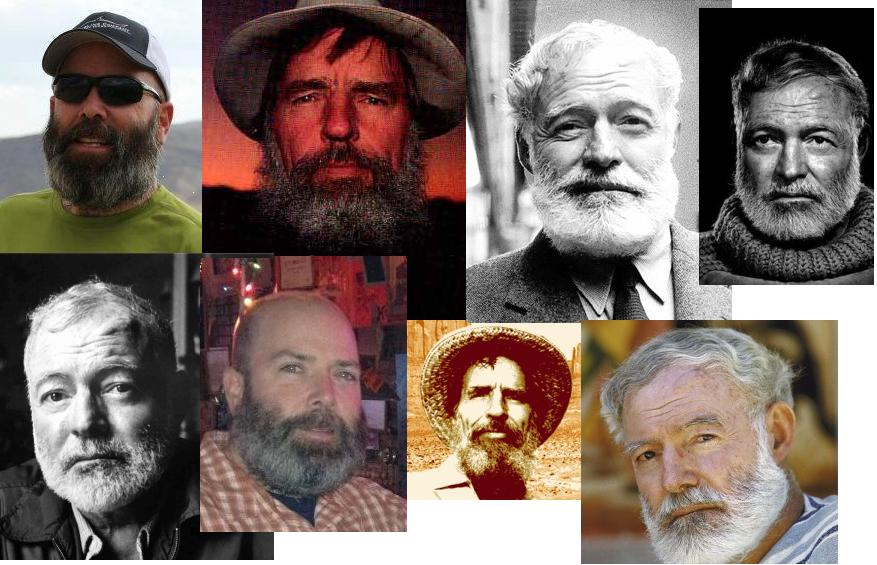
If you have noticed a pattern above, so have I: I am leaning heavily towards a certain two bearded men whose first names start with ‘E’. (On a personal note, I have been toying pictorially with the three bearded men in my life…)

Ernest Hemingway, Edward Abbey, and my Bearded Husband


My newfound (or newly recovered) interest in Abbey has come out of my love of Philip Connors’s Fire Season, which I called my favorite book of 2011. I’m still not done being moved by it; Husband is actually reading it himself (a truly momentous occurrence), I am planning a reread at the earliest available moment, and we’re planning a summer trip to the Gila National Forest itself, possibly even to meet the author who has graciously been corresponding with me and overlooking my rabid fandom. The unfortunate coincidence of Fire Season‘s publication with the worst drought in Texas’s history, and a series of wildfires including one that touched my family, has had me thinking about some of the themes involved. I’ve read a few other pieces of nature writing this year (Liebenow’s Mountains of Light and March’s River in Ruin – both lovely, and both reviews to come in Shelf Awareness). But mostly I’ve been revisiting Abbey himself, who represents the epitome of nature writing, at least for me in my not-very-well-read experience. I can’t begin to go into what his writing does for me at this moment; that’s another blog post. But he makes me laugh, and cry, and think and feel, and plan trips. I am trying to take to heart his exhortation to “get out there and hunt and fish and mess around with your friends, ramble out yonder and explore the forests, encounter the grizz, climb the mountains, bag the peaks. Run the rivers, breathe deep of that yet sweet and lucid air, sit quietly for a while and comtemplate the precious stillness, that lovely, mysterious and awesome space. Enjoy yourselves…”

And Connors, and Abbey, are shaping my reading, too, of course. I’m working on building my collection of Abbey’s books, and a few books about him; I have Aldo Leopold’s A Sand Country Almanac coming to my local library; and I have my eye on Muir, although with a few reservations. (I did love his Stickeen as a child. If you see it, grab it.) I have a few books on New Mexico and the Gila coming, too, to help plan our trip this summer.

Again, my thoughts on Abbey are large and evolving, and I’m not feeling worthy of trying to communicate them today. But I’m working on it.

And then there’s the other bearded man. I do have still a handful of Hemingway works on his little shelf that I haven’t read; and I have several biographies of him and other related fiction and nonfiction. My love for Hemingway has not faded yet.

So I guess what I’m trying to say, very long-windedly, is that I am finding great joy in my reading these days by focusing on a few areas that are holding my interest: mainly, two authors I greatly respect, and the writings about and surrounding them. I hope to delve more deeply into Abbey (and similar) and Hemingway, as 2012 rolls on by. Of course my reviews for Shelf Awareness continue; but they take 3-4 reviews a month from me, and that makes up a minority of my reading, so I have time to do my own thing. There will always be some variety, too – this weekend I checked out the new Girl Reading by Katie Ward just because it looked good – but I am doing pretty well at putting down the books that don’t work for me, because I know there’s lots more Abbey et al out there for me.

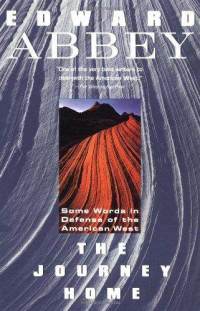
The Journey Home by Edward Abbey

This is why we read Ed Abbey. He has the power to make me laugh and cry within a few pages.

I cannot describe The Journey Home better than Abbey does himself: this book is a collection of “adversary essays and assays, polemics, visions and hallucinations… published piece by piece in various odd places from Audubon to the Vulgarian Digest” and “fragments of autobiography, journalistic battle debris, nightmares and daydreams, bits and butts of outdoors philosophizing” (from Abbey’s introduction). The subtitle is “Some Words in Defense of the American West.” It works very well in the ways he describes: it is indeed a defense of the American West (although as he puts it another way: “the idea of wilderness needs no defense. It only needs more defenders”). It is a lovely collection of some journalism, some hallucinations and dreamings, and some eloquent essays.

The introduction to The Journey Home is devoted to arguing why he is not a nature writer; he’s just a guy with a lot of experience in and love for nature, writing a memoir that naturally includes a lot of nature. I hope he would forgive me, were he still here, for saying: Abbey, you are a nature writer. Memoirs they may be (and watch out for his novels, too: I loved Fire on the Mountain; was disappointed by Black Sun which apparently he really loved; and am excited to crack open his best-known and arguably movement-starting The Monkey-Wrench Gang) but they are also some of the finest nature writing we’ve seen. His own arguments notwithstanding, Abbey absolutely belongs in the company of Thoreau and Muir. I recognize so much of what I, and modern authors and political thinkers and philosophers I admire, have thought and felt and written, in Abbey’s earlier work. He is important.

He is also so angry! He can be so funny, so flippant and casual (Husband and I both laughed til we cried over “Disorder and Early Sorrow”), but so angry, too. Rightfully so, of course, in detailing strip-mining operations and the destruction of the woods he played in as a kid. He is a contradiction; he reminds me very much of a much-loved friend who will recognize himself in this review. He throws beer cans out the window as he drives:

Rumbling along in my 1962 Dodge D-100, the last good truck Dodge ever made, I tossed my empty out the window and popped the top from another can of Schlitz. Littering the public highway? Of course I litter the public highway. Every chance I get. After all, it’s not the beer cans that are ugly; it’s the highway that is ugly. Beer cans are beautiful, and someday, when recycling becomes a serious enterprise, the government can put one million kids to work each summer picking up the cans I and others have thoughtfully stored along the roadways.

(from “The Second Rape of the West,” which deals not with beer cans on highways but strip-mining for coal, among other large-scale littering operations.)

…but is at the same time an ardent defender of wildness and nature, left alone. He advises a leave-no-trace approach to wilderness, packing out trash, dismantling fire rings, because after all, “the search and rescue team may be looking for you.” (That’s the wilderness, as opposed to the public highway.) He’s so incredibly (sadly) relevant today, only dated in some of the little details. He is poignantly hopeful; I regret the ways in which we’ve not lived up to his hopes in the few decades since he wrote. For example, our US Census in 2000 unfortunately showed our national population at 281,421,906 rather than the 250 million at which Abbey predicted we would “level off,” and we are now estimated at not quite 313 million.

Funny, angry, righteous, well-researched, poignant. A priceless glimpse into a fascinating, contradictory personality, and a moment in American time that will never be replicated. I want nothing more, after reading this book, than to go on one of his ill-conceived and poorly-planned backcountry trips with him. He makes me think – he makes me think in ways that we all desperately need to think, even more so today than when he wrote (original pub date 1977). I challenge you to read of his attempt to shake hands with a mountain lion (in “Freedom and Wilderness, Wilderness and Freedom”) and not get goosebumps.

In the end, this is a collection of essays and ramblings by a gifted author who loved our natural world, about small things as well as the big issues, like why we shouldn’t destroy what little of it we have left. I found it incredibly moving (again: I laughed and cried) and beautiful and can’t wait to read more Abbey. I only hope he’s right that

If man in his newfound power and vanity persists in the attempt to remake the planet in his own image, he will succeed only in destroying himself – not the planet. The earth will survive our most ingenious folly.

I’m afraid we’re going to push the point.

Fire on the Mountain by Edward Abbey

Oh my. I have difficulty beginning this review. I found this book very moving and beautiful. I’m glad to have found such joy in Edward Abbey this time around; I was disappointed in Black Sun, but I knew he had this in him.

Abbey tells us that this story was “inspired by an event that took place in our country not many years ago” but is fictional in its particulars. Billy Vogelin Starr has just arrived in southern New Mexico to spend another summer with his grandfather, on the ranch that has been in Grandfather’s family since the beginning. Billy is twelve, and he loves the land, the terrain, the work, the ranch, and his grandfather very much; they move something deep inside him. He only gets to be a cowboy for three months a year, but he takes this time seriously. He’s also very excited to see his friend Lee again; Lee is handsome, charismatic, a real cowboy, his grandfather’s best friend, and Billy’s hero. This year things are different, however; the United States government intends to take the Box V ranch away. The story is, they need it for national security. We’re fighting the Soviets, at least in theory and in spirit, and the land is needed for rocket testing (thus explaining the cover image, if you can see it that clearly). Grandfather’s response is that his land is not for sale. He was born here; his daddy died here, and he’ll die here, too. If he has to do battle to retain his right to his land, he’s willing. And of course, Billy wants to be right by Grandfather’s side.

A short book at under 200 pages, Fire on the Mountain is incredibly powerful. In few words – just like a cowboy – Abbey teaches his reader about old men like John Vogelin, whose tie to the land and to an older way of life is stubborn. The descriptions of the natural phenomena of Southern New Mexico are awesome, and I challenge you to resist respecting Grandfather’s final stand. Not for nothing is Abbey called (by Larry McMurtry) “the Thoreau of the American West.” This is a coming-of-age story for Billy Vogelin Starr, whose twelfth summer sees drama that will change his world forever; it’s also a lovely evocation of the beauty and power of nature, and the story of the classic, iconoclastic, Western loner resisting a world of change. An incredibly powerful and touching book, beautifully written, irresistible, exhibiting the greatness that I expect from Edward Abbey. More, please.

Black Sun by Edward Abbey

I love Edward Abbey for Desert Solitaire, and for his reputation (compounded of course by my love of Fire Season too). My Pops has gotten into him this year, and has brought me quite a few of his books, and I’ve been excited to pick them up. I confess I chose this one for its setting as I’m now working on completing the Where Are You Reading? Challenge, and it covers Arizona for me. But oh! this book has value all on its own. Those 3-4 other Abbey books that are sitting on my shelf right now just moved up the list a little bit. He wrote more nonfiction than fiction, and his best-known novel is The Monkey Wrench Gang; this lesser-known novel involves a fire lookout, which was my attraction (see again Fire Season).

The story is this. Will Gatlin has abandoned his life as college professor and husband to become a reclusive fire lookout in the Grand Canyon National Park. He is mostly alone up there, but does get a few visits and letters from his friend Art Ballantine, who still teaches college but expends more energy on chasing women. To say he is obsessed with sex, breasts, the female anatomy (he uses the c-word), young girls in every application, would be putting it mildly; his letters are raving and silly and self-deprecatingly intellectual. And very funny. In between Ballantine missives Will does his fire-lookout work, observes nature – these parts are poetic, loving and appreciative – and carries on a love affair with a girl named Sandy. I’m not sure we ever learn Will’s age, but he is probably old enough to be nineteen-year-old Sandy’s father. She is a virgin when they meet, and engaged to another man, but none of this stops them from cavorting the wilds (desert, river, canyon and forest) in the nude, wittily teasing one another and having wonderful sex. Here Abbey falls into that lamentable and oh-so-distinctive habit that older male writers sometimes fall into (Papa included!) of creating nubile young beauties who want nothing more than to have endless sex with old men. It’s unfortunate in that it seems to give away the author’s own dirty-old-man fantasies (I don’t know this about Abbey in particular but it is my reaction to the clichΓ©). But if we can move past this issue, Will and Sandy have a great time running around the wilderness, la dee da. That is, until Sandy disappears and her fiancΓ© shows up to accuse Will of disappearing her and punches him in the face.

Abbey writes beautifully, lyrically about nature and about love or at least attraction. The letters from Ballantine (and others) are amusing. The story is tragic, but it requires a certain overlooking of the older man’s fantasy before we could really sympathize with Will’s sense of loss. If you can move past this, it’s a beautiful little story with flora and fauna of the Grand Canyon painting the background. I was only partly successful in that requisite overlooking, but enjoyed it all the same. I have great hope for the other Abbey books waiting on my shelves.

I thought I could clearly see connections in Abbey’s writing style and subject matter to Keruoac, as well as Philip Connors, who in Fire Season acknowledges the debt. I recommend Black Sun, unless of course you’ve had too much euphoric losing of teenage virginities to much older men, in which case perhaps start with Desert Solitaire and I’ll let you know how the rest of them go, too!

book beginnings on Friday: Black Sun by Edward Abbey

Thanks to Katy at A Few More Pages for hosting this meme. To participate, share the first line or two of the book you are currently reading and, if you feel so moved, let us know what your first impressions were based on that first line.

Black Sun is a novel by Edward Abbey (renowned author of much nonfiction, whose best-known novel is The Monkey Wrench Gang; he has been called “the Thoreau of the West”) about a fire lookout. If you read my earlier review of Fire Season you will understand my interest in the subject. I like it so far. Check out this beginning:

Each day begins like any other. Gently. Cautiously. The way he likes it. A dawn wind through the forest, the questioning calls of obscure birds. He hears the flutelike song, cool as silver, of a hermit thrush.

I love this picture of a day beginning gently, the way he likes it… very evocative, mood-setting.

What are you reading this weekend?

Pops’s visit to Powell’s Books in Portland

Just wanted to share a few photos from my father’s trip to the famous Powell’s Books in Portland, Oregon.

A quotation he thought we’d like, on one of their blackboards (I especially appreciate that the book’s location is noted!)

LOVE these bike racks with related book titles. (click to enlarge and read ’em all)

“our room at the trendy Ace Hotel – old encyclopedia pages wallpapered to plaster walls!” (is this especially for Powell’s customers?)


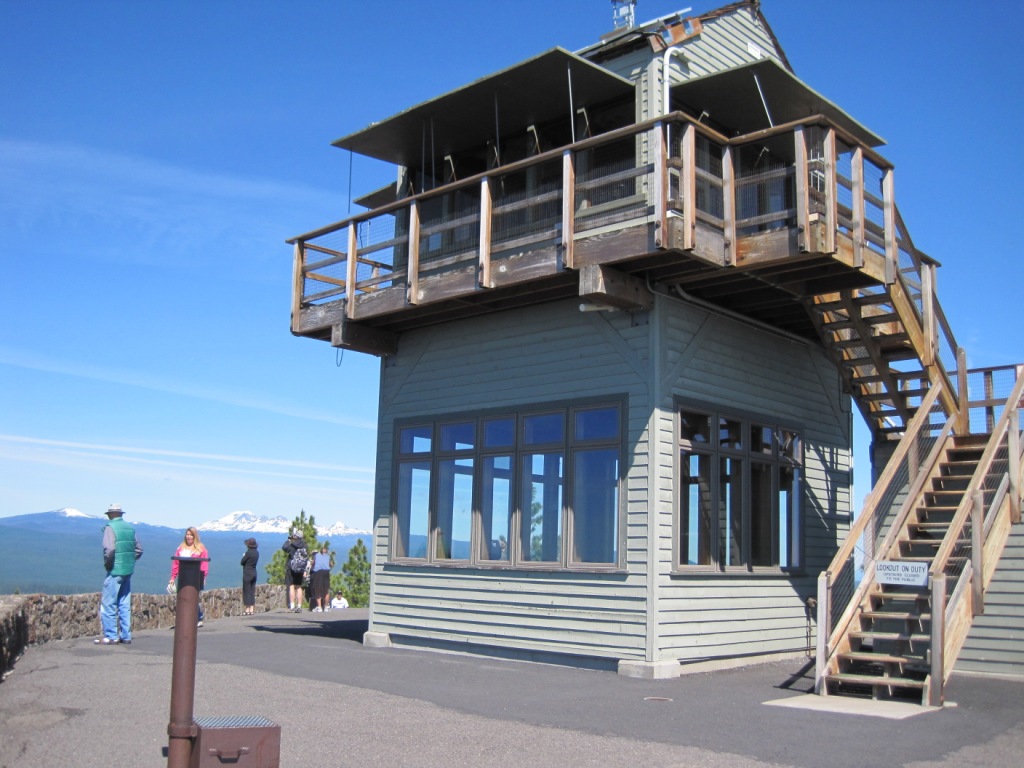
And, well, this one is not so directly connected, but: you may recall that Pops and I both read and both raved about Fire Season, by Philip Connors. (My review… and his) So he snapped this fire lookout station for me “at the top of a volcanic butte south of Bend, with a view of the Cascade snow-caps as far north as Mt. Hood, and east into the Oregon desert.” Very nice, Pops.

On a related note: Pops has also been getting into Edward Abbey this summer. I’m not sure if I had a role in that or not; I did strongly (forcibly?) recommend Fire Season to him and cite Edward Abbey as a related recommendation. He may have gotten there on his own, but at any rate the two authors (Connors & Abbey) have a clear link. He actually approached Powell’s with an Edward Abbey need, and reported that, while he’s aware that Abbey is a somewhat obscure choice, they had a full shelf of it and were very happy to talk and help. He points out that this is unsurprising, for Portland and for Powell’s – should be a specialty of theirs – but no less gratifying. He bought three books, including one of Abbey’s novels. I’m not sure I even knew he wrote fiction!


So, I have only read his Desert Solitaire, which I believe is his best-known. It is the nonfiction account of his solitary experience as a park ranger at Arches National Park near Moab, Utah. I read it many years ago, and I retain more of an impression than a distinct memory; what I do recall is that I found it very moving. I recently picked up another of his, The Journey Home, although I haven’t cracked it open yet.

And now Pops has three new books, including a novel. He mentioned that the novel is about a fire lookout, so I think that makes it Black Sun. I’m hoping that he’ll report back to us here on his continued reading, and maybe even loan me a book or two! Hm, Pops?