from the New Republic: on books

Thanks, again, to Liz for sending this along. The New Republic‘s issue of October 21, 2013 featured a cover focus on books and publishing, with five articles included. They range from a one-page infographic to 3 pages long; no serious time commitment here, although you will have to find them. I accessed these stories through a database (Ebsco, if you’re curious) through my employer; you may have similar access through your local public library, for example. I know that on Houston Public Library’s page you can go to “research databases” and search for the publication you want (New Republic), and then you’ll need to put in your library card number to see the articles. Contact your local librarian if you want to get in and you need some help; she or he will be happy to assist. Or, there’s always the print edition, if you subscribe or know of a decent newsstand!

I found these articles interesting (obviously) and wanted to share just a few thoughts. In the order I read them (I have no idea how this relates to the print magazine):

  • “Books Don’t Want to Be Free: how publishing has escaped the cruel fate of the other culture industries” by Evan Hughes examines the fact that books have avoided the way music and movies have become open to pirating and price drops. Those industries are struggling, Hughes writes, in ways that the book publishing industry isn’t. (And don’t even get started on print magazines and newspapers…) This article is optimistic and thus refreshing. It touches on the recent price-fixing court case between a group of major publishers, and Amazon. It also speaks to pricing differences between e-books and traditional print, which is addressed in the next item:
  • “The Words Business, In Numbers,” an infographic (sort of) identifying trends in revenue (e-books vs. print), reader trends, and foreign readership. In a word, “e-books are growing the pie.”
  • “The Dastardly Defender of Letters” by Laura Bennett is an article about and interview with Andrew Wylie, “who still makes millions off highbrow.” He is an infamous agent for clients including – I shamelessly reproduce those listed in the article – Amis, Nabokov, Bellow, Rushdie, Roth, and more in that vein. He is delightfully curmudgeonly, snobbish about the lowbrow, and defending books as they should be made (says he, and I largely agree). This was the most fun piece to read. His apparent serene calm regarding the future of traditional books was heartening.
  • “I Hope They Read Books in Hell” by Norene Malone, on the other hand, touches on the opposite end of the spectrum. Malone visits with the editor, Ruby-Strauss, and agent, Leavell, of Tucker Max, author of I Hope They Serve Beer in Hell.” Max’s cache, if you didn’t know, is being 1) internet-born and 2) offensive as all get-out. Ruby-Strauss and Leavell work with others in the same vein: Snooki from Jersey Shore, that University of Maryland student who wrote that bitchy email, Shit My Dad Says (whose twittering I like, btw). It was interesting to consider that counterpoint, the lowbrow, which (it is argued) helps finance the highbrow.
  • Finally, “The Rancid Smell of Success” was written by Lionel Shriver, author of a good number of novels, most famously We Need to Talk About Kevin, which became a major motion picture. She laments the changed life of a successful novelist: from the scary, financially insecure obscurity of an undiscovered writer to the publicity-exhausted successful author – who is still financially insecure and has to immediately begin work on the next book, but can’t because of all the promotional demands of the current one. It’s a beautifully written article, and she acknowledges the problem with her complaints about the literary festival she has to attend in Bali; but she justifies her complaints, too. It’s a thoughtful piece.

On the subject of e-books versus print – and the question of the future of the traditional book (“is it dead?!” they ask hysterically) – others have said it better before me, but I’ll briefly file my position. The birth or the rise of the e-book does not signal the death of the book, any more than the birth or the rise of television sounded a death knoll for radio. Radio has changed over the decades, but we still have a recognizable semblance of what it was when the television was born. There’s room for both e- and print books in this world, and both have their uses, their pros and cons, their seasons if you will; and both have their fans. Those of us who prefer print (even if we occasionally read electronically!) will continue to buy and borrow real books. Everybody calm down, is my concise message. And please, read books – any kinda way.

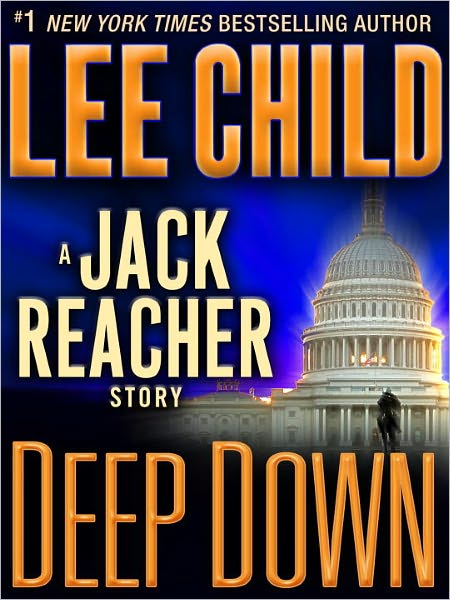
Deep Down by Lee Child

Jack Reacher is back. In this e-book-only short story, he’s back in the army, in his 20’s, making it chronologically one of the very early Reacher tales. He’s been called in from Frankfurt to Washington, D.C., where he’s put undercover as a sniper sitting in on a pre-committee… I know, bear with me… of politicos discussing a possible requisition for sniper rifles. Apparently the prior two meetings of these subcommittee politicos with military representatives have resulted in sensitive weapons information being leaked overseas, and Reacher is to find the leak. His handler in this operation is sure the leak is one of four women, and encourages Reacher to use his woman-wrangling skills as he sees fit. As we watch Reacher getting briefed and prepped in a slightly-too-small suit, we simultaneously see one of the women jogging into work. And the action begins. I’ll leave it at that in case you want to read it yourself.

Reacher fans will be able to predict how things play out. There are a few obligatory features: Reacher seems to read minds; he makes observations the average bear would not, and draws correct conclusions. There is flirtation. There is violence. He gets things right in the end. In these ways, it fits within the other Reacher stories we know and love.

What’s different here, though, is the format – and I don’t mean the e-book part, although I’m still not excited about that aspect either. No, I think I’m coming to the conclusion that short stories do not best showcase Reacher’s abilities. This is the second I’ve read, and The Second Son was interesting for the light it shed on Reacher’s past, brother Joe’s personality, and their relationship. I felt that Deep Down had some shortcomings. A lot of what I love in a full-length Reacher novel is development, the careful playing out of string, the stinginess with which we learn details, the way we get to know our characters better, often the development of a steamy relationship to boot: all things we need a full-length novel to do. While this story had all the elements Reacher needs (as observed), it didn’t give them the space they needed to grow. It didn’t do it for me. Instead, Deep Down read to me like what I fear it is: a hastily-produced holdover for Lee Child’s fans to satisfy themselves with while we await his new novel (A Wanted Man comes out in September). It was fun, and Reacher did kick butt, and it only took me 30 minutes to read – but that’s part of the problem. Only so much plot can come to fruition in a 30-minute read.

That last statement makes me wonder – is this really a problem inherent to the short story? And I don’t think it is. I’ve certainly read some very impressive, moving short stories by my favorite master of that genre, Hemingway. But you know, I don’t read a lot of short stories; I do find it a difficult genre, and I think I’m dissatisfied more often with short stories than I am with novels. New question, then: am I a poor reader of short stories, difficult to please? Or is this a difficult genre to do well in? I suspect the latter (although I’ll allow the former): with less space in which to develop characters and plot, an author has to be very precise and economical. This would help explain why Hemingway was so good at them, precision and economy being his hallmarks. And that author may need to take on less, plot-wise, so that he has time to flesh it out.

I have managed to make a rambling mess of this review. Perhaps I am not so strong on precision and economy, myself? At any rate, I found this a fine but decidedly below-average Reacher story; I am anxious for the next full-length book. Many thanks again to my mother for her loan of the e-reader so I could knock this one out on a lunch break!


Rating: 4 tough guys.

guest review: In Session by MJ Rose, from Mom

I posted my review of In Session a few days ago; now here’s my mother with a very different impression of it. For fairness’ sake. 🙂

In Session is a short but sweet introduction to the work of M. J. Rose and her character Dr. Morgan Snow, a sex therapist. I’ve never read her, but I will be looking for more of her work. The premise of this short story is that she manages to make contact with three fictional characters and involve them in her work. She makes a very satisfactory connection with Reacher, Lee Child’s hero, and the only one I have any experience with.

The first session (as in therapy session) is with Cotton Malone, who’s the creation of Steve Berry. Dr. Snow finds a way into his antiquarian bookstore to look at an erotic book from the 15th century. Discussion of the book leads to some discussion of his personal hang-ups, and a point is scored in favor of reflecting on and starting a resolution of these issues.

Calling this work erotic seems a bit of a stretch; there is certainly a lot more explicitness in many romance novels, I think. Perhaps in a full-length work, there’s more opportunity for a theme to blossom. In these sessions with the doctor, the issue of a sexual nature in couples’ lives is strong, but, as it should be, it’s also mixed with other aspects of people’s needs, such as dominance and trust. Eroticism is not the focus of the doctor’s work, but rather an important part in human nature that’s her area of expertise.

In the next two sessions, she meets with Reacher and Barry Eisler’s John Rain. I have to presume that she gives them accurate characterization, as all three authors have approved – and applauded – the work. The meetings are not contrived, but arranged so that the sexual issues can be raised with men who would never have consented to any kind of therapy. This book is just a taste of Rose, but I see lots of promise in her character and style.

I read a digital galley from NetGalley.

Thanks Mom! I’m glad you liked it.

In Session by MJ Rose

In Session involves a sex therapist named Dr. Morgan Snow (MJ Rose’s serial character), who undertakes to treat three heroes of serial fiction: Steve Berry’s Cotton Malone, Barry Eisler’s John Rain, and finally Lee Child’s Jack Reacher. Those of you who follow this blog will recognize which of these guys brought me to Dr. Snow’s office – I’ve never read any Berry or Eisler, but Reacher is my fictional main squeeze these days. That said, my brief glimpses of Rain and Malone weren’t bad; maybe I’ll check them out one day, too.

Rose apparently challenged the three authors’ heroes to sex therapy sessions, and they told her if Dr. Snow could wrangle the guys she could treat them. So this book consists of three episodes in which the good doctor meets each of the three men, outside of a standard doctor’s office/therapy setting, and chats with them – to some effect.

I had no history with MJ Rose and didn’t know what to expect. The blurb my mother got from NetGalley referred to Rose (or this book? it wasn’t exactly clear) as… Erotica, Health, Mind & Body, Literature & Fiction, Mystery & Thrillers, Romance. Wowza! What the heck have I gotten myself into? Well, I think these genres must refer to Rose’s work in total, because they don’t all apply to In Session. One sex scene is described in minimal detail; it doesn’t qualify as Erotica. Health, Mind & Body must refer to the therapist character; but her work isn’t covered in any depth. Literature & Fiction? I don’t think so (more in a minute). Mystery & Thrillers is the most likely candidate, just based on the home environments of the three male leads, although there’s not much mystery & thriller in their stories here. And not much Romance, either.

I wasn’t very impressed. Dr. Snow approaches one man under false pretenses and sneaks him some therapy while he wasn’t looking. The next she approaches with an appeal to his services, and they both learn from their interaction. And the third stumbles upon her in a time of need, and he ends up telling her (upon her repeated demands) about a particular sexual experience. In each case, the characters are completely lacking in development and dimension. The therapy is pitifully simplistic and straightforward. Dr. Snow repeats a few lines to several “patients.” The therapy – the growth, the learning about oneself and making progress as a sexual or emotional being – is too facile to feel real. Would it help if I came in with a familiarity with all three male heroes, rather than just one? Maybe; but the Reacher scene wasn’t really any more satisfying than the others. His voice didn’t sound like Reacher to me. Perhaps these tales were just too short. I read them in about an hour (total); there wasn’t time for the characters to develop or for there to really be a problem, a solution, a catharsis, a resolution, any meaningful change. But that reasoning isn’t fair to the short story format, because we all know that there are plenty of artists who paint beautiful pictures in brief snippets. It’s certainly possible to develop a character and, well, tell a story in the short story format. It’s just not done here.

I think the appeal of these three stories is in seeing your favorite hero in a different light, maybe getting into a different aspect of his character. It was a fun concept in theory; it got me: I wanted to see Reacher on the sex-therapy couch. But I was disappointed.

Anybody else check this one out? Any positive impressions? I think my mother liked it and maybe she’ll tell us about it here. How about any fans of Rain or Malone??

I read a digital galley from NetGalley.

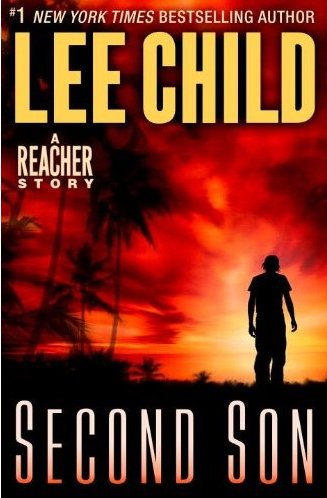
The Second Son by Lee Child

A slight diversion from the norm here, for Mr. Child as well as for me: he has written a Jack Reacher short story (as opposed to his usual novel), set in Reacher’s childhood (as opposed to adulthood), and here’s the big one – gasp – available only as an e-book, and not in “real” print. I was excited about the first two and not about the third. I have been a late adopter of many forms of technology, and the e-book, while a great thing for a lot of people (even some friends and family, people I KNOW), still scares me and strikes me as a little bit blasphemous. Give me ten years to get used to the idea and maybe I’ll get one someday. But for now, I said, how will I read this Reacher story? My mother bought it for me (thank you Mom) and I went over there on a Saturday afternoon with a brown bag lunch and sat down and read it. So this was an experiment with the e-format, as well as a Reacher story.

So. First, the story. We know Reacher (in the series of novels about him, of which I’ve read 10-and-change of 16) as an adult; I believe he was 36 when we met him in Killing Floor. In The Second Son, he’s 13. As his fans already know, his father is in the military, his mother is French, he has a brother two years older (Joe), and they move constantly – like every few months. The family of four has just arrived in Okinawa, and as usual, the local military kids (who have been there just perhaps a little longer than the Reachers) want to fight Reacher and Joe. (Yes, he went by Reacher even as a kid.) Joe is accused of one crime, and their father of another. Their maternal grandfather is dying, back in France. And Reacher saves the day. I don’t think that’s too spoilery, since he always does.

This was an enjoyable little story. If you normally like Reacher, you’ll like this; it has all the right ingredients. Reacher is a badass; he meets a cute girl and impresses her; he saves the day. If anything, the requisite suspension of disbelief is slightly greater than in the novels, because he’s just a kid here, so his badassery is that much more amazing. There’s one line I found especially funny where …some sort of military authority can’t believe he’s about to ask this 13-yr-old kid for help in his investigation. But really, if you’ve bought into Reacher, you’re comfortable with the suspension of disbelief, so you should be fine. It made me sigh with satisfaction. It’s like a Reacher novel in miniature.

And the format? Well, I don’t have any strong or specific complaint. It worked fine, although I had to tilt it just right to avoid glare at one point. The pages turned. I played with changing up the font size. I’m not against it. The strongest argument I know in favor, is for travel: not having to lug a largish number of books around, but having them all in that slim little package. My mother has some 40? books open on her machine right now, just because they’re there, but I don’t see this as a selling point; I’ve been known to read 2, 3, even 4 books at once, but more than that is just silly. I see that as actually detracting from the reading experience, because I’d be so confused, so start-and-stop. I’d rather be immersed in a book. I know the point is not to have 40 books going at once, of course, and if I were traveling it would be nice to carry less. But so far in my life this is not a great need for me.

I’m not angry at the e-book. But I’m not enamored; I love real books (battered old paperbacks, preferably) too much, and don’t feel a need for what I see as the greatest reason for e-books, that carrying of less. But it was an interesting experience to get to try one out with a quick read like this. Thanks Mom. If you read The Second Son, please do share your thoughts.

And the rest of you (Mom included) – would you care to share your e-reader-vs-print thoughts?