






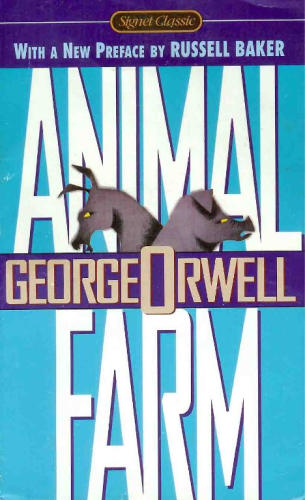
 On my way out the door headed for the airport, I realized at the last minute that I might not have enough reading material for a medium-long flight to Seattle. I’m so glad I grabbed this slim volume – the closest appropriately-sized book to hand, off my TBR shelf. I did indeed finish the one book and start and finish this one on that flight; and I enjoyed it very much and found it thought-provoking.
Animal Farm is a classic, chilling allegory from the author of 1984, whose voice I most definitely recognized in this earlier novel. My 50th anniversary edition, from Signet Classic in 1996 (pictured), includes a preface by Russell Baker (new in 1996) and a 1954 introduction by C. M. Woodhouse of The Times Literary Supplement. I found these starting pieces noteworthy. I know a little about Orwell, have read 1984 several times, and am familiar with other early dystopian novels like Brave New World, which Baker refers to (he calls these authors pessimists), so I had a little background. Interestingly, Baker makes the very optimistic statement that the pessimists were wrong, that our current leaders (in 1996) did not resemble dictators, that technology has been a liberating force. I think there is some validity to the last argument; but there is plenty of room to criticize the power of the state today, and I find Baker a trifle breezy in his reassurances. To be fair, he is right to point out that the state has turned out to be less efficient than Orwell feared: drones and wiretaps today do not approach the effectiveness of Big Brother in 1984. At least, that’s what we think… I don’t consider myself a conspiracy theorist, but I’m not particularly optimistic about the virtues of our government leaders.
Woodhouse’s introduction is more straightforwardly academic in its analysis of Animal Farm as literature and in culture and politics, and of Orwell as an artist. He considers him a prose poet, in fact. This article was informative and critical but still accessible, and I recommend it. (I recommend Baker’s preface, too, but with salt.) The most useful part, for me, was the specific placement of Animal Farm in time: it was published in August of 1945, the same month as the bombings of Hiroshima and Nagasaki, but Orwell had begun writing it in 1943, following his disquieting experience in the Spanish Civil War in the late 1930’s. As a criticism of Stalin’s Soviet Union, Animal Farm was not particularly welcome in the Britain of the early 1940’s.
And now the novel itself. Orwell (or rather Eric Blair, who used a pen name) calls it a fairy story; but I find the allegory blaring through loud and clear. Mr. Jones is a drunken farmer who does not always treat his farm animals with great respect or tenderness. An elder statesman of a pig (no, literally) makes a speech shortly before his death in which he predicts to his fellow four-legged residents an uprising of the animals against the people. This prediction will be carried out by the animals of Manor Farm: they kick Mr. Jones off, rename their property Animal Farm, and begin working for themselves, cooperatively. Aside from the anthropomorphism of the animals, it’s a straightforward and absolutely real tale. The pigs are the smartest – are in charge – assisted by the dogs; horses & a donkey are thinkers as well, while the birds and the sheep are followers. They come up with a list of Seven Commandments: no animal shall wear clothes, no animal shall sleep in a bed, etc. and finishing with “All animals are equal.” They make committees and call one another “comrade.” Two pigs, Snowball and Napoleon, struggle for power; Snowball is a better speaker, but Napoleon marshals the power of a few big, strong, brainwashed dogs, and eventually runs Snowball off the farm. The pigs begin to relish their power and to take advantage. Gradually, the rules of Animal Farm change; the Seven Commandments are amended (“no animal shall sleep in a bed with sheets”), but because very few of the subjects are literate, the pigs in charge have little trouble changing history too. Thus, it’s not that the state has changed its policies; these have always been the policies of the state. This is precisely the case in 1984 as well, where
Oceania was at war with Eurasias: therefore Oceania had always been at war with Eurasia. The enemy of the moment always represented absolute evil, and it followed that any past of future agreement with him was impossible.
Chilling, I say!
Also, credit Animal Farm with the oft-quoted amendment to the final Commandment: “All Animals Are Equal. But Some Animals Are More Equal Than Others.”
This is a short book, just over 100 pages, and easily read in just a part of my flight. And in the “fairy story” about the animals on the farm, it’s fairly straightforward, too. But the underlying message, which doesn’t lie so far beneath the surface at all, is terrifying – and also fairly straightforward, in fact. From a historical perspective, that almost makes it that much more frightening, that these things really happened, right under people’s eyes, and not so long ago either. It’s disconcerting how easily people can be convinced to disbelieve their own minds and memories.
I continue to be a fan of Orwell, of both 1984 and Animal Farm, and despite Baker’s characterization of Orwell and Huxley as “pessimists”, I think these are important books to read today. (To be fair, he agrees: “Orwell left us a lesson about the human contribution to political terror that will always be as up-to-date as next year’s election.”) Also, the writing is pretty wonderful.
Shivers! And go read!
Filed under: book reviews | Tagged: classics, dystopia, historical fiction, politics | Leave a comment »
 pagesofjulia