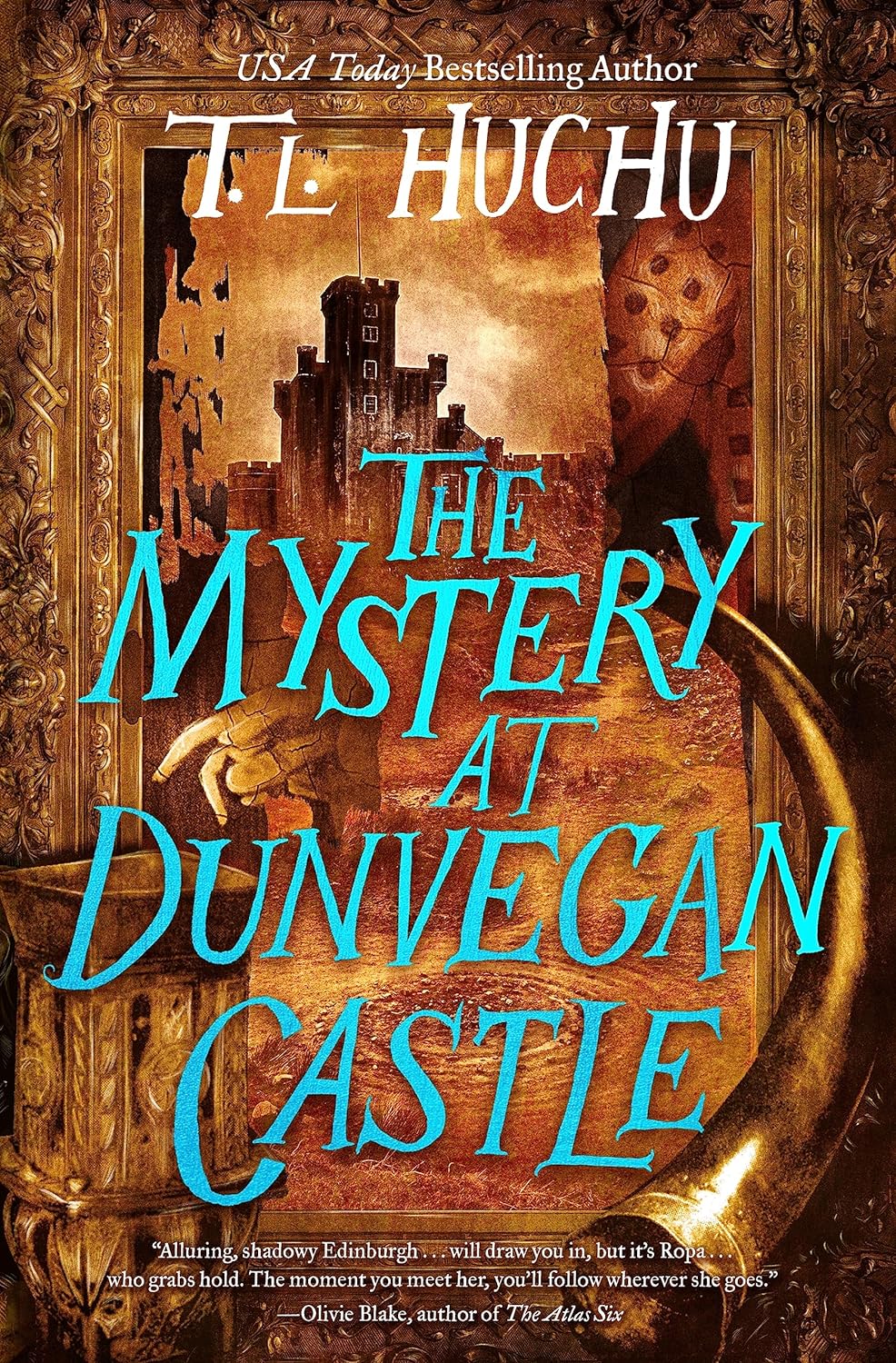
The Mystery at Dunvegan Castle by T.L. Huchu

Book three of Edinburgh Nights (The Library of the Dead; Our Lady of Mysterious Ailments) might be the best yet. Ropa is still pushing on in her unpaid internship for the Society of Sceptical Enquirers (or rather, its secretary, her patron, Sir Ian Callander), and at this book’s start, she finds herself at Dunvegan Castle on the Scottish Isle of Skye, assisting with the biennual conference. This should be low-level drudgery, but Callander is good about keeping Ropa handy; and anyway, events quickly take a turn for the unusual, necessitating Ropa’s special skills in solving mysteries. A prestigious Ethiopian magician comes to visit, a priceless ancient scroll (valued both as an antiquity and for the secrets it contains) is stolen, and a librarian – Ropa’s favorite, in fact – is murdered. And our young hero is on deck to save the day. But where she has some experience solving crimes and battling magicians, here at Dunvegan she might just be outclassed. Everybody on site except Ropa, it seems, is a professionally trained magician. Academia and the Society have turned out much less virtuous than she’d imagined. With the written advice of Niccolò Machiavelli running through her mind, Ropa decides she can trust no one. Even her heroes are suspects.

This might be the saddest in the series, as Ropa becomes disillusioned with the society and the Society she had been so keen to join. We continue to admire her for her own strong morals, even if standing on principle sometimes gets her in arguably unnecessary trouble. But her ideals are shaken as she finds out that the people she’d looked up to are fallible.

That said, it’s a great story, expertly paced and compelling, with characters we care about. And I was thinking this was a trilogy, but this book ends on a hell of a cliffhanger, and I’m glad to see there are four published books in the series with a fifth due in December! So I’m pleased to be hooked by Huchu’s singular and unforgettable young ghostalker-turned-investigator. Get on board.


Rating: 8 servings of cranachan.

Our Lady of Mysterious Ailments by T.L. Huchu

At the start of book 2 of the Edinburgh Nights series, young Ropa Moyo thinks she’s got a big break with an apprenticeship at the Society of Sceptical Enquirers, working directly with Sir Callander, Scotland’s top magician. But in the opening scene, her apprenticeship is downgraded to an unpaid internship. The big shots who work highly regarded “scientific magic” in this culture see this as a role with honor and opportunity–Callander has not taken an intern in many years–but Ropa is not exactly a member of that rank of society. She and her Gran and little sister Izwi live in a slum, in poverty, and Ropa is their sole wage earner. She cannot afford “unpaid.” (Race is not a very ‘forward’ issue in these books, but Ropa’s family is originally from Zimbabwe, and those roots influence the style of magic she’s learned from her Gran and which puts her a bit at odds with the establishment.)

Luckily, her buddy Priya has the lead on a side job: figuring out the nature of illness for a young patient at Our Lady of Mysterious Ailments. And, because Ropa is resourceful and always hustling, another mystery presents itself as well, one that might actually come with a serious paycheck. (Our protagonist is always worried about medications and medical care for Gran, and schooling for the precocious Izwi.) Chasing one puzzle and another, trying to impress the society and keep her family afloat, hard-working Ropa alternates between hopefulness and despair. Interestingly – and in a departure, as far as my memory serves, from The Library of the Dead – the case(s) here are tangled up with Scottish history and old wrongs.

Ropa’s unmistakable, unforgettable narrative voice is a big part of the charm to these novels. She offers a mix of a sort of classic, hard-boiled detective’s cynicism with a teenaged variety of same, and a youthful (not quite naïve) optimism, with both sardonic wit and earnest love for her family and friends. There is significant slang to season that combination to boot. I’d recognize Ropa anywhere, and although I have to look up the odd word, I’m always stimulated, intrigued, and entertained.

I hope it goes without saying that I’m all in for book 3 of this trilogy.


Rating: 7 movie posters.

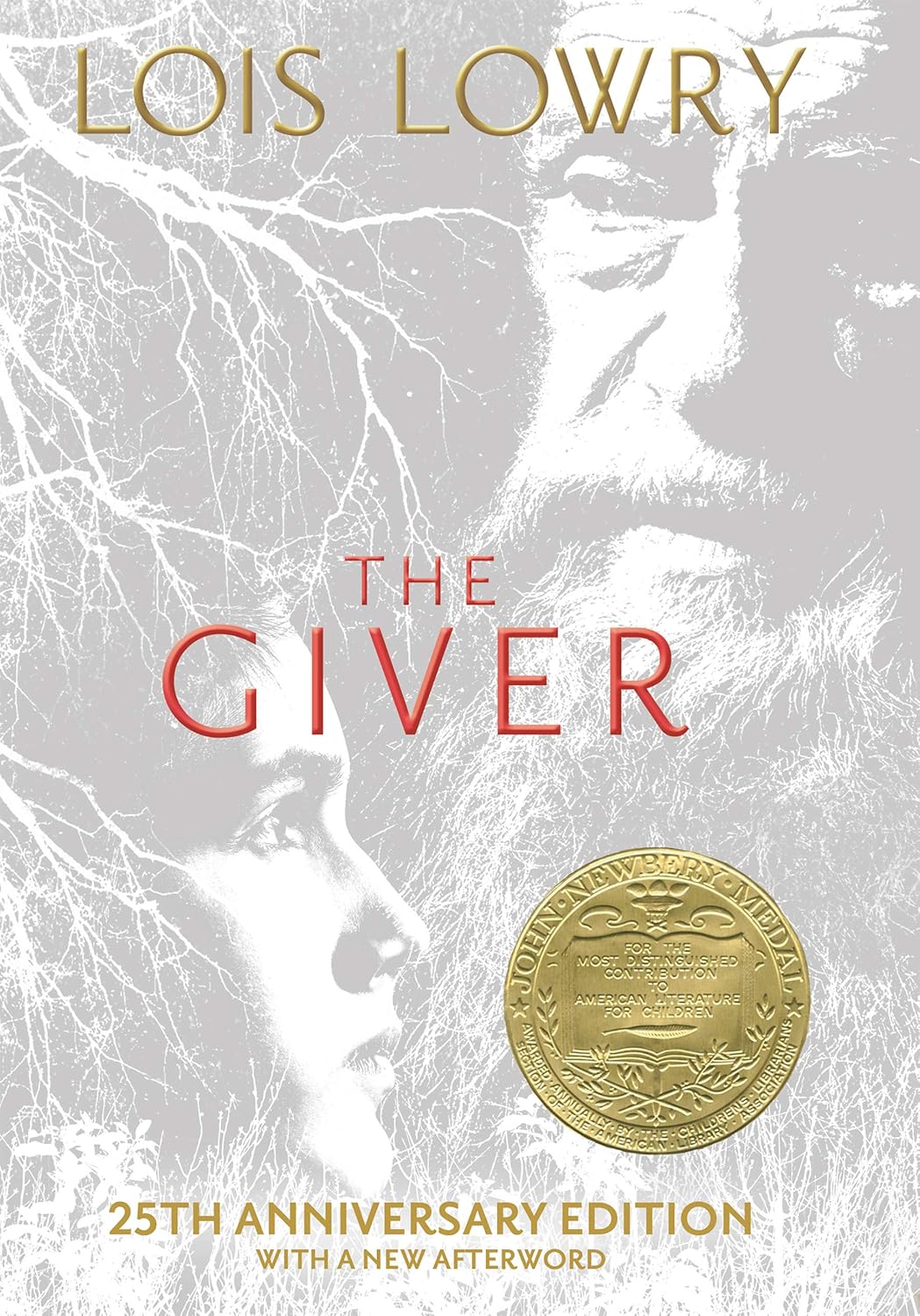
The Giver by Lois Lowry

My favorite now-13-year-old* wanted to talk about this book which I, surprisingly, had never read. (I’ve read some Lowry but this one missed me. My favorite was Number the Stars.) So, what do you do? I got a hold of the book.

I’m impressed by this clean-lines novel which feels expansive, but whose ~225 pages zipped by in a single day for me. It absolutely reminds me of Le Guin’s “The Ones Who Walk Away From Omelas” and Jackson’s “The Lottery,” but this longer book (compared to those two short stories) develops its characters further: Le Guin did not name characters, and Jackson gave us the briefest of sketches, mostly to type. Both of those choices serve their stories very well, I think, but The Giver is doing more, going further.

The tale is set in a community where everything runs very much according to system. There is a great emphasis on uniformity and order. All the children born in a single year (always 50 of them) turn one year old, officially, in December; some are great big babies and some are newborn, but by the time they are three, we’re told, it all evens out. There are certain milestones at each year, including, importantly, the Nines receiving their own bicycles. But the big one is the Ceremony of Twelve, where each child is given their lifetime assignment, their job. These assignments are made by the Committee, which spends a lot of time throughout the children’s lives – but especially when they are Elevens – observing them for preferences and talents. After the Ceremony, the Twelves are no longer children, but adults, albeit early in their training.

Our protagonist is Jonas, and we meet him as he’s approaching becoming a Twelve. Somewhat unusually, he has no idea what his assignment will be. Most children understand their own predilections, but Jonas is truly unsure. At the after-dinner ritual where everyone in his family shares and discusses their feelings, he shares his apprehension (he has thought hard about this word, because precision in language is important to Jonas), but his parents assure him the Committee always chooses well. (It is partly through this ritual that the reader learns about families in this community. Always two children, one male and one female, per household. The parents were carefully paired with the same kind of methodical, clinical decision-making as the assignments. Jonas’s father is a Nurturer: he takes care of babies their first year, after they are born to a Birthmother [shades of Handmaid’s Tale] and before they are awarded to an applicant couple. Jonas’s mother works in Law and Justice. His little sister is a Seven.)

And then the Ceremony of Twelve, where Jonas is selected for a very special role, one he’s never heard of before. Jonas is to be his community’s next Receiver of Memory.

From here on out, his life will not resemble that of his friends. He sees little of them, in fact. They enter training to work in various parts of the community, but Jonas is shut away with an old man, the former Receiver, who now requests that Jonas call him the Giver. He transfers memories to Jonas: memories of a time before the community embraced Sameness. It is only when Jonas begins receiving these memories that the reader learns just how much has been missing from his life.

So. It is a bit of a parable, and offers up similar questions to the two classic short stories I mentioned above. But it goes deeper than either, and in its details, feels closer to reality. (“Omelas,” by contrast, with its nameless character-types and invitation for the reader to fill in the details they prefer, is much more strictly a parable or thought experiment.) I absolutely appreciate the thought-provoking nature, and the emotional impact of each reveal. It feels like a truly great place for a middle-school-age class to dwell and discuss, and I can’t wait to hear more about my young friend’s experience both with the book and in the classroom. My copy included some supplemental text at the back, including a ‘guide for discussion and classroom use’ which seems potentially genuinely useful, but most special are the supplements from Lowry: “Ever After” describes the many inspirations for this story which I loved and found revealing, and her Newbery Acceptance Speech was such a treat as well.

Easy to read in one sense, but with Big Themes that require careful consideration. Excellent matter for thoughtful conversation at school or at home. I can’t wait to talk to my friend about it.


Rating: 8 snowflakes.

*She and her sister account for the books at this new tag.

The Library of the Dead by T.L. Huchu

I forget where I came across this first in a series, but I’m glad I gave it a go. Set in a magical post-apocalyptic Edinburgh, The Library of the Dead stars Ropa, a teenaged ghosttalker: she is licensed to visit with the dead, a rare skill, and carry their messages back to the living, for a fee. She can also help (or force) ghosts to move along to “the place with long grass,” where we’re all headed once we find the peace to go. Ropa considers herself unsentimental: this is all about earning a living, which she uses to support not just herself but her younger sister Izwi and her beloved Gran, a more powerful magical practitioner but who these days is mostly reduced to knitting in their cara (caravan, or what we’d call in the US a trailer). Their existence is tenuous, which is why Ropa at first refuses when she meets a ghost who asks for her help but cannot pay.

At Gran’s insistence, Ropa eventually agrees to help Nicola (dead) solve the mystery of her missing young son Oliver (not dead, yet). As she takes a break from paying work to investigate, she’s glad to have the reluctant help of her old friend Jomo, who now works at a library that he doesn’t want to talk about. Jomo is from a better-off family: he’s been able to stay in school, for one thing. Ropa is a serious autodidact, listening to audiobooks as she makes her rounds; she is forever exclaiming that school doesn’t matter and she’s not the least bit sorry, but the reader can tell how much she feels the lack. We also observe what a clever self-study she is, however, as she repeatedly quotes Sun Tzu and summarizes and meditates upon the philosophies of magic she gains new access to…

…because Jomo’s secret new workplace is the library of the dead. When he sneaks Ropa in and they get caught, the consequences are dire – she is initially sentenced to hang from the neck until she is dead, but (in a whirlwind scene) instead gets drafted as a scholar, with the privilege of book borrowing. That, and she makes a new friend, Priya, a far more advanced student of magic. With two friends behind her now, but still very much with her own life (and livelihood) on the line, Ropa follows the cold trail of Oliver’s disappearance to some surprising and disturbing intrigues and evils.

Ropa is a certain kind of heroine: actually quite caring, although she wouldn’t want you to know it, and deeply committed to her family and friends, she rides a bicycle (when it’s not been stolen) and plays the tough, but really just wants to snuggle up on her berth with Izwi and Gran and watch some good telly. She carries a katty (or slingshot – I finally figured out that this is short for catapult!) and a dagger, has a pet fox named River, and she can take a punch. Priya is a delightful addition to her crew who I hope we’ll hear more from. Jomo is perhaps a bit bumbling, but very loyal. Their world is a bit mysterious: they have electrical power, but not running water or sewage; they have cell phones (and can talk to ghosts!) and television, but not climate control. They are ruled by a king. It sounds like there was an event that broke the world, leaving us with a before and an after, but we haven’t yet learned what that was.

The worldbuilding may be less thoroughly detailed than some in some fantasies; but maybe I just haven’t gotten there yet. At any rate, I’m engaged by the strongly-felt characters and their values, the magic, and Gran’s knitting. This is book 1 of 4 and I am ready for more.


Rating: 7 desiccated ears.

The Garden by Nick Newman

This eerie, thought-provoking novel combines sisterly love and end-of-the-world horrors in an unforgettable pairing.

Nick Newman’s The Garden is a shape-shifting novel, an enigmatic fable that twists slowly into a more sinister dystopian narrative with a surprising turn at the end. The questions it asks and the hard truths its protagonists turn away from will keep readers intrigued.

Evelyn and her younger sister, Lily, have lived in the garden all their lives, more or less. They remember little from before, although in the early years there were parties, their father holding court, their mother overseeing. Then the people went away, and the gates were locked, as were the doors to the bulk of the sprawling house. The sisters live now out of the kitchen, which “still [feels] too large,” and in the garden, where they keep bees and a few aging chickens and grow vegetables, herbs, and flowers. Their mother’s handwritten almanac directs their daily work, which is getting harder as their bodies grow older, but the garden provides everything they need and nothing is expected to change–until it does.

The sisters haltingly identify the creature that appears in their kitchen, stealing their honey, as a boy. Aside from its sheer novelty, the situation is frightening. The boy is unknown and therefore unsafe, a curiosity and a threat. “You know what boys turn into, don’t you, Sissie?” Lily speculates, “He’s probably poisonous.” But Evelyn considers, “Boys did become men, Lily was right about that, but what her sister actually had in mind, she did not know. A cocoon, perhaps. A chrysalis… Evelyn could not deny a perverse desire to learn firsthand, to feed and water the grub and see what it might grow into.” As they wrestle with this new challenge in their long-immutable garden–perhaps less an Eden than a prison–the sisters find themselves facing new choices and turning against each other in new ways.

Newman’s gifts lie in the quiet accumulation of his novel’s unsettled atmosphere, its changeable nature. The garden provides food, sustenance, and floral beauty; it is also constantly threatened by dust storms capable of burying the known world. Readers know both more and less than Evelyn and Lily do, and knowledge and its absence are increasingly terrifying, especially as the sisters begin to confront long-buried secrets about their own past. The possible and the inexorable collide in this parable of change, which probes the promises and terrors of personal choice and portrays various approaches to possibility. “The vagueness of their mother’s threats had made a blank space… and only now was Evelyn realizing that she and her sister saw that blankness quite differently. It excited Lily. It terrified Evelyn.” The dystopia it represents may be more real than readers originally understand.


This review originally ran in the January 7, 2025 issue of Shelf Awareness for the Book Trade. To subscribe, click here.


Rating: 7 marigolds.

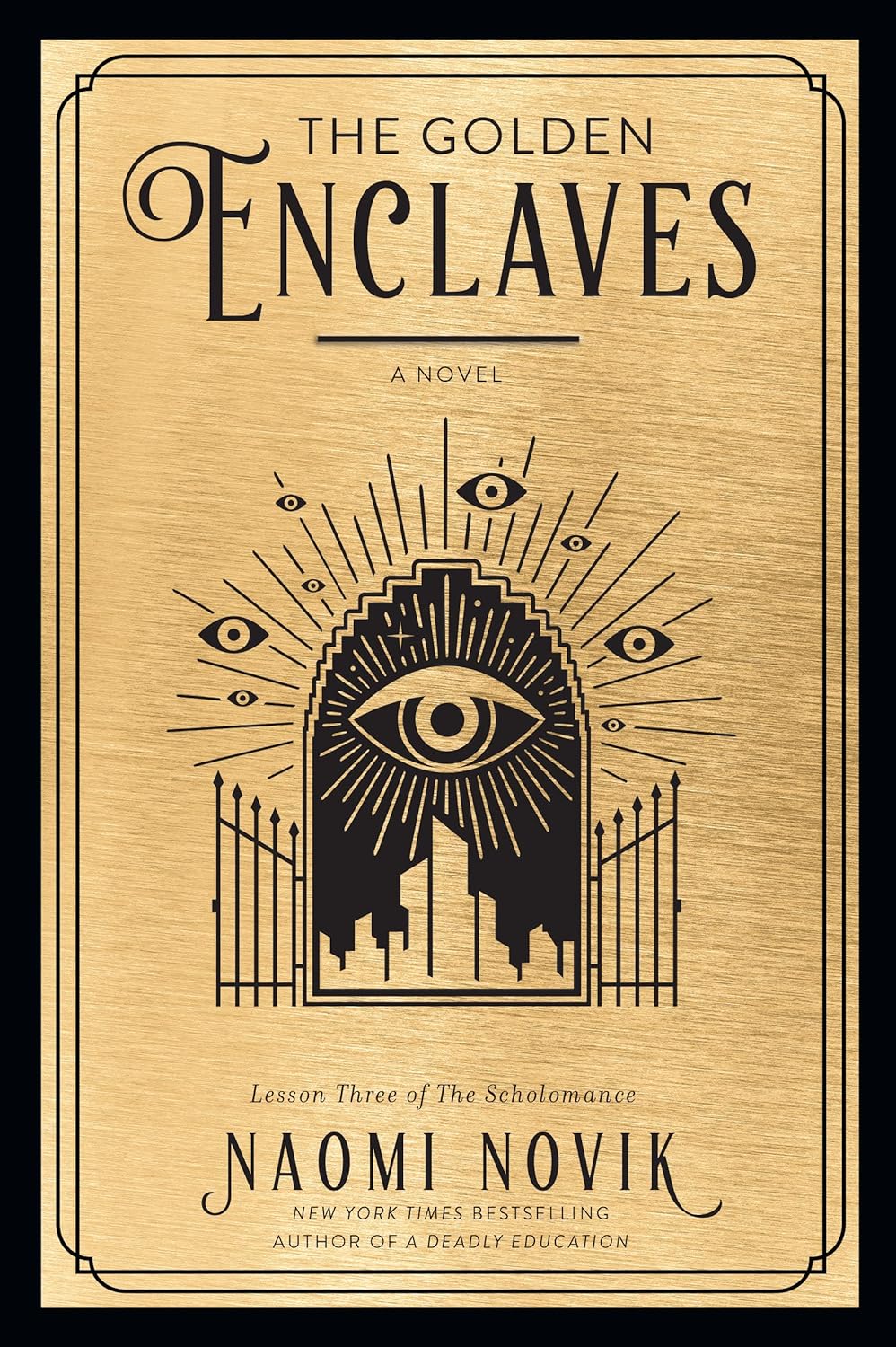
The Golden Enclaves by Naomi Novik

**Spoiler-Free!**

Following A Deadly Education and The Last Graduate, The Golden Enclaves wraps up the Scholomance series. I am very pleased with this conclusion and the whole series. For spoilers’ sake, this review includes practically no plot summary.

As a series finale, The Golden Enclaves takes on a lot, and involves a ton of action, ranging very widely in the ‘true’ geographic world as well as in the void and the magical spaces that populate Novik’s imagined world. A number of characters take great steps; this is indeed a coming-of-age for El, who has graduated from the Scholomance and achieved some real victories, but only to step out into a larger world where the monsters are decided not all neatly taken care of. She’s suffering some losses, not least in realizing the limits of her powers: she is one of the most powerful wizards ever, but there are still limits. We see her take less advantage of the friendships and alliances we’ve seen her form up til now, but also find news ones and/or revive some that have lain dormant.

I love about this whole series that it offers commentary on class divisions and the ethics of who gets to be safe and cared for in the world. Those themes are strengthened here, and complicated. There is a very pointed conflict of interests that she calls a trolley problem, of the highest order; El must face that she cannot (so to speak) save them all, that every choice has a cost. In the face of this frustration, she wavers, considers giving up. We have learned that El is incredibly strong and strong-willed; she doesn’t give up easily. But we have also never seen her tested like this.

I love the characters, including one or two who are still ‘rising’, coming to center stage. I love El herself so dearly; she struggles so hard with this book, even after having accepted help and friendship, and her struggles often yield some good snarky humor and fun amid the pathos. Novik has enormous world-building power, which was evidenced at the series’ start but is still at play here, because our understanding of the world (and El’s understanding of it!) must expand considerably in this book. I’d recommend her to anyone.


Rating: 8 bricks.

Silent City by Sarah Davis-Goff

In this darkly atmospheric novel set in a futuristic Dublin, a young woman fights for justice in an oppressive society ruled by fear during a zombie-like apocalypse.

Sarah Davis-Goff’s Silent City centers on a young woman faced with impossible choices in a post-apocalyptic version of Dublin. “To me, banshees are heroes. I saw images of banshees growing up at home on the island, women dressed in black, warriors. The ones who fight the skrake. HERE TO PROTECT, the grimy posters said.” Orpen was raised by her two mothers on an island devoid of other humans and, crucially, of skrake: monsters that bite, infect, and kill. The skrake “takes up your body and uses it like a puppet. Fast, vicious, strong, with long sharp teeth, the skrake is like a child’s bad dream.” Following the death of her mothers, Orpen ventures into a world she knows nothing about. She is bent on survival in this terrifying landscape of zombie-like beasts.

In the dystopian city that was once Dublin, she becomes a banshee, a member of the entirely female troops of paramilitary security forces ostensibly meant to protect, but actually used by “management” (entirely male, sinister, self-serving) to forage for supplies and keep other lowly citizens in check. Wallers work night and day, repairing and rebuilding the city’s walls against the skrake; the roles of farmers and breeders are equally humble. Banshees work in pairs: Orpen has found a surreal closeness and loyalty with her partner: “I never saw a woman who wasn’t sometimes beautiful, but Agata always is.”

The zombie apocalypse represents a possibly overdone subgenre, but Davis-Goff (Last Ones Left Alive) takes her readers into fresh territory here. Orpen’s struggles are not merely survivalist; raised with only two human companions and little context for other relationships, she must learn to chart new loyalties, friendships, and partnerships against existential questions of right and wrong. The city claims to provide protection and sustenance but, in fact, uses the banshees to commit atrocities and to exercise control over a subdued population, frightened into total silence lest they excite the skrake. Orpen and the women she serves alongside–all guilty of cruelties under orders–must balance loyalty against justice. “Those who can still feel for another, we feel it. I have to believe we do. I have to believe there are enough of us to change the world.”

Silent City is grim but hopeful, tackling questions of risk, trust, courage, morality, and sacrifice. Davis-Goff’s prose is stark but lovely. A strong feminist voice, austere circumstances, and a resolute sense of integrity make this dystopia memorable and inspiring.


This review originally ran in the August 25, 2023 issue of Shelf Awareness for the Book Trade. To subscribe, click here.


Rating: 7 dreams.

The Last Graduate by Naomi Novik

Book two of the Scholomance series was every bit as thrilling and engaging as book one. I love our grumpy, standoffish teddy bear of a protagonist.

El had good character development in A Deadly Education; now she’s continuing to develop as a person, both because she’s a teenager (coming of age) and because she’s made friends for the first time in her life. She’s reluctant to believe in this, because she’s endured a lifetime of trauma at the hands of almost everyone she’s ever known. Her new friends and allies do have something to gain from working with her at graduation, now that her power as a wizard is becoming more widely known, so she’s not entirely wrong to consider that this may motivate their friendship; but the reader can see better than she can that their friendship is real, too. It’s poignant to see such a sweet but enormously curmudgeonly, damaged, dear kid struggle to accept that people might actually care about her.

The privileges of class and nationality at work here, the power structures that are most invisible to those in power, and the injustice of it all, are more overtly at the center of this book. I think there are some good magical parallels to our real world here that can be instructive but also entertaining and fit neatly into the fantastical wizard-y world of Novik’s imagination, which is prodigious, by the way; this is expert-level worldbuilding. Late in the book the focus begins to move beyond the Scholomance to consider the whole world, which is clearly where book three will take us; this one ends on another final-line cliffhanger (!), so I’ll be getting there fairly quickly.

Perhaps because they were both Liz recommendations, I am reminded of the Murderbot series here, which also featured an outsider first-person narrator who is actually a loveable marshmallow on the inside but puts forward a hard, aggressively antisocial exterior. Despite being mostly rejected by their respective societies, both are driven to right the big wrongs. I do love this set-up, and I love El for being a hard-nosed, sarcastic badass.

In this installment, I actually questioned the YA label. The series does star teenagers, and deal with coming-of-age problems (therefore YA). On the other hand, it also deals with some very dark themes, heavy enough that some readers move it out of the YA category; but after some consideration, I don’t think that’s necessarily a disqualifier. It’s definitely for older kids, not least because there’s some (non-graphic) sex in this one. Maybe the line between YA and adult is blurred; certainly it depends on the reader. There’s no question that these are books for adults (hi), but I think they’re also books for young adults who are up for serious thinking on dark subjects, and some really good writing. This is a step adultward from Hunger Games, which are however very fine books in their own right. Who’s to say what kids should read, anyway? My parents didn’t seem to me to monitor my reading much, and I definitely read some stuff beyond my comprehension at a young age, and all that seems to have done is whet my fire. As ever, your mileage may vary.


Rating: 8 glaciers.

A Deadly Education by Naomi Novik

Another perfect recommendation from Liz, A Deadly Education is narrated by El, short for Galadriel, a wizard-in-training at the Scholomance. Her world looks much like ours, but you and I would qualify as ‘mundanes’ – people who don’t see or believe in magic. El is in school to learn spells and tricks and control, and as an independent wizard kid, possibly to earn an invitation to join an enclave. Wizards banded together in enclaves are much safer than indies like El, whose mother raised her in a yurt on a (mundane) commune in the Welsh countryside. But her mother Gwen is much beloved, a talented healer and source of all things good, while El’s affinity or tendency is toward large-scale destruction, as in mass murder. She is not a bad person: in fact she has spent her nearly three years in school working hard to keep her affinity in check, hiding the true extent of her powers, and making no friends with her eternally sour attitude. The tension within El between her natural affinity (murderous) and her value system (protective and good) is one of the central conflicts of this story.

Now the school itself: the Scholomance is full of terrors, like mals (short for maleficaria), monsters of all sorts; they live in the in-between spaces so that it’s dangerous to go anywhere alone, even to the bathroom, which is hard on a loner like El. Each year the massive, circular, magical space rotates and ratchets around so that the freshman dorms move down to become sophomore dorms, etc., and everyone gets closer to graduation, which is a euphemism for the seniors being dumped into a space filled with mals where they’ll have to fight their way out to real-world survival. Many of them won’t make it. Thus are your four years at the Scholomance taken up with working to form alliances to help you through graduation, unless you were lucky to come in an enclave kid from the start, with privileges and protections built in.

This accounts for several other intriguing conflicts within the novel: class and classism are up for debate within the enclave system. School in general is filled with petty jealousies and social politics, in ways recognizable to those of us who attended mundane high schools, and with the essential addition of life-or-death machinations re: mals and magic. There are plenty of larger questions about right and wrong and personal agency and what ends justify what means, but none of this is overtly or pedantically the point of the story: this is a page-turning, deliciously readable story of one awkward, socially ill-adjusted, fundamentally sweet but somehow also deadly teenager. El wants to secure her safe place in the world, but she really doesn’t want to hurt anybody. (Well, sometimes. She has a bit of a temper, and she does take a lot of abuse.) She also really wants friends, although she wouldn’t be quick to admit it.

It’s a great story, with some great secondary characters, including those cautiously interested in working with El, and the enigmatic oaf who wants to protect her. By the final chapters (which include some great action/battle sequences to boot) I was hooked and cheering. The last six words of the novel (!) contain a bombshell, and I cannot wait to start book two of this trilogy. Strongly recommend this one for awesome female lead characters, intrigue and world-building, fun magic, and poignant human drama.


Rating: 8 argonet teeth.

Maximum Shelf: My Name Is Iris by Brando Skyhorse

Maximum Shelf is the weekly Shelf Awareness feature focusing on an upcoming title we love and believe will be a great handselling opportunity for booksellers everywhere. The features are written by our editors and reviewers and the publisher has helped support the issue.

This review was published by Shelf Awareness on May 10, 2023.


My Name Is Iris by Brando Skyhorse (The Madonnas of Echo Park; Take This Man) is a chilling near-reality dystopian novel, set in an unnamed state that resembles California (and is called the “Golden State”). Protagonist Iris Prince is a second-generation Mexican American whose parents view her birthright as a gift and use the refrain “you were born here” to shame her whenever they feel her bad behavior shows a lack of gratitude. (“I am a second-generation Mexican-American daughter of Mexican immigrants, meaning that of course I was ungrateful.”) Born Inés Soto, she was glad to have her first name simplified by white schoolteachers, and then to take her husband’s last name. Iris is proud to be a rule follower, her highest ambition to blend in.

When the novel opens, Iris Prince has just left Alex, her husband of 16 years, and is determined to finally build the sanitized, magazine-cover life she’s dreamed of: a new house in a suburban neighborhood on a cul-de-sac, a new school for her nine-year-old daughter, Melanie. She has shunned her parents’ low-income home in a Spanish-speaking neighborhood (where her younger sister still lives, annoying Iris with her activism) and avoids Alex’s overtures at co-parenting or getting back together. Iris feels that her real life–coffee clubs, gardening, and white picket fences–is about to begin.

Then one morning, she looks out of her lovely new bay window to find that a wall has sprung up in her front yard. It seems permanently fixed, and no one but Iris and Melanie can see it. Her realtor and contractors claim the wall must have been there all along, until gaslit Iris wonders, “Who was I to say otherwise?” And, impossible as it is, the wall seems to be growing.

Meanwhile, a new piece of wrist-wearable tech called “the band” is sweeping across the state. Iris herself voted in favor of the proposition that established this technology as a paper-saving, easy identification to “facilitate paying for and receiving state and public services, act as a drivers’ license,… help users regulate a household’s water usage and garbage output, serve as proof of residency for your child’s enrollment in school, and potentially save the state millions of dollars.” But it turns out that, regardless of citizenship, one must have a parent born in the United States to qualify for a band. Iris’s confidence in her place in society is shaken. “Wear your bands and prove you belong here,” says the propaganda. Hatred, bigotry and intolerance quickly swell into violence. “Somehow, in an overnight or two, my social contract had been renegotiated. Politeness vanished.” Iris’s loyalties are challenged: she has long associated herself with law and order and the establishment, but those forces have turned against her, despite all her rule-following. Each morning she drops her daughter off at school, the band’s seductive glow encircling Mel’s slim wrist–due to Alex’s birthright, Mel qualifies for the privileges of the band. But Iris fears for her home and her job; her mother has been fired for her bandless status, and the family is in jeopardy. Under these pressures, Iris will have to consider just what she’ll risk to protect her hard-won sense of identity.

Skyhorse seeds his text with plenty of Spanish-language dialogue, especially with Iris’s parents and sister; non-Spanish-speaking readers will easily use context clues. In addition to this lovely linguistic texture, Skyhorse imbues his all-too-lifelike novel with fine details–Iris’s anti-nostalgia for a defunct supermarket, her love for bland ritual–and judicious use of highly impactful notes of the mysterious or the surreal. These twists of magical realism include a ghost from a childhood trauma who haunts Iris in her vulnerable moments, and of course the wall itself, which grows and morphs overnight. The wall is ever-present, at one point “almost like a co-parent,” even as it literally deprives her home of the sun’s light and heat, as well as her sense of security: “Later, when I would dream, I dreamed of walls.”

My Name Is Iris is terrifying with its proximity to reality. Iris is perhaps preoccupied with labels and appearances (as the book’s title forecasts), and not the most likable protagonist, initially; but her flaw is simply in seeking the American dream as it’s been advertised. Despite her obedience–teaching her child to always trust the police, adhering strictly to HOA rules–the world she’s trusted has turned on her. What can one woman do to fight a state security regime or a magically self-constructing wall?

This gripping dystopia poses difficult but important questions about the world as we know it and the few small steps it takes to slide into horror. Intolerance and xenophobia lurk in the most seemingly benign corners. My Name Is Iris is part social commentary and part thoughtful consideration of themes that include family, identity, transitions, perspectives, and hope. In addition to being an engrossing, discomfiting tale, this will make an excellent book club selection and fuel for tough conversations.


Rating: 6 chanclas.

Come back Monday for my interview with Skyhorse.