Cat on a Hot Tin Roof by Tennessee Williams

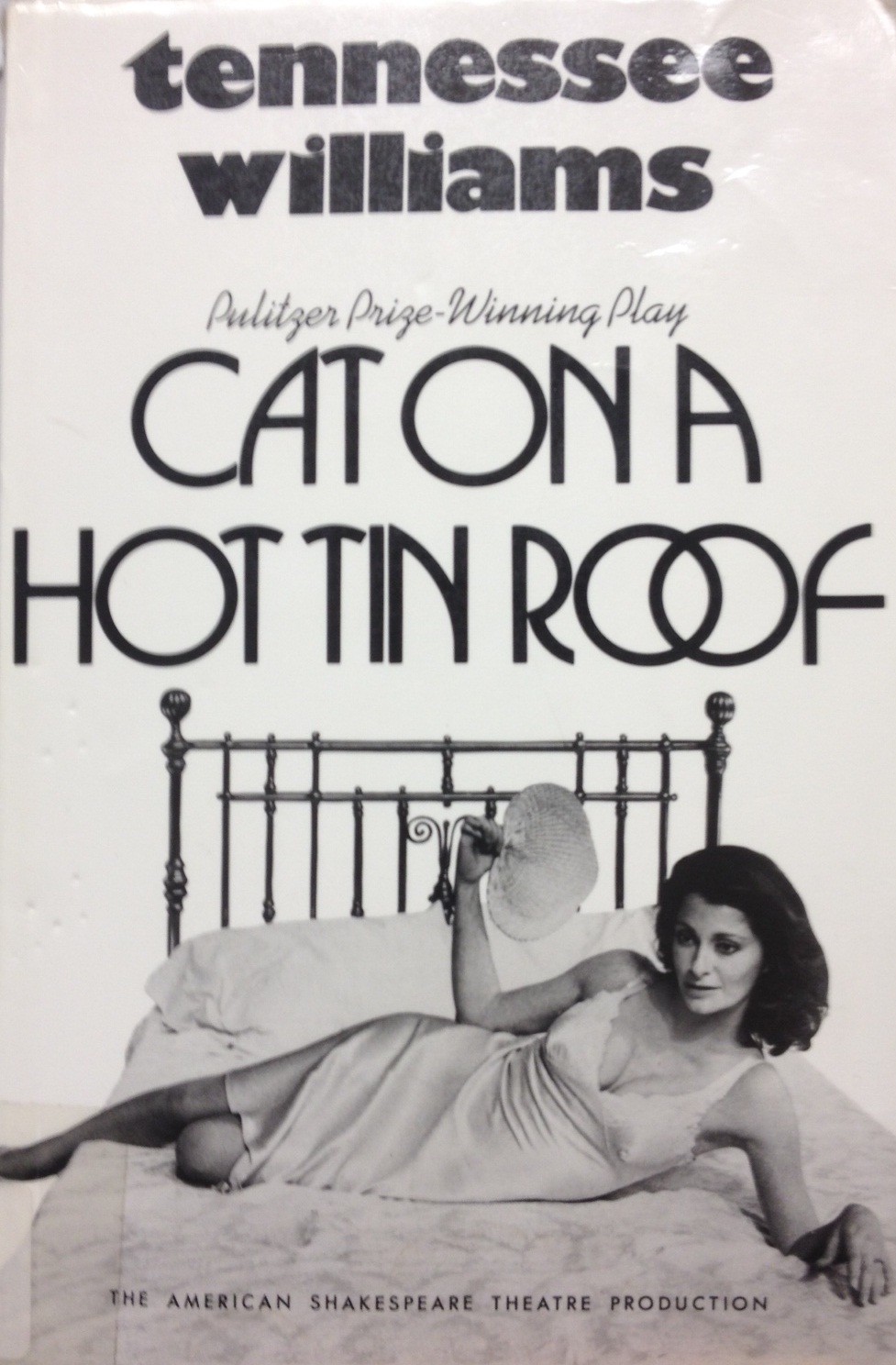
photo (2)Arguably Tennessee Williams’s best-known or best-regarded play, Cat on a Hot Tin Roof may be familiar to some of us for the 1958 film starring Elizabeth Taylor (shown on the cover of my copy from the local library) and Paul Newman. It won Williams the Pulitzer in 1955.

The action takes place in a few rooms and on the full-length upstairs gallery of a Mississippi Delta plantation home. In the opening scene, young wife Margaret is complaining to her husband, Brick, about his family: his brother Gooper (what a name!) and Gooper’s wife Mae are obnoxious people, with five children and a sixth on the way, bent on securing the plantation for themselves as inheritance, as Big Daddy is dying of cancer. Brick is no longer sleeping with Margaret, for reasons that go unexplained, at least by Brick himself. Margaret (and the rest of the family) are concerned with Brick’s drinking; and there is much innuendo directed towards his relationship with a now-dead friend named Skipper. The play, in three acts, with no break in time – so that the action of the play takes the same time as the playing of it – portrays discussions between various family members around these issues. Brick drinks too much; he doesn’t sleep with his wife; they’re expected to have a baby, at least one, to try and compete with Gooper and Mae’s outstanding performance in that department, despite which Brick is still the favored son. Big Daddy has been told he does not have cancer, but this is a lie to protect him, a lie that Brick exposes.

The nastiness of Mae is perhaps the least subtle element of this play – she is every inch a schemer – but overall it’s very well balanced in terms of what is said and what is left unsaid. The greatest victory Williams scores here, in my opinion, is atmosphere. It’s hot; there isn’t enough air flow, and the characters are mostly anxious to keep doors closed so that other family members don’t hear what is said. There are many secrets: the extent of Brick’s drinking; Margaret’s infidelity with Skipper (intended to prove his sexuality); the question of Brick’s sexuality; Big Daddy’s diagnosis of advanced and inoperable cancer. The secrets and the hot, still air are claustrophobic; and add to this “Maggie the Cat”‘s sensuality, her desire for her still-attractive husband, and her attempts to get him back into the marital bed, and we have a sultry, charged scene.

I observed about this play – but I think it’s true of all Williams’s work – that he writes quite lengthy and detailed and imaginative stage directions. There is almost a novel living within this play, so much does he put into his narratives about scenery and the manner the actors should take. It also occurred to me that some of his directions to the players were fanciful and difficult to act out; for example: “Big Mama has a dignity at this moment; she almost stops being fat.” How is Big Mama’s actor supposed to play that out?? On the other hand, Williams often releases his characters (more typically of a play script) into dialogue or monologue and lets them run. I think the characters we meet here are very well matched to help one another release truths, or hide them, or release untruths, as they will.

There’s no question that this is a beautiful piece of artwork, and another that I would very much like to see performed.

Themes include “mendacity,” as Brick continually refers to it: most overtly in regards to Big Daddy’s prognosis, but also relating to the inheritance that Gooper and Mae want so badly; Brick’s relationship with the late Skipper; and his relationship with his wife, and their likelihood of having children. A more understated theme, but one that shouldn’t be overlooked in the face of Williams’s own relationship with alcohol, is Brick’s alcoholism. This is something he doesn’t work particularly to keep hidden; the family is aware that he drinks a lot, but Big Daddy is surprised to hear about the “click” in Brick’s head that he needs before he can feel all right, and that can only be achieved by drink. I didn’t bother counting the drinks Brick takes before he feels the click, but it’s quite a few, and I believe was finally reached by three shots in quick succession. The poor guy. Adding to the claustrophobic, anxious, heated atmosphere I described above, Brick is on crutches, having twisted an ankle recreating his youthful athletic triumphs while drunk the night before; and instead of sitting and resting it, he’s jumpy, can’t stop moving. The people who want to communicate with him (Margaret, Big Daddy) try to take his crutch away to still him, but he continues to hobble. I think there is clearly some symbolism there. This wouldn’t be the same play if Brick weren’t crippled, or if he were to sit docilely and put his foot up on a pillow.

Another achievement for Tennessee Williams; and can someone produce this one locally for me, please?


Rating: 8 trips to Echo Spring.

Clothes for a Summer Hotel by Tennessee Williams

clothessummerhotelHere’s how I got here. First, the disappointing Z: A Novel of Zelda Fitzgerald, as a consolation prize, renewed my interest in the Fitzgeralds. (I have purchased, used, two biographies of Zelda based on the interest piqued by Z – the ones by Cline and Milford, respectively.) And next, I read an excellent book called The Trip to Echo Springs by Olivia Laing (sorry, it’s not published til January; you’ll see my review closer to then), about the alcoholism shared by, among others, Fitzgerald and Tennessee Williams. From Laing I learned that Tennessee’s last play, entitled Clothes for a Summer Hotel, dealt with the Fitzgeralds, with Zelda at center stage. And here we are.

Apparently this is not one of Williams’s better-regarded plays, and I suppose it does lose out to the likes of The Glass Menagerie; but I found it a fine work. It is first and foremost dreamy – Williams calls it a “ghost play,” referring to the chronological liberties he takes with the Fitzgeralds’ lives. Scott visits Zelda in the North Carolina asylum, Highland Hospital, where she died; his visit takes place just before her death, at which point he would have been dead more than 7 years. But this is no great concern, because many of the characters who take the stage are dead at different times, and yet walking and talking. The extent to which they are aware of this fact varies, or is unclear. The timing is not chronological; they zoom backwards from the asylum, to Paris of the 1920’s, and then forwards again. Zelda’s death is outside the action of the play, but heavily foreshadowed throughout. She died in a fire, locked in her barred room on the top floor; Williams, and his Zelda, are here obsessed with fire, and wind, and refer to both throughout.

I found Scott and Zelda here to be true to what I know of them, and I found Williams’s portrayal to be nicely fair in accusing them both of madness or alcoholism, and yet sensitively making allowances at the same time; which seems to me to be the proper treatment. With Williams’s stage directions, even though I was merely reading a written play, I could picture the stage set, treated with wavering ribbons, wind, and smoke (from dry ice, Williams notes), and I could feel the effect these props would have of blurring the lines between past and present for the half (or more) crazy characters onstage. I found it all rather magnificent, and I would like to see it performed, although I suppose that’s unlikely, with Williams plays like Cat on a Hot Tin Roof and A Streetcar Named Desire to compete with. Ah well.

Tennessee Williams’s reputation as a fine playwright is confirmed here. And my interest in the Fitzgeralds continues.


Rating: 7 rubies.

movie: A Streetcar Named Desire (1951)

On my recent very very long overseas flight, I watched several movies. Thanks Husband for spotting this classic for me! As you may know, A Streetcar Named Desire was a play by Tennessee Williams, published in 1947. I have not read the play, although I studied his Glass Menagerie in high school and appreciated it. Now that I’ve seen the movie, I want very much to read the original, and I would love to see one of TW’s plays performed one day. This film was released in 1951, directed by Elia Kazan, and stars Vivien Leigh and Marlon Brando – wow! [Also in high school, I studied Kazan’s On the Waterfront, alongside Arthur Miller’s The Crucible. Guess what the connection there was.]

You can get a plot synopsis anywhere, so I’ll be brief and spoiler-free. Blanche DuBois shows up at her sister Stella’s apartment in New Orleans from the plantation back in Laurel, Mississippi. She tells Stella that the plantation has been lost and she needs to stay a while. While Blanche is a delicate, swooning southern belle, and Stella a tougher urban woman, Stella’s husband Stanley is all muscle and sensuality. He has no patience with Blanche’s needy weakness, and her presence throws the small household out of balance, just as Stella is expecting a child. There is conflict. I’m stopping there.


This is a masterfully put together film. I positively adored the black and white French Quarter setting: although more than 50 years old now, it was instantly recognizable. I could almost smell the booze and feel the humid heat. Vivian Leigh, Marlon Brando, and Kim Hunter (Stella) are all so perfect, picturesque, and work as archetypes of the characters they play. Kazan is a master of the use of light and dark. Blanche undergoes a metamorphosis of sorts when moving from shadow to light – there is a dramatic scene dealing with the issue. And while I’m on dramatic scenes, the style here is highly melodramatic, with Blanche being the perfect example of what that means: fluttering hands, shrieks and gasps and exclamations, “OH! I just don’t know how I can take it…”, all of which are perfect for her damaged-southern-belle role. And perhaps this adds to the melodrama, but clothes sure do tear easy in this movie. I gave up counting the clothing that got ripped in the action.

Here’s a quick discussion with spoilers. Highlight the following white text to read: I was a little maddened by not knowing whether Stanley raped Blanche in that fade-to-black scene. So I looked it up. Wikipedia tells me that it is indeed only “implied” in Williams’s original. They certainly carried the implication into the film. I think he did rape her. I also learned from Wikipedia that Blanche’s husband had a homosexual affair prior to his suicide, which I had not gathered from the movie; and sure enough, it is later stated in the article that this detail is left out of the film, because of the Hays code. This is unsurprising in context, as I recall from high school that Kazan was a good, government-compliant filmmaker.

Tennessee Williams is absolutely recognizable to me from The Glass Menagerie: he likes his damaged and increasingly crazy southern belles, and their gentlemen callers, doesn’t he? I felt I’d seen Vivien Leigh deliver her closing line before: “I have always depended on the kindness of strangers.” But I’m sure I hadn’t. Maybe it’s just that famous.


As a piece of excellent directing and acting by all three leads (and isn’t Brando smoking hot), and as a fine production of a very fine play, I give this one a near-perfect rating and recommend it as a classic film.


Rating: 9 fluttering eyelids.

Ajax by Sophocles, trans. by E.F. Watling

I read Ajax from my copy of Electra and Other Plays after being reminded of his tragic story by Madeline Miller’s The Song of Achilles. It is a short play, an easy read, but like so many of the greatest ancient Greek works, very sad.

Ajax was one of the great Greek heroes of the Trojan War. Indeed, Miller says several times in her book (in the voice of Patroclus) that he would have been The Greatest if it weren’t for Achilles – kind of a poignant thought. He’s like the Jan Ullrich of the Trojan War. This play by Sophocles dramatizes the action following Achilles’s death, as known to myth. The background: Achilles quarrels with Agamemnon and boycotts the war; Greeks are dying; Patroclus goes to battle disguised as Achilles to get everybody going again; Hector (the great Trojan hero) kills Patroclus. Achilles is enraged, takes the battlefield, and in turn kills Hector, thus putting into action the prophecy that Achilles himself will die shortly thereafter. He does: killed by an arrow fired by Paris, who started all this nonsense in the first place.

With the Greeks’ hero Achilles dead, it is time for Ajax to shine. But Agamemnon chooses to award Achilles’s trophies of war, not to Ajax, but to Odysseus. Ajax is furious. And now begins the play…

Ajax has determined to kills the sons of Atreus (Agamemnon and Menelaus), Odysseus, and all the Greeks who have failed to honor him as he feels he deserves. He goes on a killing spree overnight. But Athena, good friend especially to Odysseus, tricks his eyes so that he ends up killing a bunch of livestock and no human Greeks. As the play begins, she is explaining this to Odysseus, offering him the view of Ajax, mad, blind, confused, killing sheep and calling them Greek names. Odysseus balks, but we end up seeing the scene. Ajax comes to his senses, sees how he has been shamed, and immediately begins planning his suicide. The Chorus (that tool of Greek drama, the group of citizens that comments on the action) and Ajax’s wife Tecmessa try to talk him out of it, reminding him of the pain his parents would feel, and the dubious fate of Tecmessa and their son if left without husband/father. He seems to change his mind, and goes offstage. But then his brother shows up, distraught, citing a prophecy that Ajax will die today. The scene shifts to watch Ajax bury the hilt of his sword, make a short speech, and throw himself upon it.

Tecmessa and the Chorus mourn; Ajax’s brother, Teucer, mourns, and plans to bury the body. Agamemnon shows up and makes disparaging remarks, commanding that the body of Ajax not be buried at all. Now, I’ve read these things before, and (ahem Antigone) you’d think these characters would have learned by now: you have to bury the dead! The gods are mightily displeased if you do not. This is an important tenet of custom and piety. Luckily, Odysseus next arrives on the scene. He had been insulting Ajax earlier, declared him an enemy, but here he lives up to his reputation for wisdom: Odysseus talks Agamemnon into allowing a reverent burial, and the grief-stricken family of Ajax carries on with their ritual. It seems that Teucer will take care of Tecmessa and her son.

I find this to be a moving story, despite the removal of centuries and the difference of cultures… I guess I’ve read enough related myth that I have learned to identify with it. I love the stories of gods and heroes, how they’re all interrelated and how the actions of one generation can effect so many generations to come. (See the above reference to the House of Atreus. That man’s impious mistake will continue to cost his offspring – just watch what happens to Agamemnon when he gets home from war.) And I mainly read Sophocles (et al) for the stories… so I had to remind myself to slow down and appreciate the language, too. I think I prefer the poetry of Homer, but I can just imagine actually seeing this performed… that would be a treat.


Rating: 6 dramatic gasps.

Othello by William Shakespeare

Wow, what a work. There’s a reason we still read, admire, study, and act this play today, what, 4 centuries after its creation. I read this, like The Taming of the Shrew, years ago, but I needed the refresher for the performance I’m going to see tonight.

What can I say about Othello? Othello is “the Moor,” a general in the Venetian army. He has happily married the beautiful Desdemona, and they have set out together to Cyprus where Othello has been posted. They are a happy and loving couple, but Shakespeare gives them a tragic fate. There are men about who do not wish them well. Iago is the main villain; he is jealous of Cassio, who Othello chooses as a second in command. He uses Rodrigo, who wanted to marry Desdemona, as a pawn. Iago tricks Othello, who believes him to be a faithful friend, into thinking that Desdemona and Cassio are lovers. He convinces Rodrigo that Desdemona will be his if he will just kill Cassio; really, Iago wants them both dead, and also encourages Othello to kill his wife. His intention is to gain himself political power. He also uses his wife, Emilia, servant to Desdemona. The handkerchief is the fateful detail: Othello gave it to Desdemona; Iago obtains it and plants it on Cassio; and it seals the innocent, saintly Desdemona’s fate. The final tragic scene ends with Othello’s murder of Desdemona, his discovery of Iago’s treachery, and his suicide.

It is classic Shakespearean tragedy, reminiscent of Romeo and Juliet in that final scene as Othello laments over his beloved wife’s body. The important difference, of course, is that there was no murder in Romeo and Juliet; Othello cannot be an entirely sympathetic character. It is especially frustrating to hear the faithful Emilia argue Desdemona’s innocence and have Othello reject it. But Iago, as I said, is the real villain; Othello is victim to his machinations.

I enjoyed this play all over again and always recommend it, as I do all of Shakespeare’s work. I’ve always been a big fan. I tend to think that I prefer the comedies, but in rereading his tragedies I find the same genius and the same ability to wrench my emotions in the desired direction. He was truly a great artist. I do have a fondness for the comedies, though; I forget, until I see or read them again, how accessible and universal the humor is. Last summer I went to A Midsummer Night’s Dream as produced by the Houston Shakespeare Festival, and marveled, once more, at how appealing, funny, and fun it is. Please! If you’re in Houston, don’t miss this annual summer event. Again, this year they’re producing Othello and The Taming of the Shrew, and it’s FREE, and you can sit on the hill with your dog and/or your picnic dinner and/or your beer, wine, whatever. Couldn’t be better. Check out the Miller Outdoor Theatre schedule for details.

The Taming of the Shrew by William Shakespeare

I am sure I have read this play before, because I have some vague memory of it; but I don’t know when. My reread is inspired by the Houston Shakespeare Festival: I’m going to go see both this, and Othello, in the next week. Fellow Houstonians, don’t miss this event! These two plays are both showing 4-5 times, in the next 8 days or so, at Miller Outdoor Theatre. For FREE. It’s an awesome summer tradition; I’ve been attending the Shakespeare Fest every summer since I was small. Don’t think I’m going to find time to reread Othello, sadly.

So. The Taming of the Shrew is not one of Shakespeare’s most famous plays (and was rather hard to find at Half Price Books. Lots of Macbeth, Romeo and Juliet, Midsummer Night’s Dream. Thus my very sweet, but visually unstimulating, little Yale Shakespeare blue cloth-bound hardback, pictured), but I think it’s a nice little romp. It’s a comedy involving two sisters: Bianca, the younger, has several suitors; she is attractive and admired. Her older sister Katherina, however, is very difficult, sharp-tongued, scolding, and generally unattractive to prospective suitors. Their father Baptista forbids any suitors to Bianca until such time as Katherina is married. I’m not entirely clear on whether it was his express intention or not, but the result of this is that Bianca’s suitors set out looking for a husband for Katherina, aka the shrew. They find a willing suitor, Petruchio, who feels that Kate’s wealth is worth the fight, and he has a plan. Thus the title: Petruchio sets out to tame the shrew, using such ugly, abusive, domineering, insane behavior that she gives up being “shrewish” and submits to his every desire, agreeing with any crazy thing he says. (The sun is the moon. An old man is a beautiful young maiden. Yes, husband, anything you say.) Petruchio weds, and tames, Kate; sundry other characters wed too. Lucentio marries Bianca, and Hortensio marries a widow (also for her money). The three new husbands make a bet on their wives, as to who can be shown to be most obedient. Petruchio’s reformed shrew wins him the bet, and she ends the play with a speech arguing that a woman should serve and obey her “lord” (husband).

There has been much controversy over this play, pretty much since it was born, regarding gender/marital roles, misogyny, feminism. I’m a bit inclined to agree with the camp that says Shakespeare was actually on the women’s side and was being instructively tongue-in-cheek, but mostly I’m willing to sit back and hear what you think; I don’t find it entirely clear what Shakespeare had in mind, from this distance. (I never did finish Fraser’s Young Shakespeare and thus have not started his Shakespeare: The Later Years. I found the writing awfully dry. If I ever finish these, or find a more palatable biography, perhaps I’ll take a stab at pretending I know what he had in mind. Until then, I am agnostic on this point.) At any rate, it’s an interesting study. Yes, Petruchio’s treatment of Kate is offensive; yes, her final speech makes me shiver. But she wasn’t a respectably independent woman early on; she was just kind of bitchy. Neither of them is sympathetic. So, it’s not as clear-cut as, Petruchio destroys Kate’s fine and virtous strong-woman spirit, or anything.

At any rate, I’m almost certain the upcoming performance will be the first time I’ve seen this play onstage, and I look forward to seeing how the Festival handles the political problems of The Taming of the Shrew. You can expect to see my write-up of the show soon.

Anybody read this play? How do you react to the chauvinism?