movie: Muscle Shoals (2013)

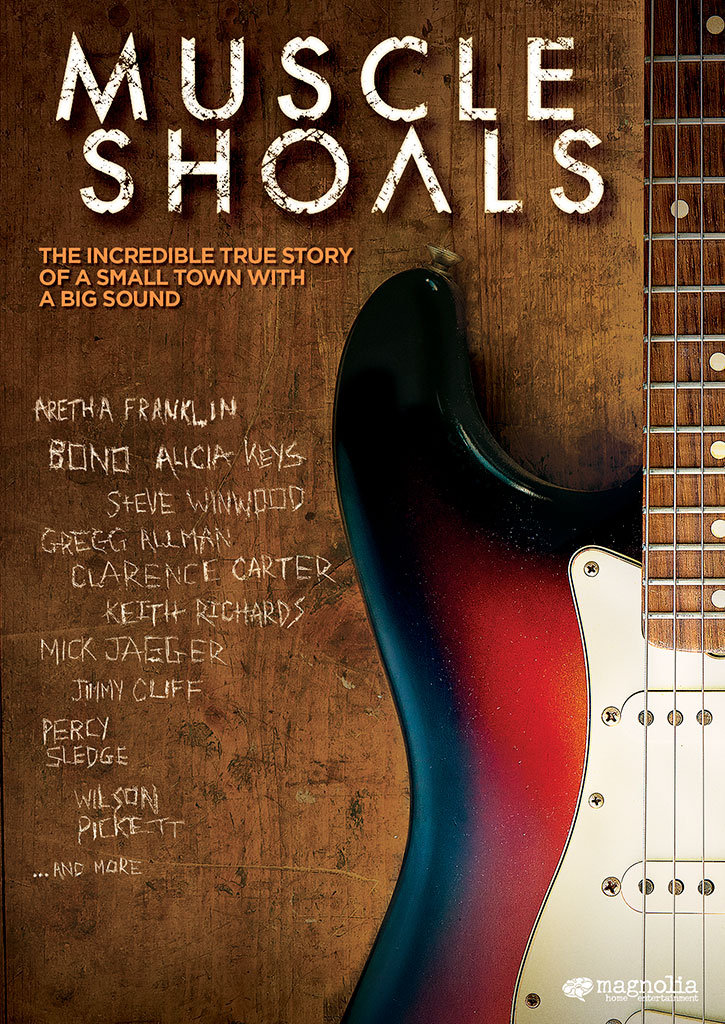
muscle shoalsFollowing up on The Secret to a Happy Ending that we watched the other night, I finally found the time to watch this 2013 documentary, too. I’ve been hearing about it for the last two years and knew I needed to see it, and now I’m passing it on: go see this film now.

Muscle Shoals is about the town in Alabama of the same name, a small place, a backwater, where some of the greatest American music ever has been recorded. It’s full of beautiful cinematography portraying the natural beauty of the place, and full of impressive musicians talking about the special magic made there. The list of contributors is formidable: Gregg Allman, Clarence Carter, Jimmy Cliff, Aretha Franklin, Rick Hall, David Hood (Patterson Hood’s dad), Mick Jagger, Alicia Keys, Ed King, Spooner Oldham, Keith Richards, Wilson Pickett, Percy Sledge, Candi Staton… and that’s a who’s who of who is in the movie, not who recorded there. That list is longer and more impressive. There are also video footage and audio tracks from back when history was being made at FAME Studio and later at Muscle Shoals Sound. The whole thing is guaranteed to give you goosebumps. You can view clips here; but really, you want to go find the whole thing.

The morning after, I ran out to my local record store and bought albums by Etta James, Wilson Pickett, the Allman Brothers, and Lynyrd Skynyrd. What will you buy?


Rating: 9 tragedies in Rick Hall’s life, whew.

movie: The Secret to a Happy Ending (2009)

From the band’s website:

This is a film about the redemptive power of rock and roll; it’s about the American South, where rock was born; it’s about a band straddling the borders of rock, punk and country; it’s about making art, making love and making a living; it’s about the Drive-By Truckers. This film documents the band and their fans as they explore tales of human weakness and redemption. With unparalleled access, this documentary encompasses three critical years of touring and recording as the band struggles to overcome trauma and survives a near breakup, in a persistent search for a happy ending.

secret to a happy endingThe Drive-by Truckers are one of my favorite bands and one that has had an impact on my life and how I look at my world. It is a love I share with the Husband. We saw this movie in a theatre when it came out to town, back in Houston. We bought a copy of it on DVD, too, and now I am in this writing class and working on a long essay about the Truckers and what they mean to me; so as research, we watched the movie again at home.

Obviously and basically, I love the movie because it is a distillation of the band. The filmmaker was lucky to have the Truckers’ cooperation, and followed them to several shows, recording live footage; and interviewed all the band members repeatedly, as well as some of their families. Cultural authorities like a university professor (and obvious DBT fan) and music writer get screen time as well. This is a fan’s documentary, and I think fans can’t help but be pleased by it. Non-fans are liable to become fans… but then, I’m biased.

I like that the movie captures a moment in the life span of this long-lived band, reviewing the early years (including the band Adam’s House Cat, where the two lead men, Patterson Hood and Mike Cooley, originally played together) and then getting into a few difficult years, when bassist Shonna Tucker and guitarist/singer/songwriter Jason Isbell divorced, and Isbell left the band. (He’s had an impressive solo career since. Look him up.) One of the things I’ve come to love about DBT is how many layers there are to love, investigate, and appreciate – like the people involved. The story of Shonna and Isbell breaking up is maybe none of my business; but you can bet all the band’s fans followed it and had feelings about it, nonetheless. For the record, I blame no one and wish them both the best.

It’s a hell of a good movie, and even if you’re not a Truckers fan, I think it’s a fine documentary about rock-and-roll (and other things too). It pulls my heartstrings.


Rating: 9 songs.

I hope this is not too off topic, but I want to share a short piece that didn’t make it into my longer essay about the Truckers and their impact on me.

I have a large tattoo covering my right arm and shoulder: a tree and its surroundings and inhabitants: fallen logs, grasses and flowers and mushrooms, a bunny rabbit, a snake, a squirrel, a turtle, a weasel, a fat yellow songbird. On the front of my shoulder, the tree’s branches part around a Cooley bird. Around the back of my shoulder, wrapping onto my back, a black owl with red eyes flies away, departing. It’s the same owl that my husband Chris has tattooed on his left bicep, flying above a leafless tree on a burnt yellow desert and under a spooky moon that looks down with knowing eyes and a slight smirk.

These tattoos borrow images from Wes Freed, a Virginia-based artist who has drawn all the art for all the Drive-by Truckers’ albums, posters, website art, promotional material, backdrops, and etc. since time immemorial (or at least the Southern Rock Opera album of 2004). He is the band’s brand. In a documentary about the Truckers called The Secret to a Happy Ending (whose cover art he also created), he says: “It’s always about the music. The music is the most important thing. But there’s so much going on with the records. It’s cool to be able to have the opportunity to illustrate the songs. That’s cool.” Wes Freed. I love that his named is a sentence: Wes Freed; or else a description: Wes, Freed. And the songs are themselves filled with dark and toothsome images. I did my own (very poor) copy of Freed’s illustration of “The Wig He Made Her Wear,” a song based on true current events in which a Tennessee preacher’s wife kills her husband: in court, her lawyers then displayed “them high-heeled shoes and that wig he made her wear,” as evidence of how abused she had been before she just snapped. Freed portrays a woman in a see-through negligee and high-heeled pumps, blue hair piled and stacked high, holding a shotgun whose smoke swirls around to caress her against an enormous yellow moon. A monkey in a fez cavorts behind her. I’ve looked and looked for Freed’s illustration of this song on the internet, but it seems to have disappeared; all I have is my poor imitation.

Thanks for reading.

movie: She’s Beautiful When She’s Angry (2014)


I’m really pleased to have gone to see this movie locally with my dad. It was so good that I went back a few days later to see it again with my mom, so now it’s a family affair (as these things should be). She’s Beautiful When She’s Angry is a recently produced history of the women’s movement of the 1960’s and 70’s. It was nice to see it with my parents, who were there, and involved.

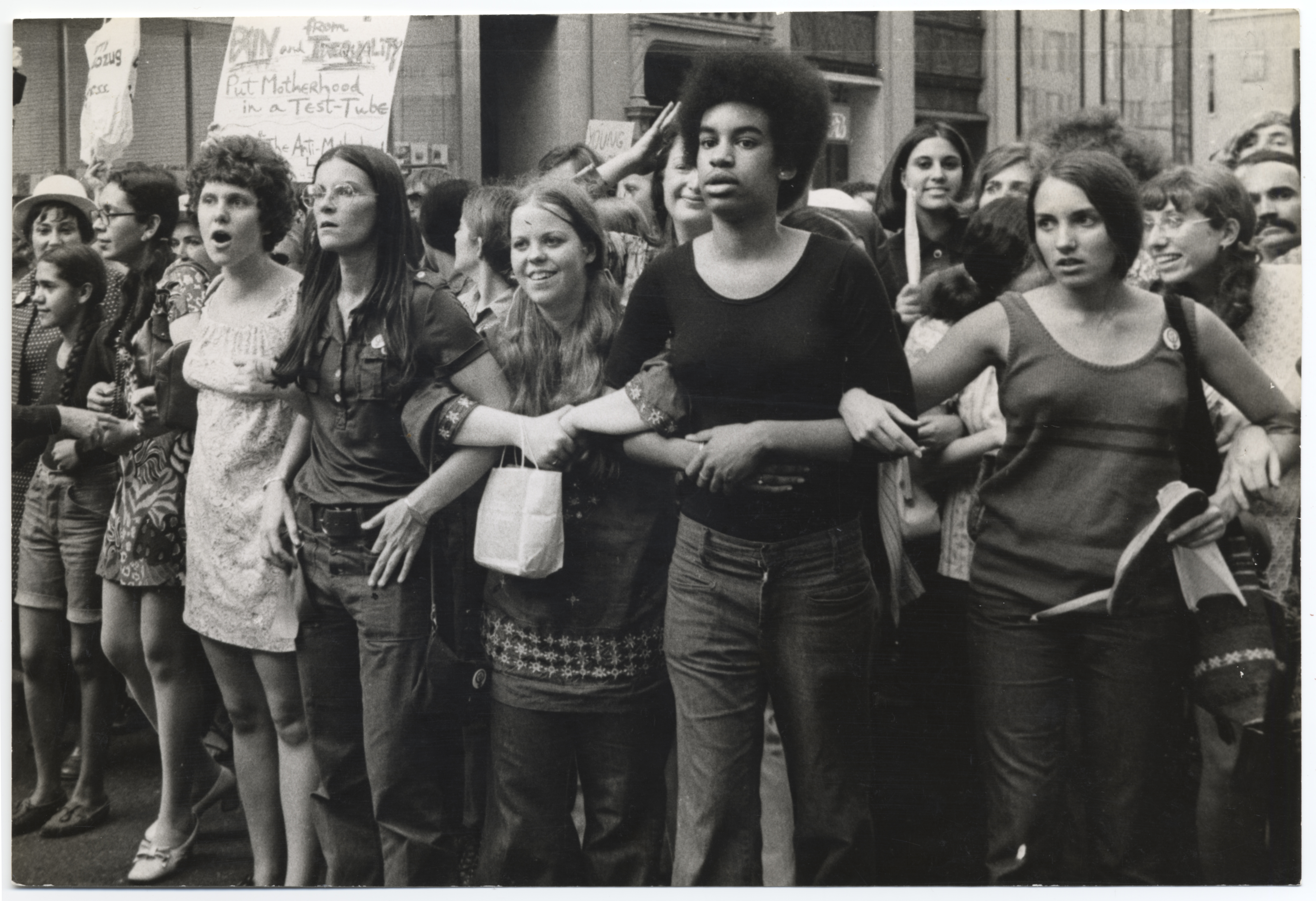
The movie includes historical footage of protests, speeches, news media, and interviews; contemporary interviews of activists who were involved in that history; the odd performances by actors; and reenactments. So many things struck me, and I’d like to point out that while I was often shocked by the horror, and the bravery, I was not surprised. Does that make sense? For example, the divisiveness of the movements – civil rights, women’s rights, peace – is unsurprising but will shock and dismay me every time. When a woman leader got up to speak in front of a crowd of “New Left” men, and they booed and catcalled her, I was (sadly) unsurprised, but astounded nonetheless. When the women’s movement ostracized its lesbian members, likewise.

"Lavender Menace," photo credit: Diana Davies, accessed here

“Lavender Menace,” photo credit: Diana Davies, accessed here

I enjoyed learning for the first time about the “Lavender Menace” action at the Second Congress to Unite Women in New York City on May 1, 1970. The need was unfortunate, but the demonstration was great fun, gave me joy. For that matter, another of the revelations of this film, for me, was the sense of fun associated with certain direct actions throughout the movement: that’s a part of the story that I hadn’t heard before, I don’t think. I also didn’t know how close we had gotten to having legislation passed supporting universal child care (thank you Nixon for this among other criminal shortcomings).

The first night I saw the movie, it was followed by a panel discussion with faculty members from local Western Washington University. These women were younger than I’d expected, in their thirties and forties, and the theatre was sold out – all good signs. We touched on the movie’s title: a criticism of the patronizing statement that we’re cute when we’re mad? or a sincere celebration of every woman’s beauty as she pursues right? (I think it’s both.)

I’m glad to have been reminded of that slogan of the women’s movement, that “the personal is political.” I’ve used some variation on this myself, because it makes so much sense: when politicians talk about forcing ultrasounds, we are quite literally talking about the inside of my reproductive organs; what could possibly be more personal? And I’m sure I knew on some level that I was citing my parents and their fellows, but I’m glad to have been reminded.

I cried when the movie got to present-day Texas, all those women in the capital protesting Senate Bill 5. I’m sorry I wasn’t there; I should have been there. Other interesting or affecting points in the film: the portrayal of our rage as a good thing (when emotion has come to be something we’re supposed to be ashamed of); and the excellent statement that the United States doesn’t like to credit radical movements with positive change in our history. Of course this only makes sense: it doesn’t behoove the powers to acknowledge that protest and civil disobedience do good. But revision of our history is a vile and insidious weapon being used all around us, and it bears noting (over and over again). Another statement of the film – I forget who made it – is that merely speaking truth aloud is a revolutionary and powerful act. Let’s not forget it.

"8-26-1970 March," photo credit: Diana Davies, accessed here

“8-26-1970 March,” photo credit: Diana Davies, accessed here


Thanks, ladies. I owe you.


Rating: 9 consciousness-raising groups.

movie: Pedal-Driven: A Bikeumentary (2011)

pedaldrivenI can’t remember who told me I needed to see this film. Thank you, whoever you are.

Pedal-Driven is a documentary about the relationship between mountain bikers and the US Forest Service, regarding the former’s right or privilege to recreate on public lands. The conflict is fairly well summed up early on: public lands are our lands, so we want access to do what we like on them; but on the other hand, we (mountain bikers or mtbers) are not the only user group in “the public,” and even beyond present-day users, the USFS (Parks services, etc.) feel a responsibility to a future public as well. Therefore the needs/wants of today’s users (mtbers and others) are balanced against a need for conservation and preservation.

The USFS doesn’t want to be entirely anti-mtber, but they can’t condone the practice of building trails on public land without permission; this is illegal. But what is a mtber to do? To go through the proper channels is a 5, 10, or even 15 year process; at some point, we’re building trails for our kids to ride, which is nice for them, but who knows if we will get to ride those trails at all. Then again, builders of illegal trails risk having their work torn down at any moment.

While I’m not particularly on the side of illegal activities – and illegal building of anything on public land rubs me the wrong way – I sympathize with the mtbers, obviously, as I am one myself and understand the desire for trail to ride. Without trail, we can’t be mountain bikers. As I summarized them in my first paragraph, all those user groups indeed deserve their rights and their voices being heard. It’s a sad quandary. This film was in danger of just depressing me, early on, with the stalemates portrayed (centrally in Leavenworth, Washington, not far from where my parents have recently settled; also in the loss of trail systems in Montana). But it does circle back around to success stories like those in Oregon; hope is not lost.

I will say that, for me, one weakness in this film is in its specificity to freeriders. Freeride is mountain biking that involves jumps, tricks and stunts; it generally requires what we call “structures” (bridges, dirt jumps, big constructed berms, skinnies, teeter-totters), and structures are a good part of the USFS’s problem with illegal builders. Don’t get me wrong; they wouldn’t let you build natural-surface trail, either, but I think it would be less offensive than the construction in question. To give you some idea:

freeride(photo credit)

freeride, from the film (photo credit)


bridge work (photo credit)

bridge work (photo credit)


wooden berm (photo credit)

wooden berm (photo credit)


Talking about building freeride-style trail with structures, then, is a certain kind of conversation. And it has left out the even larger group of cross-country (XC) mountain bikers: this activity is performed generally on natural-surface trails (bridges thrown in for function – to cross a stream or gulley – rather than for the chance to catch air), and keeps the rider mostly on the ground or close to it. XC riders look different from free-riders: no full-face helmets, different bikes, even sometimes brightly-colored spandex. These are generalizations, and there are exceptions, and there’s crossover between the two groups; but the point I’m trying to make is that as an XC rider, myself, I felt a little left out of the story that this film tells. And that’s a shame; because really, we face the same challenges in using public land, in trail construction and access and our relationship to the public and the government. I would have appreciated a little more inclusive story being told here. On the other hand, maybe there isn’t such a story about XC riders – maybe our conflicts haven’t been played out so dramatically or on such a scale, or such a stage. I’m honestly not sure. And I haven’t been deeply involved in advocacy battles as of yet (except on a local scale where I’ve done some volunteer trail work), so I want to be clear, I’m not criticizing the fine folks portrayed in this movie. Their work can only benefit my kind of rider, too. And you never know, I may find myself in a full-face helmet high up in the air one of these days too! Who knows what the future holds?

As a film, I found Pedal-Driven to be very well put together and visually impressive. I had a few minor gripes with the soundtrack (some of it was great!), but you can’t please them all in that respect! I enjoyed seeing the riding, and I ended up on the hopeful side regarding access and advocacy issues. Most of all, I’m super glad that these issues are being discussed. So thank you, Howell at the Moon, for this movie! It makes me want to ride my bike!


Rating: 7 feet of air, of course.