South Texas Tales by Patricia Cisneros Young

South Texas Tales: Stories My Father Told Me by Patricia Cisneros Young is a slim volume of short stories, taken in part from the stories the author grew up with. It’s a quick and easy read, and an enjoyable one.
These simple and simply told stories read almost like fables; they reminded me of the Coyote Native American stories I read as a child. These stories aren’t just for children, though. The writing style is sparse and straightforward, but these vignettes evoke a time and a place.

Issues addressed include race and racism, marriage and spousal abuse, religion and faith, and even suicide; many stories are about family, love, or the value of hard work. But all of these themes are understated. The stories are quietly powerful but always unpretentious. I enjoyed the minimalist, unfussy style very much; it’s rather palate-cleansing. There’s nothing fancy here, but the stories have value despite being… spare.

Just to give you a quick sampling:

Shibboleth is a story about the Masons acting ruthlessly for their own benefit, and feeling the wrath of the community in turn. The characters are drawn quickly and in broad strokes but it’s enough to feel the pride of the Hinojosas, and to respect Don Manuel’s speaking out, even if it’s too late.

Blood Moon Lullaby is heartbreaking but, I fear, all too true and common a tale.

The Courtship of Red Collins is a bit clumsy but also an awfully realistic-feeling portrayal of small town society and racism, with a surprising turn at the end. Unrealistic? Perhaps. But in that these tales read like fables, I can appreciate the moral.

A Good Day for Dying is a wise choice to finish the collection, because I found it to be the most powerful story of them all. I appreciated Don Sebastian and would like to sit under the mesquite tree with him, myself. It begins:

The old man was tired. Life had given him his fair share of trials and woes and now Sebastian, after surveying his vast estate, decided that the time had come for him to die. The bed that he crept out of had been imported from Paris and brought out to his ranch by mule train. It had been a surprise gift for Sara, the woman who had shared it with him for forty-eight years. He missed her warmth.

These unadorned, down-to-earth stories were remarkably powerful, and I think them a fine accomplishment for such a modest little book. I’m glad I stumbled across them.

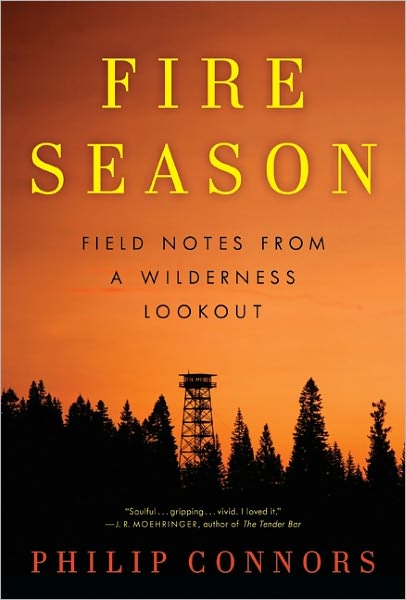
Fire Season by Philip Connors


EDIT: You might also want to check out my father’s review, and friend Tassava’s, of same.


This is an amazing book. The first sentences immediately grabbed me. Connors works summers in a teeny, tiny tower room way up in the sky in the Gila National Forest in New Mexico, as a fire lookout. His job is to spot smoke and call it in for control or “management” of the fires. But his “field notes” tell so much more than the story of his career as a lookout. This is the story of his time alone in the Gila, and of the visitors he receives and the visits he pays back to town; it’s the story of his and his dog Alice’s interactions with nature. It’s the story of fire and smoke and the Forest Service’s management of fire. It’s a history of fire, of the Forest Service, of the Gila, of so very many aspects of our nation’s history, and the natural history of the southwest. Connors discusses the varied reactions the government has had to fire: the policy of fire suppression, consistently and in every case, versus the concept of “controlled” or “prescribed” burns, and the ongoing debates. He contemplates society, its benefits and our occasional desire to escape it. He discusses his unique model of marriage, in which he spends some five months a year living alone and mostly out of touch. He also relates ecological issues like fire as a natural control mechanism, erosion, and the preferences of flora and fauna. And more.

I found Fire Season astounding and important. There’s a zen-like balance in it. Connors is a rather balanced man, in that he still craves human contact; he’s not an entirely back-to-the-wild isolationist, nor does he fail to appreciate cold beer and a variety of media. But he achieves a special and rare state of commune with nature, too. His writing, for me, parallels this balance. He can wax philosophical, crafting lyrical, beautiful odes and hymns of reverence to nature, fire, and life; but he never gets overly wordy, tempering the poetry with (still beautifully written) narrative history.

Connors tells so many little stories I would love to pull out of this book and share as vignettes. For example, the story of Apache Chief Victorio’s last stand (that lasted over a year) in the vicinity of the lookout tower where Connors is stationed:

That September day in 1879, on the headwaters of Ghost Creek, marks a peculiar moment in America’s westward march: black soldiers, most of them former slaves or the sons of slaves, commanded by white officers, guided by Navajo scouts, hunting down Apaches to make the region safe for Anglo and Hispanic miners and ranchers. The melting pot set to boil.

Or the history of the smokejumpers, which I didn’t know before – the parachuting firefighters who pre-date paratroopers and taught them their trade. Or the tale of the Electric Cowboy. Or the story of the little fawn. I cried, mostly because I empathized. Really, it could be read as a series of anecdotes; but the whole is greater than the sum of its parts. The larger story is important, too. I even glimpsed traces of the training I’ve received in trail-building and (more broadly) land management.

The history, the lore, the anecdotes, the author’s relationship with nature, his relationship with his wife, the landscape of the Gila, the details about local species of bird, fish, and game… there are so many gems in this thoughtful, loving, lovely book. I am not doing it justice. It’s a very special book and I strongly recommend this to everyone, no matter who you are. But I especially recommend it if you are… a nature lover, a hiker, a dog lover, a government bureaucrat, a pyromaniac, an environmentalist, a city dweller, a romantic, a firefighter, a skydiver, a cribbage player, a whiskey drinker, a writer, a loner, a philosopher, a historian, a student, or a teacher. This book goes on The List.

Iphigenia in Forest Hills: Anatomy of a Murder Trial by Janet Malcolm

So, Janet Malcolm is a journalist and writes for the New Yorker as well as having published a number of acclaimed works of nonfiction and biography. I have been interested for some time in reading The Silent Woman (biography of Sylvia Plath), and actually own Two Lives (of Gertrude Stein and Alice B. Toklas), although I have not yet read it. Her latest release is Iphigenia in Forest Hills, and I was interested enough to buy it at once, for the library, and to take it to lunch with my on the day of its arrival to start reading it.

First impressions: I guess the cover is boring to you here in image form, but I find it striking and respectable in its simplicity. I wish more books would try this style of straightforwardness; not that I don’t appreciate beautiful, elegant, well-designed covers that involve color and images, but this slim, simple, black book is very eye-catching in a world of graphics.

It starts off very strong. I’ve said before, my kind of nonfiction is narrative style; this is just right for me. Malcolm has a voice in her own story, including occasionally referring to herself: how she would have reacted to a certain question in the jury selection process, for example. Or, later in the book, how she interacted with the families in question during interviews; or her discussion of the different journalists and their interactions during the trial. I like that Malcolm plays a part in the book. It seems more realistic that way. Who can help being a part of the story she writes, especially in a case such as this? Malcolm followed the case for many months. She couldn’t have helped but be involved on some level.

The story is this. NYC is home to a community of Bukharan Jews in a neighborhood called Forest Hills, in Queens. Boy meets girl; they marry, and have a baby girl. Four years later, husband Daniel is murdered while handing off daughter to ex-wife. She stands trial for his murder, along with the man who allegedly fired the gun, as her hired hit man.

There are accusations that Daniel physically abused his wife and sexually abused their young daughter. There is a heated custody battle and suspicions of emotional neglect and attempts to turn her against one parent or another. The event that allegedly pushes the wife to have the husband killed, is that a custody judge chooses to remove the child from her mother’s care and place her with her father. This looks like a crazy decision, since the child barely knows her father and he was not asking for custody, merely visitation rights. There is questionable evidence; both the prosecuting and defense attorneys come in confident of victory. There are issues of culture. I learned a lot about the Bukharan sect of Jews, which I knew nothing about before reading this book.

Iphigenia in Forest Hills reads a little bit like a courtroom-procedural novel of criminal intrigue. Our questions, however, are not finally answered, as they almost certainly would be in a novel. Malcolm is not sure whether Mazeltuv Borukhova did, in fact, hire Mikhail Mallayev to kill her ex-husband Daniel Malakov. (Her title, by the way, is part of what initially attracted me to this book, along with Malcolm’s excellent reputation as an author of biographical nonfiction. It references the story of Agamemnon and his family, which I know best, and love, as told by Aeschylus. Of which, more below.*) I love that Malcolm interviews and interacts with both families and both sides involved in the legal battle, while noting her personal reactions including any bias she sees herself develop. She recognizes and gives weight to emotional reactions and personalities. It’s not a sterile treatment – because our legal justice system is far from sterile. In the end, she doesn’t tell us what really happened, because she doesn’t know. The blurb inside the front cover begins with the defining quotation of the book:

She couldn’t have done it and she must have done it.

So there you have it. A story of ambiguities and questions, beautifully and insightfully told, from myriad angles. My first Malcolm read has come far too late, and I’m more eager than ever to get into more of hers.


*The Oresteia by Aeschylus is a trilogy of ancient Greek tragedies: The Agamemnon, The Libation Bearers, and The Eumenides. I could go on all day; I love ancient Greek drama. But I’ll try to be brief. Iphigenia’s story:

As the Greeks prepare to sail to Troy (to lay seige, in the Trojan War, to recover Helen, wife of Agamemnon’s brother, stolen by Paris), the winds are against them; to appease an angry goddess, they choose to sacrifice Agamemnon’s daughter, Iphigenia. She is brought to the harbor in a wedding dress, believing she will marry Achilles, but instead is killed by her father, who then sails for Troy. Upon Agamemnon’s triumphant return ten years later, his wife (Iphigenia’s mother), Clytemnestra, along with her new lover, entrap and kill Agamemnon.

Thus, Malcolm’s title suggests that the mother in this story, Borukhova, is so angered by the “theft” of her daughter (through custody court, not sacrificial slaughter) by the girl’s father that she has him killed (by a man implied to be her new lover). As I said, I was drawn in by this allusive title. I find the allegory a bit weak in the end: the daughter in Malcolm’s story is not murdered (although there is some question that she might have been raped!); and the title’s implication suggests a bias that Malcolm generally does not profess in the body of the book. But still, it is a dramatic title, one that got my attention; and it makes a larger point, that this tale is one of epic tragedy and does no one good in the end. There is no victor; no one’s lot is improved by these sordid events (as the victim’s father points out repeatedly), regardless of whether Daniel Malakov was a good man and doctor or a deplorable and sick abuser.

I recommend Janet Malcolm’s Iphigenia in Forest Hills; and I also recommend Aeschylus!!

The Heroine’s Bookshelf by Erin Blakemore

I have a delightful little book to share with you today! I mightily enjoyed Erin Blakemore’s The Heroine’s Bookshelf: Life Lessons, from Jane Austen to Laura Ingalls Wilder.

Blakemore’s message is this: we are all heroines in our daily lives, or at least we can and should be; and we have a wealth of heroines to learn from. These are the women of our favorite books. She organizes her book by chapters which each deal with one lesson or attribute (including dignity, happiness, and simplicity), represented by one author (all are women) and one female character, from one book or series. I would love to list them all here for you but feel I should leave you something to discover when (not if!) you pick this book up yourself; so I shall tease you with Alice Walker and Margaret Mitchell, on top of the two authors Blakemore names in her subtitle.

It’s a very sweet, comforting, and comfortable little book. Twelve chapters explore twelve women’s literary impact on our world. Eleven of them I definitely call classics; one I’d never heard of! but of course I don’t know everything. Blakemore’s approach is intimate and loving and a touch incisive. It’s not an academic or intellectual book, but it’s not what you might call “fluffy”, either. She did do some research, I’m sure, as she discusses not only what’s between the pages of the books in question, but also notes biographical details about the authors and draws some conclusions. For instance, I didn’t know about the 2008 revelation by the descendants of Lucy Maud Montgomery about her death. This book is not too serious – a light read – but an important one, at the same time.

I am absolutely inspired to read, and re-read, the books examined here. I share Blakemore’s love for Jo March, and I wonder at her selection of Jane Eyre over Wuthering Heights, but we’re all unique, individual heroines, aren’t we. I marvel at her call to compare Frances Hodgson Burnett to Britney Spears and Amy Winehouse! but I admire her for it, too. Again, the adjectives that come to mind are comfortable, almost warm-n-fuzzy.

I need to own this book; the library’s copy will not suffice. And I think YOU should own it, too. Who am I talking to here? Well, I readily accept that many of these books are “girls’ books” (or women’s). But some are absolutely essential to us all: A Tree Grows in Brooklyn, for example, is an important book all around. This book is directed at women, but is not necessarily to be enjoyed by them exclusively. I’m sure you know who you are.

I can almost see a book club (or reading blog) project coming out of this. I would be very happy to shelve this book, in my home library, next to its twelve objects of study, and read them all in a streak of thirteen, with a mind to discussion. This would be a lovely thing to share with other women – and a willing man or two if they could be located. I don’t have the energy to put this together at this time, but do invite me if you decide to. 🙂

I’m so glad I found this little jewel. I hope you’ll find it, and enjoy it, too.


Edit: My mother asked who this author is, and I had to go looking for the answer, so here it is, Mom: she calls herself “a writer, entrepreneur, and inveterate bookworm” on her website, and I was immediately drawn in to her blog and have added it to the list of blogs I follow.

I’d Know You Anywhere by Laura Lippman, and Running the Books by Avi Steinberg

I had some trouble selecting a new book to read over the weekend, and ended up taking home Avi Steinberg’s Running the Books: the adventures of an accidental prison librarian. But before I could get to it, while putting new books up on my new books display, I came across Laura Lippman’s I’d Know You Anywhere, and got involved in it!

I’d Know You Anywhere is about a woman with a pretty good life: husband, two kids, nice house, generally serene, other than her daughter’s beginning to be a teenager. Then she gets a letter from the man, on death row, who abducted, raped, and held her for six weeks when she was 15. Her life is disrupted by corresponding with him, which she feels powerless to avoid. Years of carefully constructed anonymity are threatened.

It was a fun book. I read it almost straight through; it was gripping and interesting; the characters felt like real people. I found a certain theme of family and motherhood, that’s a little new and different to me in the mystery/thriller genre; this was present in Lisa Scottoline’s Look Again as well. I’m not as excited or sentimental about motherhood as some, so this theme could potentially get a bit tiring for me, but in both of these examples the authors have pulled it off. Barely. I’d Know You Anywhere is fast-paced and realistic and raises some interesting questions about victim’s rights and the death penalty, but remains an easy read (it could be a thinker only if you choose it to be). I was glad to spend my time on it.

Then yesterday I got around to Avi Steinberg’s Running the Books. It’s biographical; he’s telling his own story: former Orthodox Jew, then Harvard student, then underachieving freelance obituary writer, finally turned prison librarian. (Whew.) I haven’t gotten very far in, but I’m walking a tightrope: enjoying his clever writing style while worrying that he’s getting a bit pretentious. There’s not much question that there are some interesting stories here, but so far they’re unrelated anecdotes. Let me say this book shows potential to be fascinating and amusing, or tiresome. Jury’s out.

I’m also housing a big, fat Sharon Kay Penman paperback called When Christ and His Saints Slept, and I enjoyed The Reckoning by the same author so much that I’m excited, and hope not to be disappointed since my expectations are so high! So that’s in the queue. Also, I fly to Belgium in just 3 days for a short vacation and will need ratty paperbacks that I can leave behind on the trip. (Not sure Penman’s qualifies for this job.) There’s always more to read…

Enjoy your holidays and please do let me know what you find!

readalike: Henrietta Lacks and The Spirit Catches You

The Immortal Life of Henrietta Lacks, by Rebecca Skloot, and The Spirit Catches You and You Fall Down, by Anne Fadiman, read almost like partner volumes to me. These two nonfiction works share author/narrators who get involved in their subjects, spending a great deal of time with the families involved and forming personal bonds. Both Fadiman and Skloot are bothered by a sense of, if not wrongdoing, something having gone awry. The subject of both books is medicine, and the interaction of the institution of western medicine with a culture that doesn’t fully understand it. Humans are important. Ethics are involved, and there are no clear rights and wrongs – or perhaps it would be better to say it’s easy to see where we went wrong, but difficult to see what the right path would have been. Even the structure and tone of the two books are similar: to understand the subject at hand, we are often taken back a step or zoomed out, to a perspective where we can see the history or the culture’s role in a specific situation. The reader learns medicine, science, history without feeling lectured. I strongly recommend both.

Lee Child’s Echo Burning, and some more nonfiction: The Spirit Catches You and You Fall Down

Sorry I’ve been absent for a bit. But I have been doing some good reading.

Last week, my workday reading was Lee Child’s Echo Burning. Child and his character, Reacher, were recommended to me in my RA class, and I picked up Echo Burning because it’s set in the vast west Texas desert, an area I’m a little bit familiar with.

Child’s series starring Jack Reacher was compared by my classmate and teacher to Connelly’s series starring Harry Bosch, of which you might have noticed I’m a fan. I really read Connelly to get more of Bosch, and Reacher does share some resemblance. Bosch, while an anti-authority loner type, does actually work for the authorities as a police detective, although he’s always at odds with his bosses and occasionally leaves the fold just to make things interesting. Reacher is a former military policeman (MP) turned rogue do-gooder, in a violent sort of way. Neither has a great deal of respect for authority or the rules that dictate the way they should go about solving crimes or problems, although Harry grudgingly plays along, most of the time, at least in the clues he leaves behind, because he has to present a prosecutable case to his DA.

Reacher doesn’t have a mission like Bosch does; in this book, and I get the impression in all, he’s merely drifting, moving through town, and gets caught up in problems he then goes about solving. Bosch has a job to do, and does it well and willingly; Reacher is just taking what comes up. Actually, in many ways the Reacher story reminds me of a western, especially with this setting; he’s the lone ranger rolling through town, taking care of business and moving along. He has an endearing, chivalrous care for the ladies, but he’s awfully rough around the edges, and starkly violent.

I loved it. It was just similar enough to Connelly to get me excited – the characters were similar but different, and would probably respect one another, although they wouldn’t stick around to get to be friends. I enjoyed the setting and recognized it, which is always fun (we all enjoy realistic settings in our own hometowns, right?). I guess it had a number of my requirements: strong sense of place; moody, gritty, dark tone; and a certain “type” of main character. I think I’ll be looking for Reacher again.

This weekend I got involved in another work of nonfiction, and I have to say, I find it remarkably similar to a recent read (but I’ll tell you about that another day, so as not to ruin it). I’m about two-thirds of the way through, now, with The Spirit Catches You and You Fall Down, by Anne Fadiman. (There’s an excellent chance I’ll finish tonight.)

This book is about a little girl and her family’s experience: Lia Lee is a Hmong child, born in Merced, CA to recent immigrants from the Hmong people’s extended journey through China and Laos. She has severe epilepsy, and the book centers around the conflict between her family and culture, and western medicine, in their two very different understandings of what her illness is, what causes it, and how it should be treated. In addressing Lia’s story, Fadiman gives us a brief history of the Hmong people’s culture and history. It is absolutely fascinating, and for me, the cultural aspects make this book special.

It’s an educational book because it provides lots of information and facts, properly cited, about medicine and epilepsy, as well as about the Hmong people in history (and the U.S. involvement in Vietnam and Laos), their immigration here, and the treatment of refugees by our welfare and other systems. But like I said, the cultural interactions are most interesting to me. The local hospital and medical system struggle to treat Lia and give her the best possible life; her parents likewise want her to be happy and healthy. But they have such fundamental differences… it’s not like two doctors debating two courses of treatment; we’re talking about two absolutely non-compatible, to the extent that they’re not really translatable, understandings of what’s wrong with her and the causes of her disease. Translation is almost not possible in the traditional sense because of cultural norms that don’t allow for direct translation. Californians and the Hmong have so recently met that there’s no precedent for much of a need for translation; there hasn’t been time for much bilingualism to develop, nor has their been much interest, on either side. (I should note this book is more than ten years old, so the current situation is a little different.)

I’m totally engrossed in the story of Lia and her family, but equally so in the story of the Hmong people in history. I’m also intrigued by the involvement of the author/narrator and her experience in researching the book. One lesson or concept that I’m coming away with is the ease with which we can condemn someone as having done the Wrong thing, and the difficulty with which we can come up with the Right thing. This is something that always occurs to me in politics. I can clearly see policies or politicians with whom I disagree because they’re Wrong; but in such a big, complicated, diverse world, with such intertwined goals, interrelated causes and effects, and various goals, I have an awfully hard time clearly seeing The Right Way. This is why I am not running for public office! Anyway – Lia’s story might well make you realize that nobody was entirely right or entirely wrong (certainly not wrong in their intentions and best efforts) and yet, Lia did not get optimal care. These cultural exchanges are, whew, hard.

I recommend this book and hope you’ll join me in enjoying it. If you haven’t already guessed what recent read I’m comparing it to, stay tuned. To me it’s just as obvious as anything but we’ll see. Feel free to post your guess here… Til soon, enjoy your week and your books.

finished HeLa.

Wow. The Immortal Life of Henrietta Lacks really got me interested and taught me so much; and it was such an easy read, for something so educational. 🙂 When I finished the book I spent some time perusing the acknowledgements and notes, just out of regret that it was over. I am relieved to say that there is some measure of peace achieved in the end. It’s not a particularly happy or upbeat story; it’s very serious stuff. But there are some hopeful moments in the final wrap-up.

I count it in author Skloot’s favor that I became involved in her life as well as those of Deborah and the other Lackses we come to know. These people matter, and I know and care about some medical issues I had not bothered about before reading this book. I think this should be required reading for everyone, in the category of Knowing About Your World. Thank you KD for prompting my interest!

finally, meet Henrietta Lacks

What an amazing story. First, let me admit that I was perhaps a little wary of beginning this one because I feared it might be “heavy” (science-y, tech-y). But after a pleasant day pre-riding tomorrow’s race course with friends in perfect weather, I got brave and settled into it while the Husband worked on a bike in the garage.

I began with “A Few Words About This Book” and was enthralled in just a few sentences. Nothing about this story is dry or overly science-y. In the prologue I learned of the personal connection between author Rebecca Skloot and the story of Henrietta Lacks. This is too human to be heavy.

I’ll back up. In case you don’t know, The Immortal Life of Henrietta Lacks is a work of nonfiction, addressing the case of a Southern black woman whose cells were harvested without her knowledge shortly before a mysteriously aggressive cancer took her life just past the age of 30, leaving 5 small children to be raised by an enormous family of Lackses and friends. This family didn’t find out about the use of her cells for more than 20 years, during which time they were reproduced in numbers greater than can be contemplated. Henrietta’s cells have played an important and often the decisive role in innumerable medical and scientific advances: the polio vaccine, chemotherapy, genetic research, in vitro fertilization and the effects of the atom bomb. All of this without any attempt to inform her family, get consent, or discover their feelings; and without any compensation. While industries are birthed and men become rich,  the Lackses continue in the same culture that Henrietta’s parents knew, living in their forefather’s slave quarters and farming tobacco. Today’s Lackses are ill-equipped to even understand the story of Henrietta’s cells, and no one has bothered to try to explain it to them.

As soon as I started reading I was engrossed. Again, the author, Skloot, has a personal relationship to the story, and necessarily forms personal relationships with the modern-day players in the course of her research. I learn a surprising amount of science without feeling intellectually exercised, and it almost reads like a work of suspense; the pages keep turning; I’m anxious to hear the next bit of dialog. Human interactions with Henrietta’s relatives are interspersed with the science (which in itself is interspersed with the human stories of those players), and the thing just rolls along building momentum.

I had to tear myself away to write this entry for you. I find this to be an outrageous (as in, outrage-inducing) and educational story, and I recommend it. Skloot’s skills as a writer are commendable. I hope you’ll join me as I open a cold Avery IPA (just one, I’m racing tomorrow) and get back in it.



